 
PRESENTED BY
MR.ROMAN BAJRANG
RELIANCE INSTITUTE OF NURSING
TOPIC
HEART BLOCK
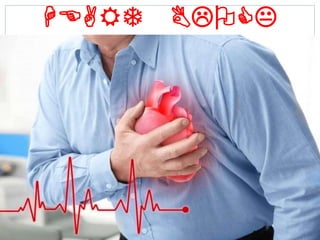
 A heart block is a disease in the electrical system
of the heart. This is opposed to coronary artery
disease, which is disease of the blood vessels of the
heart. While coronary artery disease can cause
angina (chest pain) or myocardial infarction(heart
attack), heart block can cause light headedness,
syncope (fainting), and palpitations.
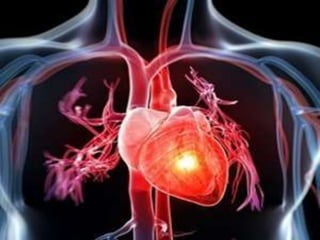
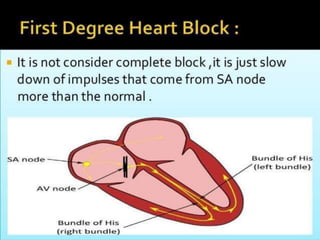
 Heart block is a delay in the conduction of
electrical current as it passes through the
atrioventricular node, bundle of His, or bothbundle
branches, all of which are located between the atria
and the ventricles.
INTRODUCTION
DEFINITION-
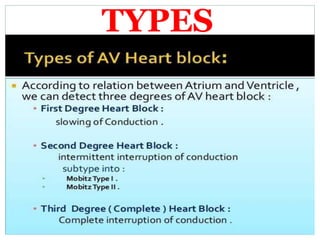
TYPES
SECOND DEGREE A.V. BLOCK
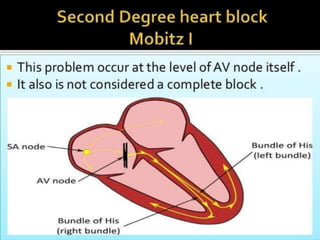
 Second-degree atrioventricular (AV) block,
or second-degree heart block, is a disorder
characterized by disturbance, delay, orinterruption
of atrial impulse conduction to the ventriclesthrough
the atrioventricular node (AVN) and bundle of
His. Electrocardiographically, some P waves are not
followed by a QRS complex.
Con…………
No electrical messages get
through. The rate and rhythm of
your heartbeat is very slow or it
may even stop entirely. This
type of heart block can be fatal.
THIRED DEGREE A.V.BLOCK
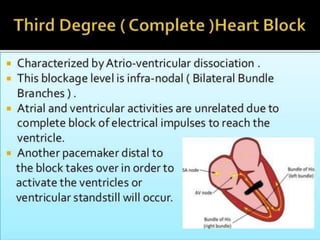
 Third-degree atrioventricular
block (AV block) is a medical condition in
which the nerve impulse generated in the
sinoatrial node (SA node) in the atrium of
the heart can not propagate to the ventricles.
Because the impulse is blocked, an accessory
pacemaker in the lower chambers will
typically activate the ventricles.
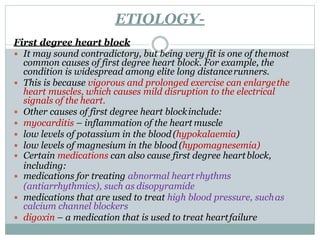
ETIOLOGY-
ETIOLOGY-
First degree heart block
 It may sound contradictory, but being very fit is one of themost
common causes of first degree heart block. For example, the
condition is widespread among elite long distancerunners.
 This is because vigorous and prolonged exercise can enlargethe
heart muscles, which causes mild disruption to the electrical
signals of the heart.
 Other causes of first degree heart blockinclude:
 myocarditis – inflammation of the heart muscle
 low levels of potassium in the blood(hypokalaemia)
 low levels of magnesium in the blood (hypomagnesemia)
 Certain medications can also cause first degree heartblock,
including:
 medications for treating abnormal heartrhythms
(antiarrhythmics), such as disopyramide
 medications that are used to treat high blood pressure, suchas
calcium channel blockers
 digoxin – a medication that is used to treat heartfailure
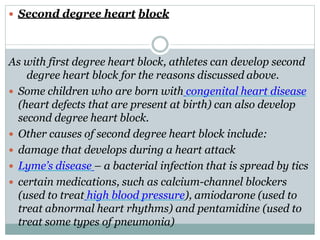
 Second degree heart block
As with first degree heart block, athletes can develop second
degree heart block for the reasons discussed above.
 Some children who are born with congenital heart disease
(heart defects that are present at birth) can also develop
second degree heart block.
 Other causes of second degree heart block include:
 damage that develops during a heart attack
 Lyme’s disease – a bacterial infection that is spread by tics
 certain medications, such as calcium-channel blockers
(used to treat high blood pressure), amiodarone (used to
treat abnormal heart rhythms) and pentamidine (used to
treat some types of pneumonia)
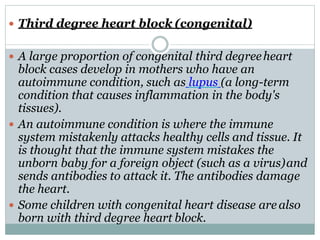
 Third degree heart block (congenital)
 A large proportion of congenital third degreeheart
block cases develop in mothers who have an
autoimmune condition, such as lupus (a long-term
condition that causes inflammation in the body's
tissues).
 An autoimmune condition is where the immune
system mistakenly attacks healthy cells and tissue. It
is thought that the immune system mistakes the
unborn baby for a foreign object (such as a virus)and
sends antibodies to attack it. The antibodies damage
the heart.
 Some children with congenital heart disease are also
born with third degree heart block.
Third degree heart block (acquired)
 Many cases of third degree heart block are caused by damage
to the muscles of the heart. The heart muscle can become
damaged for a number of reasons, including:
 as a complication of heart surgery – this is thought to be one of
the most common causes
 coronary heart disease – a condition where the heart does not
receive enough blood
 as a complication of radiotherapy (a treatment for conditions
such as cancer, thyroid disorders and some blood disorders)
 as a result of a serious infection, such as diphtheria (a bacterial
infection that can cause inflammation of theheart)
or rheumatic fever (a bacterial infection that damages the
valves of the heart)
 poorly controlled high blood pressure (hypertension)
 cancer that spread from another part of the body into the heart
 a penetrating trauma to the chest, such as a stab wound or
gunshot wound
 A number of medications can also cause third
degree heart block, including:
 digoxin
 calcium-channel blockers
 beta blockers – used to treat high blood pressure
(hypertension)
 tricyclic antidepressants – an older type of antidepressant
 clonidine – used to treat a sudden, sharp rise inblood
pressure (hypertensive crisis
CON….
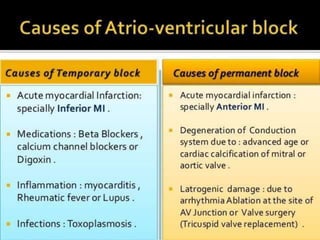
 Causes
 Some people are born with heart block. In others, it
develops later in life.
 If you’re born with it, it’s called congenital heart block.
Causes include:
AUTOIMMUNE DISEASE.
 Diseases, such as lupus, can be passed by your mother in
certain proteins through the umbilical cord.
BIRTH DEFECT.
 heart may not have developed correctly in the womb.
Doctors often don’t know what causes these birth defects.
 If you have heart block that you weren’t born with, doctors
call it “acquired” heart block. It’s the most common type.
Causes include:
Con……………
 Certain types of surgery that affect theheart’s
electrical system
 Changes in your genes
 Damage from a heart attack
 Heart issues like clogged arteries, inflammationof
the heart muscle, and heart failure
 Muscle disorders or other diseases
 Some medicines
PATHOPHYSIOLOGY
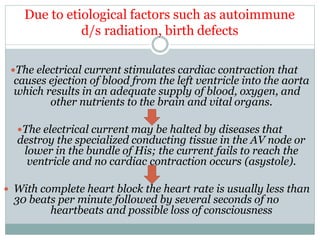
The electrical current stimulates cardiac contraction that
causes ejection of blood from the left ventricle into the aorta
which results in an adequate supply of blood, oxygen, and
other nutrients to the brain and vital organs.
The electrical current may be halted by diseases that
destroy the specialized conducting tissue in the AV node or
lower in the bundle of His; the current fails to reach the
ventricle and no cardiac contraction occurs (asystole).
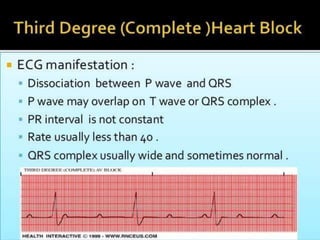
 With complete heart block the heart rate is usually less than
30 beats per minute followed by several seconds of no
heartbeats and possible loss of consciousness
Due to etiological factors such as autoimmune
d/s radiation, birth defects
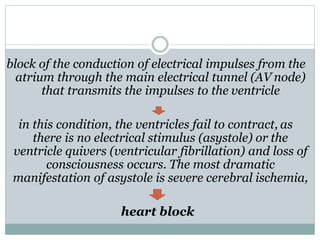
block of the conduction of electrical impulses from the
atrium through the main electrical tunnel (AV node)
that transmits the impulses to the ventricle
in this condition, the ventricles fail to contract, as
there is no electrical stimulus (asystole) or the
ventricle quivers (ventricular fibrillation) and loss of
consciousness occurs. The most dramatic
manifestation of asystole is severe cerebral ischemia,
heart block
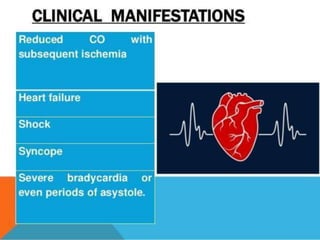
CLINICAL
MANIFESTATION
CLINICAL MANIFESTATION
 First-degree AV block has no symptoms
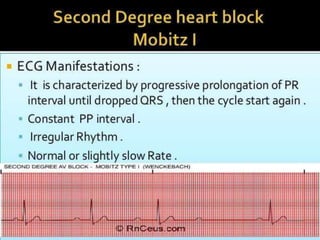
 Second-degree AV block of type I- is characterised by the
temporary absence of a heart beat described by the
patient as a break.
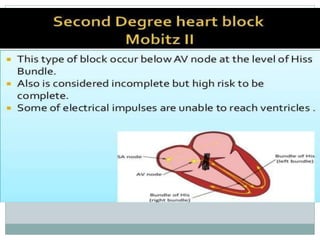
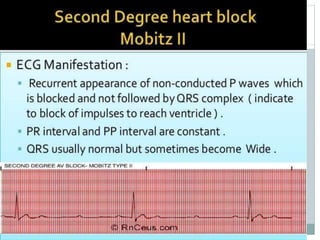
 Second-degree AV block of type II-the patient might have
bradycardia, a decrease in the ability to adapt to
exertion, rarely syncope.
 Third-degree AV block -can have one of the following
clinical manifestations:
 Severe bradycardia
 Syncope
 Cardiac failure symptoms
 Rare, regular arterial pulse
Common C.M.
 Symptoms
symptoms depend on the type of heart block you have. If you have first degree,
you may not have any at all.
 Second-degree symptoms may include:
 Chest pain
 Dizziness
 Fainting
 Fatigue
 Nausea
 Shortness of breath
 The feeling that your heart skips a beat
 Third-degree heart block needs immediate medical attention. Call 911 for any:
 Cardiac arrest
 Dizziness
 Fainting
 New, severe tiredness
 Irregular heartbeat or new palpitations
DIAGNOSTIC EVALUATION-
 Electrocardiogram (ECG) —a test that recordsthe
heart's activity by measuring electrical currents
through the heart muscle
 Echocardiogram —a test that uses high-frequency
sound waves (ultrasound) to examine the size,shape,
and motion of the heart
Troponin Serum
 An elevated troponin is in general concerning
for heart damage until proven otherwise. It canbe
from a heart attack due to a blockage or dueto
other conditions that place strain on the heart such
as heart failure or critical illness. As discussed
below there are other, non cardiac causesof
a troponin elevation.
HOLTER MONITOR
 Holter Monitor
 A holter monitor is a small, portable machinethat
you wear for 24 hours. It enables continuous
recording of your ECG as you go about your daily
activities. You will be asked to keep a diary log of
your activities and symptoms. This monitor may
detect arrhythmias that might not show up on a
resting EKG that only records for a fewseconds.
 24-hour ambulatory blood pressure
monitoring used?
 Ambulatory BP monitoring provides additional
information about how your changes in BP may
correlate with your daily activities and sleep
patterns. The United States Preventive ServicesTask
Force (USPSTF) now recommends confirming a
diagnosis of hypertension with ambulatory BP
monitoring.
CON…..
 Twenty-four-hour ambulatory blood
pressure monitoring is a way of measuring
and managing high blood pressure
(hypertension). Hypertension is a blood
pressure measurement in which the systolic
(upper) blood pressure is at or above 140
and the diastolic (lower) blood pressure is at
or above 90.
EXERCISE STRESS TEST
The exercise stress (treadmill) test
enables physicians to record your
heart's electrical activity which may
not occur at rest.
MAGNETIC SOURCE IMAGING
Magnetic source imaging (MSI) is
used as an overlay to magnetic
resonance imaging (MRI). The
device senses weak magnetic fields
generated by heart muscle tissue
and localizes the arrhythmia non-
invasively to save time during the
invasive study.
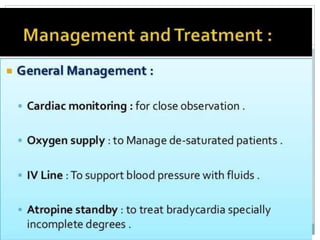
MANAGEMENT
TREATMENT
 Medication - alters the properties of ion movement across
cardiac membranes and affect automaticity as well as the
rate and duration of depolarisation and repolarisation.
 Class I ( blocks the ions of sodium)
 Procainamide, Quinidine
 Lidocaine, Tocainide
 Flecainide, Propafenone
 Class II (indirectly blocks the ions of calcium)
 Atenolol, Metoprolol,Propanolol
 Class III ( blocks the ions of potassium)
 Amiodarone, Sotalol, Ibutilide
 Class IV ( blocks the ions of calcium)
 Diltiazem, Verapamil
 Digitalis (enhances vagal tone, slows heart rate and AV
conduction
 Pacemaker implantation - should be performed in
any patient with symptomatic bradycardia and
irreversible second or third degree AV block regardless
of the cause or level of block in the conducting system.
 Implantable defibrillators – that detect lethal
rhythms and apply electric shocks to convert to normal
sinusal rhythm( for those at high risk)
 Treatment for this tpe of dysrhithmias ( AV blocks)
centers on maintaining adequate cardiac output,
providing antiarhytmic drugs when needed and
managing the underlying pathological process.
OTHER :-
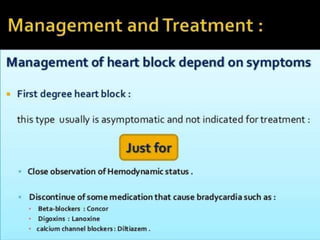
 First-degree heart block (also called first-degree AV block).
 Treatment: First-degree heart block generally requires no
treatment, although some people may need to be treated foran
underlying electrolyte imbalance.
 If medications are causing the condition, a physician may revaluate
the dosage or advise the patient to stop taking it. Medications should
not be adjusted without consulting a medicalprofessional.
 A physician may recommend follow-up with a cardiologist to be
sure that the patient does not develop a more severe form of heart
block.
 Follow-up is particularly important if first-degree heartblock
developed as a result of a past heart attack ormyocarditis.
 In patients with severe heart failure and first-degreeheart block,
implantation of a pacemaker may sometimes improve cardiac
performance.
 further treatment is generally unnecessary and prognosisis
excellent.
 Type I second-degree heart block (also known as Mobitz
Type I second-degree AV block or Wenckebach AV block).
 Treatment: Type I second-degree heart block is generally treated
by addressing any underlying conditions that are contributing toit.
Temporary pacing and/or medication (e.g., atropine) may be
required if the heartbeat is too slow, but a permanent pacemaker is
generally not necessary unless the conditionworsens.
 Type II second-degree heart block (Mobitz Type II second-
degree AV block)
 Treatment: Type II second-degree heart block often produces
noticeable symptoms and carries a significant risk of potentiallylife-
threatening complications. Therefore, treatment is very important.
A physician may administer medications (e.g., atropine) and
recommend the implantation of a permanent pacemaker. If the
condition worsens to third-degree heart block, then a temporary
pacemaker wire may be needed during the medical crisis until a
permanent pacemaker can be inserted.
 Third-degree heart block (also known as
complete heart block or complete AV block)
 Treatment: Third-degree heart block patients almost
always require an artificial pacemaker to better regulate
the electrical activity of the heart. If a medical crisis
occurs before the pacemaker can be implanted, then a
temporary pacemaker wire may be used to keep the heart
beating. Most patients who are diagnosed with complete
heart block will require placement of a permanent
pacemaker, unless a treatable cause is identified and
corrected..
 Bundle Branch Block is when electrical impulses are
slowed or blocked as they travel through specialized
conducting tissue in the ventricles.
COMPLICATION
 Complications of a second degree heart block include:
 Angina
 Fainting
 Heart attack
 Stroke
 Third-degree heart block can lead to decreased cardiac
output, circulatory impairment,
 heart failure and SCD.
 Other complications may include excessive urea in the
blood (uremia) and low blood hemoglobin (anemia).
 Complications from pacemaker insertion include
infection, medication reaction, and failure of the
pacemaker.
Heart block

Heart block

  • 1.
  • 3.
    PRESENTED BY MR.ROMAN BAJRANG RELIANCEINSTITUTE OF NURSING TOPIC HEART BLOCK
  • 6.
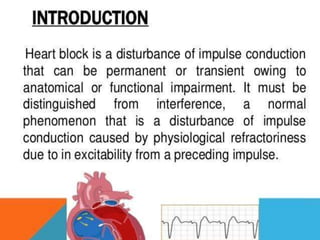
     A heartblock is a disease in the electrical system of the heart. This is opposed to coronary artery disease, which is disease of the blood vessels of the heart. While coronary artery disease can cause angina (chest pain) or myocardial infarction(heart attack), heart block can cause light headedness, syncope (fainting), and palpitations.  Heart block is a delay in the conduction of electrical current as it passes through the atrioventricular node, bundle of His, or bothbundle branches, all of which are located between the atria and the ventricles. INTRODUCTION
  • 7.
  • 9.
  • 13.
    SECOND DEGREE A.V.BLOCK  Second-degree atrioventricular (AV) block, or second-degree heart block, is a disorder characterized by disturbance, delay, orinterruption of atrial impulse conduction to the ventriclesthrough the atrioventricular node (AVN) and bundle of His. Electrocardiographically, some P waves are not followed by a QRS complex.
  • 18.
    Con………… No electrical messagesget through. The rate and rhythm of your heartbeat is very slow or it may even stop entirely. This type of heart block can be fatal.
  • 19.
    THIRED DEGREE A.V.BLOCK Third-degree atrioventricular block (AV block) is a medical condition in which the nerve impulse generated in the sinoatrial node (SA node) in the atrium of the heart can not propagate to the ventricles. Because the impulse is blocked, an accessory pacemaker in the lower chambers will typically activate the ventricles.
  • 21.
  • 23.
    ETIOLOGY- First degree heartblock  It may sound contradictory, but being very fit is one of themost common causes of first degree heart block. For example, the condition is widespread among elite long distancerunners.  This is because vigorous and prolonged exercise can enlargethe heart muscles, which causes mild disruption to the electrical signals of the heart.  Other causes of first degree heart blockinclude:  myocarditis – inflammation of the heart muscle  low levels of potassium in the blood(hypokalaemia)  low levels of magnesium in the blood (hypomagnesemia)  Certain medications can also cause first degree heartblock, including:  medications for treating abnormal heartrhythms (antiarrhythmics), such as disopyramide  medications that are used to treat high blood pressure, suchas calcium channel blockers  digoxin – a medication that is used to treat heartfailure
  • 24.
     Second degreeheart block As with first degree heart block, athletes can develop second degree heart block for the reasons discussed above.  Some children who are born with congenital heart disease (heart defects that are present at birth) can also develop second degree heart block.  Other causes of second degree heart block include:  damage that develops during a heart attack  Lyme’s disease – a bacterial infection that is spread by tics  certain medications, such as calcium-channel blockers (used to treat high blood pressure), amiodarone (used to treat abnormal heart rhythms) and pentamidine (used to treat some types of pneumonia)
  • 25.
     Third degreeheart block (congenital)  A large proportion of congenital third degreeheart block cases develop in mothers who have an autoimmune condition, such as lupus (a long-term condition that causes inflammation in the body's tissues).  An autoimmune condition is where the immune system mistakenly attacks healthy cells and tissue. It is thought that the immune system mistakes the unborn baby for a foreign object (such as a virus)and sends antibodies to attack it. The antibodies damage the heart.  Some children with congenital heart disease are also born with third degree heart block.
  • 26.
    Third degree heartblock (acquired)  Many cases of third degree heart block are caused by damage to the muscles of the heart. The heart muscle can become damaged for a number of reasons, including:  as a complication of heart surgery – this is thought to be one of the most common causes  coronary heart disease – a condition where the heart does not receive enough blood  as a complication of radiotherapy (a treatment for conditions such as cancer, thyroid disorders and some blood disorders)  as a result of a serious infection, such as diphtheria (a bacterial infection that can cause inflammation of theheart) or rheumatic fever (a bacterial infection that damages the valves of the heart)  poorly controlled high blood pressure (hypertension)  cancer that spread from another part of the body into the heart  a penetrating trauma to the chest, such as a stab wound or gunshot wound
  • 27.
     A numberof medications can also cause third degree heart block, including:  digoxin  calcium-channel blockers  beta blockers – used to treat high blood pressure (hypertension)  tricyclic antidepressants – an older type of antidepressant  clonidine – used to treat a sudden, sharp rise inblood pressure (hypertensive crisis
  • 28.
    CON….  Causes  Somepeople are born with heart block. In others, it develops later in life.  If you’re born with it, it’s called congenital heart block. Causes include: AUTOIMMUNE DISEASE.  Diseases, such as lupus, can be passed by your mother in certain proteins through the umbilical cord. BIRTH DEFECT.  heart may not have developed correctly in the womb. Doctors often don’t know what causes these birth defects.  If you have heart block that you weren’t born with, doctors call it “acquired” heart block. It’s the most common type. Causes include:
  • 29.
    Con……………  Certain typesof surgery that affect theheart’s electrical system  Changes in your genes  Damage from a heart attack  Heart issues like clogged arteries, inflammationof the heart muscle, and heart failure  Muscle disorders or other diseases  Some medicines
  • 30.
  • 31.
    The electrical currentstimulates cardiac contraction that causes ejection of blood from the left ventricle into the aorta which results in an adequate supply of blood, oxygen, and other nutrients to the brain and vital organs. The electrical current may be halted by diseases that destroy the specialized conducting tissue in the AV node or lower in the bundle of His; the current fails to reach the ventricle and no cardiac contraction occurs (asystole).  With complete heart block the heart rate is usually less than 30 beats per minute followed by several seconds of no heartbeats and possible loss of consciousness Due to etiological factors such as autoimmune d/s radiation, birth defects
  • 32.
    block of theconduction of electrical impulses from the atrium through the main electrical tunnel (AV node) that transmits the impulses to the ventricle in this condition, the ventricles fail to contract, as there is no electrical stimulus (asystole) or the ventricle quivers (ventricular fibrillation) and loss of consciousness occurs. The most dramatic manifestation of asystole is severe cerebral ischemia, heart block
  • 33.
  • 35.
    CLINICAL MANIFESTATION  First-degreeAV block has no symptoms  Second-degree AV block of type I- is characterised by the temporary absence of a heart beat described by the patient as a break.  Second-degree AV block of type II-the patient might have bradycardia, a decrease in the ability to adapt to exertion, rarely syncope.  Third-degree AV block -can have one of the following clinical manifestations:  Severe bradycardia  Syncope  Cardiac failure symptoms  Rare, regular arterial pulse
  • 36.
    Common C.M.  Symptoms symptomsdepend on the type of heart block you have. If you have first degree, you may not have any at all.  Second-degree symptoms may include:  Chest pain  Dizziness  Fainting  Fatigue  Nausea  Shortness of breath  The feeling that your heart skips a beat  Third-degree heart block needs immediate medical attention. Call 911 for any:  Cardiac arrest  Dizziness  Fainting  New, severe tiredness  Irregular heartbeat or new palpitations
  • 37.
    DIAGNOSTIC EVALUATION-  Electrocardiogram(ECG) —a test that recordsthe heart's activity by measuring electrical currents through the heart muscle  Echocardiogram —a test that uses high-frequency sound waves (ultrasound) to examine the size,shape, and motion of the heart
  • 38.
    Troponin Serum  Anelevated troponin is in general concerning for heart damage until proven otherwise. It canbe from a heart attack due to a blockage or dueto other conditions that place strain on the heart such as heart failure or critical illness. As discussed below there are other, non cardiac causesof a troponin elevation.
  • 39.
    HOLTER MONITOR  HolterMonitor  A holter monitor is a small, portable machinethat you wear for 24 hours. It enables continuous recording of your ECG as you go about your daily activities. You will be asked to keep a diary log of your activities and symptoms. This monitor may detect arrhythmias that might not show up on a resting EKG that only records for a fewseconds.
  • 40.
     24-hour ambulatoryblood pressure monitoring used?  Ambulatory BP monitoring provides additional information about how your changes in BP may correlate with your daily activities and sleep patterns. The United States Preventive ServicesTask Force (USPSTF) now recommends confirming a diagnosis of hypertension with ambulatory BP monitoring.
  • 41.
    CON…..  Twenty-four-hour ambulatoryblood pressure monitoring is a way of measuring and managing high blood pressure (hypertension). Hypertension is a blood pressure measurement in which the systolic (upper) blood pressure is at or above 140 and the diastolic (lower) blood pressure is at or above 90.
  • 42.
    EXERCISE STRESS TEST Theexercise stress (treadmill) test enables physicians to record your heart's electrical activity which may not occur at rest.
  • 43.
    MAGNETIC SOURCE IMAGING Magneticsource imaging (MSI) is used as an overlay to magnetic resonance imaging (MRI). The device senses weak magnetic fields generated by heart muscle tissue and localizes the arrhythmia non- invasively to save time during the invasive study.
  • 44.
  • 48.
    TREATMENT  Medication -alters the properties of ion movement across cardiac membranes and affect automaticity as well as the rate and duration of depolarisation and repolarisation.  Class I ( blocks the ions of sodium)  Procainamide, Quinidine  Lidocaine, Tocainide  Flecainide, Propafenone  Class II (indirectly blocks the ions of calcium)  Atenolol, Metoprolol,Propanolol  Class III ( blocks the ions of potassium)  Amiodarone, Sotalol, Ibutilide  Class IV ( blocks the ions of calcium)  Diltiazem, Verapamil
  • 49.
     Digitalis (enhancesvagal tone, slows heart rate and AV conduction  Pacemaker implantation - should be performed in any patient with symptomatic bradycardia and irreversible second or third degree AV block regardless of the cause or level of block in the conducting system.  Implantable defibrillators – that detect lethal rhythms and apply electric shocks to convert to normal sinusal rhythm( for those at high risk)  Treatment for this tpe of dysrhithmias ( AV blocks) centers on maintaining adequate cardiac output, providing antiarhytmic drugs when needed and managing the underlying pathological process. OTHER :-
  • 50.
     First-degree heartblock (also called first-degree AV block).  Treatment: First-degree heart block generally requires no treatment, although some people may need to be treated foran underlying electrolyte imbalance.  If medications are causing the condition, a physician may revaluate the dosage or advise the patient to stop taking it. Medications should not be adjusted without consulting a medicalprofessional.  A physician may recommend follow-up with a cardiologist to be sure that the patient does not develop a more severe form of heart block.  Follow-up is particularly important if first-degree heartblock developed as a result of a past heart attack ormyocarditis.  In patients with severe heart failure and first-degreeheart block, implantation of a pacemaker may sometimes improve cardiac performance.  further treatment is generally unnecessary and prognosisis excellent.
  • 51.
     Type Isecond-degree heart block (also known as Mobitz Type I second-degree AV block or Wenckebach AV block).  Treatment: Type I second-degree heart block is generally treated by addressing any underlying conditions that are contributing toit. Temporary pacing and/or medication (e.g., atropine) may be required if the heartbeat is too slow, but a permanent pacemaker is generally not necessary unless the conditionworsens.  Type II second-degree heart block (Mobitz Type II second- degree AV block)  Treatment: Type II second-degree heart block often produces noticeable symptoms and carries a significant risk of potentiallylife- threatening complications. Therefore, treatment is very important. A physician may administer medications (e.g., atropine) and recommend the implantation of a permanent pacemaker. If the condition worsens to third-degree heart block, then a temporary pacemaker wire may be needed during the medical crisis until a permanent pacemaker can be inserted.
  • 52.
     Third-degree heartblock (also known as complete heart block or complete AV block)  Treatment: Third-degree heart block patients almost always require an artificial pacemaker to better regulate the electrical activity of the heart. If a medical crisis occurs before the pacemaker can be implanted, then a temporary pacemaker wire may be used to keep the heart beating. Most patients who are diagnosed with complete heart block will require placement of a permanent pacemaker, unless a treatable cause is identified and corrected..  Bundle Branch Block is when electrical impulses are slowed or blocked as they travel through specialized conducting tissue in the ventricles.
  • 54.
    COMPLICATION  Complications ofa second degree heart block include:  Angina  Fainting  Heart attack  Stroke  Third-degree heart block can lead to decreased cardiac output, circulatory impairment,  heart failure and SCD.  Other complications may include excessive urea in the blood (uremia) and low blood hemoglobin (anemia).  Complications from pacemaker insertion include infection, medication reaction, and failure of the pacemaker.