By :-
Baljinder Singh
M. SC. (Medical
surgical Nursing)
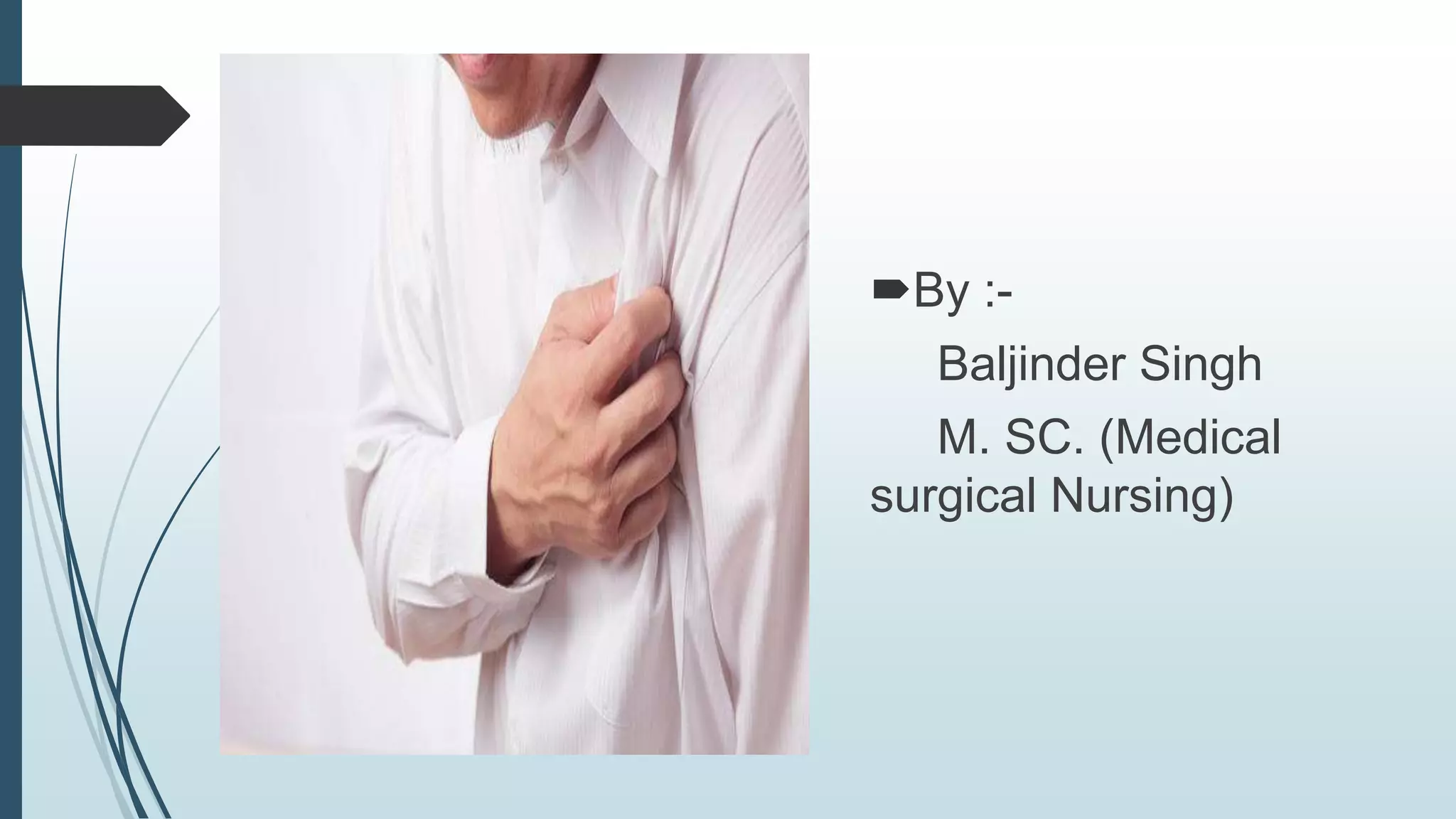
CARDIAC ARREST
Sudden stop in effective
blood circulation due to the
failure of the heart to
contract effectively.
 Medical personnel may
refer to an unexpected
cardiac arrest as a sudden
cardiac arrest (SCA).
PATHOPHYSIOLOGY
RISK FACTORS, ETIOLOGY
CONDUCTION ABNORMALITY IN HEART
INABILITY OF HEART TO CONTRACT
PROPERLY
DECREASED CARDIAC OUTPUT
DECREASED TISSUE PERFUSION COMPROMISED FUNCTION OF HEART
SIGN AND SYMPTOMS
SIGN AND SYMPTOMS
 loss of pulse
Absence of BP
Unconscious
Seizures
Chocking
Dilatation of pupil
DIAGNOSIS
1. Assessment of signs and symptoms
2. E.C.G
3. Serum Electrolytes
4. Cardiac Biomarkers
5. ABG Analysis
6. Chest X-Ray
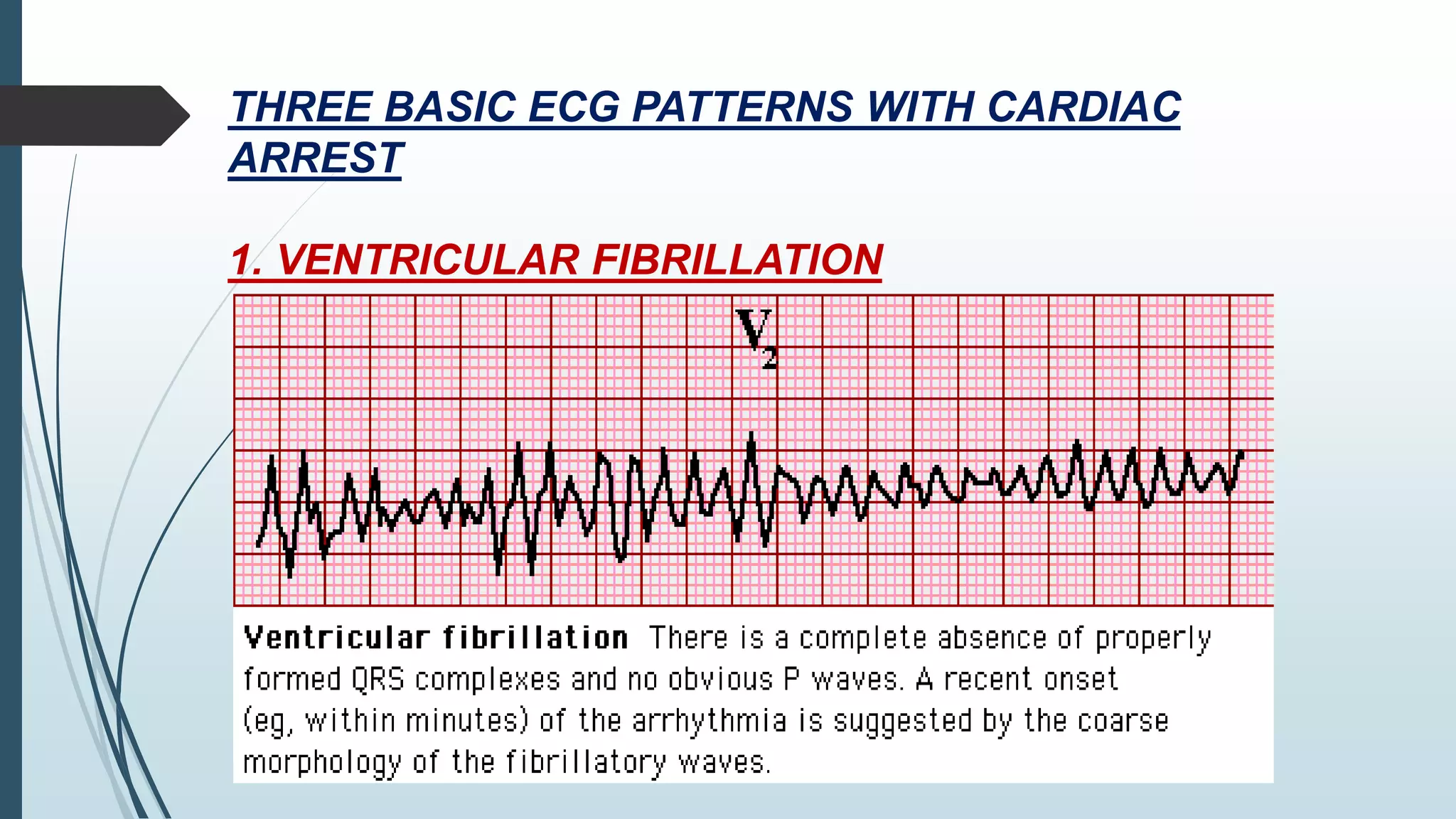
THREE BASIC ECG PATTERNS WITH CARDIAC
ARREST
1. VENTRICULAR FIBRILLATION
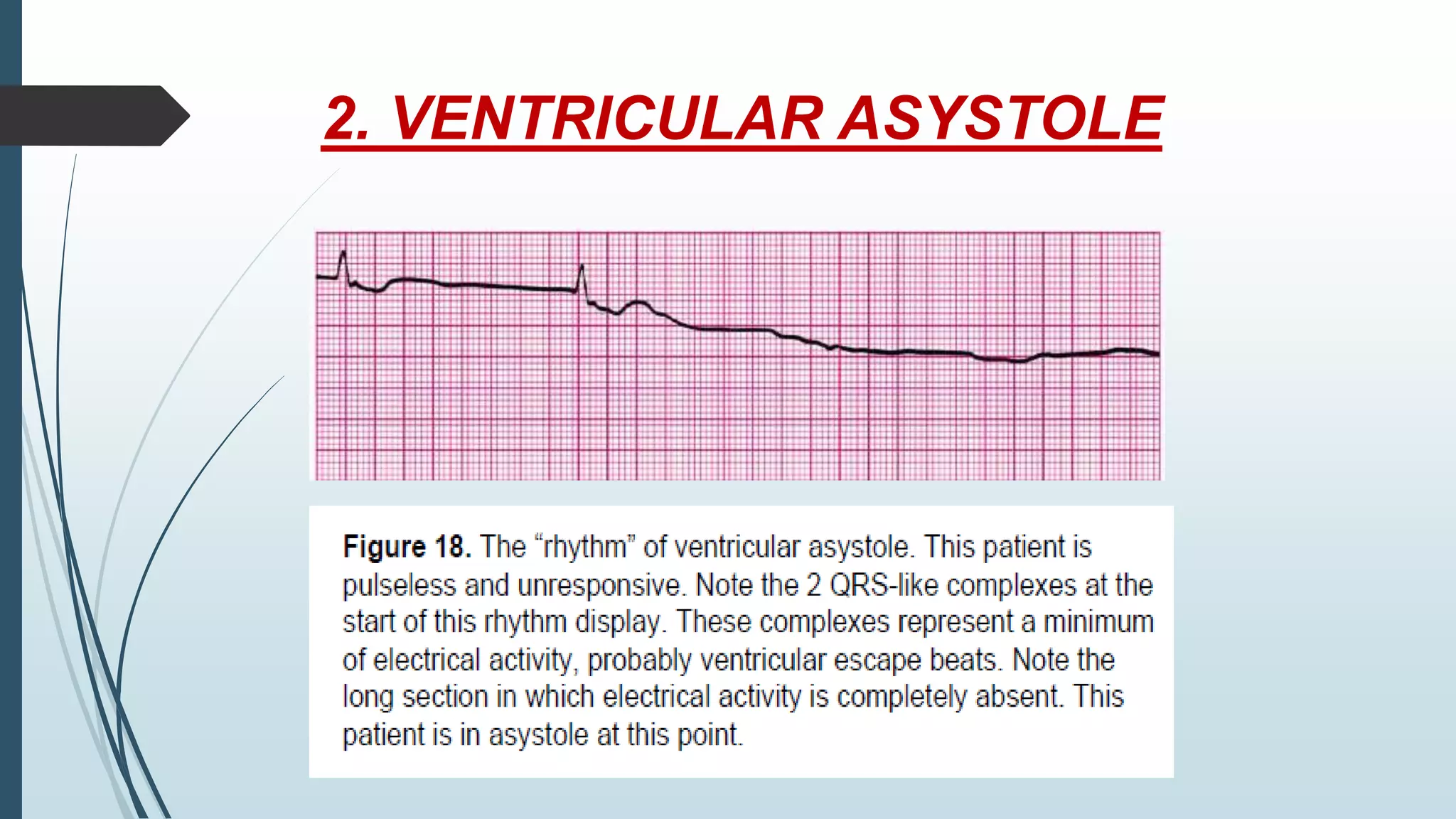
2. VENTRICULAR ASYSTOLE
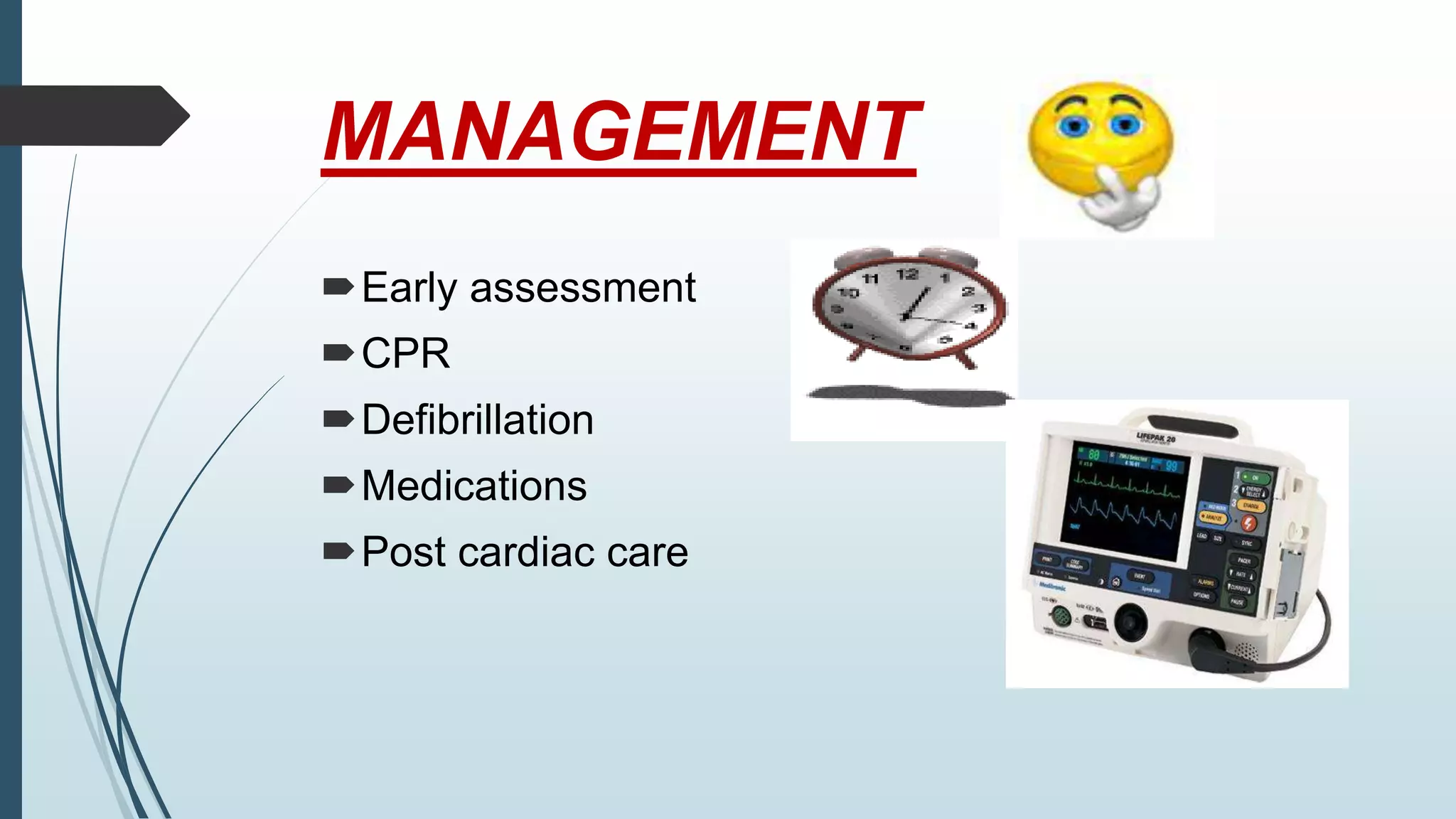
MANAGEMENT
Early assessment
CPR
Defibrillation
Medications
Post cardiac care
TREATMENT
“Chain of Survival”
 Early access.
 Early CPR.
 Early defibrillation.
 Early advanced life support.
“Chain of Survival” First link – Early
access
Call for Help !
Patient evaluation
 Determine if conscious or not, by
placing one hand on patient’s forehead
and shaking shoulders gently with
another hand.
 In case of SCA patient will not
respond.
“Chain of Survival” Second link –
Early CPR
Steps preceding Cardiopulmonary
Resuscitation (CPR)
 Determine A,B,C of Basic Cardiac Life Support
(BCLS).
* A for Airway.
* B for Breathing.
* C for Circulation.
 Airway
* Head tilt
* Finger sweep.
* Jaw Thrust.
“Chain of Survival” Second link –
Early CPR
 Breathing
* Look – Down the line of chest to
to see it rise and fall.
* Listen – at mouth and nose for
breathing sounds.
* Feel – for expired air at patients
mouth and nose.
“Chain of Survival” Second link –
Early CPR
 Circulation
* Feel - carotids
“Chain of Survival” Second link –
Early CPR
Cardiac compressions
 Locate correct chest compression
site, 2 - fingers above xiphoid.
 Place heel of other hand on the
lower end of breast bone.
 Fingers off the chest wall.
“Chain of Survival” Second link –
Early CPR
Once SCA is confirmed …………
 Patient should be placed on hard surface.
 Start CPR.
 Give 2 expired breaths, followed by 30 compressions.
 Continue 30:2 cycles for CPR both for 1- & 2 -rescuers
 Compression rate – atleast 100 per minute
“Chain of Survival” Second link – Early
CPR
Mouth to mouth ventilation
 Remove any obvious obstruction.
 Open airway.
 Pinch victims nose.
 Give mouth to mouth ventilation.
 Repeat breaths.
“Chain of Survival” Second link –
Early CPR
“Chain of Survival” Second link –
Early CPR
“Chain of Survival” Third link – Early
Defibrillation
 CPR saves time
 The most common cause of SCA is VF, a lethal rhythm
 The only effective treatment is defibrillation
PADDLE PLACEMENT
2nd intercostal space to right of sternum
5th left intercostal space on anterior
axillary line
PADDLE PLACEMENT
SHOCK PROTOCOL
VF/ pulseless ventricular tachycardia (VT)
Deliver 1 shock, immediately resume CPR,
beginning with chest compressions - 5 cycles
Analyze the cardiac rhythm deliver another
shock if indicated
ENERGY DURING DEFIBRILLATION
Start with 120 J
Increase to 200J, 360 J
Pressure = 20 to 25 pounds
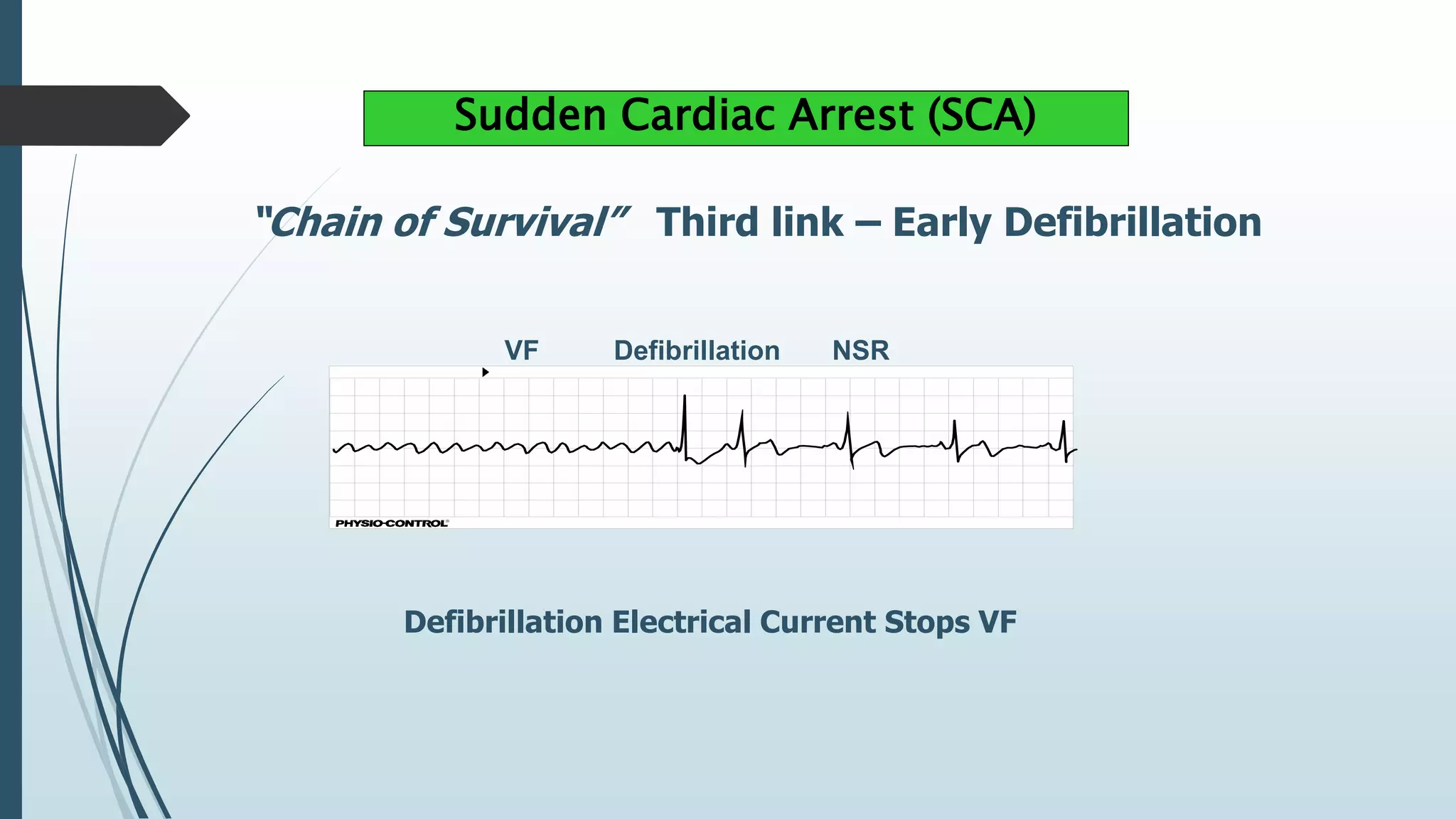
“Chain of Survival” Third link – Early Defibrillation
VF Defibrillation NSR
Defibrillation Electrical Current Stops VF
Sudden Cardiac Arrest (SCA)
“Chain of Survival” Fourth link – Early ACLS
 For advanced Cardiac Life support (ACLS) shift
the patient to the nearest hospital.
 Treat victim with medicine and advanced
therapies.
Sudden Cardiac Arrest (SCA)
NURSING MANAGEMENT
NURSING MANAGEMENT
1) ASSESSMENT :
- Observe sign and symptoms
- Observe pulse
- Assess A, B, C
- Call for help
START CPR
Immediate care after CPR
Level of consciousness
Vital signs
ECG
 CVP
 Urine output
 ABG value
NURSING DIAGNOSIS
Decreased cardiac output r/t cardiac arrest, dysrhythmia.
Assess vital signs, CVP, urinary output and peripheral pulses.
Assess heart rate and rhythm (ECG).
Oxygen administration as hypoxia can lead to further dysrhytmias.
Administer drugs, antidysrhythmic medication as ordered.
Administer fluid therapy as ordered.
NURSING DIAGNOSIS
Impaired tissue perfusion r/t to decreased cardiac output.
Note the color and temperature of the skin.
Monitor peripheral pulses
Monitor urine out put
Provide warm environment.
NURSING DIAGNOSIS
MANAGEMENTRisk for ineffective respiratory pattern r/t disease
condition.
 Assess respiratory rate.
 Auscultate breath sounds.
 Fowler’s position if difficulty.
 Monitor pulse oximetry and ABG analysis. Report any
abnormality.
 Continuous monitoring for the first half hour of
defibrillation.
NURSING DIAGNOSIS
Risk for fluid electrolyte imbalance r/t physiological changes.
Monitor intake and output.
Administer fluid and diuretics.
Monitor electrolytes daily and replace as ordered.
Monitor BUN, creatinine and urine electrolytes daily.
NURSING DIAGNOSIS
Risk for complications r/t disease process, procedure performed
and defibrillation.
 Assess level of consciousness. Reorient the time, place and person.
 Assess vital signs and ECG continuously.
 Initiate IV antidysrhythmics therapy as prescribed
 Administer IV fluid to correct fluid electrolyte imbalances
NURSING DIAGNOSIS
Anxiety r/t fear about unknown outcome.
 Prepare patient and family and explain what is expected.
 Clarify any misconceptions.
 Provide adequate rest to the patient.
 Encourage to ask questions related to equipments, monitoring,
treatment.
SUMMARY
Definition of cardiac arrest
Difference b/w heart attack and cardiac arrest
Etiology of cardiac arrest
Risk factors of cardiac arrest
Sign and symptoms of patient with cardiac arrest
Diagnosis of patient with cardiac arrest
Management of patient with cardiac arrest
REFERENCES
Braunwald et al:Principle of Internal
Medicine1508,1513 16th edition
Woods et al:``Cardiac Nursing’’LIPPINCOTT
Brunner& Siddharth, Medical Surgical Nursing’’
Meg Gulanick et al:Nursing Care Plan 200,204
Cardiac arrest bsc

Cardiac arrest bsc

  • 1.
    By :- Baljinder Singh M.SC. (Medical surgical Nursing)
  • 2.
    CARDIAC ARREST Sudden stopin effective blood circulation due to the failure of the heart to contract effectively.  Medical personnel may refer to an unexpected cardiac arrest as a sudden cardiac arrest (SCA).
  • 3.
    PATHOPHYSIOLOGY RISK FACTORS, ETIOLOGY CONDUCTIONABNORMALITY IN HEART INABILITY OF HEART TO CONTRACT PROPERLY DECREASED CARDIAC OUTPUT DECREASED TISSUE PERFUSION COMPROMISED FUNCTION OF HEART SIGN AND SYMPTOMS
  • 4.
    SIGN AND SYMPTOMS loss of pulse Absence of BP Unconscious Seizures Chocking Dilatation of pupil
  • 6.
    DIAGNOSIS 1. Assessment ofsigns and symptoms 2. E.C.G 3. Serum Electrolytes 4. Cardiac Biomarkers 5. ABG Analysis 6. Chest X-Ray
  • 7.
    THREE BASIC ECGPATTERNS WITH CARDIAC ARREST 1. VENTRICULAR FIBRILLATION
  • 8.
  • 9.
  • 10.
    TREATMENT “Chain of Survival” Early access.  Early CPR.  Early defibrillation.  Early advanced life support.
  • 11.
    “Chain of Survival”First link – Early access Call for Help ! Patient evaluation  Determine if conscious or not, by placing one hand on patient’s forehead and shaking shoulders gently with another hand.  In case of SCA patient will not respond.
  • 12.
    “Chain of Survival”Second link – Early CPR Steps preceding Cardiopulmonary Resuscitation (CPR)  Determine A,B,C of Basic Cardiac Life Support (BCLS). * A for Airway. * B for Breathing. * C for Circulation.
  • 13.
     Airway * Headtilt * Finger sweep. * Jaw Thrust. “Chain of Survival” Second link – Early CPR
  • 14.
     Breathing * Look– Down the line of chest to to see it rise and fall. * Listen – at mouth and nose for breathing sounds. * Feel – for expired air at patients mouth and nose. “Chain of Survival” Second link – Early CPR
  • 15.
     Circulation * Feel- carotids “Chain of Survival” Second link – Early CPR
  • 16.
    Cardiac compressions  Locatecorrect chest compression site, 2 - fingers above xiphoid.  Place heel of other hand on the lower end of breast bone.  Fingers off the chest wall. “Chain of Survival” Second link – Early CPR
  • 17.
    Once SCA isconfirmed …………  Patient should be placed on hard surface.  Start CPR.  Give 2 expired breaths, followed by 30 compressions.  Continue 30:2 cycles for CPR both for 1- & 2 -rescuers  Compression rate – atleast 100 per minute “Chain of Survival” Second link – Early CPR
  • 18.
    Mouth to mouthventilation  Remove any obvious obstruction.  Open airway.  Pinch victims nose.  Give mouth to mouth ventilation.  Repeat breaths. “Chain of Survival” Second link – Early CPR
  • 19.
    “Chain of Survival”Second link – Early CPR
  • 20.
    “Chain of Survival”Third link – Early Defibrillation  CPR saves time  The most common cause of SCA is VF, a lethal rhythm  The only effective treatment is defibrillation
  • 21.
    PADDLE PLACEMENT 2nd intercostalspace to right of sternum 5th left intercostal space on anterior axillary line
  • 22.
  • 23.
    SHOCK PROTOCOL VF/ pulselessventricular tachycardia (VT) Deliver 1 shock, immediately resume CPR, beginning with chest compressions - 5 cycles Analyze the cardiac rhythm deliver another shock if indicated
  • 24.
    ENERGY DURING DEFIBRILLATION Startwith 120 J Increase to 200J, 360 J Pressure = 20 to 25 pounds
  • 25.
    “Chain of Survival”Third link – Early Defibrillation VF Defibrillation NSR Defibrillation Electrical Current Stops VF Sudden Cardiac Arrest (SCA)
  • 26.
    “Chain of Survival”Fourth link – Early ACLS  For advanced Cardiac Life support (ACLS) shift the patient to the nearest hospital.  Treat victim with medicine and advanced therapies. Sudden Cardiac Arrest (SCA)
  • 27.
  • 28.
    NURSING MANAGEMENT 1) ASSESSMENT: - Observe sign and symptoms - Observe pulse - Assess A, B, C - Call for help START CPR
  • 29.
    Immediate care afterCPR Level of consciousness Vital signs ECG  CVP  Urine output  ABG value
  • 30.
    NURSING DIAGNOSIS Decreased cardiacoutput r/t cardiac arrest, dysrhythmia. Assess vital signs, CVP, urinary output and peripheral pulses. Assess heart rate and rhythm (ECG). Oxygen administration as hypoxia can lead to further dysrhytmias. Administer drugs, antidysrhythmic medication as ordered. Administer fluid therapy as ordered.
  • 31.
    NURSING DIAGNOSIS Impaired tissueperfusion r/t to decreased cardiac output. Note the color and temperature of the skin. Monitor peripheral pulses Monitor urine out put Provide warm environment.
  • 32.
    NURSING DIAGNOSIS MANAGEMENTRisk forineffective respiratory pattern r/t disease condition.  Assess respiratory rate.  Auscultate breath sounds.  Fowler’s position if difficulty.  Monitor pulse oximetry and ABG analysis. Report any abnormality.  Continuous monitoring for the first half hour of defibrillation.
  • 33.
    NURSING DIAGNOSIS Risk forfluid electrolyte imbalance r/t physiological changes. Monitor intake and output. Administer fluid and diuretics. Monitor electrolytes daily and replace as ordered. Monitor BUN, creatinine and urine electrolytes daily.
  • 34.
    NURSING DIAGNOSIS Risk forcomplications r/t disease process, procedure performed and defibrillation.  Assess level of consciousness. Reorient the time, place and person.  Assess vital signs and ECG continuously.  Initiate IV antidysrhythmics therapy as prescribed  Administer IV fluid to correct fluid electrolyte imbalances
  • 35.
    NURSING DIAGNOSIS Anxiety r/tfear about unknown outcome.  Prepare patient and family and explain what is expected.  Clarify any misconceptions.  Provide adequate rest to the patient.  Encourage to ask questions related to equipments, monitoring, treatment.
  • 36.
    SUMMARY Definition of cardiacarrest Difference b/w heart attack and cardiac arrest Etiology of cardiac arrest Risk factors of cardiac arrest Sign and symptoms of patient with cardiac arrest Diagnosis of patient with cardiac arrest Management of patient with cardiac arrest
  • 37.
    REFERENCES Braunwald et al:Principleof Internal Medicine1508,1513 16th edition Woods et al:``Cardiac Nursing’’LIPPINCOTT Brunner& Siddharth, Medical Surgical Nursing’’ Meg Gulanick et al:Nursing Care Plan 200,204