By Praveen Garg
Asst. Prof.
VITS, Satna (M.P.)
INTRODUCTION
DNA is genetic material that carries information
from generation to generation.
 But how we know that DNA is a genetic material?
Here we will explore the fun journey of the
discovery of genetic material.
PROPERTY OF GENETIC MATERIAL
For a molecule to act as the genetic material, it
should have the following properties:
 Be capable of replication i.e. form its own replica.
 It should be structurally and chemically stable.
 It must have the property to changes due to
mutation.
 Be expressed in the form of ‘Mendelian Characters’.
Although DNA is the genetic material in most
organisms, in some viruses, RNA is the genetic
material.
 According to studies, RNA was the first genetic
material. But, since RNA is unstable, DNA evolved
from RNA with chemical modifications, and it is more
stable and carry more genetic information.
Frederick Griffith Experiment
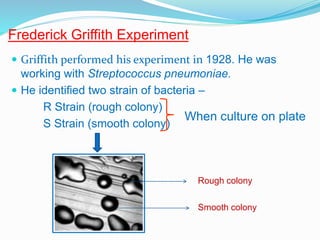
 Griffith performed his experiment in 1928. He was
working with Streptococcus pneumoniae.
 He identified two strain of bacteria –
R Strain (rough colony)
S Strain (smooth colony)
When culture on plate
Smooth colony
Rough colony
 S strain bacteria have a polysaccharide coat
which give rise to smooth and shiny colony. S
strain is virulent and cause pneumonia.
 The R strain lack of polysaccharide coat, it give
rough colony. R strain is non virulent.
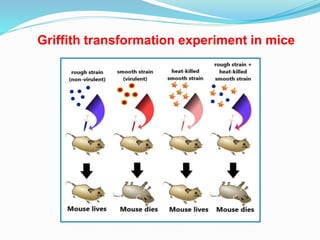
He performed the following experiment with
these bacteria and saw the different observation.
 S strain → Inject into mice → Mice develop
pneumonia and die.
 R strain → Inject into mice → Mice live.
 Heat-killed S strain → Inject into mice → Mice
live. (Griffith found that heating kills the bacteria).
 Heat-killed S strain + R strain → Inject into
mice → Mice die.
Griffith transformation experiment in mice
Conclusion of experiment
 He concluded that the R strain had been
‘transformed’ by the heat-killed S strain. This
happened due to the transfer of a ‘transforming
principle‘ from the S strain to the R strain, which
made the R strain virulent.
Although significant, his
observations did not identify the biochemical
nature of the transforming principle.
Avery, MacLeod & McCarty Experiment
 They determine the biochemical nature of the
‘transforming principle’ identified by Griffith.
 These people purified DNA, RNA, and proteins from
the heat-killed S strain and determined which
macromolecule converted the R strain into the S
strain.
Experiment:
Firstly they treated heat killed S strain to
Protease, RNAses and DNAses to break down
protein, RNA and DNA respectively.
Observation:
He observed that treated with DNAses
inhibit the transformation of R strain. Protease
and RNAses did not affect the transformation of
R strain to virulent form.
Conclusion:
They concluded that genetic material is
DNA, not RNA or Protein. But this theory was not
accepted by biologist.
Harshey and Chase Experiment
 In 1952, Hershey and Chase proof that DNA is
genetic material by his experiment.
 They used bacteriophages to experiment as follow.
 Bacteriophages is type of virus that infect bacteria.
Protocol:
Some virus grow on medium containing
radioactive phosphorus and some grow on
radioactive sulfur containing medium.
Virus have radioactive DNA that grown on
phosphorus containing medium, because DNA
contain phosphorus but protein does not.
In contrast, virus contain radioactive protein ,
which grown on sulfur containing medium,
because protein contain sulfur but DNA does not.
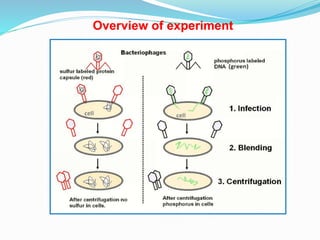
These radioactive phages were allowed to infect
bacterial cell and transfer their radiactive DNA or
protein.
After the infection, viral coat or particles were
removed from the bacteria by the centrifugation
process.
Overview of experiment
Observation:
He observed that bacteria were
radioactive, which infected with viruses
containing radioactive DNA, while bacteria were
not radioactive, which infected with viruses
containing radioactive protein.
.
Conclusion:
Harshey and Chase experiment
conclude that DNA is the genetic material
transferred from virus to bacteria, but not protein.
RNA and Protein:
• DNA is the genetic material for the majority of
organisms, But there are some viruses that use RNA as
their genetic material such as SARS, Influenza,
hepatitis C, polio and retro viruses like HIV-AIDS. They
all have either single or double stranded RNA. They
used to replicate RNA in their life cycle.
• Prions are infectious agent that transmit their
characteristics via protein.
Thank You

DNA as genetic material

  • 1.
    By Praveen Garg Asst.Prof. VITS, Satna (M.P.)
  • 2.
    INTRODUCTION DNA is geneticmaterial that carries information from generation to generation.  But how we know that DNA is a genetic material? Here we will explore the fun journey of the discovery of genetic material.
  • 3.
    PROPERTY OF GENETICMATERIAL For a molecule to act as the genetic material, it should have the following properties:  Be capable of replication i.e. form its own replica.  It should be structurally and chemically stable.  It must have the property to changes due to mutation.  Be expressed in the form of ‘Mendelian Characters’.
  • 4.
    Although DNA isthe genetic material in most organisms, in some viruses, RNA is the genetic material.  According to studies, RNA was the first genetic material. But, since RNA is unstable, DNA evolved from RNA with chemical modifications, and it is more stable and carry more genetic information.
  • 5.
    Frederick Griffith Experiment Griffith performed his experiment in 1928. He was working with Streptococcus pneumoniae.  He identified two strain of bacteria – R Strain (rough colony) S Strain (smooth colony) When culture on plate Smooth colony Rough colony
  • 6.
     S strainbacteria have a polysaccharide coat which give rise to smooth and shiny colony. S strain is virulent and cause pneumonia.  The R strain lack of polysaccharide coat, it give rough colony. R strain is non virulent.
  • 7.
    He performed thefollowing experiment with these bacteria and saw the different observation.  S strain → Inject into mice → Mice develop pneumonia and die.  R strain → Inject into mice → Mice live.  Heat-killed S strain → Inject into mice → Mice live. (Griffith found that heating kills the bacteria).  Heat-killed S strain + R strain → Inject into mice → Mice die.
  • 8.
  • 9.
    Conclusion of experiment He concluded that the R strain had been ‘transformed’ by the heat-killed S strain. This happened due to the transfer of a ‘transforming principle‘ from the S strain to the R strain, which made the R strain virulent. Although significant, his observations did not identify the biochemical nature of the transforming principle.
  • 10.
    Avery, MacLeod &McCarty Experiment  They determine the biochemical nature of the ‘transforming principle’ identified by Griffith.  These people purified DNA, RNA, and proteins from the heat-killed S strain and determined which macromolecule converted the R strain into the S strain. Experiment: Firstly they treated heat killed S strain to Protease, RNAses and DNAses to break down protein, RNA and DNA respectively.
  • 11.
    Observation: He observed thattreated with DNAses inhibit the transformation of R strain. Protease and RNAses did not affect the transformation of R strain to virulent form. Conclusion: They concluded that genetic material is DNA, not RNA or Protein. But this theory was not accepted by biologist.
  • 12.
    Harshey and ChaseExperiment  In 1952, Hershey and Chase proof that DNA is genetic material by his experiment.  They used bacteriophages to experiment as follow.  Bacteriophages is type of virus that infect bacteria. Protocol: Some virus grow on medium containing radioactive phosphorus and some grow on radioactive sulfur containing medium. Virus have radioactive DNA that grown on phosphorus containing medium, because DNA contain phosphorus but protein does not.
  • 13.
    In contrast, viruscontain radioactive protein , which grown on sulfur containing medium, because protein contain sulfur but DNA does not. These radioactive phages were allowed to infect bacterial cell and transfer their radiactive DNA or protein. After the infection, viral coat or particles were removed from the bacteria by the centrifugation process.
  • 14.
  • 15.
    Observation: He observed thatbacteria were radioactive, which infected with viruses containing radioactive DNA, while bacteria were not radioactive, which infected with viruses containing radioactive protein. . Conclusion: Harshey and Chase experiment conclude that DNA is the genetic material transferred from virus to bacteria, but not protein.
  • 16.
    RNA and Protein: •DNA is the genetic material for the majority of organisms, But there are some viruses that use RNA as their genetic material such as SARS, Influenza, hepatitis C, polio and retro viruses like HIV-AIDS. They all have either single or double stranded RNA. They used to replicate RNA in their life cycle. • Prions are infectious agent that transmit their characteristics via protein.
  • 17.