
PLEIOTROPY
By
Dr. ICHHA PURAK
UNIVERSITY PROFESSOR IN BOTANY
RANCHI WOMEN’S COLLEGE,RANCHI
SINGLE GENE AFFECTS MORE THAN ONE TRAIT
Pleiotropy 17/31/2020
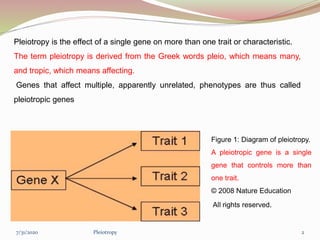
Pleiotropy is the effect of a single gene on more than one trait or characteristic.
The term pleiotropy is derived from the Greek words pleio, which means many,
and tropic, which means affecting.
Genes that affect multiple, apparently unrelated, phenotypes are thus called
pleiotropic genes
Figure 1: Diagram of pleiotropy.
A pleiotropic gene is a single
gene that controls more than
one trait.
© 2008 Nature Education
All rights reserved.
Pleiotropy 27/31/2020
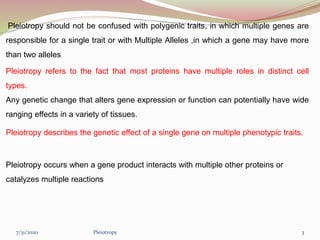
Pleiotropy should not be confused with polygenic traits, in which multiple genes are
responsible for a single trait or with Multiple Alleles ,in which a gene may have more
than two alleles
Pleiotropy refers to the fact that most proteins have multiple roles in distinct cell
types.
Any genetic change that alters gene expression or function can potentially have wide
ranging effects in a variety of tissues.
Pleiotropy describes the genetic effect of a single gene on multiple phenotypic traits.
Pleiotropy occurs when a gene product interacts with multiple other proteins or
catalyzes multiple reactions
Pleiotropy 37/31/2020
Gregor Johann Mendel while studying inheritance in pea plants ,made several
interesting observations regarding the colour of various plant components
Mendel noticed that plants with coloured seed coats always had coloured
flowers and coloured leaf axils.
Mendel also observed that pea plants with colourless seed coats always had
white flowers and no pigmentation on their axils.
Now ,it is well known that Mendel's observations were the result of pleiotropy, or
the phenomenon in which a single gene contributes to multiple phenotypic traits.
In this case, the seed coat colour gene, denoted a, was not only responsible for
seed coat colour, but also for flower and axil pigmentation
EXAMPLES OF PLEIOTROPY
PLEIOTROPY IN PEA
Pleiotropy 47/31/2020
OTHER EXAMPLES OF PLEIOTROPY
Vestigeal Gene (vg) of Fruit Fly
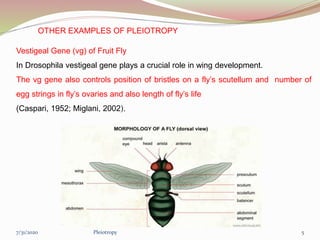
In Drosophila vestigeal gene plays a crucial role in wing development.
The vg gene also controls position of bristles on a fly’s scutellum and number of
egg strings in fly’s ovaries and also length of fly’s life
(Caspari, 1952; Miglani, 2002).
Pleiotropy 57/31/2020
Example of Pleiotropy in Cat :Pigmentation and Deafness in Cats
Harti and Jones (2005) while studying fur colour and deafness in cats
observed that approximately 40% cats with white fur and blue eyes are deaf.It
was also found that white cats with one blue eye and one yellow orange eye
were deaf only on the blue-eyed side
Pleiotropy 67/31/2020
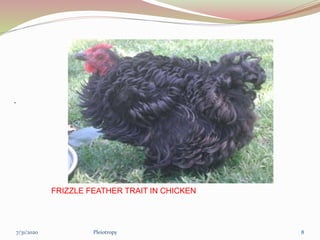
FRIZZLE FEATHER TRAIT IN CHICKEN
Chickens exhibit various traits affected by pleiotropic genes.
Some chickens exhibit frizzle feather trait, where their feathers curl outward and
upward rather than lying flat against the body.
Frizzel gene exhibits pleiotropic nature as along with producing defective feathers
, it also causes abnormal body temperature, higher metabolic and blood flow
rates, greater digestive capacity, accelerated heart rate and delayed sexual
maturity.
Females who have this allele also lay fewer eggs than their wild-type
counterparts.
Comb mass and physiological structures related to reproductive abilities are
closely linked.
Both males and females with larger combs have higher bone density and strength,
which allows females to deposit more calcium into eggshells.
Frizzle feather was found to stem from a deletion in the genomic region coding for
α-Keratin.
Pleiotropy 77/31/2020
.
FRIZZLE FEATHER TRAIT IN CHICKEN
Pleiotropy 87/31/2020
PLEIOTROPY IN HUMANS
One of the most widely cited examples of pleiotropy in humans is phenylketonuria
(PKU).
This disorder is caused by a deficiency of the enzyme phenylalanine hydroxylase,
which is necessary to convert the essential amino acid phenylalanine to tyrosine.
A defect in the single gene that codes for this enzyme therefore results in the
multiple phenotypes associated with PKU, including mental retardation, eczema,
reduced hair and skin pigmentation defects that make affected individuals lighter
skinned (Paul, 2000).
It is caused by large number of mutations in the single gene on chromosome 12
that codes for enzyme phenylalanine hydroxylase,which converts the amino acid
phenylalanine to tyrosine.
Because the enzyme is not formed ,levels of phenylalanine increase, which
creates toxicity and become fatal
PHENYL KETONE UREA (PKU)
Pleiotropy 97/31/2020
Second example of Pleiotropy in human is Sickle cell anaemia
Sickle cell anaemia is a human disease originating in warm lowland tropical areas
where malaria is common. Sickle celled individuals suffer from a number of problems
,all of which are pleiotropic effects of sickle cell allele
Sickle cell anaemia is an example of a pleiotropic human blood disease
It is caused by an allele that incorrectly codes for haemoglobin, causing normally
round red blood cells to become sickle shaped.
As a result, the cells are inflexible and cannot easily flow through blood vessels,
increasing the risk of blood clots and possibly depriving vital organs of oxygen by
reducing efficiency of RBCs in carrying oxygen.
Some complications associated with sickle cell anemia include pain, damaged
organs, strokes, high blood pressure, loss of vision, fatigue and delayed growth.
.
Pleiotropy 107/31/2020
Sickle red blood cells also have a shortened lifespan and die prematurely.
On the contrary, individuals who are carriers for the sickle cell disease (with one
sickle gene and one normal hemoglobin gene) have some protective advantage
against malaria.
As a result, the frequencies of sickle cell carriers are high in malaria-endemic areas.
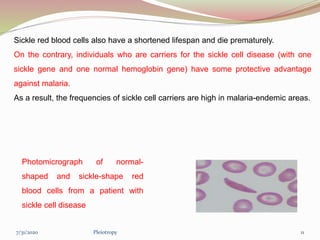
Photomicrograph of normal-
shaped and sickle-shape red
blood cells from a patient with
sickle cell disease
Pleiotropy 117/31/2020
Third example of Pleiotropy in human : Marfan Syndrome
Marfan syndrome is a disorder in humans in which one gene is responsible for a
number of symptoms, including thinness, joint hypermobility, limb elongation, lens
dislocation, and increased susceptibility to heart disease.
Marfan syndrome (MFS) is an autosomal dominant disorder which arises from
mutation in FBNI gene,which codes for the glycoprotein fibrillin-1, a major
constituent of extracellular microfibrils which form connective tissues.
Because these fibres are found in tissue through out the body, mutation in this
gene can have a widespread effect on certain systems including cardiovascular,
skeletal and nervous system as well as the eyes and lungs.
Mutation of the gene (NBN) that codes for DNA damage repair protein NBS1 leads
to microcephaly, immunodeficiency and cancer predisposition in Nijmegen breakage
syndrome, which has an autosomal recessive pattern of inheritance
Pleiotropy 127/31/2020
Fourth Example of Pleiotropy in Human :Holt-Oram syndrome (HOS)
Mutations in the gene that codes for transcription factor TBX5 cause the cardiac
and limb defects called Holt-Oram syndrome.(HOS).
HOS syndrome is an autosomal dominant condition characterized by congenital
heart defects.
Tracheal and renal anamalies , thumb anomaly, atrial septal defects and deafness
are also be associated with this syndrome
T-box transcription factor TBX5 is a protein that in human is coded by the TBX5
gene .
This gene is located on the long arm of chromosome 12.
The Tbx5 gene affects development of forelimb and heart by triggering fibroblast
growth factor FGF10.
Pleiotropy 137/31/2020
Antagonistic Pleiotropy
Sometimes, a pleiotropic gene may be both harmful and beneficial to an organism,
which is referred to as antagonistic pleiotropy.
Williams (1957) proposed antagonistic pleiotropy hypothesis
He suggested that some genes responsible for increased fitness in the younger,
fertile organism contribute to decreased fitness later in life, which may give an
evolutionary explanation for senescence.
An example is the p53 gene in human , which suppresses cancer but also
suppresses stem cells which allow the body to renew and replace deteriorating
tissue during aging
It also prevents cells with DNA damage from dividing
This situation is therefore an example of antagonistic pleiotropy, in which the
expression of a single gene causes competing effects, some of which are
beneficial and some of which are detrimental to the fitness of an organism.
Pleiotropy 147/31/2020
THE END
THANKS
Pleiotropy 157/31/2020

Pleiotropy

  • 1.
    PLEIOTROPY By Dr. ICHHA PURAK UNIVERSITYPROFESSOR IN BOTANY RANCHI WOMEN’S COLLEGE,RANCHI SINGLE GENE AFFECTS MORE THAN ONE TRAIT Pleiotropy 17/31/2020
  • 2.
    Pleiotropy is theeffect of a single gene on more than one trait or characteristic. The term pleiotropy is derived from the Greek words pleio, which means many, and tropic, which means affecting. Genes that affect multiple, apparently unrelated, phenotypes are thus called pleiotropic genes Figure 1: Diagram of pleiotropy. A pleiotropic gene is a single gene that controls more than one trait. © 2008 Nature Education All rights reserved. Pleiotropy 27/31/2020
  • 3.
    Pleiotropy should notbe confused with polygenic traits, in which multiple genes are responsible for a single trait or with Multiple Alleles ,in which a gene may have more than two alleles Pleiotropy refers to the fact that most proteins have multiple roles in distinct cell types. Any genetic change that alters gene expression or function can potentially have wide ranging effects in a variety of tissues. Pleiotropy describes the genetic effect of a single gene on multiple phenotypic traits. Pleiotropy occurs when a gene product interacts with multiple other proteins or catalyzes multiple reactions Pleiotropy 37/31/2020
  • 4.
    Gregor Johann Mendelwhile studying inheritance in pea plants ,made several interesting observations regarding the colour of various plant components Mendel noticed that plants with coloured seed coats always had coloured flowers and coloured leaf axils. Mendel also observed that pea plants with colourless seed coats always had white flowers and no pigmentation on their axils. Now ,it is well known that Mendel's observations were the result of pleiotropy, or the phenomenon in which a single gene contributes to multiple phenotypic traits. In this case, the seed coat colour gene, denoted a, was not only responsible for seed coat colour, but also for flower and axil pigmentation EXAMPLES OF PLEIOTROPY PLEIOTROPY IN PEA Pleiotropy 47/31/2020
  • 5.
    OTHER EXAMPLES OFPLEIOTROPY Vestigeal Gene (vg) of Fruit Fly In Drosophila vestigeal gene plays a crucial role in wing development. The vg gene also controls position of bristles on a fly’s scutellum and number of egg strings in fly’s ovaries and also length of fly’s life (Caspari, 1952; Miglani, 2002). Pleiotropy 57/31/2020
  • 6.
    Example of Pleiotropyin Cat :Pigmentation and Deafness in Cats Harti and Jones (2005) while studying fur colour and deafness in cats observed that approximately 40% cats with white fur and blue eyes are deaf.It was also found that white cats with one blue eye and one yellow orange eye were deaf only on the blue-eyed side Pleiotropy 67/31/2020
  • 7.
    FRIZZLE FEATHER TRAITIN CHICKEN Chickens exhibit various traits affected by pleiotropic genes. Some chickens exhibit frizzle feather trait, where their feathers curl outward and upward rather than lying flat against the body. Frizzel gene exhibits pleiotropic nature as along with producing defective feathers , it also causes abnormal body temperature, higher metabolic and blood flow rates, greater digestive capacity, accelerated heart rate and delayed sexual maturity. Females who have this allele also lay fewer eggs than their wild-type counterparts. Comb mass and physiological structures related to reproductive abilities are closely linked. Both males and females with larger combs have higher bone density and strength, which allows females to deposit more calcium into eggshells. Frizzle feather was found to stem from a deletion in the genomic region coding for α-Keratin. Pleiotropy 77/31/2020
  • 8.
    . FRIZZLE FEATHER TRAITIN CHICKEN Pleiotropy 87/31/2020
  • 9.
    PLEIOTROPY IN HUMANS Oneof the most widely cited examples of pleiotropy in humans is phenylketonuria (PKU). This disorder is caused by a deficiency of the enzyme phenylalanine hydroxylase, which is necessary to convert the essential amino acid phenylalanine to tyrosine. A defect in the single gene that codes for this enzyme therefore results in the multiple phenotypes associated with PKU, including mental retardation, eczema, reduced hair and skin pigmentation defects that make affected individuals lighter skinned (Paul, 2000). It is caused by large number of mutations in the single gene on chromosome 12 that codes for enzyme phenylalanine hydroxylase,which converts the amino acid phenylalanine to tyrosine. Because the enzyme is not formed ,levels of phenylalanine increase, which creates toxicity and become fatal PHENYL KETONE UREA (PKU) Pleiotropy 97/31/2020
  • 10.
    Second example ofPleiotropy in human is Sickle cell anaemia Sickle cell anaemia is a human disease originating in warm lowland tropical areas where malaria is common. Sickle celled individuals suffer from a number of problems ,all of which are pleiotropic effects of sickle cell allele Sickle cell anaemia is an example of a pleiotropic human blood disease It is caused by an allele that incorrectly codes for haemoglobin, causing normally round red blood cells to become sickle shaped. As a result, the cells are inflexible and cannot easily flow through blood vessels, increasing the risk of blood clots and possibly depriving vital organs of oxygen by reducing efficiency of RBCs in carrying oxygen. Some complications associated with sickle cell anemia include pain, damaged organs, strokes, high blood pressure, loss of vision, fatigue and delayed growth. . Pleiotropy 107/31/2020
  • 11.
    Sickle red bloodcells also have a shortened lifespan and die prematurely. On the contrary, individuals who are carriers for the sickle cell disease (with one sickle gene and one normal hemoglobin gene) have some protective advantage against malaria. As a result, the frequencies of sickle cell carriers are high in malaria-endemic areas. Photomicrograph of normal- shaped and sickle-shape red blood cells from a patient with sickle cell disease Pleiotropy 117/31/2020
  • 12.
    Third example ofPleiotropy in human : Marfan Syndrome Marfan syndrome is a disorder in humans in which one gene is responsible for a number of symptoms, including thinness, joint hypermobility, limb elongation, lens dislocation, and increased susceptibility to heart disease. Marfan syndrome (MFS) is an autosomal dominant disorder which arises from mutation in FBNI gene,which codes for the glycoprotein fibrillin-1, a major constituent of extracellular microfibrils which form connective tissues. Because these fibres are found in tissue through out the body, mutation in this gene can have a widespread effect on certain systems including cardiovascular, skeletal and nervous system as well as the eyes and lungs. Mutation of the gene (NBN) that codes for DNA damage repair protein NBS1 leads to microcephaly, immunodeficiency and cancer predisposition in Nijmegen breakage syndrome, which has an autosomal recessive pattern of inheritance Pleiotropy 127/31/2020
  • 13.
    Fourth Example ofPleiotropy in Human :Holt-Oram syndrome (HOS) Mutations in the gene that codes for transcription factor TBX5 cause the cardiac and limb defects called Holt-Oram syndrome.(HOS). HOS syndrome is an autosomal dominant condition characterized by congenital heart defects. Tracheal and renal anamalies , thumb anomaly, atrial septal defects and deafness are also be associated with this syndrome T-box transcription factor TBX5 is a protein that in human is coded by the TBX5 gene . This gene is located on the long arm of chromosome 12. The Tbx5 gene affects development of forelimb and heart by triggering fibroblast growth factor FGF10. Pleiotropy 137/31/2020
  • 14.
    Antagonistic Pleiotropy Sometimes, apleiotropic gene may be both harmful and beneficial to an organism, which is referred to as antagonistic pleiotropy. Williams (1957) proposed antagonistic pleiotropy hypothesis He suggested that some genes responsible for increased fitness in the younger, fertile organism contribute to decreased fitness later in life, which may give an evolutionary explanation for senescence. An example is the p53 gene in human , which suppresses cancer but also suppresses stem cells which allow the body to renew and replace deteriorating tissue during aging It also prevents cells with DNA damage from dividing This situation is therefore an example of antagonistic pleiotropy, in which the expression of a single gene causes competing effects, some of which are beneficial and some of which are detrimental to the fitness of an organism. Pleiotropy 147/31/2020
  • 15.