Topic
DNA
SEQUENCING
Chemical Modification Method
Chain Termination Method
.
Submitted Dr. Raifullah
Name Amjad Khan
Reg # 5149
Date: 09th
December, 2016
ObjectivesObjectives
• What is DNA Sequencing ?
• History of development
• Basic Methods- Chain
termination and Chemical
modification method
What isDNA Sequencing ?What isDNA Sequencing ?
• Determining the precise order of nucleotides in
DNA.
• We need to determine the order of nucleotide
bases in a strand of DNA for sequencing.
• And to analyze gene structure and its relation to gene
expression as well as protein conformation
The Need for DNA SequencingThe Need for DNA Sequencing
• Gene isolation
• Forensics
• Gene Protein Interaction
• Cloning
• Detecting mutations
• Typing microorganisms
DNADNA
• Deoxyribonucleic Acid
• Stores genetic information
• Four different nucleotides A,T,G,C
• DNA comprises of a long molecule analogous to
a chain, while the links of the chain are called
Nucleotides
Historical TimelineHistorical Timeline
1870 – Miescher discovers DNA
1940 - Avery: Proposes DNA as ‘Genetic Material’
1953 – Watson & Crick “double helical structure”
1970 - Wu: Sequences λ Cohesive End DNA
1977 – Sanger: Dideoxy Chain Termination
1977 – Gilbert: Chemical Degradation
1986 – Partial Automation
1990 – Cycle Sequencing, Improved Sequencing Enzymes, Improved
fluorescent detection schemes
2002 – NGS: 454 , pyro sequencing
Sequencing MethodsSequencing Methods
• To determine the order of the nucleotide bases
adenine, guanine, cytosine, and thymine in a
molecule of DNA two methods were used
1. Maxam and Gilbert; Chemical Sequencing
2. Sanger; Chain Termination Sequencing
• These two are conventional methods
• Robotics and automated sequencing are based
on these methods
Maxam and Gilbert MethodMaxam and Gilbert Method
• In 1976–1977, Allan Maxam and Walter Gilbert
developed a DNA sequencing method based on
chemical modification of DNA and subsequent
cleavage at specific bases
I. Chemical Modification of DNA; radioactive labeling at
one 5' end of the DNA (typically by a kinase reaction
using gamma-32
P ATP)
II. Purification of the DNA fragment to be sequenced
III. Chemical treatment generates breaks in DNA
IV. Run on the gel
Chemical Modification and CleavageChemical Modification and Cleavage
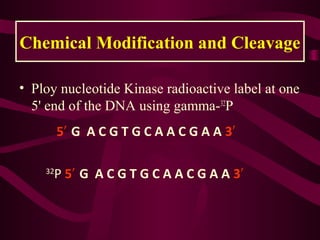
• Ploy nucleotide Kinase radioactive label at one
5' end of the DNA using gamma-32
P
5′ G A C G T G C A A C G A A 3′
32
P 5′ G A C G T G C A A C G A A 3′
Chemical Modification and CleavageChemical Modification and Cleavage
• Base Modification using Dimethyl sulphate
– Purine
• Adenine
• Guanine
– Only DMS------- G
– DMS+ Formic acid-------G+A
• Cleavage of Sugar Phosphate backbone using
Piperidine
Chemical Modification and CleavageChemical Modification and Cleavage
• Base modification using Hydrazine
– Pyrimidine
• Cytocine
• Thymidine
– Hydrazine----- C+T
– Hydrazine + NaCl--------C
• Cleavage of Sugar Phosphate backbone using
Piperidine
DMS
G
G
G
G
FA
G
A
G
G
A
G
A
A
H
C
T
T
C
T
C
C
T
H+S
C
C
C
C
Maxam Gilbert SequencingMaxam Gilbert Sequencing
32
P 5′ G A C G T G C A A C G A 3′
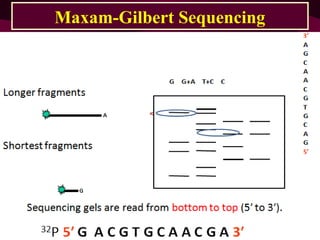
Sequencing gels are read from bottom to top (5 to 3 ).′ ′
G G+A T+C C
3′
A
G
C
A
A
C
G
T
G
C
A
G
5′
Longer fragments
Shortest fragments
G
A
Maxam-Gilbert SequencingMaxam-Gilbert Sequencing
32
P 5′ G A C G T G C A A C G A 3′
Maxam Gilbert Sequencing: Process SummarizedMaxam Gilbert Sequencing: Process Summarized
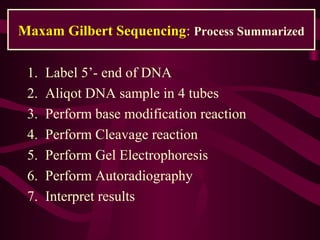
1. Label 5’- end of DNA
2. Aliqot DNA sample in 4 tubes
3. Perform base modification reaction
4. Perform Cleavage reaction
5. Perform Gel Electrophoresis
6. Perform Autoradiography
7. Interpret results
Sanger; Chain Termination Sequencing
• It is PCR based method
• A modified DNA replication reaction
• Growing chains are terminated by
dideoxynucleotides
ddATP + ddA
four dNTPs dAdGdCdTdGdCdCdCdG
ddCTP + dAdGddC
four dNTPs dAdGdCdTdGddC
dAdGdCdTdGdCddC
dAdGdCdTdGdCdCddC
ddGTP + dAddG
four dNTPs dAdGdCdTddG
dAdGdCdTdGdCdCdCddG
ddTTP + dAdGdCddT
four dNTPs dAdGdCdTdGdCdCdCdG
A
C
G
T
Sanger; Chain Termination
Sequencing
Sanger; Chain Termination
Sequencing
A G C T G C C C G
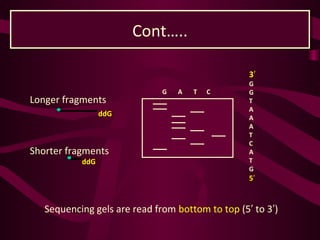
Sequencing gels are read from bottom to top (5 to 3 )′ ′
G A T C
3′
G
G
T
A
A
A
T
C
A
T
G
5′
Longer fragments
Shorter fragments
ddG
ddG
Cont…..Cont…..
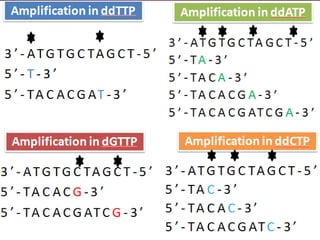
Sanger Sequencing: An Example
5’-TACACGATCGA-3’
3’-ATGTGCTAGCT-5’
Denature the sequence
Use only forward primer i.e. using 3’-5
3’-ATGTGCTAGCT-5’
5’-T-3’
5’-TACACGAT-3’
Amplification in
ddTTP
Amplification in
ddTTP
3’-ATGTGCTAGCT-5’
5’-TA-3’
5’-TACA-3’
5’-TACACGA-3’
5’-TACACGATCGA-3’
Amplification in
ddATP
Amplification in
ddATP
Amplification in
dGTTP
Amplification in
dGTTP
Amplification in
ddCTP
Amplification in
ddCTP
3’-ATGTGCTAGCT-5’
5’-TACACG-3’
5’-TACACGATCG-3’
3’-ATGTGCTAGCT-5’
5’-TAC-3’
5’-TACAC-3’
5’-TACACGATC-3’
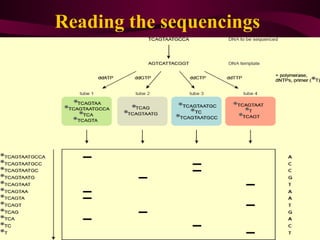
Reading the sequencings
Sanger Sequencing: Process SummarizedSanger Sequencing: Process Summarized
1. Get enough quantity of DNA (Run PCR)
2. Aliqot DNA into four different tubes
3. Prepare PCR reaction mix as below:
• Primer, taq PM, template(ss DNA), dNTPS (All)
and ddNTPs(ddATP, ddGTP,ddCTP & ddTTP
respectively)
1. Run PCR
2. Perform Gel Electrophoresis
3. Interpret results
Thank You
End

DNA sequencing

  • 2.
  • 3.
    Submitted Dr. Raifullah NameAmjad Khan Reg # 5149 Date: 09th December, 2016
  • 4.
    ObjectivesObjectives • What isDNA Sequencing ? • History of development • Basic Methods- Chain termination and Chemical modification method
  • 5.
    What isDNA Sequencing?What isDNA Sequencing ? • Determining the precise order of nucleotides in DNA. • We need to determine the order of nucleotide bases in a strand of DNA for sequencing. • And to analyze gene structure and its relation to gene expression as well as protein conformation
  • 6.
    The Need forDNA SequencingThe Need for DNA Sequencing • Gene isolation • Forensics • Gene Protein Interaction • Cloning • Detecting mutations • Typing microorganisms
  • 7.
    DNADNA • Deoxyribonucleic Acid •Stores genetic information • Four different nucleotides A,T,G,C • DNA comprises of a long molecule analogous to a chain, while the links of the chain are called Nucleotides
  • 8.
    Historical TimelineHistorical Timeline 1870– Miescher discovers DNA 1940 - Avery: Proposes DNA as ‘Genetic Material’ 1953 – Watson & Crick “double helical structure” 1970 - Wu: Sequences λ Cohesive End DNA 1977 – Sanger: Dideoxy Chain Termination 1977 – Gilbert: Chemical Degradation 1986 – Partial Automation 1990 – Cycle Sequencing, Improved Sequencing Enzymes, Improved fluorescent detection schemes 2002 – NGS: 454 , pyro sequencing
  • 9.
    Sequencing MethodsSequencing Methods •To determine the order of the nucleotide bases adenine, guanine, cytosine, and thymine in a molecule of DNA two methods were used 1. Maxam and Gilbert; Chemical Sequencing 2. Sanger; Chain Termination Sequencing • These two are conventional methods • Robotics and automated sequencing are based on these methods
  • 10.
    Maxam and GilbertMethodMaxam and Gilbert Method • In 1976–1977, Allan Maxam and Walter Gilbert developed a DNA sequencing method based on chemical modification of DNA and subsequent cleavage at specific bases I. Chemical Modification of DNA; radioactive labeling at one 5' end of the DNA (typically by a kinase reaction using gamma-32 P ATP) II. Purification of the DNA fragment to be sequenced III. Chemical treatment generates breaks in DNA IV. Run on the gel
  • 11.
    Chemical Modification andCleavageChemical Modification and Cleavage • Ploy nucleotide Kinase radioactive label at one 5' end of the DNA using gamma-32 P 5′ G A C G T G C A A C G A A 3′ 32 P 5′ G A C G T G C A A C G A A 3′
  • 12.
    Chemical Modification andCleavageChemical Modification and Cleavage • Base Modification using Dimethyl sulphate – Purine • Adenine • Guanine – Only DMS------- G – DMS+ Formic acid-------G+A • Cleavage of Sugar Phosphate backbone using Piperidine
  • 13.
    Chemical Modification andCleavageChemical Modification and Cleavage • Base modification using Hydrazine – Pyrimidine • Cytocine • Thymidine – Hydrazine----- C+T – Hydrazine + NaCl--------C • Cleavage of Sugar Phosphate backbone using Piperidine
  • 14.
  • 15.
    Sequencing gels areread from bottom to top (5 to 3 ).′ ′ G G+A T+C C 3′ A G C A A C G T G C A G 5′ Longer fragments Shortest fragments G A Maxam-Gilbert SequencingMaxam-Gilbert Sequencing 32 P 5′ G A C G T G C A A C G A 3′
  • 16.
    Maxam Gilbert Sequencing:Process SummarizedMaxam Gilbert Sequencing: Process Summarized 1. Label 5’- end of DNA 2. Aliqot DNA sample in 4 tubes 3. Perform base modification reaction 4. Perform Cleavage reaction 5. Perform Gel Electrophoresis 6. Perform Autoradiography 7. Interpret results
  • 17.
    Sanger; Chain TerminationSequencing • It is PCR based method • A modified DNA replication reaction • Growing chains are terminated by dideoxynucleotides
  • 18.
    ddATP + ddA fourdNTPs dAdGdCdTdGdCdCdCdG ddCTP + dAdGddC four dNTPs dAdGdCdTdGddC dAdGdCdTdGdCddC dAdGdCdTdGdCdCddC ddGTP + dAddG four dNTPs dAdGdCdTddG dAdGdCdTdGdCdCdCddG ddTTP + dAdGdCddT four dNTPs dAdGdCdTdGdCdCdCdG A C G T Sanger; Chain Termination Sequencing Sanger; Chain Termination Sequencing A G C T G C C C G
  • 19.
    Sequencing gels areread from bottom to top (5 to 3 )′ ′ G A T C 3′ G G T A A A T C A T G 5′ Longer fragments Shorter fragments ddG ddG Cont…..Cont…..
  • 20.
    Sanger Sequencing: AnExample 5’-TACACGATCGA-3’ 3’-ATGTGCTAGCT-5’ Denature the sequence Use only forward primer i.e. using 3’-5
  • 21.
    3’-ATGTGCTAGCT-5’ 5’-T-3’ 5’-TACACGAT-3’ Amplification in ddTTP Amplification in ddTTP 3’-ATGTGCTAGCT-5’ 5’-TA-3’ 5’-TACA-3’ 5’-TACACGA-3’ 5’-TACACGATCGA-3’ Amplificationin ddATP Amplification in ddATP Amplification in dGTTP Amplification in dGTTP Amplification in ddCTP Amplification in ddCTP 3’-ATGTGCTAGCT-5’ 5’-TACACG-3’ 5’-TACACGATCG-3’ 3’-ATGTGCTAGCT-5’ 5’-TAC-3’ 5’-TACAC-3’ 5’-TACACGATC-3’
  • 22.
  • 23.
    Sanger Sequencing: ProcessSummarizedSanger Sequencing: Process Summarized 1. Get enough quantity of DNA (Run PCR) 2. Aliqot DNA into four different tubes 3. Prepare PCR reaction mix as below: • Primer, taq PM, template(ss DNA), dNTPS (All) and ddNTPs(ddATP, ddGTP,ddCTP & ddTTP respectively) 1. Run PCR 2. Perform Gel Electrophoresis 3. Interpret results
  • 24.