Amjad Khan Afridi
Lecturer,
Department of Health & Biological Sciences Abasyn
University Peshawar
Host-parasite
interactions
 Whether or not you will catch a disease depends on:
(1) YOU: your health, nutrition, immune status.
(2) The pathogen's VIRULENCE
(A) How TOXIC the organism is?
(B) How INVASIVE the organism is?
 SYMBIOSIS: The term host and parasite relationship is also known
as Symbiosis mean the coexistence of two organisms in which one
extracts the nutrition from other.
 PARASITIOLOGY: Is a branch of microbiology, refer to
the
scientific study of parasite/parasitism.
 Interaction between pathogen & Host.
 DISEASE: Any abnormal form or condition of the body is called
“Disease”.
 INFECTIOUS DISEASE: A disease condition caused by
the
presence or growth or increased numbers of infectious
microorganisms or parasites.
 PATHOGEN: Is defined as any microorganism that has
the
capacity to cause disease.
 VIRULENCE: The degree of pathogenicity in of microorganism:
 MUTUALISM: Is a symbiosis in which both members benefit from
the relationship
 COMMENSALISM: Is a relationship in which one member
benefits, and the other one neither nor is harmed.
 OPPORTUNISTS: These are organisms that normally don't cause
disease but will if given an opportunity.
 NORMAL FLORA: Harmless microbes. Do not cause disease but
give benefit to its host.
 A HOST is any organism that allows another organism/bacteria
etc to live in or on it.
 The organism on which parasite lives is known as the host.
 Host is larger in size.
 Host is always harmed (Infection/disease/death).
HOST
 The PARASITE is the organism living on or in the host
 Smaller in size and get its food and shelter from its host
 May be Microscopic (Bacteria, fungus, Viruses) or Macroscopic
i.e. (Helminths, protozoa, algae etc.)
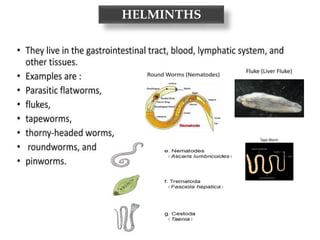
Helminths are multicellular, macroscopic parasitic worms. Although adult
worms are visible to the naked eye, their eggs and larvae are microscopic.
Protozoa are unicellular, microscopic, eukaryotic organisms. Many live freely in
the environment, but some are parasitic and can cause serious diseases in
humans.
Algae are simple, mostly aquatic photosynthetic organisms that can be
unicellular or multicellular. They are not true plants, but they perform
photosynthesis and produce a large portion of the Earth's oxygen.
 Some parasitic diseases are easily treated and some are not.
PARASITE
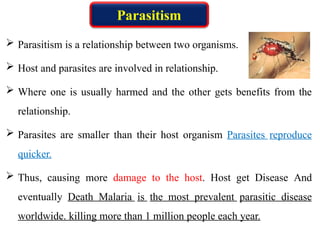
 Parasitism is a relationship between two organisms.
 Host and parasites are involved in relationship.
 Where one is usually harmed and the other gets benefits from the
relationship.
 Parasites are smaller than their host organism Parasites reproduce
quicker.
 Thus, causing more damage to the host. Host get Disease And
eventually Death Malaria is the most prevalent parasitic disease
worldwide. killing more than 1 million people each year.
Parasitism
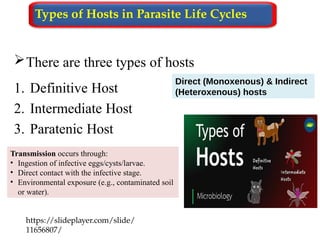
There are three types of hosts
1. Definitive Host
2. Intermediate Host
3. Paratenic Host
https://slideplayer.com/slide/
11656807/
Types of Hosts in Parasite Life Cycles
Direct (Monoxenous) & Indirect
(Heteroxenous) hosts
Transmission occurs through:
• Ingestion of infective eggs/cysts/larvae.
• Direct contact with the infective stage.
• Environmental exposure (e.g., contaminated soil
or water).
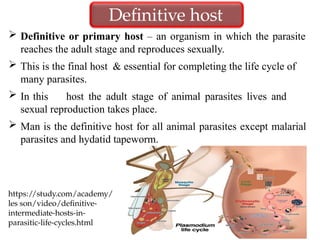
 Definitive or primary host – an organism in which the parasite
reaches the adult stage and reproduces sexually.
 This is the final host & essential for completing the life cycle of
many parasites.
 In this host the adult stage of animal parasites lives and
sexual reproduction takes place.
 Man is the definitive host for all animal parasites except malarial
parasites and hydatid tapeworm.
Definitive host
https://study.com/academy/
les son/video/definitive-
intermediate-hosts-in-
parasitic-life-cycles.html
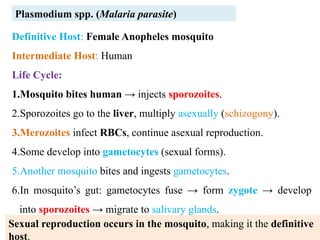
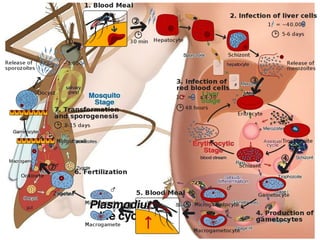
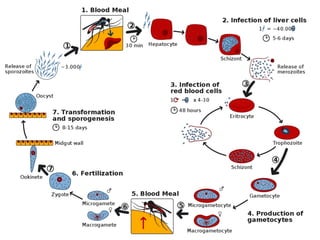
Definitive Host: Female Anopheles mosquito
Intermediate Host: Human
Life Cycle:
1.Mosquito bites human → injects sporozoites.
2.Sporozoites go to the liver, multiply asexually (schizogony).
3.Merozoites infect RBCs, continue asexual reproduction.
4.Some develop into gametocytes (sexual forms).
5.Another mosquito bites and ingests gametocytes.
6.In mosquito’s gut: gametocytes fuse → form zygote → develop
into sporozoites → migrate to salivary glands.
Plasmodium spp. (Malaria parasite)
Sexual reproduction occurs in the mosquito, making it the definitive
host.
 In this host the asexual reproduction takes place, or the larval
stages of animal parasites develops.
 When development of larval stage takes place in two different
hosts they are called 'first' and 'second' intermediate hosts.
 Required in the life cycle of parasite.
 Man is the intermediate host for malarial parasites and hydatid
tapeworm.
 Man is both definitive and intermediate host for Taenia solium
and Trichinella spiralis
Intermediate host
 A carrier or transport host.
 That Carry the Parasite and don not have any disease or infection
 No development of disease occurs but parasite remains alive
 There is no sign and symptoms of disease in Paratenic Host.
Paratenic or Transport
host
• Reservoir Host
• A reservoir is an organism in which a pathogen (such as a
virus, bacterium, or parasite) lives and reproduces.
• It serves as the natural habitat of the pathogen, where it can
survive and sometimes multiply before being
transmitted to a host (usually humans or other animals).
• Examples include bats for rabies and Ebola, and rodents for
Lyme disease.
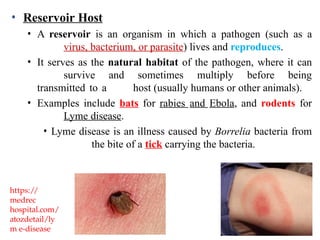
• Lyme disease is an illness caused by Borrelia bacteria from
the bite of a tick carrying the bacteria.
https://
medrec
hospital.com/
atozdetail/ly
m e-disease
Vector Host
• A vector is an organism that transports and transmits the
pathogen from one host to another.
• Vectors typically do not get the disease themselves, but they
play a role in spreading the pathogen.
• Any organism that transmits infections to humans.
• Vectors often feed on the host's blood or fluids, which allows
the pathogen to be transferred (e.g., through bites, feces,
or saliva). Examples;
• Mosquitoes dengue fever, and Zika virus. They transmit these
pathogens through their bites.
• Fleas: They spread the bacterium Yersinia pestis, which causes
the plague.
• Key Differences:
• Role:
o A reservoir is the source or environment where the pathogen lives
and multiplies.
o A vector is an organism that transports and transmits the pathogen
from
one host to another.
• Impact on the Pathogen:
o The reservoir allows the pathogen to survive and reproduce.
o The vector does not necessarily support the reproduction of the
pathogen; it
just acts as a carrier or transmitter.
• Examples:
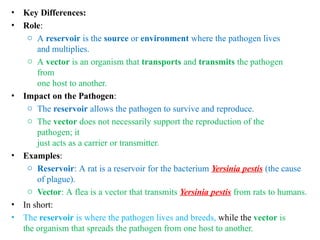
o Reservoir: A rat is a reservoir for the bacterium Yersinia pestis (the cause
of plague).
o Vector: A flea is a vector that transmits Yersinia pestis from rats to humans.
• In short:
• The reservoir is where the pathogen lives and breeds, while the vector is
the organism that spreads the pathogen from one host to another.
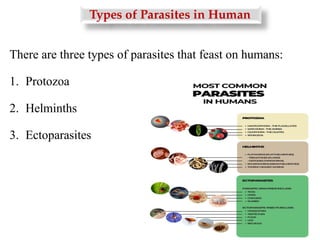
There are three types of parasites that feast on humans:
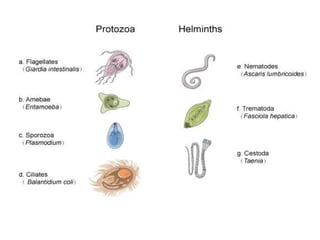
1. Protozoa
2. Helminths
3. Ectoparasites
Types of Parasites in Human
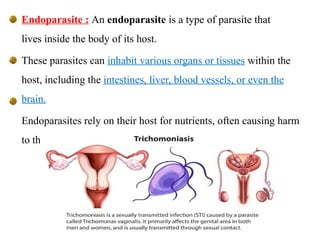
Endoparasite : An endoparasite is a type of parasite that
lives inside the body of its host.
These parasites can inhabit various organs or tissues within the
host, including the intestines, liver, blood vessels, or even the
brain.
Endoparasites rely on their host for nutrients, often causing harm
to the host in the process.
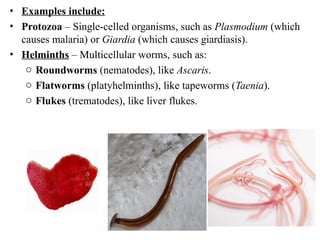
• Examples include:
• Protozoa – Single-celled organisms, such as Plasmodium (which
causes malaria) or Giardia (which causes giardiasis).
• Helminths – Multicellular worms, such as:
o Roundworms (nematodes), like Ascaris.
o Flatworms (platyhelminths), like tapeworms (Taenia).
o Flukes (trematodes), like liver flukes.
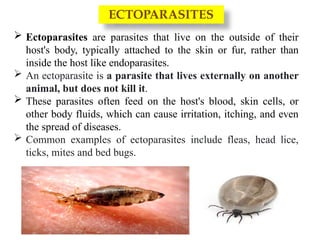
ECTOPARASITES
 Ectoparasites are parasites that live on the outside of their
host's body, typically attached to the skin or fur, rather than
inside the host like endoparasites.
 An ectoparasite is a parasite that lives externally on another
animal, but does not kill it.
 These parasites often feed on the host's blood, skin cells, or
other body fluids, which can cause irritation, itching, and even
the spread of diseases.
 Common examples of ectoparasites include fleas, head lice,
ticks, mites and bed bugs.
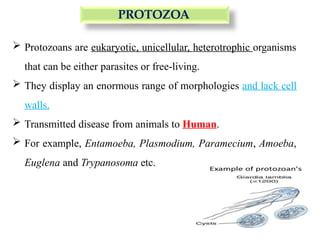
PROTOZOA
 Protozoans are eukaryotic, unicellular, heterotrophic organisms
that can be either parasites or free-living.
 They display an enormous range of morphologies and lack cell
walls.
 Transmitted disease from animals to Human.
 For example, Entamoeba, Plasmodium, Paramecium, Amoeba,
Euglena and Trypanosoma etc.
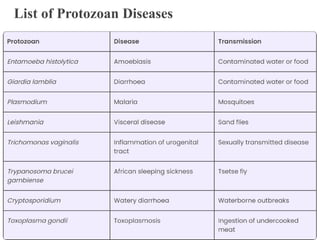
List of Protozoan Diseases
HELMINTHS
Host Parasite Interactions
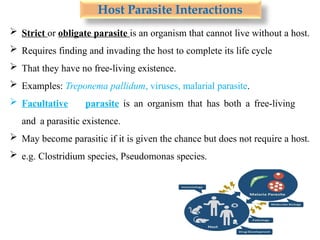
 Strict or obligate parasite is an organism that cannot live without a host.
 Requires finding and invading the host to complete its life cycle
 That they have no free-living existence.
 Examples: Treponema pallidum, viruses, malarial parasite.
 Facultative parasite is an organism that has both a free-living
and a parasitic existence.
 May become parasitic if it is given the chance but does not require a host.
 e.g. Clostridium species, Pseudomonas species.
Cont…
 Nonpathogenic: An organism that does not cause
disease.
It may be a member of normal flora.
 Opportunistic pathogen is an organism (nonpathogen,
commensal or saprophyte) that can cause disease only in
immuno-compromised individuals that is having impaired
resistance. Example: Cytomegalovirus, Pneumocystis carinii,
Atypical mycobacteria, opportunist fungi.
 Saprophyte is an organism that lives on dead organic
Cont…
 NORMAL FLORA are Microorganisms that is present on the skin
and mucous membrane of normal (healthy) persons.
Non-
pathogen, or opportunistic pathogen.
 Normal flora is of two types:
 (1) Resident flora
 (2) Transient flora
 Normal flora is the population of microbes that is a
permanent inhabitant of different body sites in a healthy person.
 Normal flora is also referred to as resident flora, which are fixed
types of microbes that are found in a specific site at a given age.
 These are microorganisms regularly present in the region at a given
age, e.g.
 Viridans streptococci in mouth and throat,
 Escherichia coli in intestine.
Normal Flora
 Transient flora are microorganisms that temporarily live on
the
to weeks, e.g.
skin, in the stomach, and other parts of the body.
 The microorganism is present only for
hours
Streptococcus pyogenes in throat.
 Microorganisms of transient flora play no role when the
normal
resident flora remains intact.
 But if the resident flora is disturbed than the microorganisms
of transient flora may colonize and produce disease.
Transient Flora
HOW TO DETERMINE IF AN ORGANISM IS THE ETIOLOGIC
AGENT OF DISEASE
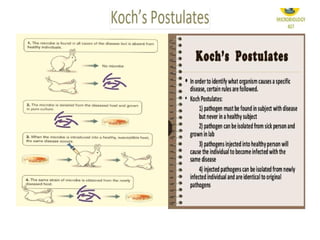
 REVIEW KOCH'S POSTULATES:
1. The agent must be observed in every case of the disease.
2.The agent must be isolated from a diseased host and grown in
pure culture.
3.When purified agent is inoculated into a healthy but
susceptible host, it must cause the same disease.
4.The agent must be reisolated from the newly infected,
diseased host, and be identical to the previously identified
causative agent.
13th March, 2025

Host Parasite Relationship

  • 1.
    Amjad Khan Afridi Lecturer, Departmentof Health & Biological Sciences Abasyn University Peshawar Host-parasite interactions
  • 2.
     Whether ornot you will catch a disease depends on: (1) YOU: your health, nutrition, immune status. (2) The pathogen's VIRULENCE (A) How TOXIC the organism is? (B) How INVASIVE the organism is?
  • 3.
     SYMBIOSIS: Theterm host and parasite relationship is also known as Symbiosis mean the coexistence of two organisms in which one extracts the nutrition from other.  PARASITIOLOGY: Is a branch of microbiology, refer to the scientific study of parasite/parasitism.  Interaction between pathogen & Host.  DISEASE: Any abnormal form or condition of the body is called “Disease”.  INFECTIOUS DISEASE: A disease condition caused by the presence or growth or increased numbers of infectious microorganisms or parasites.  PATHOGEN: Is defined as any microorganism that has the capacity to cause disease.  VIRULENCE: The degree of pathogenicity in of microorganism:
  • 4.
     MUTUALISM: Isa symbiosis in which both members benefit from the relationship  COMMENSALISM: Is a relationship in which one member benefits, and the other one neither nor is harmed.  OPPORTUNISTS: These are organisms that normally don't cause disease but will if given an opportunity.  NORMAL FLORA: Harmless microbes. Do not cause disease but give benefit to its host.
  • 5.
     A HOSTis any organism that allows another organism/bacteria etc to live in or on it.  The organism on which parasite lives is known as the host.  Host is larger in size.  Host is always harmed (Infection/disease/death). HOST
  • 6.
     The PARASITEis the organism living on or in the host  Smaller in size and get its food and shelter from its host  May be Microscopic (Bacteria, fungus, Viruses) or Macroscopic i.e. (Helminths, protozoa, algae etc.) Helminths are multicellular, macroscopic parasitic worms. Although adult worms are visible to the naked eye, their eggs and larvae are microscopic. Protozoa are unicellular, microscopic, eukaryotic organisms. Many live freely in the environment, but some are parasitic and can cause serious diseases in humans. Algae are simple, mostly aquatic photosynthetic organisms that can be unicellular or multicellular. They are not true plants, but they perform photosynthesis and produce a large portion of the Earth's oxygen.  Some parasitic diseases are easily treated and some are not. PARASITE
  • 7.
     Parasitism isa relationship between two organisms.  Host and parasites are involved in relationship.  Where one is usually harmed and the other gets benefits from the relationship.  Parasites are smaller than their host organism Parasites reproduce quicker.  Thus, causing more damage to the host. Host get Disease And eventually Death Malaria is the most prevalent parasitic disease worldwide. killing more than 1 million people each year. Parasitism
  • 8.
    There are threetypes of hosts 1. Definitive Host 2. Intermediate Host 3. Paratenic Host https://slideplayer.com/slide/ 11656807/ Types of Hosts in Parasite Life Cycles Direct (Monoxenous) & Indirect (Heteroxenous) hosts Transmission occurs through: • Ingestion of infective eggs/cysts/larvae. • Direct contact with the infective stage. • Environmental exposure (e.g., contaminated soil or water).
  • 9.
     Definitive orprimary host – an organism in which the parasite reaches the adult stage and reproduces sexually.  This is the final host & essential for completing the life cycle of many parasites.  In this host the adult stage of animal parasites lives and sexual reproduction takes place.  Man is the definitive host for all animal parasites except malarial parasites and hydatid tapeworm. Definitive host https://study.com/academy/ les son/video/definitive- intermediate-hosts-in- parasitic-life-cycles.html
  • 10.
    Definitive Host: FemaleAnopheles mosquito Intermediate Host: Human Life Cycle: 1.Mosquito bites human → injects sporozoites. 2.Sporozoites go to the liver, multiply asexually (schizogony). 3.Merozoites infect RBCs, continue asexual reproduction. 4.Some develop into gametocytes (sexual forms). 5.Another mosquito bites and ingests gametocytes. 6.In mosquito’s gut: gametocytes fuse → form zygote → develop into sporozoites → migrate to salivary glands. Plasmodium spp. (Malaria parasite) Sexual reproduction occurs in the mosquito, making it the definitive host.
  • 13.
     In thishost the asexual reproduction takes place, or the larval stages of animal parasites develops.  When development of larval stage takes place in two different hosts they are called 'first' and 'second' intermediate hosts.  Required in the life cycle of parasite.  Man is the intermediate host for malarial parasites and hydatid tapeworm.  Man is both definitive and intermediate host for Taenia solium and Trichinella spiralis Intermediate host
  • 14.
     A carrieror transport host.  That Carry the Parasite and don not have any disease or infection  No development of disease occurs but parasite remains alive  There is no sign and symptoms of disease in Paratenic Host. Paratenic or Transport host
  • 15.
    • Reservoir Host •A reservoir is an organism in which a pathogen (such as a virus, bacterium, or parasite) lives and reproduces. • It serves as the natural habitat of the pathogen, where it can survive and sometimes multiply before being transmitted to a host (usually humans or other animals). • Examples include bats for rabies and Ebola, and rodents for Lyme disease. • Lyme disease is an illness caused by Borrelia bacteria from the bite of a tick carrying the bacteria. https:// medrec hospital.com/ atozdetail/ly m e-disease
  • 16.
    Vector Host • Avector is an organism that transports and transmits the pathogen from one host to another. • Vectors typically do not get the disease themselves, but they play a role in spreading the pathogen. • Any organism that transmits infections to humans. • Vectors often feed on the host's blood or fluids, which allows the pathogen to be transferred (e.g., through bites, feces, or saliva). Examples; • Mosquitoes dengue fever, and Zika virus. They transmit these pathogens through their bites. • Fleas: They spread the bacterium Yersinia pestis, which causes the plague.
  • 17.
    • Key Differences: •Role: o A reservoir is the source or environment where the pathogen lives and multiplies. o A vector is an organism that transports and transmits the pathogen from one host to another. • Impact on the Pathogen: o The reservoir allows the pathogen to survive and reproduce. o The vector does not necessarily support the reproduction of the pathogen; it just acts as a carrier or transmitter. • Examples: o Reservoir: A rat is a reservoir for the bacterium Yersinia pestis (the cause of plague). o Vector: A flea is a vector that transmits Yersinia pestis from rats to humans. • In short: • The reservoir is where the pathogen lives and breeds, while the vector is the organism that spreads the pathogen from one host to another.
  • 18.
    There are threetypes of parasites that feast on humans: 1. Protozoa 2. Helminths 3. Ectoparasites Types of Parasites in Human
  • 19.
    Endoparasite : Anendoparasite is a type of parasite that lives inside the body of its host. These parasites can inhabit various organs or tissues within the host, including the intestines, liver, blood vessels, or even the brain. Endoparasites rely on their host for nutrients, often causing harm to the host in the process.
  • 20.
    • Examples include: •Protozoa – Single-celled organisms, such as Plasmodium (which causes malaria) or Giardia (which causes giardiasis). • Helminths – Multicellular worms, such as: o Roundworms (nematodes), like Ascaris. o Flatworms (platyhelminths), like tapeworms (Taenia). o Flukes (trematodes), like liver flukes.
  • 21.
    ECTOPARASITES  Ectoparasites areparasites that live on the outside of their host's body, typically attached to the skin or fur, rather than inside the host like endoparasites.  An ectoparasite is a parasite that lives externally on another animal, but does not kill it.  These parasites often feed on the host's blood, skin cells, or other body fluids, which can cause irritation, itching, and even the spread of diseases.  Common examples of ectoparasites include fleas, head lice, ticks, mites and bed bugs.
  • 23.
    PROTOZOA  Protozoans areeukaryotic, unicellular, heterotrophic organisms that can be either parasites or free-living.  They display an enormous range of morphologies and lack cell walls.  Transmitted disease from animals to Human.  For example, Entamoeba, Plasmodium, Paramecium, Amoeba, Euglena and Trypanosoma etc.
  • 24.
  • 25.
  • 26.
    Host Parasite Interactions Strict or obligate parasite is an organism that cannot live without a host.  Requires finding and invading the host to complete its life cycle  That they have no free-living existence.  Examples: Treponema pallidum, viruses, malarial parasite.  Facultative parasite is an organism that has both a free-living and a parasitic existence.  May become parasitic if it is given the chance but does not require a host.  e.g. Clostridium species, Pseudomonas species.
  • 27.
    Cont…  Nonpathogenic: Anorganism that does not cause disease. It may be a member of normal flora.  Opportunistic pathogen is an organism (nonpathogen, commensal or saprophyte) that can cause disease only in immuno-compromised individuals that is having impaired resistance. Example: Cytomegalovirus, Pneumocystis carinii, Atypical mycobacteria, opportunist fungi.  Saprophyte is an organism that lives on dead organic
  • 28.
    Cont…  NORMAL FLORAare Microorganisms that is present on the skin and mucous membrane of normal (healthy) persons. Non- pathogen, or opportunistic pathogen.  Normal flora is of two types:  (1) Resident flora  (2) Transient flora
  • 29.
     Normal florais the population of microbes that is a permanent inhabitant of different body sites in a healthy person.  Normal flora is also referred to as resident flora, which are fixed types of microbes that are found in a specific site at a given age.  These are microorganisms regularly present in the region at a given age, e.g.  Viridans streptococci in mouth and throat,  Escherichia coli in intestine. Normal Flora
  • 30.
     Transient floraare microorganisms that temporarily live on the to weeks, e.g. skin, in the stomach, and other parts of the body.  The microorganism is present only for hours Streptococcus pyogenes in throat.  Microorganisms of transient flora play no role when the normal resident flora remains intact.  But if the resident flora is disturbed than the microorganisms of transient flora may colonize and produce disease. Transient Flora
  • 31.
    HOW TO DETERMINEIF AN ORGANISM IS THE ETIOLOGIC AGENT OF DISEASE  REVIEW KOCH'S POSTULATES: 1. The agent must be observed in every case of the disease. 2.The agent must be isolated from a diseased host and grown in pure culture. 3.When purified agent is inoculated into a healthy but susceptible host, it must cause the same disease. 4.The agent must be reisolated from the newly infected, diseased host, and be identical to the previously identified causative agent.
  • 33.

Editor's Notes

  • #8 Monoxenous: Ascaris lumbricoides (Roundworm) Host: Human only Life Cycle: Eggs ingested via contaminated food/water. Larvae hatch in intestines → migrate via bloodstream to lungs. Coughed up and swallowed → mature in intestines. Eggs passed in feces. Enterobius vermicularis (Pinworm) Whipworm, Hookworms Life Cycle: Female lays eggs around anus at night. Eggs cause itching → fingers carry eggs to mouth (auto-infection). Eggs hatch in intestine → mature into adults → repeat.
  • #9 A parasite life cycle describes the stages, including hosts, growth, and reproduction, a parasite must complete to survive and reproduce. Life cycles are either direct, with one host (monoxenous), or complex, requiring multiple hosts (heteroxenous). Key stages include the infective stage (when a parasite invades a host) and the diagnostic stage (when it can be detected).