

Primer Designing, PCR
Dr Karan Veer Singh
Senior Scientist
ICAR-National Bureau of Animal Genetic
Resources, Karnal
PCR Background
• Invented in 1982 (Cetus Corp)
• Discovery of Taq polymerase in 1985
• Kary Mullis: Nobel Prize 1993
• Widely used method with wide application
• Many variations of commercial kits
KARAN VEER SINGH, ICAR- NBAGR
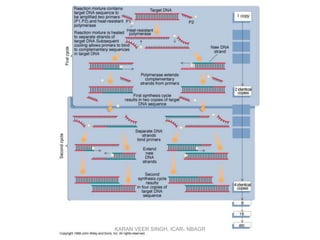
Polymerase Chain Reaction
• Method for exponential amplification of DNA or RNA
sequences
• Basic requirements
– template DNA or RNA
– 2 oligonucleotide primers complementary to different regions
of the template
– heat stable DNA polymerase
– 4 nucleotides and appropriate buffer
In vitro DNA amplification mimics the in vivo DNA replication
process
KARAN VEER SINGH, ICAR- NBAGR
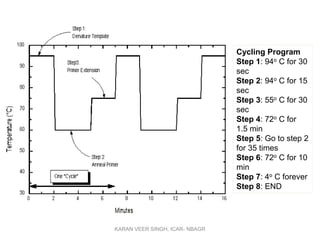
Cycling Program
Step 1: 94o C for 30
sec
Step 2: 94o C for 15
sec
Step 3: 55o C for 30
sec
Step 4: 72o C for
1.5 min
Step 5: Go to step 2
for 35 times
Step 6: 72o C for 10
min
Step 7: 4o C forever
Step 8: END
KARAN VEER SINGH, ICAR- NBAGR
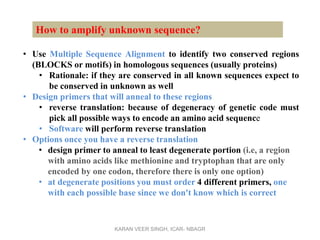
• Use Multiple Sequence Alignment to identify two conserved regions
(BLOCKS or motifs) in homologous sequences (usually proteins)
• Rationale: if they are conserved in all known sequences expect to
be conserved in unknown as well
• Design primers that will anneal to these regions
• reverse translation: because of degeneracy of genetic code must
pick all possible ways to encode an amino acid sequence
• Software will perform reverse translation
• Options once you have a reverse translation
• design primer to anneal to least degenerate portion (i.e, a region
with amino acids like methionine and tryptophan that are only
encoded by one codon, therefore there is only one option)
• at degenerate positions you must order 4 different primers, one
with each possible base since we don't know which is correct
How to amplify unknown sequence?
KARAN VEER SINGH, ICAR- NBAGR
 simplest case is when you are simply testing for the presence of a
sequence
• then all you need to do is find good binding sites within a
reasonable distance 5' and 3' to the target.
• Designing primers to clone specific fragments or for site -directed
mutagenesis is more difficult because they must start or finish at
specific locations
• In this case it is important to test the primers to make sure they
have no hairpins or primer dimers
• Often must modify settings dramatically to get results
Designing primers
KARAN VEER SINGH, ICAR- NBAGR
Where do primers come from ?
• Chemically synthesized as ssDNA
• Typically 15-25 nucleotides in length
• The nucleotide sequence determined by
- prior knowledge of target DNA sequence
- reverse translation of protein sequence
Primers
– Can be specific for:
– A certain bacterium
– Bacterial species
– Genes (e.g., toxin gene)
KARAN VEER SINGH, ICAR- NBAGR
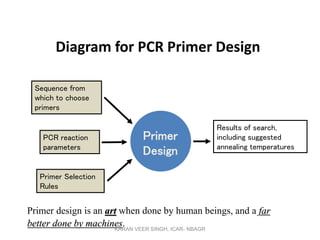
Diagram for PCR Primer Design
Primer
Design
PCR reaction
parameters
Sequence from
which to choose
primers
Primer Selection
Rules
Results of search,
including suggested
annealing temperatures
Primer design is an art when done by human beings, and a far
better done by machines.
KARAN VEER SINGH, ICAR- NBAGR
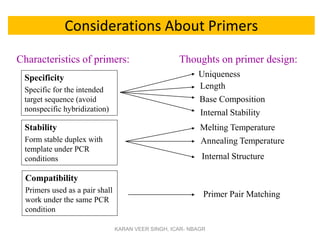
Considerations About Primers
Specificity
Specific for the intended
target sequence (avoid
nonspecific hybridization)
Stability
Form stable duplex with
template under PCR
conditions
Compatibility
Primers used as a pair shall
work under the same PCR
condition
Uniqueness
Length
Annealing Temperature
Primer Pair Matching
Internal Structure
Base Composition
Internal Stability
Characteristics of primers: Thoughts on primer design:
Melting Temperature
KARAN VEER SINGH, ICAR- NBAGR
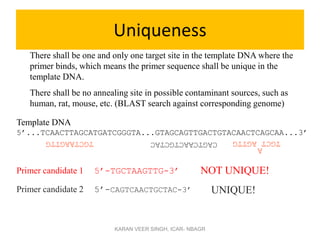
Uniqueness
There shall be one and only one target site in the template DNA where the
primer binds, which means the primer sequence shall be unique in the
template DNA.
There shall be no annealing site in possible contaminant sources, such as
human, rat, mouse, etc. (BLAST search against corresponding genome)
Primer candidate 1 5’-TGCTAAGTTG-3’
Primer candidate 2 5’-CAGTCAACTGCTAC-3’
TGCTAAGTTG CAGTCAACTGCTAC
Template DNA
5’...TCAACTTAGCATGATCGGGTA...GTAGCAGTTGACTGTACAACTCAGCAA...3’
NOT UNIQUE!
UNIQUE!
TGCT
AGTTG
A
KARAN VEER SINGH, ICAR- NBAGR
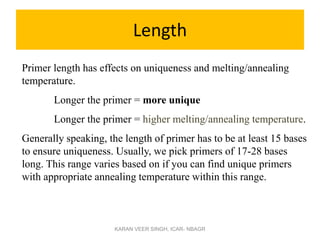
Length
Primer length has effects on uniqueness and melting/annealing
temperature.
Longer the primer = more unique
Longer the primer = higher melting/annealing temperature.
Generally speaking, the length of primer has to be at least 15 bases
to ensure uniqueness. Usually, we pick primers of 17-28 bases
long. This range varies based on if you can find unique primers
with appropriate annealing temperature within this range.
KARAN VEER SINGH, ICAR- NBAGR
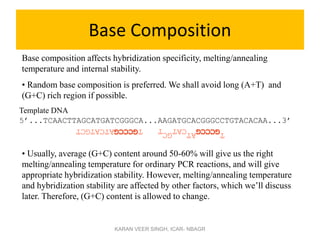
Base Composition
Base composition affects hybridization specificity, melting/annealing
temperature and internal stability.
• Random base composition is preferred. We shall avoid long (A+T) and
(G+C) rich region if possible.
• Usually, average (G+C) content around 50-60% will give us the right
melting/annealing temperature for ordinary PCR reactions, and will give
appropriate hybridization stability. However, melting/annealing temperature
and hybridization stability are affected by other factors, which we’ll discuss
later. Therefore, (G+C) content is allowed to change.
Template DNA
5’...TCAACTTAGCATGATCGGGCA...AAGATGCACGGGCCTGTACACAA...3’
TGCCCGATCATGCT
KARAN VEER SINGH, ICAR- NBAGR
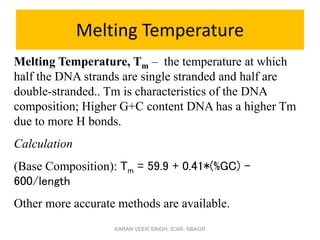
Melting Temperature
Melting Temperature, Tm – the temperature at which
half the DNA strands are single stranded and half are
double-stranded.. Tm is characteristics of the DNA
composition; Higher G+C content DNA has a higher Tm
due to more H bonds.
Calculation
(Base Composition): Tm = 59.9 + 0.41*(%GC) -
600/length
Other more accurate methods are available.
KARAN VEER SINGH, ICAR- NBAGR
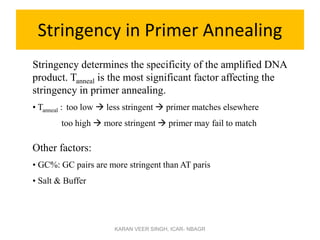
Stringency in Primer Annealing
Stringency determines the specificity of the amplified DNA
product. Tanneal is the most significant factor affecting the
stringency in primer annealing.
• Tanneal : too low  less stringent  primer matches elsewhere
too high  more stringent  primer may fail to match
Other factors:
• GC%: GC pairs are more stringent than AT paris
• Salt & Buffer
KARAN VEER SINGH, ICAR- NBAGR
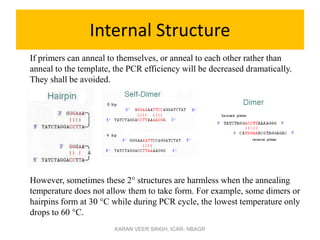
Internal Structure
If primers can anneal to themselves, or anneal to each other rather than
anneal to the template, the PCR efficiency will be decreased dramatically.
They shall be avoided.
However, sometimes these 2 structures are harmless when the annealing
temperature does not allow them to take form. For example, some dimers or
hairpins form at 30 C while during PCR cycle, the lowest temperature only
drops to 60 C.
KARAN VEER SINGH, ICAR- NBAGR
Primer Pair Matching
Primers work in pairs – forward primer and reverse primer.
Since they are used in the same PCR reaction, it shall be
ensured that the PCR condition is suitable for both of them.
One critical feature is their annealing temperatures, which
shall be compatible with each other. The maximum
difference allowed is 3 C. The closer their Tanneal are, the
better.
KARAN VEER SINGH, ICAR- NBAGR
Internal stability of the primers
• Primers with stable 5’ termini give the best
performance: reduces false priming on unknown
targets
• Low 3’ stability prevents formation of duplexes
that may initiate DNA synthesis: 5’ end must also
pair in order to form a stable duplex
• Optimal terminal ∆G ~ 8.5 kcal/mol; excessive
low ∆G reduces priming efficiency
KARAN VEER SINGH, ICAR- NBAGR
Common problems in PCR
• PCR contamination
• Pre-PCR mispriming
• Non-template nucleotide addition
“Plus A artifacts”
KARAN VEER SINGH, ICAR- NBAGR
Applications of PCR
Detection of specific genome
– Classical with a primer pair
– Nested – amplification of larger area then specific detection in multiplied
genome part (more sensitive)
– Real time PCR to quantify the amount of genome in sample
– Detection of RNA with reverse transcriptase
Screening specific genes for unknown mutations
Genotyping using short primers or primer pairs that are often repeated in the
genome
KARAN VEER SINGH, ICAR- NBAGR
Identification–-- Sequencing—Genetic Engineering
KARAN VEER SINGH, ICAR- NBAGR
PCR- Technical adaptations:
 Random primed PCR of DNA: for RAPD, RACE,
 Nested PCR
 Duplex/ Triplex / Multiplex PCR
 Anchored PCR: for MLPH
 PCR of restriction fragmented DNA ligated to linkers: for AFLP
 PCR of probe ligated DNA: for MLPA
 RT-PCR of m RNA to produce cDNA.
 One sided anchored PCR of cDNA.
 In situ PCR: (amplification and detection of DNA in situ from tissues).
KARAN VEER SINGH, ICAR- NBAGR
Multiplex PCR
• Multiple primer pairs can be added in the
same tube to do the PCR
• Good for amplifying multiple sites
• Application example: genome identification
• Design difficulty
– Melting temperatures should be similar
– No dimer formulation
Tetra primer ARMS PCR: SNPs in DNA regions
KARAN VEER SINGH, ICAR- NBAGR
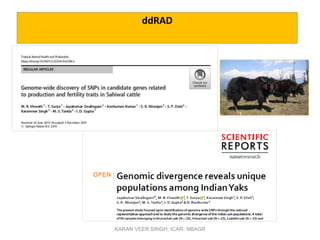
ddRAD
KARAN VEER SINGH, ICAR- NBAGR
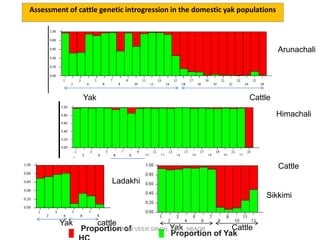
Proportion of
Proportion of Yak
Arunachali
Himachali
Yak Cattle
Yak Cattle
Ladakhi
Yak cattle
Sikkimi
Yak Cattle
KARAN VEER SINGH, ICAR- NBAGR
Assessment of cattle genetic introgression in the domestic yak populations
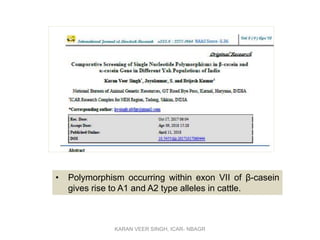
• Polymorphism occurring within exon VII of β-casein
gives rise to A1 and A2 type alleles in cattle.
KARAN VEER SINGH, ICAR- NBAGR
Pre-PCR mispriming
• undesired annealing between primers themselves or
with ssDNA molecules at low temperature
• DNA polymerase extends the misannealed primers,
adding nucleotides to their 3’ end, rendering these
modified primers unable to anneal to their intended
sites and resulting in amplification of unwanted DNA
KARAN VEER SINGH, ICAR- NBAGR
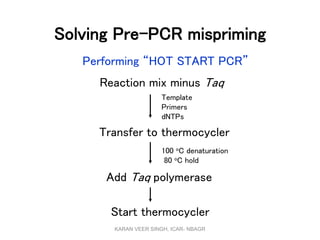
Solving Pre-PCR mispriming
Performing “HOT START PCR”
Reaction mix minus Taq
Template
Primers
dNTPs
Transfer to thermocycler
100 oC denaturation
80 oC hold
Add Taq polymerase
Start thermocycler
KARAN VEER SINGH, ICAR- NBAGR
Universal Primers
Primers can also be designed to amplify multiple products. We call such
primers “universal primers”. For example, design primers to amplify all
HPV genes.
Strategy:
1. Align groups of sequences you want to amplify.
2. Find the most conservative regions at 5’ end and at 3’ end.
3. Design forward primer at the 5’ conservative region.
4. Design reverse primer at the 3’ conservative regions.
5. Matching forward and reverse primers to find the best pair.
6. Ensure uniqueness in all template sequences.
7. Ensure uniqueness in possible contaminant sources.
KARAN VEER SINGH, ICAR- NBAGR
Advanced Primer Design
Primers can be designed to serve various purposes. Universal primer, semi-
universal primer, guessmers are some of them.
There are many more fields where primer design skills are required, such as
real-time PCR, population polymorphism study (microsatellite, AFLP, SNP …),
internal probe design, and so on.
However, the basic rules always apply –
hybridization
specificity
stability.
KARAN VEER SINGH, ICAR- NBAGR
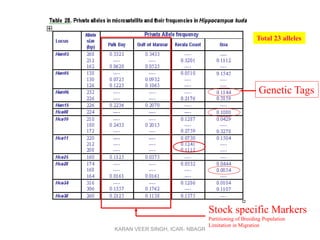
Genetic Diversity Studies of seahorse: Microsatellite
KARAN VEER SINGH, ICAR- NBAGR
Total 23 alleles
Genetic Tags
Stock specific Markers
Partitioning of Breeding Population
Limitation in Migration
KARAN VEER SINGH, ICAR- NBAGR
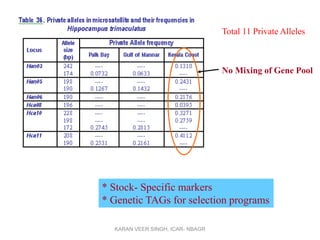
No Mixing of Gene Pool
* Stock- Specific markers
* Genetic TAGs for selection programs
Total 11 Private Alleles
KARAN VEER SINGH, ICAR- NBAGR
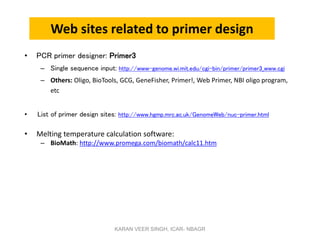
Web sites related to primer design
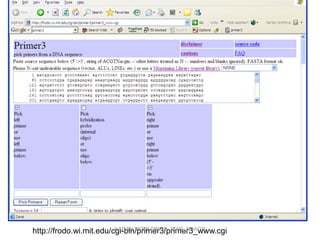
• PCR primer designer: Primer3
– Single sequence input: http://www-genome.wi.mit.edu/cgi-bin/primer/primer3_www.cgi
– Others: Oligo, BioTools, GCG, GeneFisher, Primer!, Web Primer, NBI oligo program,
etc
• List of primer design sites: http://www.hgmp.mrc.ac.uk/GenomeWeb/nuc-primer.html
• Melting temperature calculation software:
– BioMath: http://www.promega.com/biomath/calc11.htm
KARAN VEER SINGH, ICAR- NBAGR
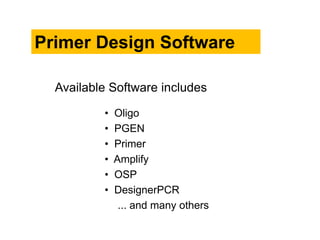
• Oligo
• PGEN
• Primer
• Amplify
• OSP
• DesignerPCR
... and many others
Primer Design Software
Available Software includes
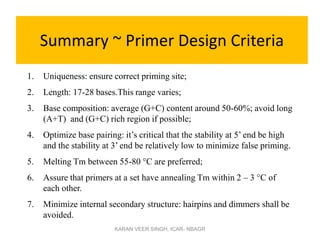
Summary ~ Primer Design Criteria
1. Uniqueness: ensure correct priming site;
2. Length: 17-28 bases.This range varies;
3. Base composition: average (G+C) content around 50-60%; avoid long
(A+T) and (G+C) rich region if possible;
4. Optimize base pairing: it’s critical that the stability at 5’ end be high
and the stability at 3’ end be relatively low to minimize false priming.
5. Melting Tm between 55-80 C are preferred;
6. Assure that primers at a set have annealing Tm within 2 – 3 C of
each other.
7. Minimize internal secondary structure: hairpins and dimmers shall be
avoided.
KARAN VEER SINGH, ICAR- NBAGR
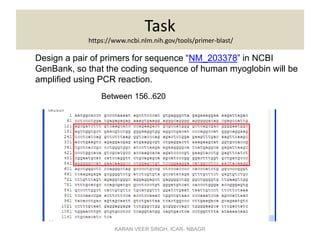
Task
https://www.ncbi.nlm.nih.gov/tools/primer-blast/
Design a pair of primers for sequence “NM_203378” in NCBI
GenBank, so that the coding sequence of human myoglobin will be
amplified using PCR reaction.
Between 156..620
KARAN VEER SINGH, ICAR- NBAGR
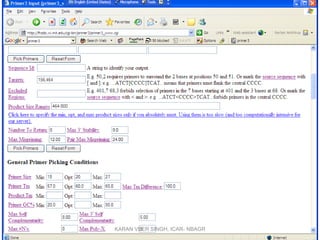
Primer3
http://frodo.wi.mit.edu/cgi-bin/primer3/primer3_www.cgi
KARAN VEER SINGH, ICAR- NBAGR
Primer3
KARAN VEER SINGH, ICAR- NBAGR

Pcr primer design

  • 1.
    Primer Designing, PCR DrKaran Veer Singh Senior Scientist ICAR-National Bureau of Animal Genetic Resources, Karnal
  • 2.
    PCR Background • Inventedin 1982 (Cetus Corp) • Discovery of Taq polymerase in 1985 • Kary Mullis: Nobel Prize 1993 • Widely used method with wide application • Many variations of commercial kits KARAN VEER SINGH, ICAR- NBAGR
  • 3.
    Polymerase Chain Reaction •Method for exponential amplification of DNA or RNA sequences • Basic requirements – template DNA or RNA – 2 oligonucleotide primers complementary to different regions of the template – heat stable DNA polymerase – 4 nucleotides and appropriate buffer In vitro DNA amplification mimics the in vivo DNA replication process KARAN VEER SINGH, ICAR- NBAGR
  • 4.
    Cycling Program Step 1:94o C for 30 sec Step 2: 94o C for 15 sec Step 3: 55o C for 30 sec Step 4: 72o C for 1.5 min Step 5: Go to step 2 for 35 times Step 6: 72o C for 10 min Step 7: 4o C forever Step 8: END KARAN VEER SINGH, ICAR- NBAGR
  • 5.
    KARAN VEER SINGH,ICAR- NBAGR
  • 6.
    • Use MultipleSequence Alignment to identify two conserved regions (BLOCKS or motifs) in homologous sequences (usually proteins) • Rationale: if they are conserved in all known sequences expect to be conserved in unknown as well • Design primers that will anneal to these regions • reverse translation: because of degeneracy of genetic code must pick all possible ways to encode an amino acid sequence • Software will perform reverse translation • Options once you have a reverse translation • design primer to anneal to least degenerate portion (i.e, a region with amino acids like methionine and tryptophan that are only encoded by one codon, therefore there is only one option) • at degenerate positions you must order 4 different primers, one with each possible base since we don't know which is correct How to amplify unknown sequence? KARAN VEER SINGH, ICAR- NBAGR
  • 7.
     simplest caseis when you are simply testing for the presence of a sequence • then all you need to do is find good binding sites within a reasonable distance 5' and 3' to the target. • Designing primers to clone specific fragments or for site -directed mutagenesis is more difficult because they must start or finish at specific locations • In this case it is important to test the primers to make sure they have no hairpins or primer dimers • Often must modify settings dramatically to get results Designing primers KARAN VEER SINGH, ICAR- NBAGR
  • 8.
    Where do primerscome from ? • Chemically synthesized as ssDNA • Typically 15-25 nucleotides in length • The nucleotide sequence determined by - prior knowledge of target DNA sequence - reverse translation of protein sequence Primers – Can be specific for: – A certain bacterium – Bacterial species – Genes (e.g., toxin gene) KARAN VEER SINGH, ICAR- NBAGR
  • 9.
    Diagram for PCRPrimer Design Primer Design PCR reaction parameters Sequence from which to choose primers Primer Selection Rules Results of search, including suggested annealing temperatures Primer design is an art when done by human beings, and a far better done by machines. KARAN VEER SINGH, ICAR- NBAGR
  • 10.
    Considerations About Primers Specificity Specificfor the intended target sequence (avoid nonspecific hybridization) Stability Form stable duplex with template under PCR conditions Compatibility Primers used as a pair shall work under the same PCR condition Uniqueness Length Annealing Temperature Primer Pair Matching Internal Structure Base Composition Internal Stability Characteristics of primers: Thoughts on primer design: Melting Temperature KARAN VEER SINGH, ICAR- NBAGR
  • 11.
    Uniqueness There shall beone and only one target site in the template DNA where the primer binds, which means the primer sequence shall be unique in the template DNA. There shall be no annealing site in possible contaminant sources, such as human, rat, mouse, etc. (BLAST search against corresponding genome) Primer candidate 1 5’-TGCTAAGTTG-3’ Primer candidate 2 5’-CAGTCAACTGCTAC-3’ TGCTAAGTTG CAGTCAACTGCTAC Template DNA 5’...TCAACTTAGCATGATCGGGTA...GTAGCAGTTGACTGTACAACTCAGCAA...3’ NOT UNIQUE! UNIQUE! TGCT AGTTG A KARAN VEER SINGH, ICAR- NBAGR
  • 12.
    Length Primer length haseffects on uniqueness and melting/annealing temperature. Longer the primer = more unique Longer the primer = higher melting/annealing temperature. Generally speaking, the length of primer has to be at least 15 bases to ensure uniqueness. Usually, we pick primers of 17-28 bases long. This range varies based on if you can find unique primers with appropriate annealing temperature within this range. KARAN VEER SINGH, ICAR- NBAGR
  • 13.
    Base Composition Base compositionaffects hybridization specificity, melting/annealing temperature and internal stability. • Random base composition is preferred. We shall avoid long (A+T) and (G+C) rich region if possible. • Usually, average (G+C) content around 50-60% will give us the right melting/annealing temperature for ordinary PCR reactions, and will give appropriate hybridization stability. However, melting/annealing temperature and hybridization stability are affected by other factors, which we’ll discuss later. Therefore, (G+C) content is allowed to change. Template DNA 5’...TCAACTTAGCATGATCGGGCA...AAGATGCACGGGCCTGTACACAA...3’ TGCCCGATCATGCT KARAN VEER SINGH, ICAR- NBAGR
  • 14.
    Melting Temperature Melting Temperature,Tm – the temperature at which half the DNA strands are single stranded and half are double-stranded.. Tm is characteristics of the DNA composition; Higher G+C content DNA has a higher Tm due to more H bonds. Calculation (Base Composition): Tm = 59.9 + 0.41*(%GC) - 600/length Other more accurate methods are available. KARAN VEER SINGH, ICAR- NBAGR
  • 15.
    Stringency in PrimerAnnealing Stringency determines the specificity of the amplified DNA product. Tanneal is the most significant factor affecting the stringency in primer annealing. • Tanneal : too low  less stringent  primer matches elsewhere too high  more stringent  primer may fail to match Other factors: • GC%: GC pairs are more stringent than AT paris • Salt & Buffer KARAN VEER SINGH, ICAR- NBAGR
  • 16.
    Internal Structure If primerscan anneal to themselves, or anneal to each other rather than anneal to the template, the PCR efficiency will be decreased dramatically. They shall be avoided. However, sometimes these 2 structures are harmless when the annealing temperature does not allow them to take form. For example, some dimers or hairpins form at 30 C while during PCR cycle, the lowest temperature only drops to 60 C. KARAN VEER SINGH, ICAR- NBAGR
  • 17.
    Primer Pair Matching Primerswork in pairs – forward primer and reverse primer. Since they are used in the same PCR reaction, it shall be ensured that the PCR condition is suitable for both of them. One critical feature is their annealing temperatures, which shall be compatible with each other. The maximum difference allowed is 3 C. The closer their Tanneal are, the better. KARAN VEER SINGH, ICAR- NBAGR
  • 18.
    Internal stability ofthe primers • Primers with stable 5’ termini give the best performance: reduces false priming on unknown targets • Low 3’ stability prevents formation of duplexes that may initiate DNA synthesis: 5’ end must also pair in order to form a stable duplex • Optimal terminal ∆G ~ 8.5 kcal/mol; excessive low ∆G reduces priming efficiency KARAN VEER SINGH, ICAR- NBAGR
  • 19.
    Common problems inPCR • PCR contamination • Pre-PCR mispriming • Non-template nucleotide addition “Plus A artifacts” KARAN VEER SINGH, ICAR- NBAGR
  • 20.
    KARAN VEER SINGH,ICAR- NBAGR
  • 21.
    Applications of PCR Detectionof specific genome – Classical with a primer pair – Nested – amplification of larger area then specific detection in multiplied genome part (more sensitive) – Real time PCR to quantify the amount of genome in sample – Detection of RNA with reverse transcriptase Screening specific genes for unknown mutations Genotyping using short primers or primer pairs that are often repeated in the genome KARAN VEER SINGH, ICAR- NBAGR Identification–-- Sequencing—Genetic Engineering
  • 22.
    KARAN VEER SINGH,ICAR- NBAGR
  • 23.
    PCR- Technical adaptations: Random primed PCR of DNA: for RAPD, RACE,  Nested PCR  Duplex/ Triplex / Multiplex PCR  Anchored PCR: for MLPH  PCR of restriction fragmented DNA ligated to linkers: for AFLP  PCR of probe ligated DNA: for MLPA  RT-PCR of m RNA to produce cDNA.  One sided anchored PCR of cDNA.  In situ PCR: (amplification and detection of DNA in situ from tissues). KARAN VEER SINGH, ICAR- NBAGR
  • 24.
    Multiplex PCR • Multipleprimer pairs can be added in the same tube to do the PCR • Good for amplifying multiple sites • Application example: genome identification • Design difficulty – Melting temperatures should be similar – No dimer formulation Tetra primer ARMS PCR: SNPs in DNA regions KARAN VEER SINGH, ICAR- NBAGR
  • 25.
  • 26.
    Proportion of Proportion ofYak Arunachali Himachali Yak Cattle Yak Cattle Ladakhi Yak cattle Sikkimi Yak Cattle KARAN VEER SINGH, ICAR- NBAGR Assessment of cattle genetic introgression in the domestic yak populations
  • 27.
    • Polymorphism occurringwithin exon VII of β-casein gives rise to A1 and A2 type alleles in cattle. KARAN VEER SINGH, ICAR- NBAGR
  • 28.
    KARAN VEER SINGH,ICAR- NBAGR
  • 29.
    KARAN VEER SINGH,ICAR- NBAGR
  • 30.
    Pre-PCR mispriming • undesiredannealing between primers themselves or with ssDNA molecules at low temperature • DNA polymerase extends the misannealed primers, adding nucleotides to their 3’ end, rendering these modified primers unable to anneal to their intended sites and resulting in amplification of unwanted DNA KARAN VEER SINGH, ICAR- NBAGR
  • 31.
    Solving Pre-PCR mispriming Performing“HOT START PCR” Reaction mix minus Taq Template Primers dNTPs Transfer to thermocycler 100 oC denaturation 80 oC hold Add Taq polymerase Start thermocycler KARAN VEER SINGH, ICAR- NBAGR
  • 32.
    Universal Primers Primers canalso be designed to amplify multiple products. We call such primers “universal primers”. For example, design primers to amplify all HPV genes. Strategy: 1. Align groups of sequences you want to amplify. 2. Find the most conservative regions at 5’ end and at 3’ end. 3. Design forward primer at the 5’ conservative region. 4. Design reverse primer at the 3’ conservative regions. 5. Matching forward and reverse primers to find the best pair. 6. Ensure uniqueness in all template sequences. 7. Ensure uniqueness in possible contaminant sources. KARAN VEER SINGH, ICAR- NBAGR
  • 33.
    Advanced Primer Design Primerscan be designed to serve various purposes. Universal primer, semi- universal primer, guessmers are some of them. There are many more fields where primer design skills are required, such as real-time PCR, population polymorphism study (microsatellite, AFLP, SNP …), internal probe design, and so on. However, the basic rules always apply – hybridization specificity stability. KARAN VEER SINGH, ICAR- NBAGR
  • 34.
    Genetic Diversity Studiesof seahorse: Microsatellite KARAN VEER SINGH, ICAR- NBAGR
  • 35.
    Total 23 alleles GeneticTags Stock specific Markers Partitioning of Breeding Population Limitation in Migration KARAN VEER SINGH, ICAR- NBAGR
  • 36.
    No Mixing ofGene Pool * Stock- Specific markers * Genetic TAGs for selection programs Total 11 Private Alleles KARAN VEER SINGH, ICAR- NBAGR
  • 37.
    Web sites relatedto primer design • PCR primer designer: Primer3 – Single sequence input: http://www-genome.wi.mit.edu/cgi-bin/primer/primer3_www.cgi – Others: Oligo, BioTools, GCG, GeneFisher, Primer!, Web Primer, NBI oligo program, etc • List of primer design sites: http://www.hgmp.mrc.ac.uk/GenomeWeb/nuc-primer.html • Melting temperature calculation software: – BioMath: http://www.promega.com/biomath/calc11.htm KARAN VEER SINGH, ICAR- NBAGR
  • 38.
    • Oligo • PGEN •Primer • Amplify • OSP • DesignerPCR ... and many others Primer Design Software Available Software includes
  • 39.
    Summary ~ PrimerDesign Criteria 1. Uniqueness: ensure correct priming site; 2. Length: 17-28 bases.This range varies; 3. Base composition: average (G+C) content around 50-60%; avoid long (A+T) and (G+C) rich region if possible; 4. Optimize base pairing: it’s critical that the stability at 5’ end be high and the stability at 3’ end be relatively low to minimize false priming. 5. Melting Tm between 55-80 C are preferred; 6. Assure that primers at a set have annealing Tm within 2 – 3 C of each other. 7. Minimize internal secondary structure: hairpins and dimmers shall be avoided. KARAN VEER SINGH, ICAR- NBAGR
  • 40.
    Task https://www.ncbi.nlm.nih.gov/tools/primer-blast/ Design a pairof primers for sequence “NM_203378” in NCBI GenBank, so that the coding sequence of human myoglobin will be amplified using PCR reaction. Between 156..620 KARAN VEER SINGH, ICAR- NBAGR
  • 41.
  • 42.
  • 43.
    KARAN VEER SINGH,ICAR- NBAGR