1Amjad Khan Afridi, 25th
October, 2020
Extinction
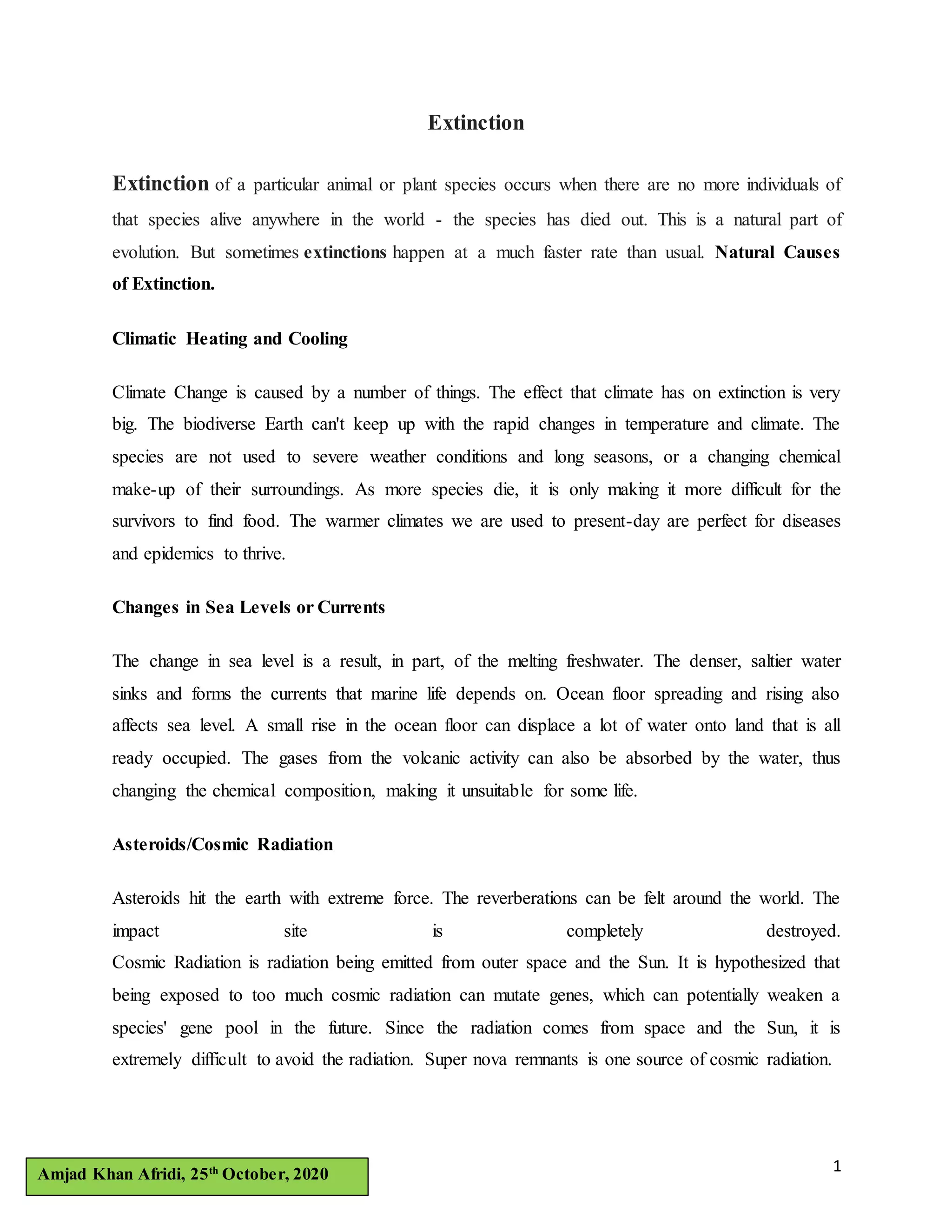
Extinction of a particular animal or plant species occurs when there are no more individuals of
that species alive anywhere in the world - the species has died out. This is a natural part of
evolution. But sometimes extinctions happen at a much faster rate than usual. Natural Causes
of Extinction.
Climatic Heating and Cooling
Climate Change is caused by a number of things. The effect that climate has on extinction is very
big. The biodiverse Earth can't keep up with the rapid changes in temperature and climate. The
species are not used to severe weather conditions and long seasons, or a changing chemical
make-up of their surroundings. As more species die, it is only making it more difficult for the
survivors to find food. The warmer climates we are used to present-day are perfect for diseases
and epidemics to thrive.
Changes in Sea Levels or Currents
The change in sea level is a result, in part, of the melting freshwater. The denser, saltier water
sinks and forms the currents that marine life depends on. Ocean floor spreading and rising also
affects sea level. A small rise in the ocean floor can displace a lot of water onto land that is all
ready occupied. The gases from the volcanic activity can also be absorbed by the water, thus
changing the chemical composition, making it unsuitable for some life.
Asteroids/Cosmic Radiation
Asteroids hit the earth with extreme force. The reverberations can be felt around the world. The
impact site is completely destroyed.
Cosmic Radiation is radiation being emitted from outer space and the Sun. It is hypothesized that
being exposed to too much cosmic radiation can mutate genes, which can potentially weaken a
species' gene pool in the future. Since the radiation comes from space and the Sun, it is
extremely difficult to avoid the radiation. Super nova remnants is one source of cosmic radiation.
2Amjad Khan Afridi, 25th
October, 2020
Acid Rain
Acid rain forms when sulfur dioxide and/or nitrogen oxides are put out into the atmosphere. The
chemicals get absorbed by water droplets in the clouds, and eventually fall to the earth as acid
precipitation. Acid rain increases the acidity of the soil which affects plant life. It can also disturb
rivers and lakes to a possibly lethal level.
Disease/Epidemic
Each species has defense mechanisms like immunities and the ability to fight disease. With the
changing climate and landscape certain species are losing their ability to fend off disease. They
are becoming more susceptible to disease and epidemics, which can lead to their eventual
extinction.
Spread of Invasive Species
Invasive species invade foreign territory. They use resources that the other species depend on.
Once competition gets too great, the survival of the fittest plan will begin, and one of the species,
usually the natural one, will die off.
Natural factors usually occur at a slower rate than human factors and therefore cause a lower
extinction rate. Human activities occur at a faster rate and cause higher extinction rates. Human
activities are mostly responsible for the present extinction rates.
Human Causes of Extinction
Top Human Causes of Extinction
 Increased human population
Destruction/Fragmentation of Habitat
3Amjad Khan Afridi, 25th
October, 2020
Pollution
Climate Change/Global Warming
 Extinctions caused by humans are generally considered to be a recent
phenomena. HOWEVER:
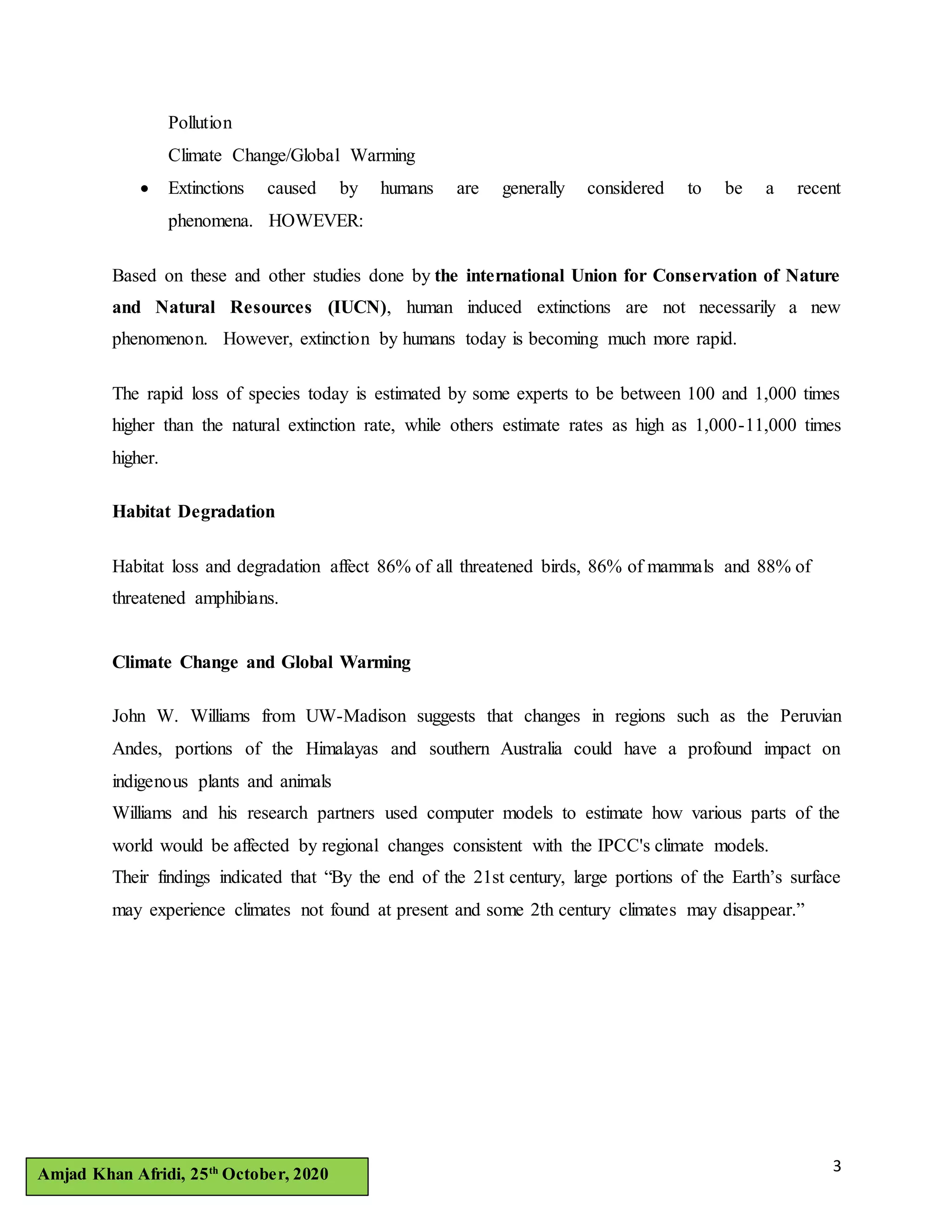
Based on these and other studies done by the international Union for Conservation of Nature
and Natural Resources (IUCN), human induced extinctions are not necessarily a new
phenomenon. However, extinction by humans today is becoming much more rapid.
The rapid loss of species today is estimated by some experts to be between 100 and 1,000 times
higher than the natural extinction rate, while others estimate rates as high as 1,000-11,000 times
higher.
Habitat Degradation
Habitat loss and degradation affect 86% of all threatened birds, 86% of mammals and 88% of
threatened amphibians.
Climate Change and Global Warming
John W. Williams from UW-Madison suggests that changes in regions such as the Peruvian
Andes, portions of the Himalayas and southern Australia could have a profound impact on
indigenous plants and animals
Williams and his research partners used computer models to estimate how various parts of the
world would be affected by regional changes consistent with the IPCC's climate models.
Their findings indicated that “By the end of the 21st century, large portions of the Earth’s surface
may experience climates not found at present and some 2th century climates may disappear.”

Extinction

  • 1.
    1Amjad Khan Afridi,25th October, 2020 Extinction Extinction of a particular animal or plant species occurs when there are no more individuals of that species alive anywhere in the world - the species has died out. This is a natural part of evolution. But sometimes extinctions happen at a much faster rate than usual. Natural Causes of Extinction. Climatic Heating and Cooling Climate Change is caused by a number of things. The effect that climate has on extinction is very big. The biodiverse Earth can't keep up with the rapid changes in temperature and climate. The species are not used to severe weather conditions and long seasons, or a changing chemical make-up of their surroundings. As more species die, it is only making it more difficult for the survivors to find food. The warmer climates we are used to present-day are perfect for diseases and epidemics to thrive. Changes in Sea Levels or Currents The change in sea level is a result, in part, of the melting freshwater. The denser, saltier water sinks and forms the currents that marine life depends on. Ocean floor spreading and rising also affects sea level. A small rise in the ocean floor can displace a lot of water onto land that is all ready occupied. The gases from the volcanic activity can also be absorbed by the water, thus changing the chemical composition, making it unsuitable for some life. Asteroids/Cosmic Radiation Asteroids hit the earth with extreme force. The reverberations can be felt around the world. The impact site is completely destroyed. Cosmic Radiation is radiation being emitted from outer space and the Sun. It is hypothesized that being exposed to too much cosmic radiation can mutate genes, which can potentially weaken a species' gene pool in the future. Since the radiation comes from space and the Sun, it is extremely difficult to avoid the radiation. Super nova remnants is one source of cosmic radiation.
  • 2.
    2Amjad Khan Afridi,25th October, 2020 Acid Rain Acid rain forms when sulfur dioxide and/or nitrogen oxides are put out into the atmosphere. The chemicals get absorbed by water droplets in the clouds, and eventually fall to the earth as acid precipitation. Acid rain increases the acidity of the soil which affects plant life. It can also disturb rivers and lakes to a possibly lethal level. Disease/Epidemic Each species has defense mechanisms like immunities and the ability to fight disease. With the changing climate and landscape certain species are losing their ability to fend off disease. They are becoming more susceptible to disease and epidemics, which can lead to their eventual extinction. Spread of Invasive Species Invasive species invade foreign territory. They use resources that the other species depend on. Once competition gets too great, the survival of the fittest plan will begin, and one of the species, usually the natural one, will die off. Natural factors usually occur at a slower rate than human factors and therefore cause a lower extinction rate. Human activities occur at a faster rate and cause higher extinction rates. Human activities are mostly responsible for the present extinction rates. Human Causes of Extinction Top Human Causes of Extinction  Increased human population Destruction/Fragmentation of Habitat
  • 3.
    3Amjad Khan Afridi,25th October, 2020 Pollution Climate Change/Global Warming  Extinctions caused by humans are generally considered to be a recent phenomena. HOWEVER: Based on these and other studies done by the international Union for Conservation of Nature and Natural Resources (IUCN), human induced extinctions are not necessarily a new phenomenon. However, extinction by humans today is becoming much more rapid. The rapid loss of species today is estimated by some experts to be between 100 and 1,000 times higher than the natural extinction rate, while others estimate rates as high as 1,000-11,000 times higher. Habitat Degradation Habitat loss and degradation affect 86% of all threatened birds, 86% of mammals and 88% of threatened amphibians. Climate Change and Global Warming John W. Williams from UW-Madison suggests that changes in regions such as the Peruvian Andes, portions of the Himalayas and southern Australia could have a profound impact on indigenous plants and animals Williams and his research partners used computer models to estimate how various parts of the world would be affected by regional changes consistent with the IPCC's climate models. Their findings indicated that “By the end of the 21st century, large portions of the Earth’s surface may experience climates not found at present and some 2th century climates may disappear.”