BLOTTING
TECHNIQUES
BINCY MARIAM
YESUDAS
MSC BOTANY
INTRODUCTION
 Gel electrophoresis techniques enables us to separate
fragments of DNA in a mixture and by staining we can
visualise and detect them.
 Use of specific labelled probes enables in detection and
identifications of fragments of DNA by hybridization
procedure.
 To facilitate this hybridization , the bands are often
transferred to a nitrocellulose membrane. This technique
resembles blotting.
 For such blotting, DNA has to be single stranded form. This
can be achieved by denaturation of DNA.
BLOTTING TECHNIQUES-DIFFERENT TYPES
1.SOUTHERN BLOTTING
2.NORTHERN BLOTTING
3.WESTERN BLOTTING
4.DOT BLOT TECHNIQUE
SOUTHERN BLOTTING
 Southern blotting is the first blotting technique which made analysis
and recording easy.
 In Southern blotting ,a DNA fragment containing a specific sequence
can be identified by electrophoresis , transferring them into
nitrocellulose & hybridizing with a 32p labelled single stranded DNA
probe complementary to the sequence.
 The fragment containing the sequence then visualized by
audioradiography
 It was first developed by E.M.Southern in 1975
PROCEDURE
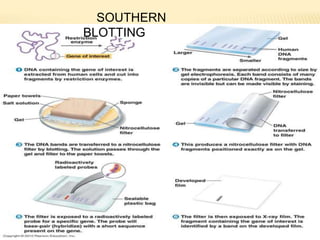
 For Southern blotting,DNA sample is first digested with a
restriction enzyme and digested sample is electrophoresed.
 The DNA bands in the gel are denatured into single strands
with the help of an alkali solution.
 Subsequently the gel is laid on top of a buffer saturated filter
paper placed on a solid support(eg.glass plate),with its two
edges immersed in the buffer.
 A sheet of nitrocellulose filter membrane is placed on top of the
gel and a stack of many papers on top of this membrane.
 Capillary action pulls the buffer from the bottom filter through
the gel, to the transfer medium and up through the paper towel
stack.
 While passing through the gel, the buffer carries with its single
stranded DNA, which binds on to the nitrocellulose membrane,
when the buffer passes through it to the paper towels.
 The nitro cellulose membrane with single stranded DNA bands
blotted on to it, is baked at 80c for 2-3 hours to fix the DNA
permanently on the membrane.
 DNA fragments on membrane can then be probed for sequence
of interest by hybridization between them.
 Membrane is washed to remove the unbound DNA.
 X-ray film is then exposed to the membrane to get
autoradiographs.
SOUTHERN
BLOTTING
APPLICATIONS
 Southern blotting is extremely sensitive and can be applied to
mapping restriction sites around a single copy gene sequence
in a complex genome such as that of man.
 When minisatellite probe is used the technique can be also
used for forensic purpose for identification of minute amount of
DNA.
 The use of southern blot technique has also been done for
analyzing the role of DNA methylation in gene expression.
 Blotting analysis useful in detection of mutated genes in
genetic disorders.
 Restriction analysis of genes studied with southern blot helps
in this respect.
 RFLP mapping.
 DNA finger printing.
NORTHERN BLOTTING
 The Northern blot procedure essentially identical to that of
southern blotting except that here RNAs are separated by gel
electrophoresis.
 Initially southern blotting could not be used directly to blot
transfer RNA from gel to nitrocellulose membrane because
RNA did not bind to cellulose nitrate.
 Alwine,Kemp and Stark(1979)developed a procedure for blot
transfer of RNA.
 He used a chemically reactive paper(diazotization of amino
benzyl oxymethyl paper which is prepared from Whatsman 540
papers).
PROCEDURE
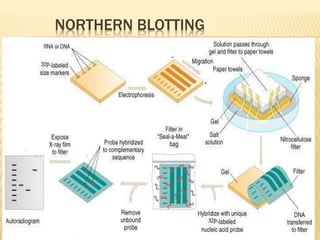
 RNA species are separated on the basis of size by
electrophoresis through agarose gel containing
formaldehyde or glyoxal and dimethyl sulfoxide.
 The separated RNA bands are then blotted on
chemically reactive filter paper.
 RNA species after blotting are hybridized to radiolabelled
DNA probe.
 Auto radiography is carried onto locate RNA bands that
are complementary to the probe.
NORTHERN BLOTTING
APPLICATIONS
 Used for detection and quantitative
estimation of hybridized mRNA.
 Study RNA degradation
 Study RNA half life
 Study RNA splicing
 It is useful in the studies of gene expression.
WESTERN BLOTTING
 This technique is used to detect the proteins of a
particular specificity.
 When a transferred gene expresses in transformed
cells,
 The translated product in the form of proteins can
be identified by this technique.
PROCEDURE
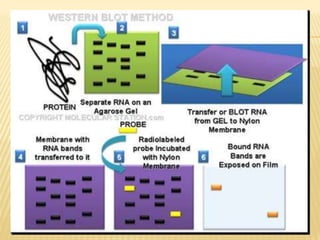
 First we isolate the protein or extract the protein.
 The extracted proteins are subjected to PAGE(Poly
Acrylamide Gel Electrophoresis) and are then
transferred onto nitro cellulose to which they bind.
 Then radiolabelled specific antibody is added on such
membrane and it binds only to specific complementary
protein.
 The antibody is labelled with 125 I and the signal is
detected again with autoradiography.
 If radio active label is not used, bound antibody may be
detected by a second antibody tagged with an enzyme.
APPLICATIONS
 The confirmatory HIV test employs a western blot to detect anti-
HIV antibody in a human serum sample. Proteins from known
HIV-infected cells are separated and blotted on a membrane as
above. Then, the serum to be tested is applied in the primary
antibody incubation step; free antibody is washed away, and a
secondary anti-human antibody linked to an enzyme signal is
added. The stained bands then indicate the proteins to which
the patient's serum contains antibody.
 A western blot is also used as the definitive test for Bovine
spongiform encephalopathy (BSE, commonly referred to as
'mad cow disease').
 Western blot can also be used as a confirmatory test for
Hepatitis B infection.
DOT BLOT TECHNIQUE
 This technique is used to detect the presence of a
given sequence of DNA/RNA in the non-
fractionated(not subjected to electrophoresis) DNA
sample.
 DNA from many samples can be tested in a single
test.
 A Dot blot (or Slot blot) is a technique used to detect
biomolecules.
 It represents a simplification of the northern blot,
Southern blot, or western blot methods. In a dot blot
the biomolecules to be detected are not first separated
 Instead, a mixture containing the molecule to be
detected is applied directly on a membrane as a
dot.
 Then is spotted through circular templates
directly onto the membrane or paper substrate.
.
 Then followed by detection by either nucleotide
probes (for a northern blot and Southern blot) or
antibodies (for a western blot).
PROCEDURE
 Sample DNA/RNA from different individuals are transferred to a
nitrocellulose filter paper in the form of dots. Several samples
are blotted on to a single filter paper.
 The DNA is first denatured and then the filter is baked at 80c to
fix DNA firmly on to the filter.
 The filter is treated with the appropriate radio active single
stranded probe under conditions favouring hybridization.The
filter is washed to remove the unhybridized probes.
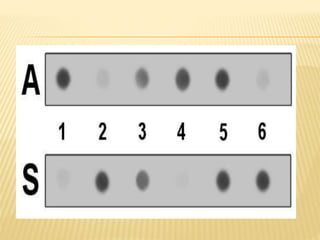
 The dots with hybridized probes are detected by
autoradiography intensity of the dots corresponds fairly with the
extent to which DNA/RNA is represented in the sample.
 The dot blot test can be used to detect the
Chlamydia trachomatis infection and other
sexually transmitted diseases.
 Dot blot is used to detect Antidiacyltrehalose
Antibodies in Tuberculosis patients and
typhoid Fever
Blotting techniques includes southren,northern,western and dot blotting