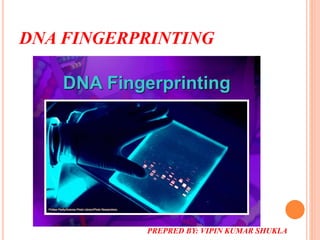
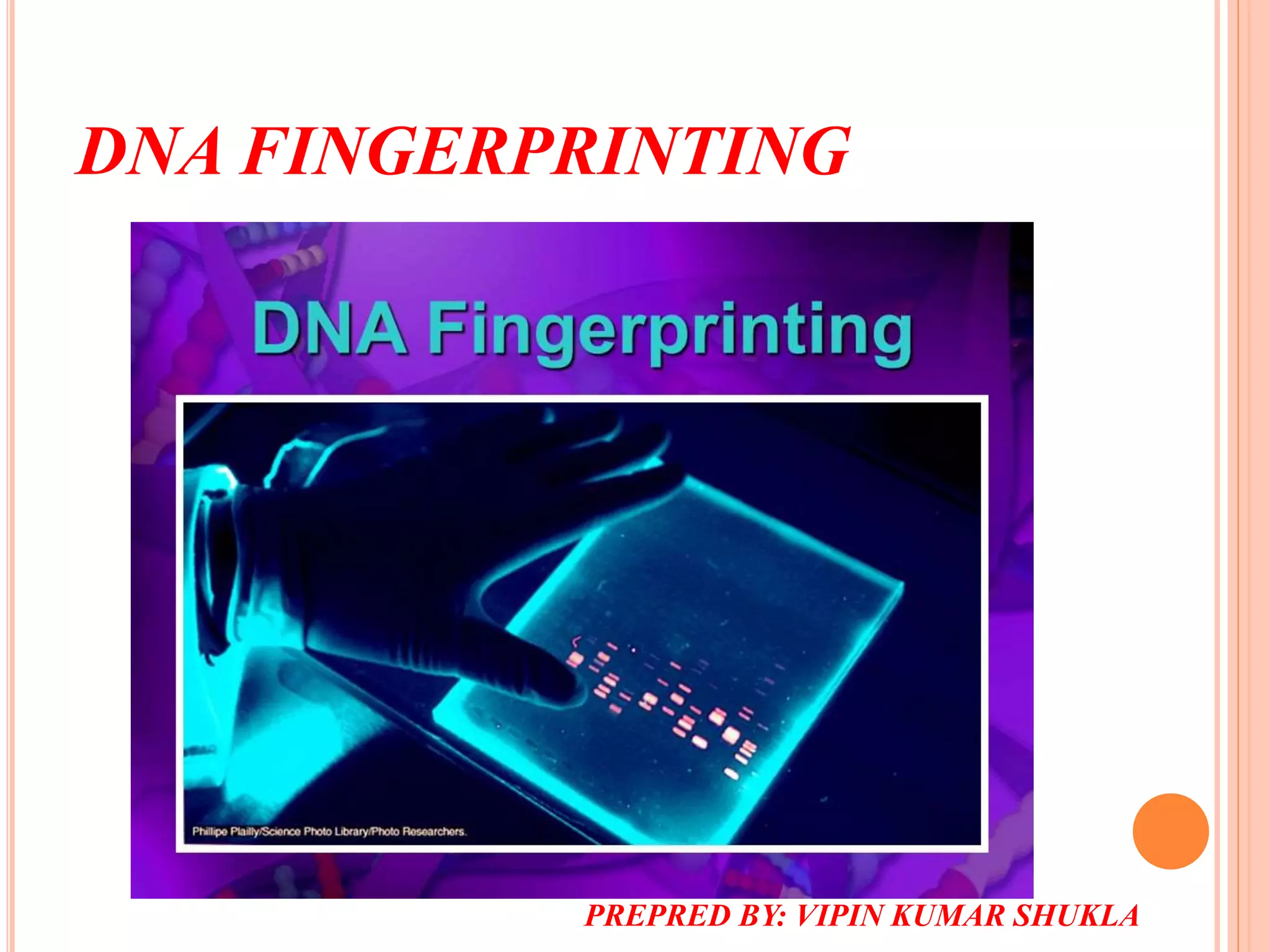
DNA FINGERPRINTING
PREPRED BY: VIPIN KUMAR SHUKLA
(INTRODUCTION)
 DNA fingerprinting is the technique to establish the
identity of victims (Murder, Accidents, Criminals) with
the help of blood stains, Semen stains, Hair roots, Tears or
Saliva, etc.
 This technique was developed by “Alec Jeffery's (1985-
86) and his colleagues in U.K.
 DNA fingerprinting of an individual is the description of
specific alleles present at a series of polymorphic loci of
the genome.
CONTD…..
 A polymorphic locus is that region of genomic DNA
whose sequence is different in different individuals.
 DNA fingerprinting is the most sensitive and most popular
technique in Forensic science in identifying criminals in
cases of rape, murder and solving paternity disputes.
 It is also called as DNA Profiling.
 The polymorphism of different DNA sequences is studied
either as RFLP or by PCR amplification.
CONTD…..
 The study includes polymorphism of minisatellites,
microsatellite and minivarient repeats (MVR).
 These sequences together are called variable number of
tandem repeats (VNTR).
 They are end to end duplications of identical or almost
identical sequence of (2-80 bases)
 They are dispersed throughout the genome and constitute
hypervariable dispersed repetitive sequence.
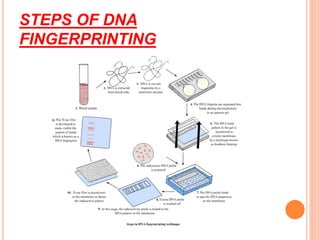
STEPS OF DNA
FINGERPRINTING
RFLP ANALYSIS
 This is based on probe hybridization.
 It includes study of Multilocus Polymorphism
(MLP) and Single Locus Polymorphism (SLP).
 For this analysis the genomic DNA is isolated
from the blood stains, semen stains or hair roots,
etc. and then this is hybridized with specific
DNA probes.
CONTD……
 This process involves:
 Digestion of genomic DNA with a selected restriction
enzyme.
 Separation of DNA segments by Agarose gel
electrophoresis.
 Denaturation of DNA fragments by alkali treatment.
 Transfer of single stranded DNA onto a Nylon membrane
(i.e., blotting of DNA.
 Fixation of separated DNA fragments to the membrane by
exposing to UV light.
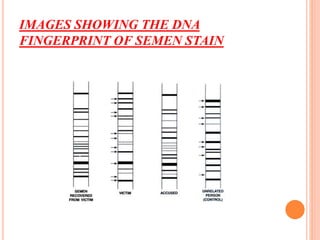
IMAGES SHOWING THE DNA
FINGERPRINT OF SEMEN STAIN
CONTD….
 DNA fragments are hybridized to specific DNA probes.
 The DNA probes correspond to the hypervariable
minisatellites in DNA.
 These have tendem repeats of short sequence ranging from
(1 to 20kb).
 A large number of these minisatellites are scattered
throughout the human genome.
 These attribute polymorphism in DNA and have a stable
inheritance.
CONTD…..
 The probes used may be Multilocus or single
locus and are represented as MLPs and SLPs
(Multilocus probes and Single locus probes).
 In case of MLP analysis hybridization takes
place not only between the probe and DNA
fragments strictly complementary to it but also
with those fragments that have similar related
sequences.
 As a result many different fragments are
detected.
SLP ANALYSIS
 In case of SLP analysis, probe hybridizes with
DNA fragments of only that VNTR locus, which
has exactly the same sequence of repeat units as
that of the probe.
 As a result, which has exactly the same sequence
of repeat units as that of the probe.
 As a result, just two bands develop in each lane
of the gel.
 In case of MLP analysis only one hybridization
and detection is needed but in SLP method, the
same process repeated four or more times.
PCR ANALYSIS OF STRS
 DNA fingerprinting by probe hybridization of
polymorphism of VNTR sequences needs relatively large
amounts of DNA which may not be available in many
cases.
 Also it is doubted that there may be chances of unrelated
individuals having same or very similar fingerprinting.
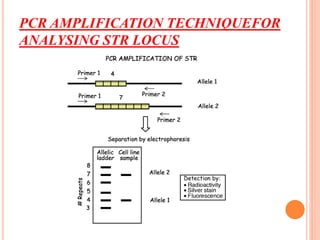
 Therefore STR sequences are obtained by PCR
amplification and are used for DNA fingerprinting.
CONTD….
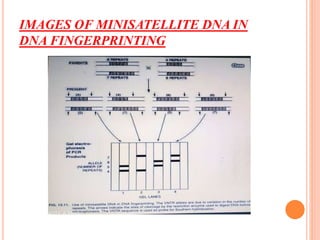
 Each STR in human population may have as many as ( 10)
different alleles.
 These alleles differ in the number of tandem repeats of
short sequence repeat unit.
 The two primers used for PCR anneal to the unique DNA
sequences located outside the STR sequence.
 The product of the PCR are subjected to Agarose gel
electrophoresis.
 The amplification products of different STR alleles s
distinct bands.
IMAGES OF MINISATELLITE DNA IN
DNA FINGERPRINTING
PCR METHOD
 The PCR method can produce results from very
minute amount of DNA from the site of crime.
 PCR can also be used for Minisatellite variant
repeat (MVR).
 It works on the basis of variation within the
sequence of repeat unit and the variation in the
numbers of repeat units.
PCR AMPLIFICATION TECHNIQUEFOR
ANALYSING STR LOCUS
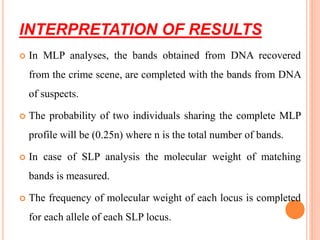
INTERPRETATION OF RESULTS
 In MLP analyses, the bands obtained from DNA recovered
from the crime scene, are completed with the bands from DNA
of suspects.
 The probability of two individuals sharing the complete MLP
profile will be (0.25n) where n is the total number of bands.
 In case of SLP analysis the molecular weight of matching
bands is measured.
 The frequency of molecular weight of each locus is completed
for each allele of each SLP locus.
APPLICATIONS OF DNA
PROFILING
 DNA fingerprinting or DNA profiling is applicable for
following :
 It enables identification of criminals and victims of crime
or accidents.
 Kinship analysis: It is used to infer the blood relationship
in the members of the same family.
 Paternity dispute: DNA fingerprinting is used in
determining whether a given male is father of a given
child.
CONTD…..
 Parentage Determination: In case of lost child, is
possible to determine the actual parents.
 Sex of an Individual: In sex of badly damaged
bodies of accident victims or of archaeological
specimens, can be identified by DNA profiling.

Dna fingerprinting

  • 1.
  • 2.
    (INTRODUCTION)  DNA fingerprintingis the technique to establish the identity of victims (Murder, Accidents, Criminals) with the help of blood stains, Semen stains, Hair roots, Tears or Saliva, etc.  This technique was developed by “Alec Jeffery's (1985- 86) and his colleagues in U.K.  DNA fingerprinting of an individual is the description of specific alleles present at a series of polymorphic loci of the genome.
  • 3.
    CONTD…..  A polymorphiclocus is that region of genomic DNA whose sequence is different in different individuals.  DNA fingerprinting is the most sensitive and most popular technique in Forensic science in identifying criminals in cases of rape, murder and solving paternity disputes.  It is also called as DNA Profiling.  The polymorphism of different DNA sequences is studied either as RFLP or by PCR amplification.
  • 4.
    CONTD…..  The studyincludes polymorphism of minisatellites, microsatellite and minivarient repeats (MVR).  These sequences together are called variable number of tandem repeats (VNTR).  They are end to end duplications of identical or almost identical sequence of (2-80 bases)  They are dispersed throughout the genome and constitute hypervariable dispersed repetitive sequence.
  • 5.
  • 6.
    RFLP ANALYSIS  Thisis based on probe hybridization.  It includes study of Multilocus Polymorphism (MLP) and Single Locus Polymorphism (SLP).  For this analysis the genomic DNA is isolated from the blood stains, semen stains or hair roots, etc. and then this is hybridized with specific DNA probes.
  • 7.
    CONTD……  This processinvolves:  Digestion of genomic DNA with a selected restriction enzyme.  Separation of DNA segments by Agarose gel electrophoresis.  Denaturation of DNA fragments by alkali treatment.  Transfer of single stranded DNA onto a Nylon membrane (i.e., blotting of DNA.  Fixation of separated DNA fragments to the membrane by exposing to UV light.
  • 8.
    IMAGES SHOWING THEDNA FINGERPRINT OF SEMEN STAIN
  • 9.
    CONTD….  DNA fragmentsare hybridized to specific DNA probes.  The DNA probes correspond to the hypervariable minisatellites in DNA.  These have tendem repeats of short sequence ranging from (1 to 20kb).  A large number of these minisatellites are scattered throughout the human genome.  These attribute polymorphism in DNA and have a stable inheritance.
  • 10.
    CONTD…..  The probesused may be Multilocus or single locus and are represented as MLPs and SLPs (Multilocus probes and Single locus probes).  In case of MLP analysis hybridization takes place not only between the probe and DNA fragments strictly complementary to it but also with those fragments that have similar related sequences.  As a result many different fragments are detected.
  • 11.
    SLP ANALYSIS  Incase of SLP analysis, probe hybridizes with DNA fragments of only that VNTR locus, which has exactly the same sequence of repeat units as that of the probe.  As a result, which has exactly the same sequence of repeat units as that of the probe.  As a result, just two bands develop in each lane of the gel.  In case of MLP analysis only one hybridization and detection is needed but in SLP method, the same process repeated four or more times.
  • 12.
    PCR ANALYSIS OFSTRS  DNA fingerprinting by probe hybridization of polymorphism of VNTR sequences needs relatively large amounts of DNA which may not be available in many cases.  Also it is doubted that there may be chances of unrelated individuals having same or very similar fingerprinting.  Therefore STR sequences are obtained by PCR amplification and are used for DNA fingerprinting.
  • 13.
    CONTD….  Each STRin human population may have as many as ( 10) different alleles.  These alleles differ in the number of tandem repeats of short sequence repeat unit.  The two primers used for PCR anneal to the unique DNA sequences located outside the STR sequence.  The product of the PCR are subjected to Agarose gel electrophoresis.  The amplification products of different STR alleles s distinct bands.
  • 14.
    IMAGES OF MINISATELLITEDNA IN DNA FINGERPRINTING
  • 15.
    PCR METHOD  ThePCR method can produce results from very minute amount of DNA from the site of crime.  PCR can also be used for Minisatellite variant repeat (MVR).  It works on the basis of variation within the sequence of repeat unit and the variation in the numbers of repeat units.
  • 16.
  • 17.
    INTERPRETATION OF RESULTS In MLP analyses, the bands obtained from DNA recovered from the crime scene, are completed with the bands from DNA of suspects.  The probability of two individuals sharing the complete MLP profile will be (0.25n) where n is the total number of bands.  In case of SLP analysis the molecular weight of matching bands is measured.  The frequency of molecular weight of each locus is completed for each allele of each SLP locus.
  • 18.
    APPLICATIONS OF DNA PROFILING DNA fingerprinting or DNA profiling is applicable for following :  It enables identification of criminals and victims of crime or accidents.  Kinship analysis: It is used to infer the blood relationship in the members of the same family.  Paternity dispute: DNA fingerprinting is used in determining whether a given male is father of a given child.
  • 19.
    CONTD…..  Parentage Determination:In case of lost child, is possible to determine the actual parents.  Sex of an Individual: In sex of badly damaged bodies of accident victims or of archaeological specimens, can be identified by DNA profiling.