SUBMITTED BY – RAMAN KISHOR
SUBMITTED TO- ASST. PROF. PANKAJ GUPTA
DEPARTMENT- ZOOLOGY
B.SC.LIFE SCIENCES 3RD YEAR
DNA FINGERPRINTING
CONTENTS:
1. DNA FINGERPRINTING (DEFINITION)
2. Principle
3. Some terms related to Dna fingerprinting:dna barcoding,tandem repeats,junk dna,
polymorphism
4. Dna Polymorphism
5. Satellite dna,str,snp,vntr
6. profiling process ,dna extraction
7. Rflp analysis
8. advantages or disadvantages of rflp
9. pcr analysis
10. Advantages or disadvantages of pcr
DNA FINGERPRINTING (DEFINITION)
It is a forensic technique in criminal investigation , comparing
criminal suspects profile to DNA evidence so as to assess the
likelihood of their involvement in the crime.
• In this technique DNA fragments produced by cleaving isolated
DNA with the help of restriction endonucleases to identify
particular individuals.
• Also known as DNA profiling , Genetic fingerprinting
PRINCIPLE:-
It is based on the principle that every person has specific
pattern of DNA sequences which shows combination of DNA
sequences of both mother and father. Comparison of
fingerprints help in identification of person,criminal,paternity
test etc.
• 99.9% of human DNA sequences are same in every person
,only those 0.1% of DNA sequences are considered for DNA
profiling which are highly variable amongst population ,it
works effectively unless the persons are monozygotic twins.
SOME TERMS RELATED TO DNA PROFILING:-
1.DNA barcoding:
The analysis of DNA intended to identify a species rather
than a individual is called DNA barcoding.
2.Tandem repeats:
It occurs in DNA when a pattern of one or more
nucleotides is repeated and the repetitions are directly adjacent to
each other.
3. JUNK DNA:
• Term “junk DNA”refers to the region of DNA that contains
non coding sequences(i.e. these sequences do not code for
proteins)
4. POLYMORPHISM:
5.DNA POLYMORPHISM:
• Polymorphism at DNA level include wide range of
variations from single base pair change,many base pairs
and repeated sequences.
• It leads to genetic variabilities like- SNPs(single Nucleotide
polymorphism), VNTRs,structural alterations,copy number
variations.
• Total no. of nucleotide in Human Genome=6 billion,so
probability of varying polymorphic DNA is higher.
6.SATELLITE DNA
7.SHORT TANDEN REPEATS(STR): MICROSATELLITE
8.SINGLE NUCLEOTIDE POLYMORPHISM (SNP):
• Involves variation of single base pair.
• Present in large fraction of population.
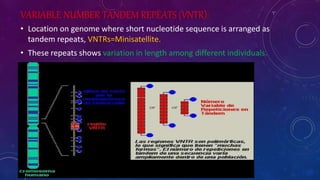
VARIABLE NUMBER TANDEM REPEATS (VNTR):
• Location on genome where short nucleotide sequence is arranged as
tandem repeats, VNTRs=Minisatellite.
• These repeats shows variation in length among different individuals.
• DNA profiling uses repetitive sequences that are highly variable (VNTRs) in particular
STRs also known as Minisatellite and Microsatellite.
• VNTR loci are similar between closely related individuals but are so variable that
unrelated individuals are unlikely to have same VNTRs.
PROFILING PROCESS:-
1. DNA EXTRACTION:
• Reference sample(from where DNA is isolated): Blood
Stains,Semen,hair roots, buccal swab, saliva etc.
• Sample DNA is Extracted from the cells and purified .For this nuclear
membrane are broken down by incubating cell with proteinase
enzyme- causis cell lysis.
• DNA is Purified by Alcohol Precipitation.
• Other methods used: Phenol chloroform extraction,chelax extraction,
differential extraction.
• Extracted DNA is analyzed by either one of two methods:
• 1. RFLPAnalysis (Restriction Fragment Length Polymorphism)
• 2. PCR Analysis (Pylymerase Chain Reaction)
RFLP – ANALYSIS:
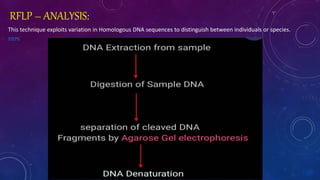
This technique exploits variation in Homologous DNA sequences to distinguish between individuals or species.
STEPS:
USE IN RESOLVING
PARENTAGE DISPUTE:
• By the use of DNA
fingerprinting using
RFLP Analysis,
parentage disputes are
resolved by comparing
bands after completing
procedure.
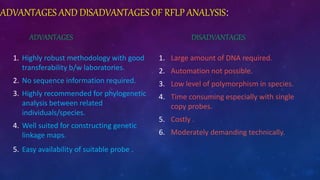
ADVANTAGES AND DISADVANTAGES OF RFLP ANALYSIS:
ADVANTAGES
1. Highly robust methodology with good
transferability b/w laboratories.
2. No sequence information required.
3. Highly recommended for phylogenetic
analysis between related
individuals/species.
4. Well suited for constructing genetic
linkage maps.
5. Easy availability of suitable probe .
DISADVANTAGES
1. Large amount of DNA required.
2. Automation not possible.
3. Low level of polymorphism in species.
4. Time consuming especially with single
copy probes.
5. Costly .
6. Moderately demanding technically.
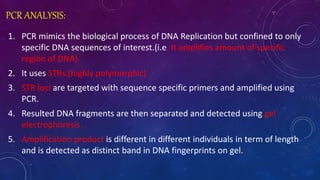
PCR ANALYSIS:
1. PCR mimics the biological process of DNA Replication but confined to only
specific DNA sequences of interest.(i.e. It amplifies amount of specific
region of DNA)
2. It uses STRs.(highly polymorphic)
3. STR loci are targeted with sequence specific primers and amplified using
PCR.
4. Resulted DNA fragments are then separated and detected using gel
electrophoresis .
5. Amplification product is different in different individuals in term of length
and is detected as distinct band in DNA fingerprints on gel.
PROCESS:
USED IN FINDING CRIMINAL :
• PCR Analysis is used to
find the criminal out of
the suspects by
comparing the bands
from DNA recoverd from
crime scene to those of
the suspects.
• Chance of two unrelated
individuals having a
common band is 0.25%
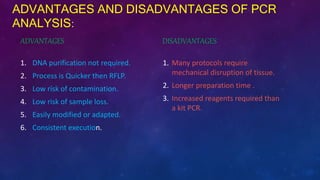
ADVANTAGES AND DISADVANTAGES OF PCR
ANALYSIS:
ADVANTAGES
1. DNA purification not required.
2. Process is Quicker then RFLP.
3. Low risk of contamination.
4. Low risk of sample loss.
5. Easily modified or adapted.
6. Consistent execution.
DISADVANTAGES
1. Many protocols require
mechanical disruption of tissue.
2. Longer preparation time .
3. Increased reagents required than
a kit PCR.

Presentation dna fingerprinting

  • 1.
    SUBMITTED BY –RAMAN KISHOR SUBMITTED TO- ASST. PROF. PANKAJ GUPTA DEPARTMENT- ZOOLOGY B.SC.LIFE SCIENCES 3RD YEAR DNA FINGERPRINTING
  • 2.
    CONTENTS: 1. DNA FINGERPRINTING(DEFINITION) 2. Principle 3. Some terms related to Dna fingerprinting:dna barcoding,tandem repeats,junk dna, polymorphism 4. Dna Polymorphism 5. Satellite dna,str,snp,vntr 6. profiling process ,dna extraction 7. Rflp analysis 8. advantages or disadvantages of rflp 9. pcr analysis 10. Advantages or disadvantages of pcr
  • 3.
    DNA FINGERPRINTING (DEFINITION) Itis a forensic technique in criminal investigation , comparing criminal suspects profile to DNA evidence so as to assess the likelihood of their involvement in the crime. • In this technique DNA fragments produced by cleaving isolated DNA with the help of restriction endonucleases to identify particular individuals. • Also known as DNA profiling , Genetic fingerprinting
  • 4.
    PRINCIPLE:- It is basedon the principle that every person has specific pattern of DNA sequences which shows combination of DNA sequences of both mother and father. Comparison of fingerprints help in identification of person,criminal,paternity test etc. • 99.9% of human DNA sequences are same in every person ,only those 0.1% of DNA sequences are considered for DNA profiling which are highly variable amongst population ,it works effectively unless the persons are monozygotic twins.
  • 5.
    SOME TERMS RELATEDTO DNA PROFILING:- 1.DNA barcoding: The analysis of DNA intended to identify a species rather than a individual is called DNA barcoding. 2.Tandem repeats: It occurs in DNA when a pattern of one or more nucleotides is repeated and the repetitions are directly adjacent to each other.
  • 6.
    3. JUNK DNA: •Term “junk DNA”refers to the region of DNA that contains non coding sequences(i.e. these sequences do not code for proteins)
  • 7.
  • 8.
    5.DNA POLYMORPHISM: • Polymorphismat DNA level include wide range of variations from single base pair change,many base pairs and repeated sequences. • It leads to genetic variabilities like- SNPs(single Nucleotide polymorphism), VNTRs,structural alterations,copy number variations. • Total no. of nucleotide in Human Genome=6 billion,so probability of varying polymorphic DNA is higher.
  • 9.
  • 10.
  • 11.
    8.SINGLE NUCLEOTIDE POLYMORPHISM(SNP): • Involves variation of single base pair. • Present in large fraction of population.
  • 12.
    VARIABLE NUMBER TANDEMREPEATS (VNTR): • Location on genome where short nucleotide sequence is arranged as tandem repeats, VNTRs=Minisatellite. • These repeats shows variation in length among different individuals.
  • 13.
    • DNA profilinguses repetitive sequences that are highly variable (VNTRs) in particular STRs also known as Minisatellite and Microsatellite. • VNTR loci are similar between closely related individuals but are so variable that unrelated individuals are unlikely to have same VNTRs.
  • 14.
    PROFILING PROCESS:- 1. DNAEXTRACTION: • Reference sample(from where DNA is isolated): Blood Stains,Semen,hair roots, buccal swab, saliva etc. • Sample DNA is Extracted from the cells and purified .For this nuclear membrane are broken down by incubating cell with proteinase enzyme- causis cell lysis. • DNA is Purified by Alcohol Precipitation. • Other methods used: Phenol chloroform extraction,chelax extraction, differential extraction. • Extracted DNA is analyzed by either one of two methods: • 1. RFLPAnalysis (Restriction Fragment Length Polymorphism) • 2. PCR Analysis (Pylymerase Chain Reaction)
  • 16.
    RFLP – ANALYSIS: Thistechnique exploits variation in Homologous DNA sequences to distinguish between individuals or species. STEPS:
  • 20.
    USE IN RESOLVING PARENTAGEDISPUTE: • By the use of DNA fingerprinting using RFLP Analysis, parentage disputes are resolved by comparing bands after completing procedure.
  • 21.
    ADVANTAGES AND DISADVANTAGESOF RFLP ANALYSIS: ADVANTAGES 1. Highly robust methodology with good transferability b/w laboratories. 2. No sequence information required. 3. Highly recommended for phylogenetic analysis between related individuals/species. 4. Well suited for constructing genetic linkage maps. 5. Easy availability of suitable probe . DISADVANTAGES 1. Large amount of DNA required. 2. Automation not possible. 3. Low level of polymorphism in species. 4. Time consuming especially with single copy probes. 5. Costly . 6. Moderately demanding technically.
  • 22.
    PCR ANALYSIS: 1. PCRmimics the biological process of DNA Replication but confined to only specific DNA sequences of interest.(i.e. It amplifies amount of specific region of DNA) 2. It uses STRs.(highly polymorphic) 3. STR loci are targeted with sequence specific primers and amplified using PCR. 4. Resulted DNA fragments are then separated and detected using gel electrophoresis . 5. Amplification product is different in different individuals in term of length and is detected as distinct band in DNA fingerprints on gel.
  • 23.
  • 25.
    USED IN FINDINGCRIMINAL : • PCR Analysis is used to find the criminal out of the suspects by comparing the bands from DNA recoverd from crime scene to those of the suspects. • Chance of two unrelated individuals having a common band is 0.25%
  • 26.
    ADVANTAGES AND DISADVANTAGESOF PCR ANALYSIS: ADVANTAGES 1. DNA purification not required. 2. Process is Quicker then RFLP. 3. Low risk of contamination. 4. Low risk of sample loss. 5. Easily modified or adapted. 6. Consistent execution. DISADVANTAGES 1. Many protocols require mechanical disruption of tissue. 2. Longer preparation time . 3. Increased reagents required than a kit PCR.