
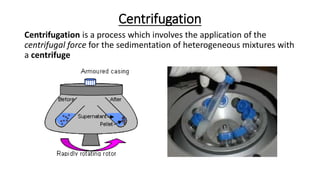
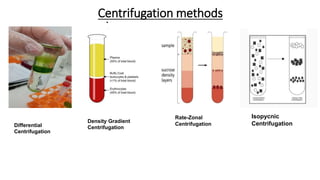
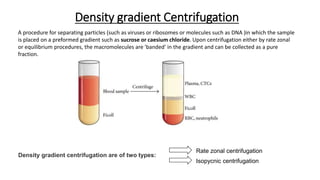
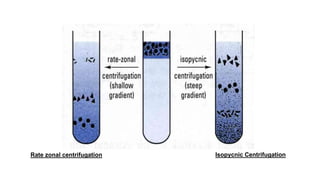
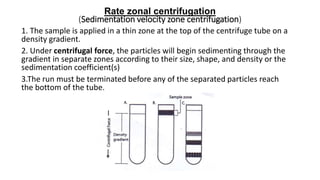
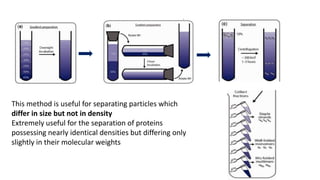
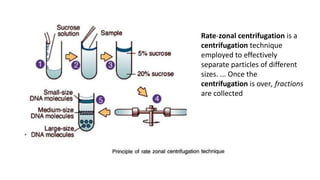
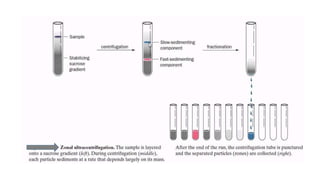
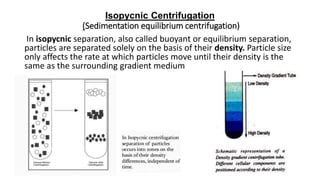
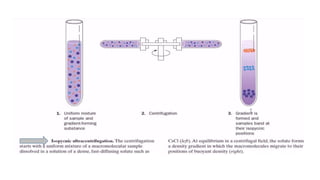
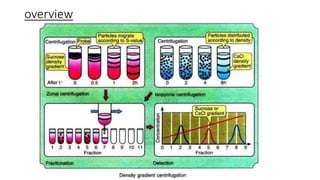


Density gradient centrifugation is a technique used to separate particles based on density. It involves placing a sample on a preformed density gradient, such as sucrose or cesium chloride, and centrifuging. Under centrifugation, particles band within the gradient according to their density. There are two types of density gradient centrifugation - rate zonal centrifugation, which separates particles of differing sizes, and isopycnic centrifugation, which separates particles solely based on density. Density gradient centrifugation has many applications, including purification of viruses, bacteria, proteins, and separation of biomolecules.


