 Sodium dodecyl sulphate polyacrylamide gel
electrophoresis(SDS-PAGE) is an analytical
technique used to separate proteins based on
their molecular weight.
 Electrophoresis is a technique used to
separate macromolecules in an electrical
field.
 This technique employs discontinuous
polyacrylamide gel for support and SDS for
denaturation.
 SDS (also called lauryl sulfate) is an anionic
detergent.
 Its molecules have a net negative charge
within a wide pH range.
 A polypeptide chain binds amounts of SDS in
proportion to its relative molecular mass.
 The negative charges on SDS masks all the
charges present on protein molecules giving
the protein a net negative charge.
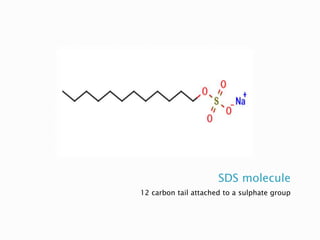
SDS molecule
12 carbon tail attached to a sulphate group
 Polyacrylamide is a polymer formed from
acrylamide subunits.
 It is highly water-absorbent, forming a
soft gel when hydrated.
 Polyacrylamide is ideal for protein separations
because it is chemically inert and electrically
neutral.
 It forms a mesh like matrix which allows for
separation based on weight.
 When proteins are separated by electrophoresis
through a gel matrix, smaller proteins migrate
faster due to less resistance from the gel matrix.
 SDS is a detergent with a strong protein-
denaturing effect and binds to the protein
backbone in ratio to its mass. In the presence of
SDS and a reducing agent(mercaptoethanol) that
cleaves disulfide bonds critical for proper
folding, proteins unfold into linear chains with
negative charge proportional to the polypeptide
chain length.
 Polyacrylamide gels restrain larger molecules
from migrating as fast as smaller molecules.
Because the charge-to-mass ratio is nearly
the same among SDS-denatured
polypeptides, the final separation of proteins
is dependent almost entirely on the
differences in relative molecular mass of
polypeptides
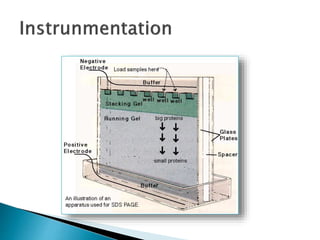
 Gel is polymerized between two glass plates
in a gel caster or casting frame, one is short
plate and the other is spacer plate.
 Clamping frame to hold gel cassettes inside
the tank.
 Electrode assembly.
 Combs for well formation.
 Power supply.
 The gel used in SDS may or may not be a
discontinuous system.
 Discontinuous system comprises of a 5% stacking
and 4-15% resolving gel based on the
concentration of TEMED.
 Typical components of these gels are:
o SDS
o APS (ammonium per sulphate)
o TEMED(tetra methyl ethylene diamine)
o Acrylamide bis
o Tris (Molarity varies between resolving and
stacking gels).
 Hand cast gels can be made in laboratory by the researchers
themselves.
 Align the short plate and stacker plate such that their
bottoms are at exactly the same level and clamp them into
casting frame.
 Place casting frame upon casting stand.
 As a non standard step, water can be poured in between the
two plates, to check for a leak which can later be removed by
filter paper.
 Add all the ingredients into a beaker except for TEMED.
 When the performer is ready to pour the ingredients between
the two plates only right before then the TEMED should be
added to the rest of ingredients.
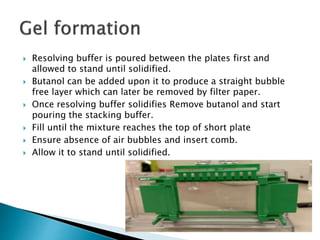
 Resolving buffer is poured between the plates first and
allowed to stand until solidified.
 Butanol can be added upon it to produce a straight bubble
free layer which can later be removed by filter paper.
 Once resolving buffer solidifies Remove butanol and start
pouring the stacking buffer.
 Fill until the mixture reaches the top of short plate
 Ensure absence of air bubbles and insert comb.
 Allow it to stand until solidified.
 The sample loaded on a SDS gel usually contains:
o Laemlli buffer
o DI water
o Protein sample
 Laemlli buffer contains:
o SDS
o  Mercaptoethanol
o Tris Hcl pH 6.8
o Bromophenol blue
o glycerol
 Add all the ingredients to a centrifuge
eppendorf.
 Centrifuge for1 Minute for run down.
 Heat on thermal cycler or in Hot water at 95
C for 5 minutes.
 Assemble the electrophoresis assembly.
 Place the gel cassette in the electrode
assembly with the short plate facing inside of
the electrode assembly.
 For running a single gel place dummy
plate(buffer dam) on the other end of
electrode assembly.
 Remove the comb from gel cassette.
 Load sample in the well produced by combs
using micropipette tips.
 Add running buffer into gel box and fill up to
the mark stating two gels or four gels as per
requirement.
 Also add running buffer in between assembly
holding two gel cassettes.
 Place the cap of gel box aligning the color coded
electrodes(red to red and black to black).
 insert the switch into power supply, select the
desired current or voltage and press run.
 Alllow it to run until the sample reaches bottom
end of the gel.
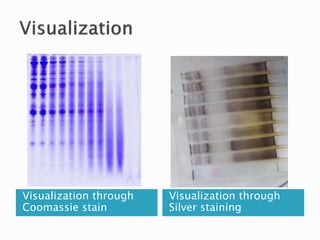
Visualization through
Coomassie stain
Visualization through
Silver staining
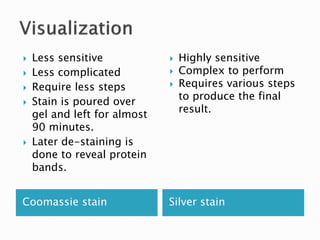
Coomassie stain Silver stain
 Less sensitive
 Less complicated
 Require less steps
 Stain is poured over
gel and left for almost
90 minutes.
 Later de-staining is
done to reveal protein
bands.
 Highly sensitive
 Complex to perform
 Requires various steps
to produce the final
result.
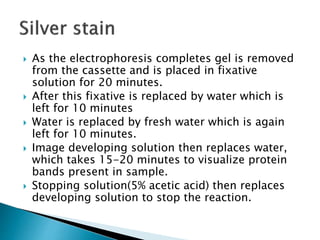
 As the electrophoresis completes gel is removed
from the cassette and is placed in fixative
solution for 20 minutes.
 After this fixative is replaced by water which is
left for 10 minutes
 Water is replaced by fresh water which is again
left for 10 minutes.
 Image developing solution then replaces water,
which takes 15-20 minutes to visualize protein
bands present in sample.
 Stopping solution(5% acetic acid) then replaces
developing solution to stop the reaction.
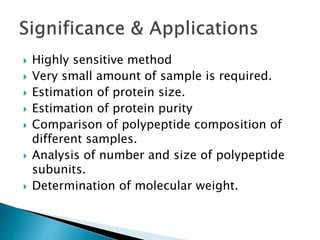
 Highly sensitive method
 Very small amount of sample is required.
 Estimation of protein size.
 Estimation of protein purity
 Comparison of polypeptide composition of
different samples.
 Analysis of number and size of polypeptide
subunits.
 Determination of molecular weight.

SDS PAGE

  • 2.
     Sodium dodecylsulphate polyacrylamide gel electrophoresis(SDS-PAGE) is an analytical technique used to separate proteins based on their molecular weight.  Electrophoresis is a technique used to separate macromolecules in an electrical field.  This technique employs discontinuous polyacrylamide gel for support and SDS for denaturation.
  • 3.
     SDS (alsocalled lauryl sulfate) is an anionic detergent.  Its molecules have a net negative charge within a wide pH range.  A polypeptide chain binds amounts of SDS in proportion to its relative molecular mass.  The negative charges on SDS masks all the charges present on protein molecules giving the protein a net negative charge.
  • 4.
    SDS molecule 12 carbontail attached to a sulphate group
  • 5.
     Polyacrylamide isa polymer formed from acrylamide subunits.  It is highly water-absorbent, forming a soft gel when hydrated.  Polyacrylamide is ideal for protein separations because it is chemically inert and electrically neutral.  It forms a mesh like matrix which allows for separation based on weight.
  • 6.
     When proteinsare separated by electrophoresis through a gel matrix, smaller proteins migrate faster due to less resistance from the gel matrix.  SDS is a detergent with a strong protein- denaturing effect and binds to the protein backbone in ratio to its mass. In the presence of SDS and a reducing agent(mercaptoethanol) that cleaves disulfide bonds critical for proper folding, proteins unfold into linear chains with negative charge proportional to the polypeptide chain length.
  • 7.
     Polyacrylamide gelsrestrain larger molecules from migrating as fast as smaller molecules. Because the charge-to-mass ratio is nearly the same among SDS-denatured polypeptides, the final separation of proteins is dependent almost entirely on the differences in relative molecular mass of polypeptides
  • 9.
     Gel ispolymerized between two glass plates in a gel caster or casting frame, one is short plate and the other is spacer plate.  Clamping frame to hold gel cassettes inside the tank.  Electrode assembly.  Combs for well formation.  Power supply.
  • 10.
     The gelused in SDS may or may not be a discontinuous system.  Discontinuous system comprises of a 5% stacking and 4-15% resolving gel based on the concentration of TEMED.  Typical components of these gels are: o SDS o APS (ammonium per sulphate) o TEMED(tetra methyl ethylene diamine) o Acrylamide bis o Tris (Molarity varies between resolving and stacking gels).
  • 11.
     Hand castgels can be made in laboratory by the researchers themselves.  Align the short plate and stacker plate such that their bottoms are at exactly the same level and clamp them into casting frame.  Place casting frame upon casting stand.  As a non standard step, water can be poured in between the two plates, to check for a leak which can later be removed by filter paper.  Add all the ingredients into a beaker except for TEMED.  When the performer is ready to pour the ingredients between the two plates only right before then the TEMED should be added to the rest of ingredients.
  • 12.
     Resolving bufferis poured between the plates first and allowed to stand until solidified.  Butanol can be added upon it to produce a straight bubble free layer which can later be removed by filter paper.  Once resolving buffer solidifies Remove butanol and start pouring the stacking buffer.  Fill until the mixture reaches the top of short plate  Ensure absence of air bubbles and insert comb.  Allow it to stand until solidified.
  • 13.
     The sampleloaded on a SDS gel usually contains: o Laemlli buffer o DI water o Protein sample  Laemlli buffer contains: o SDS o  Mercaptoethanol o Tris Hcl pH 6.8 o Bromophenol blue o glycerol
  • 14.
     Add allthe ingredients to a centrifuge eppendorf.  Centrifuge for1 Minute for run down.  Heat on thermal cycler or in Hot water at 95 C for 5 minutes.
  • 15.
     Assemble theelectrophoresis assembly.  Place the gel cassette in the electrode assembly with the short plate facing inside of the electrode assembly.  For running a single gel place dummy plate(buffer dam) on the other end of electrode assembly.  Remove the comb from gel cassette.  Load sample in the well produced by combs using micropipette tips.
  • 16.
     Add runningbuffer into gel box and fill up to the mark stating two gels or four gels as per requirement.  Also add running buffer in between assembly holding two gel cassettes.  Place the cap of gel box aligning the color coded electrodes(red to red and black to black).  insert the switch into power supply, select the desired current or voltage and press run.  Alllow it to run until the sample reaches bottom end of the gel.
  • 17.
  • 18.
    Coomassie stain Silverstain  Less sensitive  Less complicated  Require less steps  Stain is poured over gel and left for almost 90 minutes.  Later de-staining is done to reveal protein bands.  Highly sensitive  Complex to perform  Requires various steps to produce the final result.
  • 19.
     As theelectrophoresis completes gel is removed from the cassette and is placed in fixative solution for 20 minutes.  After this fixative is replaced by water which is left for 10 minutes  Water is replaced by fresh water which is again left for 10 minutes.  Image developing solution then replaces water, which takes 15-20 minutes to visualize protein bands present in sample.  Stopping solution(5% acetic acid) then replaces developing solution to stop the reaction.
  • 20.
     Highly sensitivemethod  Very small amount of sample is required.  Estimation of protein size.  Estimation of protein purity  Comparison of polypeptide composition of different samples.  Analysis of number and size of polypeptide subunits.  Determination of molecular weight.

Editor's Notes

  • #2 Need finishing
  • #3 SDS-PAGE (sodium dodecyl sulfate–polyacrylamide gel electrophoresis) is a variant of polyacrylamide gel electrophoresis, an analytical method in biochemistry for the separation of charged molecules in mixtures by their molecular masses in an electric field.
  • #15 Prepare 2X sample buffer consisting of 0.5M Tris-HCl, pH 6.8, 4.4% SDS, 300mM Mercaptoethanol, 10mg/ml Bromophenol Blue and mix with equal volume of sample (For greater reproducibility, employ National Diagnostics preformulated 2X sample buffer, Protein Loading Buffer Blue 2X). Bring to 95° C for 10 minutes, cool to room temperature before loading. 
  • #19 50 ml development accelerator 5 ml image development reagent 5 ml reduction moderator 5 ml silver stain complex 35 ml DI h2O
  • #20 Fixative soln:Mthanol 60ml, DI h2O 20ml, Acetic acid 20ml ,Image enhancing concentrate 20ml Image developing soln:image developing reagent:5 ml,reduction moderator:5 ml, silver stain complex: 5ml and image development accelerator 50 ml add at the end.