
Prepared By: Vipin Kr Shukla
Assistant Lecturer
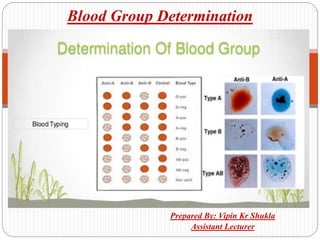
Blood Group Determination
ABO Blood Group:
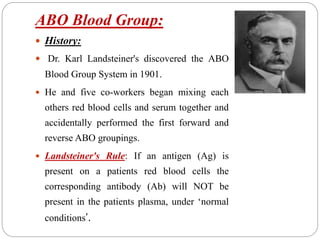
 History:
 Dr. Karl Landsteiner's discovered the ABO
Blood Group System in 1901.
 He and five co-workers began mixing each
others red blood cells and serum together and
accidentally performed the first forward and
reverse ABO groupings.
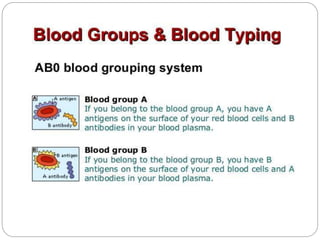
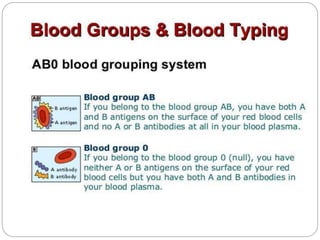
 Landsteiner's Rule: If an antigen (Ag) is
present on a patients red blood cells the
corresponding antibody (Ab) will NOT be
present in the patients plasma, under ‘normal
conditions’.
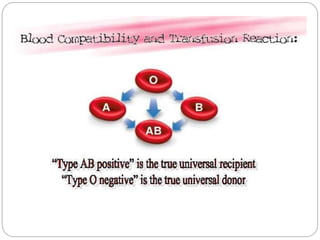
The ABO Blood System:
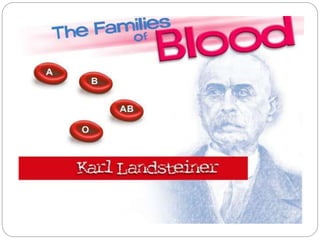
 4 main phenotypes (A, B, AB, O)
 ABO gene located on long arm of chromosome 9.
 Antigens/Agglutinogens Type A and Type B on the surface
of the RBCs are the cause of blood transfusion reactions.
 Thus, the presence or absence of these Ag’s is the essential
basis that blood is grouped for the purpose of transfusion
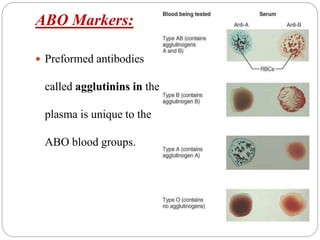
ABO Markers:
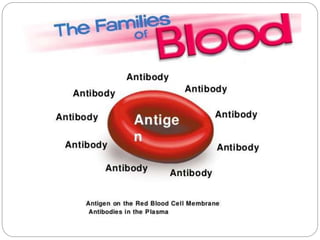
 Preformed antibodies
called agglutinins in the
plasma is unique to the
ABO blood groups.
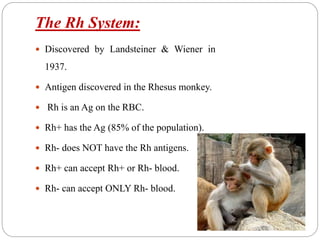
The Rh System:
 Discovered by Landsteiner & Wiener in
1937.
 Antigen discovered in the Rhesus monkey.
 Rh is an Ag on the RBC.
 Rh+ has the Ag (85% of the population).
 Rh- does NOT have the Rh antigens.
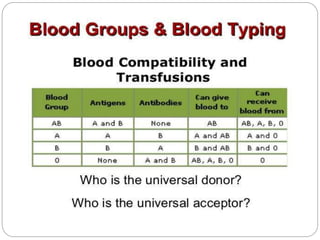
 Rh+ can accept Rh+ or Rh- blood.
 Rh- can accept ONLY Rh- blood.
RH Factor:
 There are 45 different types of Rh Agglutinogens.
 Common : C, D, and E
 ~ 85% of Americans are Rh positive, carrying the D
antigen.
 Presence of the Rh Agglutinogens on RBCs is indicated as
Rh+.
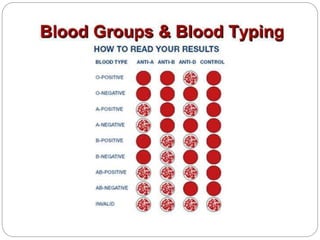
 As a rule, a person’s ABO and Rh blood groups are
reported together, for example, O+, A-, and so on.
RH Antigens:
 D antigen is the most common and most immunogenic
 Approximately 80-85% Caucasians have D antigen
 Individuals lacking this allele are called “Rh-negative”
 Only develop antibodies against the D antigen after
exposure (transfusion/pregnancy).
Rh Antibodies:
 IgG class of immunoglobulin's
 Lack capacity to bind complements
Characteristics of Bombay Blood Group:
 First reported by Bhende et al in Bombay in 1952.
 Frequency estimated to be about 1 in 7600 in Bombay.
 Absence of H, A & B antigens. No agglutination with anti-
A, anti-B or anti-H.
 Presence of anti-H, anti-A and anti-B in the serum
 No A, B or H substances present in saliva.
 Incompatible with any ABO blood groups, compatible with
Bombay phenotype only.
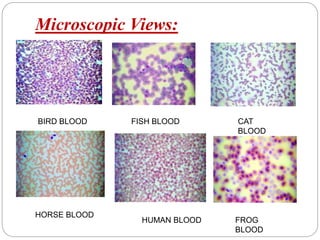
Microscopic Views:
BIRD BLOOD FISH BLOOD CAT
BLOOD
HORSE BLOOD
HUMAN BLOOD FROG
BLOOD
Blood group determination

Blood group determination

  • 1.
    Prepared By: VipinKr Shukla Assistant Lecturer Blood Group Determination
  • 2.
    ABO Blood Group: History:  Dr. Karl Landsteiner's discovered the ABO Blood Group System in 1901.  He and five co-workers began mixing each others red blood cells and serum together and accidentally performed the first forward and reverse ABO groupings.  Landsteiner's Rule: If an antigen (Ag) is present on a patients red blood cells the corresponding antibody (Ab) will NOT be present in the patients plasma, under ‘normal conditions’.
  • 3.
    The ABO BloodSystem:  4 main phenotypes (A, B, AB, O)  ABO gene located on long arm of chromosome 9.  Antigens/Agglutinogens Type A and Type B on the surface of the RBCs are the cause of blood transfusion reactions.  Thus, the presence or absence of these Ag’s is the essential basis that blood is grouped for the purpose of transfusion
  • 11.
    ABO Markers:  Preformedantibodies called agglutinins in the plasma is unique to the ABO blood groups.
  • 12.
    The Rh System: Discovered by Landsteiner & Wiener in 1937.  Antigen discovered in the Rhesus monkey.  Rh is an Ag on the RBC.  Rh+ has the Ag (85% of the population).  Rh- does NOT have the Rh antigens.  Rh+ can accept Rh+ or Rh- blood.  Rh- can accept ONLY Rh- blood.
  • 13.
    RH Factor:  Thereare 45 different types of Rh Agglutinogens.  Common : C, D, and E  ~ 85% of Americans are Rh positive, carrying the D antigen.  Presence of the Rh Agglutinogens on RBCs is indicated as Rh+.  As a rule, a person’s ABO and Rh blood groups are reported together, for example, O+, A-, and so on.
  • 14.
    RH Antigens:  Dantigen is the most common and most immunogenic  Approximately 80-85% Caucasians have D antigen  Individuals lacking this allele are called “Rh-negative”  Only develop antibodies against the D antigen after exposure (transfusion/pregnancy).
  • 15.
    Rh Antibodies:  IgGclass of immunoglobulin's  Lack capacity to bind complements
  • 17.
    Characteristics of BombayBlood Group:  First reported by Bhende et al in Bombay in 1952.  Frequency estimated to be about 1 in 7600 in Bombay.  Absence of H, A & B antigens. No agglutination with anti- A, anti-B or anti-H.  Presence of anti-H, anti-A and anti-B in the serum  No A, B or H substances present in saliva.  Incompatible with any ABO blood groups, compatible with Bombay phenotype only.
  • 19.
    Microscopic Views: BIRD BLOODFISH BLOOD CAT BLOOD HORSE BLOOD HUMAN BLOOD FROG BLOOD