Mapping genetic diversity
• Biodiversity is an essential natural
resource like soil and water
• The genetic diversity of agricultural crops
is represented by
• bred cultivars, landraces, breeders lines,
experimental lines, wild relatives of
cultivated plants
• All these form a gene pool of agricultural
crops which is used
• to improve important traits,
• to broaden the genetic base of cultivars
• and a source of new diversity for
agriculture
Diversity in nature
• genetic diversity in nature is often
seriously endangered
• In nature, biodiversity has been reduced
due to the industrial development, climatic
changes and agricultural practices
Diversity in crops
• biodiversity in agricultural systems also
decreased.
• the diversity of local landraces has been
replaced by a much narrower spectrum of
bred cultivars
• that are often genetically similar.
• Some valuable original resources were
lost in many crops in most countries
Markers
I. The genetic improvement of animals/plants is a
continuous process.
II. Man has always been busy in improving his genetic
resources.
III. many methods have been developed
IV. currently, the demonstration of genetic
polymorphism at the DNA sequence level has
provided a number of marker techniques
V. This prompted consideration for the potential
utility of these markers in animal/crop
breed/cultivar improvement.
VI. However, utilization of marker-based information
for genetic improvement depends on the choice
of an appropriate marker.
Measuring Genetic Diversity
• Within an individual: %
heterozygosity (alleles same or
different in a given set of genes)
• Among individuals in a population:
allele frequencies for given genes
• Between populations: %
heterozygosity, allele frequencies,
unique molecular markers
Conservation Genetics
1) Rate of evolutionary change in a
population is proportional to the
amount of genetic diversity available
2) Higher genetic diversity is usually
positively related to fitness
3) Global pool of genetic diversity
represents all of the information for
all biological processes (= genetic
library)
Genetic Variation
• Most genes have small sequence differences
between individuals
– Occur every 1350 bp on average
• Some of these polymorphisms may affect:
– How well the protein works
– How the protein interacts with another protein or
substrate
• The different gene forms containing
polymorphisms are called alleles
Mutations
• Neutral
• Functional
• Helpful in understanding biological
phenomena
Genetic/molecular marker
• sequence of DNA located within a known
position on the chromosome
• or a gene whose expression is easily
detectable
• can be used to identify individuals or
species.
• or as a probe to mark a chromosome
properties
• Markers show polymorphism, which may
arise due to alteration of nucleotide or
mutation in the genome loci
• make it possible to identify genetic
differences between individual organisms
or species
Applications
• are used in different areas such as
• genetic mapping, paternal tests,
• Detect mutant genes which are connected
to hereditary diseases,
• cultivars identification, marker assisted
breeding of crops,
• population history, epidemiology
Desirable Properties of
Molecular Markers
• Easily available
• Assay is rapid and reproducible
• highly polymorphic
• Co-dominant inheritance
• recurrent occurrence in genome
• Selectively neutral to environmental
conditions
• Data exchange be easy.
The objectives best served by
the markers
• molecular markers are generally
considered to measure neutral DNA
variation and consequently are useful in
studies of species
Random Amplified Polymorphic
DNA (RAPD)
• Random Amplified Polymorphic DNA
(RAPD), Arbitrarily Primed PCR (AP-
PCR), and DNA Amplification
Fingerprinting (DAF) have been
collectively termed Multiple Arbitrary
Amplicon Profiling (MAAP)
• These techniques were first used to
amplify any species DNA fragments
without prior sequences information
Difference from standard PCR
• changing primer length, sequence and
annealing Temperature, the thermostable
DNA polymerase, the number of PCR
Cycles, digestion of template DNA or
amplification products, and alternative
methods of fragment separation and
staining.
• These three techniques produce markedly
different amplification profiles
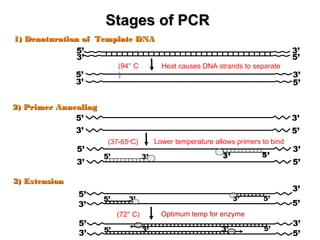
Stages of PCRStages of PCR
3’
5’
5’
3’
3’ 5’3’5’
2) Primer2) Primer AnnealingAnnealing
3’
5’
5’
3’
Lower temperature allows primers to bind(37-65o
C)
3’
5’
3’
5’
1) Denaturation of Template DNA1) Denaturation of Template DNA
5’
3’
5’
3’
Heat causes DNA strands to separate(94° C
)
3) Extension3) Extension
Optimum temp for enzyme
3’
5’
3’ 5’3’5’
3’
5’
3’ 5’3’5’
5’
3’
5’
3’
(72° C)
History
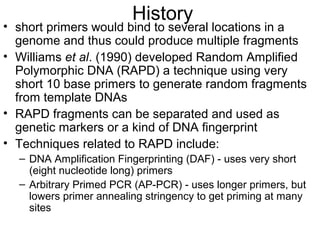
• short primers would bind to several locations in a
genome and thus could produce multiple fragments
• Williams et al. (1990) developed Random Amplified
Polymorphic DNA (RAPD) a technique using very
short 10 base primers to generate random fragments
from template DNAs
• RAPD fragments can be separated and used as
genetic markers or a kind of DNA fingerprint
• Techniques related to RAPD include:
– DNA Amplification Fingerprinting (DAF) - uses very short
(eight nucleotide long) primers
– Arbitrary Primed PCR (AP-PCR) - uses longer primers, but
lowers primer annealing stringency to get priming at many
sites
• RAPD markers are small usually 10 bp in
length
• These primers bind to the complementary
sequences
• and amplification occurs when the regions
between the opposing primer sites are
within amplifiable distances.
RAPDRAPD
- a method based on PCR developed in 1990.
- RAPD is different from conventional PCR as
it needs one primer for amplification. The
size of primer is normally short (10
nucleotides), and therefore, less specific.
- the primers can be designed without the
experimenter having any genetic information
for the organism being tested.
- more than 2000 different RAPD primers can
be available commercially.
RAPDRAPD
- Genomic DNA normally has complimentary
sequences to RAPD primers at many
locations.
-If two of these locations are close to each
other (<3000bp), and the sequences are in
opposite orientation, the amplification will be
established. This amplified region is said as a
RAPD locus.
-Normally, a few (3-20) loci can be amplified
by one single RAPD primer.
Inter-Simple Sequence Repeat
(ISSR)
• Inter-simple sequence repeats (ISSRs)
are regions in the genome flanked by
microsatellite sequences.
• PCR amplification of these regions using a
single primer yields multiple amplification
products
• Can be used as a dominant multilocus
marker system for the study of genetic
variation in various organisms.
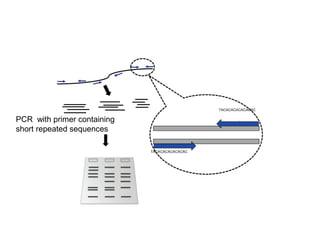
• involves amplification of DNA segment
present at an amplifiable distance
between two identical microsatellite repeat
regions oriented in opposite direction
PCR with primer containing
short repeated sequences
TACACACACACACAC
TACACACACACACAC
• Inter-Simple Sequence Repeat usually 16-
25 bp long
• primers in a single primer PCR reaction
targeting multiple genomic loci to amplify
different sizes of inter-SSR sequences
uses
• ISSR markers are highly polymorphic and
are used in
• genetic diversity,
• gene tagging,
• phylogeny,
• evolutionary biology
• and genome mapping studies
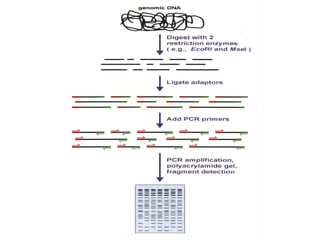
AFLPAFLP
The AFLP technique is based on the
principle of selectively amplifying a
subset of restriction fragments from a
complex mixture of DNA fragments
obtained after digestion of genomic
DNA with restriction endonucleases.
AFLPAFLP
Procedures in AFLP:
- Digestion
- Adaptor Ligation
- Amplification
- Electrophoresis
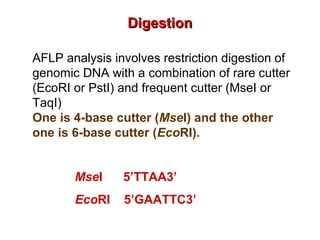
AFLP analysis involves restriction digestion of
genomic DNA with a combination of rare cutter
(EcoRI or PstI) and frequent cutter (MseI or
TaqI)
One is 4-base cutter (MseI) and the other
one is 6-base cutter (EcoRI).
DigestionDigestion
MseI 5’TTAA3’
EcoRI 5’GAATTC3’
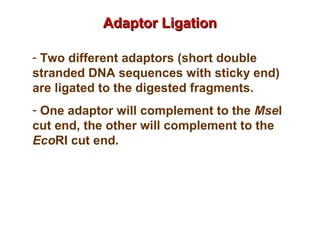
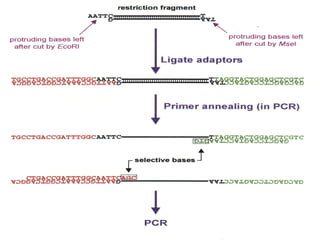
- Two different adaptors (short double
stranded DNA sequences with sticky end)
are ligated to the digested fragments.
- One adaptor will complement to the Msel
cut end, the other will complement to the
EcoRI cut end.
Adaptor LigationAdaptor Ligation
- DNA fragments with MseI-EcoRI ends will
be selected as DNA template for
amplication.
- two PCR primers complementary to the
two adaptors are used in amplification.
- the PCR primers are labelled with
radioactive or fluorescence dye for
detection of DNA bands on gels.
AmplificationAmplification
- polyacrylamide gel is used for separating
DNA bands.
- Normally, 30-100 DNA bands can be
detected by AFLP on polycrylamide gel.
ElectrophoresisElectrophoresis
It is highly reproducible and reliable.
It does not require any DNA sequence information
from the organism under study.
It is information-rich due to its ability to analyze a
large number of polymorphic loci simultaneously with a
single primer combination on a single gel as compared
to RFLPs and microsatellites
Restriction
Fragment
Length
Polymorphism
RFLP
Analysis
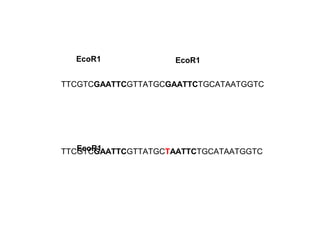
• Some genetic polymorphisms
can be identified by the presence
or absence of a specific
restriction endonuclease
recognition site:For example:
GAATTC versus GATTTC
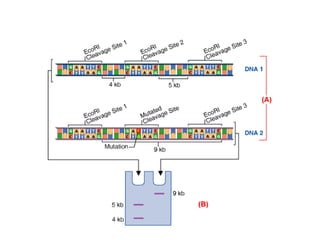
• RFLP analysis is the detection
of the change in the length of the
restriction fragments as a result of
these mutations.
TTCGTCGAATTCGTTATGCGAATTCTGCATAATGGTC
TTCGTCGAATTCGTTATGCTAATTCTGCATAATGGTC
EcoR1 EcoR1
EcoR1
uses
• RFLP markers were used for constructing
genetic maps.
• RFLPs are co-dominant and reliable
marke
• can be easily determined in homozygous
or heterozygous state of an individual.
De-merits
• the large amount of DNA required for
restriction
• Expensive, time-consuming
• Microsatellites, also known as simple
sequence repeats (SSR),
• variable number tandem repeats (VNTR)
and short tandem repeats (STR)
• are tandem repeats of 1-6 nucleotides
found at high frequency in the nuclear
genomes of most taxa
• For example,
• (A)11, (GT)12, (ATT)9, (ATCG)8,
(TAATC)6 and (TGTGCA)5
• Unlike conserved flanking regions,
microsatellite repeat sequences mutate
frequently
• Because alleles differ in length, they can
be distinguished by high-resolution gel
electrophoresis
VNTR
• variable number tandem repeats
– Location in a genome where a short
nucleotide is organized as a tandem repeat
– These can be found on many chromosomes
and often show variations in length
– Each variant acts as an inherited allele
allowing used for identification
– Useful in genetics, biology research, forensics
and DNA fingerprinting
STR
• – short tandem repeat in DNA
– when a pattern of 2 or more nucleotides are
repeated and the repeated sequences are
adjacent to each other.
– Pattern can range in length from 2 to 10 bp
– Typically in non-coding intron region
– Count how many repeats of a specific STR at
a given locus can create unique genetic
profile
– Currently over 10,000 published STR
sequences in human genome
– Prevalent method for determining genetic
profiles in forensic cases.
• Microsatellites are hypervariable; they
often show tens of alleles at a locus that
differ from each other in the numbers of
the repeats.
• They are still the markers of choice for
diversity studies as well as for parentage
analysis
• Minisatellites share the same
characteristics as microsatellites, but the
repeats are ten to a few hundreds bp long.
Micro and minisatellites are also known as
VNTRs (Variable Number of Tandem
Repeats) polymorphisms.
• SSR are used for plant breeding,
conservation biology and population
genetics as forensics, paternity analysis
and gene mapping
• require little amount of DNA, which does
not have to be of high quality.
• the simple interpretation of results
Mitochondrial DNA markers
• Mitochondrial DNA (mtDNA)
polymorphisms have been extensively
used in phylogenetic and genetic diversity
analyses. The haploid mtDNA, carried by
the mitochondria in the cell cytoplasm, has
a maternal mode of inheritance
(individuals inherit the mtDNA from their
dams and not from their sires)

Mapping genetic diversity through genetic markers

  • 1.
    Mapping genetic diversity •Biodiversity is an essential natural resource like soil and water • The genetic diversity of agricultural crops is represented by • bred cultivars, landraces, breeders lines, experimental lines, wild relatives of cultivated plants
  • 2.
    • All theseform a gene pool of agricultural crops which is used • to improve important traits, • to broaden the genetic base of cultivars • and a source of new diversity for agriculture
  • 3.
    Diversity in nature •genetic diversity in nature is often seriously endangered • In nature, biodiversity has been reduced due to the industrial development, climatic changes and agricultural practices
  • 4.
    Diversity in crops •biodiversity in agricultural systems also decreased. • the diversity of local landraces has been replaced by a much narrower spectrum of bred cultivars • that are often genetically similar. • Some valuable original resources were lost in many crops in most countries
  • 5.
    Markers I. The geneticimprovement of animals/plants is a continuous process. II. Man has always been busy in improving his genetic resources. III. many methods have been developed IV. currently, the demonstration of genetic polymorphism at the DNA sequence level has provided a number of marker techniques V. This prompted consideration for the potential utility of these markers in animal/crop breed/cultivar improvement. VI. However, utilization of marker-based information for genetic improvement depends on the choice of an appropriate marker.
  • 6.
    Measuring Genetic Diversity •Within an individual: % heterozygosity (alleles same or different in a given set of genes) • Among individuals in a population: allele frequencies for given genes • Between populations: % heterozygosity, allele frequencies, unique molecular markers
  • 7.
    Conservation Genetics 1) Rateof evolutionary change in a population is proportional to the amount of genetic diversity available 2) Higher genetic diversity is usually positively related to fitness 3) Global pool of genetic diversity represents all of the information for all biological processes (= genetic library)
  • 8.
    Genetic Variation • Mostgenes have small sequence differences between individuals – Occur every 1350 bp on average • Some of these polymorphisms may affect: – How well the protein works – How the protein interacts with another protein or substrate • The different gene forms containing polymorphisms are called alleles
  • 9.
    Mutations • Neutral • Functional •Helpful in understanding biological phenomena
  • 10.
    Genetic/molecular marker • sequenceof DNA located within a known position on the chromosome • or a gene whose expression is easily detectable • can be used to identify individuals or species. • or as a probe to mark a chromosome
  • 11.
    properties • Markers showpolymorphism, which may arise due to alteration of nucleotide or mutation in the genome loci • make it possible to identify genetic differences between individual organisms or species
  • 12.
    Applications • are usedin different areas such as • genetic mapping, paternal tests, • Detect mutant genes which are connected to hereditary diseases, • cultivars identification, marker assisted breeding of crops, • population history, epidemiology
  • 13.
    Desirable Properties of MolecularMarkers • Easily available • Assay is rapid and reproducible • highly polymorphic • Co-dominant inheritance • recurrent occurrence in genome • Selectively neutral to environmental conditions • Data exchange be easy.
  • 14.
    The objectives bestserved by the markers • molecular markers are generally considered to measure neutral DNA variation and consequently are useful in studies of species
  • 15.
    Random Amplified Polymorphic DNA(RAPD) • Random Amplified Polymorphic DNA (RAPD), Arbitrarily Primed PCR (AP- PCR), and DNA Amplification Fingerprinting (DAF) have been collectively termed Multiple Arbitrary Amplicon Profiling (MAAP) • These techniques were first used to amplify any species DNA fragments without prior sequences information
  • 16.
    Difference from standardPCR • changing primer length, sequence and annealing Temperature, the thermostable DNA polymerase, the number of PCR Cycles, digestion of template DNA or amplification products, and alternative methods of fragment separation and staining. • These three techniques produce markedly different amplification profiles
  • 17.
    Stages of PCRStagesof PCR 3’ 5’ 5’ 3’ 3’ 5’3’5’ 2) Primer2) Primer AnnealingAnnealing 3’ 5’ 5’ 3’ Lower temperature allows primers to bind(37-65o C) 3’ 5’ 3’ 5’ 1) Denaturation of Template DNA1) Denaturation of Template DNA 5’ 3’ 5’ 3’ Heat causes DNA strands to separate(94° C ) 3) Extension3) Extension Optimum temp for enzyme 3’ 5’ 3’ 5’3’5’ 3’ 5’ 3’ 5’3’5’ 5’ 3’ 5’ 3’ (72° C)
  • 18.
    History • short primerswould bind to several locations in a genome and thus could produce multiple fragments • Williams et al. (1990) developed Random Amplified Polymorphic DNA (RAPD) a technique using very short 10 base primers to generate random fragments from template DNAs • RAPD fragments can be separated and used as genetic markers or a kind of DNA fingerprint • Techniques related to RAPD include: – DNA Amplification Fingerprinting (DAF) - uses very short (eight nucleotide long) primers – Arbitrary Primed PCR (AP-PCR) - uses longer primers, but lowers primer annealing stringency to get priming at many sites
  • 19.
    • RAPD markersare small usually 10 bp in length • These primers bind to the complementary sequences • and amplification occurs when the regions between the opposing primer sites are within amplifiable distances.
  • 20.
    RAPDRAPD - a methodbased on PCR developed in 1990. - RAPD is different from conventional PCR as it needs one primer for amplification. The size of primer is normally short (10 nucleotides), and therefore, less specific. - the primers can be designed without the experimenter having any genetic information for the organism being tested. - more than 2000 different RAPD primers can be available commercially.
  • 21.
    RAPDRAPD - Genomic DNAnormally has complimentary sequences to RAPD primers at many locations. -If two of these locations are close to each other (<3000bp), and the sequences are in opposite orientation, the amplification will be established. This amplified region is said as a RAPD locus. -Normally, a few (3-20) loci can be amplified by one single RAPD primer.
  • 22.
    Inter-Simple Sequence Repeat (ISSR) •Inter-simple sequence repeats (ISSRs) are regions in the genome flanked by microsatellite sequences. • PCR amplification of these regions using a single primer yields multiple amplification products • Can be used as a dominant multilocus marker system for the study of genetic variation in various organisms.
  • 23.
    • involves amplificationof DNA segment present at an amplifiable distance between two identical microsatellite repeat regions oriented in opposite direction
  • 24.
    PCR with primercontaining short repeated sequences TACACACACACACAC TACACACACACACAC
  • 25.
    • Inter-Simple SequenceRepeat usually 16- 25 bp long • primers in a single primer PCR reaction targeting multiple genomic loci to amplify different sizes of inter-SSR sequences
  • 26.
    uses • ISSR markersare highly polymorphic and are used in • genetic diversity, • gene tagging, • phylogeny, • evolutionary biology • and genome mapping studies
  • 27.
    AFLPAFLP The AFLP techniqueis based on the principle of selectively amplifying a subset of restriction fragments from a complex mixture of DNA fragments obtained after digestion of genomic DNA with restriction endonucleases.
  • 28.
    AFLPAFLP Procedures in AFLP: -Digestion - Adaptor Ligation - Amplification - Electrophoresis
  • 30.
    AFLP analysis involvesrestriction digestion of genomic DNA with a combination of rare cutter (EcoRI or PstI) and frequent cutter (MseI or TaqI) One is 4-base cutter (MseI) and the other one is 6-base cutter (EcoRI). DigestionDigestion MseI 5’TTAA3’ EcoRI 5’GAATTC3’
  • 31.
    - Two differentadaptors (short double stranded DNA sequences with sticky end) are ligated to the digested fragments. - One adaptor will complement to the Msel cut end, the other will complement to the EcoRI cut end. Adaptor LigationAdaptor Ligation
  • 33.
    - DNA fragmentswith MseI-EcoRI ends will be selected as DNA template for amplication. - two PCR primers complementary to the two adaptors are used in amplification. - the PCR primers are labelled with radioactive or fluorescence dye for detection of DNA bands on gels. AmplificationAmplification
  • 34.
    - polyacrylamide gelis used for separating DNA bands. - Normally, 30-100 DNA bands can be detected by AFLP on polycrylamide gel. ElectrophoresisElectrophoresis
  • 35.
    It is highlyreproducible and reliable. It does not require any DNA sequence information from the organism under study. It is information-rich due to its ability to analyze a large number of polymorphic loci simultaneously with a single primer combination on a single gel as compared to RFLPs and microsatellites
  • 36.
    Restriction Fragment Length Polymorphism RFLP Analysis • Some geneticpolymorphisms can be identified by the presence or absence of a specific restriction endonuclease recognition site:For example: GAATTC versus GATTTC • RFLP analysis is the detection of the change in the length of the restriction fragments as a result of these mutations.
  • 37.
  • 39.
    uses • RFLP markerswere used for constructing genetic maps. • RFLPs are co-dominant and reliable marke • can be easily determined in homozygous or heterozygous state of an individual.
  • 40.
    De-merits • the largeamount of DNA required for restriction • Expensive, time-consuming
  • 41.
    • Microsatellites, alsoknown as simple sequence repeats (SSR), • variable number tandem repeats (VNTR) and short tandem repeats (STR) • are tandem repeats of 1-6 nucleotides found at high frequency in the nuclear genomes of most taxa
  • 42.
    • For example, •(A)11, (GT)12, (ATT)9, (ATCG)8, (TAATC)6 and (TGTGCA)5
  • 43.
    • Unlike conservedflanking regions, microsatellite repeat sequences mutate frequently • Because alleles differ in length, they can be distinguished by high-resolution gel electrophoresis
  • 44.
    VNTR • variable numbertandem repeats – Location in a genome where a short nucleotide is organized as a tandem repeat – These can be found on many chromosomes and often show variations in length – Each variant acts as an inherited allele allowing used for identification – Useful in genetics, biology research, forensics and DNA fingerprinting
  • 45.
    STR • – shorttandem repeat in DNA – when a pattern of 2 or more nucleotides are repeated and the repeated sequences are adjacent to each other. – Pattern can range in length from 2 to 10 bp – Typically in non-coding intron region
  • 46.
    – Count howmany repeats of a specific STR at a given locus can create unique genetic profile – Currently over 10,000 published STR sequences in human genome – Prevalent method for determining genetic profiles in forensic cases.
  • 47.
    • Microsatellites arehypervariable; they often show tens of alleles at a locus that differ from each other in the numbers of the repeats. • They are still the markers of choice for diversity studies as well as for parentage analysis
  • 48.
    • Minisatellites sharethe same characteristics as microsatellites, but the repeats are ten to a few hundreds bp long. Micro and minisatellites are also known as VNTRs (Variable Number of Tandem Repeats) polymorphisms.
  • 49.
    • SSR areused for plant breeding, conservation biology and population genetics as forensics, paternity analysis and gene mapping • require little amount of DNA, which does not have to be of high quality. • the simple interpretation of results
  • 50.
    Mitochondrial DNA markers •Mitochondrial DNA (mtDNA) polymorphisms have been extensively used in phylogenetic and genetic diversity analyses. The haploid mtDNA, carried by the mitochondria in the cell cytoplasm, has a maternal mode of inheritance (individuals inherit the mtDNA from their dams and not from their sires)