Computational Fluid
Dynamics
Submitted by
Khusro Kamaluddin
ME-1 IVth Year
Submitted to
Mr. Ravi Goel
Department of Mechanical Engineering Quantum School of
Technology Roorkee - 247667(.K.)
What is CFD ?
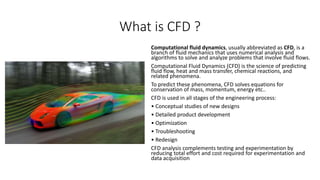
Computational fluid dynamics, usually abbreviated as CFD, is a
branch of fluid mechanics that uses numerical analysis and
algorithms to solve and analyze problems that involve fluid flows.
Computational Fluid Dynamics (CFD) is the science of predicting
fluid flow, heat and mass transfer, chemical reactions, and
related phenomena.
To predict these phenomena, CFD solves equations for
conservation of mass, momentum, energy etc..
CFD is used in all stages of the engineering process:
• Conceptual studies of new designs
• Detailed product development
• Optimization
• Troubleshooting
• Redesign
CFD analysis complements testing and experimentation by
reducing total effort and cost required for experimentation and
data acquisition
Previously Available Methods
Historically there were two broad methodologies for solving fluid flow
problems :
1. Analytical Fluid Dynamics (AFD)
2. Experimental Fluid Dynamics (EFD)
Previously Available Methods
Analytical Fluid Dynamics (AFD) : The exact solutions of fluid flow
problems were found by applying first principles of fluid dynamics
along with mathematical modelling of the entire fluid domain by
various mathematical techniques. But even a little increase in fluid
model the mathematical exponentially increased. Further it is
practically impossible to mathematically model complicated fluid flow
situations.
Weakness : Cannot be independently verified and very difficult for
complex flow.
Previously Available Methods
Experimental Fluid Dynamics (EFD) : The flow problem is solved by
making a model of the domain and the measurable flow properties are
measured using various measurement techniques(such as hot wire
anemometry, Acoustics Doppler Current Profiler) and then other
properties can be calculated using imperial relationships.
Moreover Experimental Fluid Dynamics was used to verify the results
obtained from Analytical Fluid Dynamics.
Weakness : loss of (significant/insignificant)similitude in case of
extremely large and small domains and error in measurements.
Birth of CFD
With the advance of computational capabilities and numerical
techniques in 1950s various alternate methods to solve fluid flow
problems were found under the common name CFD.
This involved :
Constructing a
fluid domain to
be analyzed.
Applying
Suitable
Boundary
Conditions.
Breaking the
domain into
finite small
elements using
discretization
methods.
Generating
differential
equations for
each of the
generated
element.
Converting of
each of the
differential
equation into a
linear equation
using
numerical
techniques.
Using the
Computational
Capabilities to
solve these
equations in an
iterative
fashion.
Bringing
together all
the elements
properties and
use suitable
interpolation
for the final
results.
Is CFD an Independent Technique ?
Although it seams that every thing we need to
analyze a fluid domain is already in there. But it is
not the case. It is just a simulation and the
authenticity of the simulation cannot be verified
unless it is compared with the real world.
Experimental Fluid Dynamics is used to test the
validity of a CFD simulation and is more or less an
approval that the CFD model is correct and can
further be applied to similar situations without even
getting verified.
NO
Is CFD an Independent Technique ?
CFD is indeed a very powerful TOOL if used wisely.
• It can be used to study fluid flows in visually
obstructed situations(ex. Flows in nuclear reactor,
combustion chamber etc. )
• It can be used to short list experiments to find the
best options that can be the solution.
• To help get hands on more comprehensive results
in the fluid domain that couldn’t have been
possible with experiments alone.
TOOL
Turbulence Models
• A turbulence model is a computational procedure to close the system of mean flow
equations.
• For most engineering applications it is unnecessary to resolve the details of the turbulent
fluctuations.
• Turbulence models allow the calculation of the mean flow without first calculating the
full time-dependent flow field.
• We only need to know how turbulence affected the mean flow.
• In particular we need expressions for the Reynolds stresses.
• For a turbulence model to be useful it:
1. must have wide applicability
2. be accurate
3. simple
4. economical to run.
Turbulence Models
Common turbulence models :
Classical models. Based on Reynolds Averaged Navier-Stokes (RANS)
equations (time averaged):
1. Zero equation model: mixing length model.
2. One equation model: Spalart-Almaras.
3. Two equation models: k- ε style models (standard, RNG, realizable), k- ω
model.
4. Seven equation model: Reynolds stress model.
The number of equations denotes the number of additional PDEs that are
being solved.
Discretization Methods
In order to solve the governing equations of the fluid motion, first their
numerical analogue must be generated. This is done by a process referred to
as discretization. In the discretization process, each term within the partial
differential equation describing the flow is written in such a manner that the
computer can be programmed to calculate.
There are various techniques for numerical discretization. Here we will
introduce three
of the most commonly used techniques, namely:
(1) The finite difference method
(2) The finite element method
(3) The finite volume method
The Finite Volume Method
The finite volume method is currently the
most popular method in CFD.
Generally, the finite volume method is a
special case of finite element. A typical finite
volume, or cell, is shown. In this figure the
centroid of the volume, point P, is the
reference point at which we want to
discretize the partial differential equation.
The Finite Volume Method
The above method is also referred to as the Cell
Centered (CC) Method, where the flow variables are
allocated at the center of the computational cell. The CC
variable arrangement is the most popular, since it leads
to considerably simpler implementations than other
arrangements. On the other hand, the CC arrangement is
more susceptible to truncation errors, when the mesh
departs from uniform rectangles.
Traditionally the finite volume methods have used
regular grids for the efficiency of the computations.
However, recently, irregular grids have become more
popular for simulating flows in complex geometries.
Obviously, the computational effort is more when
irregular grids are used, since the algorithm should use a
table to lookup the geometrical relationships between
the volumes or element faces. This involves.
Steps involved in CFD
CFD codes are structured around the numerical algorithms that can
tackle fluid flow problems. In order to provide easy access to their
solving power all commercial CFD packages include sophisticated user
interfaces to input problem parameters and to examine the results.
Hence all codes contain three main elements:
1. Pre-processor
2. Solver
3. Post-processor
Pre-processor
Pre-processing consists of the input of a flow problem to a CFD program by means
of an operator-friendly interface and the subsequent transformation of this input
into a form suitable for use by the solver. The user activities at the pre-processing
stage involve:
• Definition of the geometry of the region of interest: the computational domain
• Grid generation – the sub-division of the domain into a number of smaller, non-
overlapping sub-domains: a grid (or mesh) of cells (or control volumes or elements)
• Selection of the physical and chemical phenomena that need to be modelled
• Definition of fluid properties
• Specification of appropriate boundary conditions at cells which coincide with or
touch the domain boundary
Definition of Geometry
Step 1: Define your modelling Goals
Definition of Geometry
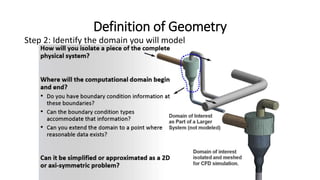
Step 2: Identify the domain you will model
Definition of Geometry
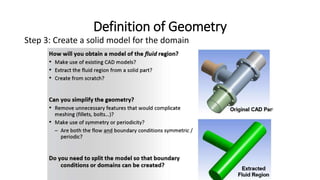
Step 3: Create a solid model for the domain
Definition of Geometry
Step 4: Design and create the mesh
Meshing
In computational solutions of partial differential equations, meshing is a discrete representation of the geometry that is
involved in the problem. Essentially, it partitions space into elements (or cells or zones) over which the equations can be
approximated. Zone boundaries can be free to create computationally best shaped zones, or they can be fixed to represent
internal or external boundaries within a model.
The mesh quality can be conclusively determined based on the following factors.
• Rate of convergence
The greater the rate of convergence, the better the mesh quality. It means that the correct solution has been achieved
faster. An inferior mesh quality may leave out certain important phenomena such as the boundary layer that occurs in fluid
flow. In this case the solution may not converge or the rate of convergence will be impaired.
• Solution accuracy
A better mesh quality provides a more accurate solution. For example, one can refine the mesh at certain areas of the
geometry where the gradients are high, thus increasing the fidelity of solutions in the region. Also, this means that if a
mesh is not sufficiently refined then the accuracy of the solution is more limited. Thus, mesh quality is dictated by the
required accuracy.
• CPU time required
CPU time is a necessary yet undesirable factor. For a highly refined mesh, where the number of cells per unit area is
maximum, the CPU time required will be relatively large. Time will generally be proportional to the number of elements.
Meshing
Common cell shapes :
1. Two Dimensional :
There are two types of two-dimensional cell shapes that are commonly used.
These are the triangle and the quadrilateral.
Computationally poor elements will have sharp internal angles or short edges
or both.
• Triangle
This cell shape consists of 3 sides and is one of the simplest types of mesh. A
triangular surface mesh is always quick and easy to create. It is most common
in unstructured grids.
• Quadrilateral
This cell shape is a basic 4 sided one as shown in the figure. It is most
common in structured grids.
Quadrilateral elements are usually excluded from being or becoming concave.
Meshing
Common cell shapes :
2. Three Dimensional :
The basic 3-dimensional element are the tetrahedron, quadrilateral pyramid, triangular prism, and hexahedron. They
all have triangular and quadrilateral faces.
Extruded 2-dimensional models may be represented entirely by prisms and hexahedra as extruded triangles and
quadrilaterals.
In general, quadrilateral faces in 3-dimensions may not be perfectly planar. A nonplanar quadrilateral face can be
considered a thin tetrahedral volume that is shared by two neighboring elements.
Tetrahedron
A tetrahedron has 4 vertices, 6 edges, and is bounded by 4 triangular faces. In most cases a tetrahedral volume mesh
can be generated automatically.
Pyramid
A quadrilaterally-based pyramid has 5 vertices, 8 edges, bounded by 4 triangular and 1 quadrilateral face. These are
effectively used as transition elements between square and triangular faced elements and other in hybrid meshes
and grids.
Triangular prism
A triangular prism has 6 vertices, 9 edges, bounded by 2 triangular and 3 quadrilateral faces. The advantage with this
type of layer is that it resolves boundary layer efficiently.
Hexahedron
A hexahedron, a topological cube, has 8 vertices, 12 edges, bounded by 6 quadrilateral faces. It is also called a hex or
a brick.For the same cell amount, the accuracy of solutions in hexahedral meshes is the highest.
The pyramid and triangular prism zones can be considered computationally as degenerate hexahedrons, where some
edges have been reduced to zero. Other degenate forms of a hexahedron may also be represented.
Meshing
Classification of grids :
• Structured grids
Structured grids are identified by regular connectivity. The possible element choices
are quadrilateral in 2D and hexahedra in 3D. This model is highly space efficient, i.e.
since the neighborhood relationships are defined by storage arrangement. Some
other advantages of structured grid over unstructured are better convergence and
higher resolution.
• Unstructured grids
An unstructured grid is identified by irregular connectivity. It cannot easily be
expressed as a two-dimensional or three-dimensional array in computer memory.
This allows for any possible element that a solver might be able to use. Compared to
structured meshes, this model can be highly space inefficient since it calls for explicit
storage of neighborhood relationships. These grids typically employ triangles in 2D
and tetrahedra in 3D.
• Hybrid/multizone grids
A hybrid grid contains a mixture of structured portions and unstructured portions. It
integrates the structured meshes and the unstructured meshes in an efficient
manner. Those parts of the geometry that are regular can have structured grids and
those that are complex can have unstructured grids. These grids can be non-
conformal which means that grid lines don’t need to match at block boundaries.
Meshing
Classification of grids :
• Structured grids
Structured grids are identified by regular connectivity. The possible element choices
are quadrilateral in 2D and hexahedra in 3D. This model is highly space efficient, i.e.
since the neighborhood relationships are defined by storage arrangement. Some
other advantages of structured grid over unstructured are better convergence and
higher resolution.
• Unstructured grids
An unstructured grid is identified by irregular connectivity. It cannot easily be
expressed as a two-dimensional or three-dimensional array in computer memory.
This allows for any possible element that a solver might be able to use. Compared to
structured meshes, this model can be highly space inefficient since it calls for explicit
storage of neighborhood relationships. These grids typically employ triangles in 2D
and tetrahedra in 3D.
• Hybrid/multizone grids
A hybrid grid contains a mixture of structured portions and unstructured portions. It
integrates the structured meshes and the unstructured meshes in an efficient
manner. Those parts of the geometry that are regular can have structured grids and
those that are complex can have unstructured grids. These grids can be non-
conformal which means that grid lines don’t need to match at block boundaries.
Meshing
Classification of grids :
• Structured grids
Structured grids are identified by regular connectivity. The possible element choices
are quadrilateral in 2D and hexahedra in 3D. This model is highly space efficient, i.e.
since the neighborhood relationships are defined by storage arrangement. Some
other advantages of structured grid over unstructured are better convergence and
higher resolution.
• Unstructured grids
An unstructured grid is identified by irregular connectivity. It cannot easily be
expressed as a two-dimensional or three-dimensional array in computer memory.
This allows for any possible element that a solver might be able to use. Compared to
structured meshes, this model can be highly space inefficient since it calls for explicit
storage of neighborhood relationships. These grids typically employ triangles in 2D
and tetrahedra in 3D.
• Hybrid/multizone grids
A hybrid grid contains a mixture of structured portions and unstructured portions. It
integrates the structured meshes and the unstructured meshes in an efficient
manner. Those parts of the geometry that are regular can have structured grids and
those that are complex can have unstructured grids. These grids can be non-
conformal which means that grid lines don’t need to match at block boundaries.
Meshing
Mesh – Hexahedron(Hex)
Meshing
Mesh – Tetrahedron (Tet)
Meshing
Mesh – Tetrahedral (Prism)
Meshing
Mesh – Pyramidal
Meshing
Mesh – Recommendation
• 1st Option -> Hex grid
– Best accuracy and numerical efficiency
– Time and effort manageable?
• 2nd Option -> Tet/hex/pyramid grid
– Hex near walls & shear layers
– Developing technology …
• 3rd Option -> Tet/prism grid
– High degree of automation
– Quality (prism/tet transition, …)
• 4th Option -> Tet grid
– Shear layer resolution?
Best Practices-Meshing
Grid must be able to capture
important physics:
– Boundary layers
– Heat transfer
– Wakes, shock
– Flow gradients
Best Practices-Meshing
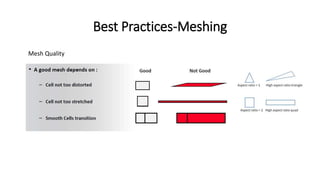
Mesh Quality
Best Practices-Meshing
Mesh Quality
Best Practices-Meshing
Mesh Quality
It is very important to keep in mind that CDF
utilizes Finite Volume Method as it
discretization method.
Finite Volume Method is a Cell Centric (CC)
method and results are catastrophic for
irregular cell shapes(if not very small in
size).Thus it is always advisable to keep the
meshing uniform. But to capture various
phenomena the mesh density has to be
varied.
For this very reason it is strongly
recommended that the variation of the mesh
size should not be abrupt but smooth.
Adaptive Meshing
Adaptive Meshing
Boundary Conditions
Available Boundary condition types :
Boundary Conditions
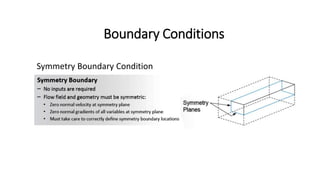
Symmetry Boundary Condition
Pre-processor
The solution to a flow problem (velocity, pressure,
temperature etc.) is defined at nodes inside each cell. The
accuracy of a CFD solution is governed by the number of
cells in the grid. In general, the larger the number of cells,
the better the solution accuracy. Both the accuracy of a
solution and its cost in terms of necessary computer
hardware and calculation time are dependent on the
fineness of the grid. Optimal meshes are often non-uniform:
finer in areas where large variations occur from point to
point and coarser in regions with relatively little change.
Efforts are under way to develop CFD codes with a (self-
)adaptive meshing capability. Ultimately such programs will
automatically refine the grid in areas of rapid variations. A
substantial amount of basic development work still needs to
be done before these techniques are robust enough to be
incorporated into commercial CFD codes. At present it is still
up to the skills of the CFD user to design a grid that is a
suitable compromise between desired accuracy and solution
cost.
Over 50% of the time spent in industry on a CFD project is
devoted to the definition of the domain geometry and grid
generation
Solver
There are three distinct streams of numerical solution techniques:
finite difference, finite element and spectral methods. We shall be
solely concerned with the finite volume method, a special finite
difference formulation that is central to the most well-established CFD
codes: CFX/ANSYS, FLUENT, PHOENICS and STAR-CD. In outline the
numerical algorithm consists of the following steps:
• Integration of the governing equations of fluid flow over all the
(finite) control volumes of the domain
• Discretisation – conversion of the resulting integral equations into a
system of algebraic equations
• Solution of the algebraic equations by an iterative method
Solver
The first step, the control volume integration, distinguishes the finite volume method from all
other CFD techniques.
The resulting statements express the (exact) conservation of relevant properties for each finite
size cell. This clear relationship between the numerical algorithm and the underlying physical
conservation principle forms one of the main attractions of the finite volume method and makes
its concepts much more simple to understand by engineers than the finite element and spectral
methods. The conservation of a general flow variable φ, e.g. a velocity component or enthalpy,
within a finite control volume can be expressed as a balance between the various processes
tending to increase or decrease it. In words we have:
CFD codes contain discretisation techniques suitable for the treatment of the key transport
phenomena, convection (transport due to fluid flow) and diffusion (transport due to variations of
φ from point to point) as well as for the source terms (associated with the creation or destruction
of φ) and the rate of change with respect to time. The underlying physical phenomena are
complex and non-linear so an iterative solution approach is required.
Solver
Solution Procedure Overview :
Solver
Available Solvers :
Solver
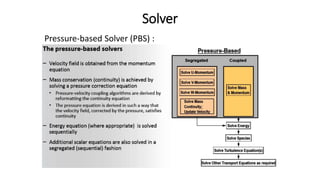
Pressure-based Solver (PBS) :
Solver
Density-based Solver (DBS) :
Post-processor
As in pre-processing, a huge amount of development
work has recently taken place in the post-processing
field. Due to the increased popularity of engineering
workstations, many of which have outstanding graphics
capabilities, the leading CFD packages are now
equipped with versatile data visualization tools. These
include:
• Domain geometry and grid display
• Vector plots
• Line and shaded contour plots
• 2D and 3D surface plots
• Particle tracking
• View manipulation (translation, rotation, scaling etc.)
• Colour PostScript outpu
Post-processor
As in pre-processing, a huge amount of development
work has recently taken place in the post-processing
field. Due to the increased popularity of engineering
workstations, many of which have outstanding graphics
capabilities, the leading CFD packages are now
equipped with versatile data visualization tools. These
include:
• Domain geometry and grid display
• Vector plots
• Line and shaded contour plots
• 2D and 3D surface plots
• Particle tracking
• View manipulation (translation, rotation, scaling etc.)
• Colour PostScript outpu
Post-processor
As in pre-processing, a huge amount of development
work has recently taken place in the post-processing
field. Due to the increased popularity of engineering
workstations, many of which have outstanding graphics
capabilities, the leading CFD packages are now
equipped with versatile data visualization tools. These
include:
• Domain geometry and grid display
• Vector plots
• Line and shaded contour plots
• 2D and 3D surface plots
• Particle tracking
• View manipulation (translation, rotation, scaling etc.)
• Color PostScript output
Thank You
Queries ?
Biblography
1. Fluent User ‘s Guide (Online)
2. F M White “Fluid Mechanics” 7th Edition Mc Graw Hill
3. H. Versteeg, W. Malalasekra-An Introduction to Computational Fluid
Dynamics_ The Finite Volume Method (2nd Edition) -Prentice Hall
(2007)
4. Date A. W.-Introduction to Computational Fluid Dynamics (2005)
5. Anderson, Computational Fluid Dynamics With Basics and Applications
Mc Graw Hill
6. Kundu Cohen Dowling Fluid Mechanics 5th Edition Academic Press

Computational Fluid Dynamics (CFD)

  • 1.
    Computational Fluid Dynamics Submitted by KhusroKamaluddin ME-1 IVth Year Submitted to Mr. Ravi Goel Department of Mechanical Engineering Quantum School of Technology Roorkee - 247667(.K.)
  • 2.
    What is CFD? Computational fluid dynamics, usually abbreviated as CFD, is a branch of fluid mechanics that uses numerical analysis and algorithms to solve and analyze problems that involve fluid flows. Computational Fluid Dynamics (CFD) is the science of predicting fluid flow, heat and mass transfer, chemical reactions, and related phenomena. To predict these phenomena, CFD solves equations for conservation of mass, momentum, energy etc.. CFD is used in all stages of the engineering process: • Conceptual studies of new designs • Detailed product development • Optimization • Troubleshooting • Redesign CFD analysis complements testing and experimentation by reducing total effort and cost required for experimentation and data acquisition
  • 3.
    Previously Available Methods Historicallythere were two broad methodologies for solving fluid flow problems : 1. Analytical Fluid Dynamics (AFD) 2. Experimental Fluid Dynamics (EFD)
  • 4.
    Previously Available Methods AnalyticalFluid Dynamics (AFD) : The exact solutions of fluid flow problems were found by applying first principles of fluid dynamics along with mathematical modelling of the entire fluid domain by various mathematical techniques. But even a little increase in fluid model the mathematical exponentially increased. Further it is practically impossible to mathematically model complicated fluid flow situations. Weakness : Cannot be independently verified and very difficult for complex flow.
  • 5.
    Previously Available Methods ExperimentalFluid Dynamics (EFD) : The flow problem is solved by making a model of the domain and the measurable flow properties are measured using various measurement techniques(such as hot wire anemometry, Acoustics Doppler Current Profiler) and then other properties can be calculated using imperial relationships. Moreover Experimental Fluid Dynamics was used to verify the results obtained from Analytical Fluid Dynamics. Weakness : loss of (significant/insignificant)similitude in case of extremely large and small domains and error in measurements.
  • 6.
    Birth of CFD Withthe advance of computational capabilities and numerical techniques in 1950s various alternate methods to solve fluid flow problems were found under the common name CFD. This involved : Constructing a fluid domain to be analyzed. Applying Suitable Boundary Conditions. Breaking the domain into finite small elements using discretization methods. Generating differential equations for each of the generated element. Converting of each of the differential equation into a linear equation using numerical techniques. Using the Computational Capabilities to solve these equations in an iterative fashion. Bringing together all the elements properties and use suitable interpolation for the final results.
  • 7.
    Is CFD anIndependent Technique ? Although it seams that every thing we need to analyze a fluid domain is already in there. But it is not the case. It is just a simulation and the authenticity of the simulation cannot be verified unless it is compared with the real world. Experimental Fluid Dynamics is used to test the validity of a CFD simulation and is more or less an approval that the CFD model is correct and can further be applied to similar situations without even getting verified. NO
  • 8.
    Is CFD anIndependent Technique ? CFD is indeed a very powerful TOOL if used wisely. • It can be used to study fluid flows in visually obstructed situations(ex. Flows in nuclear reactor, combustion chamber etc. ) • It can be used to short list experiments to find the best options that can be the solution. • To help get hands on more comprehensive results in the fluid domain that couldn’t have been possible with experiments alone. TOOL
  • 9.
    Turbulence Models • Aturbulence model is a computational procedure to close the system of mean flow equations. • For most engineering applications it is unnecessary to resolve the details of the turbulent fluctuations. • Turbulence models allow the calculation of the mean flow without first calculating the full time-dependent flow field. • We only need to know how turbulence affected the mean flow. • In particular we need expressions for the Reynolds stresses. • For a turbulence model to be useful it: 1. must have wide applicability 2. be accurate 3. simple 4. economical to run.
  • 10.
    Turbulence Models Common turbulencemodels : Classical models. Based on Reynolds Averaged Navier-Stokes (RANS) equations (time averaged): 1. Zero equation model: mixing length model. 2. One equation model: Spalart-Almaras. 3. Two equation models: k- ε style models (standard, RNG, realizable), k- ω model. 4. Seven equation model: Reynolds stress model. The number of equations denotes the number of additional PDEs that are being solved.
  • 11.
    Discretization Methods In orderto solve the governing equations of the fluid motion, first their numerical analogue must be generated. This is done by a process referred to as discretization. In the discretization process, each term within the partial differential equation describing the flow is written in such a manner that the computer can be programmed to calculate. There are various techniques for numerical discretization. Here we will introduce three of the most commonly used techniques, namely: (1) The finite difference method (2) The finite element method (3) The finite volume method
  • 12.
    The Finite VolumeMethod The finite volume method is currently the most popular method in CFD. Generally, the finite volume method is a special case of finite element. A typical finite volume, or cell, is shown. In this figure the centroid of the volume, point P, is the reference point at which we want to discretize the partial differential equation.
  • 13.
    The Finite VolumeMethod The above method is also referred to as the Cell Centered (CC) Method, where the flow variables are allocated at the center of the computational cell. The CC variable arrangement is the most popular, since it leads to considerably simpler implementations than other arrangements. On the other hand, the CC arrangement is more susceptible to truncation errors, when the mesh departs from uniform rectangles. Traditionally the finite volume methods have used regular grids for the efficiency of the computations. However, recently, irregular grids have become more popular for simulating flows in complex geometries. Obviously, the computational effort is more when irregular grids are used, since the algorithm should use a table to lookup the geometrical relationships between the volumes or element faces. This involves.
  • 14.
    Steps involved inCFD CFD codes are structured around the numerical algorithms that can tackle fluid flow problems. In order to provide easy access to their solving power all commercial CFD packages include sophisticated user interfaces to input problem parameters and to examine the results. Hence all codes contain three main elements: 1. Pre-processor 2. Solver 3. Post-processor
  • 15.
    Pre-processor Pre-processing consists ofthe input of a flow problem to a CFD program by means of an operator-friendly interface and the subsequent transformation of this input into a form suitable for use by the solver. The user activities at the pre-processing stage involve: • Definition of the geometry of the region of interest: the computational domain • Grid generation – the sub-division of the domain into a number of smaller, non- overlapping sub-domains: a grid (or mesh) of cells (or control volumes or elements) • Selection of the physical and chemical phenomena that need to be modelled • Definition of fluid properties • Specification of appropriate boundary conditions at cells which coincide with or touch the domain boundary
  • 16.
    Definition of Geometry Step1: Define your modelling Goals
  • 17.
    Definition of Geometry Step2: Identify the domain you will model
  • 18.
    Definition of Geometry Step3: Create a solid model for the domain
  • 19.
    Definition of Geometry Step4: Design and create the mesh
  • 20.
    Meshing In computational solutionsof partial differential equations, meshing is a discrete representation of the geometry that is involved in the problem. Essentially, it partitions space into elements (or cells or zones) over which the equations can be approximated. Zone boundaries can be free to create computationally best shaped zones, or they can be fixed to represent internal or external boundaries within a model. The mesh quality can be conclusively determined based on the following factors. • Rate of convergence The greater the rate of convergence, the better the mesh quality. It means that the correct solution has been achieved faster. An inferior mesh quality may leave out certain important phenomena such as the boundary layer that occurs in fluid flow. In this case the solution may not converge or the rate of convergence will be impaired. • Solution accuracy A better mesh quality provides a more accurate solution. For example, one can refine the mesh at certain areas of the geometry where the gradients are high, thus increasing the fidelity of solutions in the region. Also, this means that if a mesh is not sufficiently refined then the accuracy of the solution is more limited. Thus, mesh quality is dictated by the required accuracy. • CPU time required CPU time is a necessary yet undesirable factor. For a highly refined mesh, where the number of cells per unit area is maximum, the CPU time required will be relatively large. Time will generally be proportional to the number of elements.
  • 21.
    Meshing Common cell shapes: 1. Two Dimensional : There are two types of two-dimensional cell shapes that are commonly used. These are the triangle and the quadrilateral. Computationally poor elements will have sharp internal angles or short edges or both. • Triangle This cell shape consists of 3 sides and is one of the simplest types of mesh. A triangular surface mesh is always quick and easy to create. It is most common in unstructured grids. • Quadrilateral This cell shape is a basic 4 sided one as shown in the figure. It is most common in structured grids. Quadrilateral elements are usually excluded from being or becoming concave.
  • 22.
    Meshing Common cell shapes: 2. Three Dimensional : The basic 3-dimensional element are the tetrahedron, quadrilateral pyramid, triangular prism, and hexahedron. They all have triangular and quadrilateral faces. Extruded 2-dimensional models may be represented entirely by prisms and hexahedra as extruded triangles and quadrilaterals. In general, quadrilateral faces in 3-dimensions may not be perfectly planar. A nonplanar quadrilateral face can be considered a thin tetrahedral volume that is shared by two neighboring elements. Tetrahedron A tetrahedron has 4 vertices, 6 edges, and is bounded by 4 triangular faces. In most cases a tetrahedral volume mesh can be generated automatically. Pyramid A quadrilaterally-based pyramid has 5 vertices, 8 edges, bounded by 4 triangular and 1 quadrilateral face. These are effectively used as transition elements between square and triangular faced elements and other in hybrid meshes and grids. Triangular prism A triangular prism has 6 vertices, 9 edges, bounded by 2 triangular and 3 quadrilateral faces. The advantage with this type of layer is that it resolves boundary layer efficiently. Hexahedron A hexahedron, a topological cube, has 8 vertices, 12 edges, bounded by 6 quadrilateral faces. It is also called a hex or a brick.For the same cell amount, the accuracy of solutions in hexahedral meshes is the highest. The pyramid and triangular prism zones can be considered computationally as degenerate hexahedrons, where some edges have been reduced to zero. Other degenate forms of a hexahedron may also be represented.
  • 23.
    Meshing Classification of grids: • Structured grids Structured grids are identified by regular connectivity. The possible element choices are quadrilateral in 2D and hexahedra in 3D. This model is highly space efficient, i.e. since the neighborhood relationships are defined by storage arrangement. Some other advantages of structured grid over unstructured are better convergence and higher resolution. • Unstructured grids An unstructured grid is identified by irregular connectivity. It cannot easily be expressed as a two-dimensional or three-dimensional array in computer memory. This allows for any possible element that a solver might be able to use. Compared to structured meshes, this model can be highly space inefficient since it calls for explicit storage of neighborhood relationships. These grids typically employ triangles in 2D and tetrahedra in 3D. • Hybrid/multizone grids A hybrid grid contains a mixture of structured portions and unstructured portions. It integrates the structured meshes and the unstructured meshes in an efficient manner. Those parts of the geometry that are regular can have structured grids and those that are complex can have unstructured grids. These grids can be non- conformal which means that grid lines don’t need to match at block boundaries.
  • 24.
    Meshing Classification of grids: • Structured grids Structured grids are identified by regular connectivity. The possible element choices are quadrilateral in 2D and hexahedra in 3D. This model is highly space efficient, i.e. since the neighborhood relationships are defined by storage arrangement. Some other advantages of structured grid over unstructured are better convergence and higher resolution. • Unstructured grids An unstructured grid is identified by irregular connectivity. It cannot easily be expressed as a two-dimensional or three-dimensional array in computer memory. This allows for any possible element that a solver might be able to use. Compared to structured meshes, this model can be highly space inefficient since it calls for explicit storage of neighborhood relationships. These grids typically employ triangles in 2D and tetrahedra in 3D. • Hybrid/multizone grids A hybrid grid contains a mixture of structured portions and unstructured portions. It integrates the structured meshes and the unstructured meshes in an efficient manner. Those parts of the geometry that are regular can have structured grids and those that are complex can have unstructured grids. These grids can be non- conformal which means that grid lines don’t need to match at block boundaries.
  • 25.
    Meshing Classification of grids: • Structured grids Structured grids are identified by regular connectivity. The possible element choices are quadrilateral in 2D and hexahedra in 3D. This model is highly space efficient, i.e. since the neighborhood relationships are defined by storage arrangement. Some other advantages of structured grid over unstructured are better convergence and higher resolution. • Unstructured grids An unstructured grid is identified by irregular connectivity. It cannot easily be expressed as a two-dimensional or three-dimensional array in computer memory. This allows for any possible element that a solver might be able to use. Compared to structured meshes, this model can be highly space inefficient since it calls for explicit storage of neighborhood relationships. These grids typically employ triangles in 2D and tetrahedra in 3D. • Hybrid/multizone grids A hybrid grid contains a mixture of structured portions and unstructured portions. It integrates the structured meshes and the unstructured meshes in an efficient manner. Those parts of the geometry that are regular can have structured grids and those that are complex can have unstructured grids. These grids can be non- conformal which means that grid lines don’t need to match at block boundaries.
  • 26.
  • 27.
  • 28.
  • 29.
  • 30.
    Meshing Mesh – Recommendation •1st Option -> Hex grid – Best accuracy and numerical efficiency – Time and effort manageable? • 2nd Option -> Tet/hex/pyramid grid – Hex near walls & shear layers – Developing technology … • 3rd Option -> Tet/prism grid – High degree of automation – Quality (prism/tet transition, …) • 4th Option -> Tet grid – Shear layer resolution?
  • 31.
  • 32.
    Best Practices-Meshing Grid mustbe able to capture important physics: – Boundary layers – Heat transfer – Wakes, shock – Flow gradients
  • 33.
  • 34.
  • 35.
    Best Practices-Meshing Mesh Quality Itis very important to keep in mind that CDF utilizes Finite Volume Method as it discretization method. Finite Volume Method is a Cell Centric (CC) method and results are catastrophic for irregular cell shapes(if not very small in size).Thus it is always advisable to keep the meshing uniform. But to capture various phenomena the mesh density has to be varied. For this very reason it is strongly recommended that the variation of the mesh size should not be abrupt but smooth.
  • 36.
  • 37.
  • 38.
  • 39.
  • 40.
    Pre-processor The solution toa flow problem (velocity, pressure, temperature etc.) is defined at nodes inside each cell. The accuracy of a CFD solution is governed by the number of cells in the grid. In general, the larger the number of cells, the better the solution accuracy. Both the accuracy of a solution and its cost in terms of necessary computer hardware and calculation time are dependent on the fineness of the grid. Optimal meshes are often non-uniform: finer in areas where large variations occur from point to point and coarser in regions with relatively little change. Efforts are under way to develop CFD codes with a (self- )adaptive meshing capability. Ultimately such programs will automatically refine the grid in areas of rapid variations. A substantial amount of basic development work still needs to be done before these techniques are robust enough to be incorporated into commercial CFD codes. At present it is still up to the skills of the CFD user to design a grid that is a suitable compromise between desired accuracy and solution cost. Over 50% of the time spent in industry on a CFD project is devoted to the definition of the domain geometry and grid generation
  • 41.
    Solver There are threedistinct streams of numerical solution techniques: finite difference, finite element and spectral methods. We shall be solely concerned with the finite volume method, a special finite difference formulation that is central to the most well-established CFD codes: CFX/ANSYS, FLUENT, PHOENICS and STAR-CD. In outline the numerical algorithm consists of the following steps: • Integration of the governing equations of fluid flow over all the (finite) control volumes of the domain • Discretisation – conversion of the resulting integral equations into a system of algebraic equations • Solution of the algebraic equations by an iterative method
  • 42.
    Solver The first step,the control volume integration, distinguishes the finite volume method from all other CFD techniques. The resulting statements express the (exact) conservation of relevant properties for each finite size cell. This clear relationship between the numerical algorithm and the underlying physical conservation principle forms one of the main attractions of the finite volume method and makes its concepts much more simple to understand by engineers than the finite element and spectral methods. The conservation of a general flow variable φ, e.g. a velocity component or enthalpy, within a finite control volume can be expressed as a balance between the various processes tending to increase or decrease it. In words we have: CFD codes contain discretisation techniques suitable for the treatment of the key transport phenomena, convection (transport due to fluid flow) and diffusion (transport due to variations of φ from point to point) as well as for the source terms (associated with the creation or destruction of φ) and the rate of change with respect to time. The underlying physical phenomena are complex and non-linear so an iterative solution approach is required.
  • 43.
  • 44.
  • 45.
  • 46.
  • 47.
    Post-processor As in pre-processing,a huge amount of development work has recently taken place in the post-processing field. Due to the increased popularity of engineering workstations, many of which have outstanding graphics capabilities, the leading CFD packages are now equipped with versatile data visualization tools. These include: • Domain geometry and grid display • Vector plots • Line and shaded contour plots • 2D and 3D surface plots • Particle tracking • View manipulation (translation, rotation, scaling etc.) • Colour PostScript outpu
  • 48.
    Post-processor As in pre-processing,a huge amount of development work has recently taken place in the post-processing field. Due to the increased popularity of engineering workstations, many of which have outstanding graphics capabilities, the leading CFD packages are now equipped with versatile data visualization tools. These include: • Domain geometry and grid display • Vector plots • Line and shaded contour plots • 2D and 3D surface plots • Particle tracking • View manipulation (translation, rotation, scaling etc.) • Colour PostScript outpu
  • 49.
    Post-processor As in pre-processing,a huge amount of development work has recently taken place in the post-processing field. Due to the increased popularity of engineering workstations, many of which have outstanding graphics capabilities, the leading CFD packages are now equipped with versatile data visualization tools. These include: • Domain geometry and grid display • Vector plots • Line and shaded contour plots • 2D and 3D surface plots • Particle tracking • View manipulation (translation, rotation, scaling etc.) • Color PostScript output
  • 50.
  • 51.
  • 52.
    Biblography 1. Fluent User‘s Guide (Online) 2. F M White “Fluid Mechanics” 7th Edition Mc Graw Hill 3. H. Versteeg, W. Malalasekra-An Introduction to Computational Fluid Dynamics_ The Finite Volume Method (2nd Edition) -Prentice Hall (2007) 4. Date A. W.-Introduction to Computational Fluid Dynamics (2005) 5. Anderson, Computational Fluid Dynamics With Basics and Applications Mc Graw Hill 6. Kundu Cohen Dowling Fluid Mechanics 5th Edition Academic Press