By:
Abhishek Singh Chauhan
Scholar no. 121116087
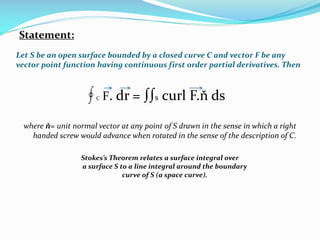
Let S be an open surface bounded by a closed curve C and vector F be any
vector point function having continuous first order partial derivatives. Then
C F. dr = ∫∫s curl F.ň ds
where ň= unit normal vector at any point of S drawn in the sense in which a right
handed screw would advance when rotated in the sense of the description of C.
Stokes’s Theorem relates a surface integral over
a surface S to a line integral around the boundary
curve of S (a space curve).
Statement:
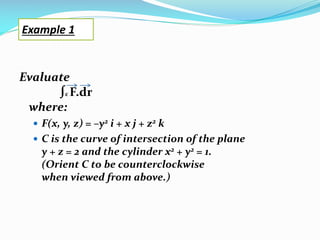
Evaluate
∫c F.dr
where:
 F(x, y, z) = –y2 i + x j + z2 k
 C is the curve of intersection of the plane
y + z = 2 and the cylinder x2 + y2 = 1.
(Orient C to be counterclockwise
when viewed from above.)
Example 1
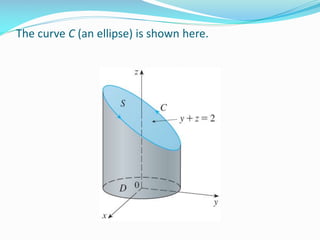
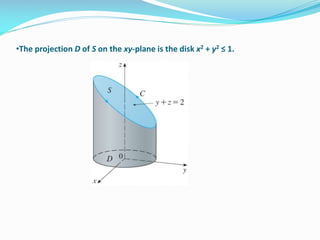
The curve C (an ellipse) is shown here.
We first compute:
 
2 2
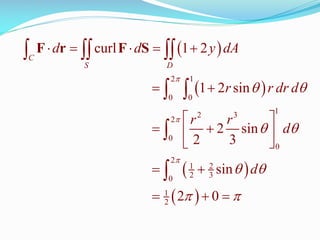
curl 1 2y
x y z
y x z
  
  
  

i j k
F k
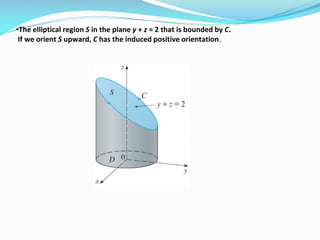
•The elliptical region S in the plane y + z = 2 that is bounded by C.
If we orient S upward, C has the induced positive orientation.
•The projection D of S on the xy-plane is the disk x2 + y2 ≤ 1.
 
 
 
 
2 1
0 0
12 3
2
0
0
2
1 2
2 30
1
2
curl 1 2
1 2 sin
2 sin
2 3
sin
2 0
C
S D
d d y dA
r r dr d
r r
d
d



 
 
 
 
    
 
 
  
 
 
  
  
 


F r F S
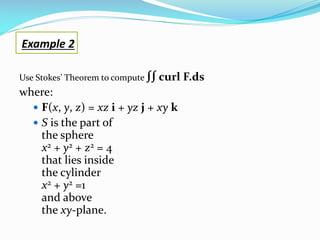
Use Stokes’ Theorem to compute ∫∫ curl F.ds
where:
 F(x, y, z) = xz i + yz j + xy k
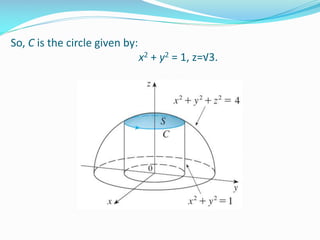
 S is the part of
the sphere
x2 + y2 + z2 = 4
that lies inside
the cylinder
x2 + y2 =1
and above
the xy-plane.
Example 2
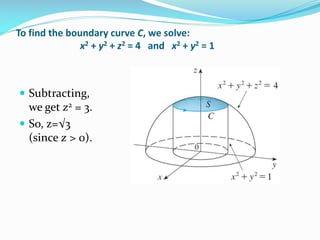
To find the boundary curve C, we solve:
x2 + y2 + z2 = 4 and x2 + y2 = 1
 Subtracting,
we get z2 = 3.
 So, z=√3
(since z > 0).
So, C is the circle given by:
x2 + y2 = 1, z=√3.
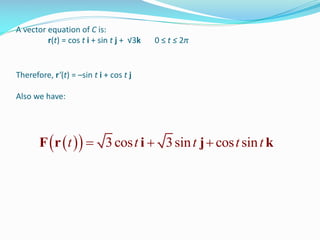
A vector equation of C is:
r(t) = cos t i + sin t j + √3k 0 ≤ t ≤ 2π
Therefore, r’(t) = –sin t i + cos t j
Also we have:
   3cos 3sin cos sint t t t t  F r i j k
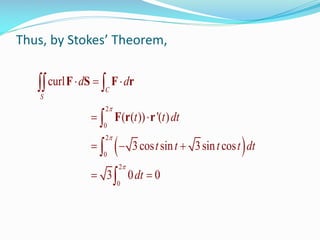
Thus, by Stokes’ Theorem,
 
2
0
2
0
2
0
curl
( ( )) '( )
3cos sin 3sin cos
3 0 0
C
S
d d
t t dt
t t t t dt
dt



  
 
  
 
 



F S F r
F r r
Verify Stokes’ Theorem for the field F =<x2, 2x, z2> on the ellipse S = {(x, y , z) :
4x2 + y 2 6 4, z = 0}.
Solution: We compute both sides in ∫c F · dr =∫∫s curl F · n dσ.
We start computing the circulation
integral on the ellipse x2 + =1.
We need to choose a counterclockwise parametrization,
hence the normal to S
points upwards. We choose, for t ∈ [0, 2π],
r(t) = <cos(t), 2 sin(t), 0>.
Therefore, the right-hand rule normal n to S is n = <0, 0,
Example 3
Recall: ∫ c F · dr = ∫∫s curl F · n dσ. r(t) = <cos(t), 2 sin(t), 0>, t ∈ [0, 2π] and n = <0, 0,
1>. The circulation integral is:
∫ F. dr=
∫c F. dr=
The substitution on the first term u = cos(t) and du = − sin(t) dt implies
=
Since = 0, we conclude that ∫c F. dr= 4π
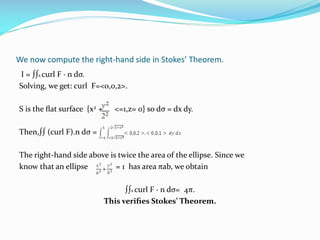
We now compute the right-hand side in Stokes’ Theorem.
I = ∫∫s curl F · n dσ.
Solving, we get: curl F=<0,0,2>.
S is the flat surface {x2 + <=1,z= 0} so dσ = dx dy.
Then,∫∫ (curl F).n dσ =
The right-hand side above is twice the area of the ellipse. Since we
know that an ellipse = 1 has area πab, we obtain
∫∫s curl F · n dσ= 4π.
This verifies Stokes’ Theorem.
Thank
you!!!!!

Stoke’s theorem

  • 1.
  • 2.
    Let S bean open surface bounded by a closed curve C and vector F be any vector point function having continuous first order partial derivatives. Then C F. dr = ∫∫s curl F.ň ds where ň= unit normal vector at any point of S drawn in the sense in which a right handed screw would advance when rotated in the sense of the description of C. Stokes’s Theorem relates a surface integral over a surface S to a line integral around the boundary curve of S (a space curve). Statement:
  • 3.
    Evaluate ∫c F.dr where:  F(x,y, z) = –y2 i + x j + z2 k  C is the curve of intersection of the plane y + z = 2 and the cylinder x2 + y2 = 1. (Orient C to be counterclockwise when viewed from above.) Example 1
  • 4.
    The curve C(an ellipse) is shown here.
  • 5.
    We first compute:  2 2 curl 1 2y x y z y x z           i j k F k
  • 6.
    •The elliptical regionS in the plane y + z = 2 that is bounded by C. If we orient S upward, C has the induced positive orientation.
  • 7.
    •The projection Dof S on the xy-plane is the disk x2 + y2 ≤ 1.
  • 8.
           2 1 0 0 12 3 2 0 0 2 1 2 2 30 1 2 curl 1 2 1 2 sin 2 sin 2 3 sin 2 0 C S D d d y dA r r dr d r r d d                                      F r F S
  • 9.
    Use Stokes’ Theoremto compute ∫∫ curl F.ds where:  F(x, y, z) = xz i + yz j + xy k  S is the part of the sphere x2 + y2 + z2 = 4 that lies inside the cylinder x2 + y2 =1 and above the xy-plane. Example 2
  • 10.
    To find theboundary curve C, we solve: x2 + y2 + z2 = 4 and x2 + y2 = 1  Subtracting, we get z2 = 3.  So, z=√3 (since z > 0).
  • 11.
    So, C isthe circle given by: x2 + y2 = 1, z=√3.
  • 12.
    A vector equationof C is: r(t) = cos t i + sin t j + √3k 0 ≤ t ≤ 2π Therefore, r’(t) = –sin t i + cos t j Also we have:    3cos 3sin cos sint t t t t  F r i j k
  • 13.
    Thus, by Stokes’Theorem,   2 0 2 0 2 0 curl ( ( )) '( ) 3cos sin 3sin cos 3 0 0 C S d d t t dt t t t t dt dt                   F S F r F r r
  • 14.
    Verify Stokes’ Theoremfor the field F =<x2, 2x, z2> on the ellipse S = {(x, y , z) : 4x2 + y 2 6 4, z = 0}. Solution: We compute both sides in ∫c F · dr =∫∫s curl F · n dσ. We start computing the circulation integral on the ellipse x2 + =1. We need to choose a counterclockwise parametrization, hence the normal to S points upwards. We choose, for t ∈ [0, 2π], r(t) = <cos(t), 2 sin(t), 0>. Therefore, the right-hand rule normal n to S is n = <0, 0, Example 3
  • 15.
    Recall: ∫ cF · dr = ∫∫s curl F · n dσ. r(t) = <cos(t), 2 sin(t), 0>, t ∈ [0, 2π] and n = <0, 0, 1>. The circulation integral is: ∫ F. dr= ∫c F. dr= The substitution on the first term u = cos(t) and du = − sin(t) dt implies = Since = 0, we conclude that ∫c F. dr= 4π
  • 16.
    We now computethe right-hand side in Stokes’ Theorem. I = ∫∫s curl F · n dσ. Solving, we get: curl F=<0,0,2>. S is the flat surface {x2 + <=1,z= 0} so dσ = dx dy. Then,∫∫ (curl F).n dσ = The right-hand side above is twice the area of the ellipse. Since we know that an ellipse = 1 has area πab, we obtain ∫∫s curl F · n dσ= 4π. This verifies Stokes’ Theorem.
  • 17.