Vector Algebra
Mr. HIMANSHU DIWAKAR
Assistant professor
ECED
Mr. Himanshu Diwakar 1JETGI
Mr. Himanshu Diwakar JETGI 2
VECTOR CALCULUS
Introduction
Scalars And Vectors
Gradient Of A Scalar
Divergence Of A Vector
Divergence Theorem
Curl Of A Vector
Stokes’s Theorem
Laplacian Of A Scalar
Mr. Himanshu Diwakar 3JETGI
Introduction
• Electromagnetics(EM):-
Interaction between electric charges
at rest
and
in motion.
• It entails the analysis, synthesis, physical interpretation, and
application of electric and magnetic fields.
Mr. Himanshu Diwakar 4JETGI
Scalars and vectors
• A scalar is a quantity that has only magnitude
Ex:- time, mass, distance, temperature, entropy etc.
• A vector is a quantity that has both magnitude and direction
• Velocity, force, displacement and electric field intensity.
Mr. Himanshu Diwakar JETGI 5
Unit vectors
Mr. Himanshu Diwakar JETGI 6
x
z
y
az
ay
ax
Unit vectors
az ,ay ,az
Similarly a A vector in Cartesian co-
ordinate
A=Ax.ax+Ay.ay+Az.az
So Unit vector of A
𝐴 =
𝐴
𝐴
Position and distance vector
Mr. Himanshu Diwakar JETGI 7
x
z
y
az
ay
ax
P (3, 4, 5)
O (0, 0, 0)
The distance vector is the displacement
from one point to another.
A= 3.ax+ 4.ay+ 5.az
OP distance
OP=(3−0).ax+ (4−0).ay+ (5−0).az
𝑂𝑃 = (3−0).ax+ (4−0).ay+ (5−0).az
= 9 + 16 + 25
=7.071
Vector multiplication
• Scalar (or dot) product = A.B
• Vector (or cross) product = A×B
• Scalar triple product : A. (B × C)
• Vector triple product :
A × B × C = B A. C − C(A. B)
Mr. Himanshu Diwakar JETGI 8
Angels
Mr. Himanshu Diwakar JETGI 9
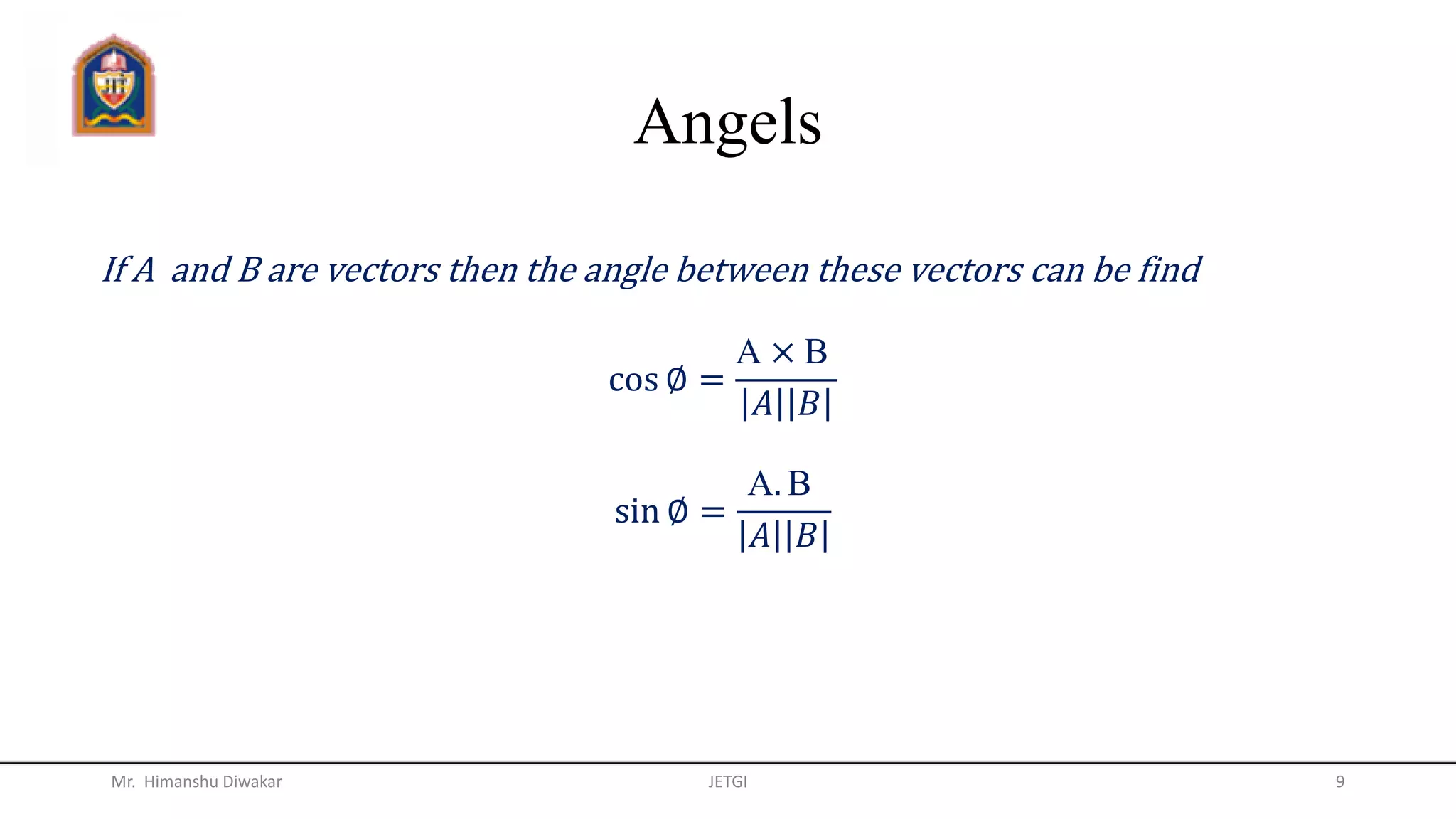
If A and B are vectors then the angle between these vectors can be find
cos ∅ =
A × B
𝐴 𝐵
sin ∅ =
A. B
𝐴 𝐵
Differential Length (Cartesian Coordinates )
• Differential elements in length, area, and volume are useful in vector calculus.
They are defined in the Cartesian, cylindrical, and spherical coordinate systems.
1. Differential displacement is given by
2. Differential normal area is given by
3. Differential volume is given by
Mr. Himanshu Diwakar JETGI 10
Mr. Himanshu Diwakar JETGI 11
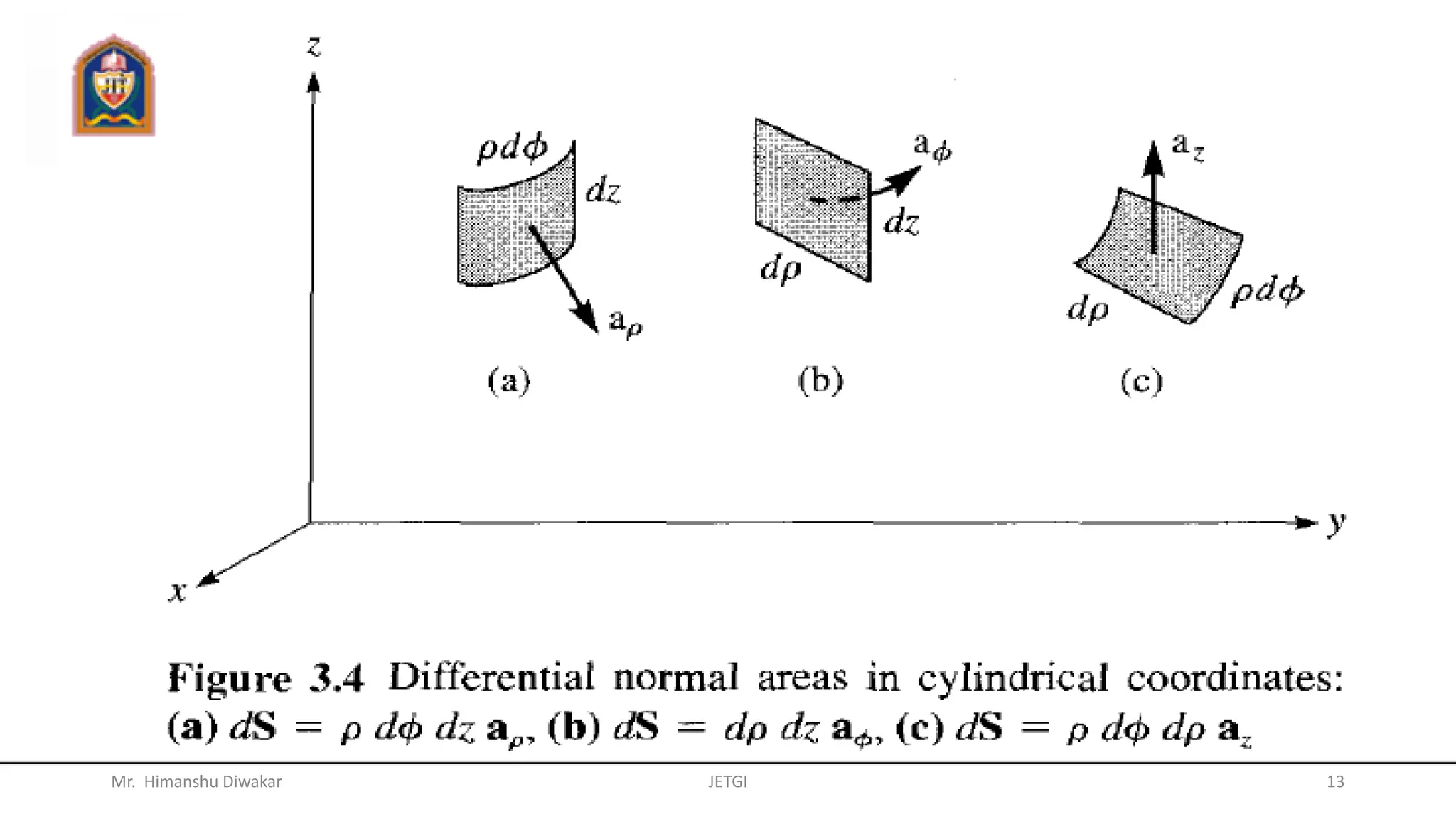
Cylindrical Coordinates
• Notice from Figure that in cylindrical coordinates, differential
elements can be found as follows:
1. Differential displacement is given by
2. Differential normal area is given by
3. Differential volume is given by
Mr. Himanshu Diwakar JETGI 12
Mr. Himanshu Diwakar JETGI 13
Mr. Himanshu Diwakar JETGI 14
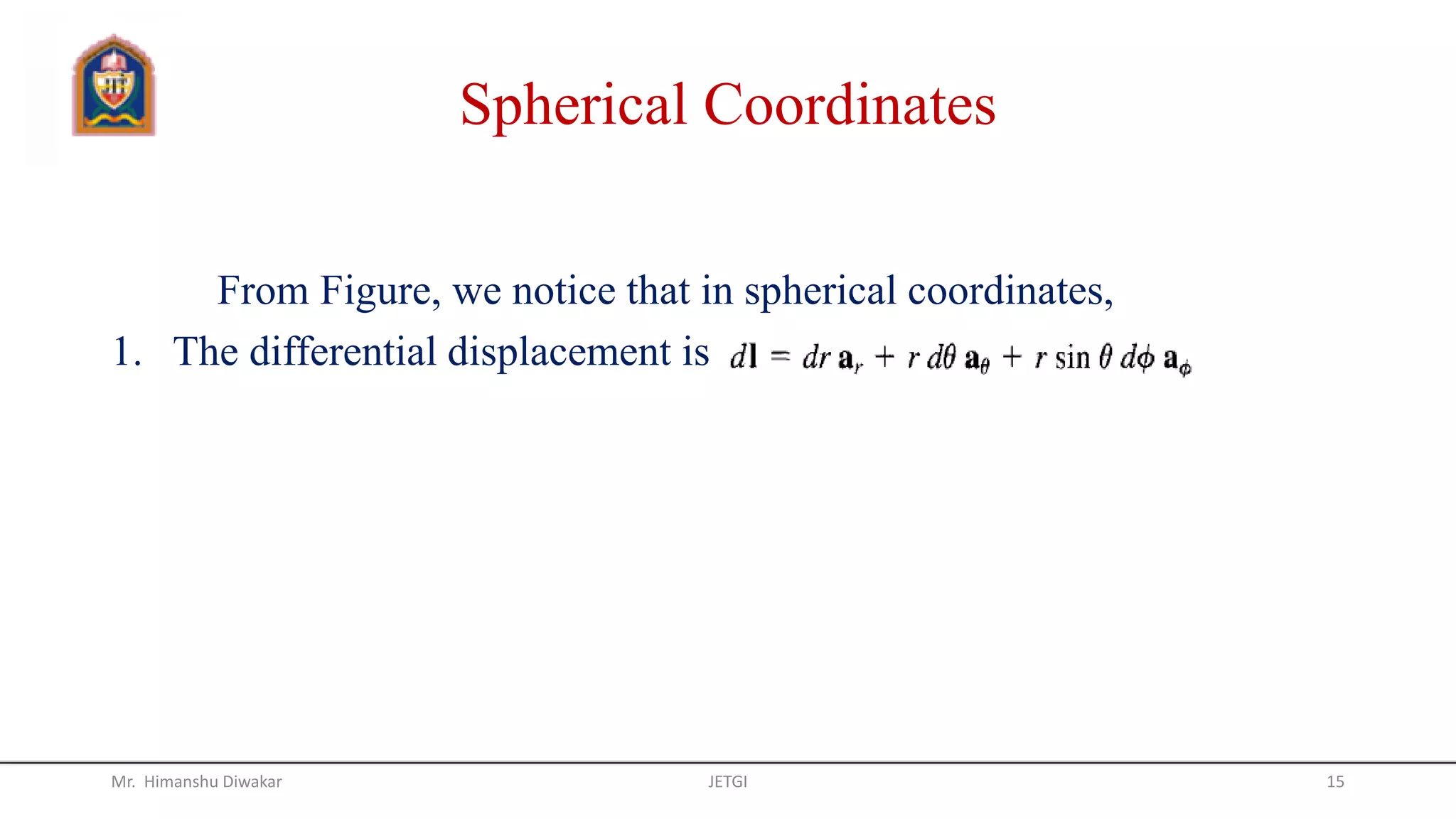
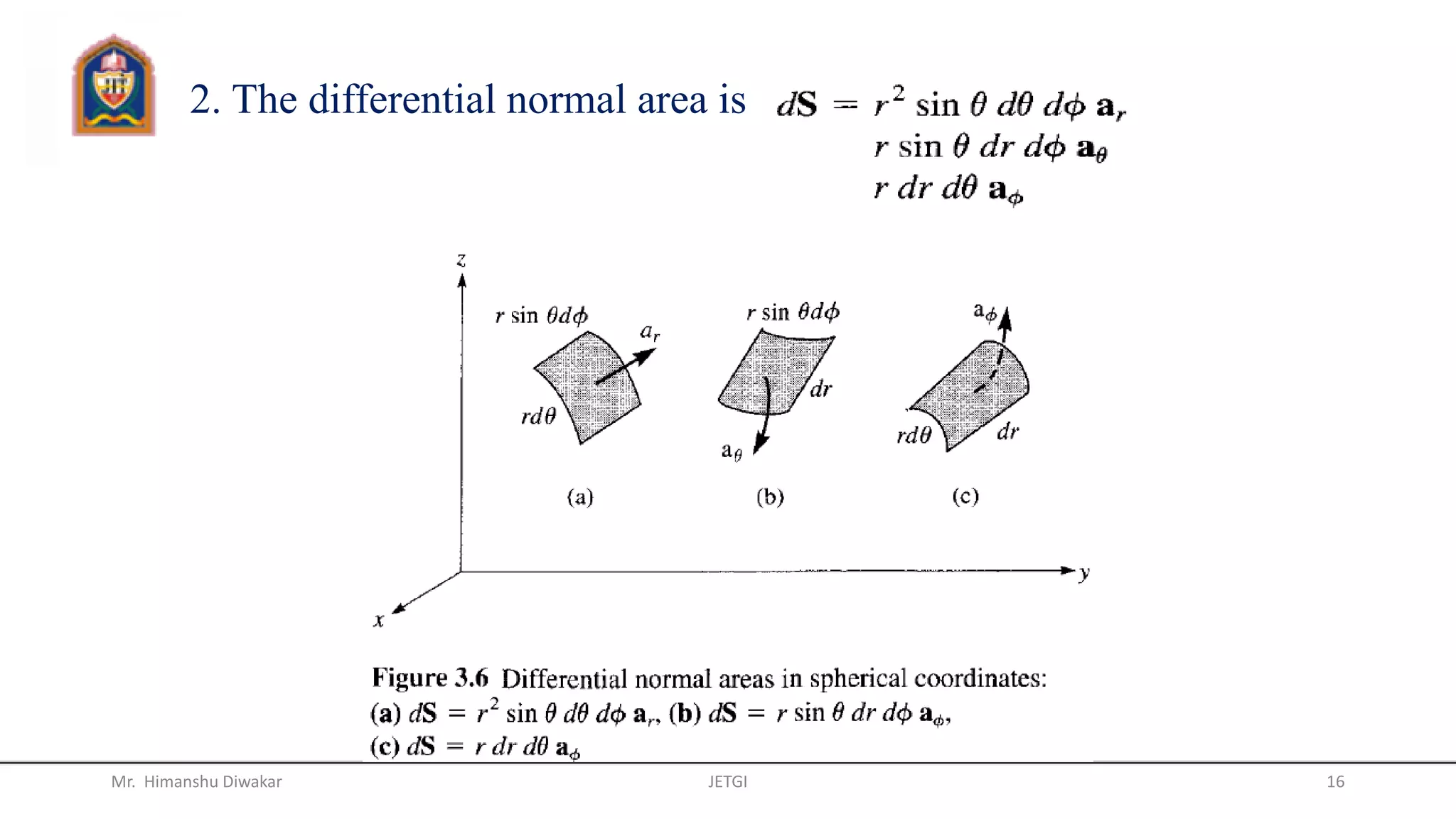
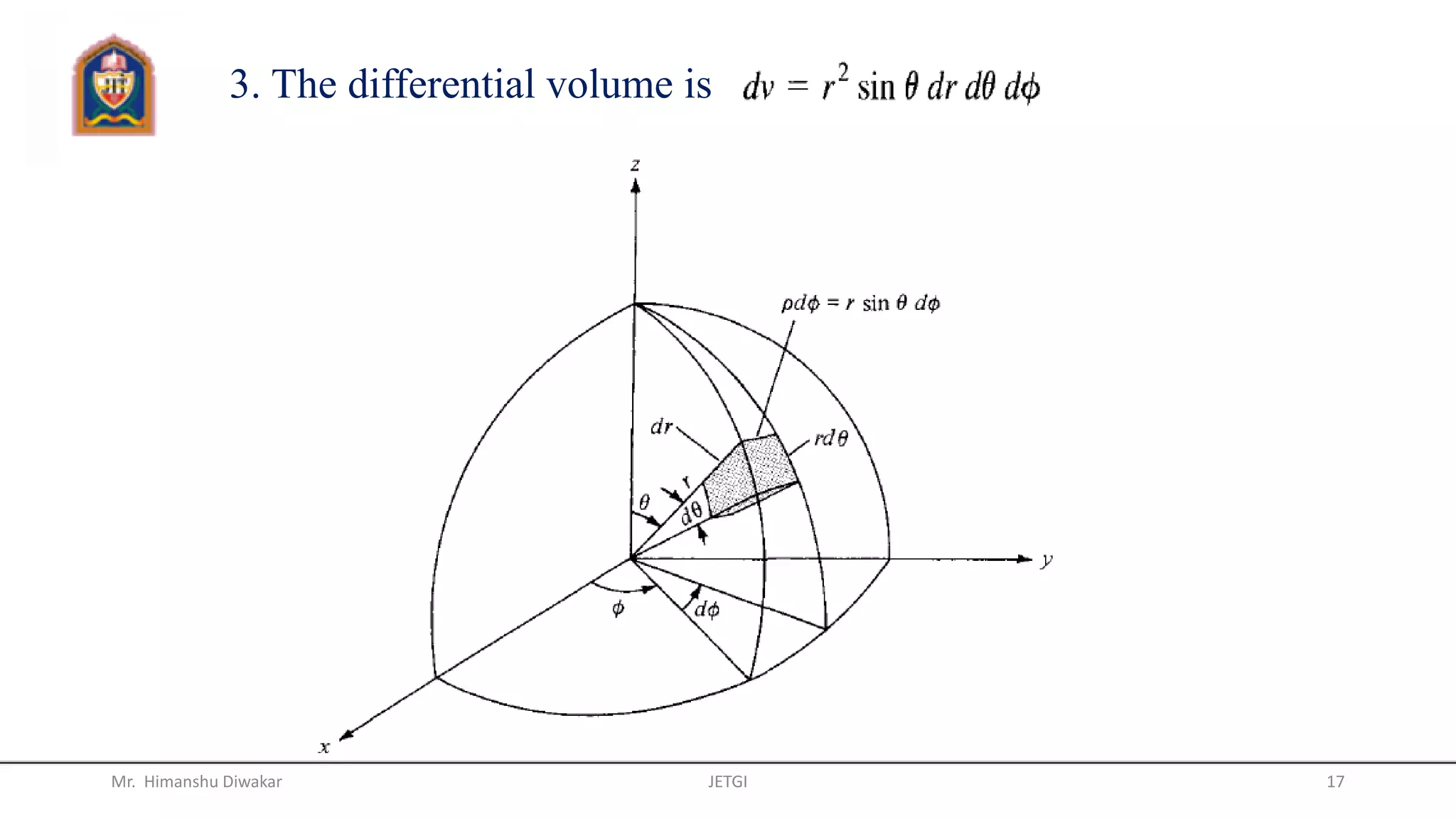
Spherical Coordinates
From Figure, we notice that in spherical coordinates,
1. The differential displacement is
Mr. Himanshu Diwakar JETGI 15
2. The differential normal area is
Mr. Himanshu Diwakar JETGI 16
3. The differential volume is
Mr. Himanshu Diwakar JETGI 17
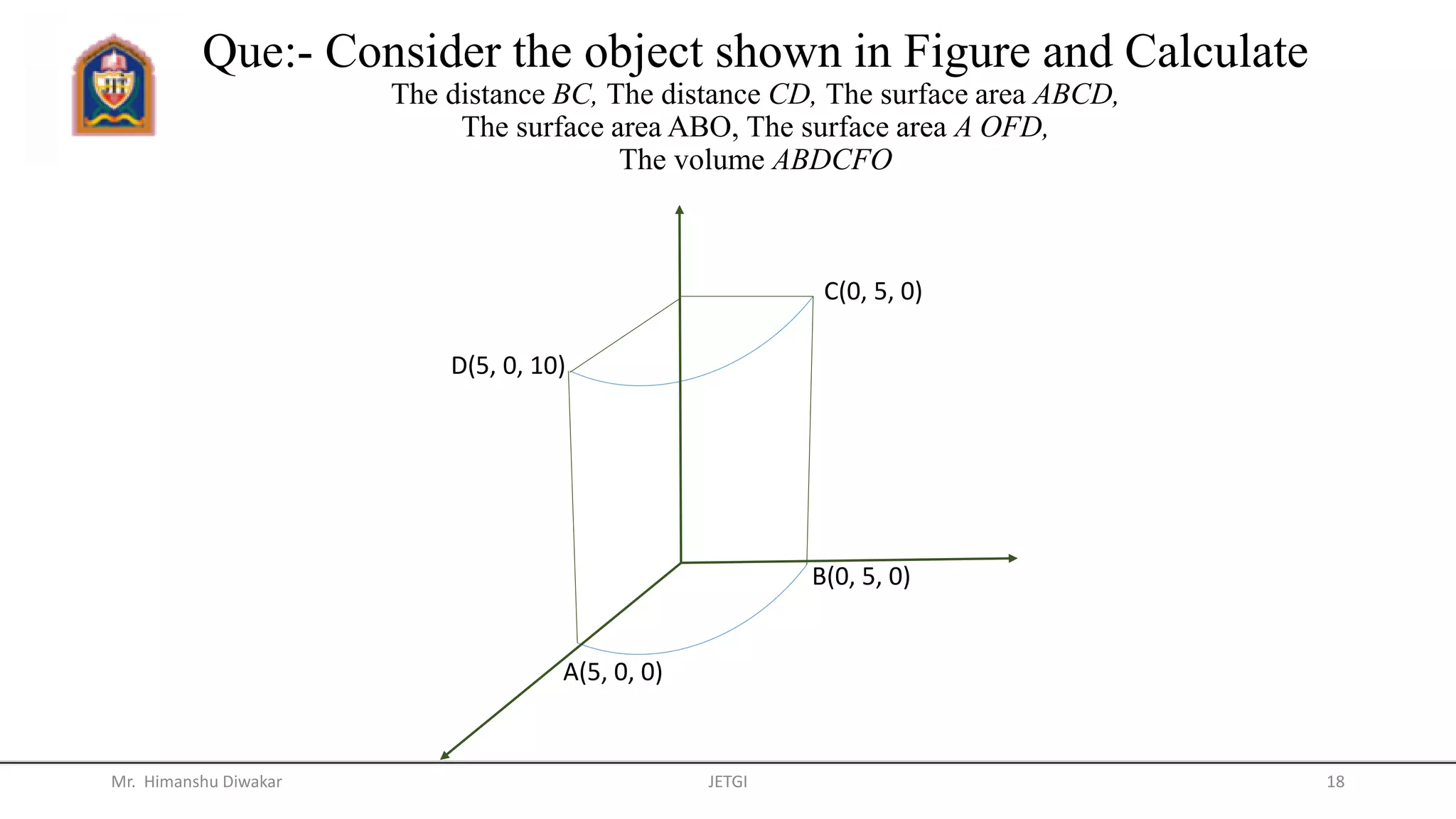
Que:- Consider the object shown in Figure and Calculate
The distance BC, The distance CD, The surface area ABCD,
The surface area ABO, The surface area A OFD,
The volume ABDCFO
Mr. Himanshu Diwakar JETGI 18
C(0, 5, 0)
B(0, 5, 0)
D(5, 0, 10)
A(5, 0, 0)
Line, Surface And Volume Integrals
• The familiar concept of integration will now be extended to cases
when the integrand involves a vector. By a line we mean the path
along a curve in space. We shall use terms such as line, curve, and
contour interchangeably.
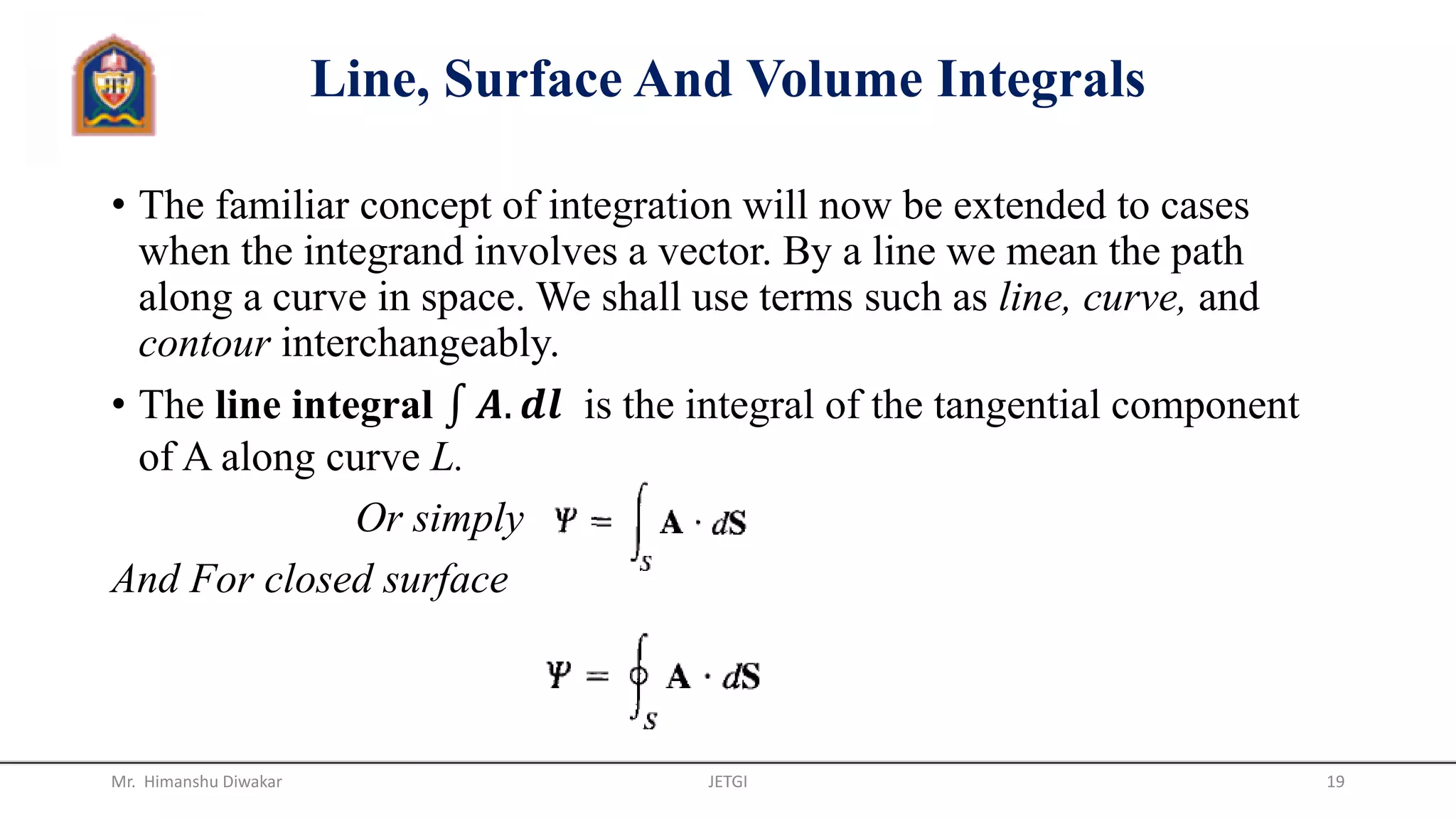
• The line integral 𝑨. 𝒅𝒍 is the integral of the tangential component
of A along curve L.
Or simply
And For closed surface
Mr. Himanshu Diwakar JETGI 19
Example:-
Given that F = 𝑥2 𝑎 𝑥 − 𝑥𝑧𝑎 𝑦 − 𝑦2 𝑎 𝑧, calculate the circulation of F
around the (closed) path shown in Figure
Ans:−
1
6
Mr. Himanshu Diwakar JETGI 20
Dell operator
• The del operator, written 𝛻, is the vector differential operator. In
Cartesian coordinates,
• This vector differential operator, otherwise known as the gradient
operator, is not a vector in itself, but when it operates on a scalar
function, for example, a vector ensues. The operator is useful in
defining
Mr. Himanshu Diwakar JETGI 21
1. The gradient of a scalar V, written, as (𝛻𝑉)
2. The divergence of a vector A, written as (𝛻 • A)
3. The curl of a vector A, written as (𝛻 X A)
4. The Laplacian of a scalar V, written as (𝛻2 𝑉)
Each of these will be denned in detail in the subsequent sections.
Mr. Himanshu Diwakar JETGI 22
Mr. Himanshu Diwakar JETGI 23
Mr. Himanshu Diwakar JETGI 24
So the solution for above equations is
CLASSIFICATION OF VECTOR FIELDS
• A vector field is uniquely characterized by its divergence and curl.
Neither the divergence nor curl of a vector field is sufficient to
completely describe the field.
• All vector fields can be classified in terms of their vanishing or non
vanishing divergence or curl as follows:
Mr. Himanshu Diwakar JETGI 25
Typical fields with vanishing and non vanishing divergence or curl.
Mr. Himanshu Diwakar JETGI 26
• A vector field A is said to be solenoidal (or divergenceless) if
𝛻•𝐴 = 0.
• A vector field A is said to be irrotational (or potential) if
𝛻 × 𝐴 = 0.
Mr. Himanshu Diwakar JETGI 27
The differential distances are the
components of the differential distance
vector :
dzdydx ,,
zyx dzdydxd aaaL 
Ld
However, from differential calculus, the differential
temperature:
dz
z
T
dy
y
T
dx
x
T
TTdT








 12
GRADIENT OF A SCALAR
Mr. Himanshu Diwakar 28JETGI
But,
z
y
x
ddz
ddy
ddx
aL
aL
aL



So, previous equation can be rewritten as:
Laaa
LaLaLa
d
z
T
y
T
x
T
d
z
T
d
y
T
d
x
T
dT
zyx
zyx

























GRADIENT OF A SCALAR (Cont’d)
Mr. Himanshu Diwakar 29JETGI
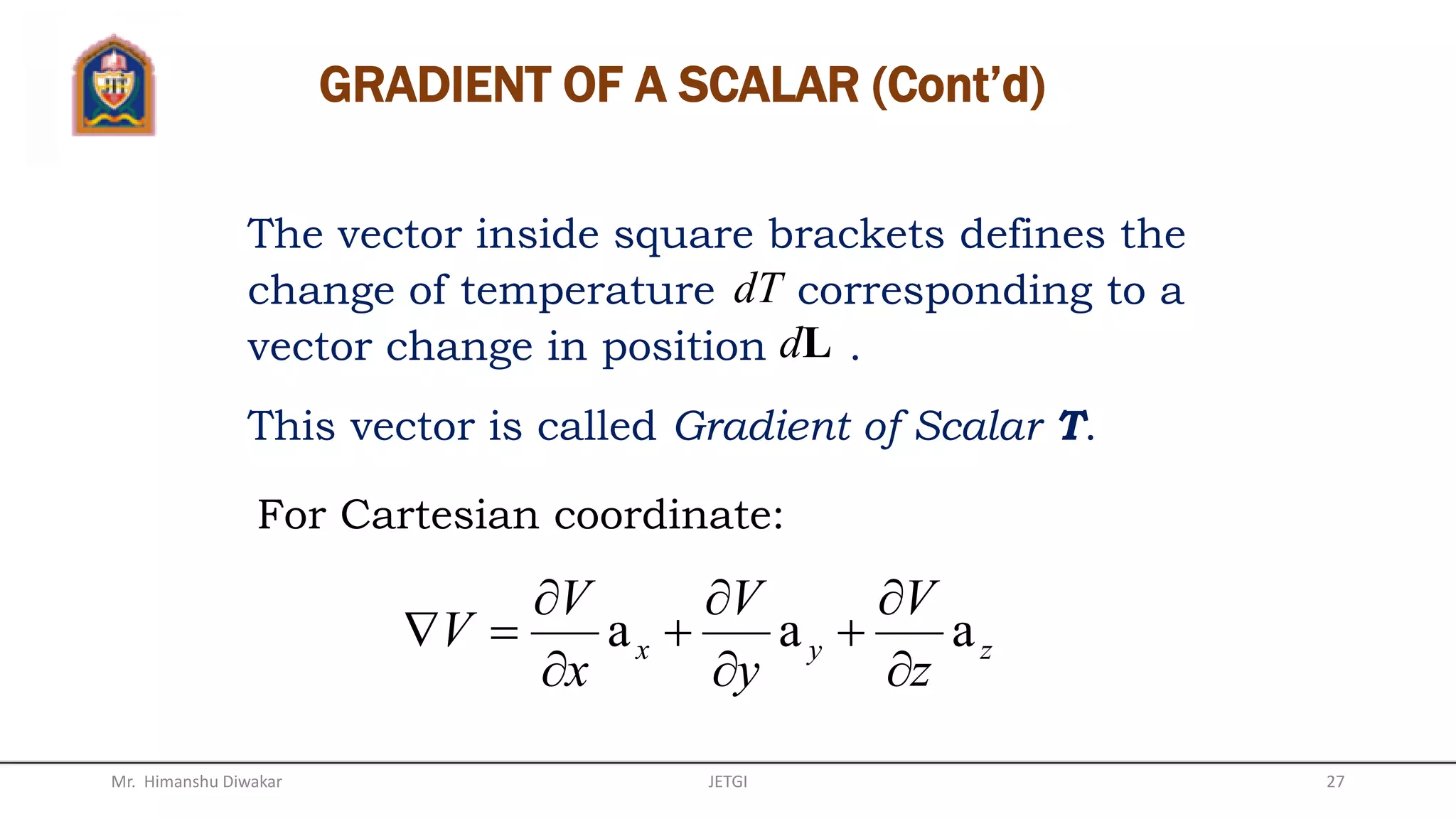
The vector inside square brackets defines the
change of temperature corresponding to a
vector change in position .
This vector is called Gradient of Scalar T.
Ld
dT
GRADIENT OF A SCALAR (Cont’d)
For Cartesian coordinate:
zyx
z
V
y
V
x
V
V aaa









Mr. Himanshu Diwakar 30JETGI
GRADIENT OF A SCALAR (Cont’d)
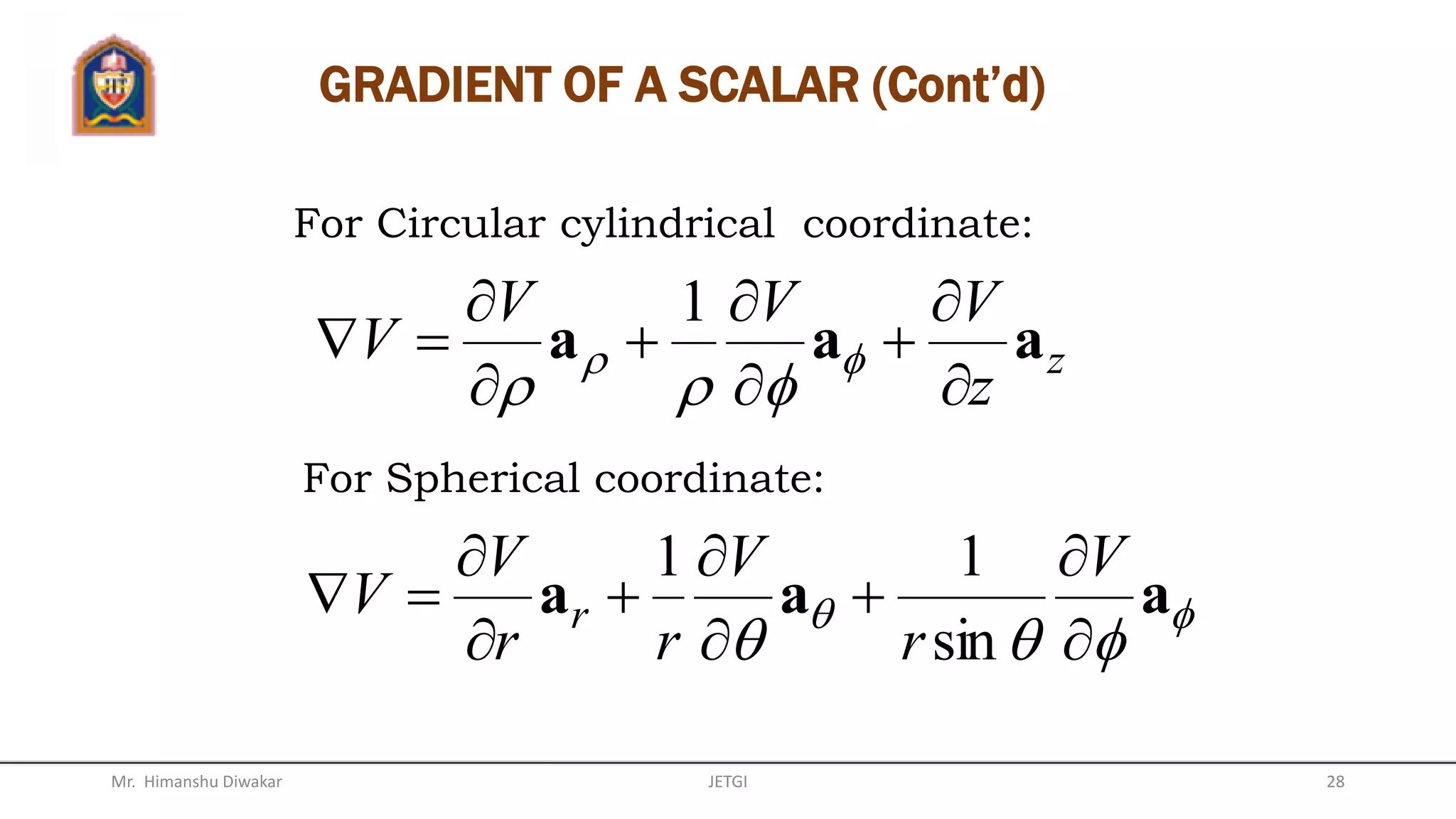
For Circular cylindrical coordinate:
z
z
VVV
V aaa








 

1
For Spherical coordinate:


aaa









V
r
V
rr
V
V r
sin
11
Mr. Himanshu Diwakar 31JETGI
EXAMPLE 1
Find gradient of these scalars:
yxeV z
cosh2sin

 2cos2
zU 
 cossin10 2
rW 
(a)
(b)
(c)
Mr. Himanshu Diwakar 32JETGI
SOLUTION TO EXAMPLE 1
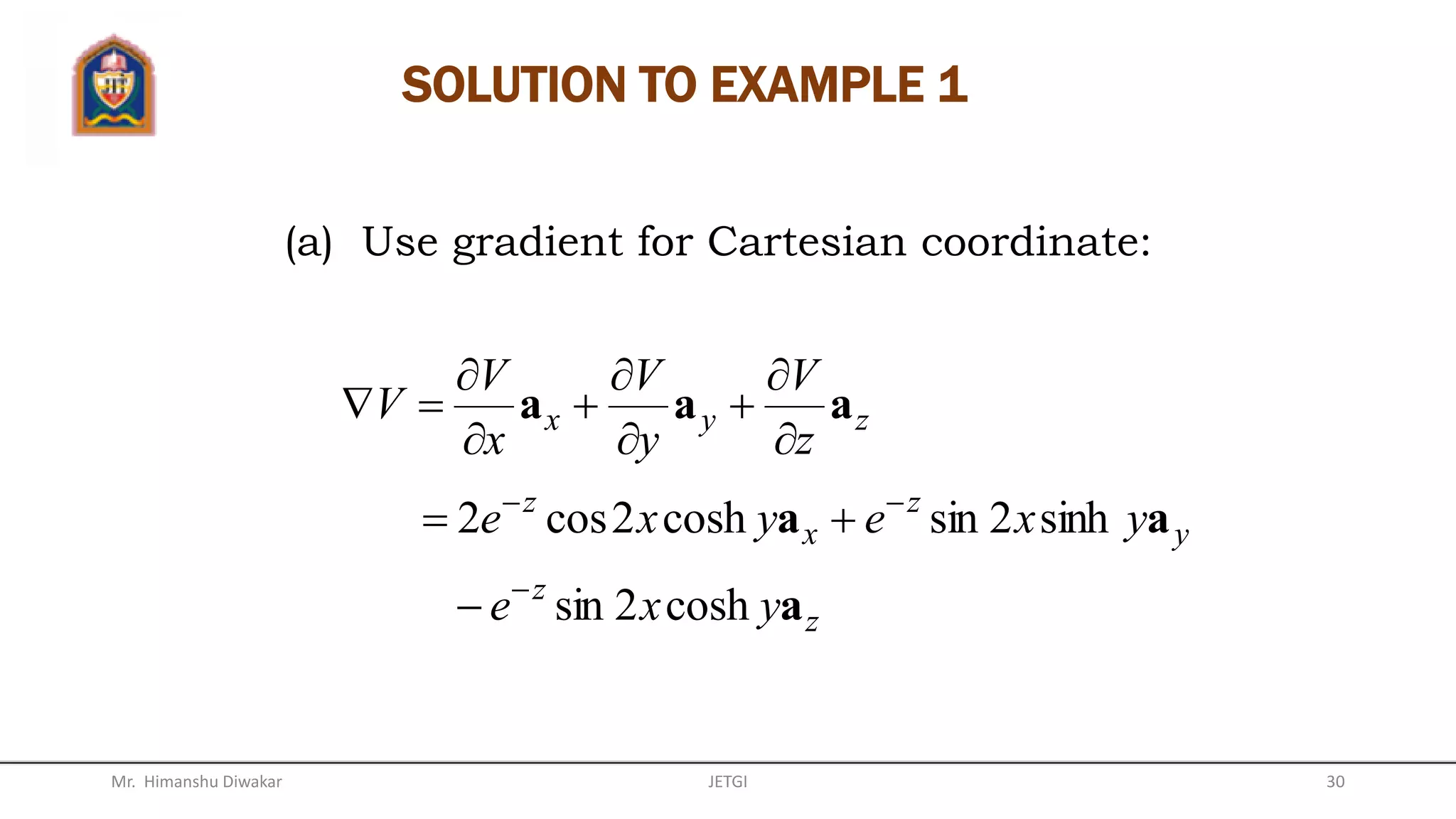
(a) Use gradient for Cartesian coordinate:
z
z
y
z
x
z
zyx
yxe
yxeyxe
z
V
y
V
x
V
V
a
aa
aaa
cosh2sin
sinh2sincosh2cos2













Mr. Himanshu Diwakar 33JETGI
SOLUTION TO EXAMPLE 1 (Cont’d)
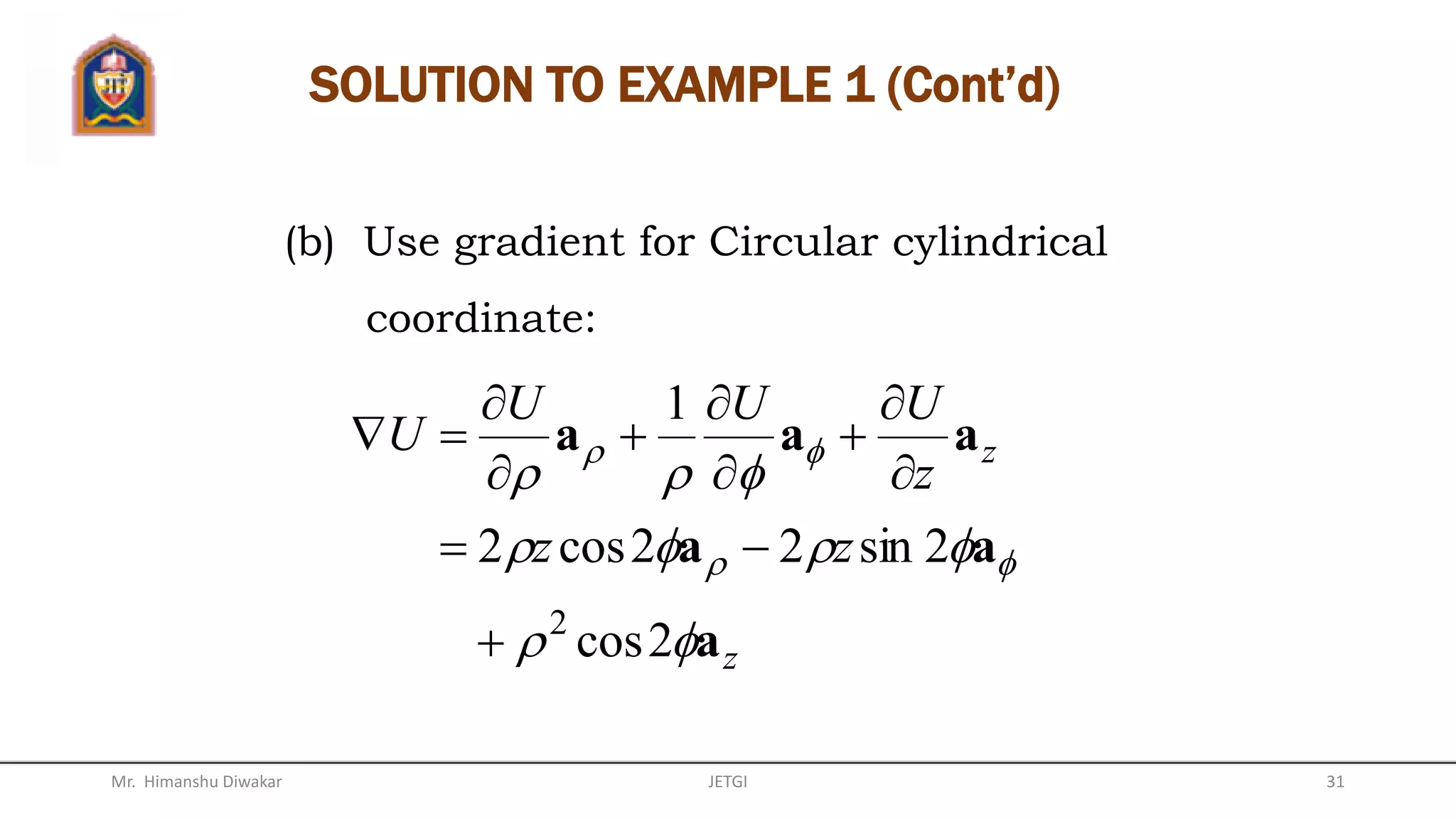
(b) Use gradient for Circular cylindrical
coordinate:
z
z
zz
z
UUU
U
a
aa
aaa





2cos
2sin22cos2
1
2











Mr. Himanshu Diwakar 34JETGI
SOLUTION TO EXAMPLE 1 (Cont’d)
(c) Use gradient for Spherical coordinate:






a
aa
aaa
sinsin10
cos2sin10cossin10
sin
11
2











r
r
W
r
W
rr
W
W
Mr. Himanshu Diwakar 35JETGI
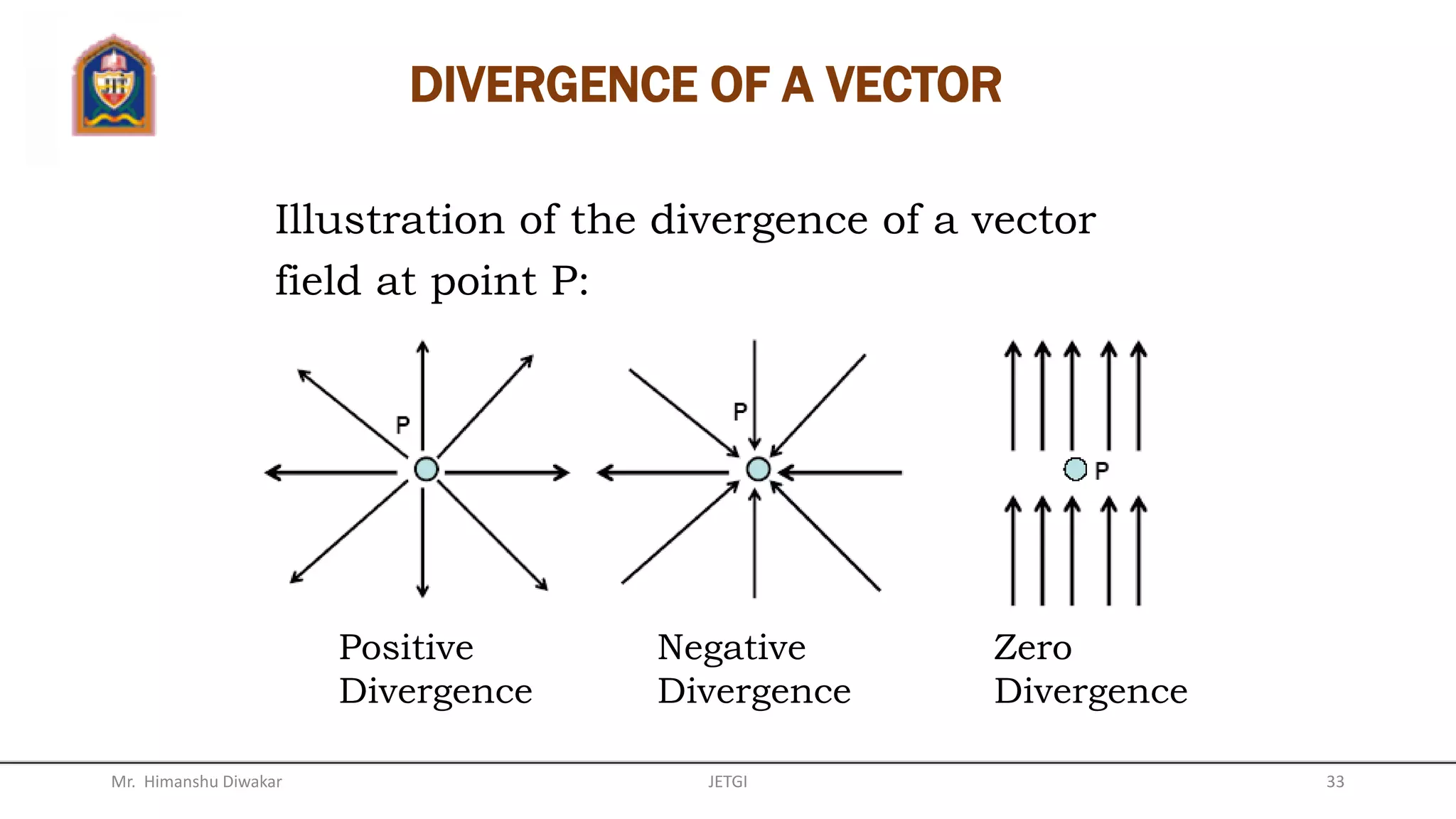
DIVERGENCE OF A VECTOR
Illustration of the divergence of a vector
field at point P:
Positive
Divergence
Negative
Divergence
Zero
Divergence
Mr. Himanshu Diwakar 36JETGI
DIVERGENCE OF A VECTOR (Cont’d)
The divergence of A at a given point P
is the outward flux per unit volume:
v
dS
div s
v 




A
AA lim
0
Mr. Himanshu Diwakar 37JETGI
DIVERGENCE OF A VECTOR (Cont’d)
What is ?? 
s
dSA Vector field A at
closed surface S
Mr. Himanshu Diwakar 38JETGI
Where,
dSdS
bottomtoprightleftbackfronts









  AA
And, v is volume enclosed by surface S
DIVERGENCE OF A VECTOR (Cont’d)
Mr. Himanshu Diwakar 39JETGI
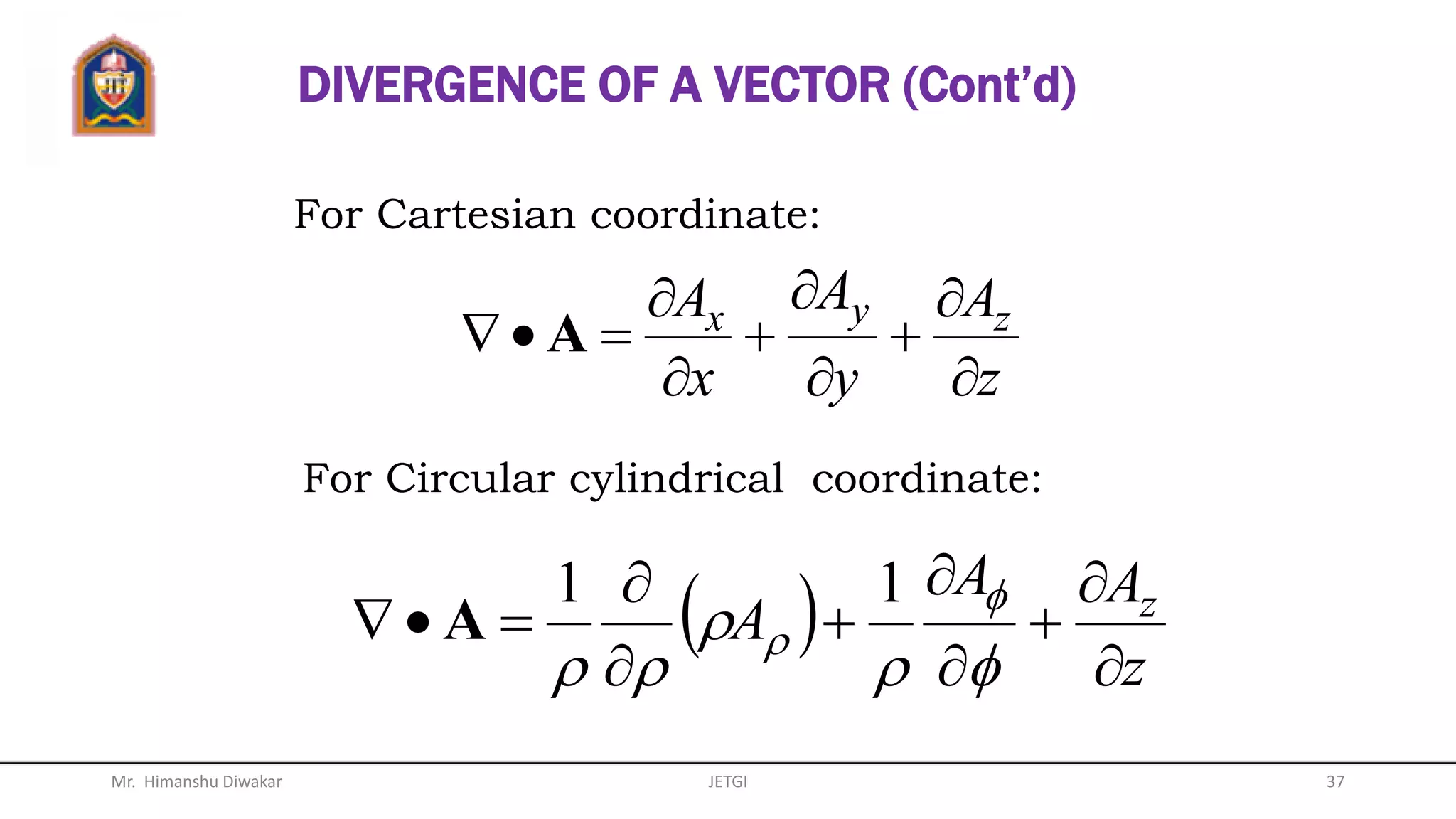
For Cartesian coordinate:
z
A
y
A
x
A zyx








 A
For Circular cylindrical coordinate:
  z
AA
A z














11
A
DIVERGENCE OF A VECTOR (Cont’d)
Mr. Himanshu Diwakar 40JETGI
For Spherical coordinate:
   













A
r
A
r
Ar
rr
r
sin
1sin
sin
11 2
2
A
DIVERGENCE OF A VECTOR (Cont’d)
Mr. Himanshu Diwakar 41JETGI
EXAMPLE 11
Find divergence of these vectors:
zx xzyzxP aa  2
zzzQ aaa   cossin 2

  aaa coscossincos
1
2
 r
r
W r
(a)
(b)
(c)
Mr. Himanshu Diwakar 42JETGI
43
(a) Use divergence for Cartesian
coordinate:
SOLUTION TO EXAMPLE 11
     
xxyz
xz
zy
yzx
x
z
P
y
P
x
P zyx



















2
02
P
Mr. Himanshu Diwakar JETGI
(b) Use divergence for Circular cylindrical
coordinate:
 
     










cossin2
cos
1
sin
1
11
22


















 Q
z
z
z
z
QQ
Q z
SOLUTION TO EXAMPLE 11 (Cont’d)
Mr. Himanshu Diwakar 44JETGI
SOLUTION TO EXAMPLE 11 (Cont’d)
(c) Use divergence for Spherical coordinate:
   
   
 










coscos2
cos
sin
1
cossin
sin
1
cos
1
sin
1sin
sin
11
2
2
2
2


















 W
r
r
rrr
W
r
W
r
Wr
rr
r
Mr. Himanshu Diwakar 45JETGI
It states that the total outward flux of a vector
field A at the closed surface S is the same as
volume integral of divergence of A.
 
VV
dVdS AA
DIVERGENCE THEOREM
Mr. Himanshu Diwakar 46JETGI
EXAMPLE 12
A vector field exists in the region
between two concentric cylindrical surfaces
defined by ρ = 1 and ρ = 2, with both cylinders
extending between z = 0 and z = 5. Verify the
divergence theorem by evaluating:
 aD 3


 
S
dsD
 
V
DdV
(a)
(b)
Mr. Himanshu Diwakar 47JETGI
SOLUTION TO EXAMPLE 12
(a) For two concentric cylinder, the left side:
topbottomouterinner
S
d DDDDSD 
Where,










10)(
)(
2
0
5
0
1
4
2
0
5
0
1
3


 
 
 

 

z
z
inner
dzd
dzdD
aa
aa
Mr. Himanshu Diwakar 48JETGI










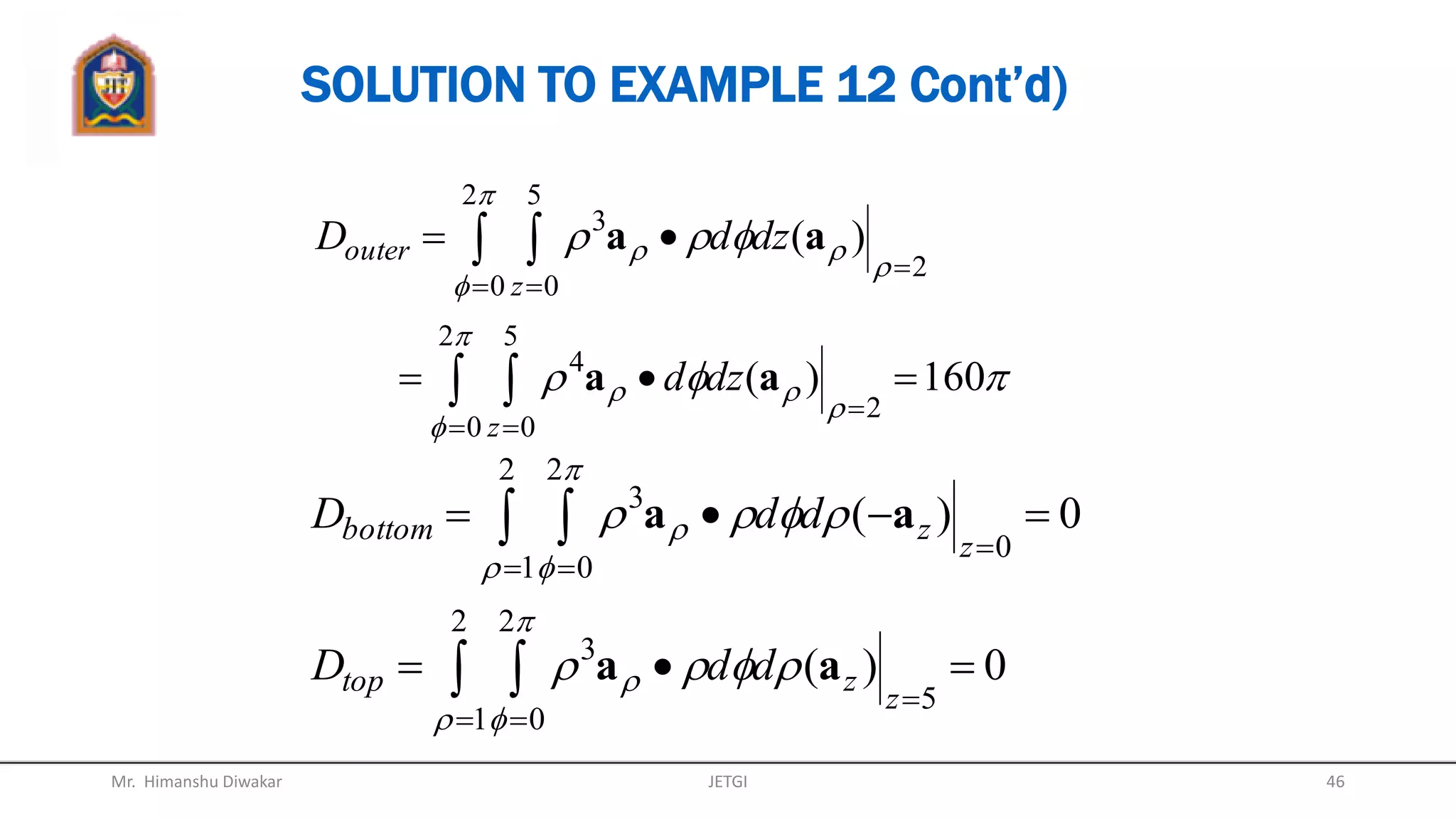
160)(
)(
2
0
5
0
2
4
2
0
5
0
2
3


 
 
 

 

z
z
outer
dzd
dzdD
aa
aa
 
 
 

 



2
1
2
0
5
3
2
1
2
0
0
3
0)(
0)(










z
ztop
z
zbottom
ddD
ddD
aa
aa
SOLUTION TO EXAMPLE 12 Cont’d)
Mr. Himanshu Diwakar 49JETGI
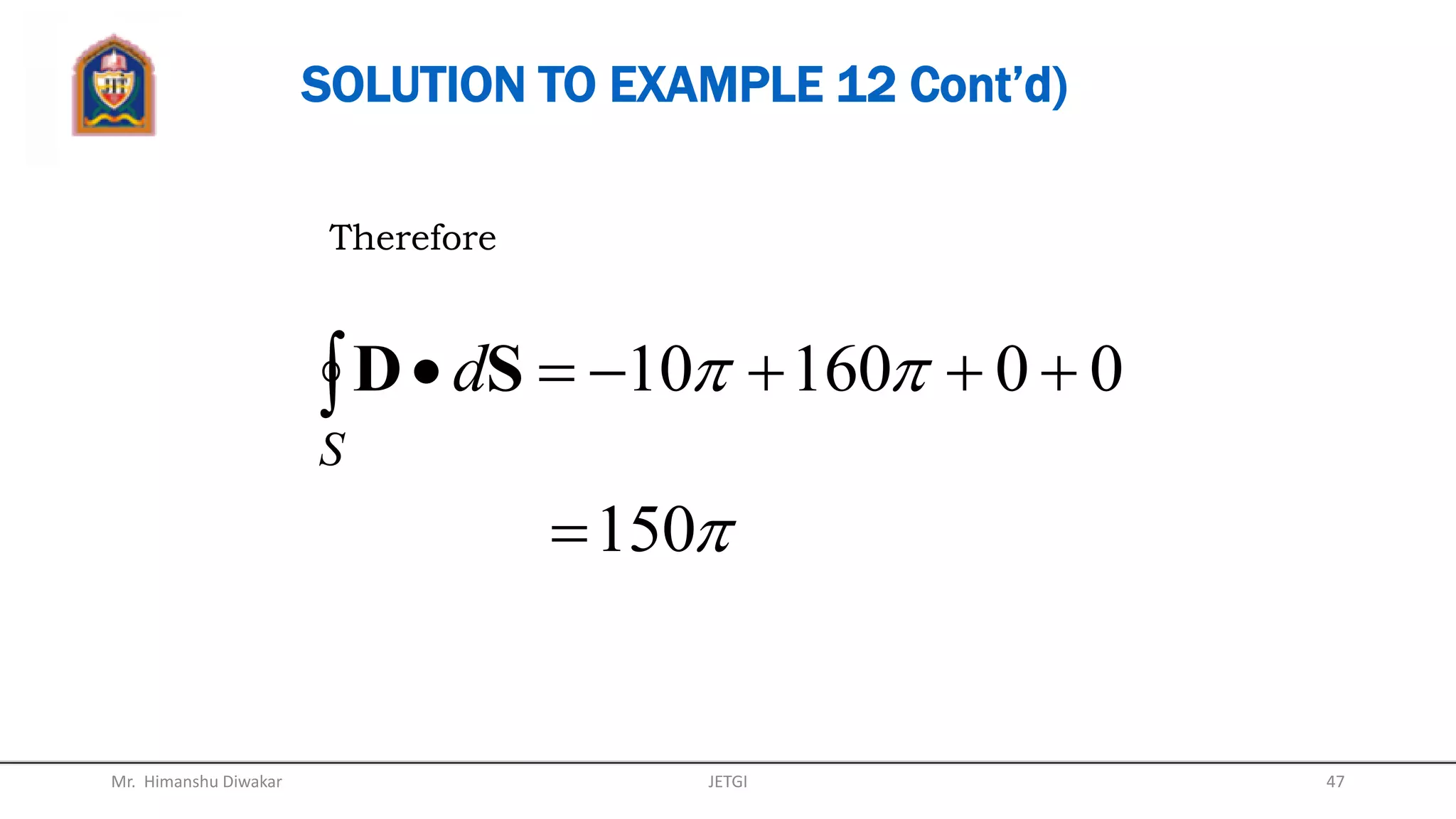
Therefore


150
0016010

 SD
S
d
SOLUTION TO EXAMPLE 12 Cont’d)
Mr. Himanshu Diwakar 50JETGI
SOLUTION TO EXAMPLE 12 Cont’d)
(b) For the right side of Divergence Theorem,
evaluate divergence of D
  23
4
1





 D
So,





 
150
4
5
0
2
0
2
1
4
5
0
2
0
2
1
2





























  
  
z
r
z
dzdddVD
Mr. Himanshu Diwakar 51JETGI
CURL OF A VECTOR
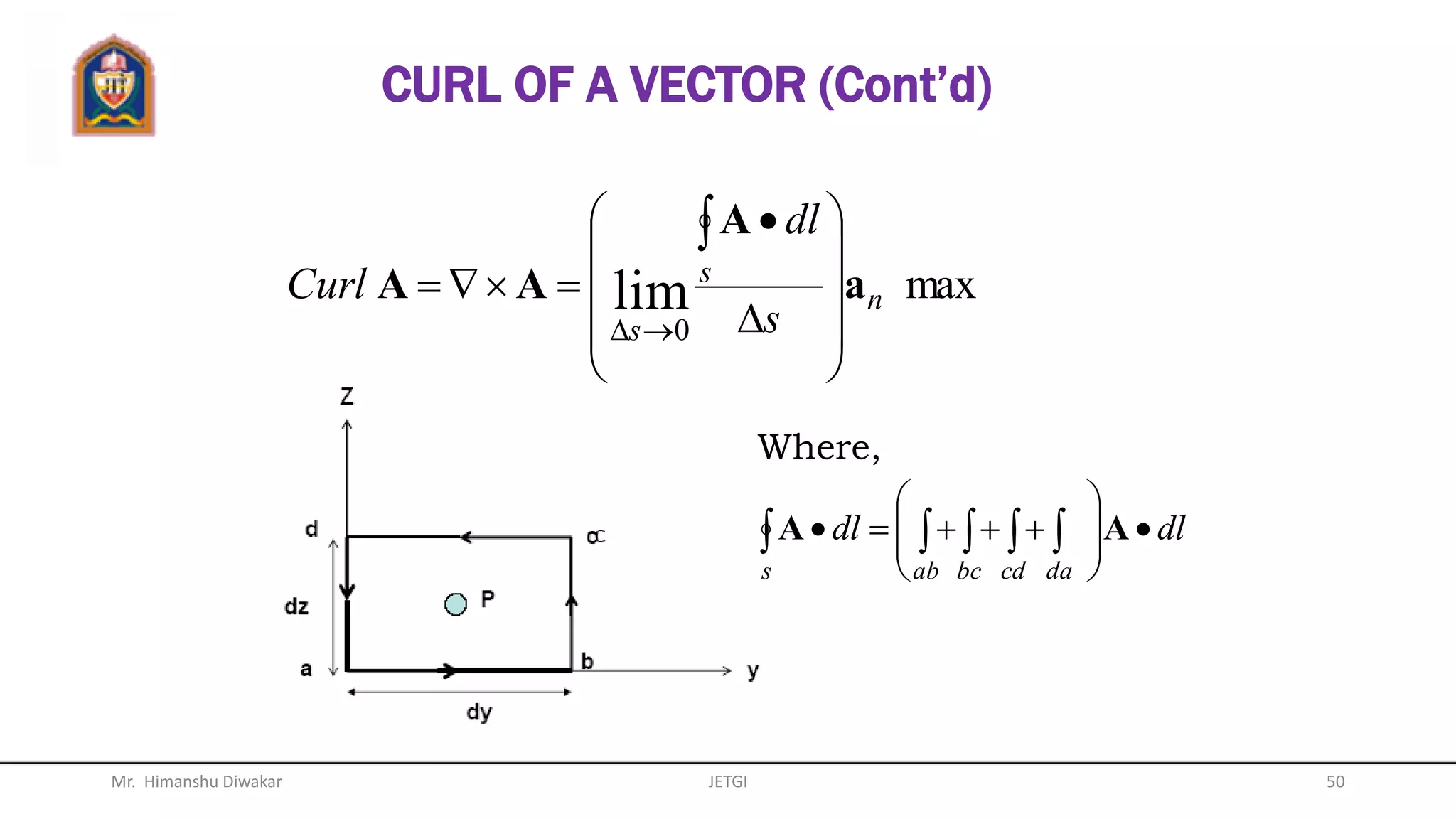
The curl of vector A is an axial
(rotational) vector whose magnitude is
the maximum circulation of A per unit
area tends to zero and whose direction
is the normal direction of the area
when the area is oriented so as to
make the circulation maximum.
Mr. Himanshu Diwakar 52JETGI
maxlim
0
a
A
AA n
s
s s
dl
Curl















Where,
CURL OF A VECTOR (Cont’d)
dldl
dacdbcabs








  AA
Mr. Himanshu Diwakar 53JETGI
CURL OF A VECTOR (Cont’d)
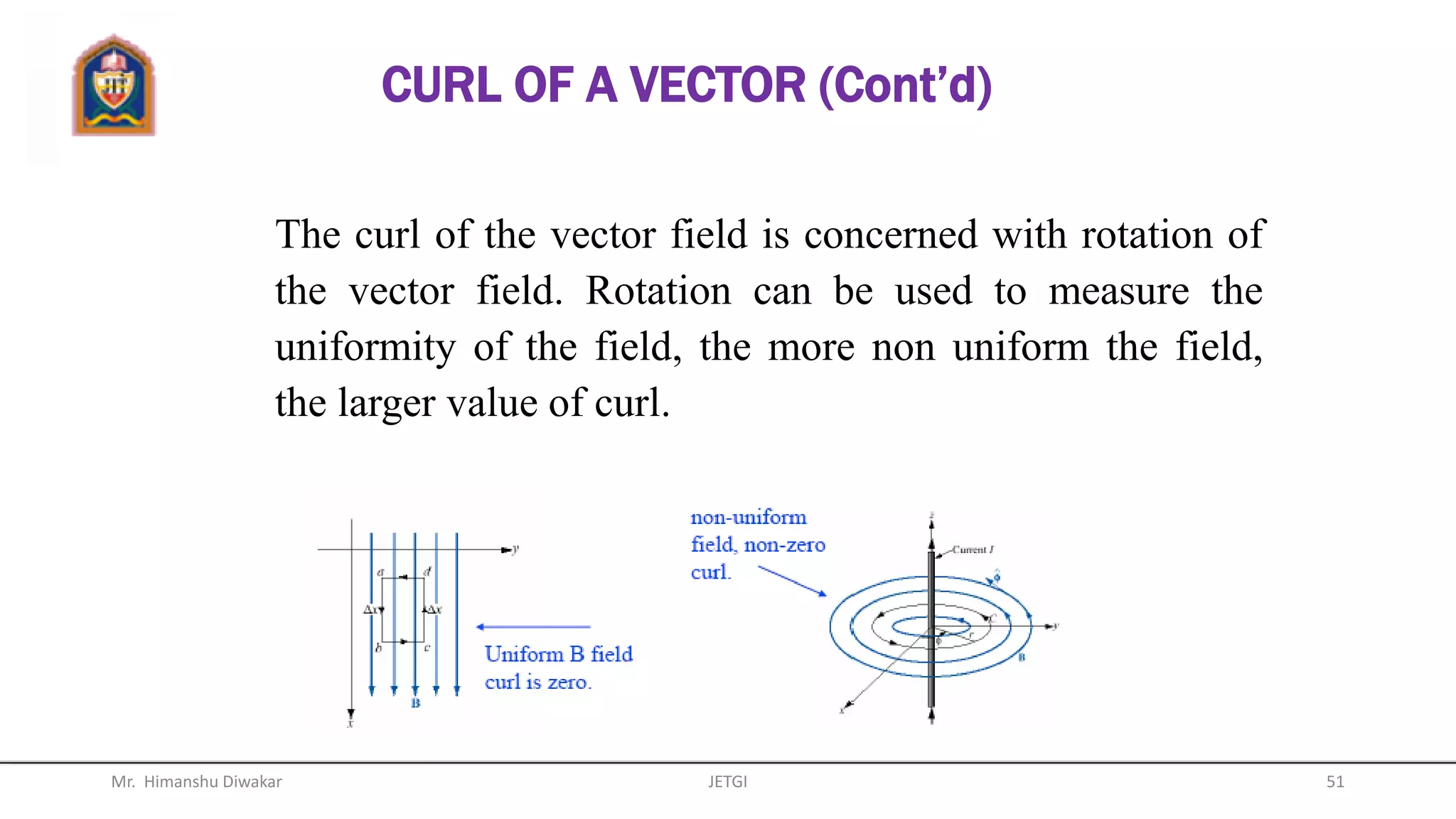
The curl of the vector field is concerned with rotation of
the vector field. Rotation can be used to measure the
uniformity of the field, the more non uniform the field,
the larger value of curl.
Mr. Himanshu Diwakar 54JETGI
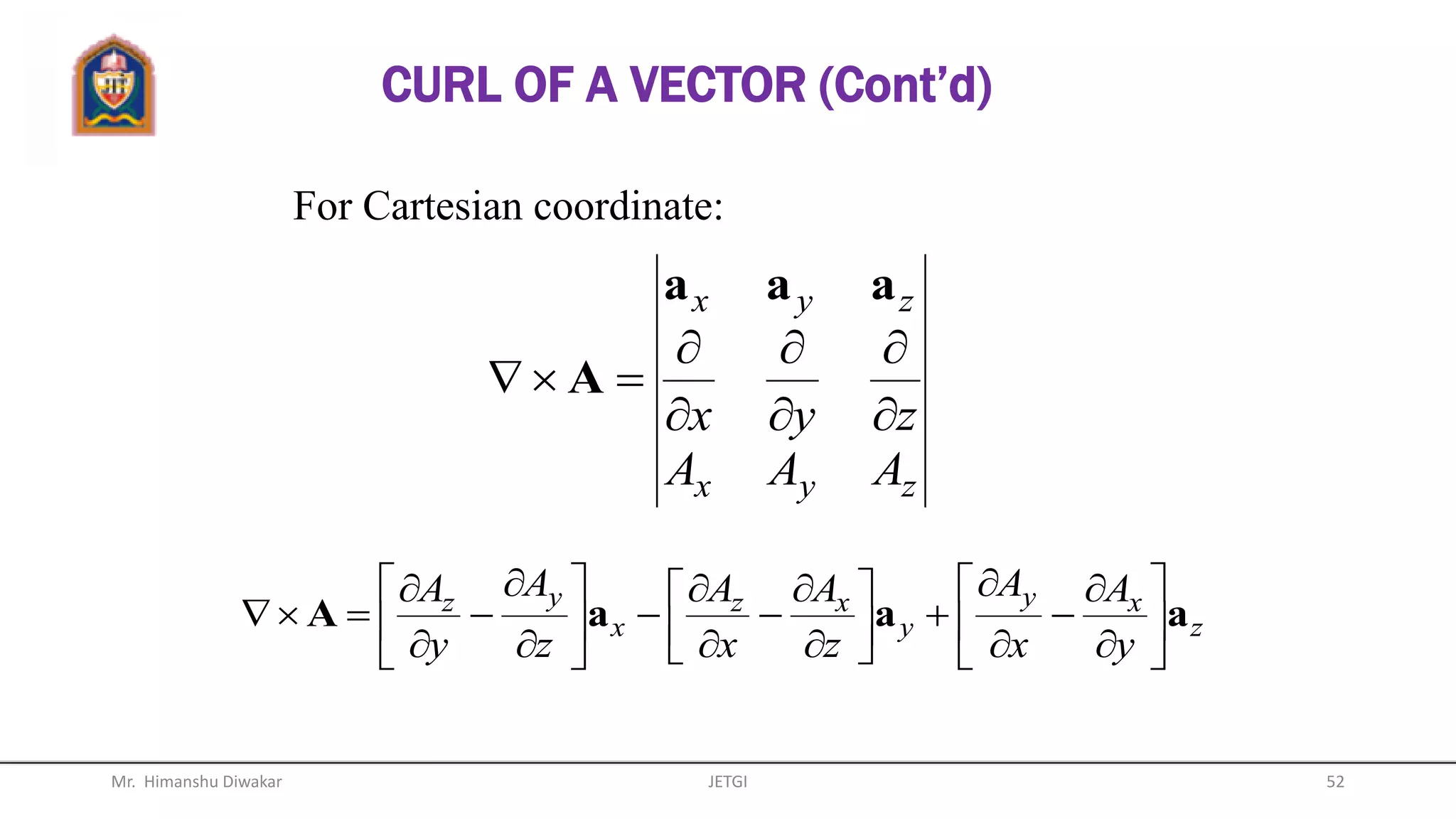
For Cartesian coordinate:
CURL OF A VECTOR (Cont’d)
zyx
zyx
AAA
zyx 






aaa
A
z
xy
y
xz
x
yz
y
A
x
A
z
A
x
A
z
A
y
A
aaaA 































Mr. Himanshu Diwakar 55JETGI
z
z
AAA
z





 






aaa
A
1
 
z
zz
AA
z
AA
z
AA
a
aaA












































1
1
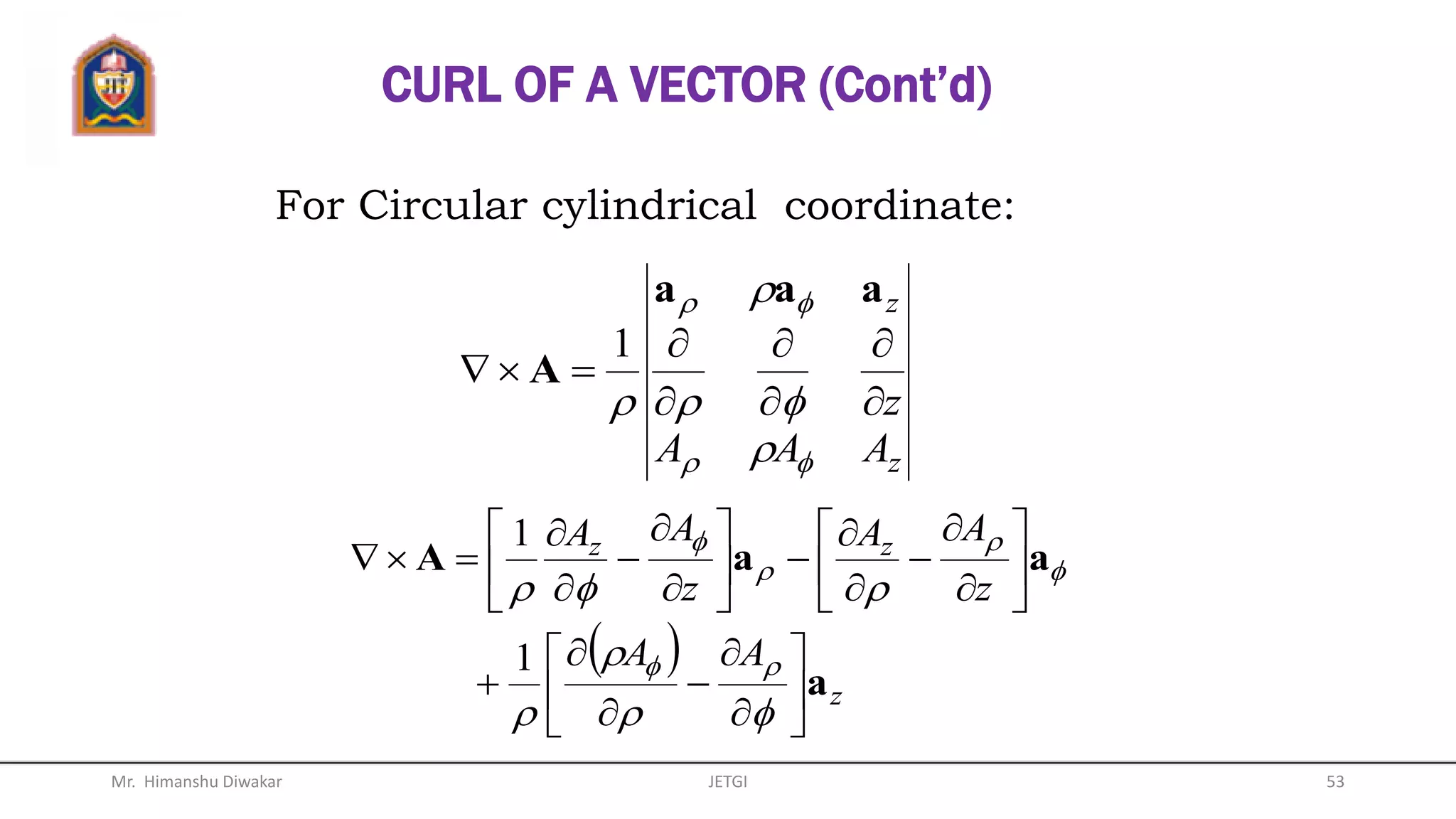
For Circular cylindrical coordinate:
CURL OF A VECTOR (Cont’d)
Mr. Himanshu Diwakar 56JETGI
CURL OF A VECTOR (Cont’d)
For Spherical coordinate:
  



ArrAA
rr
r
r
sin
sin
1
2







aaa
A
   
 








a
aaA



































r
r
r
A
r
rA
r
r
rAA
r
AA
r
)(1
sin
11sin
sin
1
Mr. Himanshu Diwakar 57JETGI
EXAMPLE 13
zx xzyzxP aa  2
zzzQ aaa   cossin 2

  aaa coscossincos
1
2
 r
r
W r
(a)
(b)
(c)
Find curl of these vectors:
Mr. Himanshu Diwakar 58JETGI
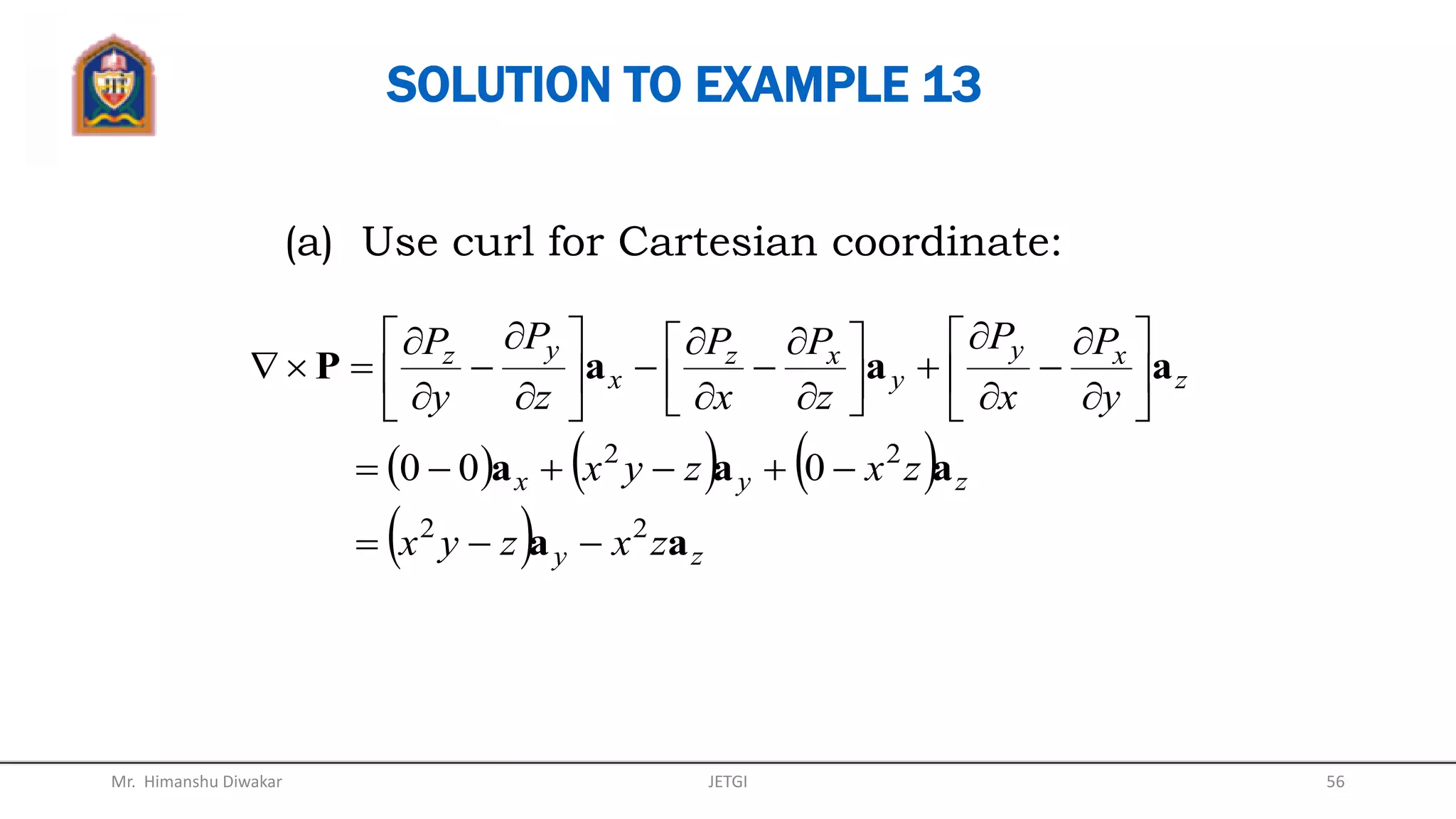
SOLUTION TO EXAMPLE 13
(a) Use curl for Cartesian coordinate:
     
  zy
zyx
z
xy
y
xz
x
yz
zxzyx
zxzyx
y
P
x
P
z
P
x
P
z
P
y
P
aa
aaa
aaaP
22
22
000


































Mr. Himanshu Diwakar 59JETGI
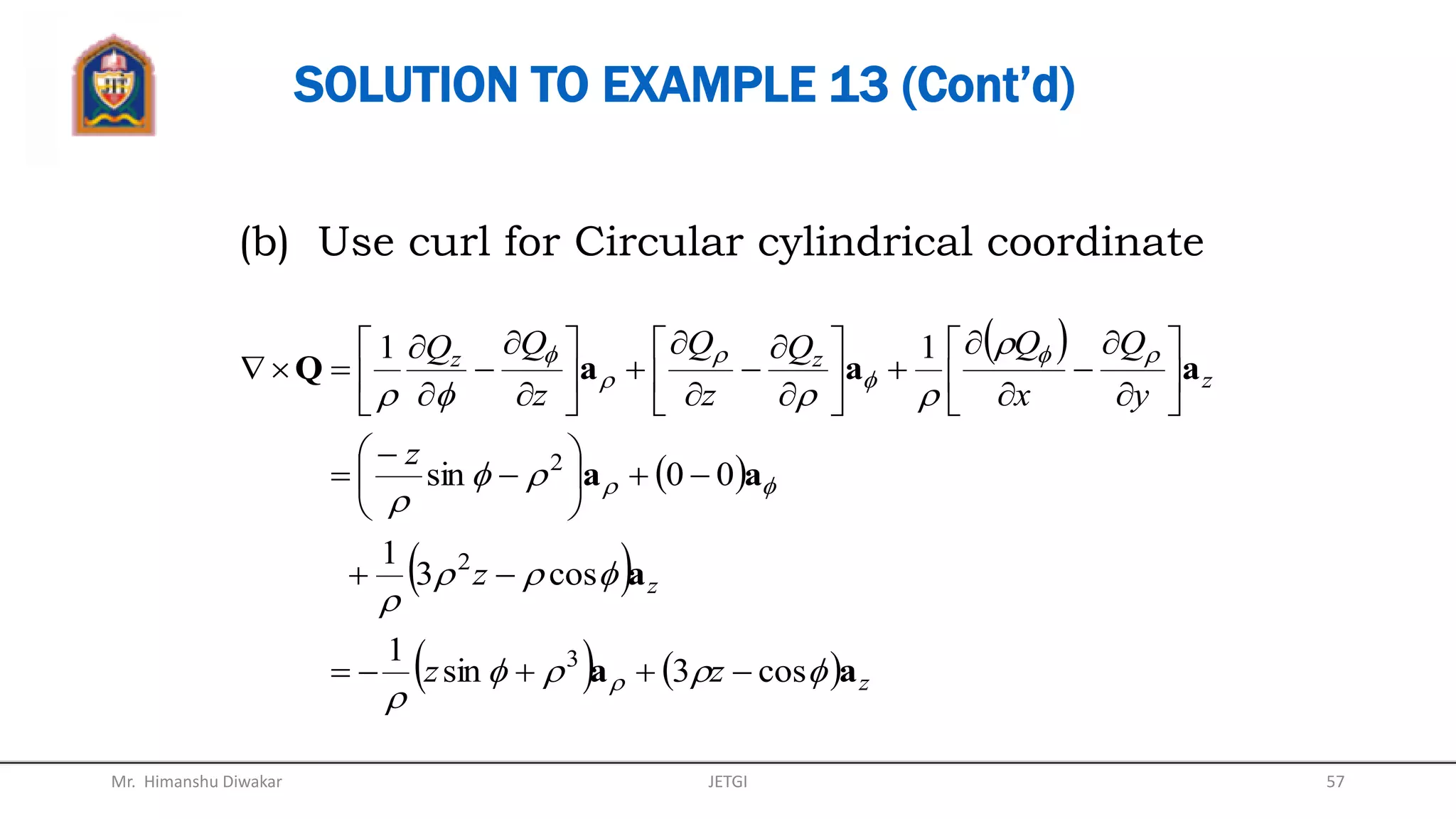
(b) Use curl for Circular cylindrical coordinate
 
 
 
    z
z
z
zz
zz
z
z
y
Q
x
QQ
z
Q
z
QQ
aa
a
aa
aaaQ















cos3sin
1
cos3
1
00sin
11
3
2
2













































SOLUTION TO EXAMPLE 13 (Cont’d)
Mr. Himanshu Diwakar 60JETGI
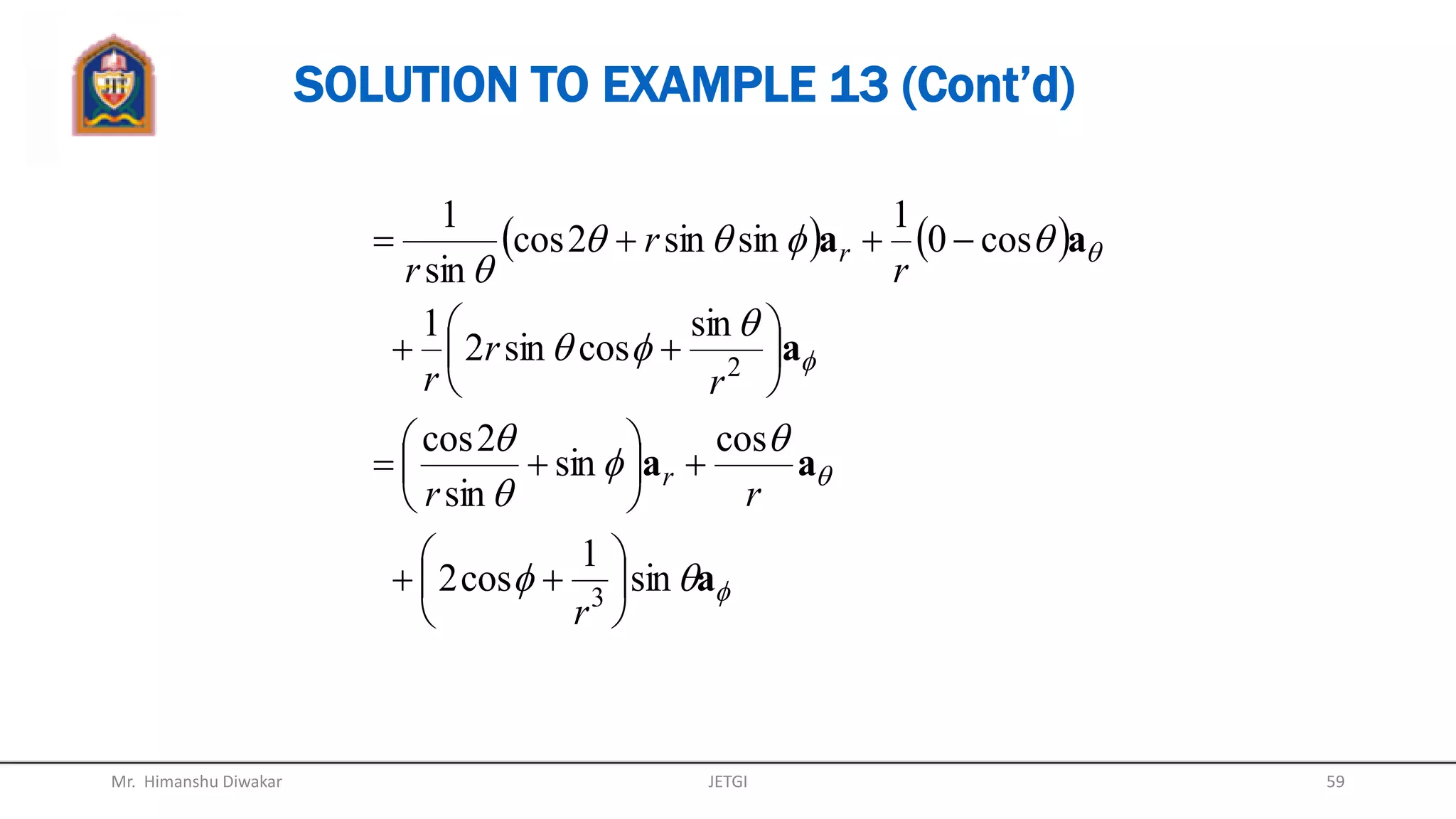
(c) Use curl for Spherical coordinate:
   
 
     





















a
aa
a
aaW






















































































22
2
cos
)cossin(1
cos
cos
sin
11cossinsincos
sin
1
)(1
sin
11sin
sin
1
r
r
r
r
r
rr
r
r
r
W
r
rW
r
r
rWW
r
WW
r
r
r
r
r
SOLUTION TO EXAMPLE 13 (Cont’d)
Mr. Himanshu Diwakar 61JETGI
SOLUTION TO EXAMPLE 13 (Cont’d)
   
a
aa
a
aa













sin
1
cos2
cos
sin
sin
2cos
sin
cossin2
1
cos0
1
sinsin2cos
sin
1
3
2






















r
rr
r
r
r
r
r
r
r
r
Mr. Himanshu Diwakar 62JETGI
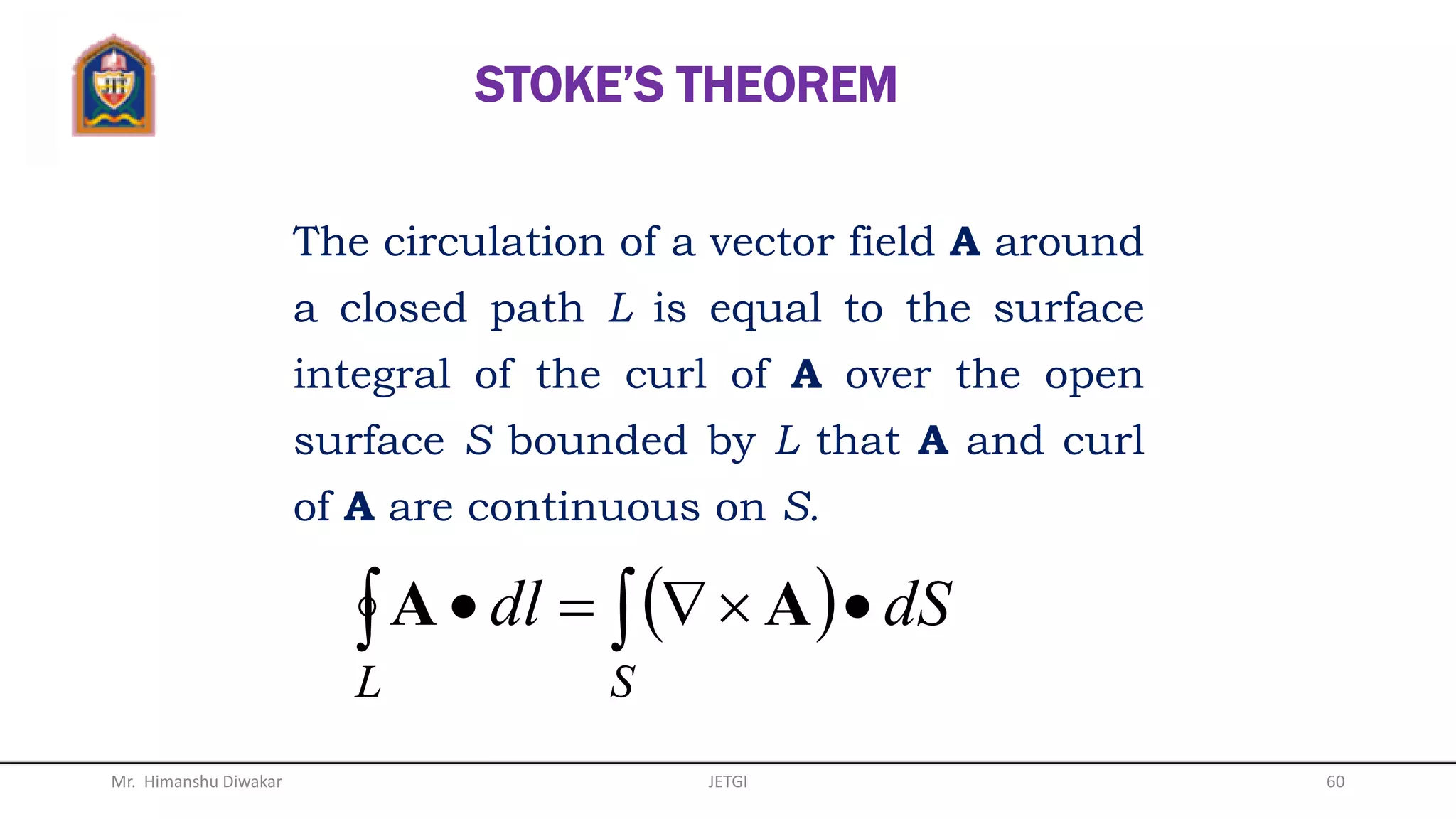
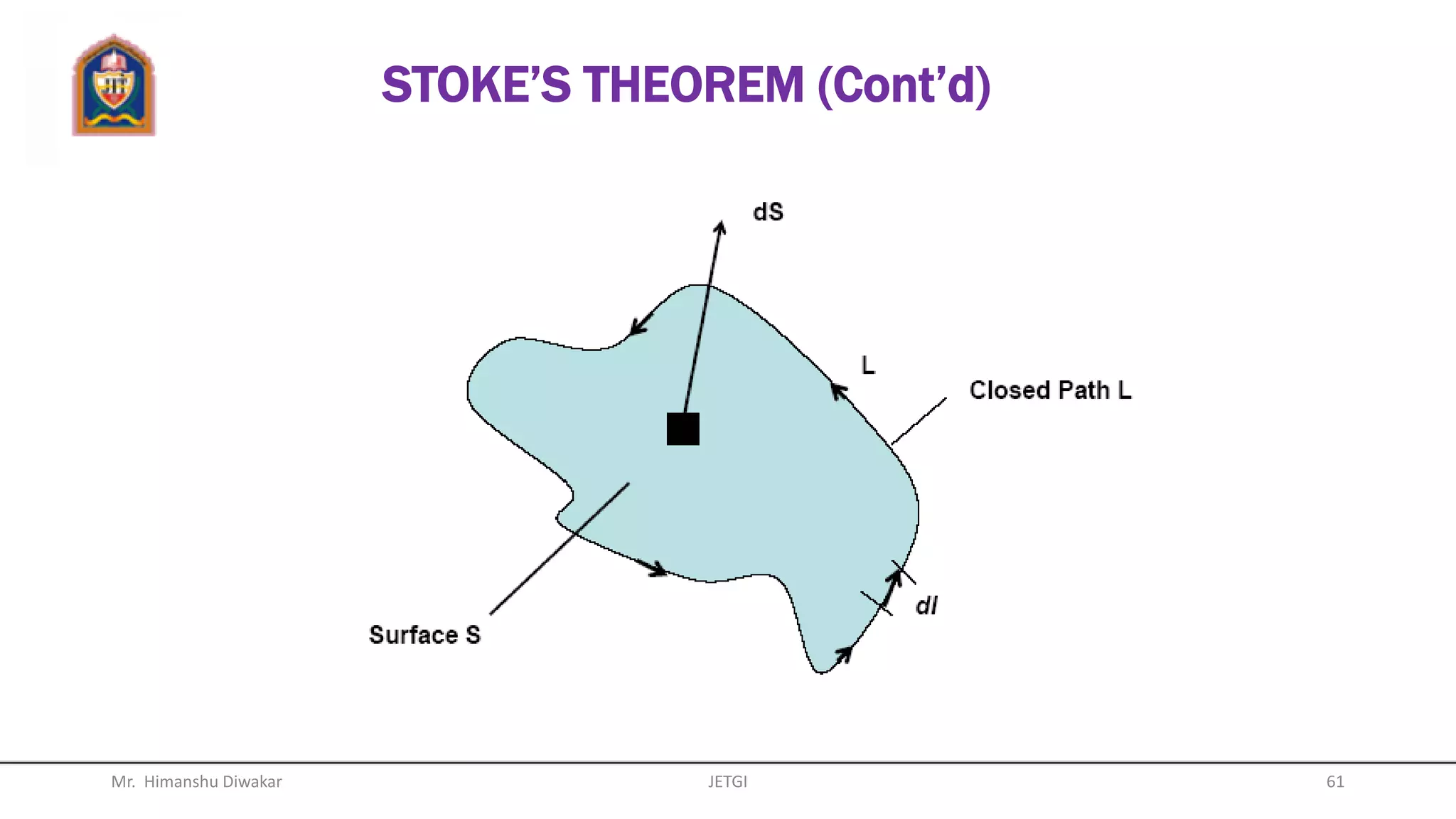
STOKE’S THEOREM
The circulation of a vector field A around
a closed path L is equal to the surface
integral of the curl of A over the open
surface S bounded by L that A and curl
of A are continuous on S.
  
SL
dSdl AA
Mr. Himanshu Diwakar 63JETGI
STOKE’S THEOREM (Cont’d)
Mr. Himanshu Diwakar 64JETGI
EXAMPLE 14
By using Stoke’s Theorem, evaluate
for
  dlA
  aaA sincos 

Mr. Himanshu Diwakar 65JETGI
EXAMPLE 14 (Cont’d)
Mr. Himanshu Diwakar 66JETGI
SOLUTION TO EXAMPLE 14
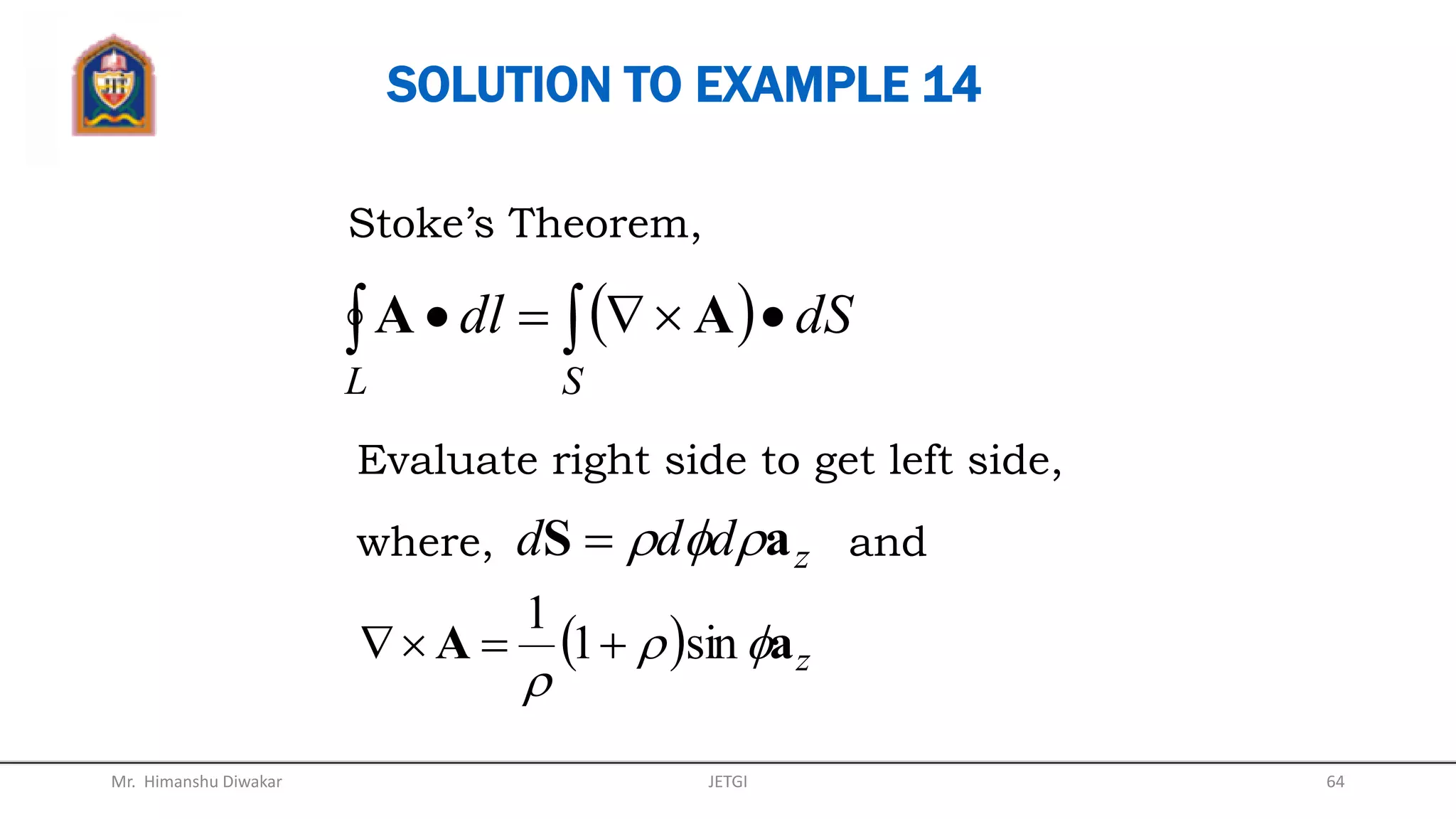
Stoke’s Theorem,
  
SL
dSdl AA
where, andzddd aS 
Evaluate right side to get left side,
  zaA 

sin1
1

Mr. Himanshu Diwakar 67JETGI
SOLUTION TO EXAMPLE 14 (Cont’d)
   
941.4
sin1
1
0
0
60
30
5
2

  
 
aA z
S
dddS 
 
Mr. Himanshu Diwakar 68JETGI
EXAMPLE 15
Verify Stoke’s theorem for the vector field
for given figure by evaluating:  aaB sincos 

(a) over the
semicircular contour.
  LB d
(b) over the
surface of semicircular
contour.
   SB d
Mr. Himanshu Diwakar 69JETGI
SOLUTION TO EXAMPLE 15
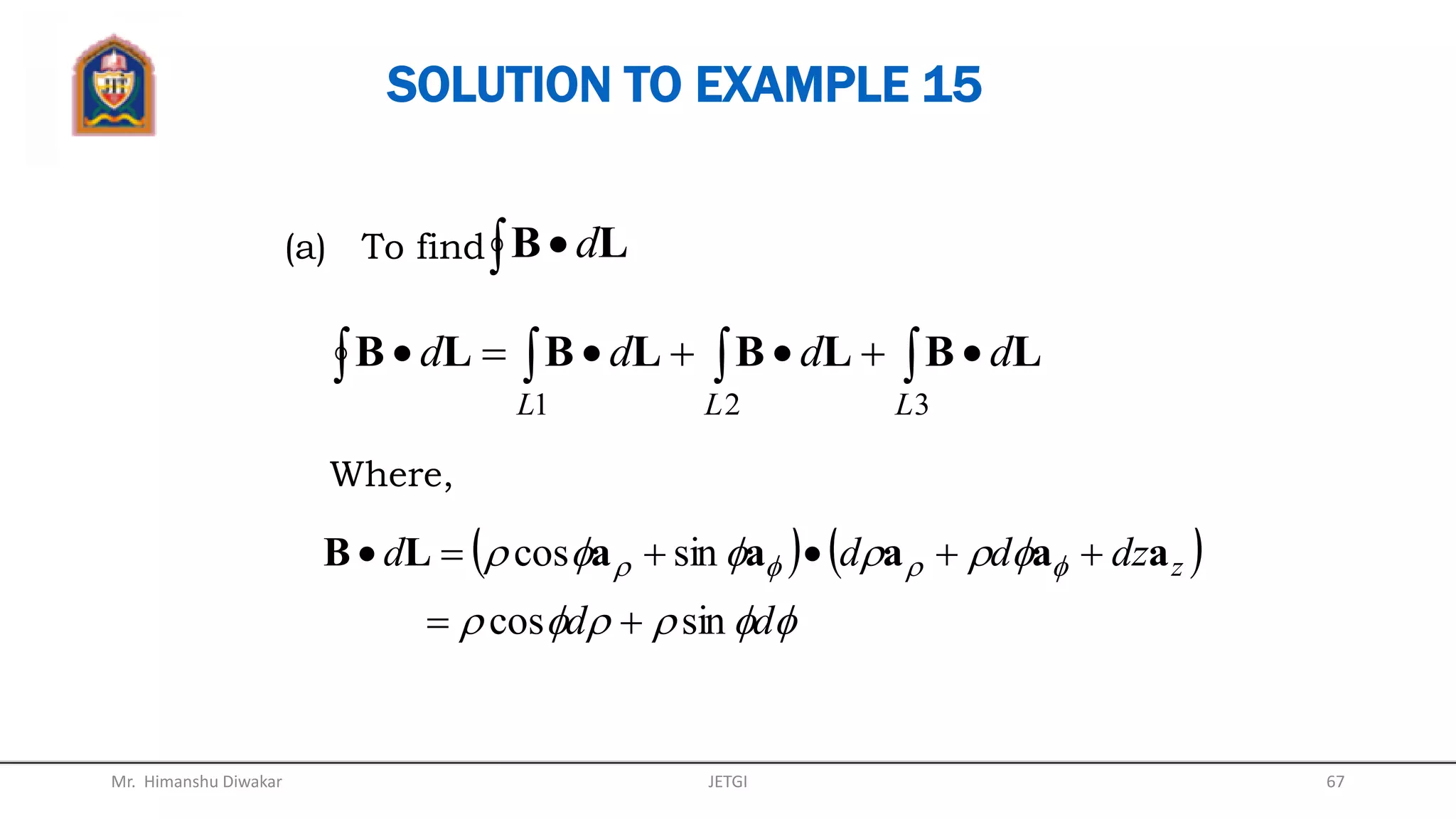
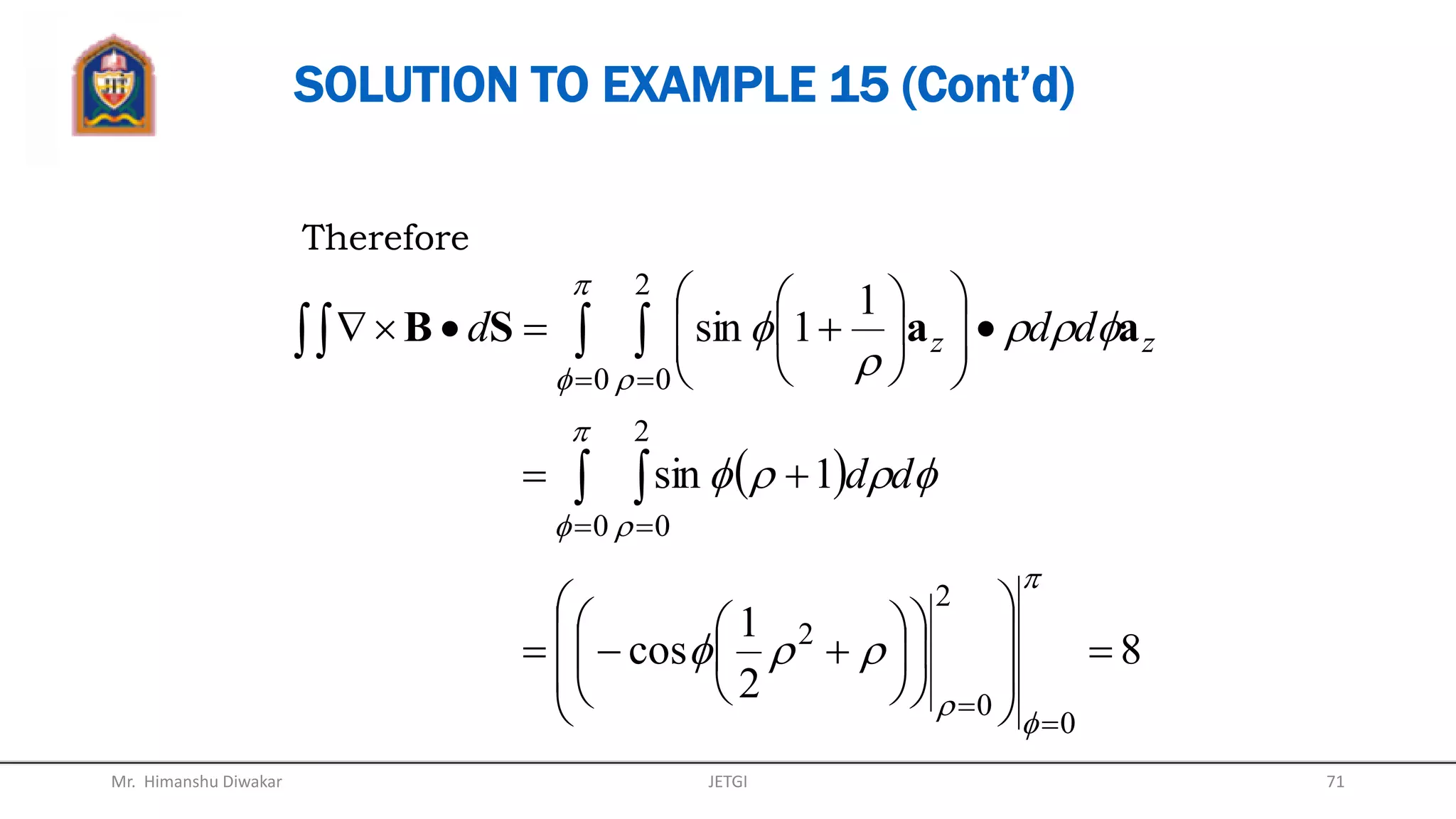
(a) To find  LB d
 
321 LLL
dddd LBLBLBLB
Where,
   

 
dd
dzddd z
sincos
sincos

 aaaaaLB
Mr. Himanshu Diwakar 70JETGI
So
20
2
1
sincos
2
0
2
0
0
0
0,0
2
01


































LB
zz
L
ddd
  4cos20
sincos
0
0,2
0
0
2
22































LB
zz
L
ddd
SOLUTION TO EXAMPLE 15 (Cont’d)
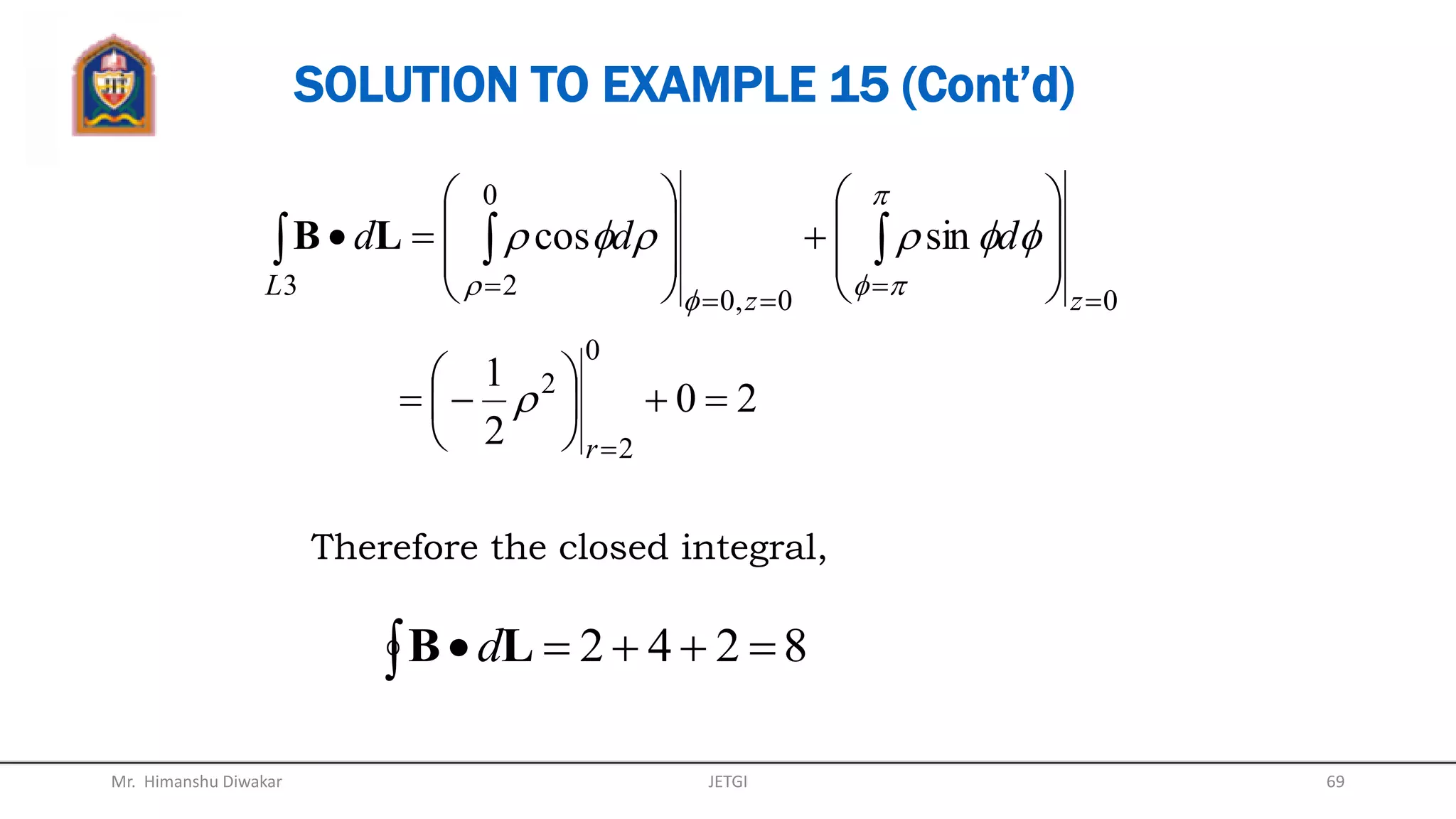
Mr. Himanshu Diwakar 71JETGI
20
2
1
sincos
0
2
2
00,0
0
23































r
zz
L
ddd




LB
SOLUTION TO EXAMPLE 15 (Cont’d)
Therefore the closed integral,
8242  LB d
Mr. Himanshu Diwakar 72JETGI
SOLUTION TO EXAMPLE 15 (Cont’d)
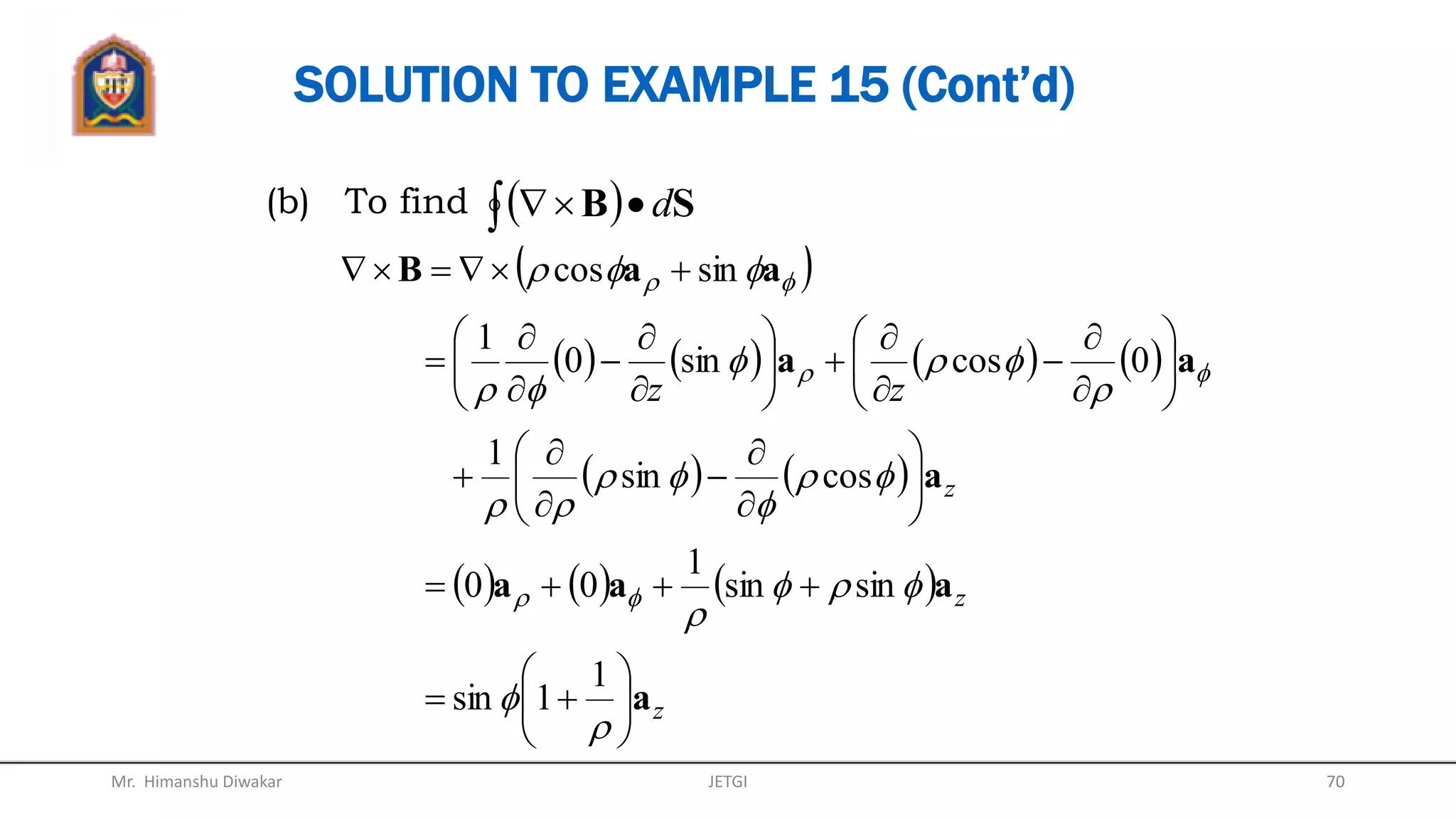
(b) To find    SB d
 
       
   
     
z
z
z
zz
a
aaa
a
aa
aaB



























































1
1sin
sinsin
1
00
cossin
1
0cossin0
1
sincos
Mr. Himanshu Diwakar 73JETGI
SOLUTION TO EXAMPLE 15 (Cont’d)
Therefore
 
8
2
1
cos
1sin
1
1sin
0
2
0
2
0
2
0
0
2
0






































 
 
 
 




 

 




 aaSB
dd
ddd zz
Mr. Himanshu Diwakar 74JETGI
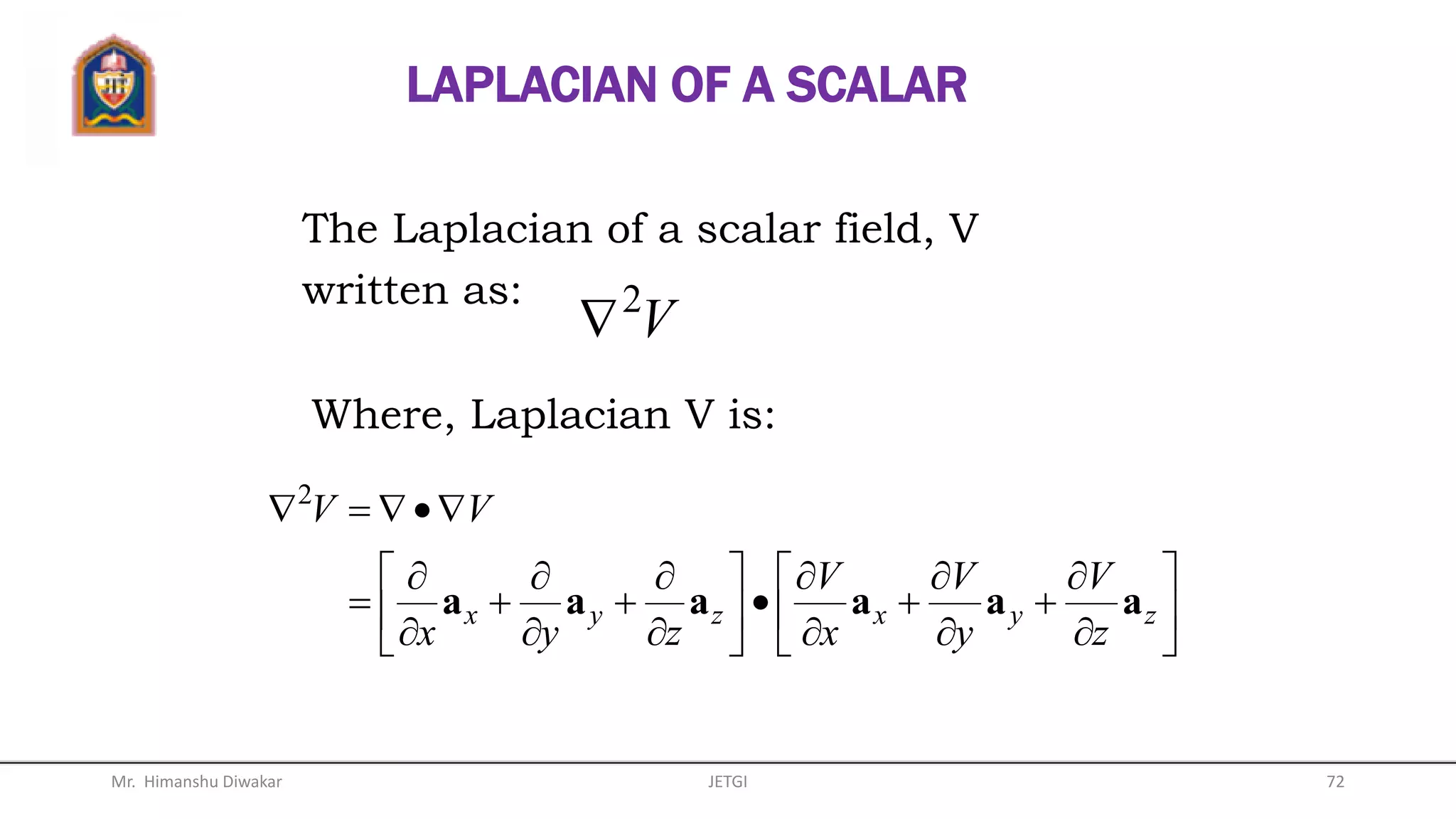
LAPLACIAN OF A SCALAR
The Laplacian of a scalar field, V
written as:
V2

Where, Laplacian V is:






























zyxzyx
z
V
y
V
x
V
zyx
VV
aaaaaa
2
Mr. Himanshu Diwakar 75JETGI
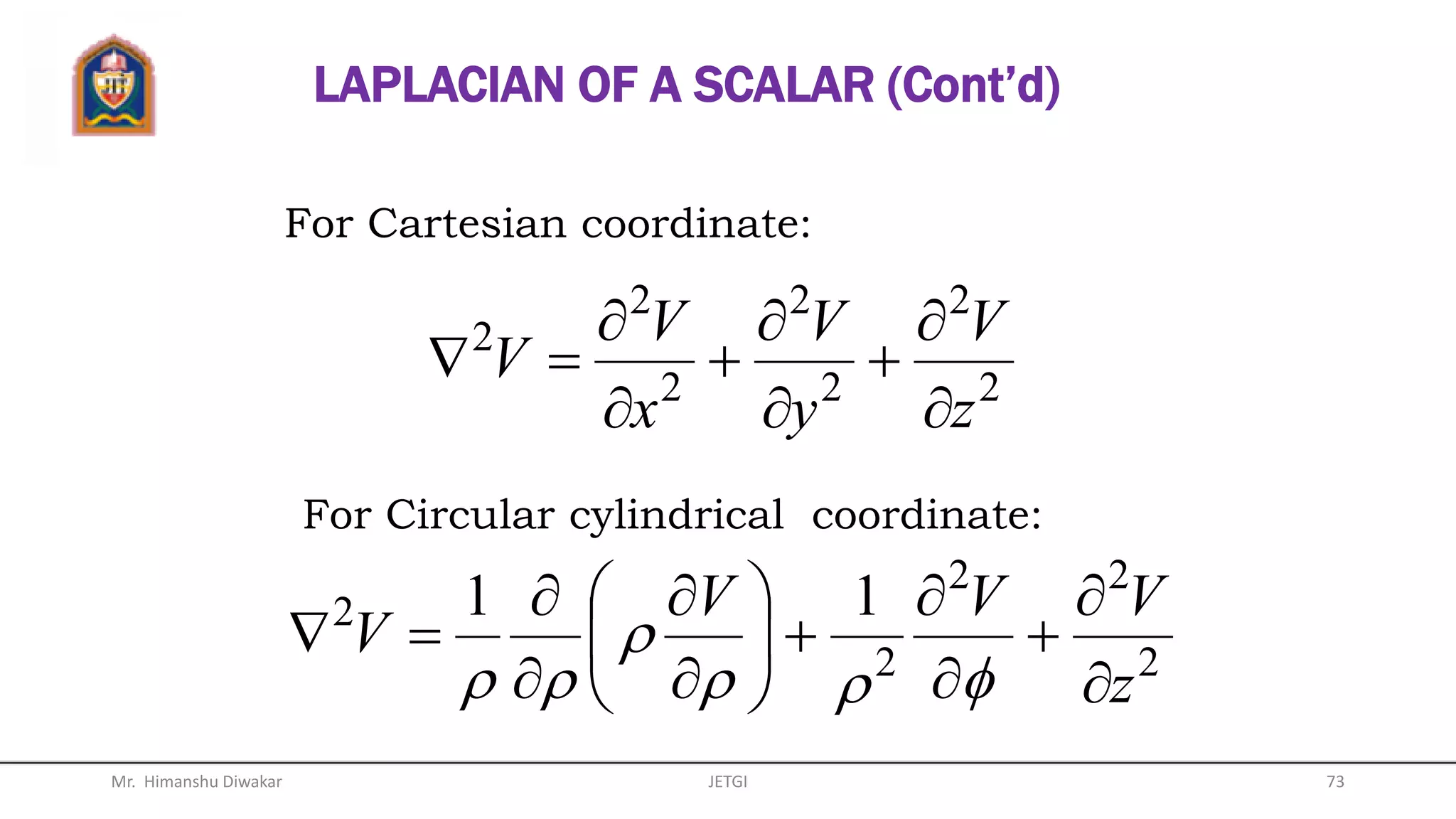
For Cartesian coordinate:
2
2
2
2
2
2
2
z
V
y
V
x
V
V









For Circular cylindrical coordinate:
2
22
2
2 11
z
VVV
V



















LAPLACIAN OF A SCALAR (Cont’d)
Mr. Himanshu Diwakar 76JETGI
LAPLACIAN OF A SCALAR (Cont’d)
For Spherical coordinate:
2
2
22
2
2
2
2
sin
1
sin
sin
11




























V
r
V
rr
V
r
rr
V
Mr. Himanshu Diwakar 77JETGI
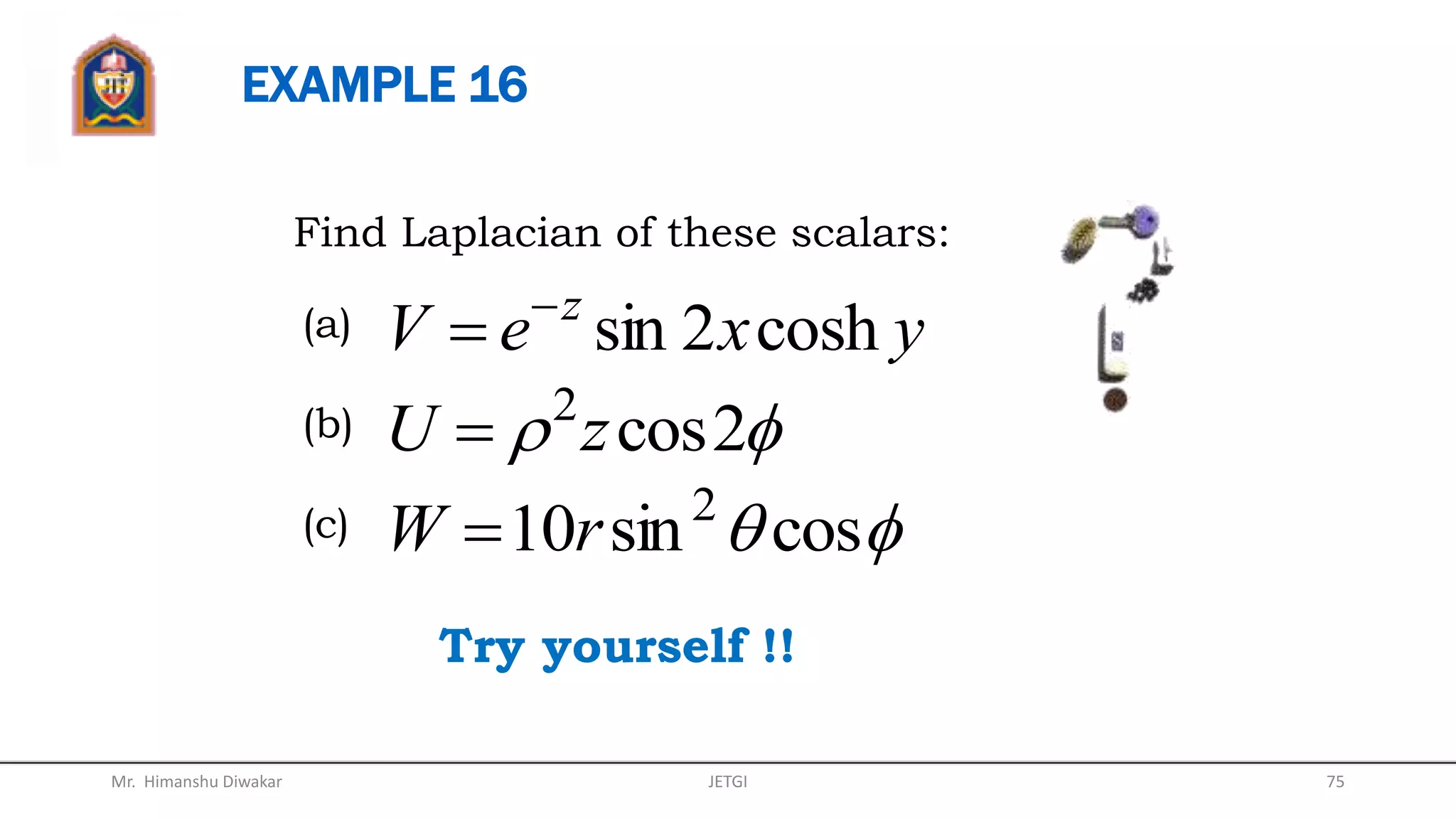
EXAMPLE 16
Find Laplacian of these scalars:
yxeV z
cosh2sin

 2cos2
zU 
 cossin10 2
rW 
(a)
(b)
(c)
Try yourself !!
Mr. Himanshu Diwakar 78JETGI
SOLUTION TO EXAMPLE 16
yxeV z
cosh2sin22 

02
 U
 

2cos21
cos102

r
W
(a)
(b)
(c)
Mr. Himanshu Diwakar 79JETGI
THANK YOU
Mr. Himanshu Diwakar 80JETGI

Vector calculus 1st 2

  • 1.
    Vector Algebra Mr. HIMANSHUDIWAKAR Assistant professor ECED Mr. Himanshu Diwakar 1JETGI
  • 2.
  • 3.
    VECTOR CALCULUS Introduction Scalars AndVectors Gradient Of A Scalar Divergence Of A Vector Divergence Theorem Curl Of A Vector Stokes’s Theorem Laplacian Of A Scalar Mr. Himanshu Diwakar 3JETGI
  • 4.
    Introduction • Electromagnetics(EM):- Interaction betweenelectric charges at rest and in motion. • It entails the analysis, synthesis, physical interpretation, and application of electric and magnetic fields. Mr. Himanshu Diwakar 4JETGI
  • 5.
    Scalars and vectors •A scalar is a quantity that has only magnitude Ex:- time, mass, distance, temperature, entropy etc. • A vector is a quantity that has both magnitude and direction • Velocity, force, displacement and electric field intensity. Mr. Himanshu Diwakar JETGI 5
  • 6.
    Unit vectors Mr. HimanshuDiwakar JETGI 6 x z y az ay ax Unit vectors az ,ay ,az Similarly a A vector in Cartesian co- ordinate A=Ax.ax+Ay.ay+Az.az So Unit vector of A 𝐴 = 𝐴 𝐴
  • 7.
    Position and distancevector Mr. Himanshu Diwakar JETGI 7 x z y az ay ax P (3, 4, 5) O (0, 0, 0) The distance vector is the displacement from one point to another. A= 3.ax+ 4.ay+ 5.az OP distance OP=(3−0).ax+ (4−0).ay+ (5−0).az 𝑂𝑃 = (3−0).ax+ (4−0).ay+ (5−0).az = 9 + 16 + 25 =7.071
  • 8.
    Vector multiplication • Scalar(or dot) product = A.B • Vector (or cross) product = A×B • Scalar triple product : A. (B × C) • Vector triple product : A × B × C = B A. C − C(A. B) Mr. Himanshu Diwakar JETGI 8
  • 9.
    Angels Mr. Himanshu DiwakarJETGI 9 If A and B are vectors then the angle between these vectors can be find cos ∅ = A × B 𝐴 𝐵 sin ∅ = A. B 𝐴 𝐵
  • 10.
    Differential Length (CartesianCoordinates ) • Differential elements in length, area, and volume are useful in vector calculus. They are defined in the Cartesian, cylindrical, and spherical coordinate systems. 1. Differential displacement is given by 2. Differential normal area is given by 3. Differential volume is given by Mr. Himanshu Diwakar JETGI 10
  • 11.
  • 12.
    Cylindrical Coordinates • Noticefrom Figure that in cylindrical coordinates, differential elements can be found as follows: 1. Differential displacement is given by 2. Differential normal area is given by 3. Differential volume is given by Mr. Himanshu Diwakar JETGI 12
  • 13.
  • 14.
  • 15.
    Spherical Coordinates From Figure,we notice that in spherical coordinates, 1. The differential displacement is Mr. Himanshu Diwakar JETGI 15
  • 16.
    2. The differentialnormal area is Mr. Himanshu Diwakar JETGI 16
  • 17.
    3. The differentialvolume is Mr. Himanshu Diwakar JETGI 17
  • 18.
    Que:- Consider theobject shown in Figure and Calculate The distance BC, The distance CD, The surface area ABCD, The surface area ABO, The surface area A OFD, The volume ABDCFO Mr. Himanshu Diwakar JETGI 18 C(0, 5, 0) B(0, 5, 0) D(5, 0, 10) A(5, 0, 0)
  • 19.
    Line, Surface AndVolume Integrals • The familiar concept of integration will now be extended to cases when the integrand involves a vector. By a line we mean the path along a curve in space. We shall use terms such as line, curve, and contour interchangeably. • The line integral 𝑨. 𝒅𝒍 is the integral of the tangential component of A along curve L. Or simply And For closed surface Mr. Himanshu Diwakar JETGI 19
  • 20.
    Example:- Given that F= 𝑥2 𝑎 𝑥 − 𝑥𝑧𝑎 𝑦 − 𝑦2 𝑎 𝑧, calculate the circulation of F around the (closed) path shown in Figure Ans:− 1 6 Mr. Himanshu Diwakar JETGI 20
  • 21.
    Dell operator • Thedel operator, written 𝛻, is the vector differential operator. In Cartesian coordinates, • This vector differential operator, otherwise known as the gradient operator, is not a vector in itself, but when it operates on a scalar function, for example, a vector ensues. The operator is useful in defining Mr. Himanshu Diwakar JETGI 21
  • 22.
    1. The gradientof a scalar V, written, as (𝛻𝑉) 2. The divergence of a vector A, written as (𝛻 • A) 3. The curl of a vector A, written as (𝛻 X A) 4. The Laplacian of a scalar V, written as (𝛻2 𝑉) Each of these will be denned in detail in the subsequent sections. Mr. Himanshu Diwakar JETGI 22
  • 23.
  • 24.
    Mr. Himanshu DiwakarJETGI 24 So the solution for above equations is
  • 25.
    CLASSIFICATION OF VECTORFIELDS • A vector field is uniquely characterized by its divergence and curl. Neither the divergence nor curl of a vector field is sufficient to completely describe the field. • All vector fields can be classified in terms of their vanishing or non vanishing divergence or curl as follows: Mr. Himanshu Diwakar JETGI 25
  • 26.
    Typical fields withvanishing and non vanishing divergence or curl. Mr. Himanshu Diwakar JETGI 26
  • 27.
    • A vectorfield A is said to be solenoidal (or divergenceless) if 𝛻•𝐴 = 0. • A vector field A is said to be irrotational (or potential) if 𝛻 × 𝐴 = 0. Mr. Himanshu Diwakar JETGI 27
  • 28.
    The differential distancesare the components of the differential distance vector : dzdydx ,, zyx dzdydxd aaaL  Ld However, from differential calculus, the differential temperature: dz z T dy y T dx x T TTdT          12 GRADIENT OF A SCALAR Mr. Himanshu Diwakar 28JETGI
  • 29.
    But, z y x ddz ddy ddx aL aL aL    So, previous equationcan be rewritten as: Laaa LaLaLa d z T y T x T d z T d y T d x T dT zyx zyx                          GRADIENT OF A SCALAR (Cont’d) Mr. Himanshu Diwakar 29JETGI
  • 30.
    The vector insidesquare brackets defines the change of temperature corresponding to a vector change in position . This vector is called Gradient of Scalar T. Ld dT GRADIENT OF A SCALAR (Cont’d) For Cartesian coordinate: zyx z V y V x V V aaa          Mr. Himanshu Diwakar 30JETGI
  • 31.
    GRADIENT OF ASCALAR (Cont’d) For Circular cylindrical coordinate: z z VVV V aaa            1 For Spherical coordinate:   aaa          V r V rr V V r sin 11 Mr. Himanshu Diwakar 31JETGI
  • 32.
    EXAMPLE 1 Find gradientof these scalars: yxeV z cosh2sin   2cos2 zU   cossin10 2 rW  (a) (b) (c) Mr. Himanshu Diwakar 32JETGI
  • 33.
    SOLUTION TO EXAMPLE1 (a) Use gradient for Cartesian coordinate: z z y z x z zyx yxe yxeyxe z V y V x V V a aa aaa cosh2sin sinh2sincosh2cos2              Mr. Himanshu Diwakar 33JETGI
  • 34.
    SOLUTION TO EXAMPLE1 (Cont’d) (b) Use gradient for Circular cylindrical coordinate: z z zz z UUU U a aa aaa      2cos 2sin22cos2 1 2            Mr. Himanshu Diwakar 34JETGI
  • 35.
    SOLUTION TO EXAMPLE1 (Cont’d) (c) Use gradient for Spherical coordinate:       a aa aaa sinsin10 cos2sin10cossin10 sin 11 2            r r W r W rr W W Mr. Himanshu Diwakar 35JETGI
  • 36.
    DIVERGENCE OF AVECTOR Illustration of the divergence of a vector field at point P: Positive Divergence Negative Divergence Zero Divergence Mr. Himanshu Diwakar 36JETGI
  • 37.
    DIVERGENCE OF AVECTOR (Cont’d) The divergence of A at a given point P is the outward flux per unit volume: v dS div s v      A AA lim 0 Mr. Himanshu Diwakar 37JETGI
  • 38.
    DIVERGENCE OF AVECTOR (Cont’d) What is ??  s dSA Vector field A at closed surface S Mr. Himanshu Diwakar 38JETGI
  • 39.
    Where, dSdS bottomtoprightleftbackfronts            AA And,v is volume enclosed by surface S DIVERGENCE OF A VECTOR (Cont’d) Mr. Himanshu Diwakar 39JETGI
  • 40.
    For Cartesian coordinate: z A y A x Azyx          A For Circular cylindrical coordinate:   z AA A z               11 A DIVERGENCE OF A VECTOR (Cont’d) Mr. Himanshu Diwakar 40JETGI
  • 41.
    For Spherical coordinate:                 A r A r Ar rr r sin 1sin sin 11 2 2 A DIVERGENCE OF A VECTOR (Cont’d) Mr. Himanshu Diwakar 41JETGI
  • 42.
    EXAMPLE 11 Find divergenceof these vectors: zx xzyzxP aa  2 zzzQ aaa   cossin 2    aaa coscossincos 1 2  r r W r (a) (b) (c) Mr. Himanshu Diwakar 42JETGI
  • 43.
    43 (a) Use divergencefor Cartesian coordinate: SOLUTION TO EXAMPLE 11       xxyz xz zy yzx x z P y P x P zyx                    2 02 P Mr. Himanshu Diwakar JETGI
  • 44.
    (b) Use divergencefor Circular cylindrical coordinate:                   cossin2 cos 1 sin 1 11 22                    Q z z z z QQ Q z SOLUTION TO EXAMPLE 11 (Cont’d) Mr. Himanshu Diwakar 44JETGI
  • 45.
    SOLUTION TO EXAMPLE11 (Cont’d) (c) Use divergence for Spherical coordinate:                     coscos2 cos sin 1 cossin sin 1 cos 1 sin 1sin sin 11 2 2 2 2                    W r r rrr W r W r Wr rr r Mr. Himanshu Diwakar 45JETGI
  • 46.
    It states thatthe total outward flux of a vector field A at the closed surface S is the same as volume integral of divergence of A.   VV dVdS AA DIVERGENCE THEOREM Mr. Himanshu Diwakar 46JETGI
  • 47.
    EXAMPLE 12 A vectorfield exists in the region between two concentric cylindrical surfaces defined by ρ = 1 and ρ = 2, with both cylinders extending between z = 0 and z = 5. Verify the divergence theorem by evaluating:  aD 3     S dsD   V DdV (a) (b) Mr. Himanshu Diwakar 47JETGI
  • 48.
    SOLUTION TO EXAMPLE12 (a) For two concentric cylinder, the left side: topbottomouterinner S d DDDDSD  Where,           10)( )( 2 0 5 0 1 4 2 0 5 0 1 3             z z inner dzd dzdD aa aa Mr. Himanshu Diwakar 48JETGI
  • 49.
              160)( )( 2 0 5 0 2 4 2 0 5 0 2 3            z z outer dzd dzdD aa aa             2 1 2 0 5 3 2 1 2 0 0 3 0)( 0)(           z ztop z zbottom ddD ddD aa aa SOLUTION TO EXAMPLE 12 Cont’d) Mr. Himanshu Diwakar 49JETGI
  • 50.
  • 51.
    SOLUTION TO EXAMPLE12 Cont’d) (b) For the right side of Divergence Theorem, evaluate divergence of D   23 4 1       D So,        150 4 5 0 2 0 2 1 4 5 0 2 0 2 1 2                                    z r z dzdddVD Mr. Himanshu Diwakar 51JETGI
  • 52.
    CURL OF AVECTOR The curl of vector A is an axial (rotational) vector whose magnitude is the maximum circulation of A per unit area tends to zero and whose direction is the normal direction of the area when the area is oriented so as to make the circulation maximum. Mr. Himanshu Diwakar 52JETGI
  • 53.
    maxlim 0 a A AA n s s s dl Curl                Where, CURLOF A VECTOR (Cont’d) dldl dacdbcabs           AA Mr. Himanshu Diwakar 53JETGI
  • 54.
    CURL OF AVECTOR (Cont’d) The curl of the vector field is concerned with rotation of the vector field. Rotation can be used to measure the uniformity of the field, the more non uniform the field, the larger value of curl. Mr. Himanshu Diwakar 54JETGI
  • 55.
    For Cartesian coordinate: CURLOF A VECTOR (Cont’d) zyx zyx AAA zyx        aaa A z xy y xz x yz y A x A z A x A z A y A aaaA                                 Mr. Himanshu Diwakar 55JETGI
  • 56.
  • 57.
    CURL OF AVECTOR (Cont’d) For Spherical coordinate:       ArrAA rr r r sin sin 1 2        aaa A               a aaA                                    r r r A r rA r r rAA r AA r )(1 sin 11sin sin 1 Mr. Himanshu Diwakar 57JETGI
  • 58.
    EXAMPLE 13 zx xzyzxPaa  2 zzzQ aaa   cossin 2    aaa coscossincos 1 2  r r W r (a) (b) (c) Find curl of these vectors: Mr. Himanshu Diwakar 58JETGI
  • 59.
    SOLUTION TO EXAMPLE13 (a) Use curl for Cartesian coordinate:         zy zyx z xy y xz x yz zxzyx zxzyx y P x P z P x P z P y P aa aaa aaaP 22 22 000                                   Mr. Himanshu Diwakar 59JETGI
  • 60.
    (b) Use curlfor Circular cylindrical coordinate           z z z zz zz z z y Q x QQ z Q z QQ aa a aa aaaQ                cos3sin 1 cos3 1 00sin 11 3 2 2                                              SOLUTION TO EXAMPLE 13 (Cont’d) Mr. Himanshu Diwakar 60JETGI
  • 61.
    (c) Use curlfor Spherical coordinate:                                  a aa a aaW                                                                                       22 2 cos )cossin(1 cos cos sin 11cossinsincos sin 1 )(1 sin 11sin sin 1 r r r r r rr r r r W r rW r r rWW r WW r r r r r SOLUTION TO EXAMPLE 13 (Cont’d) Mr. Himanshu Diwakar 61JETGI
  • 62.
    SOLUTION TO EXAMPLE13 (Cont’d)     a aa a aa              sin 1 cos2 cos sin sin 2cos sin cossin2 1 cos0 1 sinsin2cos sin 1 3 2                       r rr r r r r r r r r Mr. Himanshu Diwakar 62JETGI
  • 63.
    STOKE’S THEOREM The circulationof a vector field A around a closed path L is equal to the surface integral of the curl of A over the open surface S bounded by L that A and curl of A are continuous on S.    SL dSdl AA Mr. Himanshu Diwakar 63JETGI
  • 64.
    STOKE’S THEOREM (Cont’d) Mr.Himanshu Diwakar 64JETGI
  • 65.
    EXAMPLE 14 By usingStoke’s Theorem, evaluate for   dlA   aaA sincos   Mr. Himanshu Diwakar 65JETGI
  • 66.
    EXAMPLE 14 (Cont’d) Mr.Himanshu Diwakar 66JETGI
  • 67.
    SOLUTION TO EXAMPLE14 Stoke’s Theorem,    SL dSdl AA where, andzddd aS  Evaluate right side to get left side,   zaA   sin1 1  Mr. Himanshu Diwakar 67JETGI
  • 68.
    SOLUTION TO EXAMPLE14 (Cont’d)     941.4 sin1 1 0 0 60 30 5 2       aA z S dddS    Mr. Himanshu Diwakar 68JETGI
  • 69.
    EXAMPLE 15 Verify Stoke’stheorem for the vector field for given figure by evaluating:  aaB sincos   (a) over the semicircular contour.   LB d (b) over the surface of semicircular contour.    SB d Mr. Himanshu Diwakar 69JETGI
  • 70.
    SOLUTION TO EXAMPLE15 (a) To find  LB d   321 LLL dddd LBLBLBLB Where,        dd dzddd z sincos sincos   aaaaaLB Mr. Himanshu Diwakar 70JETGI
  • 71.
  • 72.
  • 73.
    SOLUTION TO EXAMPLE15 (Cont’d) (b) To find    SB d                     z z z zz a aaa a aa aaB                                                            1 1sin sinsin 1 00 cossin 1 0cossin0 1 sincos Mr. Himanshu Diwakar 73JETGI
  • 74.
    SOLUTION TO EXAMPLE15 (Cont’d) Therefore   8 2 1 cos 1sin 1 1sin 0 2 0 2 0 2 0 0 2 0                                                             aaSB dd ddd zz Mr. Himanshu Diwakar 74JETGI
  • 75.
    LAPLACIAN OF ASCALAR The Laplacian of a scalar field, V written as: V2  Where, Laplacian V is:                               zyxzyx z V y V x V zyx VV aaaaaa 2 Mr. Himanshu Diwakar 75JETGI
  • 76.
    For Cartesian coordinate: 2 2 2 2 2 2 2 z V y V x V V          ForCircular cylindrical coordinate: 2 22 2 2 11 z VVV V                    LAPLACIAN OF A SCALAR (Cont’d) Mr. Himanshu Diwakar 76JETGI
  • 77.
    LAPLACIAN OF ASCALAR (Cont’d) For Spherical coordinate: 2 2 22 2 2 2 2 sin 1 sin sin 11                             V r V rr V r rr V Mr. Himanshu Diwakar 77JETGI
  • 78.
    EXAMPLE 16 Find Laplacianof these scalars: yxeV z cosh2sin   2cos2 zU   cossin10 2 rW  (a) (b) (c) Try yourself !! Mr. Himanshu Diwakar 78JETGI
  • 79.
    SOLUTION TO EXAMPLE16 yxeV z cosh2sin22   02  U    2cos21 cos102  r W (a) (b) (c) Mr. Himanshu Diwakar 79JETGI
  • 80.
    THANK YOU Mr. HimanshuDiwakar 80JETGI