Fourier Transforms
IsaacLu
Conception
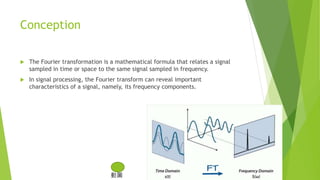
 The Fourier transformation is a mathematical formula that relates a signal
sampled in time or space to the same signal sampled in frequency.
 In signal processing, the Fourier transform can reveal important
characteristics of a signal, namely, its frequency components.
動圖
Background knowledge
 Euler’s formula
 𝑒 𝑖𝜃
= 𝑐𝑜𝑠𝜃 + 𝑖𝑠𝑖𝑛𝜃
 Euler’s formula tells us that if we take exponential to some number 𝜃 times i,
we will we get the point land on a circle with radius 1 rotating 𝜃 angle.
𝜃
1
Background knowledge
 𝑒2𝜋𝑖𝑡
means the vector rotating 360 degree per time(time = t).
 So when we want to change frequency of rotation, the formula can change to
𝑒2𝜋𝑖𝑓, for example 𝑓 = 1/10 means it make one full turn every 10 seconds.
 𝑒−2𝜋𝑖𝑓
if we throw a negative sign up into that exponent mean rotation
direction from counterclockwise to clockwise.
t=10(f = 1/10)
𝑒−2𝜋𝑖𝑓
Mathematical definition
 𝑓(𝑘 + 1) = 𝑗=0
𝑛−1
𝑔 𝑗 + 1 ∗ 𝑒−2𝜋𝑖∗𝑡[𝑗]∗𝑘
,
 𝑠. 𝑡. 0 ≤ j, k ≤ n − 1
Length of signal: n
Time vector: t
Sampling frequency: k
Number of time point: j
𝜔 = 𝑒−2𝜋𝑖𝑡
Example
𝑔 𝑗 = cos 2𝜋 ∗ 50 ∗ 𝑡[𝑗] + 1.2, this is our time domain data.
Length of signal j = 1000, t[0] = 0,t[1] = 0.001, …, t[999] = 0.999
Our propose is using Fourier transformation to transforms data
from time domain to frequency.
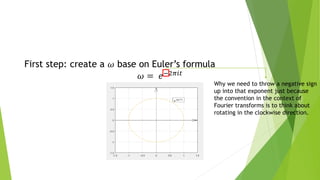
First step: create a 𝜔 base on Euler’s formula
𝜔 = 𝑒−2𝜋𝑖𝑡
Why we need to throw a negative sign
up into that exponent just because
the convention in the context of
Fourier transforms is to think about
rotating in the clockwise direction.
Example
 Second step: 𝑔 𝑗 ∗ 𝑒−2𝜋𝑖𝑡
 Reason : We want to make our wave(g(t)) winding and rotation follow complex
number 𝑒−2𝜋𝑖𝑡
and getting scaled up and down base on amplitude(振幅).
Figure of 𝑔 𝑡 ∗ 𝑤
point 1 to point 500, I didn’t
draw next 500 points because
it will make figure to
intensive.
𝜔 = 𝑒−2𝜋𝑖𝑡
 Third step: time 𝑒 𝑘 with our equation →
 𝑔 𝑗 + 1 ∗ 𝑒−2𝜋𝑖∗𝑡∗𝑘
, 0 ≤ k ≤ n − 1
 Reason: So far there is still nothing about frequency and how to change time
domain to frequency domain, so we time 𝑒 𝑘
with our equation, to import frequency
k into our equation
 How: we summarize N points of their coordinate then divide by N(FT does not
divide by N) t[j]=5
f 𝑘 + 1 =
𝑗=0
𝑛−1
𝑔 𝑗 + 1 ∗ 𝑒−2𝜋𝑖∗𝑡[𝑗]∗𝑘
, 0 ≤ k, j ≤ n − 1
So our equation can be separate into
But also we know0 ≤ k ≤ n − 1, so the equation can do more separate into
𝑔 1 ∗ 𝑒−2𝜋𝑖∗𝑡[0]∗0
+ 𝑔 1 ∗ 𝑒−2𝜋𝑖∗𝑡 0 ∗1
+ 𝑔 1 ∗ 𝑒−2𝜋𝑖∗𝑡[0]∗2
+ … + 𝑔 1 ∗ 𝑒−2𝜋𝑖∗𝑡[0]∗(𝑛−1)
𝑔 2 ∗ 𝑒−2𝜋𝑖∗𝑡 1 ∗0 + 𝑔 2 ∗ 𝑒−2𝜋𝑖∗𝑡 1 ∗1 + 𝑔 2 ∗ 𝑒−2𝜋𝑖∗𝑡[1]∗2 + … + 𝑔 2 ∗ 𝑒−2𝜋𝑖∗𝑡[1]∗(𝑛−1)
.
.
.
𝑔 𝑛 ∗ 𝑒−2𝜋𝑖∗𝑡 𝑛−1 ∗0
+ 𝑔 𝑛 ∗ 𝑒−2𝜋𝑖∗𝑡 𝑛−1 ∗1
+ 𝑔 𝑛 ∗ 𝑒−2𝜋𝑖∗𝑡[𝑛−1]∗2
+ … + 𝑔 𝑛 ∗ 𝑒−2𝜋𝑖∗𝑡[𝑛−1]∗(𝑛−1)
𝑗=0
𝑛−1
𝑔 𝑗 + 1 ∗ 𝑒−2𝜋𝑖∗𝑡[𝑗]∗𝑘
= 𝑔 1 ∗ 𝑒−2𝜋𝑖∗𝑡 0 ∗𝑘
+
𝑔 2 ∗ 𝑒−2𝜋𝑖∗𝑡 1 ∗𝑘
+
.
.
.
𝑔 𝑛 ∗ 𝑒−2𝜋𝑖∗𝑡 𝑛−1 ∗𝑘
Time
domain
Frequency
domain
 Third step: summarize points on the wound-up graph with different frequency
 Reason:
 How: we summarize N points of their coordinate then divide by N(FT does not
divide by N)
FT 𝑘 + 1 = 𝑡=0
𝑛−1
𝑔 𝑗 + 1 ∗ 𝑒−2𝜋𝑖∗𝑡∗𝑓
, 0 ≤ f ≤ n − 1
 Third step: summarize points on the wound-up graph with different frequency
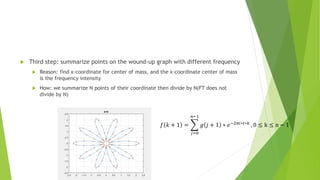
 Reason: find x-coordinate for center of mass, and the x-coordinate center of mass
is the frequency intensity
 How: we summarize N points of their coordinate then divide by N(FT does not
divide by N)
𝑓 𝑘 + 1 =
𝑗=0
𝑛−1
𝑔 𝑗 + 1 ∗ 𝑒−2𝜋𝑖∗𝑡∗𝑘 , 0 ≤ k ≤ n − 1
Changing variable k will find out our figure changed base on
frequency.
𝑔 𝑗 + 1 ∗ 𝑒−2𝜋𝑖∗𝑡[𝑗]∗𝑘
k = 1, 5, 10, 20, 30, 40, 50
K=1 K=5 K=10 K=20 K=30 K=40 K=50
x-
coordinate
center of
mass
5.77E-17 6.39E-17 -9.81E-17 -9.81E-17 -9.37E-17 1.72E-16 0.5
Follow-up processing
 After those three steps we finish Fourier transformation, but we get a lot of complex number
in our example f(k) has 1000 complex number.
 How to use them?
1. We divide f(k) by N
 Reason: just finish what FT didn’t do.
2. We calculate absolute value of f(k)/N and time 2
 Reason: our complex number data of f(k) is symmetrical
and conjugated, so we can just use positive part and because
we ignore negative part so we need time 2.
 After finish this two steps the new data is like
figure on the right side. And because data is
symmetrical so we only look at data from
0~500 is fine.
Conclusion
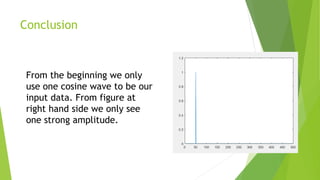
From the beginning we only
use one cosine wave to be our
input data. From figure at
right hand side we only see
one strong amplitude.
reference
 https://www.youtube.com/watch?v=spUNpyF58BY&
 https://zh.wikipedia.org/zh-
tw/%E5%82%85%E9%87%8C%E5%8F%B6%E5%8F%98%E6%8D%A2

Fourier transforms

  • 1.
  • 2.
    Conception  The Fouriertransformation is a mathematical formula that relates a signal sampled in time or space to the same signal sampled in frequency.  In signal processing, the Fourier transform can reveal important characteristics of a signal, namely, its frequency components. 動圖
  • 3.
    Background knowledge  Euler’sformula  𝑒 𝑖𝜃 = 𝑐𝑜𝑠𝜃 + 𝑖𝑠𝑖𝑛𝜃  Euler’s formula tells us that if we take exponential to some number 𝜃 times i, we will we get the point land on a circle with radius 1 rotating 𝜃 angle. 𝜃 1
  • 4.
    Background knowledge  𝑒2𝜋𝑖𝑡 meansthe vector rotating 360 degree per time(time = t).  So when we want to change frequency of rotation, the formula can change to 𝑒2𝜋𝑖𝑓, for example 𝑓 = 1/10 means it make one full turn every 10 seconds.  𝑒−2𝜋𝑖𝑓 if we throw a negative sign up into that exponent mean rotation direction from counterclockwise to clockwise. t=10(f = 1/10) 𝑒−2𝜋𝑖𝑓
  • 5.
    Mathematical definition  𝑓(𝑘+ 1) = 𝑗=0 𝑛−1 𝑔 𝑗 + 1 ∗ 𝑒−2𝜋𝑖∗𝑡[𝑗]∗𝑘 ,  𝑠. 𝑡. 0 ≤ j, k ≤ n − 1 Length of signal: n Time vector: t Sampling frequency: k Number of time point: j 𝜔 = 𝑒−2𝜋𝑖𝑡
  • 6.
    Example 𝑔 𝑗 =cos 2𝜋 ∗ 50 ∗ 𝑡[𝑗] + 1.2, this is our time domain data. Length of signal j = 1000, t[0] = 0,t[1] = 0.001, …, t[999] = 0.999 Our propose is using Fourier transformation to transforms data from time domain to frequency.
  • 7.
    First step: createa 𝜔 base on Euler’s formula 𝜔 = 𝑒−2𝜋𝑖𝑡 Why we need to throw a negative sign up into that exponent just because the convention in the context of Fourier transforms is to think about rotating in the clockwise direction.
  • 8.
    Example  Second step:𝑔 𝑗 ∗ 𝑒−2𝜋𝑖𝑡  Reason : We want to make our wave(g(t)) winding and rotation follow complex number 𝑒−2𝜋𝑖𝑡 and getting scaled up and down base on amplitude(振幅). Figure of 𝑔 𝑡 ∗ 𝑤 point 1 to point 500, I didn’t draw next 500 points because it will make figure to intensive. 𝜔 = 𝑒−2𝜋𝑖𝑡
  • 9.
     Third step:time 𝑒 𝑘 with our equation →  𝑔 𝑗 + 1 ∗ 𝑒−2𝜋𝑖∗𝑡∗𝑘 , 0 ≤ k ≤ n − 1  Reason: So far there is still nothing about frequency and how to change time domain to frequency domain, so we time 𝑒 𝑘 with our equation, to import frequency k into our equation  How: we summarize N points of their coordinate then divide by N(FT does not divide by N) t[j]=5 f 𝑘 + 1 = 𝑗=0 𝑛−1 𝑔 𝑗 + 1 ∗ 𝑒−2𝜋𝑖∗𝑡[𝑗]∗𝑘 , 0 ≤ k, j ≤ n − 1
  • 10.
    So our equationcan be separate into But also we know0 ≤ k ≤ n − 1, so the equation can do more separate into 𝑔 1 ∗ 𝑒−2𝜋𝑖∗𝑡[0]∗0 + 𝑔 1 ∗ 𝑒−2𝜋𝑖∗𝑡 0 ∗1 + 𝑔 1 ∗ 𝑒−2𝜋𝑖∗𝑡[0]∗2 + … + 𝑔 1 ∗ 𝑒−2𝜋𝑖∗𝑡[0]∗(𝑛−1) 𝑔 2 ∗ 𝑒−2𝜋𝑖∗𝑡 1 ∗0 + 𝑔 2 ∗ 𝑒−2𝜋𝑖∗𝑡 1 ∗1 + 𝑔 2 ∗ 𝑒−2𝜋𝑖∗𝑡[1]∗2 + … + 𝑔 2 ∗ 𝑒−2𝜋𝑖∗𝑡[1]∗(𝑛−1) . . . 𝑔 𝑛 ∗ 𝑒−2𝜋𝑖∗𝑡 𝑛−1 ∗0 + 𝑔 𝑛 ∗ 𝑒−2𝜋𝑖∗𝑡 𝑛−1 ∗1 + 𝑔 𝑛 ∗ 𝑒−2𝜋𝑖∗𝑡[𝑛−1]∗2 + … + 𝑔 𝑛 ∗ 𝑒−2𝜋𝑖∗𝑡[𝑛−1]∗(𝑛−1) 𝑗=0 𝑛−1 𝑔 𝑗 + 1 ∗ 𝑒−2𝜋𝑖∗𝑡[𝑗]∗𝑘 = 𝑔 1 ∗ 𝑒−2𝜋𝑖∗𝑡 0 ∗𝑘 + 𝑔 2 ∗ 𝑒−2𝜋𝑖∗𝑡 1 ∗𝑘 + . . . 𝑔 𝑛 ∗ 𝑒−2𝜋𝑖∗𝑡 𝑛−1 ∗𝑘 Time domain Frequency domain
  • 11.
     Third step:summarize points on the wound-up graph with different frequency  Reason:  How: we summarize N points of their coordinate then divide by N(FT does not divide by N) FT 𝑘 + 1 = 𝑡=0 𝑛−1 𝑔 𝑗 + 1 ∗ 𝑒−2𝜋𝑖∗𝑡∗𝑓 , 0 ≤ f ≤ n − 1
  • 12.
     Third step:summarize points on the wound-up graph with different frequency  Reason: find x-coordinate for center of mass, and the x-coordinate center of mass is the frequency intensity  How: we summarize N points of their coordinate then divide by N(FT does not divide by N) 𝑓 𝑘 + 1 = 𝑗=0 𝑛−1 𝑔 𝑗 + 1 ∗ 𝑒−2𝜋𝑖∗𝑡∗𝑘 , 0 ≤ k ≤ n − 1
  • 13.
    Changing variable kwill find out our figure changed base on frequency. 𝑔 𝑗 + 1 ∗ 𝑒−2𝜋𝑖∗𝑡[𝑗]∗𝑘 k = 1, 5, 10, 20, 30, 40, 50 K=1 K=5 K=10 K=20 K=30 K=40 K=50 x- coordinate center of mass 5.77E-17 6.39E-17 -9.81E-17 -9.81E-17 -9.37E-17 1.72E-16 0.5
  • 14.
    Follow-up processing  Afterthose three steps we finish Fourier transformation, but we get a lot of complex number in our example f(k) has 1000 complex number.  How to use them? 1. We divide f(k) by N  Reason: just finish what FT didn’t do. 2. We calculate absolute value of f(k)/N and time 2  Reason: our complex number data of f(k) is symmetrical and conjugated, so we can just use positive part and because we ignore negative part so we need time 2.  After finish this two steps the new data is like figure on the right side. And because data is symmetrical so we only look at data from 0~500 is fine.
  • 15.
    Conclusion From the beginningwe only use one cosine wave to be our input data. From figure at right hand side we only see one strong amplitude.
  • 16.

Editor's Notes

  • #6 Original formula look like this: 𝑓 𝑘+1 = 𝑗=0 𝑛−1 𝑔 𝑗+1 ∗ 𝑒 −2𝜋𝑖∗𝑡∗𝑘/𝑛 . In my formula t already divide by n so we only need time 𝑒 −2𝜋𝑖∗𝑡∗𝑘
  • #10 乘上這個 𝑒 𝑘 是為了進行時域與頻域的轉換,原本的方程式是由t[j]來當變數的方程式,其所表現的是在t[0]~t[n-1]的波繞著原點的位置, 在乘上 𝑒 𝑘 之後,我們的圖形就能從頻率的面向去分析