This document discusses two theorems: Gauss divergence theorem and Stokes theorem. It provides an example problem to verify each theorem. For Gauss divergence theorem, it calculates the surface integral of a vector function over the surfaces of a rectangle parallelepiped and shows it equals the volume integral of the divergence of the function over the volume, verifying the theorem. For Stokes theorem, it similarly calculates line and surface integrals of a vector function over a rectangular region to verify the theorem holds.
![Gauss divergence theorem
If V is the volume bounded by a closed surface S and 𝑓 is a vector
valued function having continuous partial derivatives then 𝑆
𝑓 . 𝑛 𝑑𝑆 =
𝑉
𝛻. 𝑓 𝑑𝑉
Example:
Verify Gauss divergence theorem for
𝑓 = 𝑥2
− 𝑦𝑧 𝑖 + 𝑦2
− 𝑧𝑥 𝑗 + (𝑧2
− 𝑥𝑦)𝑘) taken over the rectangle
parallelepiped, 0 ≤ 𝑥 ≤ 𝑎, 0 ≤ 𝑦 ≤ 𝑏, 0 ≤ 𝑧 ≤ 𝑐.
Solution:
Gauss divergence theorem is 𝑆
𝑓 . 𝑛 𝑑𝑆 = 𝑉
𝛻. 𝑓 𝑑𝑉
Now Consider, 𝑉
𝛻. 𝑓 𝑑𝑉 = 0
𝑎
0
𝑏
0
𝑐
2 𝑥 + 𝑦 + 𝑧 𝑑𝑧 𝑑𝑦 𝑑𝑥
[∵ 𝛻. 𝑓 =
𝜕
𝜕𝑥
𝑖 +
𝜕
𝜕𝑦
𝑗 +
𝜕
𝜕𝑧
𝑘 . [ 𝑥2 − 𝑦𝑧 𝑖 + 𝑦2 − 𝑧𝑥 𝑗 + (𝑧2 − 𝑥𝑦)𝑘)]
=
𝜕
𝜕𝑥
𝑥2
− 𝑦𝑧 +
𝜕
𝜕𝑦
𝑦2
− 𝑧𝑥 +
𝜕
𝜕𝑧
𝑧2
− 𝑥𝑦 = 2(𝑥 + 𝑦 + 𝑧)]](https://image.slidesharecdn.com/vectorcalculus-200414065533/85/Vector-calculus-2-320.jpg)
![= 2
0
𝑎
0
𝑏
𝑥𝑧 + 𝑦𝑧 +
𝑧2
2 0
𝑐
𝑑𝑦 𝑑𝑥
= 2
0
𝑎
0
𝑏
𝑥𝑐 + 𝑦𝑐 +
𝑐2
2
𝑑𝑦 𝑑𝑥
= 2
0
𝑎
𝑥𝑦𝑐 +
𝑦2
2
𝑐 +
𝑦𝑐2
2 0
𝑏
𝑑𝑥
= 2
0
𝑎
[𝑥𝑏𝑐 +
𝑏2
2
𝑐 +
𝑏𝑐2
2
]𝑑𝑥
= 2
𝑥2
2
𝑏𝑐 + 𝑥
𝑏2
2
𝑐 +
𝑥𝑏𝑐2
2 0
𝑎
= 2[
𝑎2
2
𝑏𝑐 + 𝑎
𝑏2
2
𝑐 +
𝑎𝑏𝑐2
2
]
𝑉
𝛻. 𝑓 𝑑𝑉 = 𝑎𝑏𝑐 𝑎 + 𝑏 + 𝑐 → 𝟏
Now Consider, 𝑆
𝑓 . 𝑛 𝑑𝑆 Where S is the surface of the
rectangle parallelepiped given by
0 ≤ 𝑥 ≤ 𝑎, 0 ≤ 𝑦 ≤ 𝑏, 0 ≤ 𝑧 ≤ 𝑐.](https://image.slidesharecdn.com/vectorcalculus-200414065533/85/Vector-calculus-3-320.jpg)
![It has the following six faces OABC (xz-plane); OAFE (xy-plane); OEDC (yz-plane);
DEFG (opposite to xz-plane); AFGB (opposite to (yz-plane); BCDG (opposite to xy-
plane)
On the face OABC we have 𝑦 = 0, 𝑛 = − 𝑗, 0 ≤ 𝑥 ≤ 𝑎 and 0 ≤ 𝑧 ≤ 𝑐.
∴
𝑂𝐴𝐵𝐶
𝑓 . 𝑛 𝑑𝑆 =
0
𝑎
0
𝑐
[ 𝑥2 − 𝑦𝑧 𝑖 + 𝑦2 − 𝑧𝑥 𝑗 + (𝑧2 − 𝑥𝑦)𝑘)]. (− 𝑗) 𝑑𝑧 𝑑𝑥
=
0
𝑎
0
𝑐
𝑦2 − 𝑧𝑥 𝑑𝑧 𝑑𝑥
= 0
𝑎
0
𝑐
𝑧𝑥 𝑑𝑧 𝑑𝑥 (since y = 0)
=
0
𝑎
𝑥
𝑧2
2 0
𝑐
𝑑𝑥
=
𝑎
𝑥
𝑐2
𝑑𝑥](https://image.slidesharecdn.com/vectorcalculus-200414065533/85/Vector-calculus-4-320.jpg)
![On the face DEFG we have 𝑦 = 𝑏, 𝑛 = 𝑗, 0 ≤ 𝑥 ≤ 𝑎 and 0 ≤ 𝑧 ≤ 𝑐.
∴
𝐷𝐸𝐹𝐺
𝑓 . 𝑛 𝑑𝑆 =
0
𝑎
0
𝑐
[ 𝑥2
− 𝑦𝑧 𝑖 + 𝑦2
− 𝑧𝑥 𝑗 + (𝑧2
− 𝑥𝑦)𝑘)]. ( 𝑗) 𝑑𝑧 𝑑𝑥
=
0
𝑎
0
𝑐
𝑦2
− 𝑧𝑥 𝑑𝑧 𝑑𝑥
= 0
𝑎
0
𝑐
(𝑏2
− 𝑧𝑥) 𝑑𝑧 𝑑𝑥 (since y = b)
=
0
𝑎
𝑏2
𝑧 − 𝑥
𝑧2
2 0
𝑐
𝑑𝑥
=
0
𝑎
[𝑏2 𝑐 − 𝑥
𝑐2
2
]𝑑𝑥
= 𝑥𝑏2
𝑐 −
𝑐2
2
𝑥2
2 0
𝑎
= 𝑎𝑏2
𝑐 −
𝑎2 𝑐2
4
→ 𝟑
On the face OAFE we have 𝑧 = 0, 𝑛 = −𝑘, 0 ≤ 𝑥 ≤ 𝑎 and 0 ≤ 𝑦 ≤ 𝑏.
∴ 𝑓 . 𝑛 𝑑𝑆 =
𝑎 𝑏
[ 𝑥2
− 𝑦𝑧 𝑖 + 𝑦2
− 𝑧𝑥 𝑗 + (𝑧2
− 𝑥𝑦)𝑘)]. (−𝑘) 𝑑𝑦 𝑑𝑥](https://image.slidesharecdn.com/vectorcalculus-200414065533/85/Vector-calculus-5-320.jpg)
![=
𝑏2
2
𝑥2
2 0
𝑎
=
𝑎2 𝑏2
4
→ 𝟒
On the face BCDG we have 𝑧 = 𝑐, 𝑛 = 𝑘, 0 ≤ 𝑥 ≤ 𝑎 and 0 ≤ 𝑦 ≤ 𝑏.
∴
𝐵𝐶𝐷𝐺
𝑓 . 𝑛 𝑑𝑆 =
0
𝑎
0
𝑏
[ 𝑥2
− 𝑦𝑧 𝑖 + 𝑦2
− 𝑧𝑥 𝑗 + (𝑧2
− 𝑥𝑦)𝑘)]. (𝑘) 𝑑𝑦 𝑑𝑥
=
0
𝑎
0
𝑏
𝑧2
− 𝑥𝑦 𝑑𝑦 𝑑𝑥
= 0
𝑎
0
𝑏
(𝑐2
− 𝑥𝑦) 𝑑𝑦 𝑑𝑥 (since z = c)
=
0
𝑎
𝑐2 𝑦 − 𝑥
𝑦2
2 0
𝑏
𝑑𝑥
=
0
𝑎
[𝑐2 𝑏 − 𝑥
𝑏2
2
]𝑑𝑥
= 𝑥𝑐2
𝑏 −
𝑏2
2
𝑥2
2 0
𝑎
= 𝑎𝑐2
𝑏 −
𝑎2
𝑏2
4
→ 𝟓
On the face OEDC we have 𝑥 = 0, 𝑛 = − 𝑖, 0 ≤ 𝑦 ≤ 𝑏 and 0 ≤ 𝑧 ≤ 𝑐.
𝑏 𝑐
=
0
𝑎
𝑥
𝑦2
2 0
𝑏
𝑑𝑥
=
0
𝑎
𝑥
𝑏2
2
𝑑𝑥](https://image.slidesharecdn.com/vectorcalculus-200414065533/85/Vector-calculus-6-320.jpg)
![= 0
𝑏
0
𝑐
𝑦𝑧 𝑑𝑧 𝑑𝑦 (since x = 0)
=
0
𝑏
𝑦
𝑧2
2 0
𝑐
𝑑𝑦
=
0
𝑏
𝑦
𝑐2
2
𝑑𝑦
=
𝑐2
2
𝑦2
2 0
𝑏
=
𝑏2 𝑐2
4
→ 𝟔
On the face ABGF we have 𝑥 = 𝑎, 𝑛 = 𝑖, 0 ≤ 𝑦 ≤ 𝑏 and 0 ≤ 𝑧 ≤ 𝑐.
∴
𝐴𝐵𝐺𝐹
𝑓 . 𝑛 𝑑𝑆 =
0
𝑏
0
𝑐
[ 𝑥2 − 𝑦𝑧 𝑖 + 𝑦2 − 𝑧𝑥 𝑗 + (𝑧2 − 𝑥𝑦)𝑘)]. ( 𝑖) 𝑑𝑧 𝑑𝑦
=
0
𝑏
0
𝑐
𝑥2
− 𝑦𝑧 𝑑𝑧 𝑑𝑦
= 0
𝑏
0
𝑐
(𝑎2
− 𝑦𝑧) 𝑑𝑧 𝑑𝑦 (since x = a)
=
0
𝑏
𝑎2
𝑧 − 𝑦
𝑧2
2 0
𝑐
𝑑𝑦](https://image.slidesharecdn.com/vectorcalculus-200414065533/85/Vector-calculus-7-320.jpg)
![=
0
𝑏
[𝑎2 𝑐 − 𝑦
𝑐2
2
]𝑑𝑦
= 𝑦𝑎2
𝑐 −
𝑐2
2
𝑦2
2 0
𝑏
= 𝑎2
𝑏𝑐 −
𝑏2
𝑐2
4
→ 𝟕
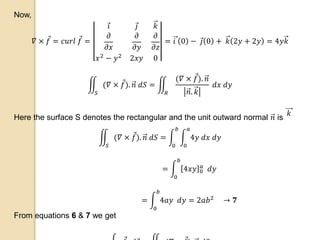
Adding equations 2, 3, 4, 5, 6 & 7 we get
𝑆
𝑓 . 𝑛 𝑑𝑆 = 𝑎𝑏𝑐 𝑎 + 𝑏 + 𝑐 → 𝟖
From equations 1 & 8 we get
𝑆
𝑓 . 𝑛 𝑑𝑆 =
𝑉
𝛻. 𝑓 𝑑𝑉
Hence Gauss divergence theorem is verified.
---------------------------------------------------------------------------------------------------------------
----------](https://image.slidesharecdn.com/vectorcalculus-200414065533/85/Vector-calculus-8-320.jpg)
![∴ The parametric equation of OA can be taken as x = t, y = 0 where 0 ≤ 𝑡 ≤ 𝑎
𝑂𝐴
𝑓 . 𝑑 𝑟 =
𝑂𝐴
𝑥2
− 𝑦2
𝑖 + 2𝑥𝑦 𝑗 . [𝑑𝑥 𝑖 + 𝑑𝑦 𝑗 + 𝑑𝑧 𝑘]
=
𝑂𝐴
𝑥2
− 𝑦2
𝑑𝑥 + 2𝑥𝑦 𝑑𝑦
= 0
𝑎
𝑡2
− 0 𝑑𝑡 (since x = t, y = 0, dx = dt)
=
𝑡3
3 0
𝑎
=
𝑎3
3
→ 𝟐
∴ The parametric equation of AB can be taken as x = a, y = t where 0 ≤ 𝑡 ≤ 𝑏
𝐴𝐵
𝑓 . 𝑑 𝑟 =
𝐴𝐵
𝑥2
− 𝑦2
𝑖 + 2𝑥𝑦 𝑗 . [𝑑𝑥 𝑖 + 𝑑𝑦 𝑗 + 𝑑𝑧 𝑘]
=
𝐴𝐵
𝑥2
− 𝑦2
𝑑𝑥 + 2𝑥𝑦 𝑑𝑦
= 0
𝑏
2𝑎𝑡 𝑑𝑡 (since x = a, y = t, dy = dt)](https://image.slidesharecdn.com/vectorcalculus-200414065533/85/Vector-calculus-10-320.jpg)
![The parametric equation of BC can be taken as x = t, y = b where 0 ≤ 𝑡 ≤ 𝑎
𝐵𝐶
𝑓 . 𝑑 𝑟 = −
𝐶𝐵
𝑥2 − 𝑦2 𝑖 + 2𝑥𝑦 𝑗 . [𝑑𝑥 𝑖 + 𝑑𝑦 𝑗 + 𝑑𝑧 𝑘]
= −
𝐶𝐵
𝑥2 − 𝑦2 𝑑𝑥 + 2𝑥𝑦 𝑑𝑦
= − 0
𝑎
(𝑡2
− 𝑏2
) 𝑑𝑡 (since x = t, y = b, dx = dt)
=
𝑡3
3
− 𝑏2 𝑡
0
𝑎
= −
𝑎3
3
+ 𝑎𝑏2 → 𝟒
∴ The parametric equation of BC can be taken as x = 0, y = t where 0 ≤ 𝑡 ≤ 𝑎
𝐶𝑂
𝑓 . 𝑑 𝑟 = −
𝑂𝐶
𝑓 . 𝑑 𝑟 = −
0
𝑏
0 𝑑𝑡 = 0 → 𝟓
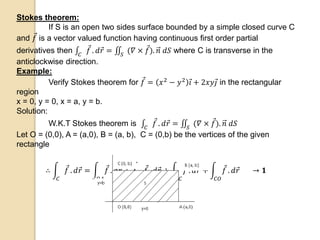
Substitute equations 2, 3, 4&5 in equation 1 we get
𝐶
𝑓 . 𝑑 𝑟 = 2𝑎𝑏2
→ 𝟔](https://image.slidesharecdn.com/vectorcalculus-200414065533/85/Vector-calculus-11-320.jpg)