POWER SYSTEM STABILIZER

SUMAN SOURABH
B.TECH EEE,FINAL YEAR
06570104910
Power System Stability

Power system stability is the ability of an electric power
system, for a given initial operating condition, to regain a
state of operating equilibrium after being subjected to a
physical disturbance, with most system variables bounded
so that practically the entire system remains intact.
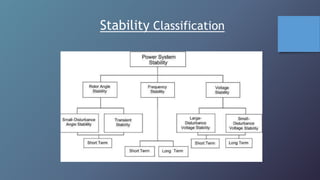
Stability Classification
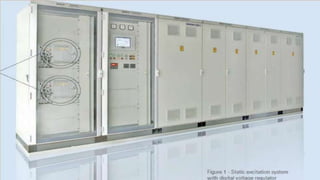
POWER SYSTEM STABILIZERS
• PSS are generator control equipments which are used
in feed back to enhance the damping of rotor
oscillation caused due to small signal disturbance.
• This disturbance may be caused by the even small
change in the reference voltage of the automatic
voltage regulator/exciter which results in ever
increasing rotor oscillations.
Contd...........
• This is achieved by modulating the generator
excitation so as to develop components of
electrical torque in phase with rotor speed
deviations. The PSS thus contributes to the
enhancement of small-signal stability of power
systems.
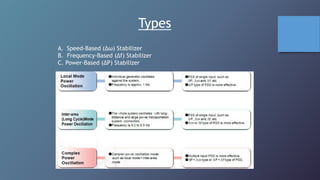
Types
A. Speed-Based (Δω) Stabilizer
B. Frequency-Based (Δf) Stabilizer
C. Power-Based (ΔP) Stabilizer
WORKING

• under some conditions, such as much
impedance, heavy load need etc., the
additional torque ΔMe2 provided by the AVR lags
the negative feedback voltage by some angle.
• The power system stabilizer, using the speed signal
(Δ ω) as input signal, will have a positive damping
torque component ΔMp2.
• So, the synthesis torque with positive synchronous
torque and the damping torque can enhance the
capacity of the damping
oscillation.
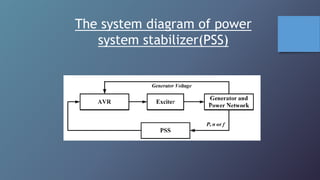
The system diagram of power
system stabilizer(PSS)
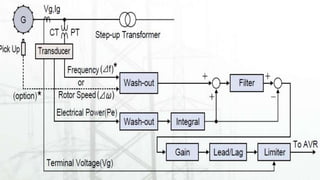
Functional block diagram of
PSS
ADVANTAGES &
DISADVANTAGES
•
•
•
•
•

Improved damping of the system
The dynamic stability of a system is improved.
Reduced power losses.
Time consuming tuning of PSS.
Non-optimal damping in the entire operating range.
REFRENCES
1. Kunder, P. (1994). Power System Stability and Control, McGraw-Hill.
2. Anderson, P. M.; & Fouad, A. A. (2003). Power System Control and Stability(Second
Edition),John Wiley & Sons.
3. Zhang, X.P.; Rehtanz, C.; & Pal, B.(2006). Flexible AC Transmission Systems:
Modeling and Control.
4. Study on Oscillation Damping Effects of Power,System Stabilizer with Eigenvalue
Analysis Method for the Stability of Power Systems,Fang Liu1, Ryuichi
Yokoyama, Yicheng Zhou, Min Wu,Waseda University,Japan.
5. www.google.com
6. www.bing.com
7. www.wikipaedia.com
QUERIES???
THANK YOU

Power System Stabilizer

  • 1.
    POWER SYSTEM STABILIZER SUMANSOURABH B.TECH EEE,FINAL YEAR 06570104910
  • 2.
    Power System Stability Powersystem stability is the ability of an electric power system, for a given initial operating condition, to regain a state of operating equilibrium after being subjected to a physical disturbance, with most system variables bounded so that practically the entire system remains intact.
  • 3.
  • 4.
    POWER SYSTEM STABILIZERS •PSS are generator control equipments which are used in feed back to enhance the damping of rotor oscillation caused due to small signal disturbance. • This disturbance may be caused by the even small change in the reference voltage of the automatic voltage regulator/exciter which results in ever increasing rotor oscillations.
  • 5.
    Contd........... • This isachieved by modulating the generator excitation so as to develop components of electrical torque in phase with rotor speed deviations. The PSS thus contributes to the enhancement of small-signal stability of power systems.
  • 6.
    Types A. Speed-Based (Δω)Stabilizer B. Frequency-Based (Δf) Stabilizer C. Power-Based (ΔP) Stabilizer
  • 8.
    WORKING • under someconditions, such as much impedance, heavy load need etc., the additional torque ΔMe2 provided by the AVR lags the negative feedback voltage by some angle.
  • 9.
    • The powersystem stabilizer, using the speed signal (Δ ω) as input signal, will have a positive damping torque component ΔMp2. • So, the synthesis torque with positive synchronous torque and the damping torque can enhance the capacity of the damping oscillation.
  • 10.
    The system diagramof power system stabilizer(PSS)
  • 11.
  • 14.
    ADVANTAGES & DISADVANTAGES • • • • • Improved dampingof the system The dynamic stability of a system is improved. Reduced power losses. Time consuming tuning of PSS. Non-optimal damping in the entire operating range.
  • 15.
    REFRENCES 1. Kunder, P.(1994). Power System Stability and Control, McGraw-Hill. 2. Anderson, P. M.; & Fouad, A. A. (2003). Power System Control and Stability(Second Edition),John Wiley & Sons. 3. Zhang, X.P.; Rehtanz, C.; & Pal, B.(2006). Flexible AC Transmission Systems: Modeling and Control. 4. Study on Oscillation Damping Effects of Power,System Stabilizer with Eigenvalue Analysis Method for the Stability of Power Systems,Fang Liu1, Ryuichi Yokoyama, Yicheng Zhou, Min Wu,Waseda University,Japan. 5. www.google.com 6. www.bing.com 7. www.wikipaedia.com
  • 16.
  • 17.