Ayele Nigussie
 Accurate electric load forecasting is crucial for
power system planning and operation.
 The forecasted load should be close to the load
demand on the power system.
 Load forecasting is always associated with some
uncertainty.
 Power systems, however, are to be planned in
such a way that changing load developments can
be accommodated by the expansion of the system
.
 load forecasting helps a company to decide
◦ Purchasing electric power
◦ Generating electric power
◦ Load switching
◦ Infrastructure development
 Three types of forecasts:
1. short-term forecasts- which are usually from one hour
to one week
2. Medium-term forecasts- which are usually from a
week to a year
3. long-term forecasts- which are longer than a year
 Some load forecasting methods are:
1. Load forecast with load increase factors
2. Load forecast based on economic characteristic
data
3. Load forecast with estimated values
4. Load forecast with standardized load curves.
5. Regression
6. Modern forecasting methods
 The precise application of the different methods
cannot be determined exactly.
 And combinations of the methods are usually
applied.
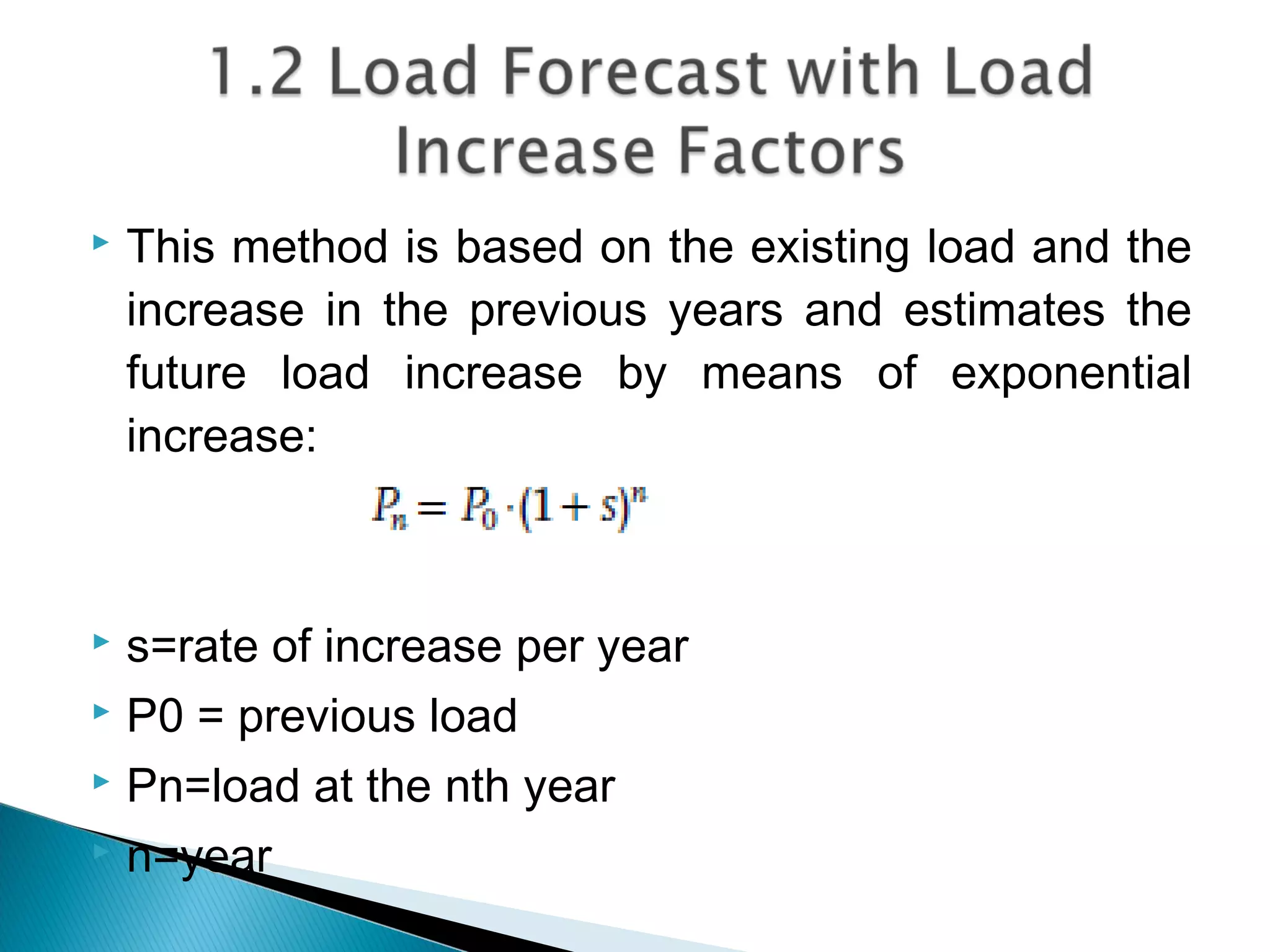
 This method is based on the existing load and the
increase in the previous years and estimates the
future load increase by means of exponential
increase:
 s=rate of increase per year
 P0 = previous load
 Pn=load at the nth year
 n=year
 This method is simple but cannot consider
externally measured variables and is hardly
suitable to provide reliable load and energy
predictions.
Example:
 Assume the pick load on Haramaya substation is 5
MW and the annual growth rate is 7%. What will
be the pick load after 10 solid years?
 Ans: P10=9.84 MW
 An increase in accuracy is obtained if the load
forecast is carried out separately for the individual
consumption sectors, such as households,
commercial, public supply and industrial sectors.
 Then the individual results are summed for each
year to obtain the total system load.
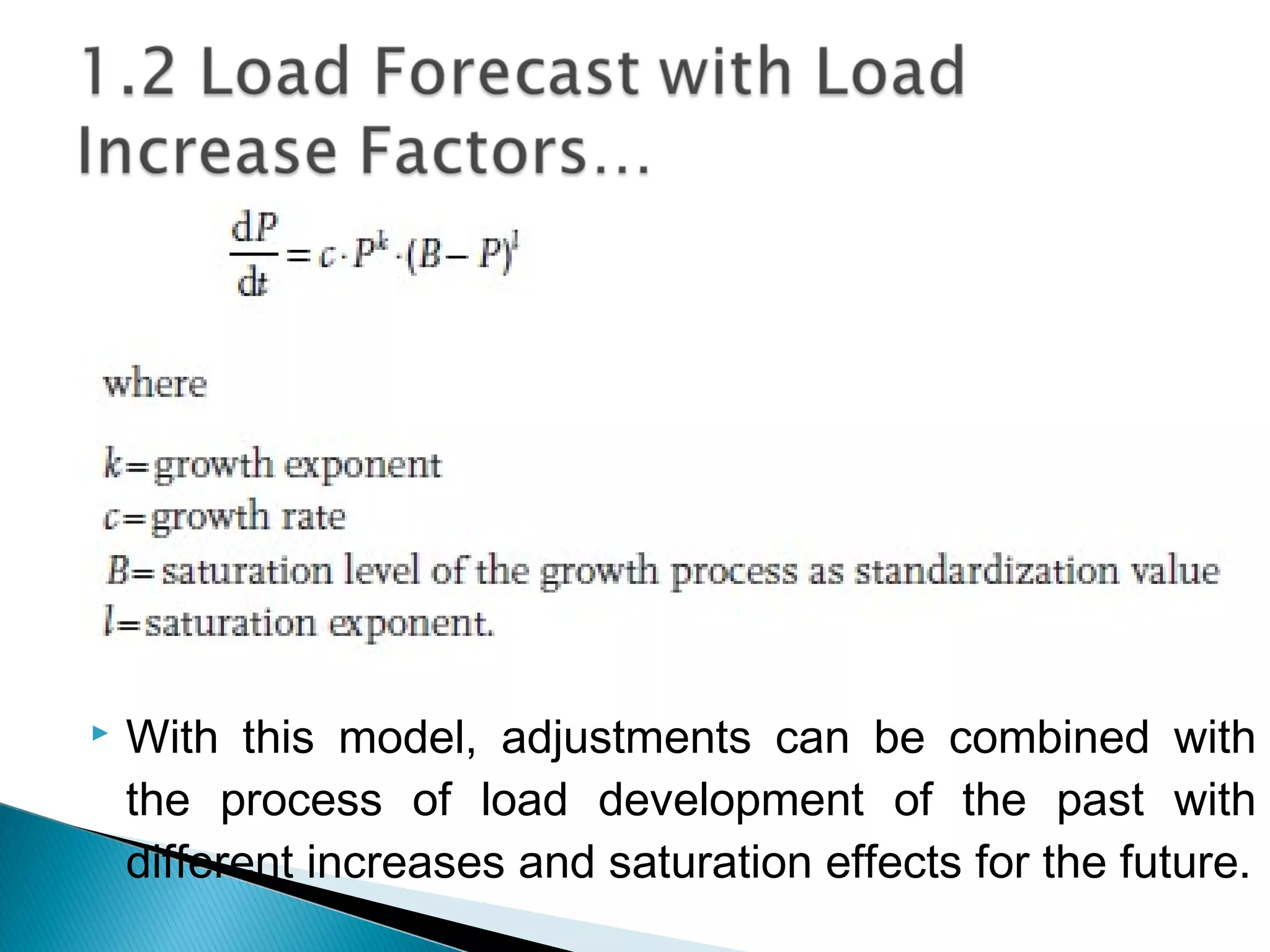
 Another model for load forecasting is based on the
phenomenological description of the growth of
electrical energy consumption as shown next:
 With this model, adjustments can be combined with
the process of load development of the past with
different increases and saturation effects for the future.
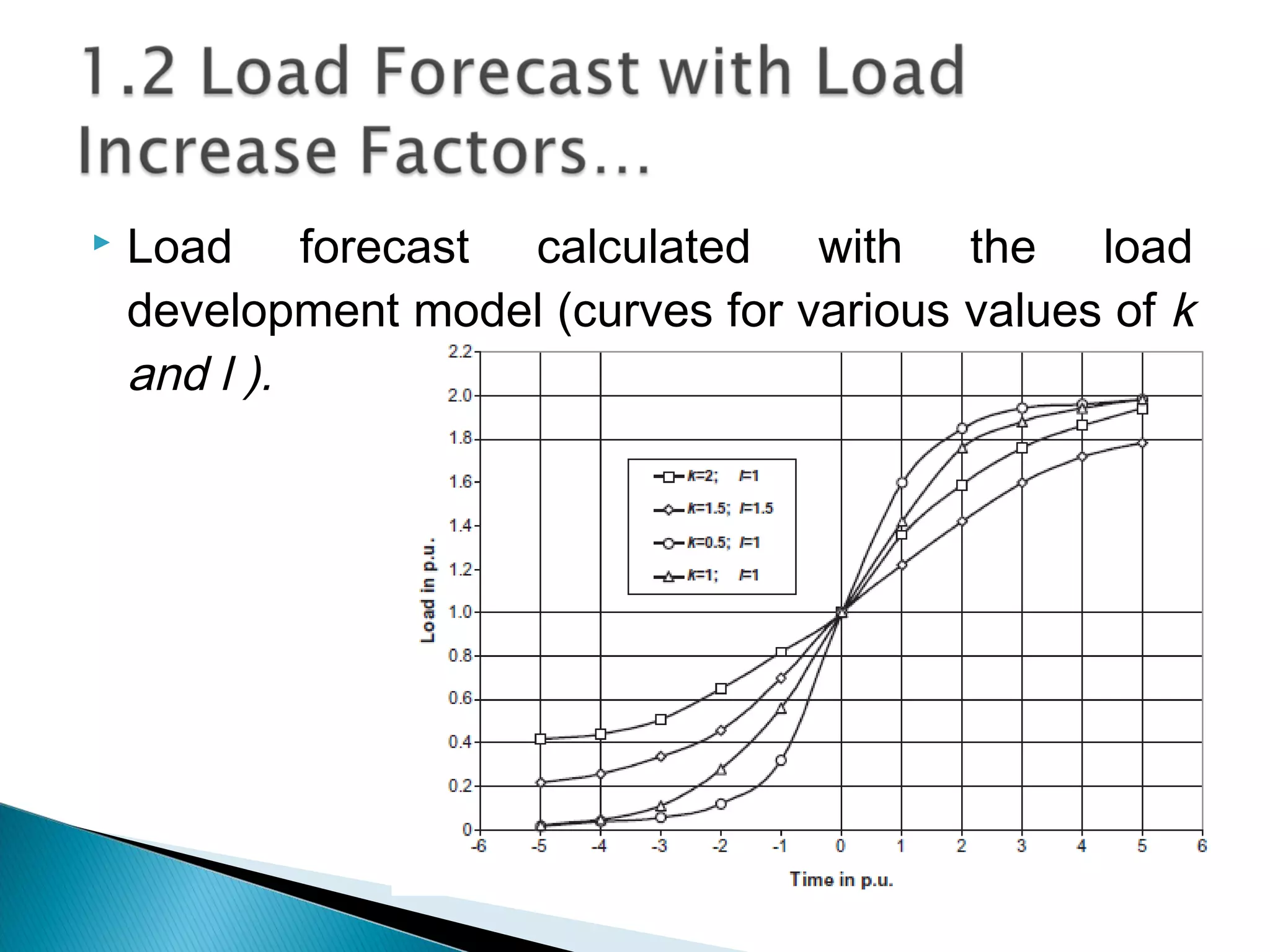
 Load forecast calculated with the load
development model (curves for various values of k
and l ).
 As the economy of a country grows, so does the
power demand.
 Load forecast with economic characteristic data
obtained from energy statistics assumes different
relations between economic growth, availability of
energy resources, energy consumption and
requirements in general, such as the increase in
energy consumption due to growth of population, and
in special applications, such as energy requirements
of industry.
 The requirement for electrical energy per capita of the
population is determined to a large extent by the standard of
living and the degree of industrialization of a country.
 However, high consumption of energy can be also an
indicator of high waste of energy.
 The increase of electrical energy consumption in
industrialized countries is less affected by the growth of
population and predominantly by the growth of the gross
domestic product ( GDP ) and/or the gross national product (
GNP ).
Example:
 In the GTP, the GDP of Ethiopia is supposed to grow at 15%.
Before the GTP period, the power demand was growing at a
rate of 23% (GDP growth=11%). Assuming a direct relationship
between the economy and the power demand,
a. What is the rate of power demand growth in the GTP period?
b. In 2002 E.C, the national power demand was approximately
1500 MW. What will be the expected power demand in 2007
E.C?
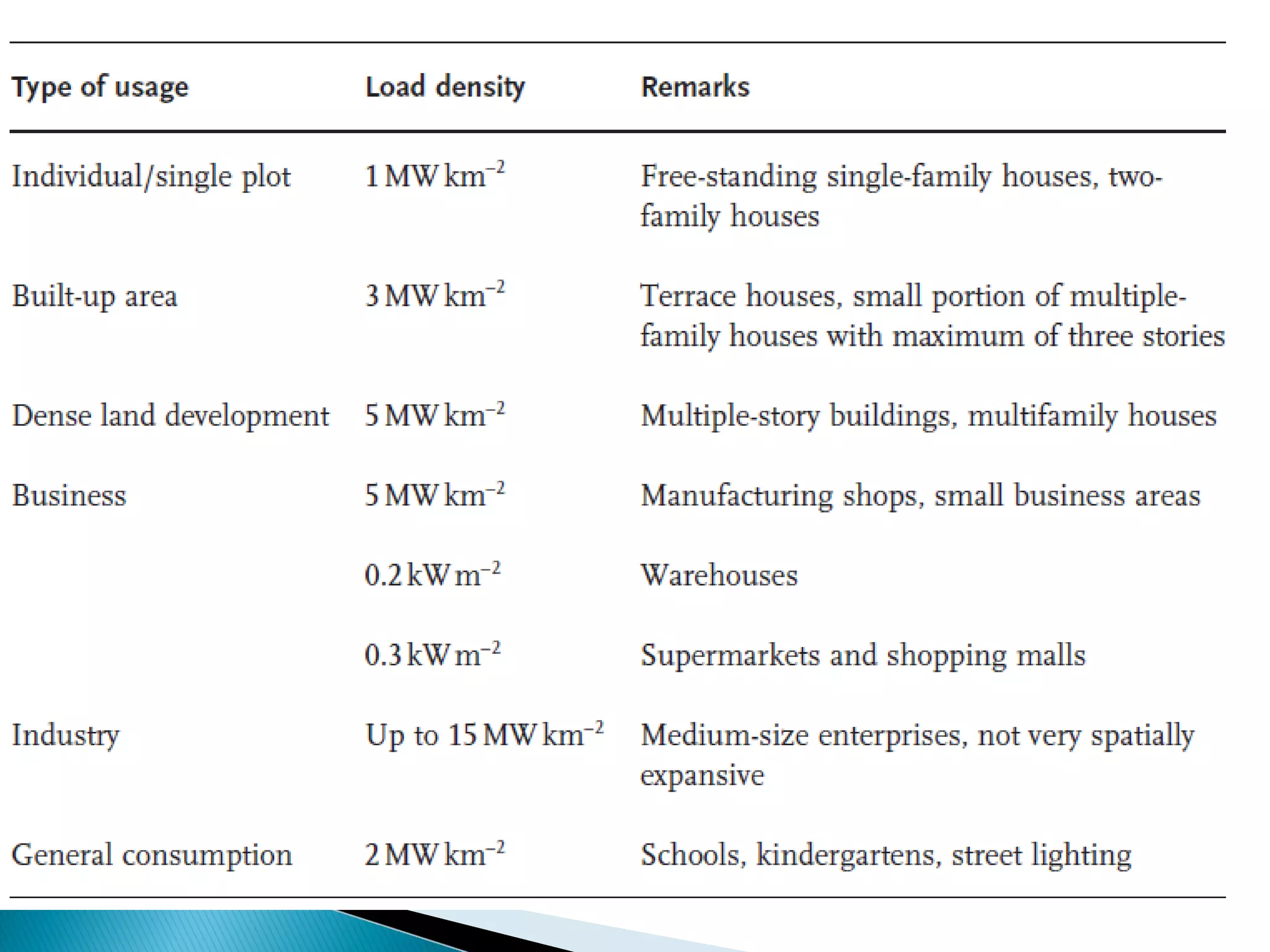
 In power system expansion, development plan is
vital in forecasting the power requirement.
 For instance, we can use the table on the next
slide in power system planning.
Example:
 Near Addis, a business area of 10km-squared is to be
electrified. Forecast the power demand.
 Land development plans contain general information
about the area development and use of land, and the
size, location and types of residential, industrial and
commercial areas, without allowing one to be able to
derive detailed individual measures from them.
 Another way of load forecasting is based on the
annual energy consumption of individual consumer or
consumer groups, which can be taken from the annual
electricity bill.
 The system load can be determined by means of
standardized load curves for different consumer
groups such as
◦ Residential
◦ Commercial
◦ Public sectors
◦ industrial
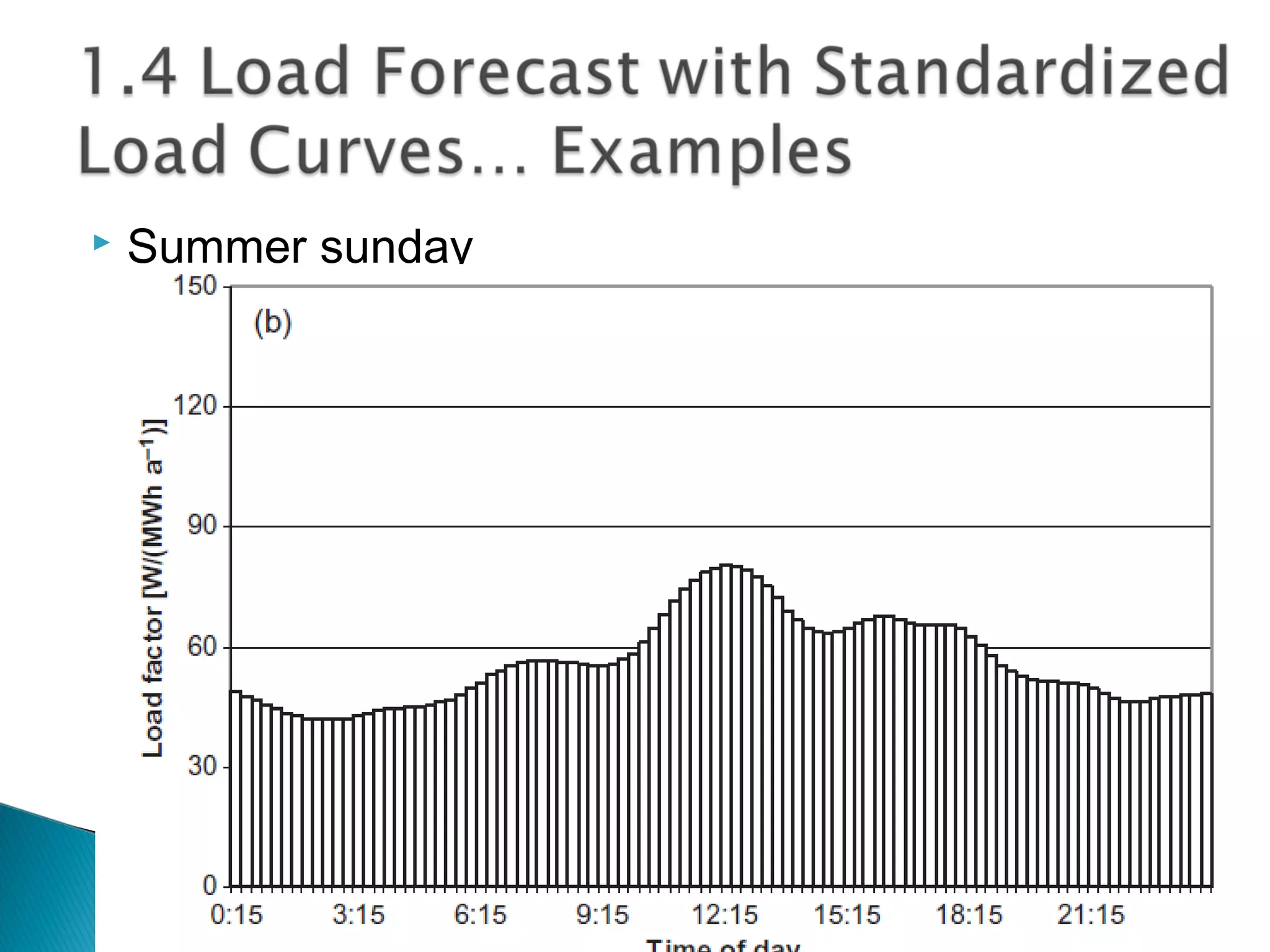
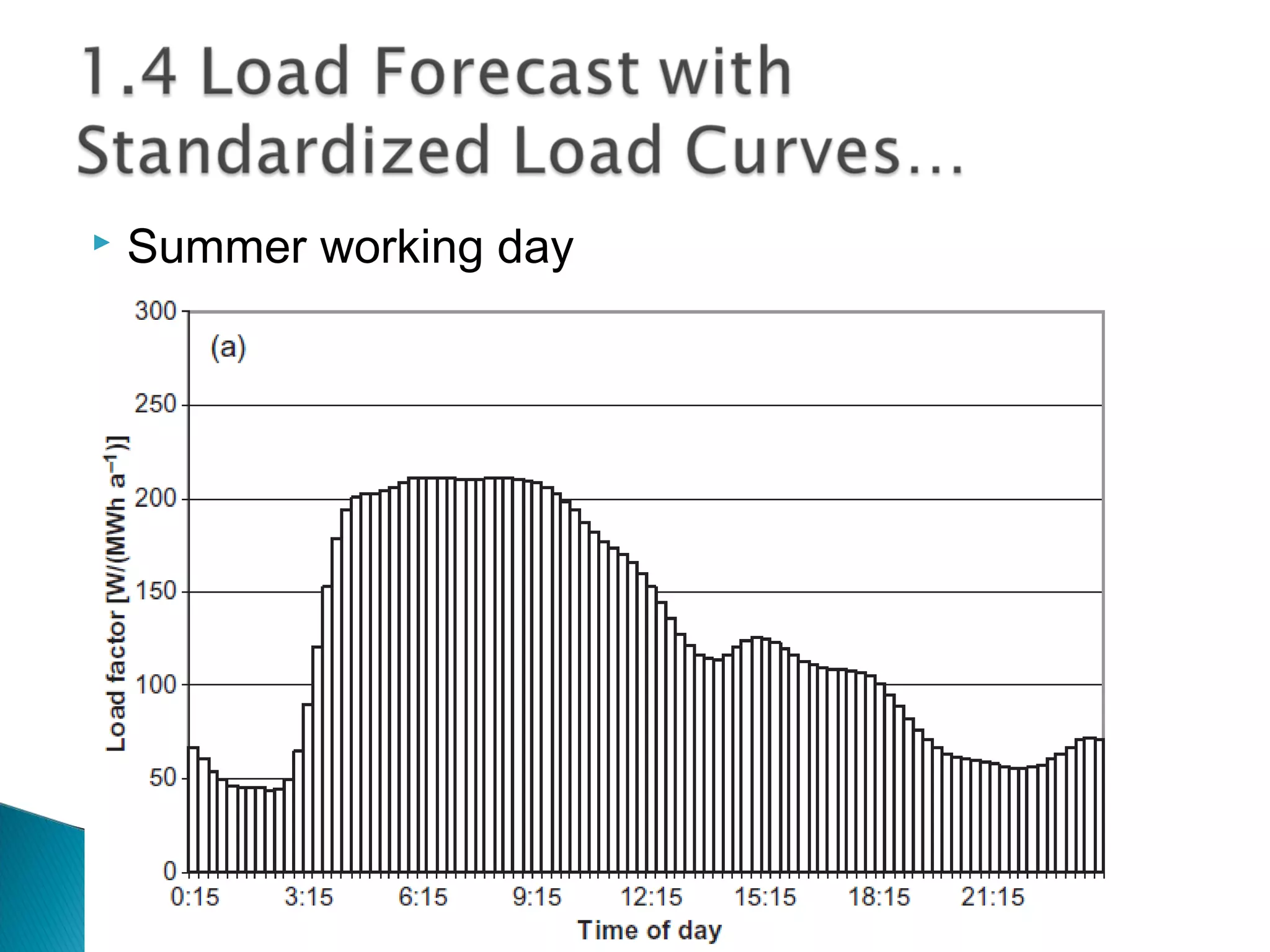
 As consumption profiles of the particular customer
groups not only change with time of day but also show
day - of - week and seasonal changes, characteristic
days are defined, such as working - day, Saturday,
Sunday (or Friday in Islamic countries) and holiday as
well as seasonal differences in winter, summer and
transition periods.
 Based on the load curves we can forecast the future load
for a particular hour, a particular day and a particular
year.
 Summer sunday
 Summer working day
 Regression is also used in forecasting loads.
 Read this at your home.
 Nowadays, fuzy logic, ANN, and other algorithms
are used in power system planning to forecast
load.
 These algorithms have artificial learning
capabilities.
 And thus, by taking the past into consideration,
they can predict the future.
Planning and Design of hydro generation
stations
Ayele Nigussie
1. Introduction
2. Layout
3. Environmental Effects of HPPs
4. Economic Aspects of HPPs
5. Designing HPPs
6. Summary
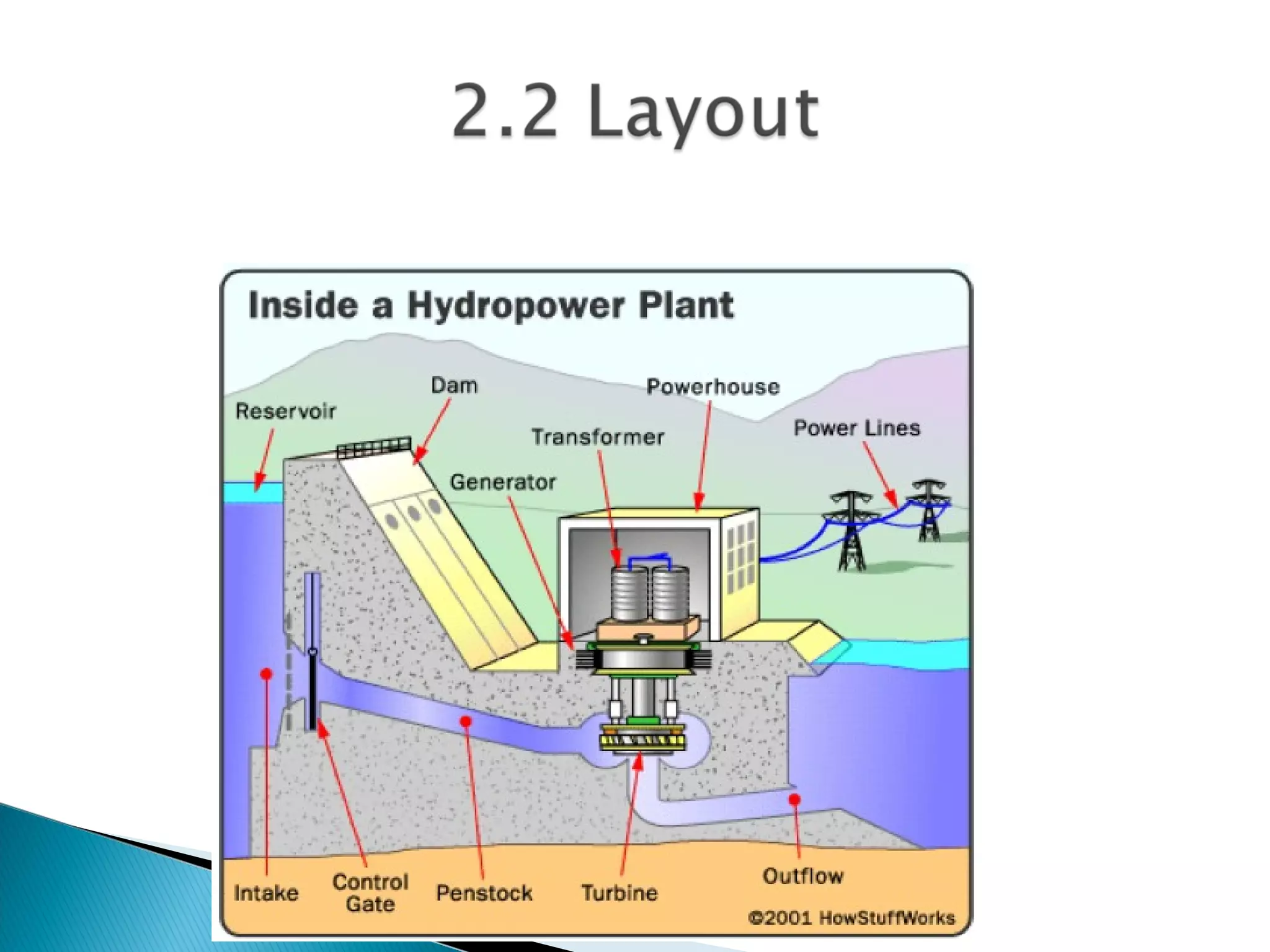
 Hydroelectric power captures the energy released
from falling water.
 Potential Energy  Kinetic energy  Electrical
Energy
 Hydroelectric power plants are categorized as
◦ Micro hydropower plants [<100 kW)
◦ Mini Hydropower Plants [100 kW – 1 MW]
◦ Small Hydropower Plants [1 MW – 30 MW]
◦ Large Hydropower Plants [>30 MW]
 In Ethiopia, more than 96% of the electricity is hydro.
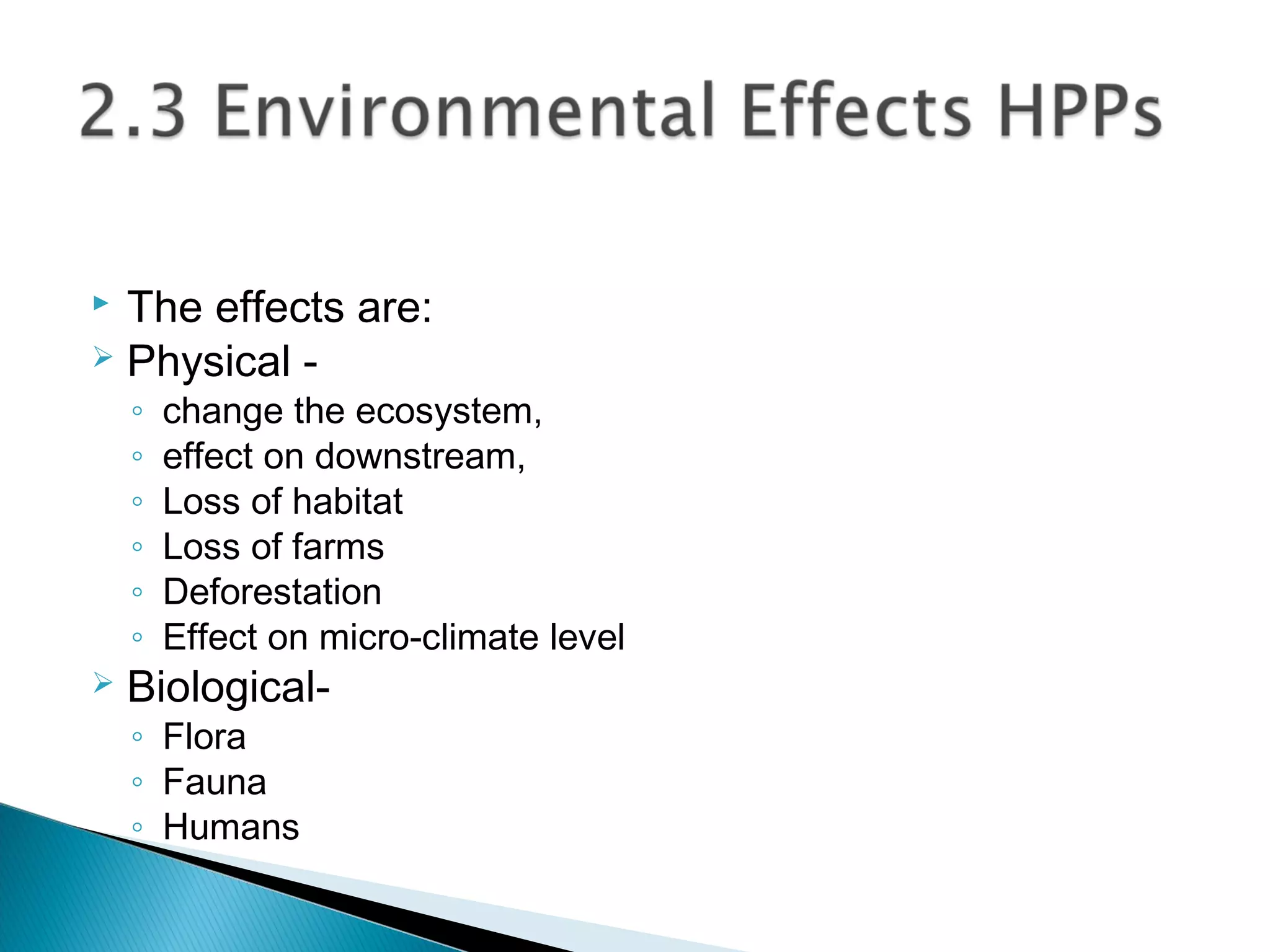
 The effects are:
 Physical -
◦ change the ecosystem,
◦ effect on downstream,
◦ Loss of habitat
◦ Loss of farms
◦ Deforestation
◦ Effect on micro-climate level
 Biological-
◦ Flora
◦ Fauna
◦ Humans
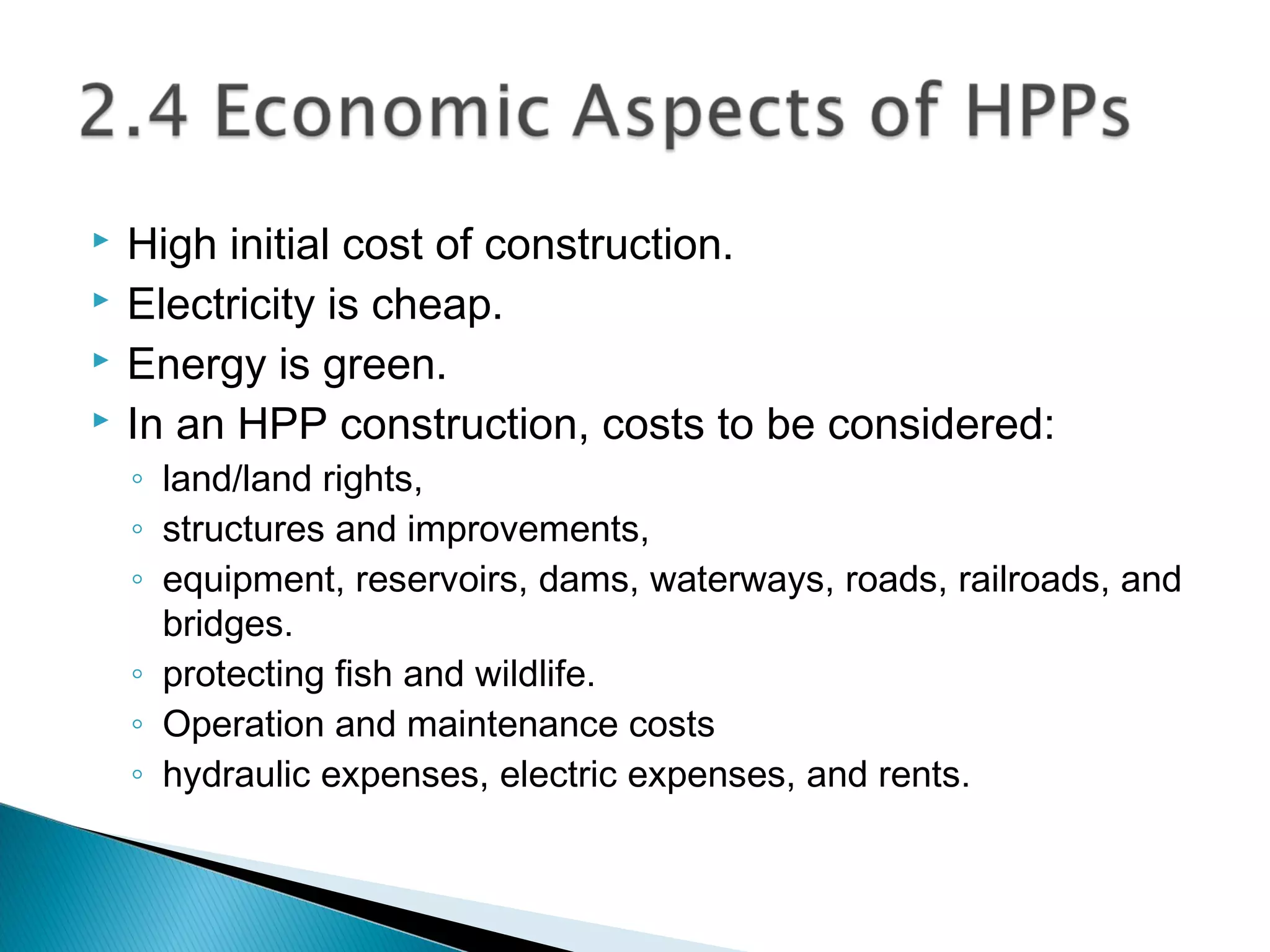
 High initial cost of construction.
 Electricity is cheap.
 Energy is green.
 In an HPP construction, costs to be considered:
◦ land/land rights,
◦ structures and improvements,
◦ equipment, reservoirs, dams, waterways, roads, railroads, and
bridges.
◦ protecting fish and wildlife.
◦ Operation and maintenance costs
◦ hydraulic expenses, electric expenses, and rents.
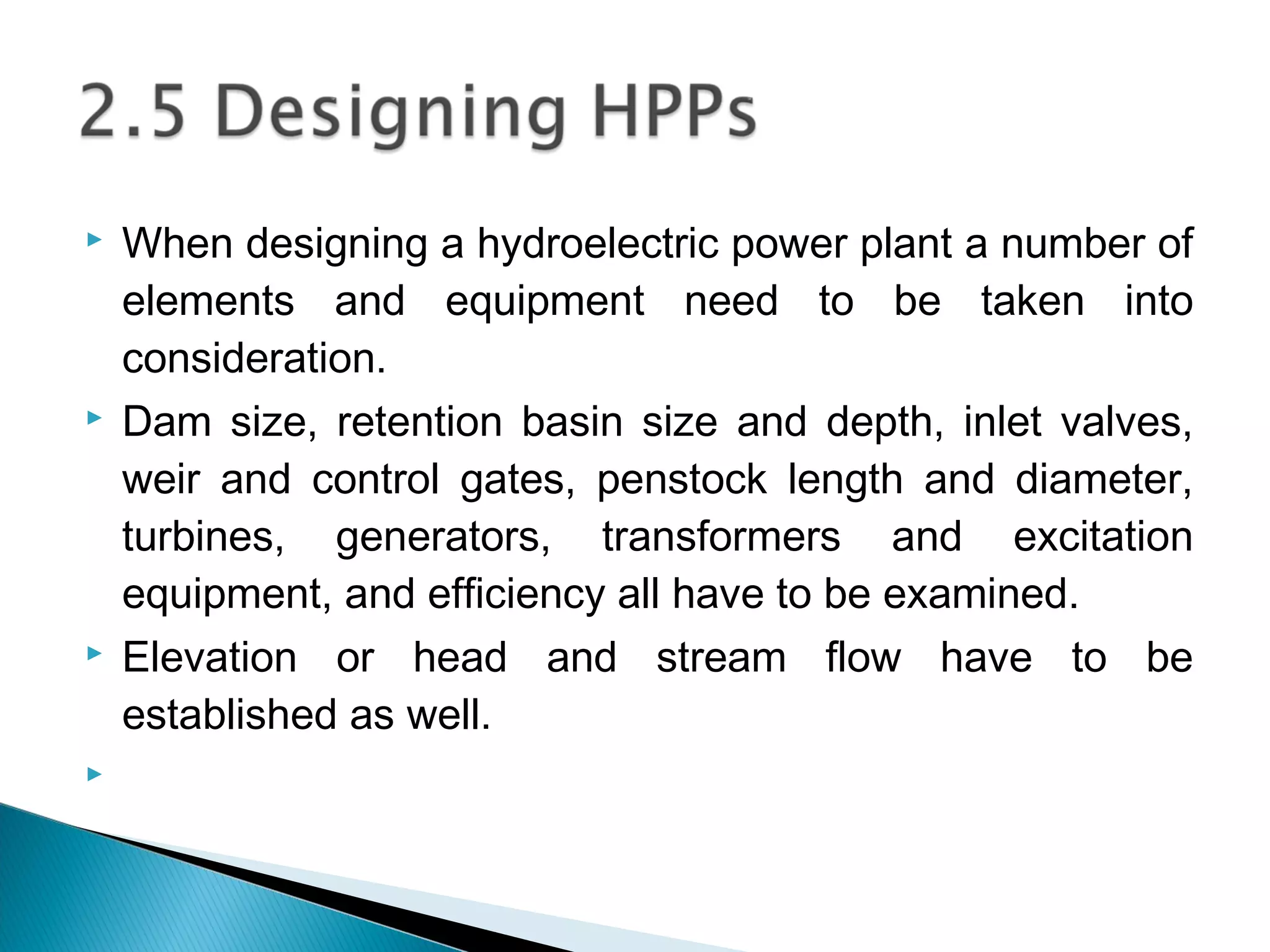
 When designing a hydroelectric power plant a number of
elements and equipment need to be taken into
consideration.
 Dam size, retention basin size and depth, inlet valves,
weir and control gates, penstock length and diameter,
turbines, generators, transformers and excitation
equipment, and efficiency all have to be examined.
 Elevation or head and stream flow have to be
established as well.

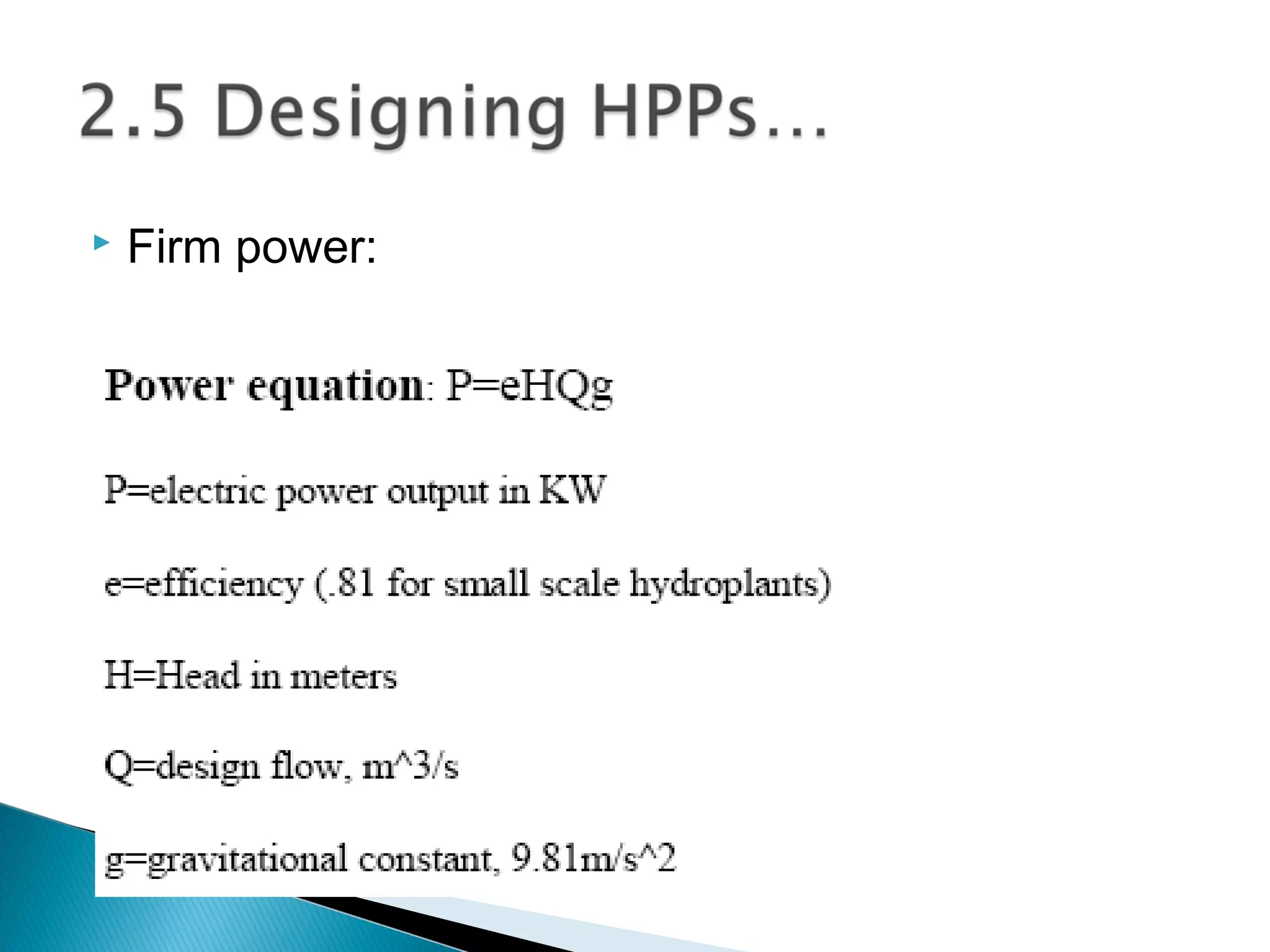
 Firm power:
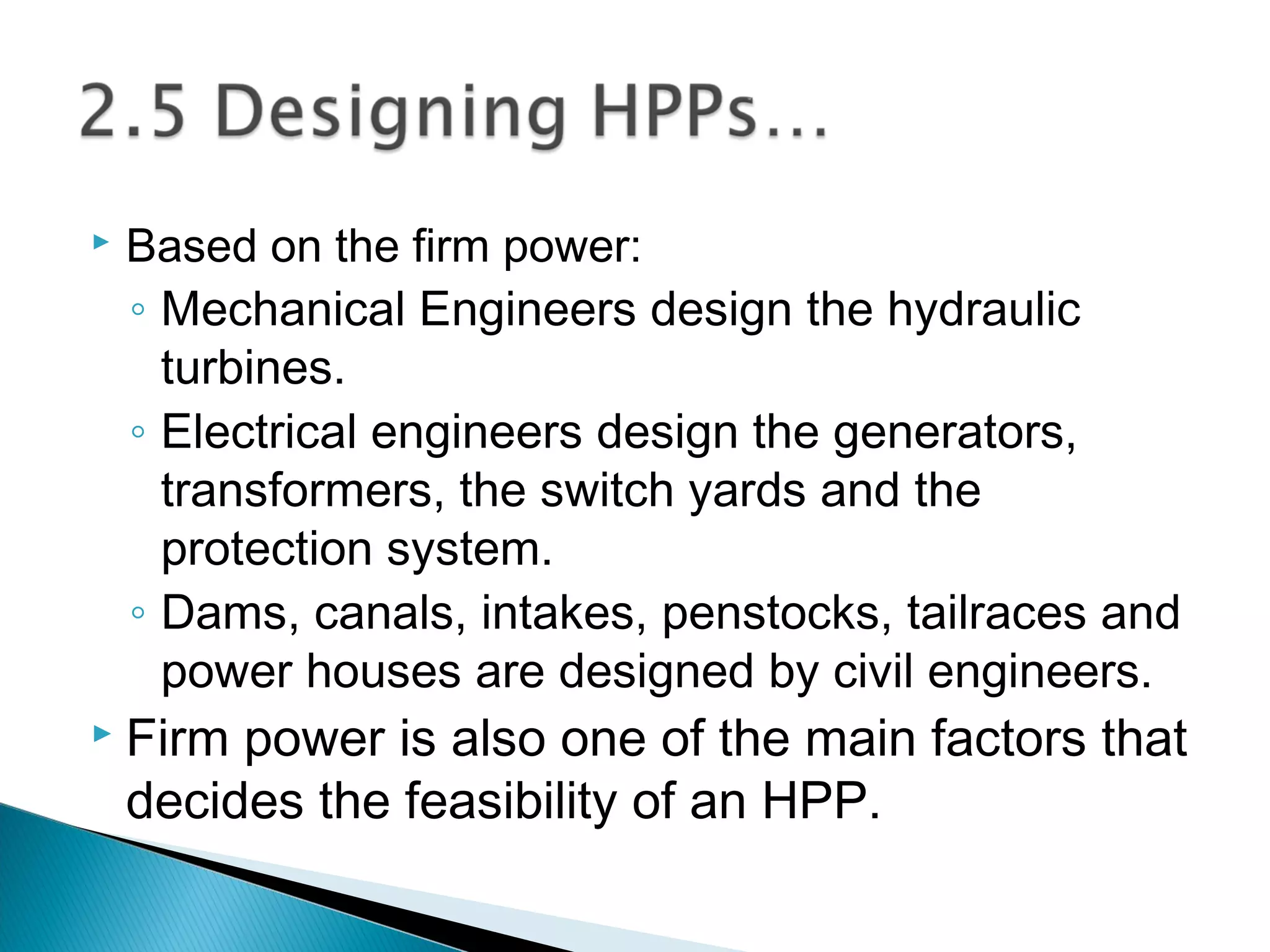
 Based on the firm power:
◦ Mechanical Engineers design the hydraulic
turbines.
◦ Electrical engineers design the generators,
transformers, the switch yards and the
protection system.
◦ Dams, canals, intakes, penstocks, tailraces and
power houses are designed by civil engineers.
 Firm power is also one of the main factors that
decides the feasibility of an HPP.
 Feasibility study contains:
◦ Site visit and selection
◦ Capacity analysis
◦ Economic analysis
◦ Environmental impact analysis
 Feasibility study is the first step in HPP construction.
 In planning an HHP, the general
requirements are:
◦ Determining location of the powerhouse , location of
switchyard ,
◦ Laying out the highway and railroad access, other site
features,
◦ Determining types of powerhouse, structures,
◦ selection of type of powerhouse,
◦ location of main transformers, powerhouse and
switchyard, equipment, powerhouse Auxiliary Equipment
 Architectural design requirements are:
◦ Exterior Design
◦ Exterior Details
◦ Interior Design
◦ Interior Details
◦ Schedule of Finishes
◦ Painting
◦ Design memorandum
◦ Drawings
 The structural requirements are:
◦ All the civil works are under this category.
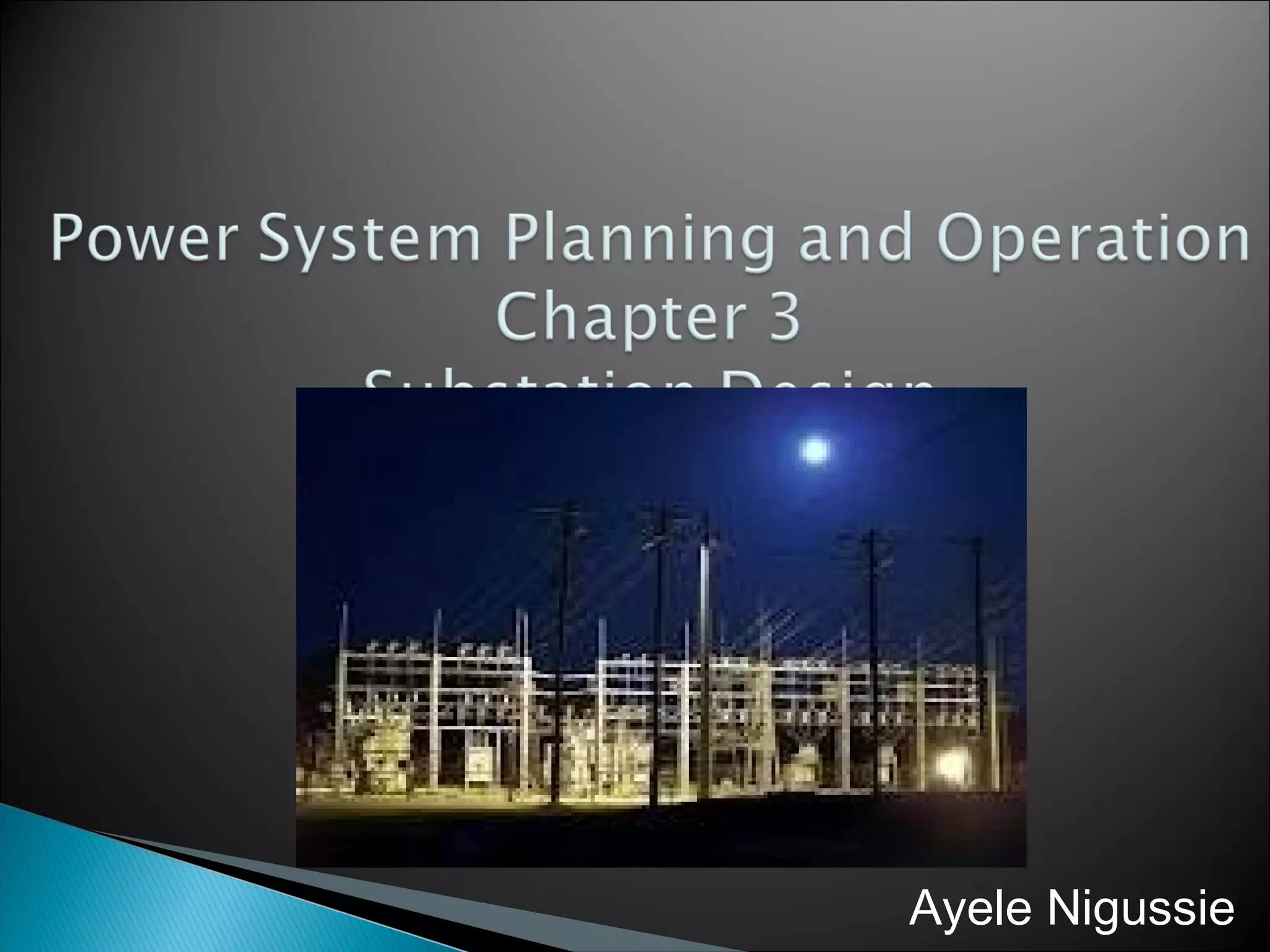
Ayele Nigussie
3.1 Introduction
3.2 What is a substation?
3.3 Important points
3.4 Classification of substations
3.5 Substation equipments
3.6 Substation Configurations
3.7 Substation design
3.8 Planning of substations
3.9 Conclusion
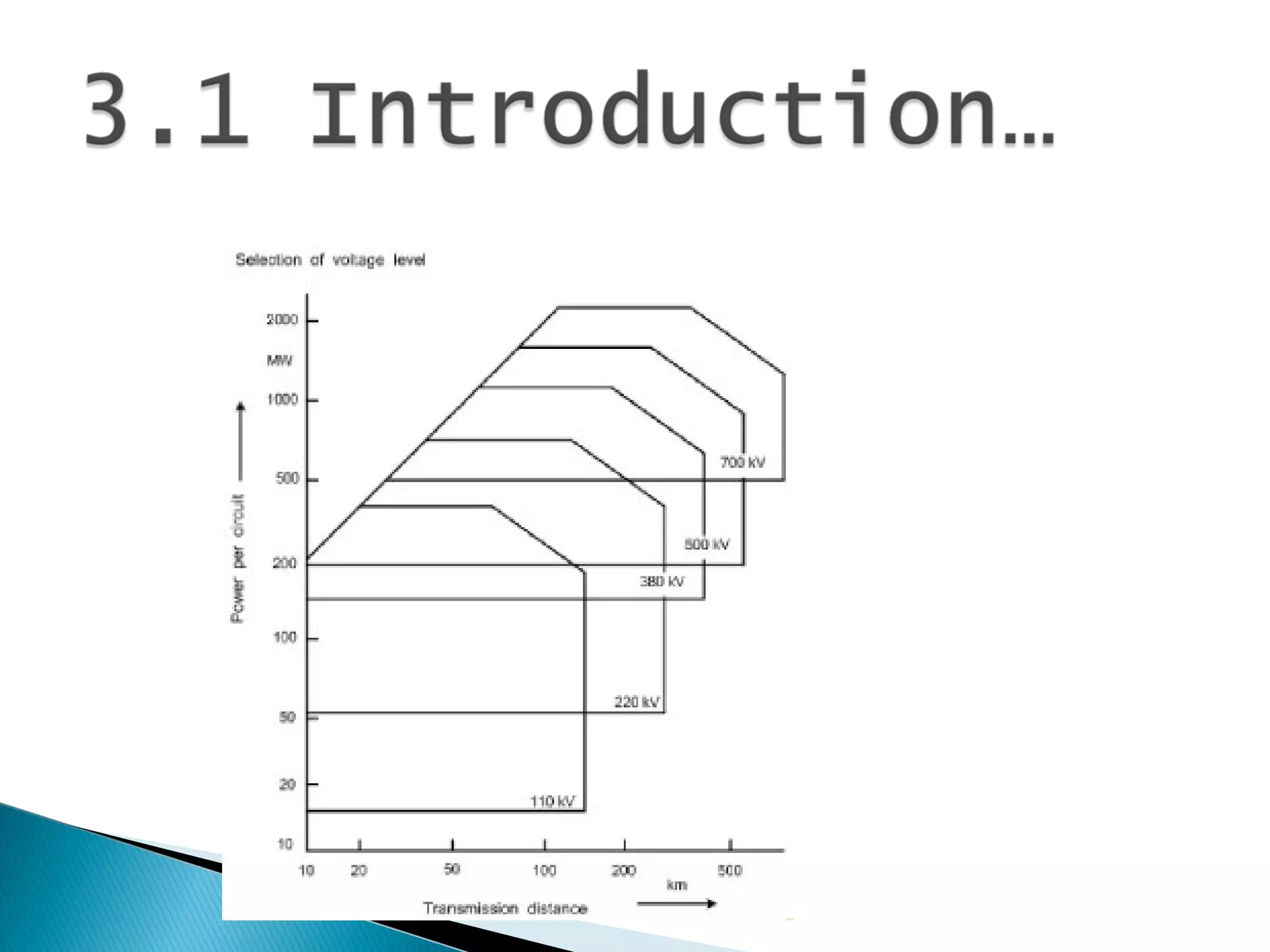
 A substation is a nodal point in a power
system.
 Internationally standardized voltage level
for substations:
 66 kV, 110 kV, 132 kV, 150 kV, 220
kV, 380 kV,
 For very long transmission distances : 500
kV, 800 kV
Tasks of substation:
 Distribution of power towards load circuit
 Separation of different network groups (reduction
of short circuit power)
 Coupling of different voltage level via power
transformers
 Measuring, signaling and monitoring of network
data (e.g. U, I, P, Q, f)
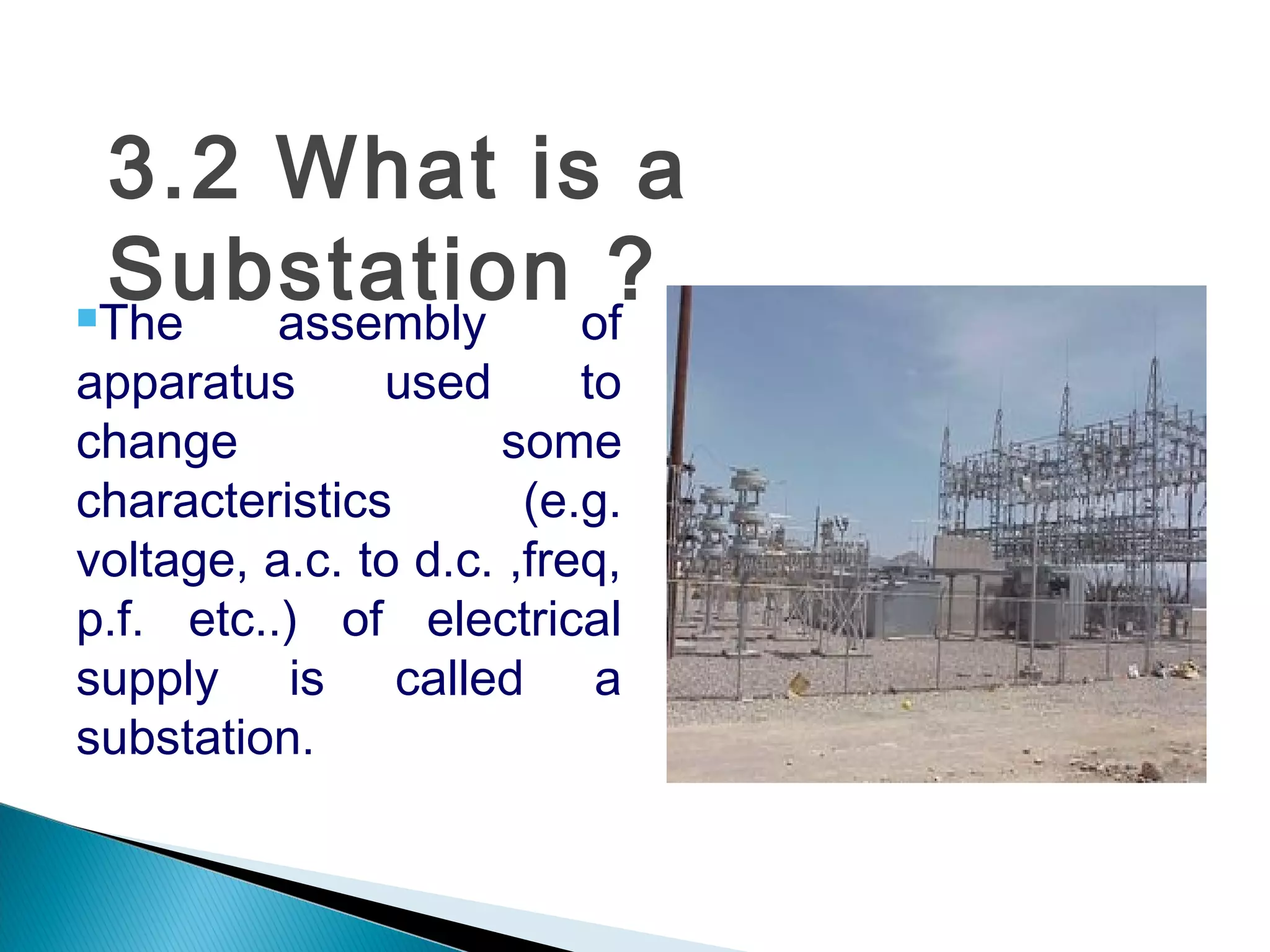
3.2 What is a
Substation ?The assembly of
apparatus used to
change some
characteristics (e.g.
voltage, a.c. to d.c. ,freq,
p.f. etc..) of electrical
supply is called a
substation.
 It should be located at a proper site(i.e. at
the center of gravity of load).
 It should provide safe and reliable
arrangement.
 It should be easily operated and
maintained.
 It should involve minimum capital costs.
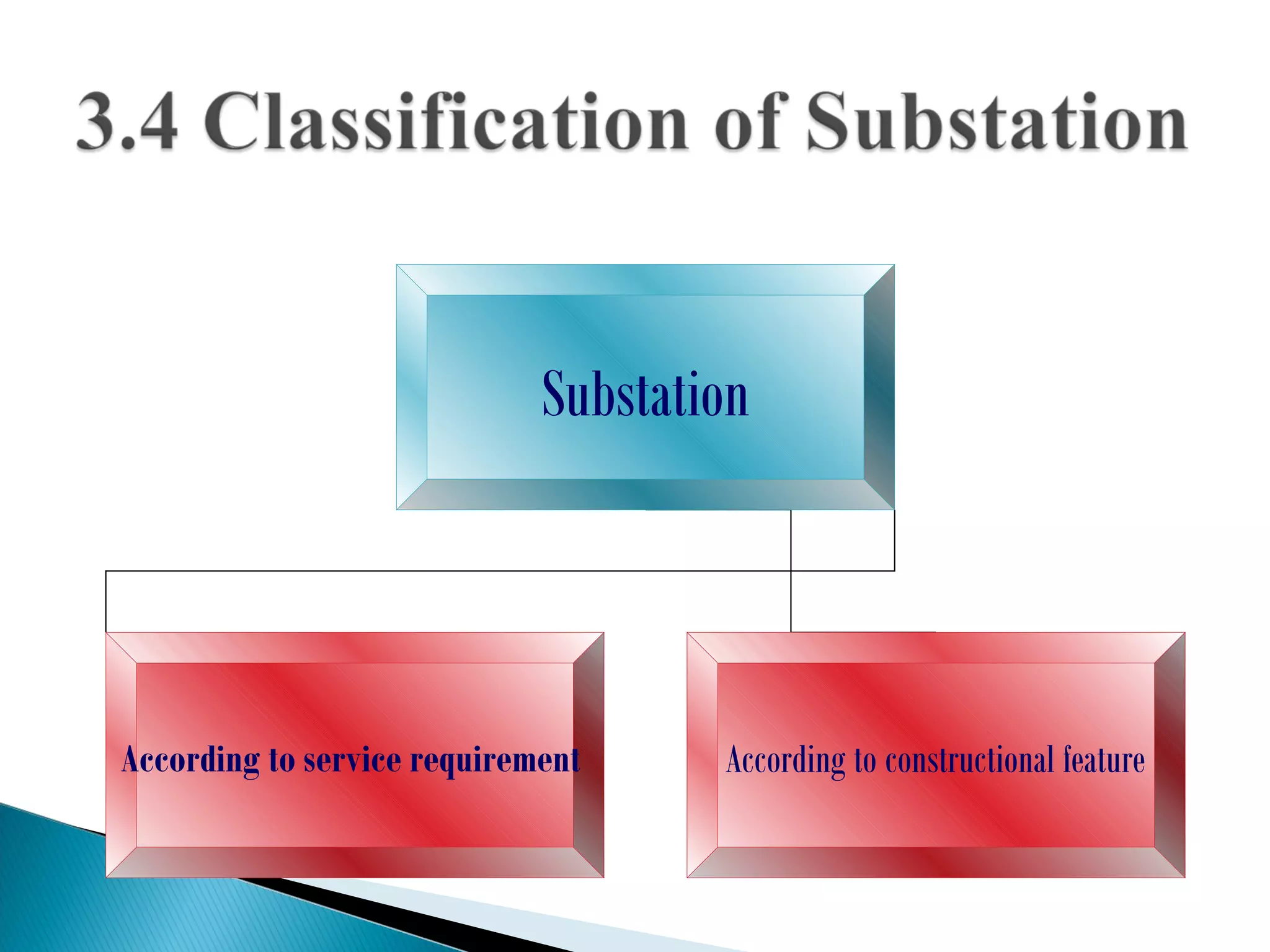
Substation
According to service requirement According to constructional feature
According to Service requirement:
 Transformer Substation: Transformers are installed to
transform voltage from one level to another as per needs.
 Switching Substations: This substations mean for switching
operation of powerlines with out transforming the voltage.
 Power factor correction Substation: This substations are
installed to increase the power factor to minimise losses.
 Frequency Changer Substation: This substations are installed
where speed control of motors is required.
 Converting Substation: This substations convert a.c to d.c or
vice versa.
 Industrial Substation: This substations are installed to supply
power only to an industries.
According To Constructional Features:
 Indoor SubstationsIndoor Substations: In this substations, the apparatus are
installed with in the substation building. Till 66 kV.
 Outdoor SubstationsOutdoor Substations: this substations are installed in open land.
This substations are employed for voltage levels beyond 66k.v.
 Underground SubstationsUnderground Substations: This: This substations are installed under
ground in densely populated cities where cost of the land is
more.
 Pole-Mounted SubstationsPole-Mounted Substations: This substations are erected for
distribution of power in localities. This is employed for
transformers up to 250 kVA.).
 Foundation Mounted SubstationsFoundation Mounted Substations: This substations are installed
3.4 Classification of
Substation …
 Busbar: is a conductor connecting
power line to substation equipment.
 Insulators & fittings: fix and isolate the
busbar system.
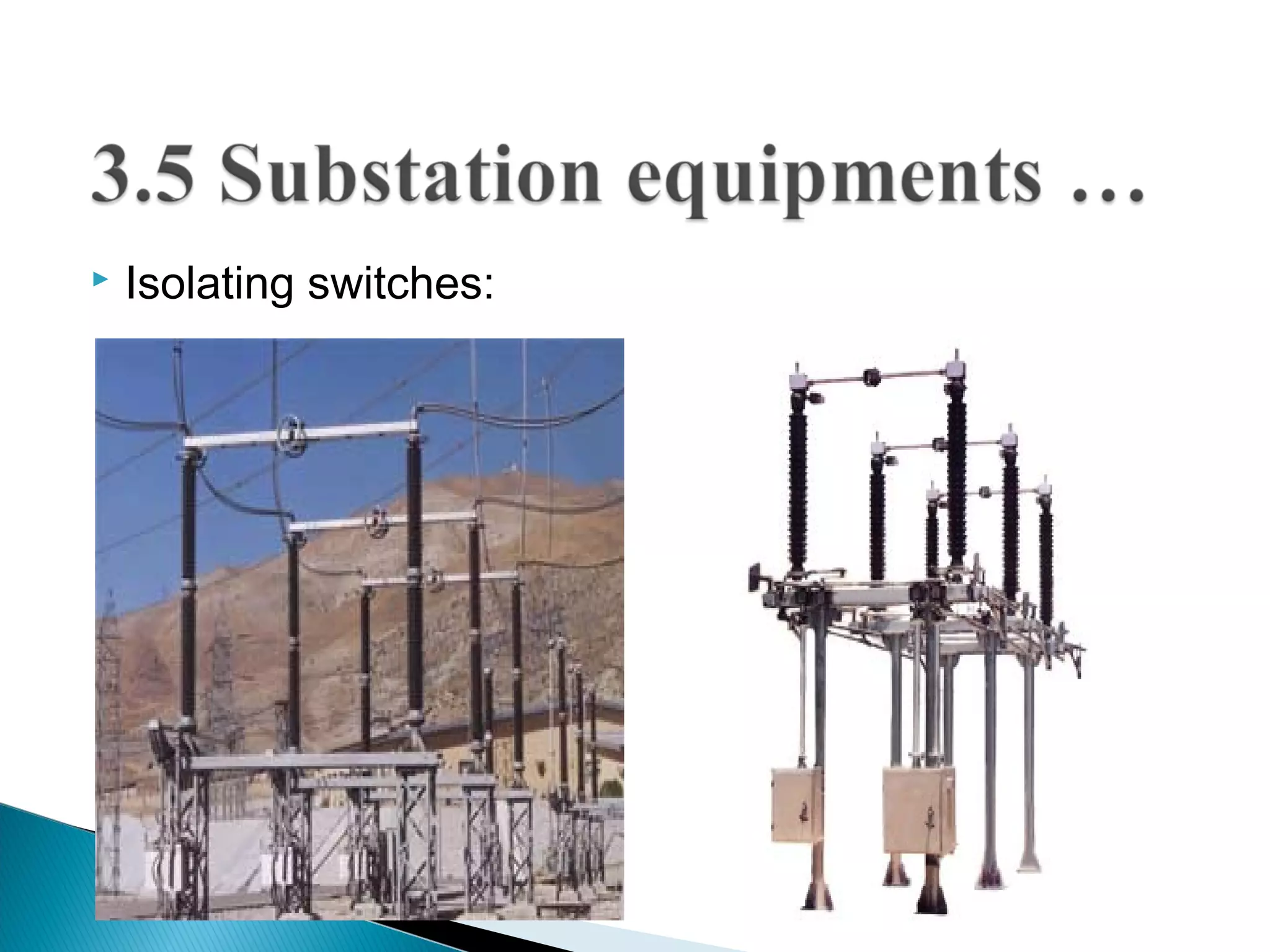
 Isolating Switch: is used for
disconnecting equipment for
maintenance and repair.
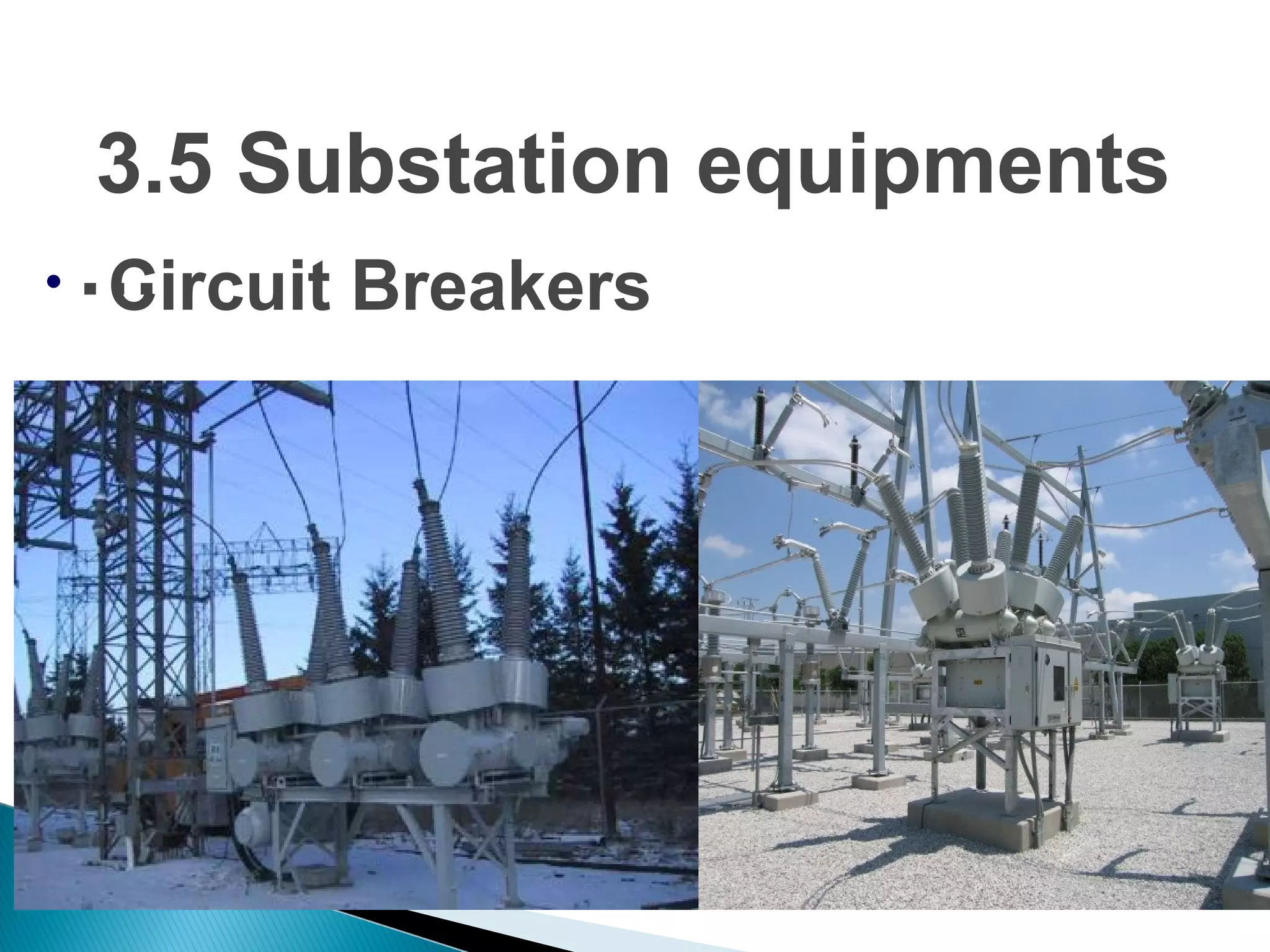
 Relays & Circuit Breaker: open and
close a circuit under normal and fault
conditions.
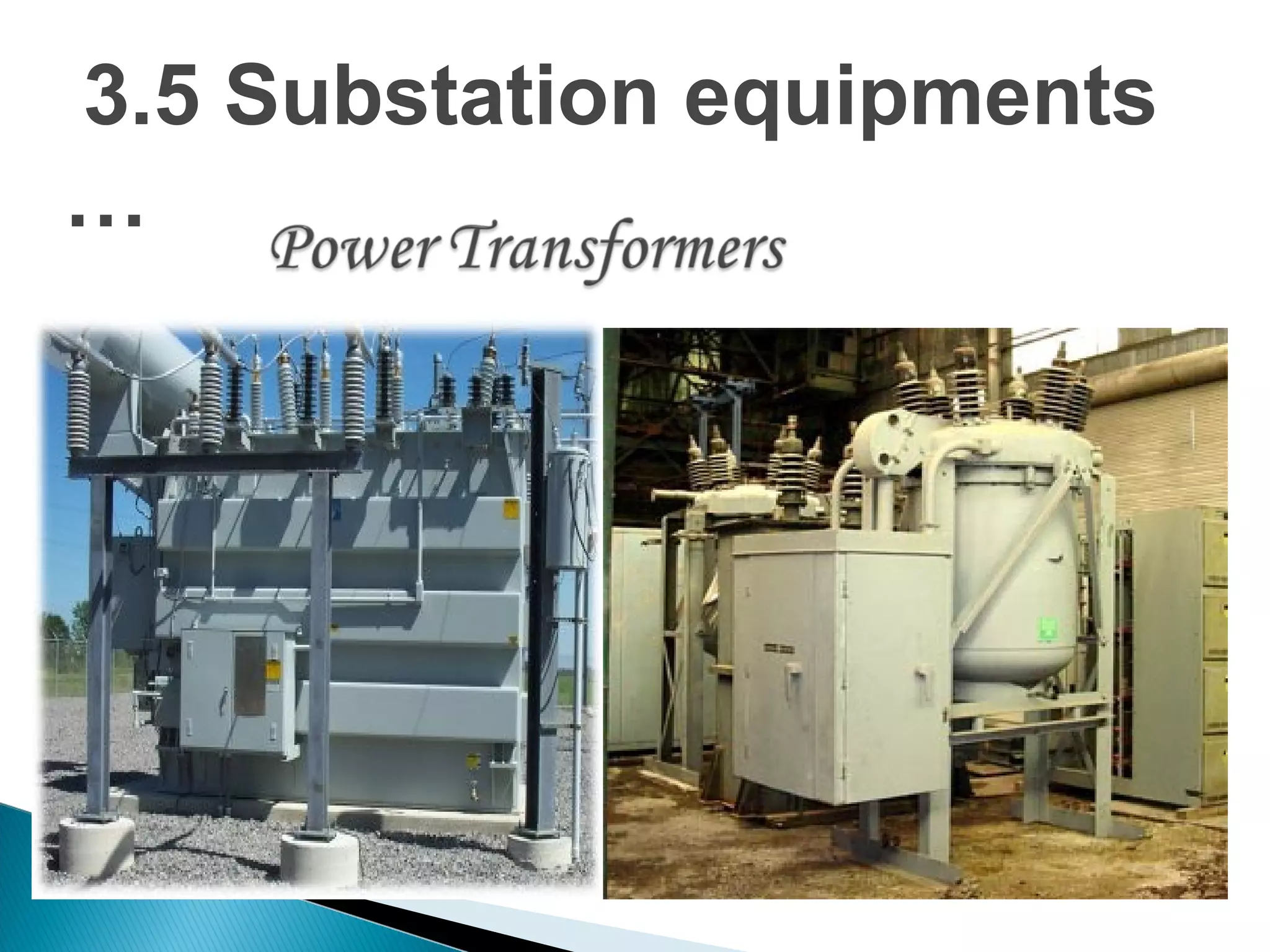
 Power Transformers: are used in
substations to step up or step down
the voltages.
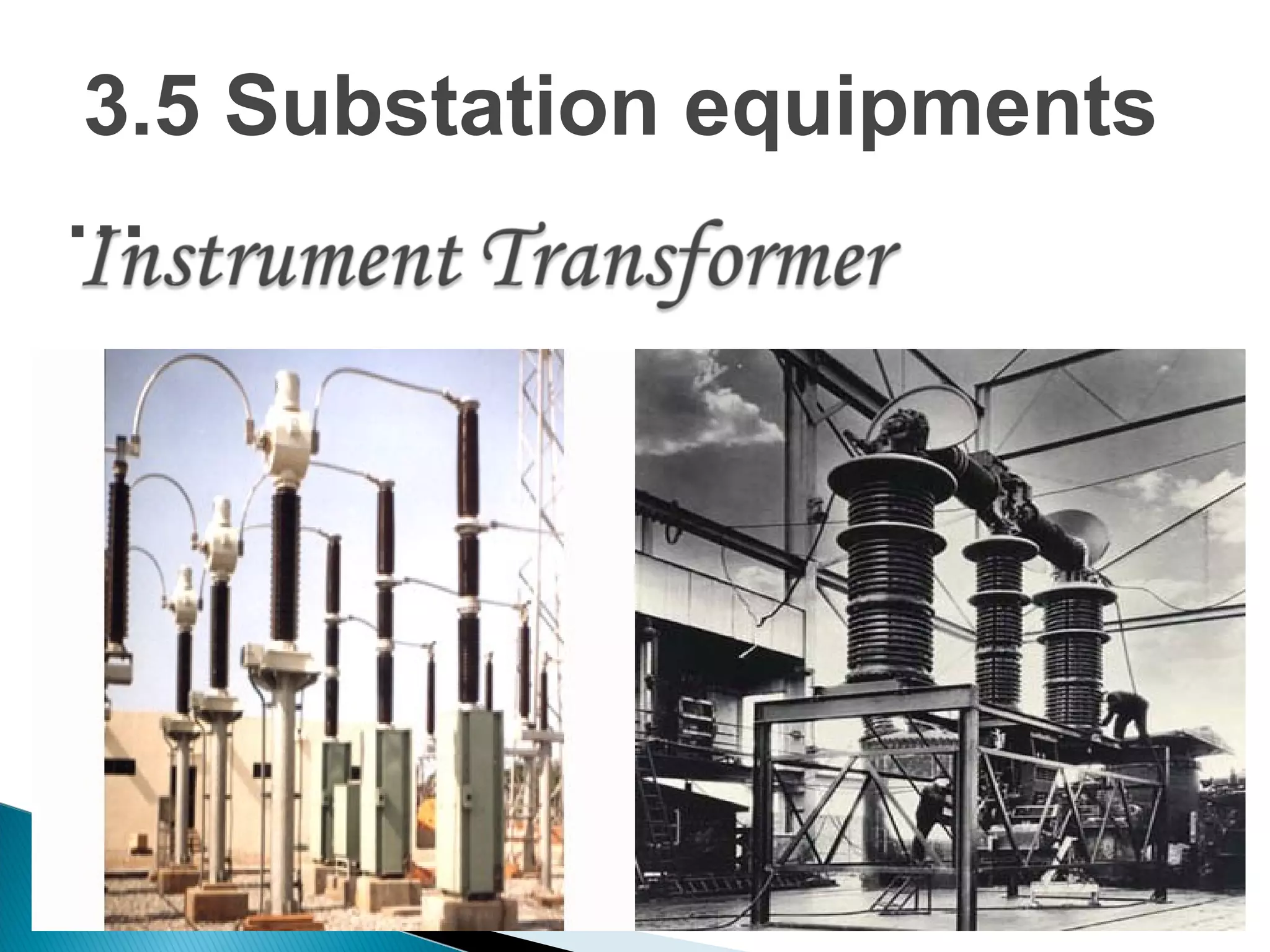
 Instrument Transformers: used for
measuring .
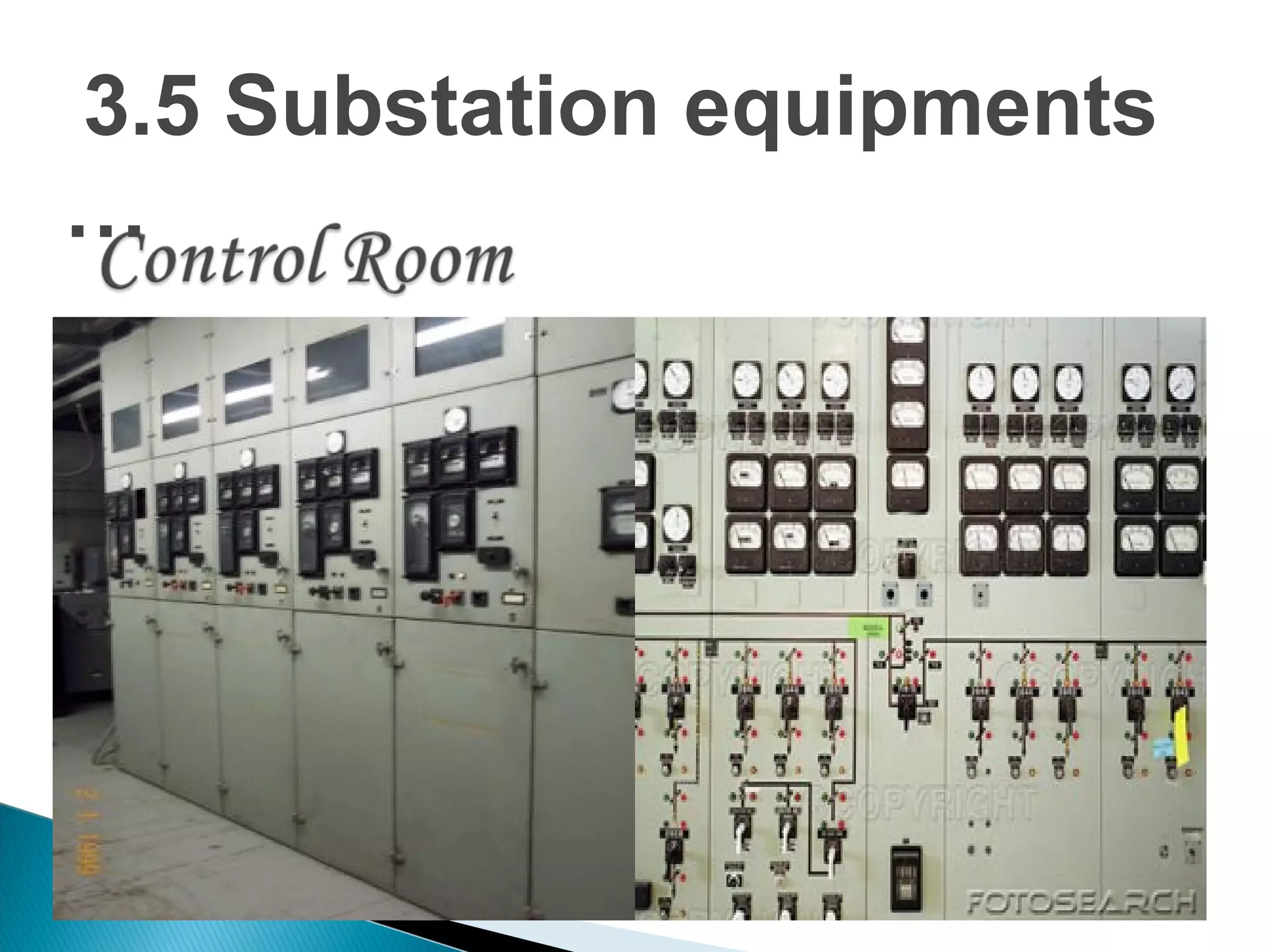
 Metering & Indicating Instruments:
used to watch over the circuit
quantities.
 Power line carrier communication
systems: used for SCADA.
 Coupling capacitors and wave traps
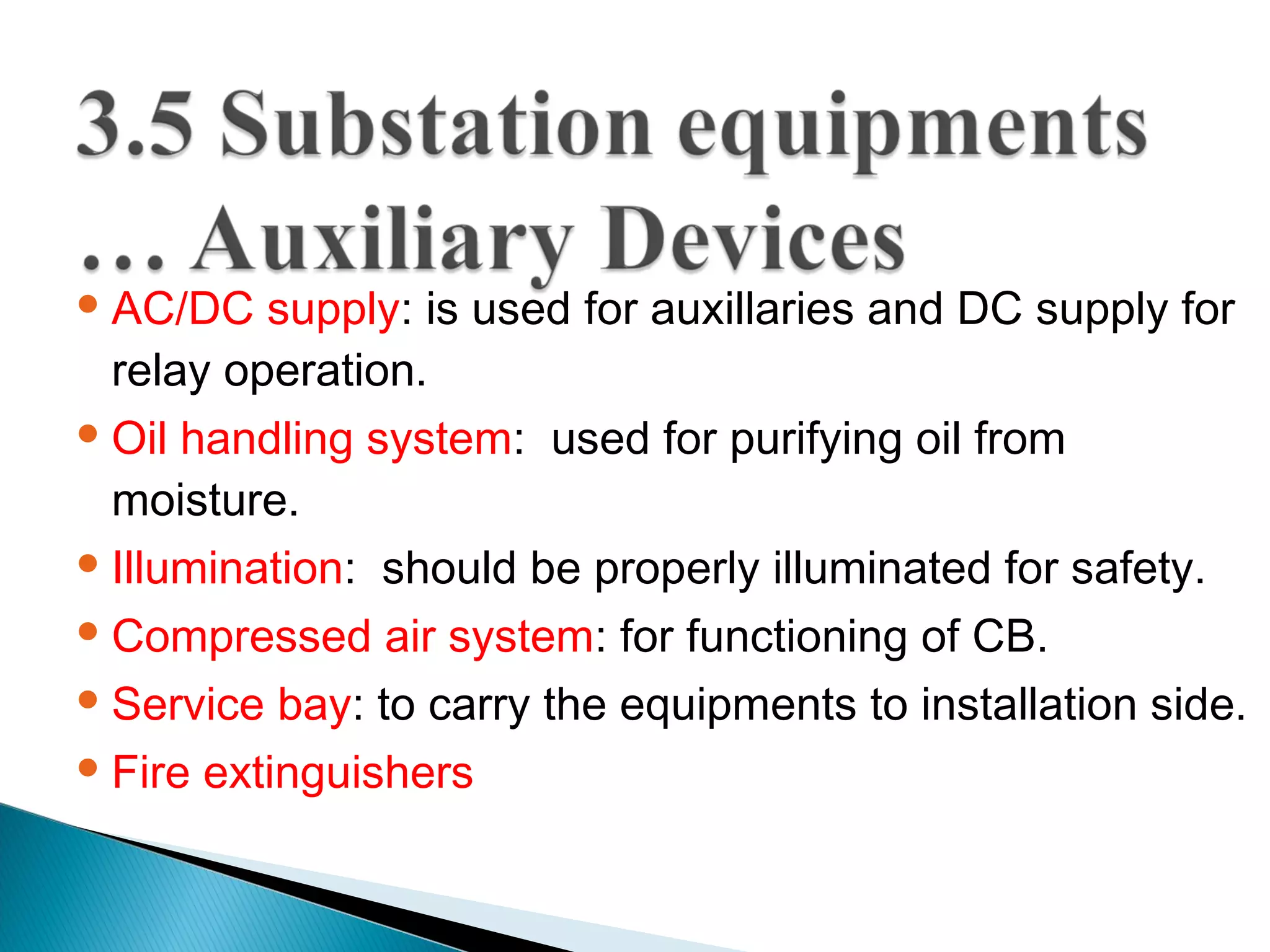
AC/DC supply: is used for auxillaries and DC supply for
relay operation.
Oil handling system: used for purifying oil from
moisture.
Illumination: should be properly illuminated for safety.
Compressed air system: for functioning of CB.
Service bay: to carry the equipments to installation side.
Fire extinguishers
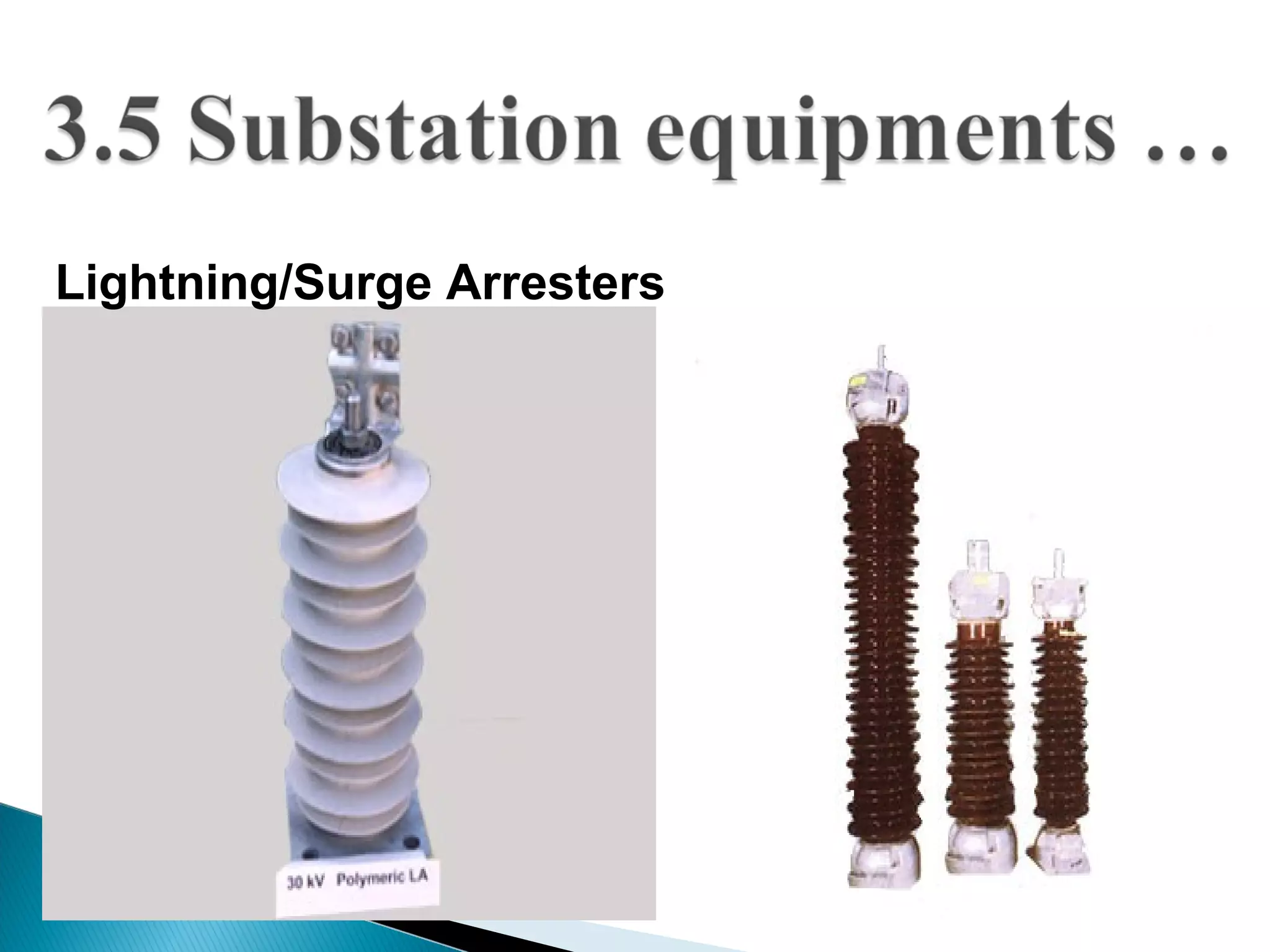
Lightning/Surge Arresters
 Isolating switches:
• Circuit Breakers
3.5 Substation equipments
…
3.5 Substation equipments
…
3.5 Substation equipments
…
3.5 Substation equipments
…
Piezoelectric motorsPiezoelectric motors
Piezo GeneratorsPiezo Generators
ActuatorsActuators
Ultrasonic TransducersUltrasonic Transducers
And many more…And many more…
What are to be considered?
 Site selection
 Design of structures
 Design of foundation for transformers &
structures(IE Rules 64)
 Control room building
 Cable trench & drainage
 Design of earthing
 Protection schemes & interlocks
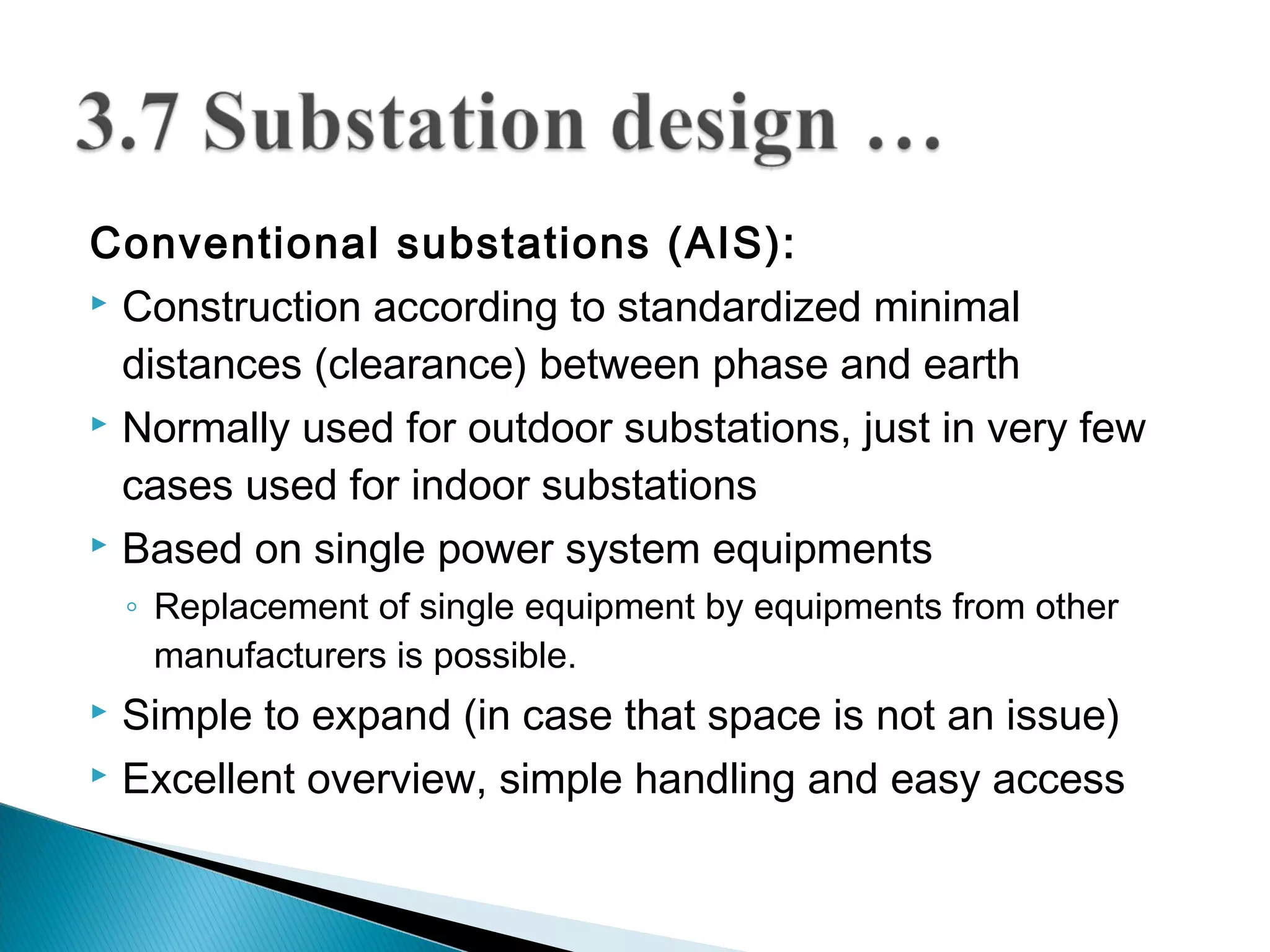
Conventional substations (AIS):
 Construction according to standardized minimal
distances (clearance) between phase and earth
 Normally used for outdoor substations, just in very few
cases used for indoor substations
 Based on single power system equipments
◦ Replacement of single equipment by equipments from other
manufacturers is possible.
 Simple to expand (in case that space is not an issue)
 Excellent overview, simple handling and easy access
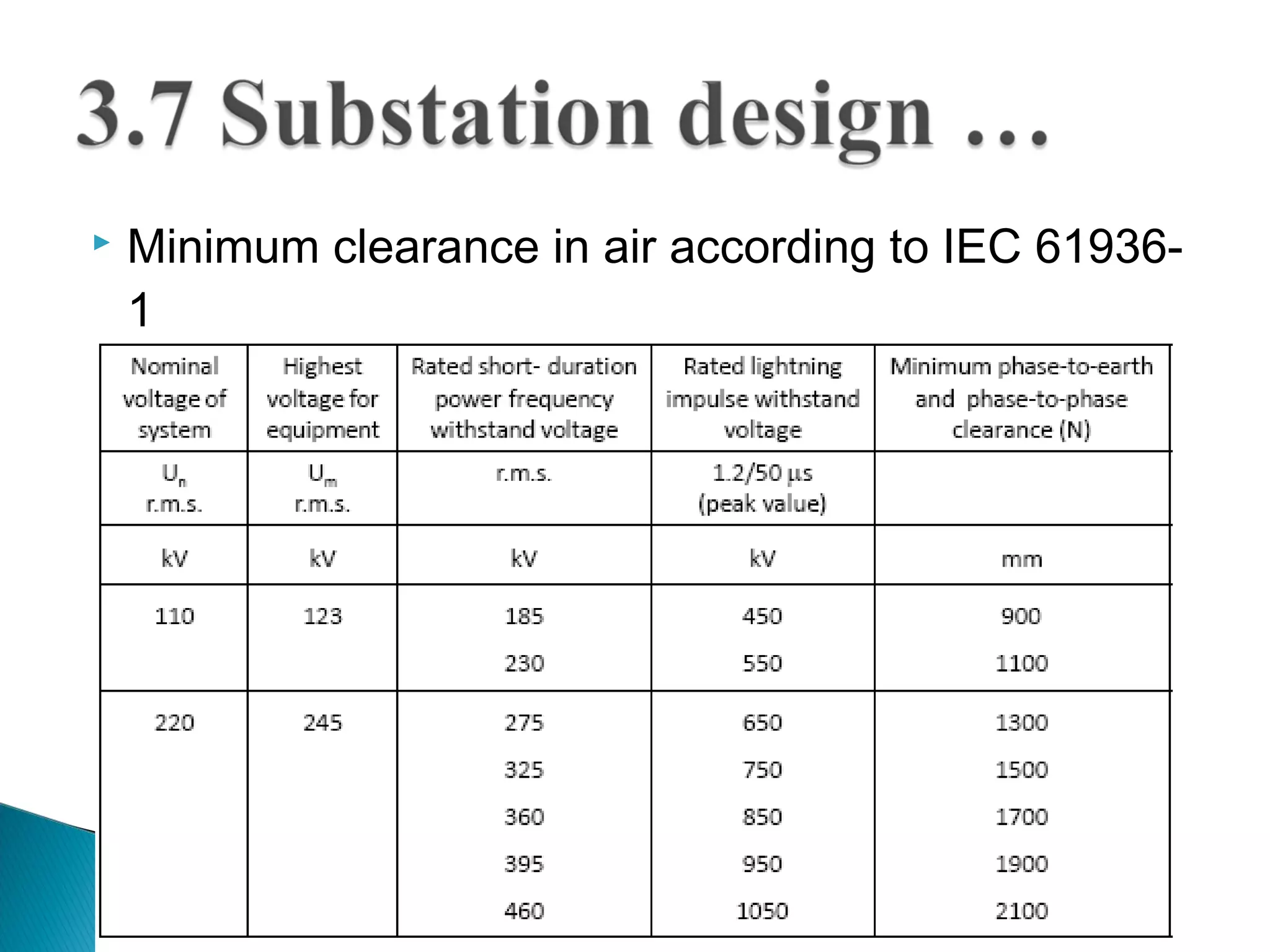
 Minimum clearance in air according to IEC 61936-
1
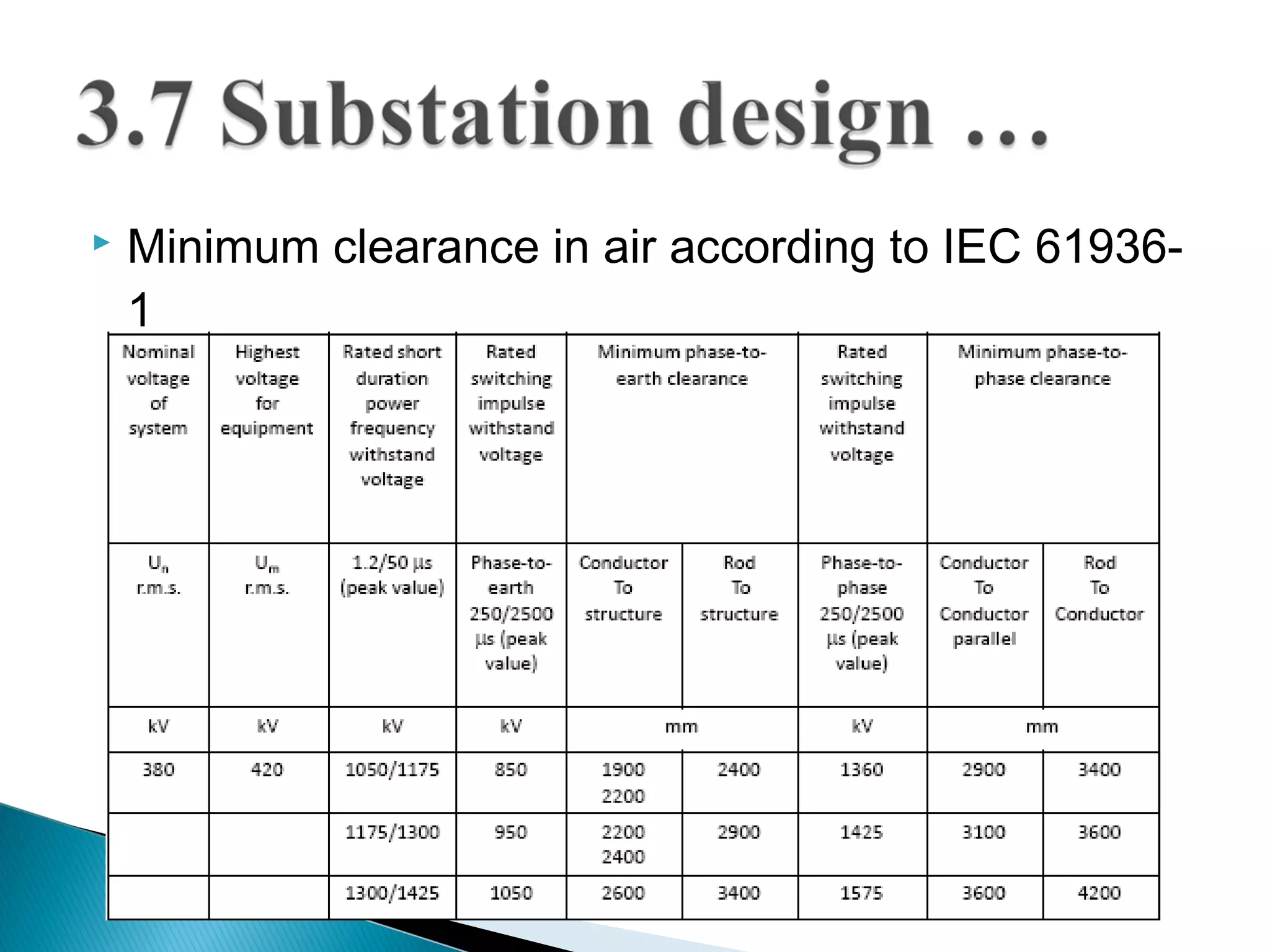
 Minimum clearance in air according to IEC 61936-
1
Basis requirements for new substations:
 Optimal location of substations within power system (load flow, short
circuit, customer requirements, long term planning, land space)
 Selection of substation design
 Calculation of short-circuit currents and long term development
(ratings)
 Selection of power system requirements
 Adaption of design according to available space, fixing of busbar
configuration (e.g. using wire conductor or tubular conductor)
 Detailed planning of: primary and secondary equipment, auxiliary
equipment, basement, steel structure, building, earthing system
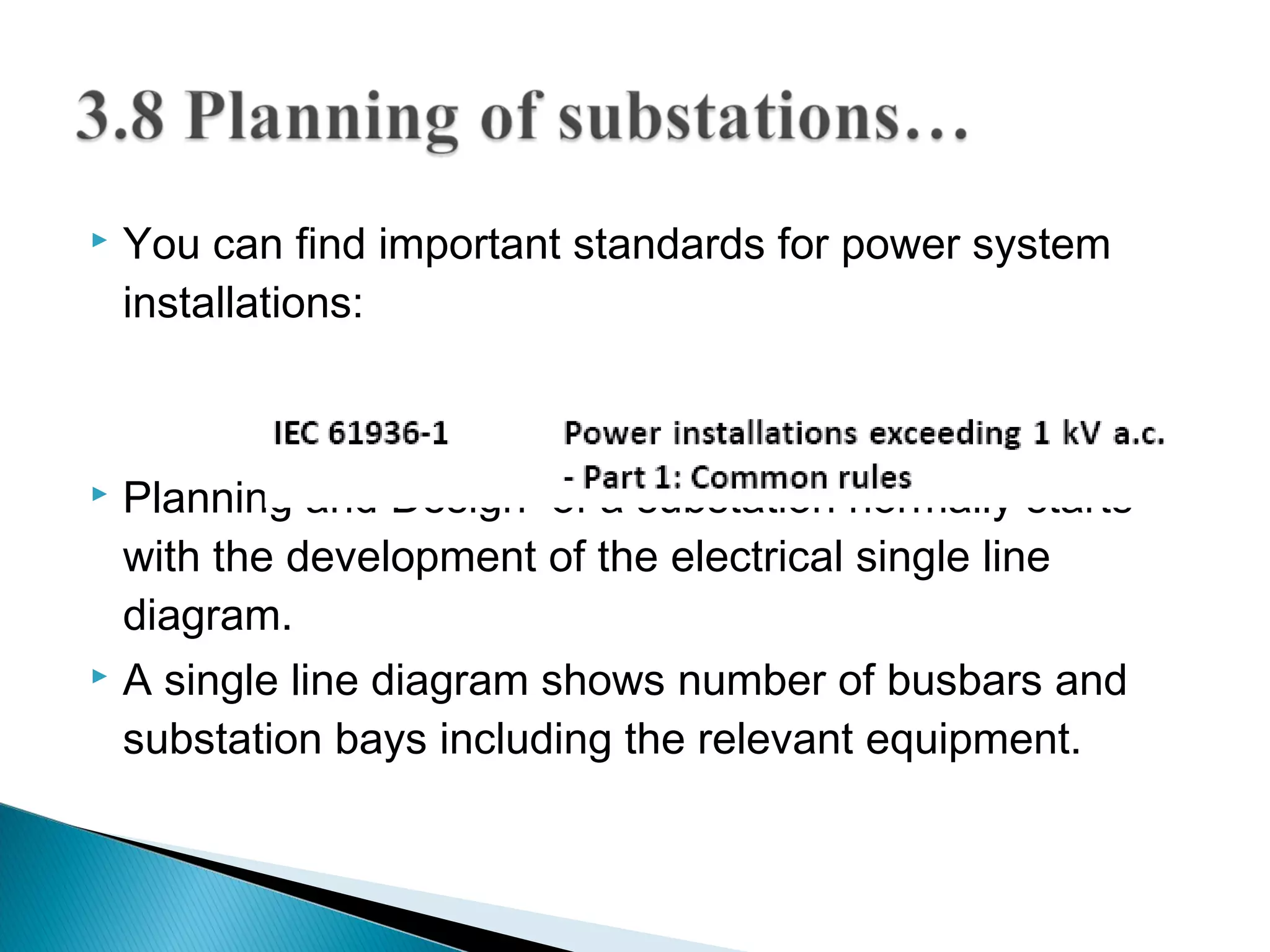
 You can find important standards for power system
installations:
 Planning and Design of a substation normally starts
with the development of the electrical single line
diagram.
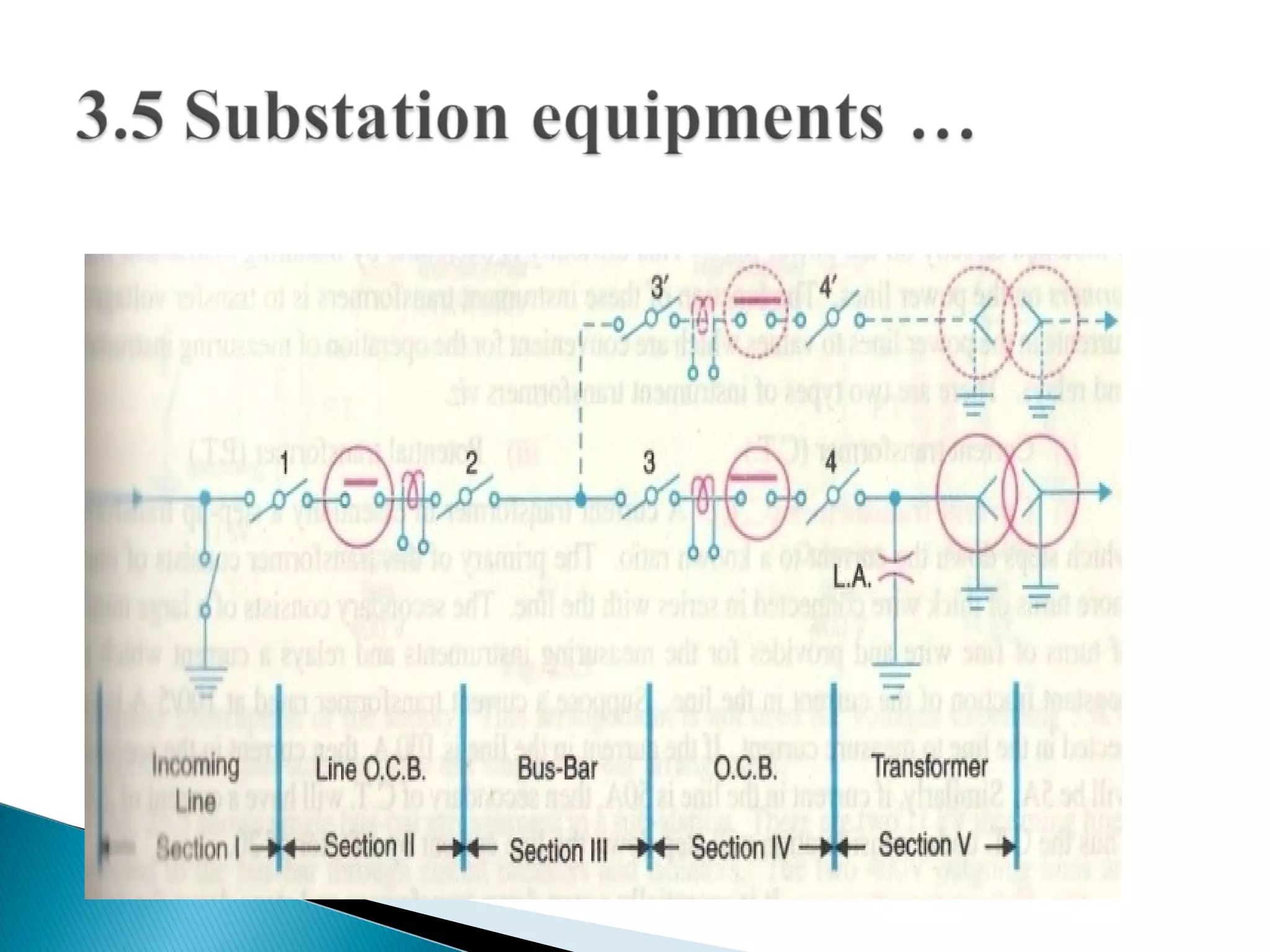
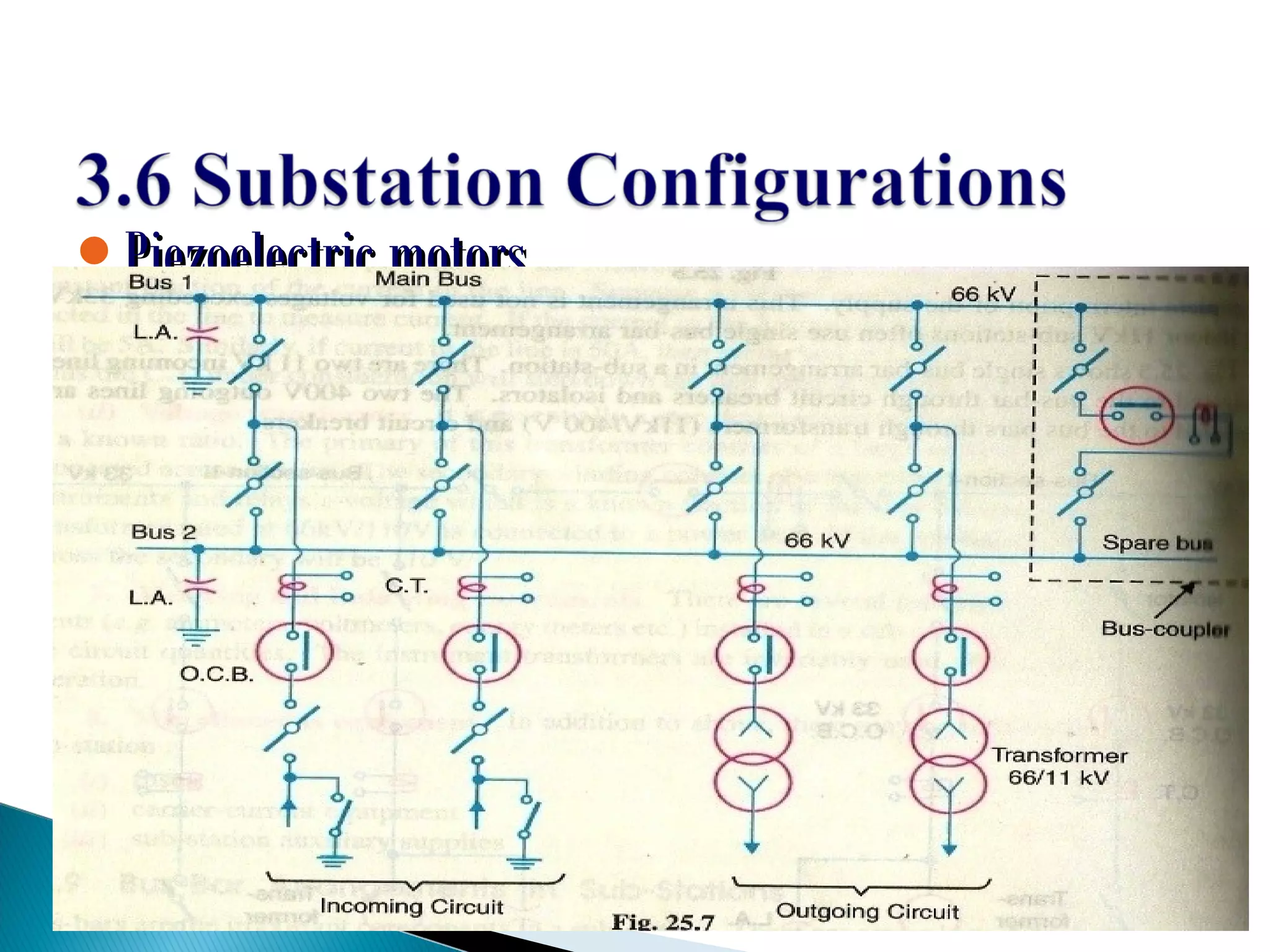
 A single line diagram shows number of busbars and
substation bays including the relevant equipment.
 Selection of substation layout depends on
◦ Its importance within the power system
(power system reliability in case of
failures and maintenance activities)
◦ Power system operation
Substation is the heart of a
power system. Hence, its
design should be such that it
will provide continuous ,
quality & desired power with
safety.
 Read further on substations.
THANK YOU
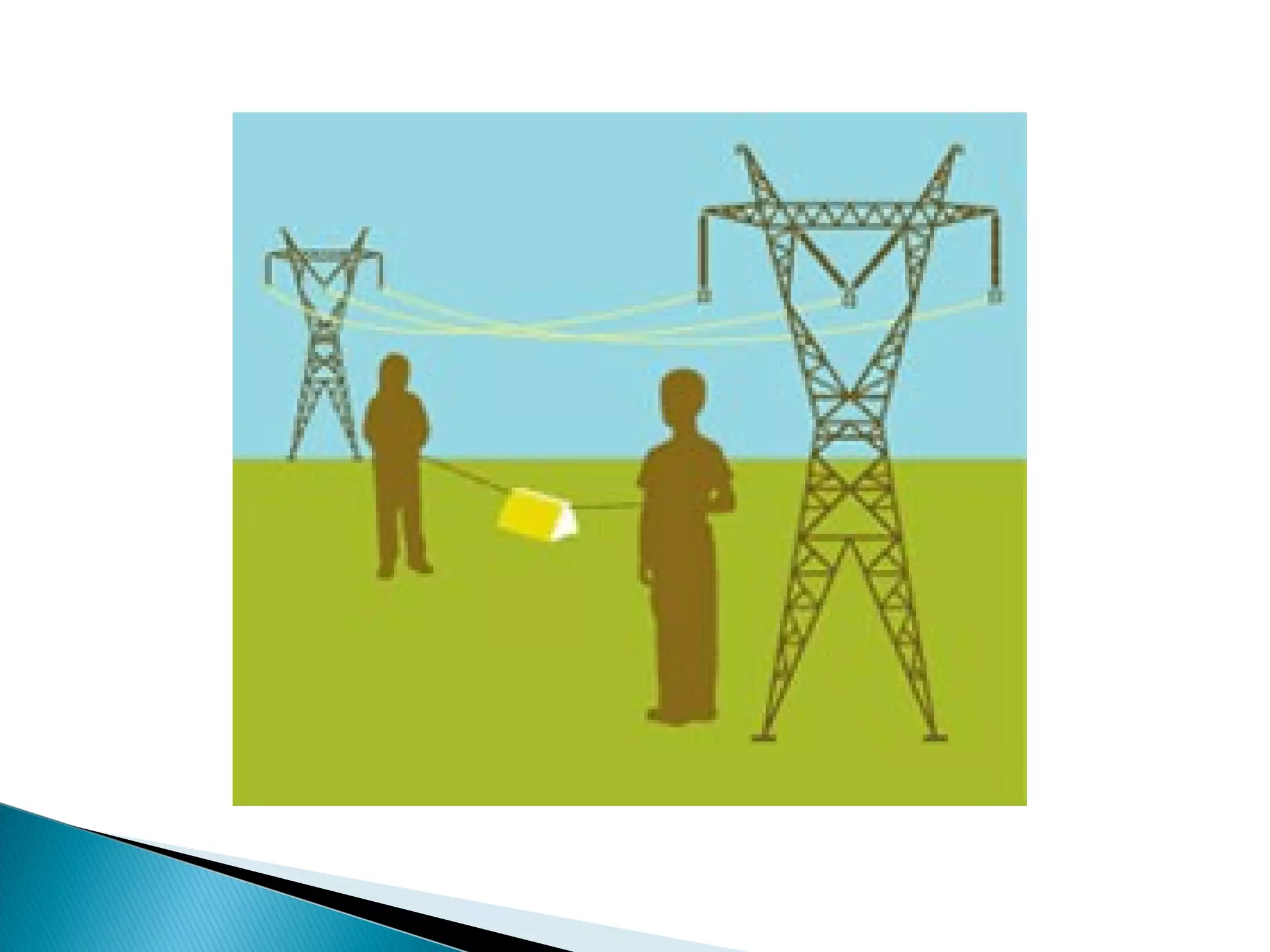
Electrical Considerations for T.L. Design:
 Low voltage drop
 Minimum power loss for high efficiency of
power transmission.
 The line should have sufficient current
carrying capacity so that the power can be
transmitted without excessive voltage
drop or overheating.
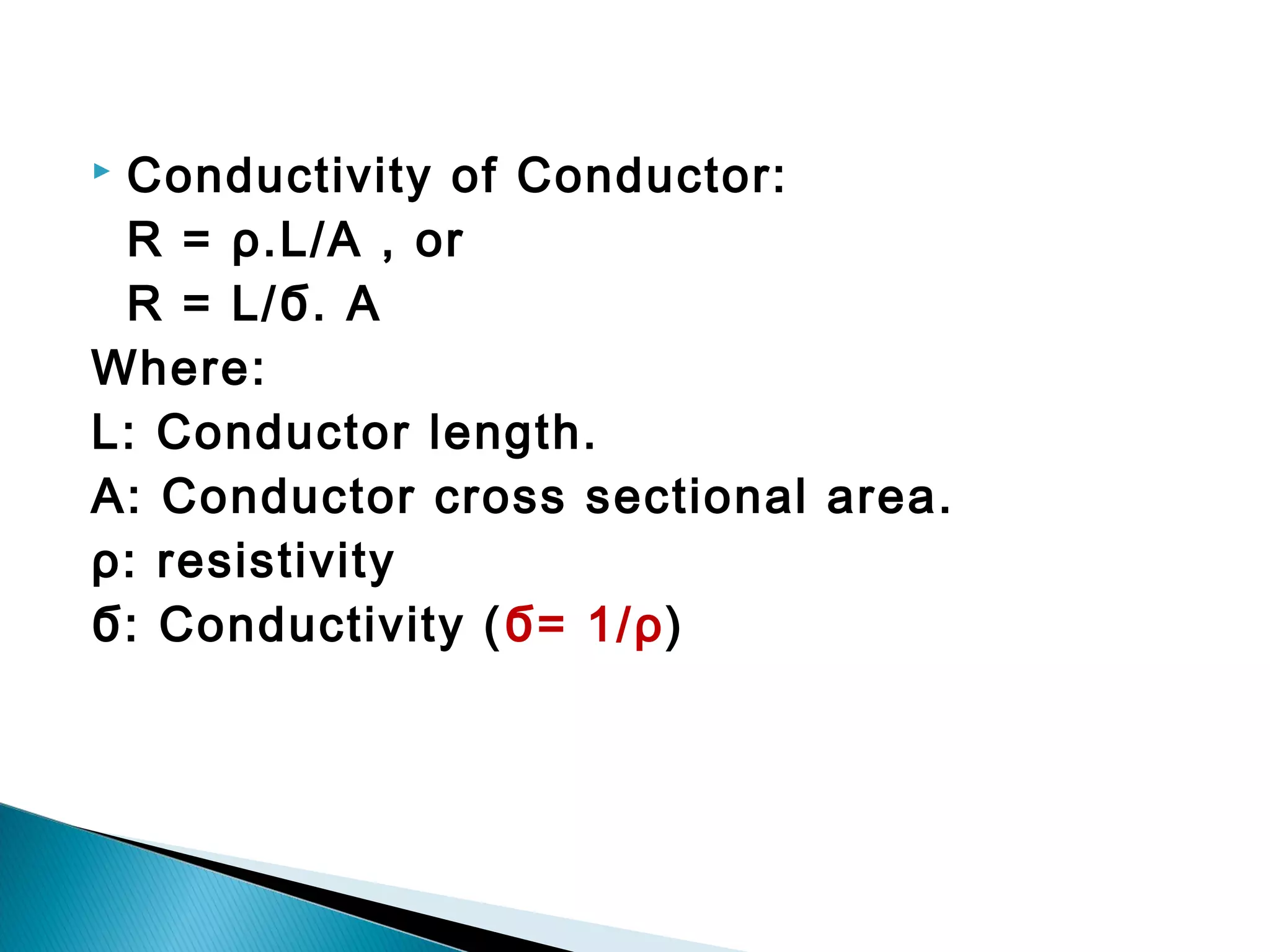
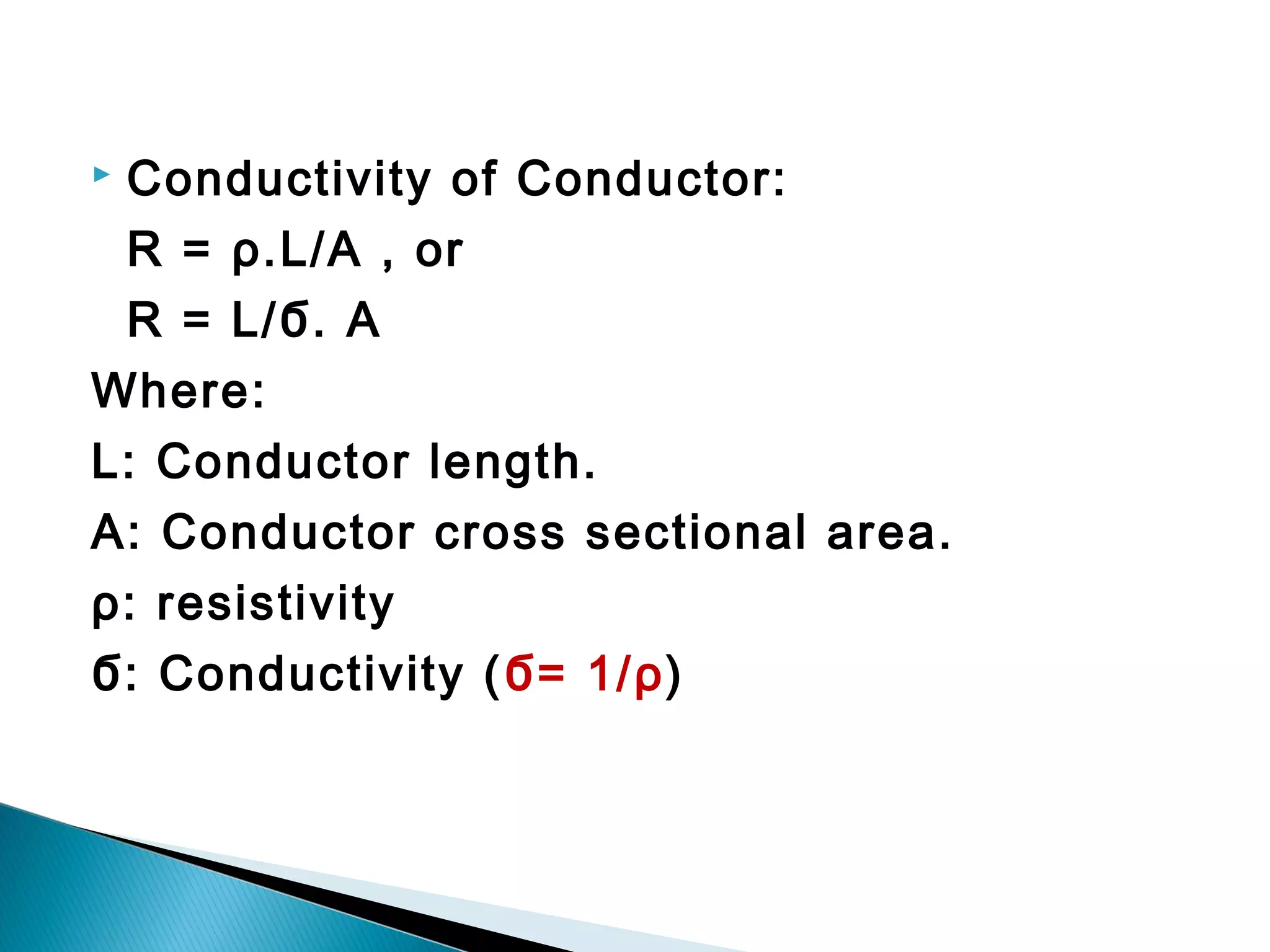
 Conductivity of Conductor:
R = ρ.L/A , or
R = L/Ϭ. A
Where:
L: Conductor length.
A: Conductor cross sectional area.
ρ: resistivity
Ϭ: Conductivity (Ϭ= 1/ρ)
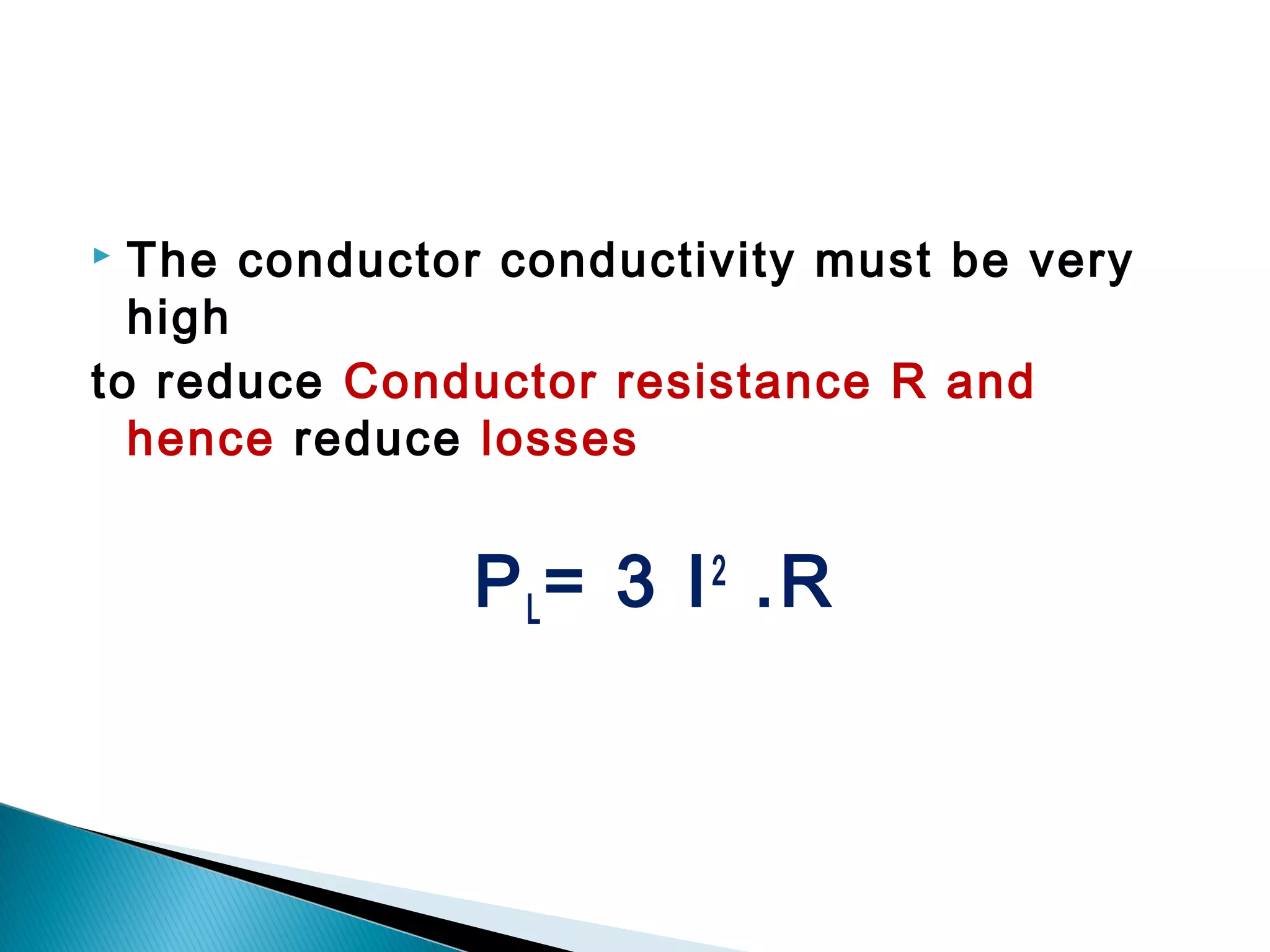
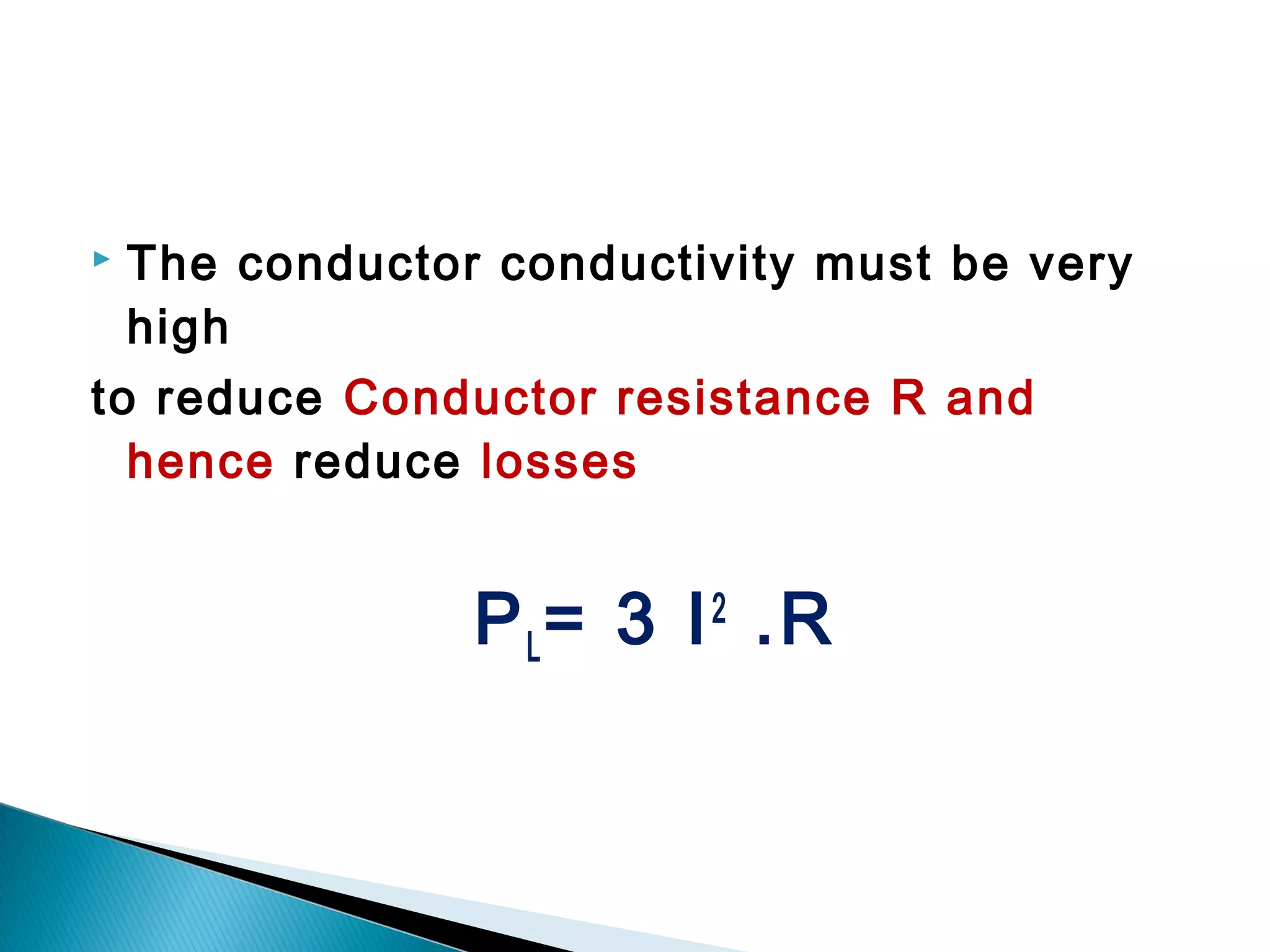
 The conductor conductivity must be very
high
to reduce Conductor resistance R and
hence reduce losses
PL= 3 I2
.R
Mechanical Considerations for T.L.
Design:
 The conductors and line supports should
have sufficient mechanical strength:
- to withstand conductor weight, Conductor
Tension and weather conditions (wind,
ice).
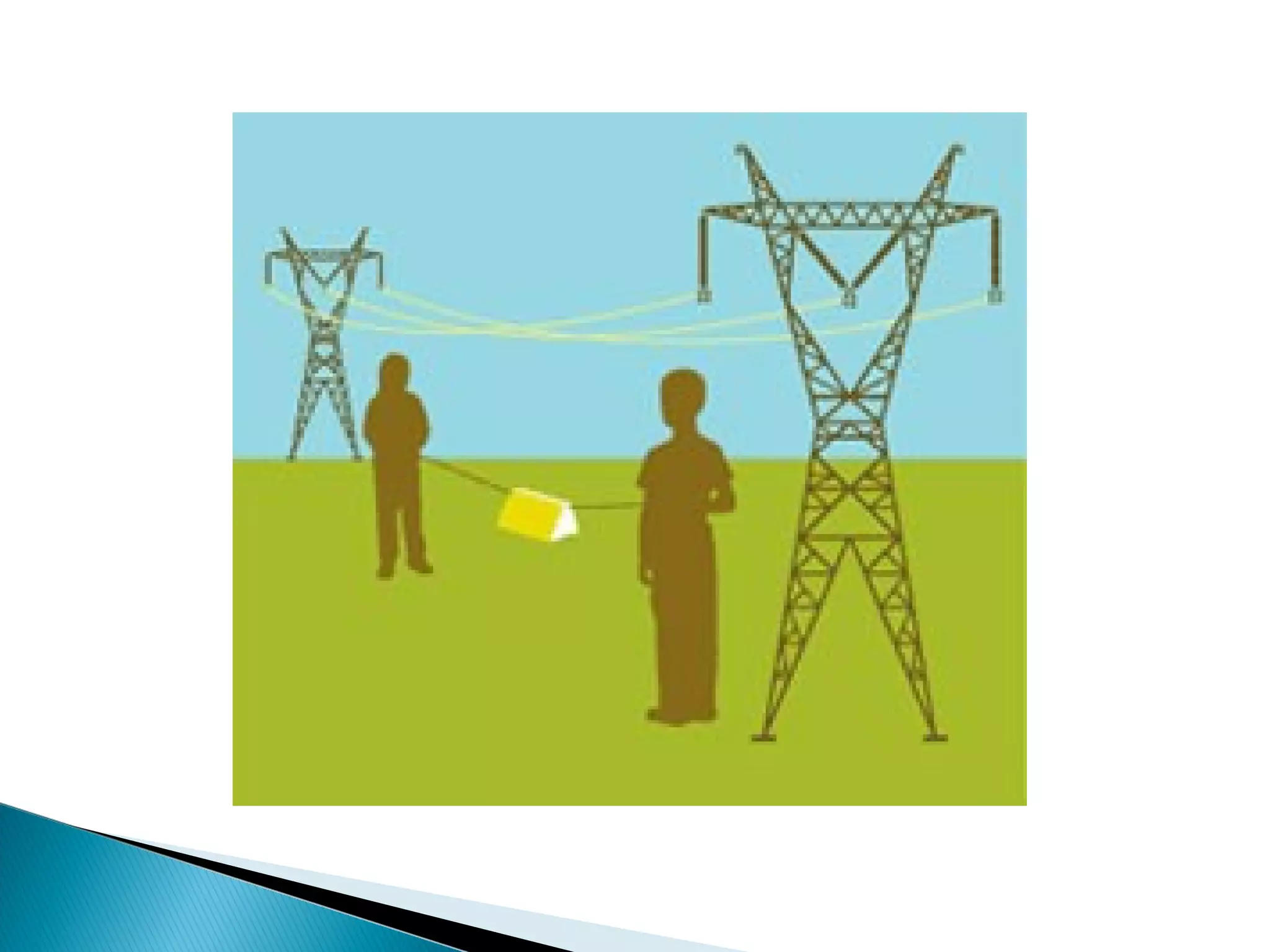
- The Spans between the towers can be
long.
- Sag will be small.
- Reducing the number and height of towers
and the number of insulators.
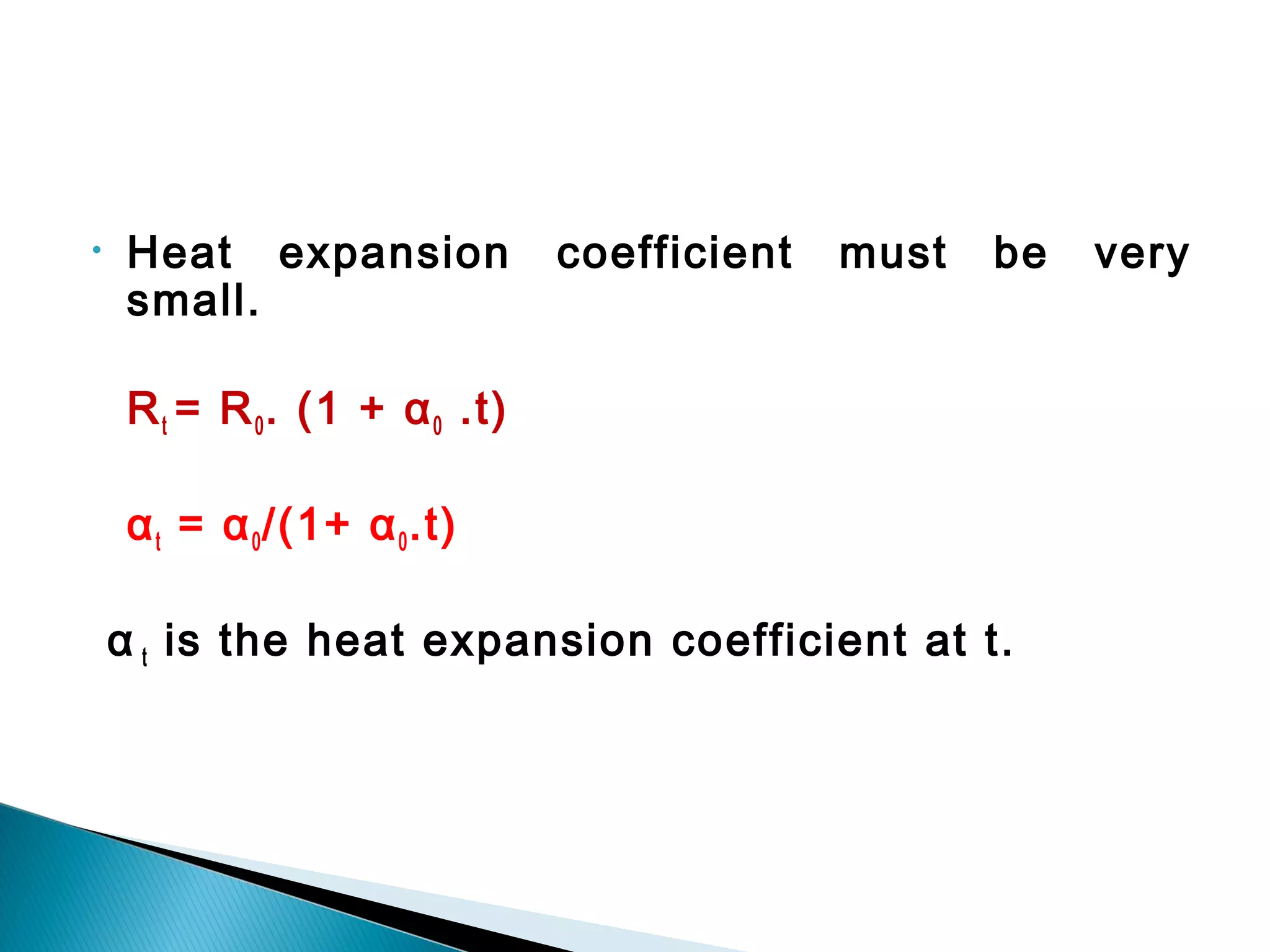
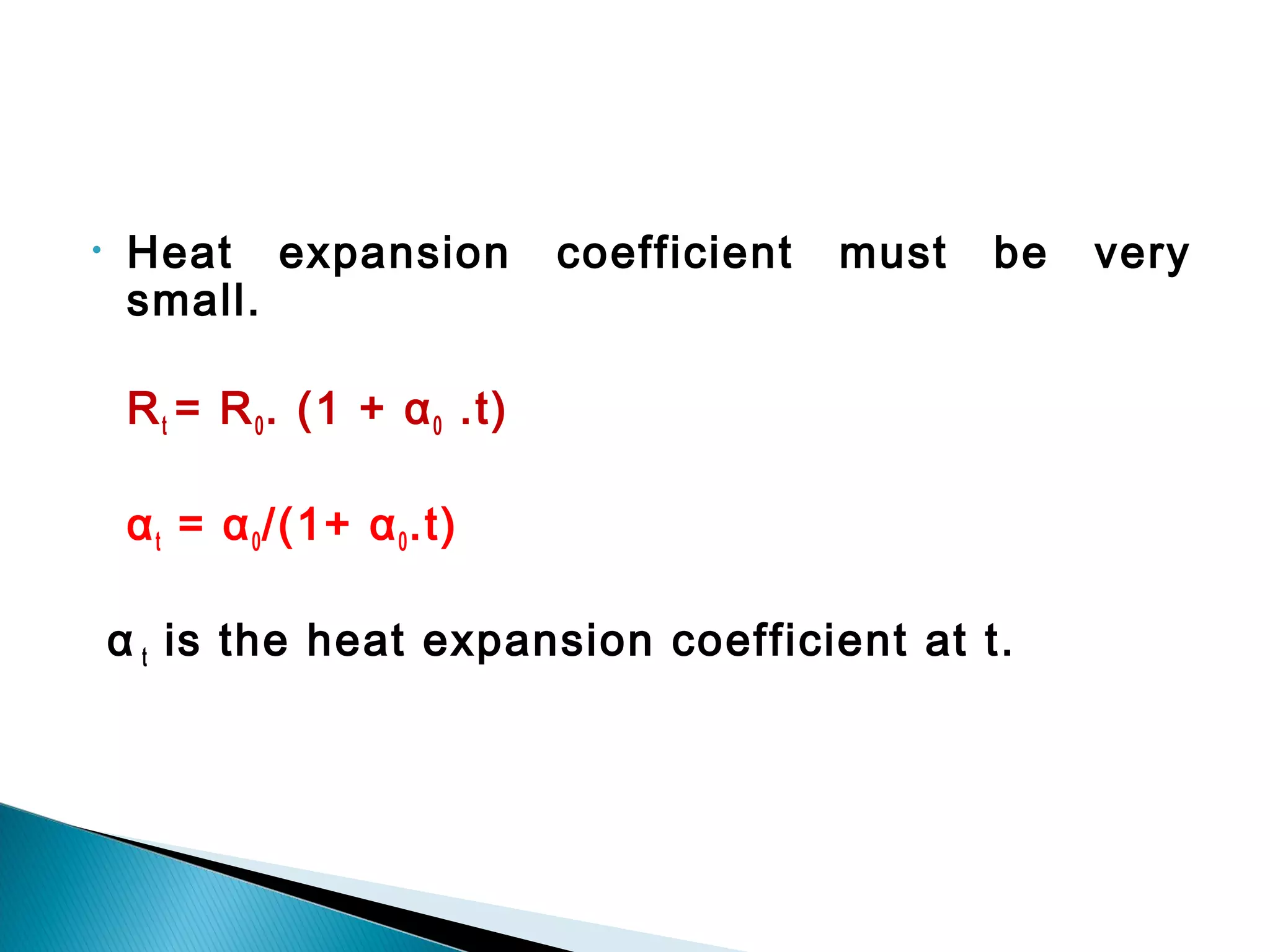
• Heat expansion coefficient must be very
small.
Rt = R0. (1 + α0 .t)
αt = α0/(1+ α0.t)
α t is the heat expansion coefficient at t.
TYPES OF
CONDUCTORS
MATERIALS
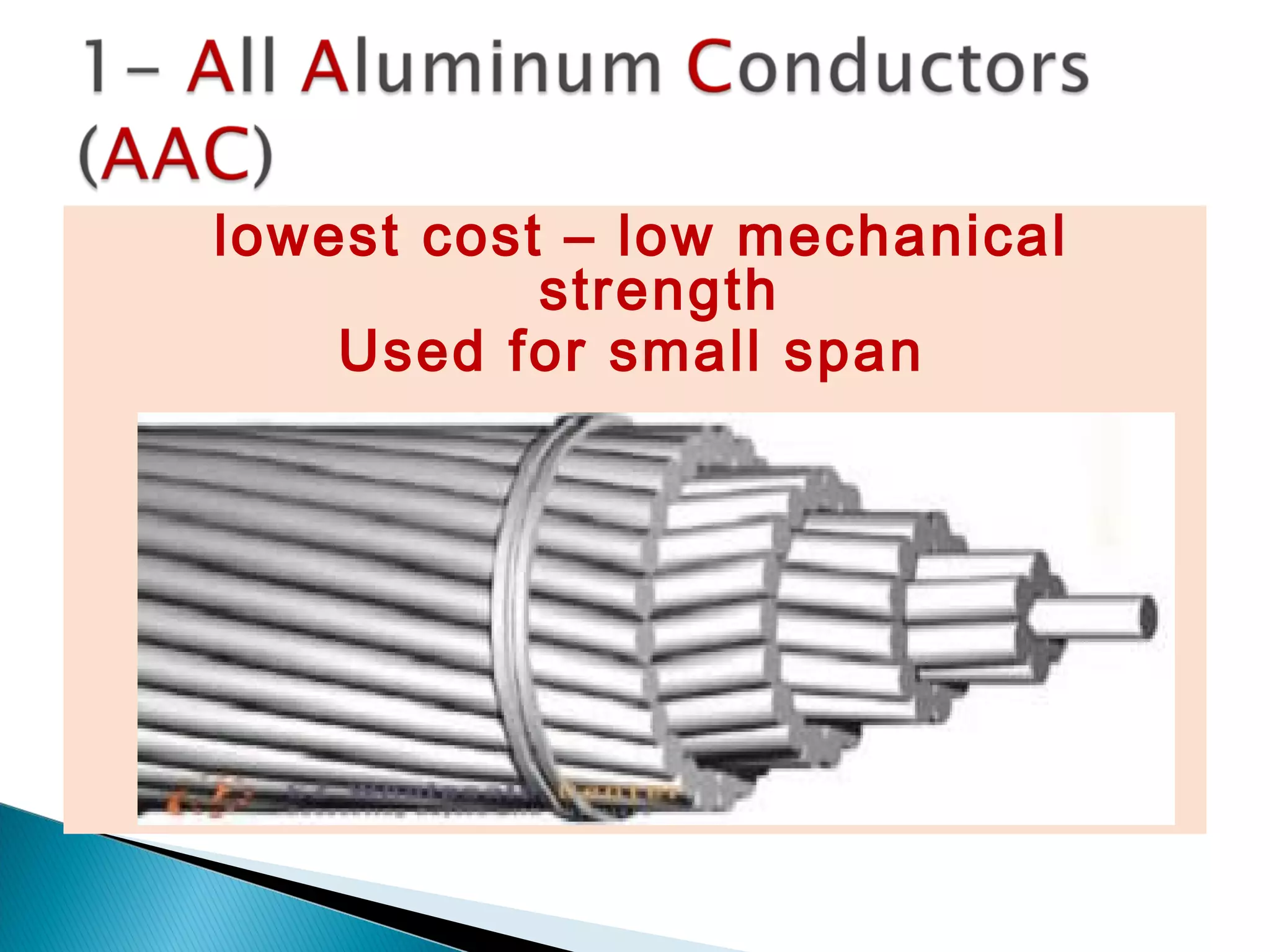
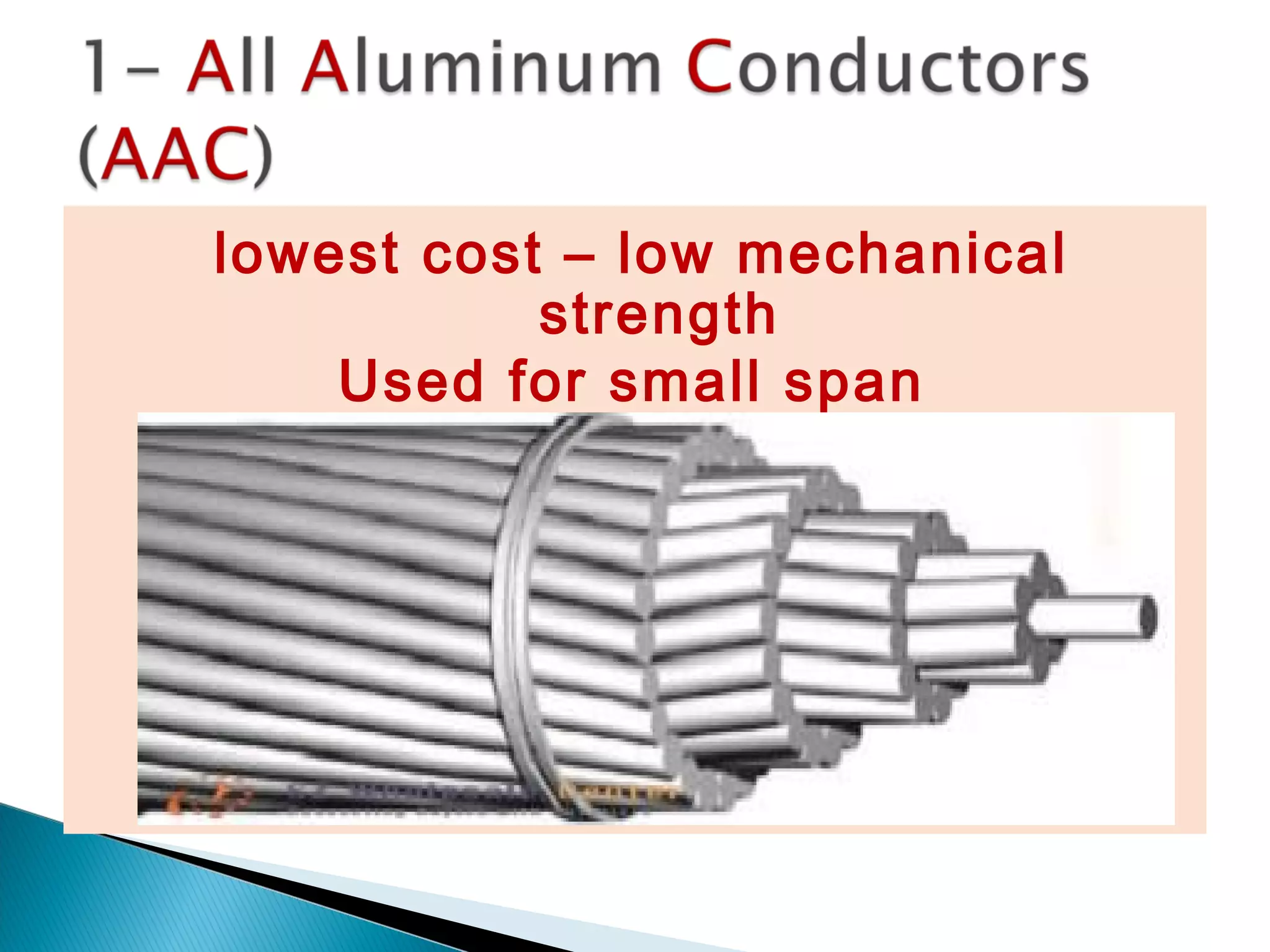
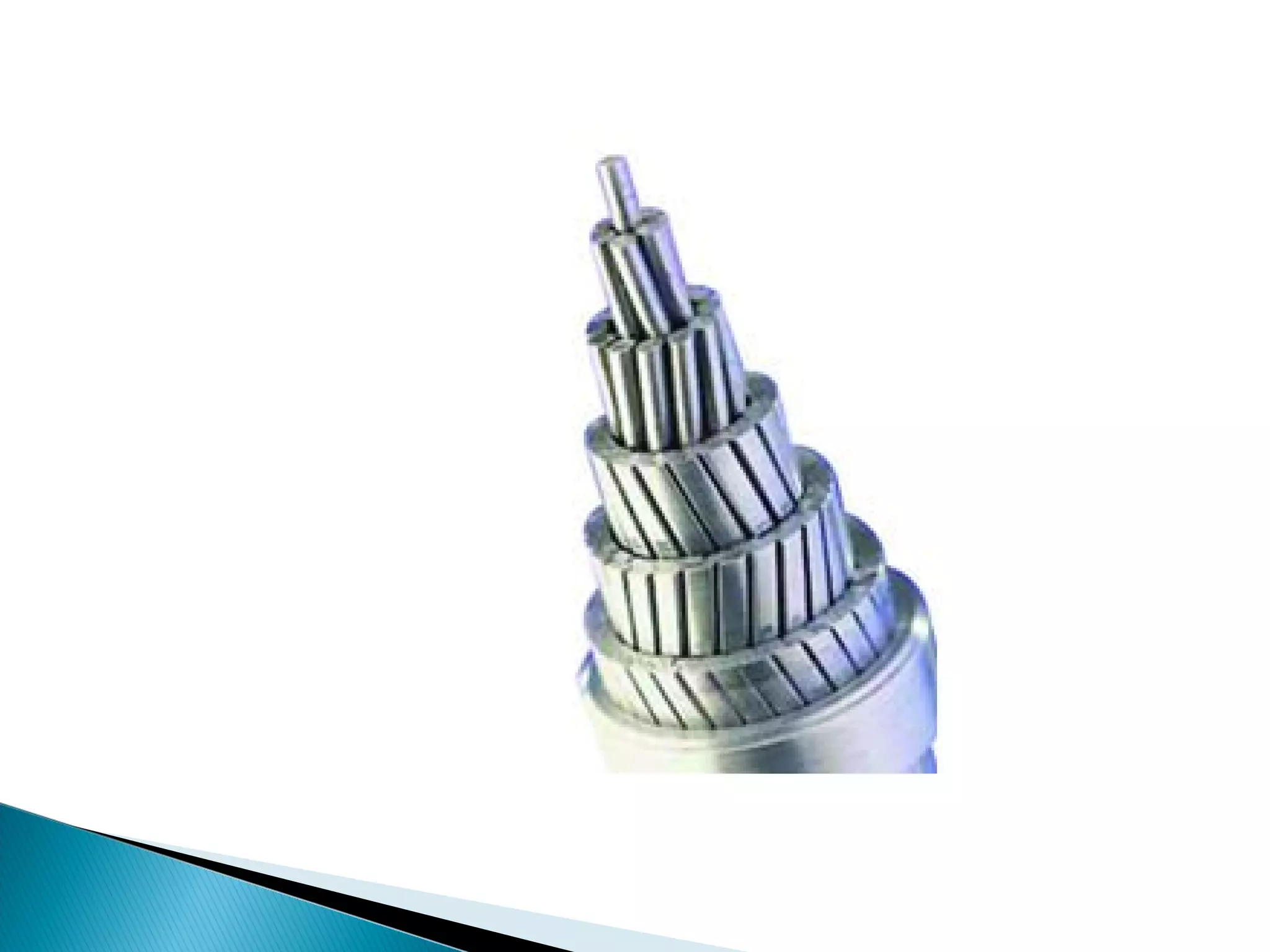
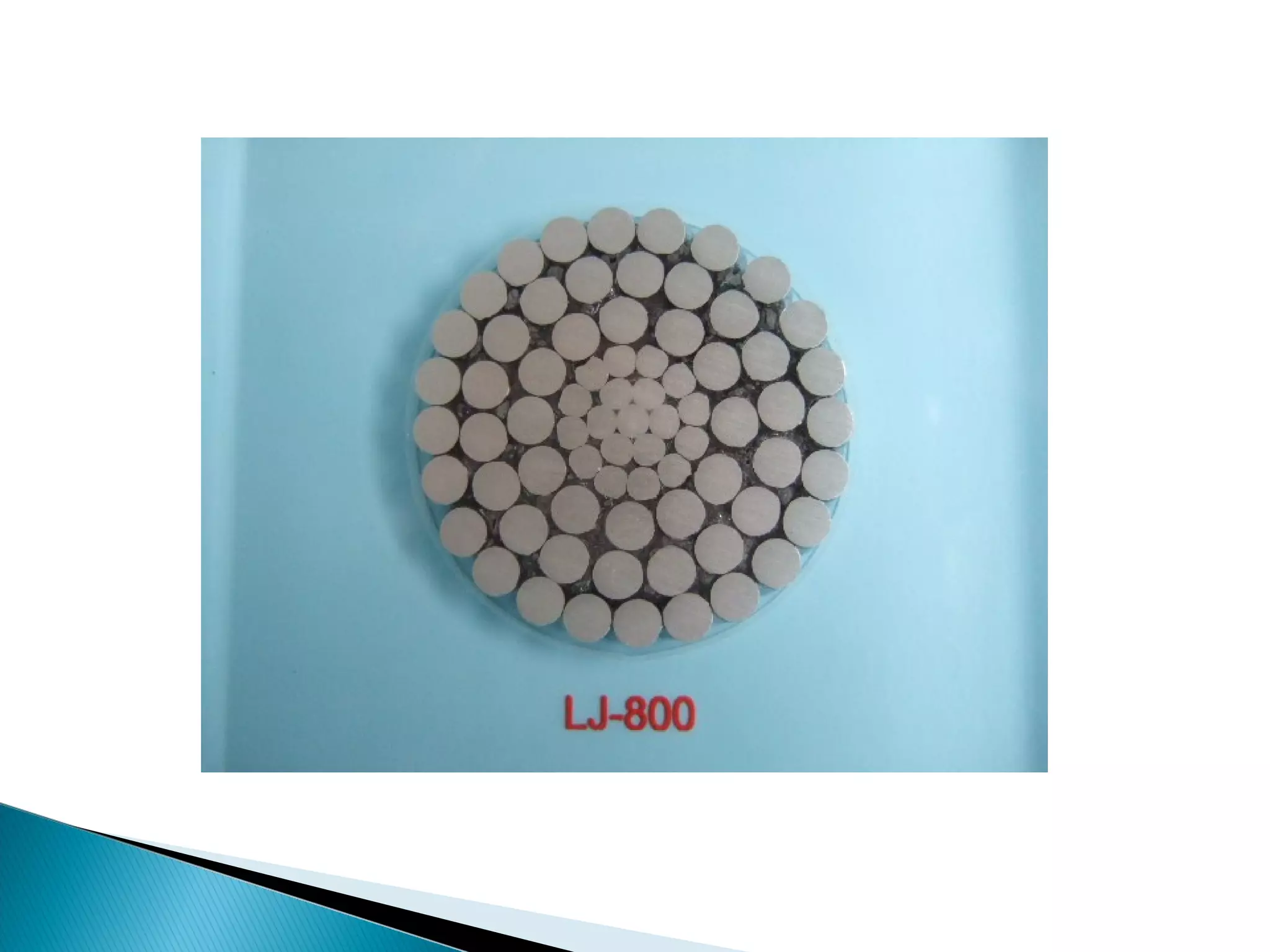
lowest cost – low mechanical
strength
Used for small span
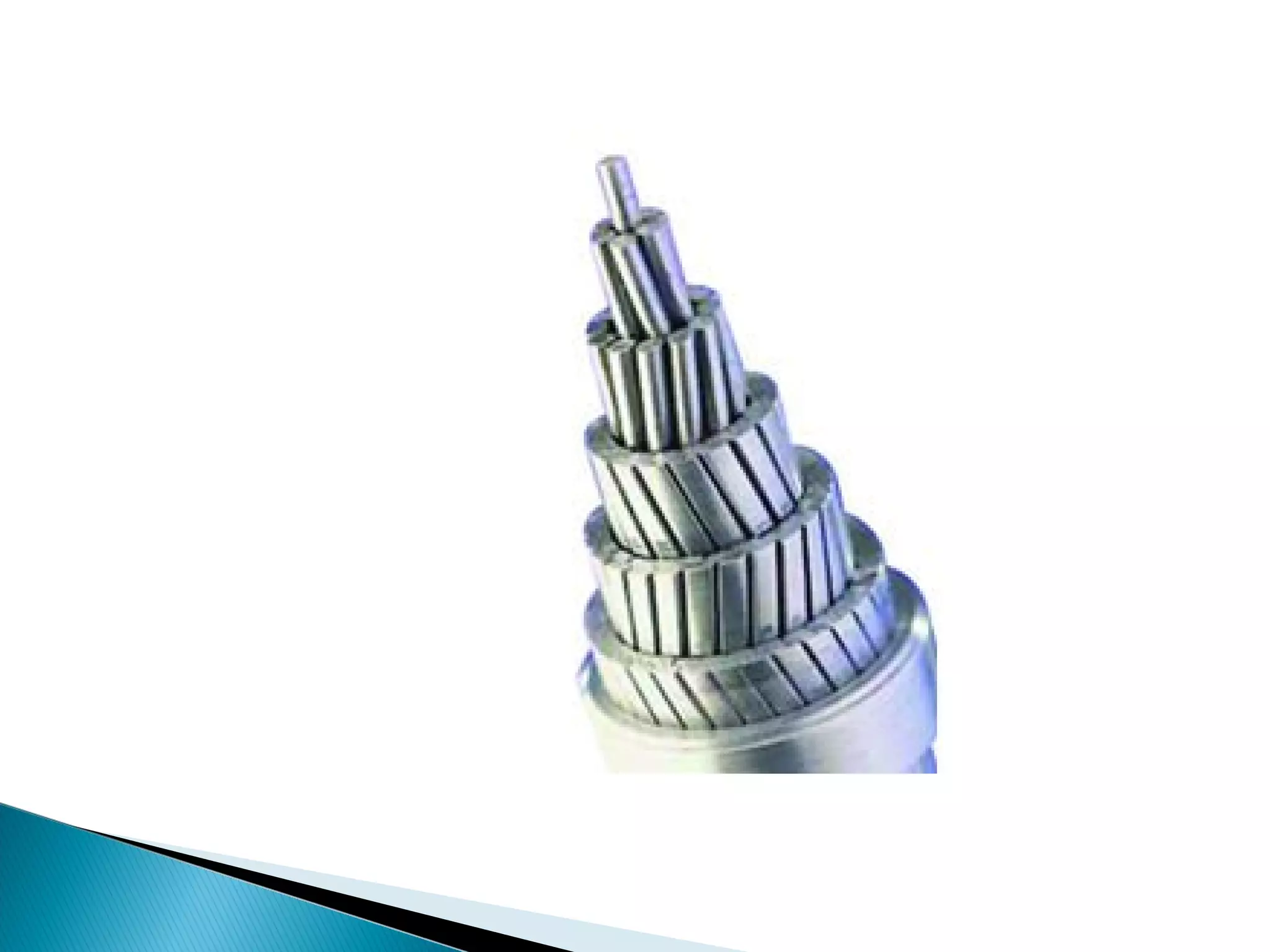
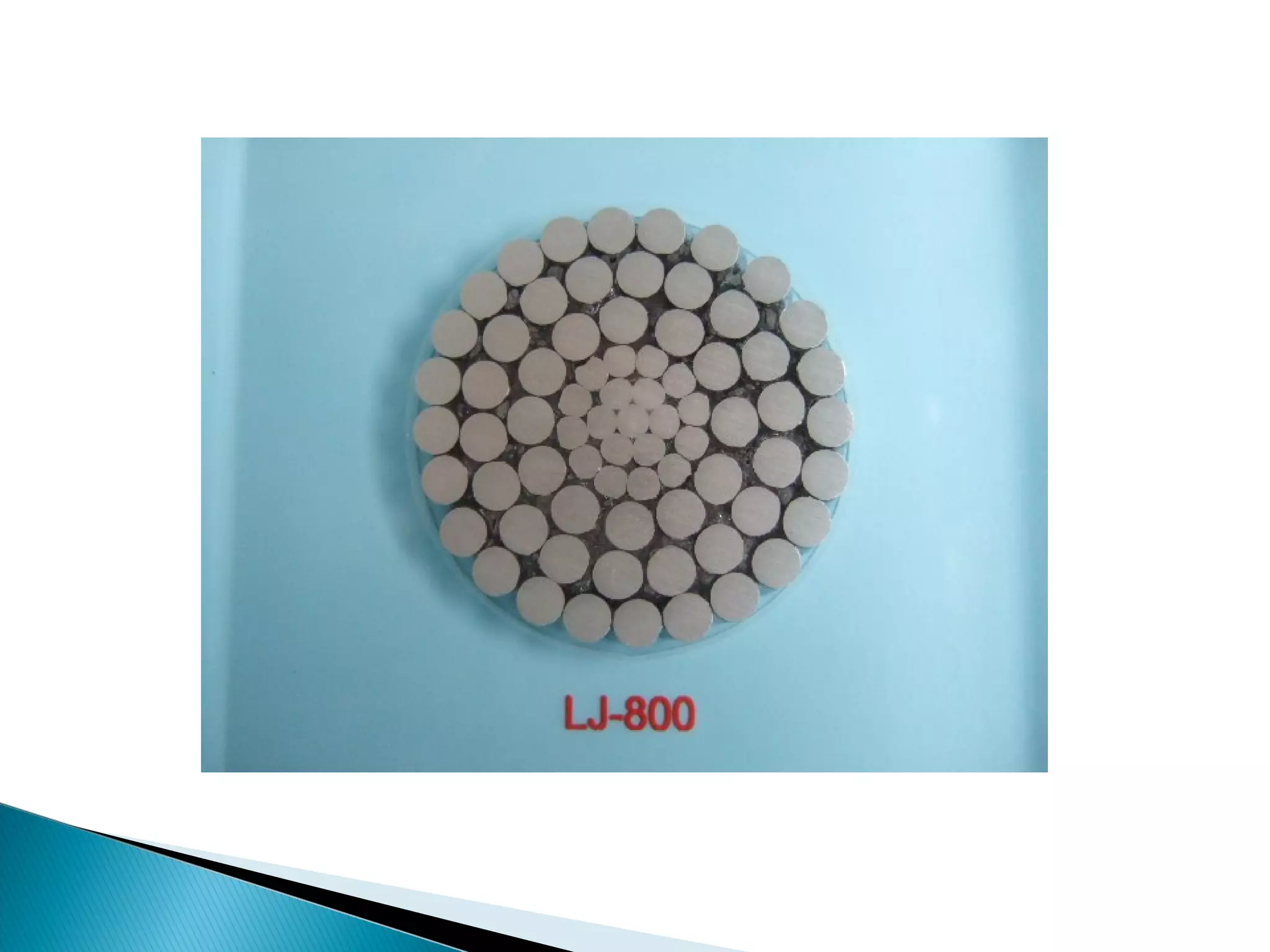
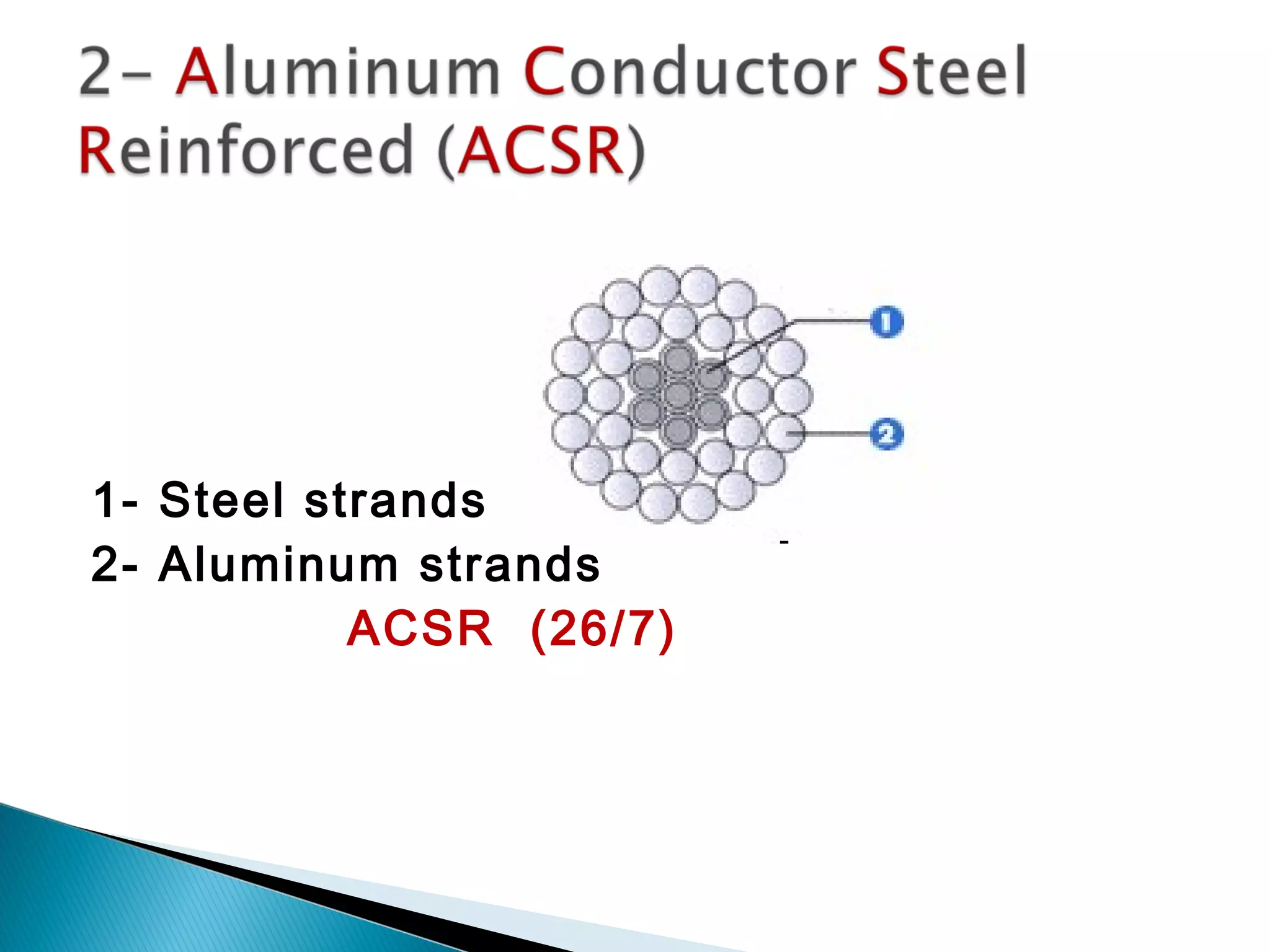
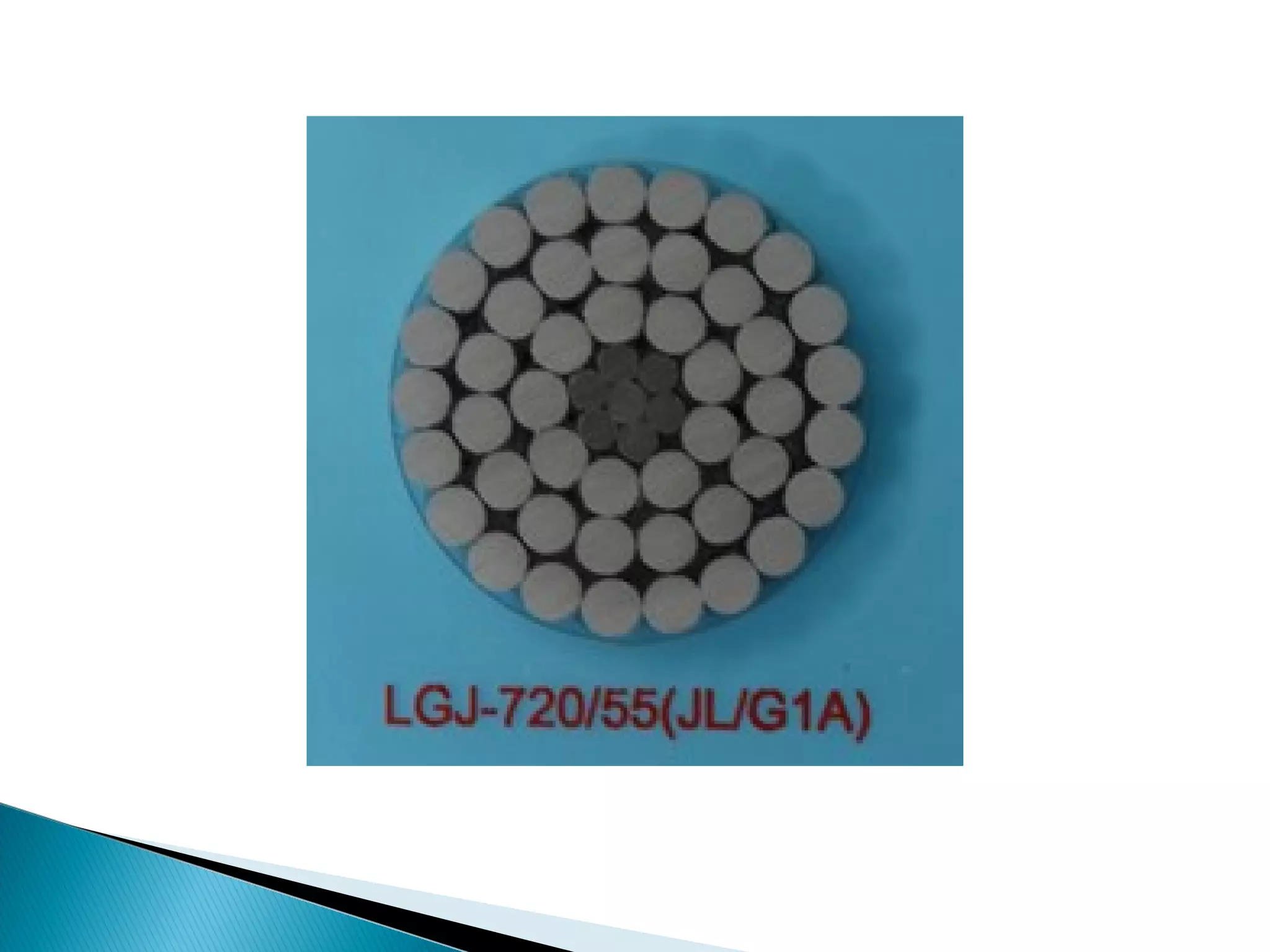
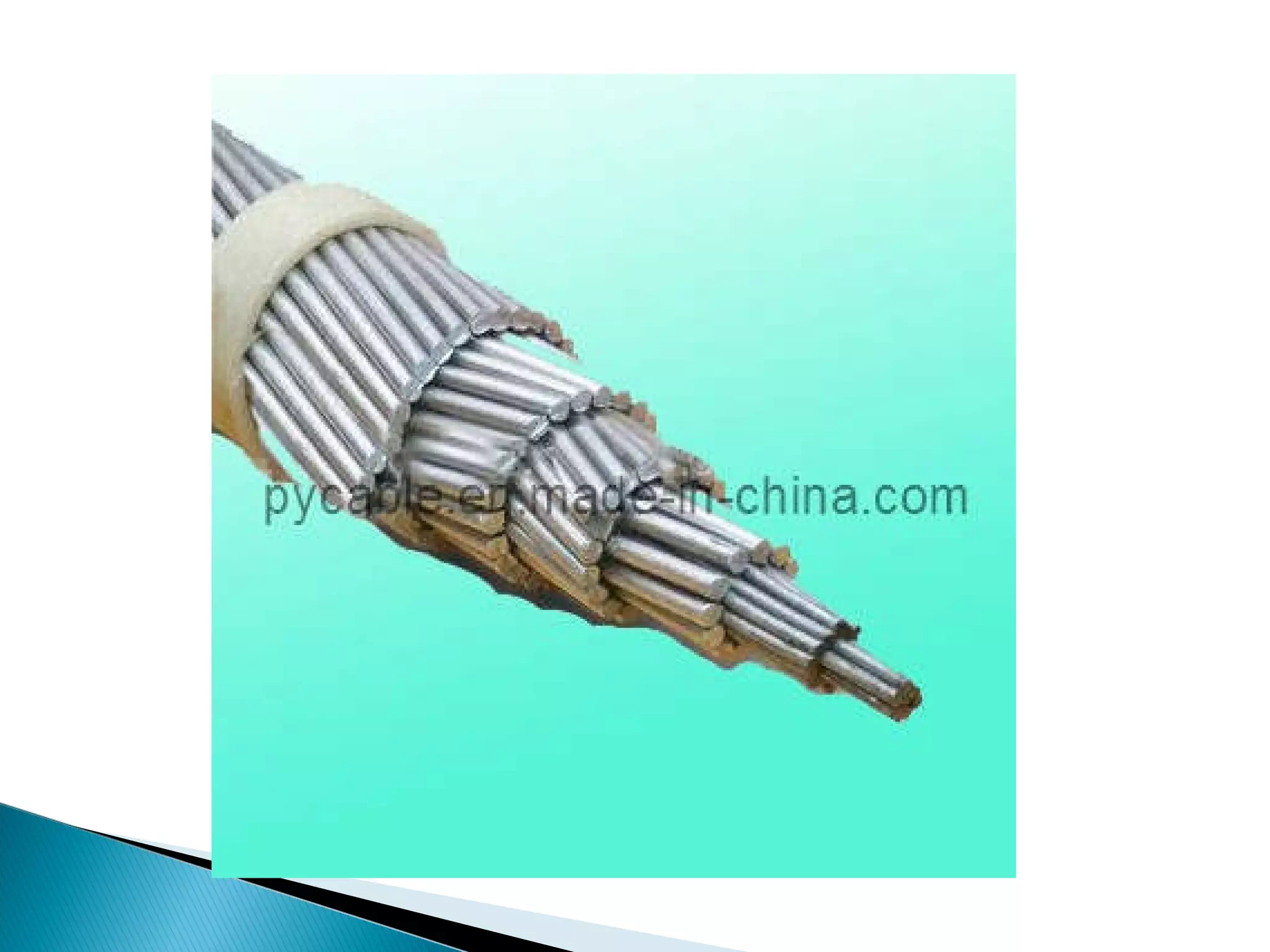
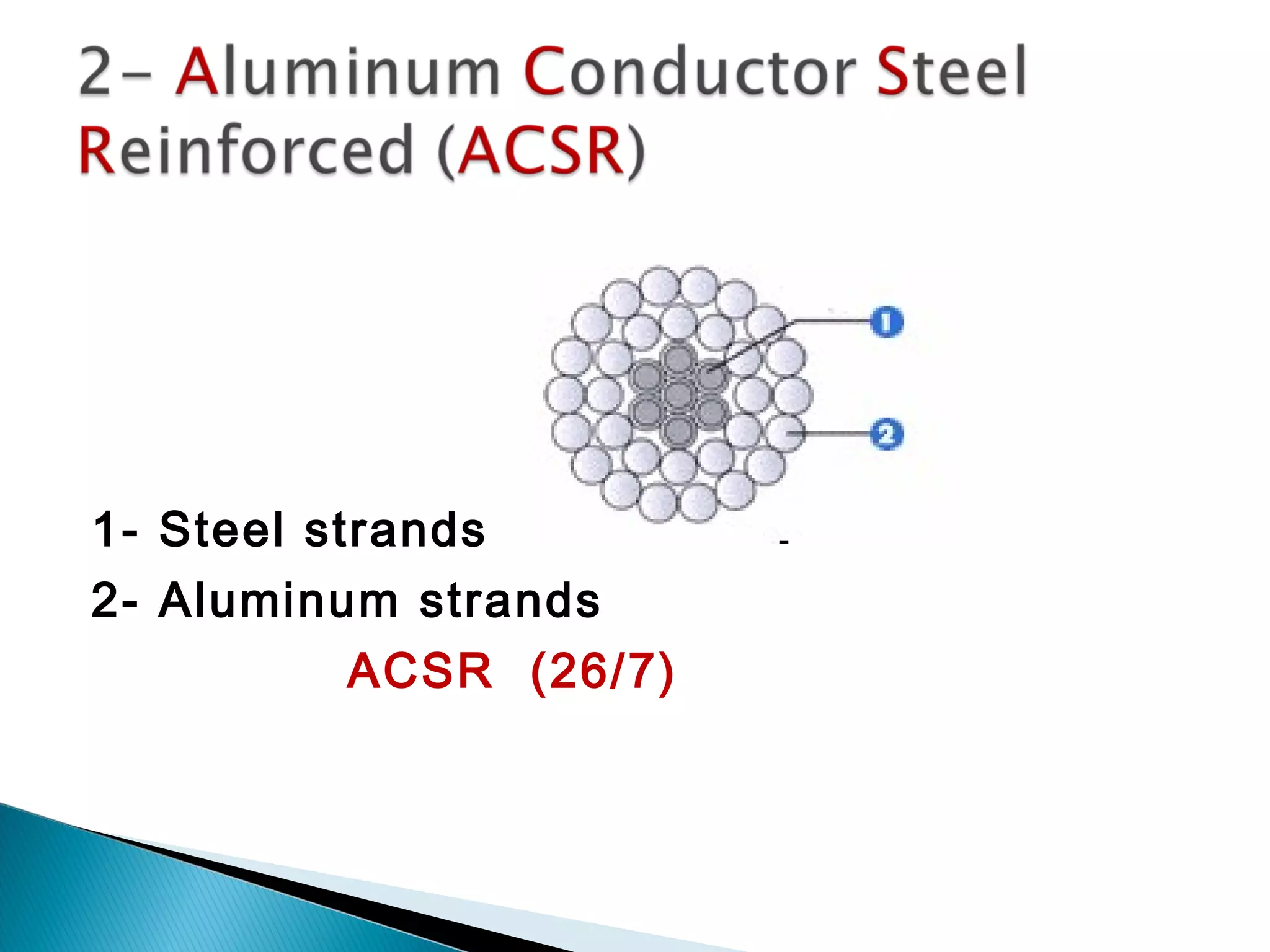
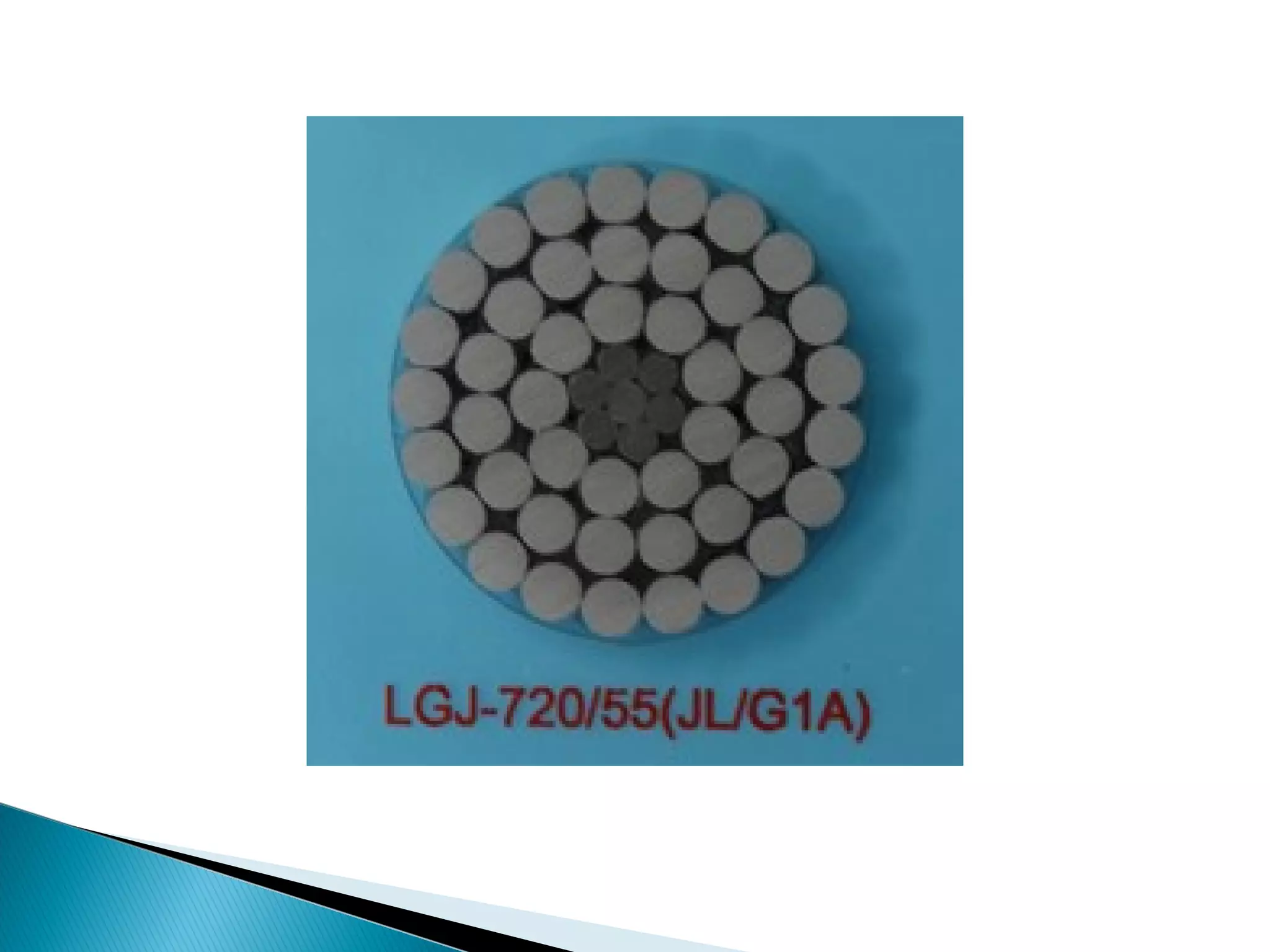
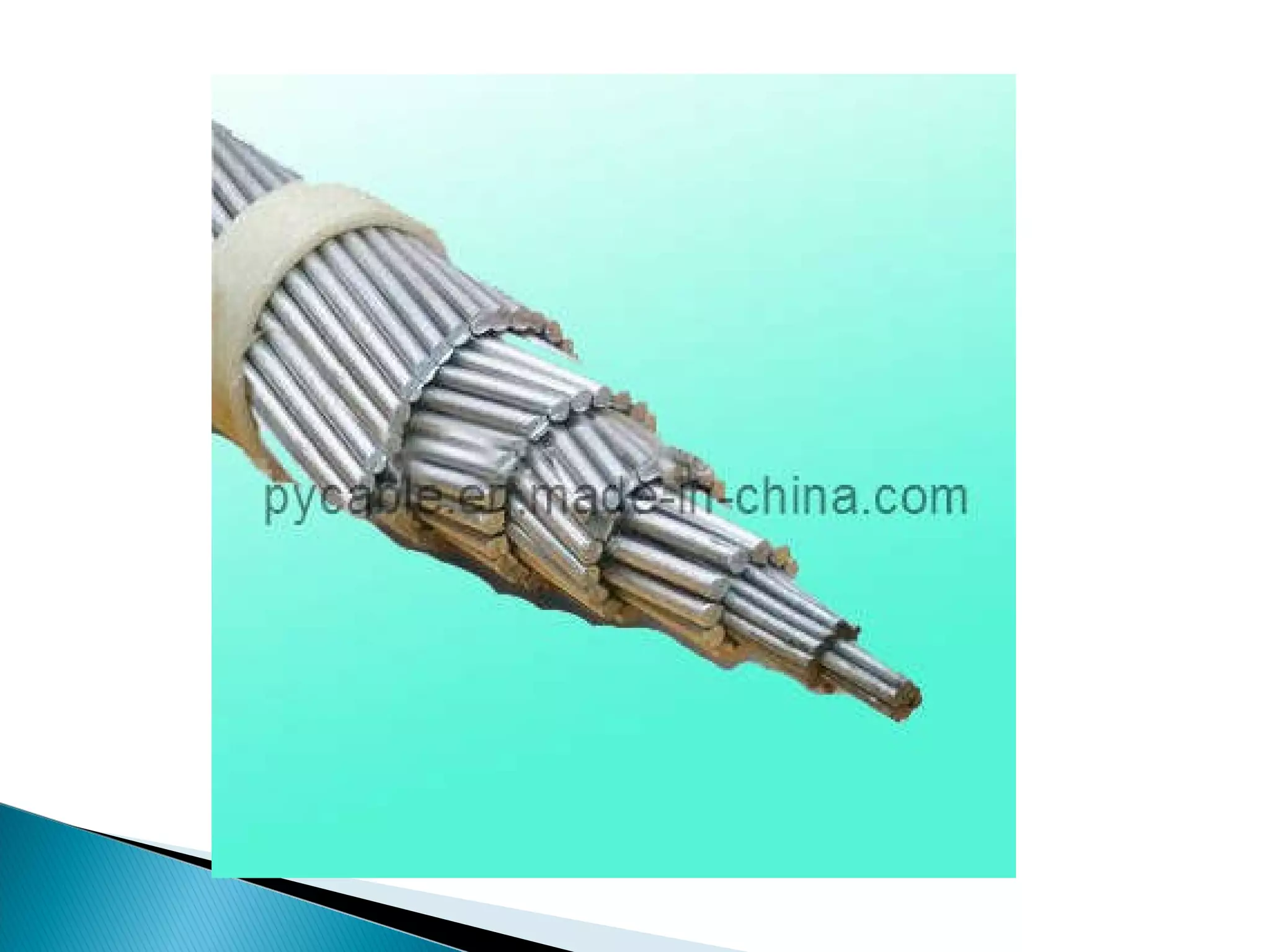
1- Steel strands
2- Aluminum strands
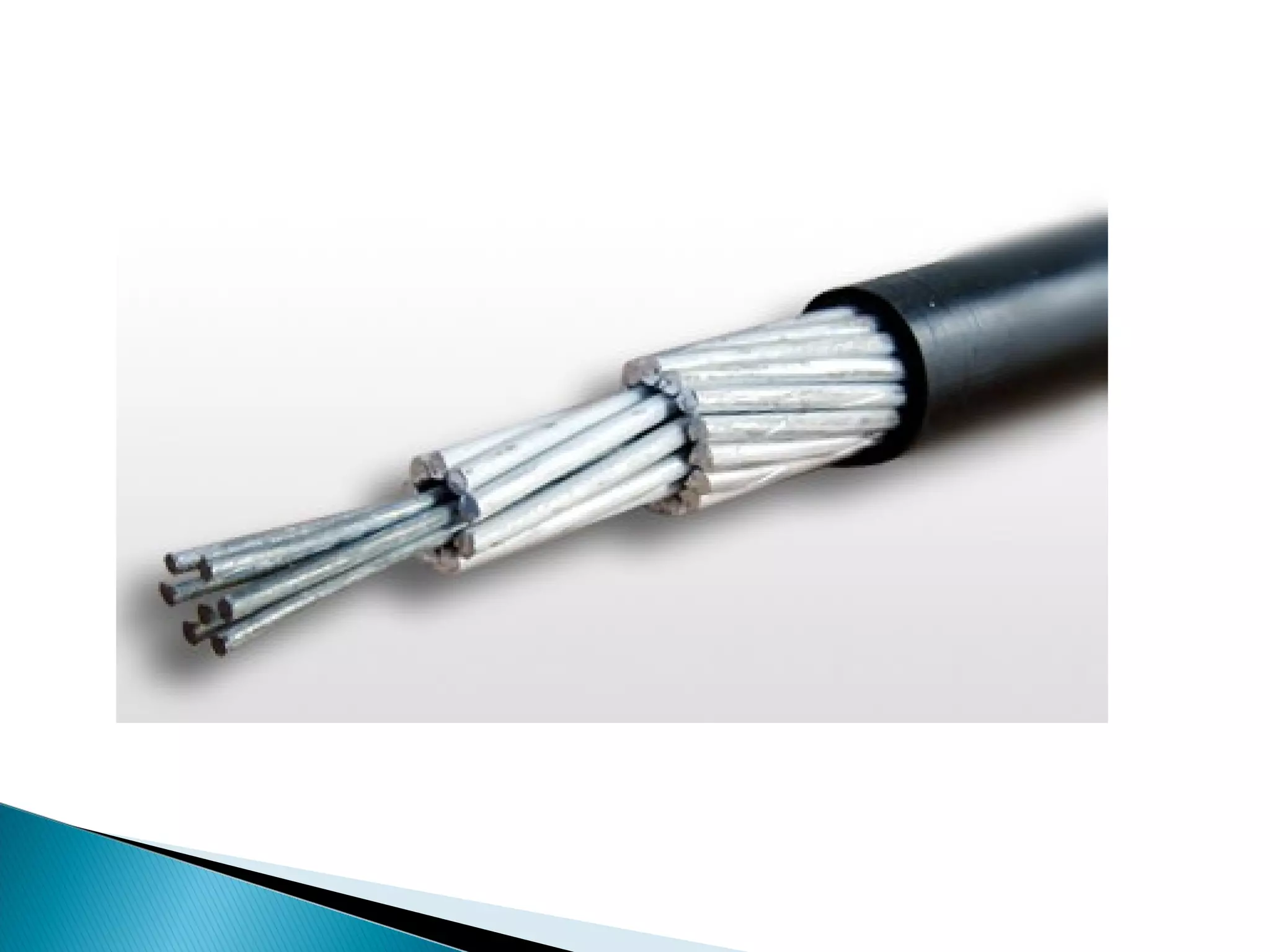
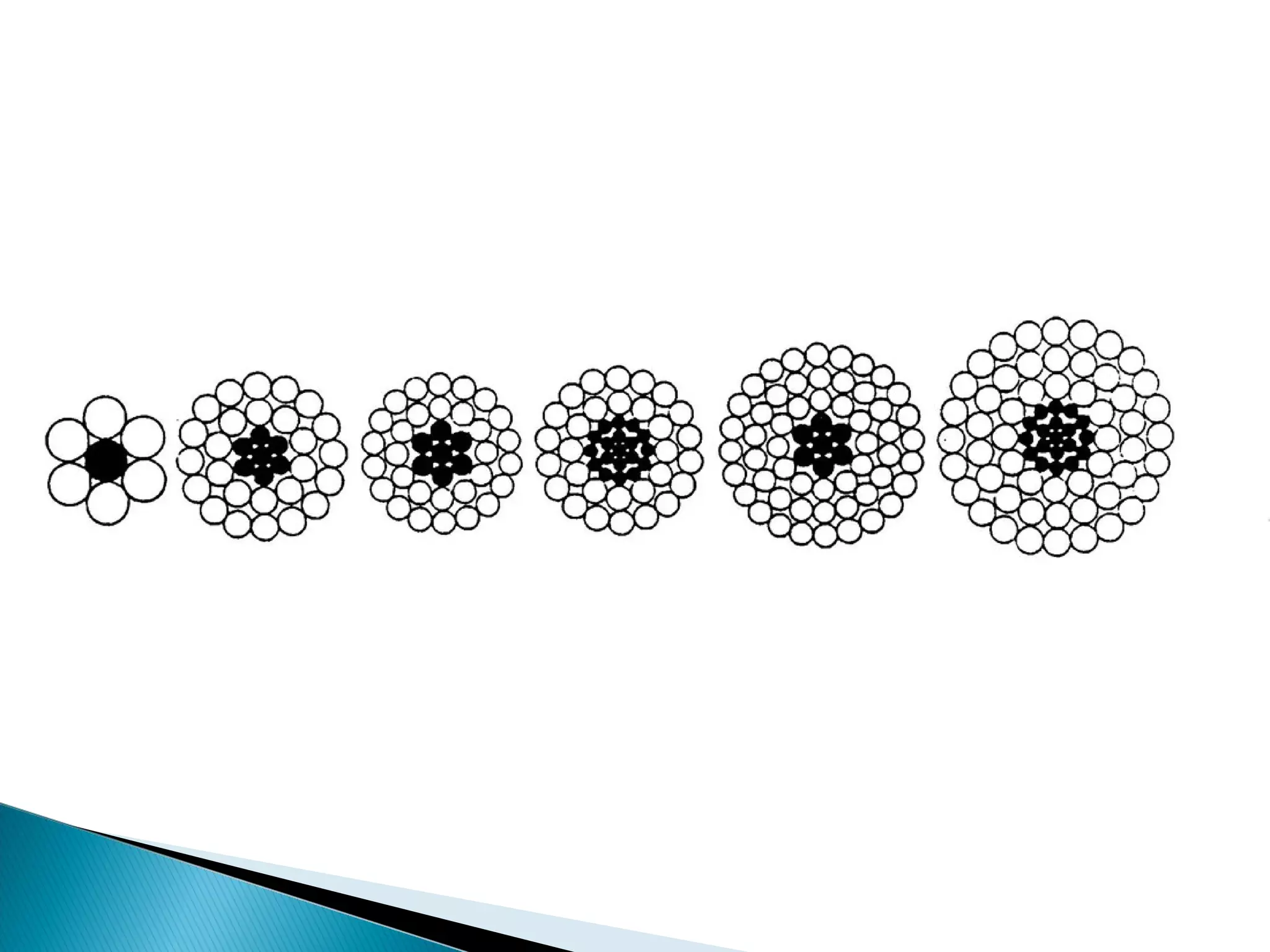
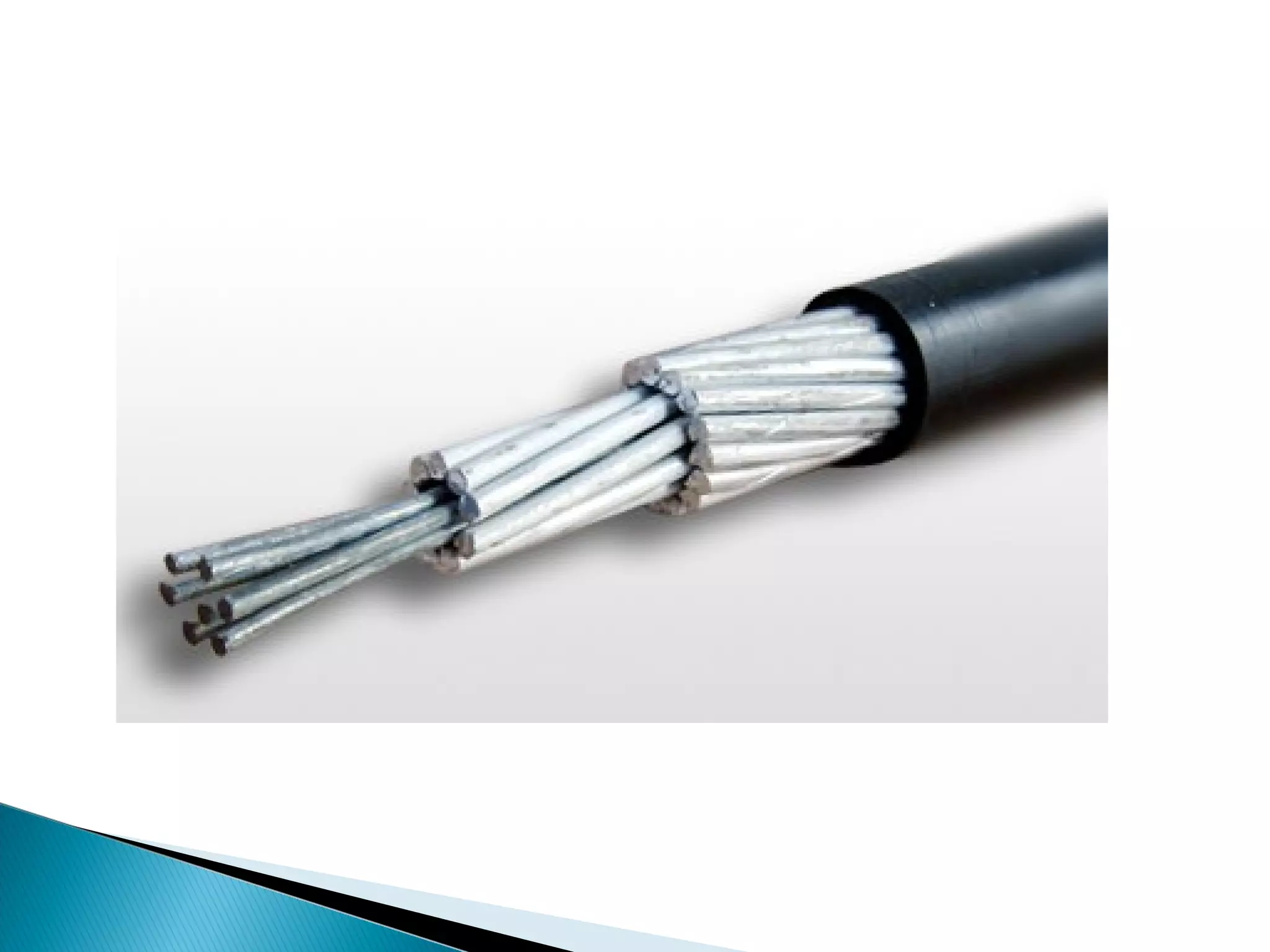
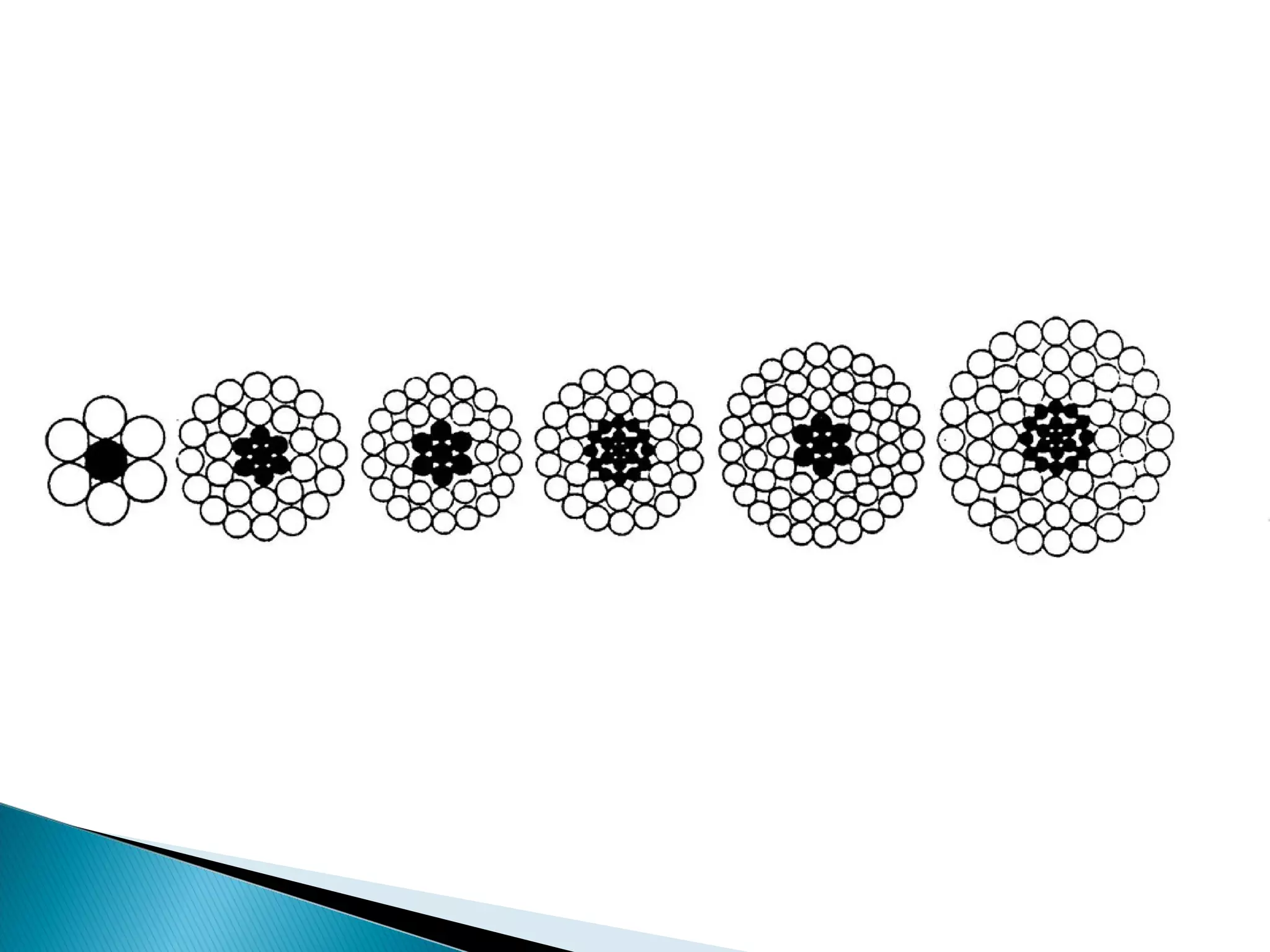
ACSR (26/7)
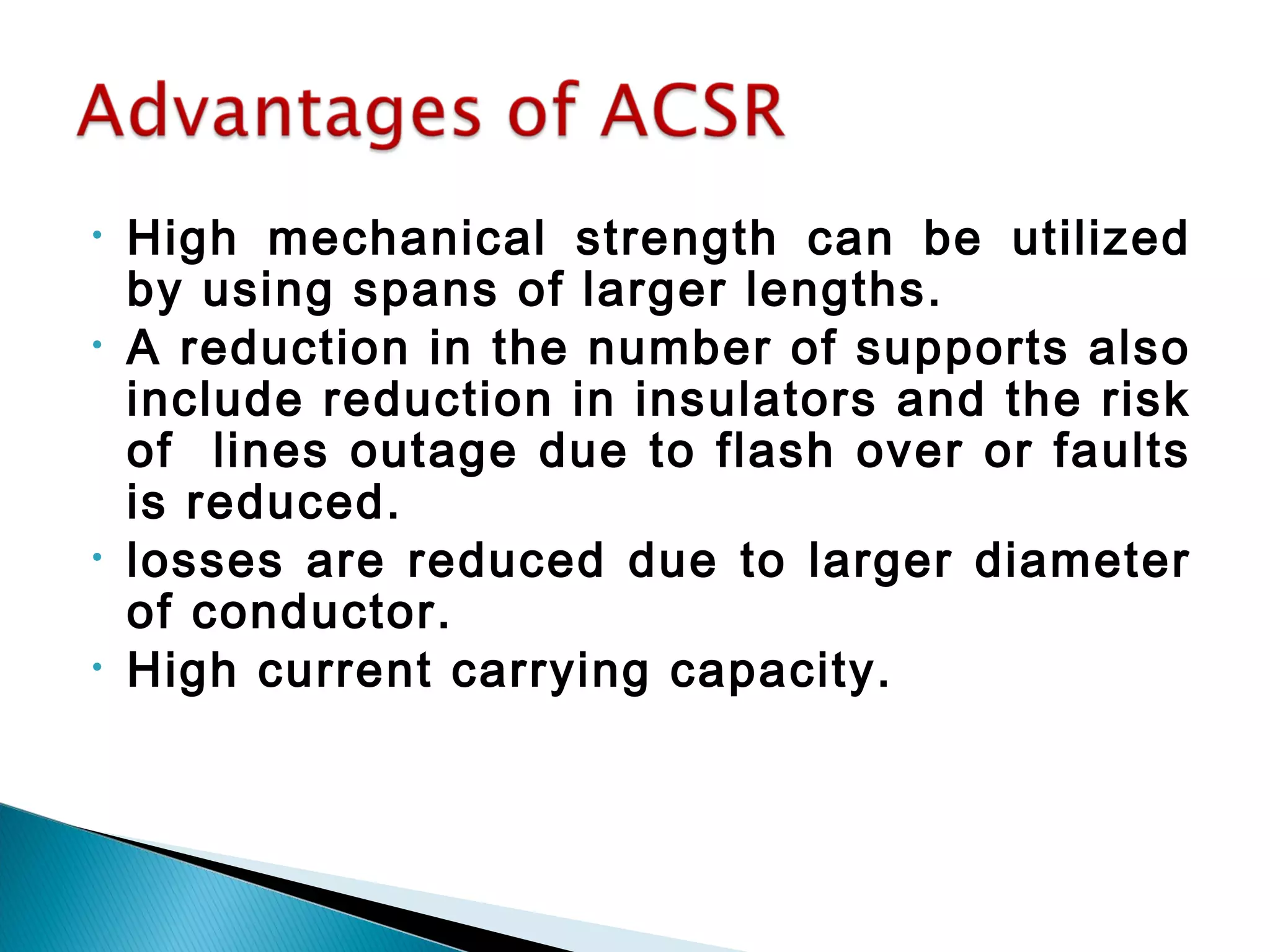
• High mechanical strength can be utilized
by using spans of larger lengths.
• A reduction in the number of supports also
include reduction in insulators and the risk
of lines outage due to flash over or faults
is reduced.
• losses are reduced due to larger diameter
of conductor.
• High current carrying capacity.
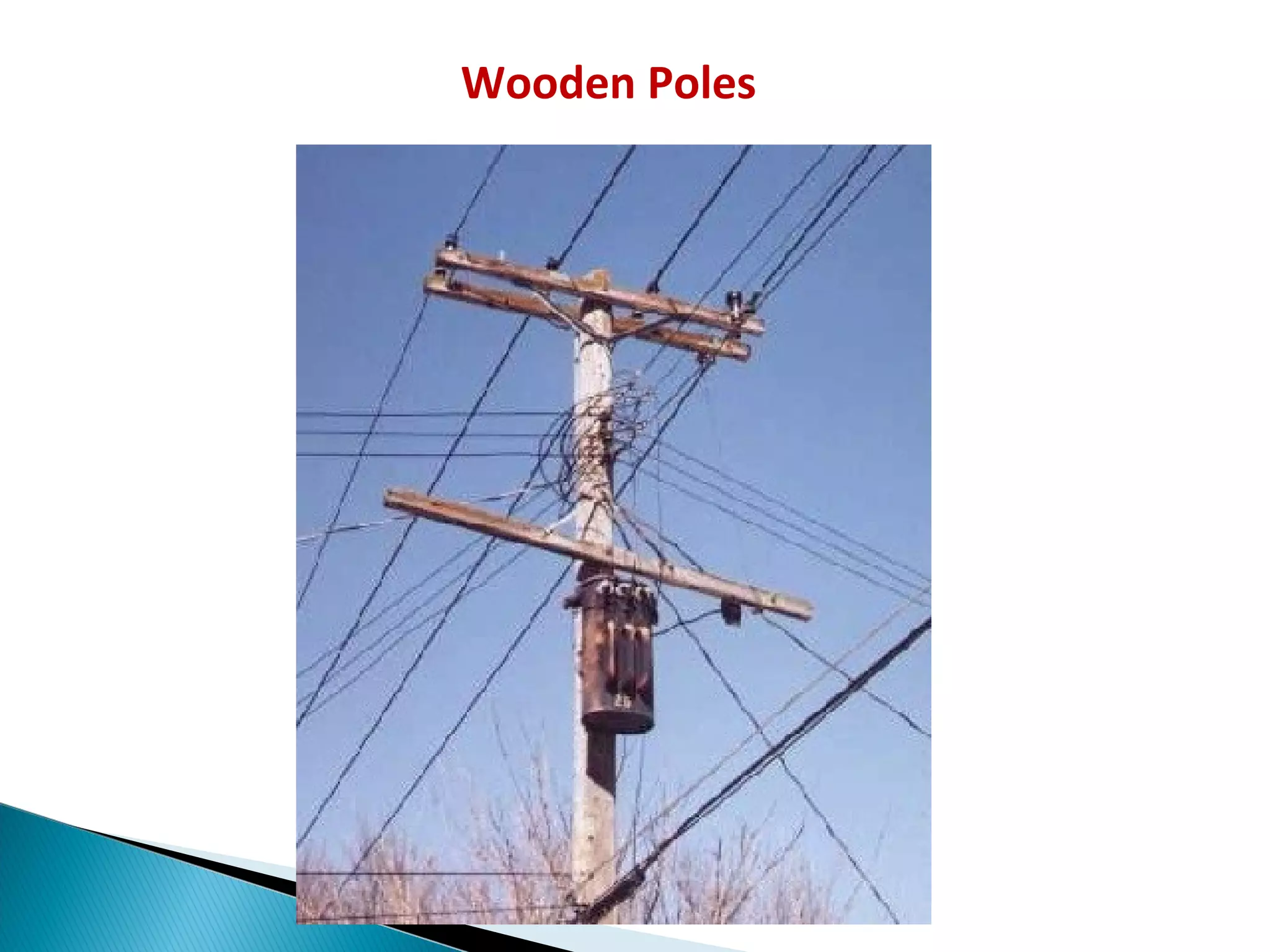
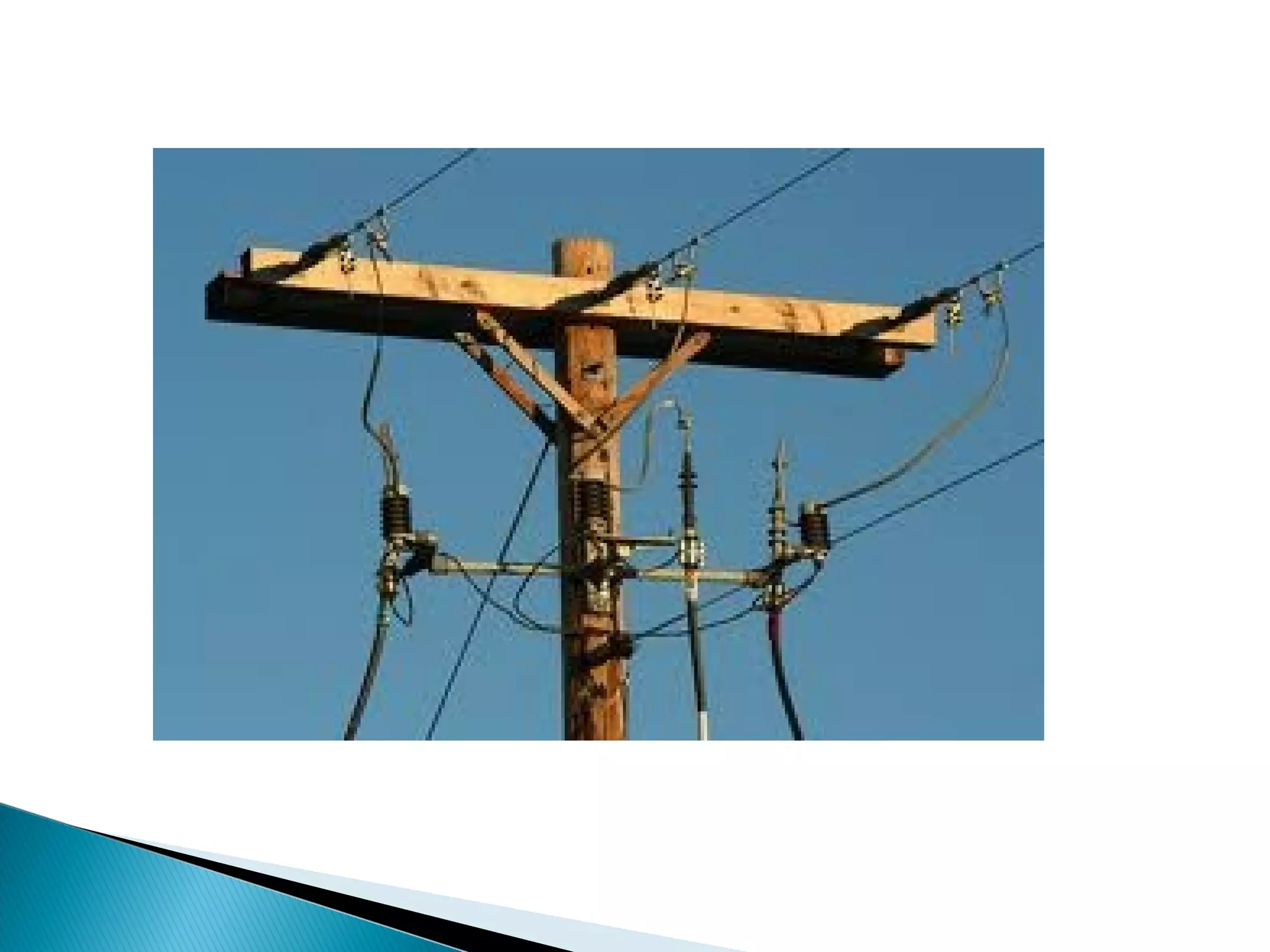
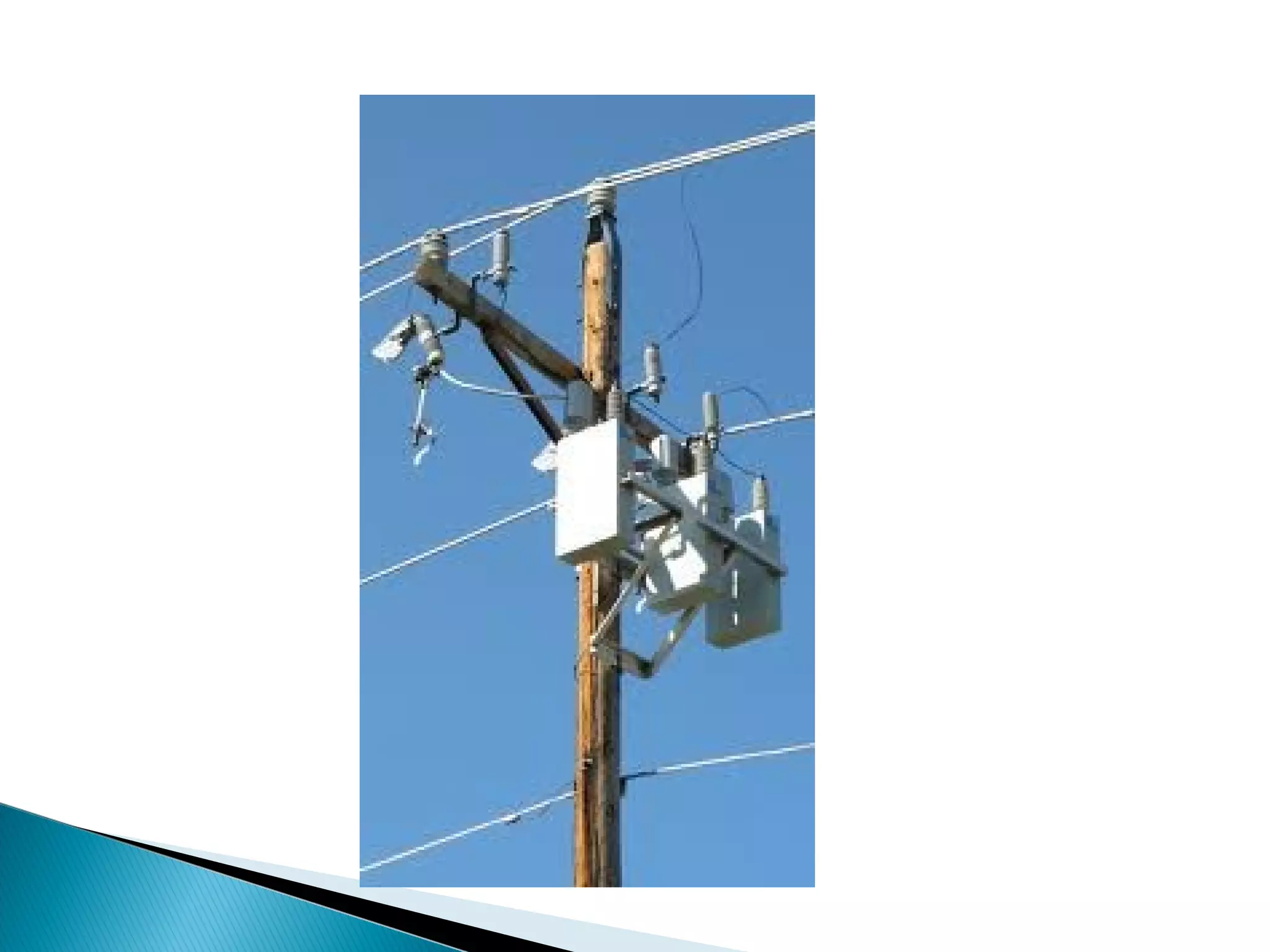
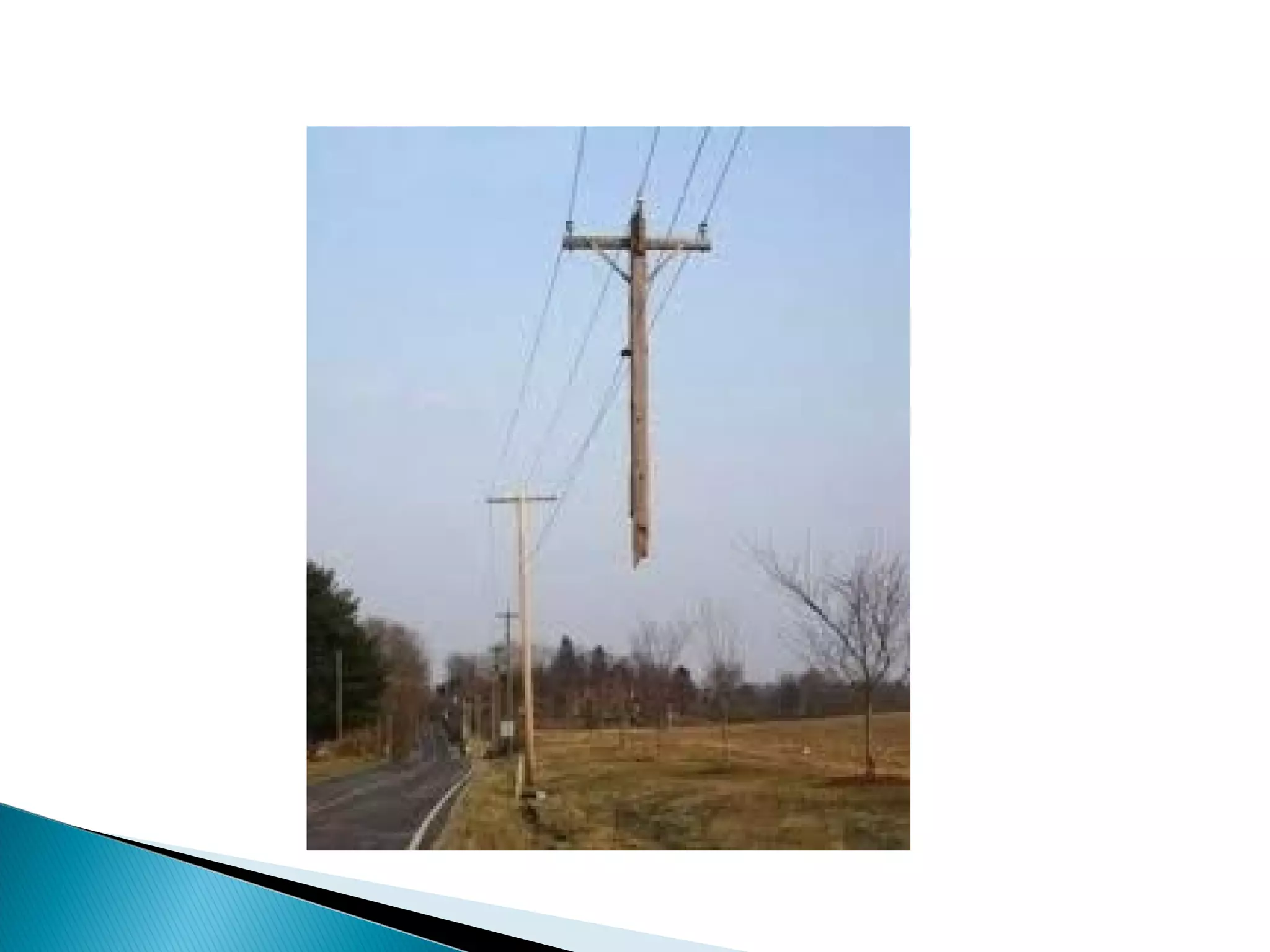
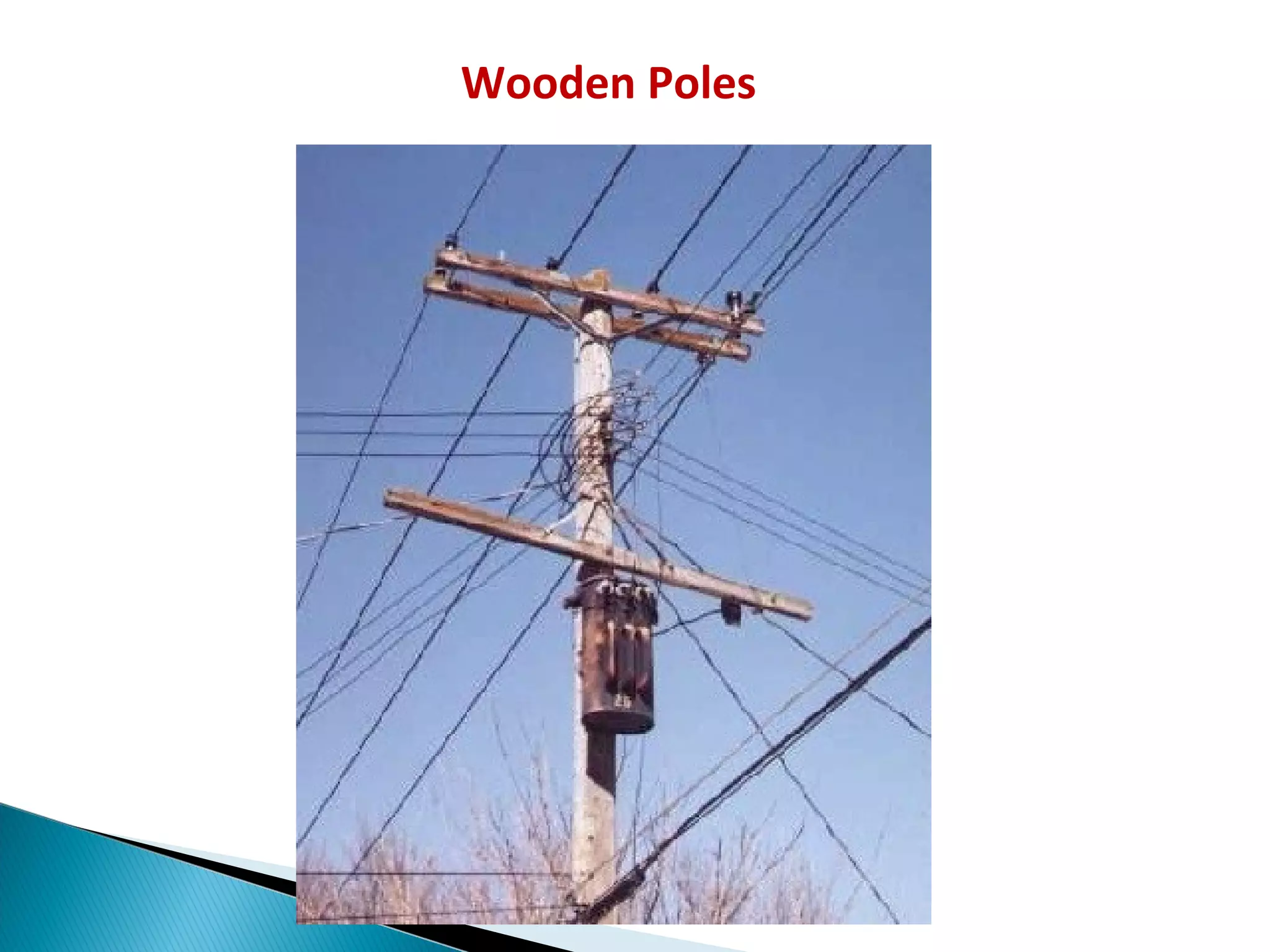
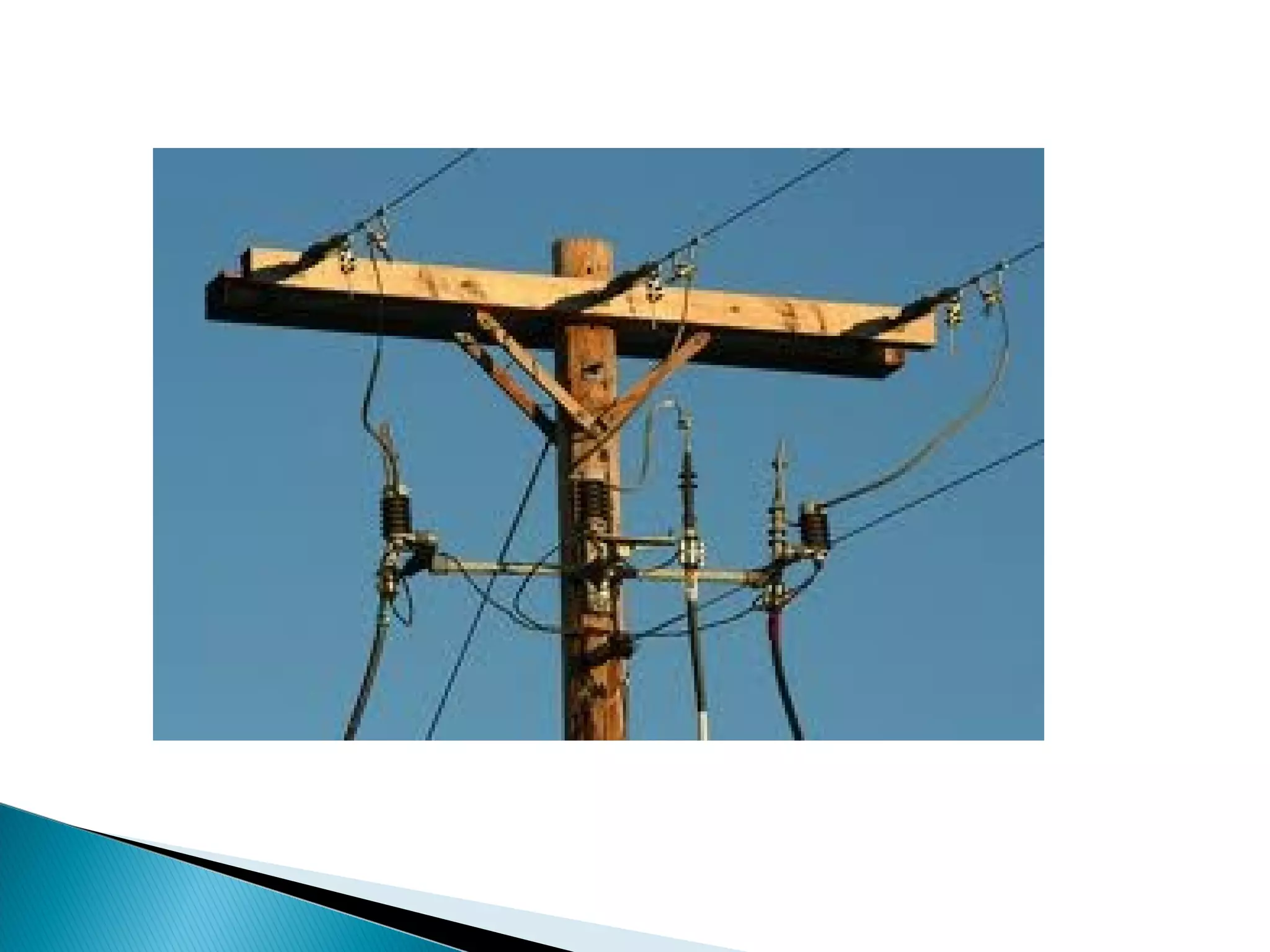
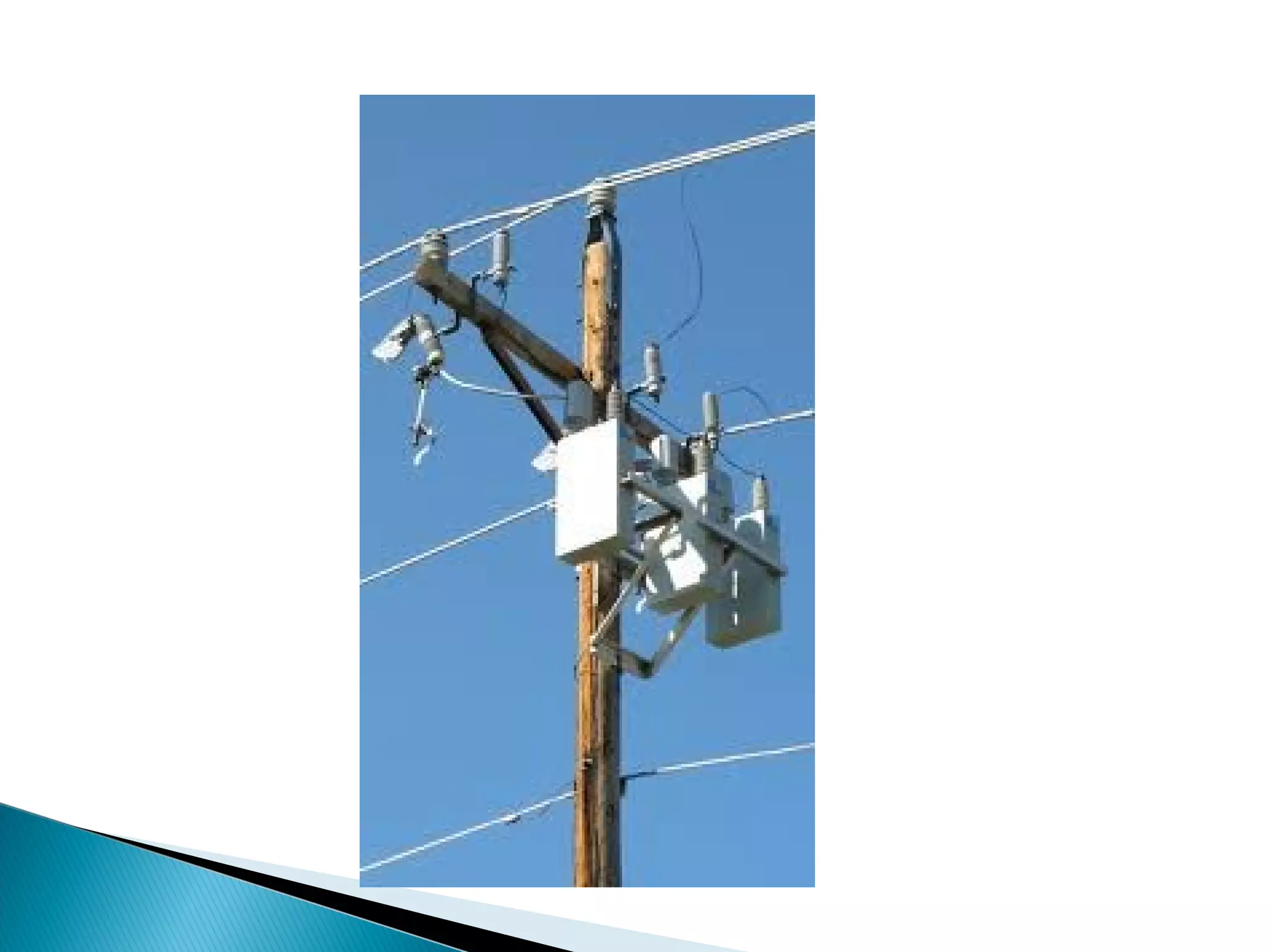
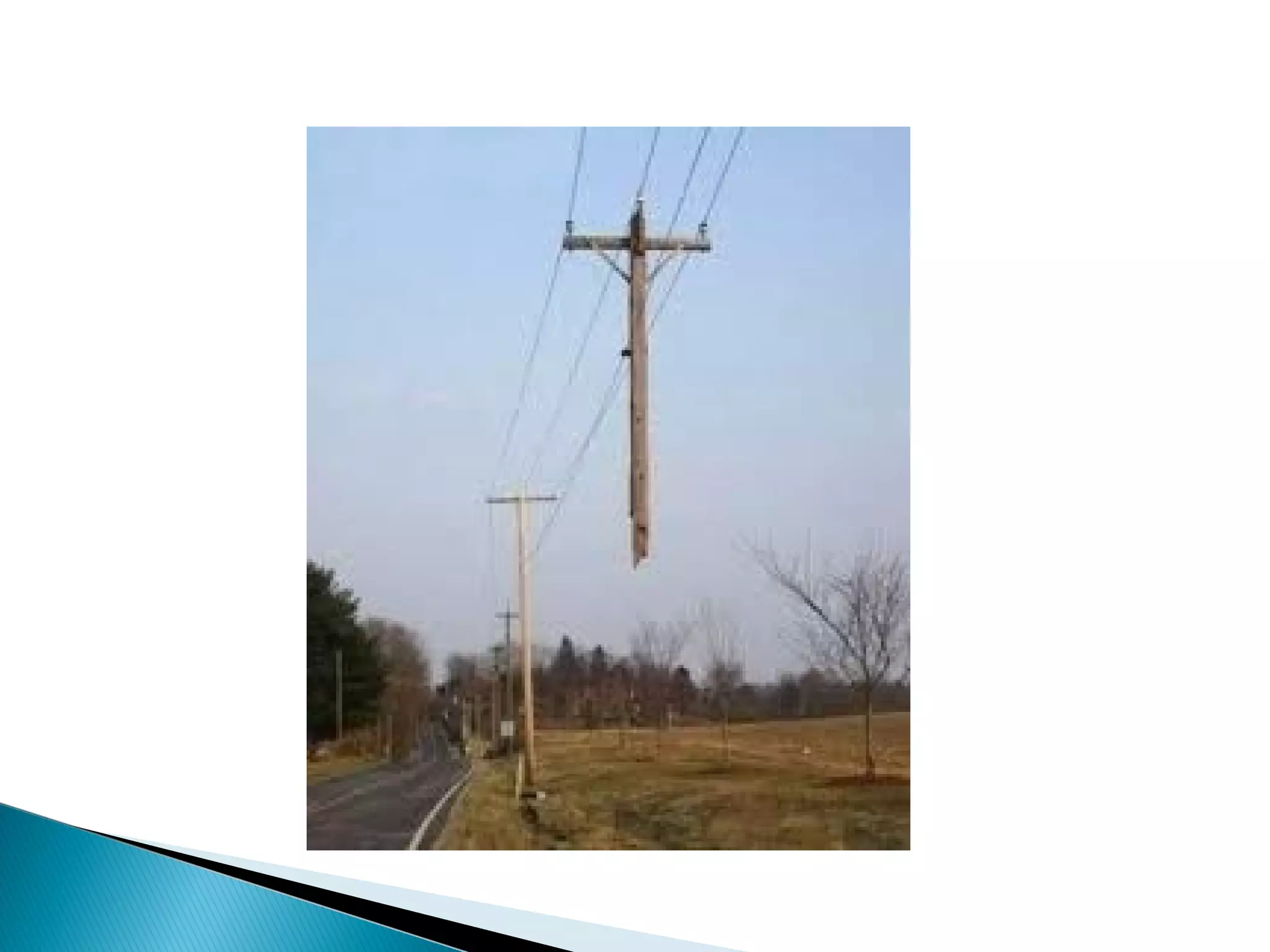
 Wooden Poles
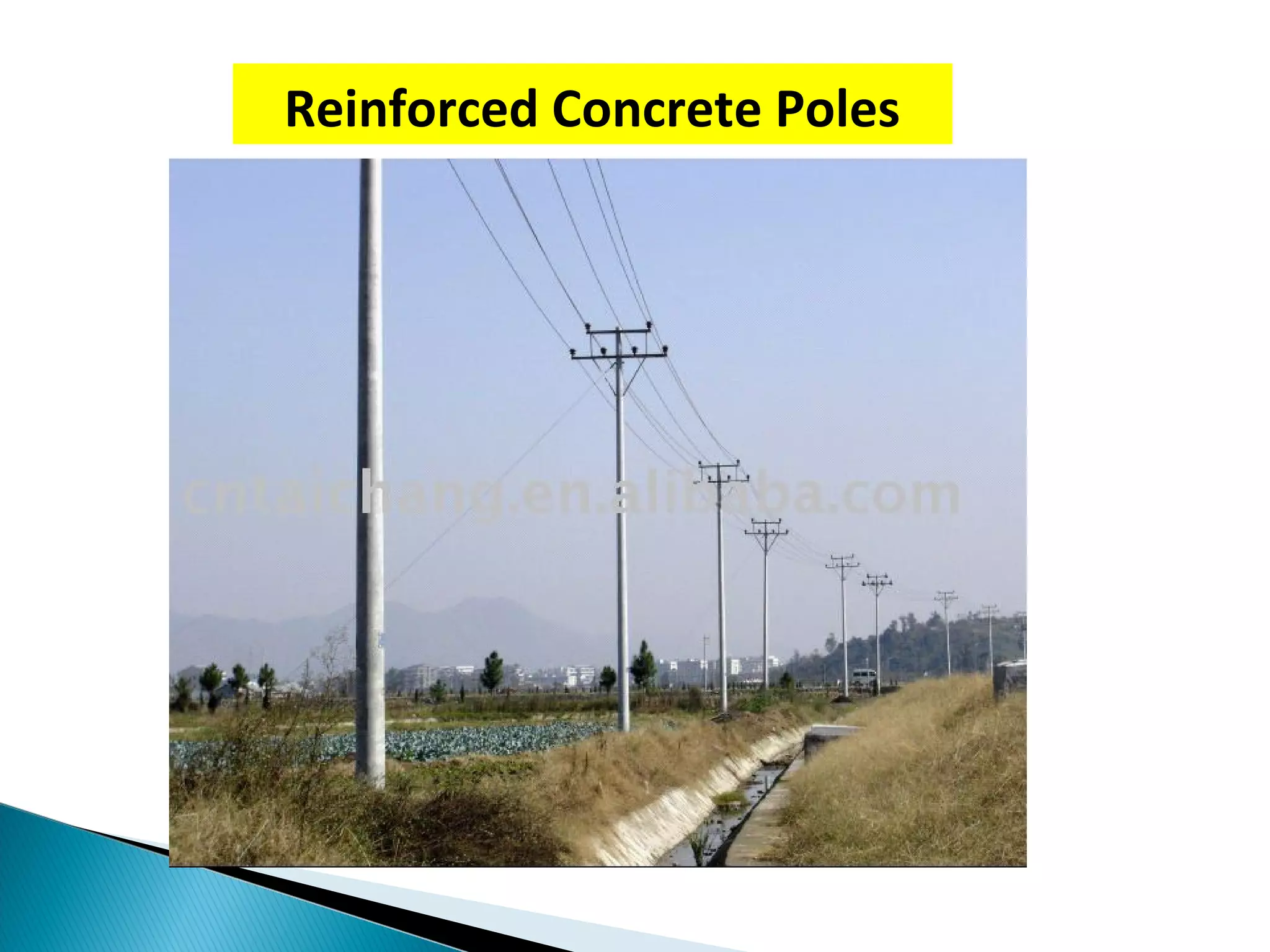
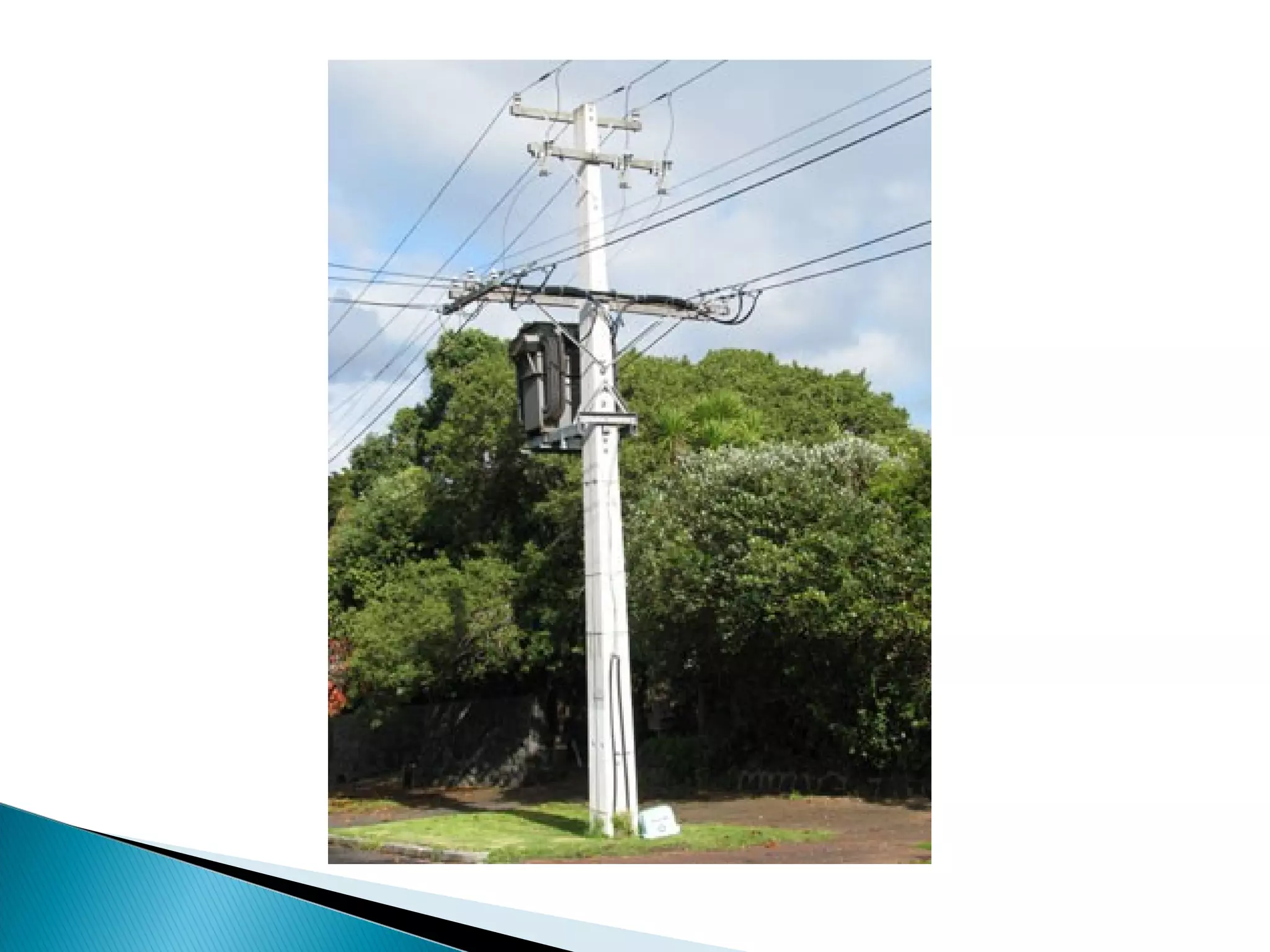
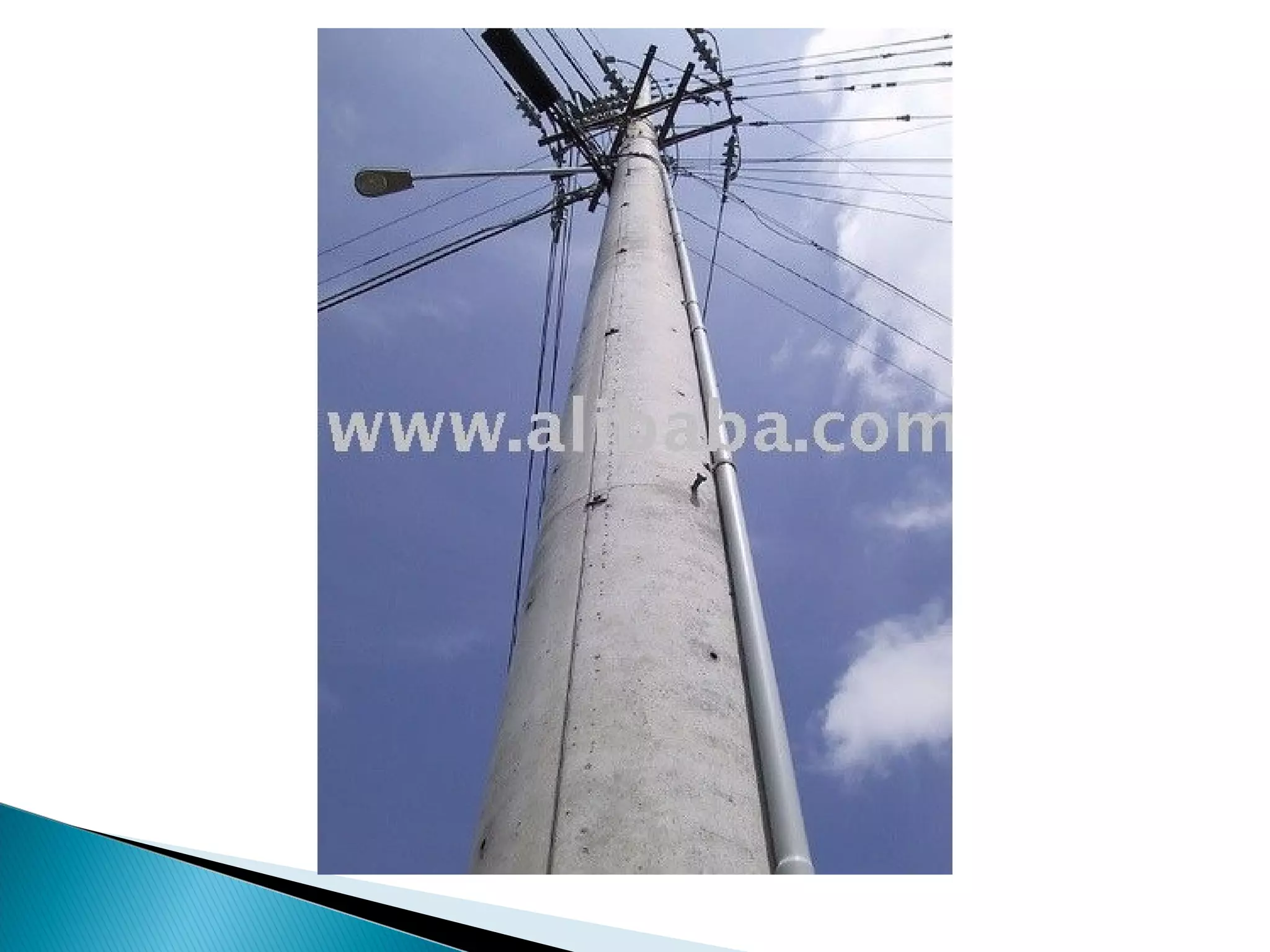
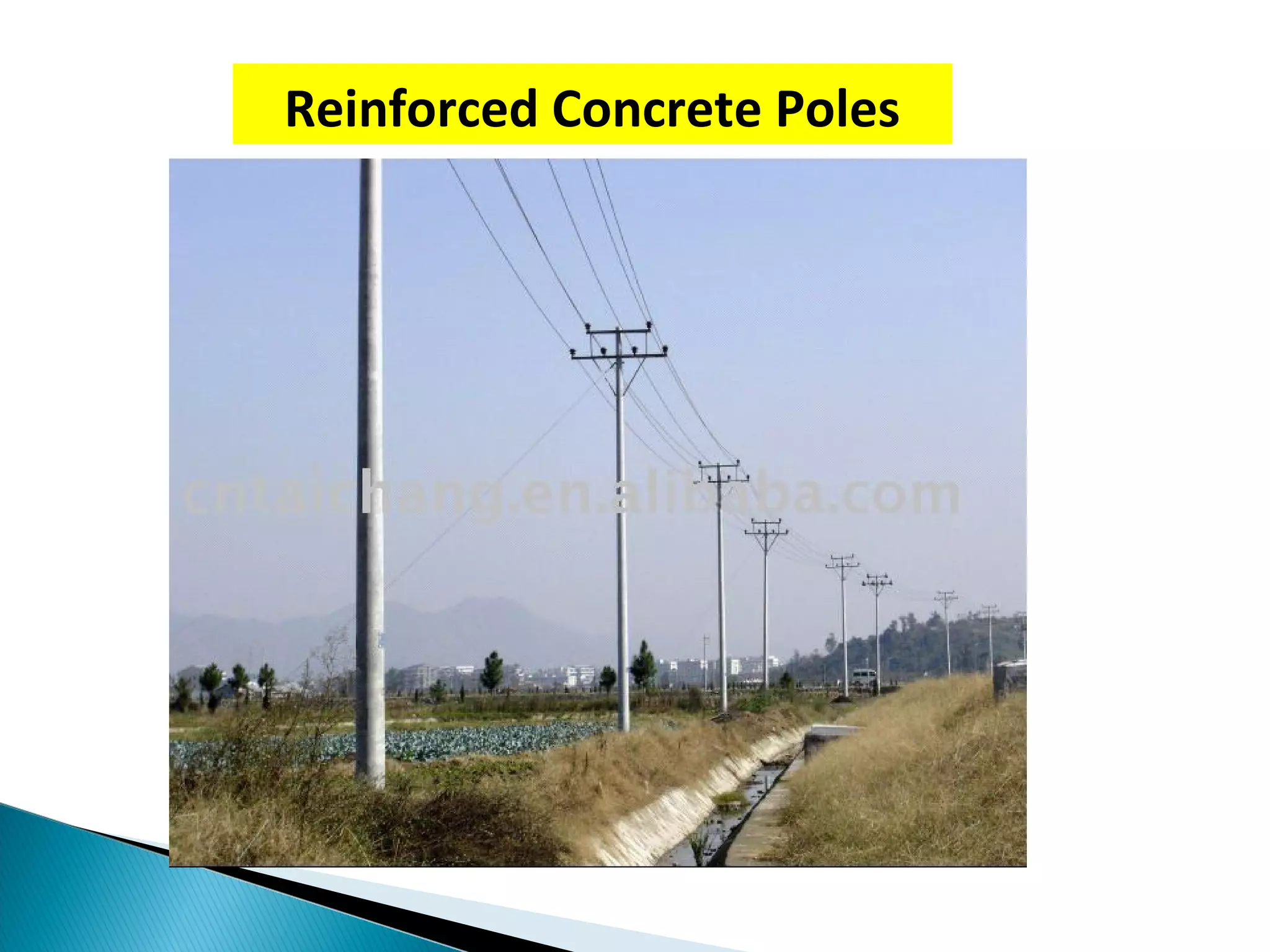
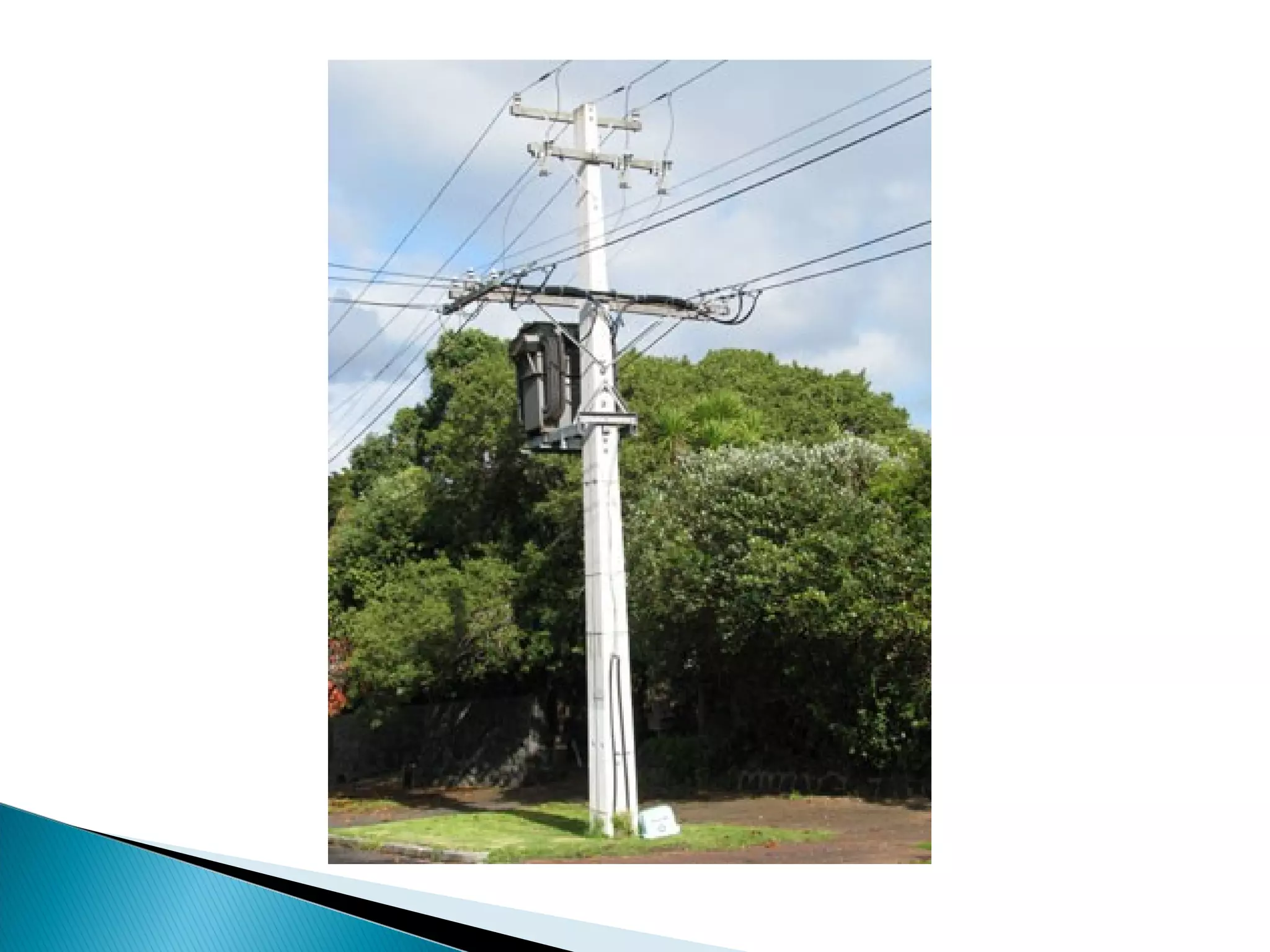
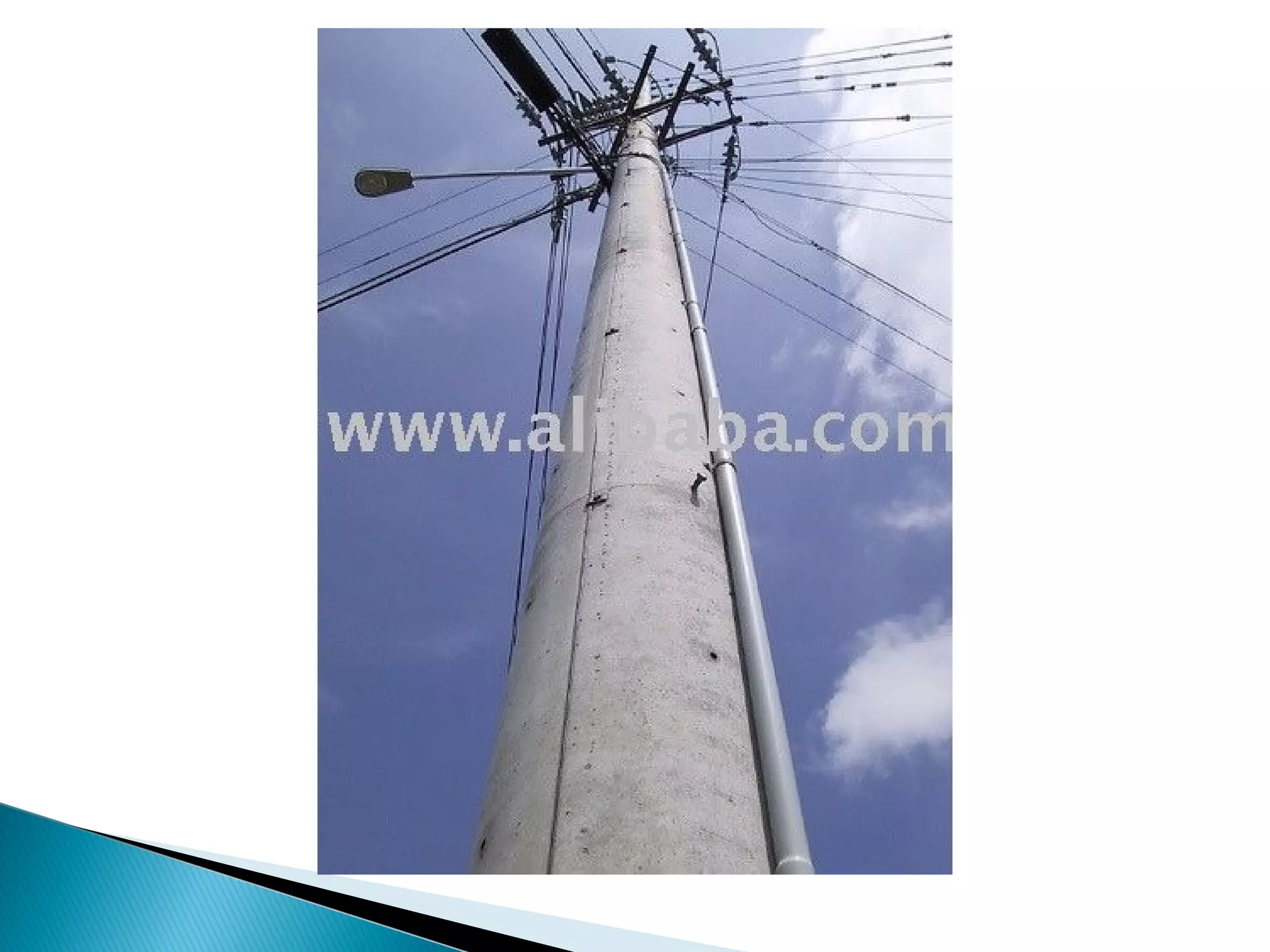
 Reinforced Concrete Poles
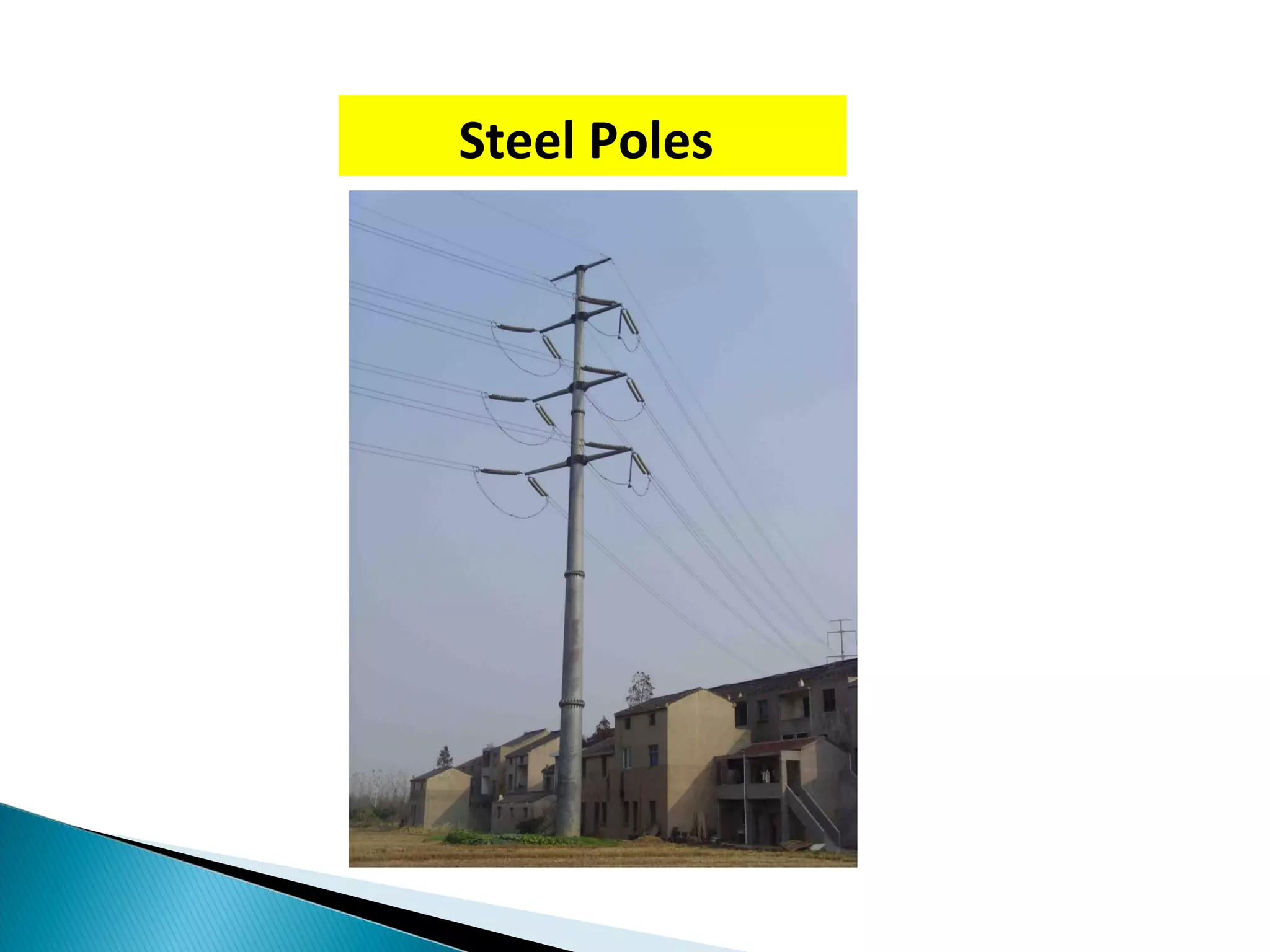
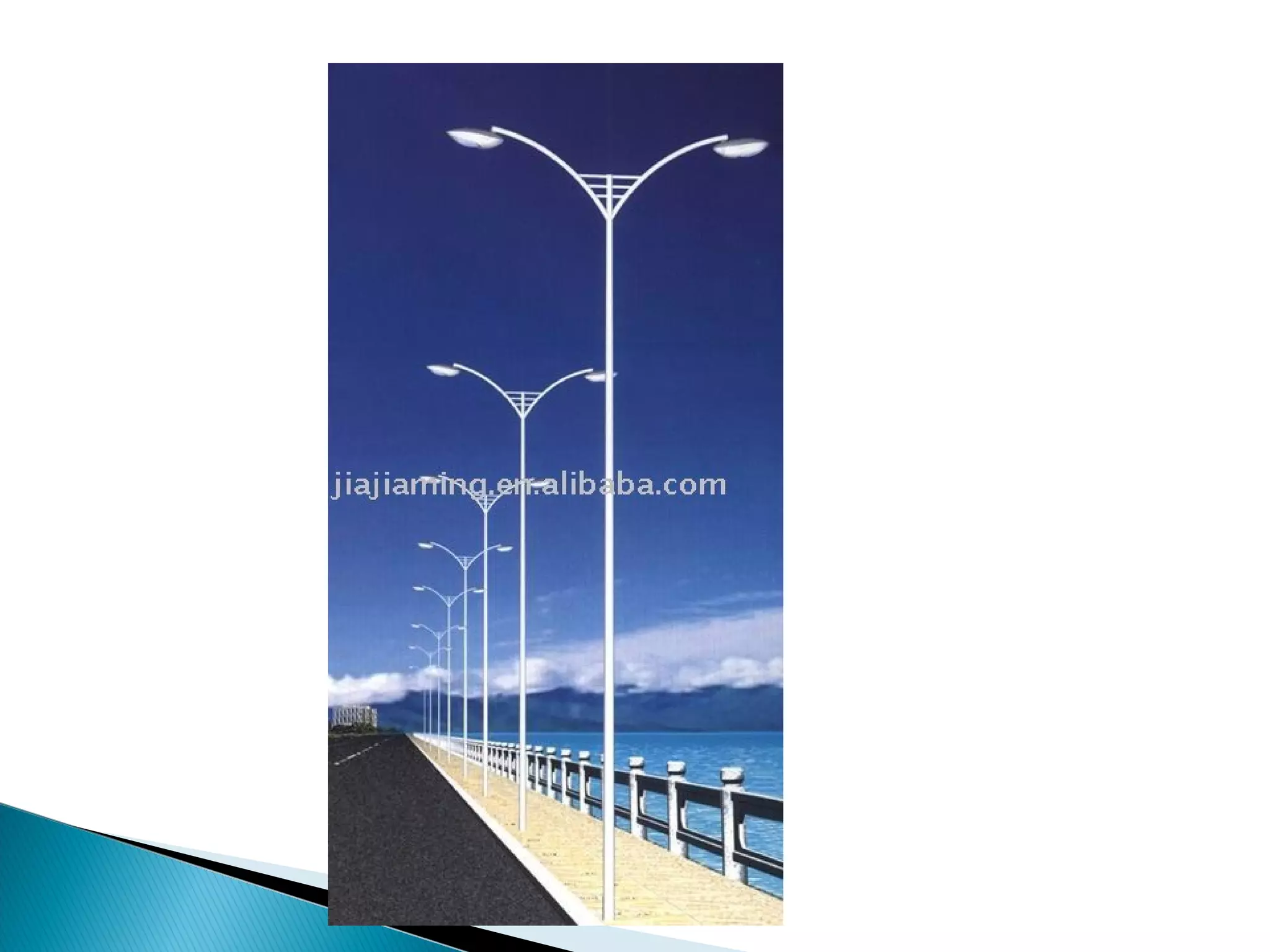
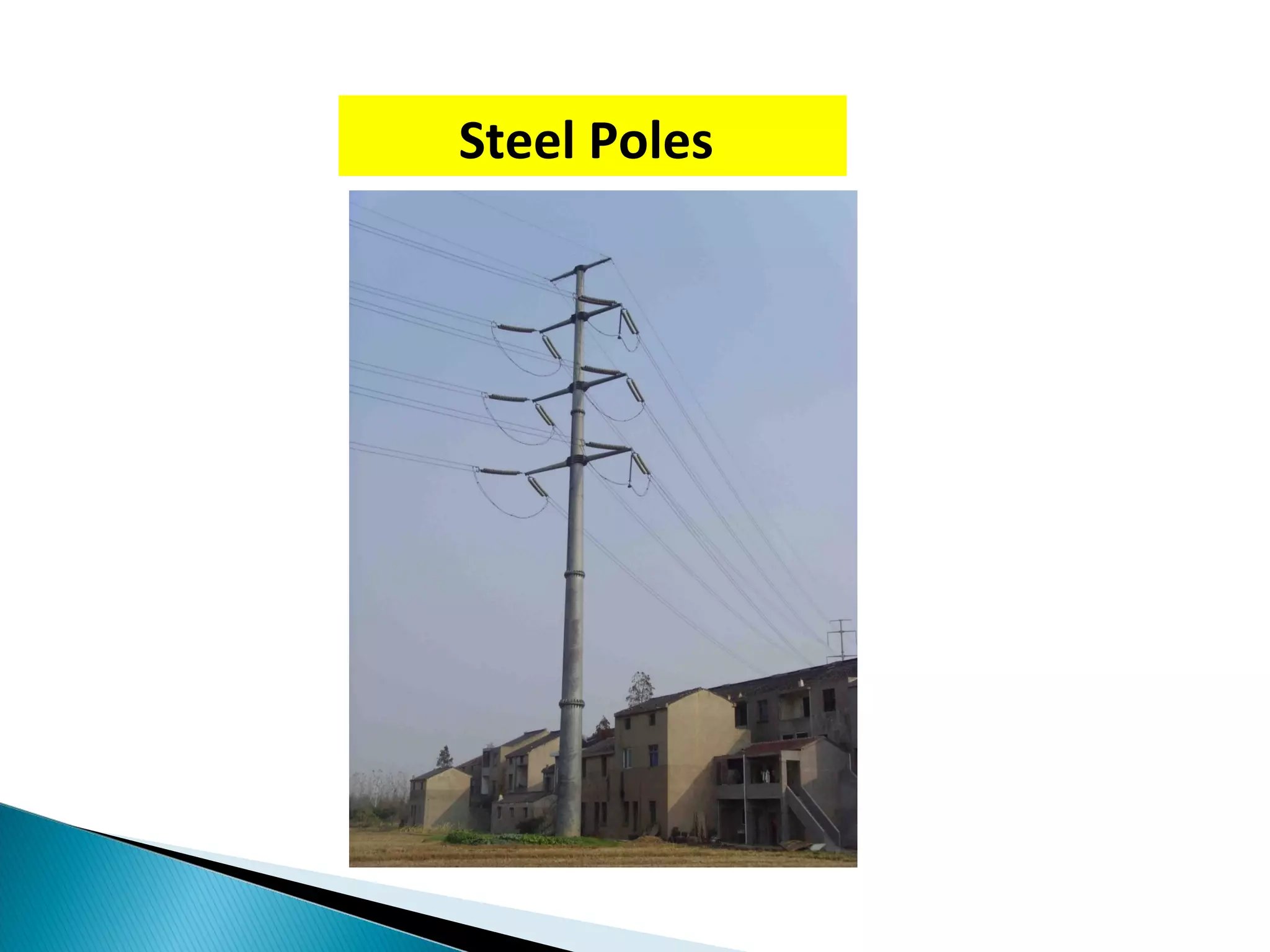
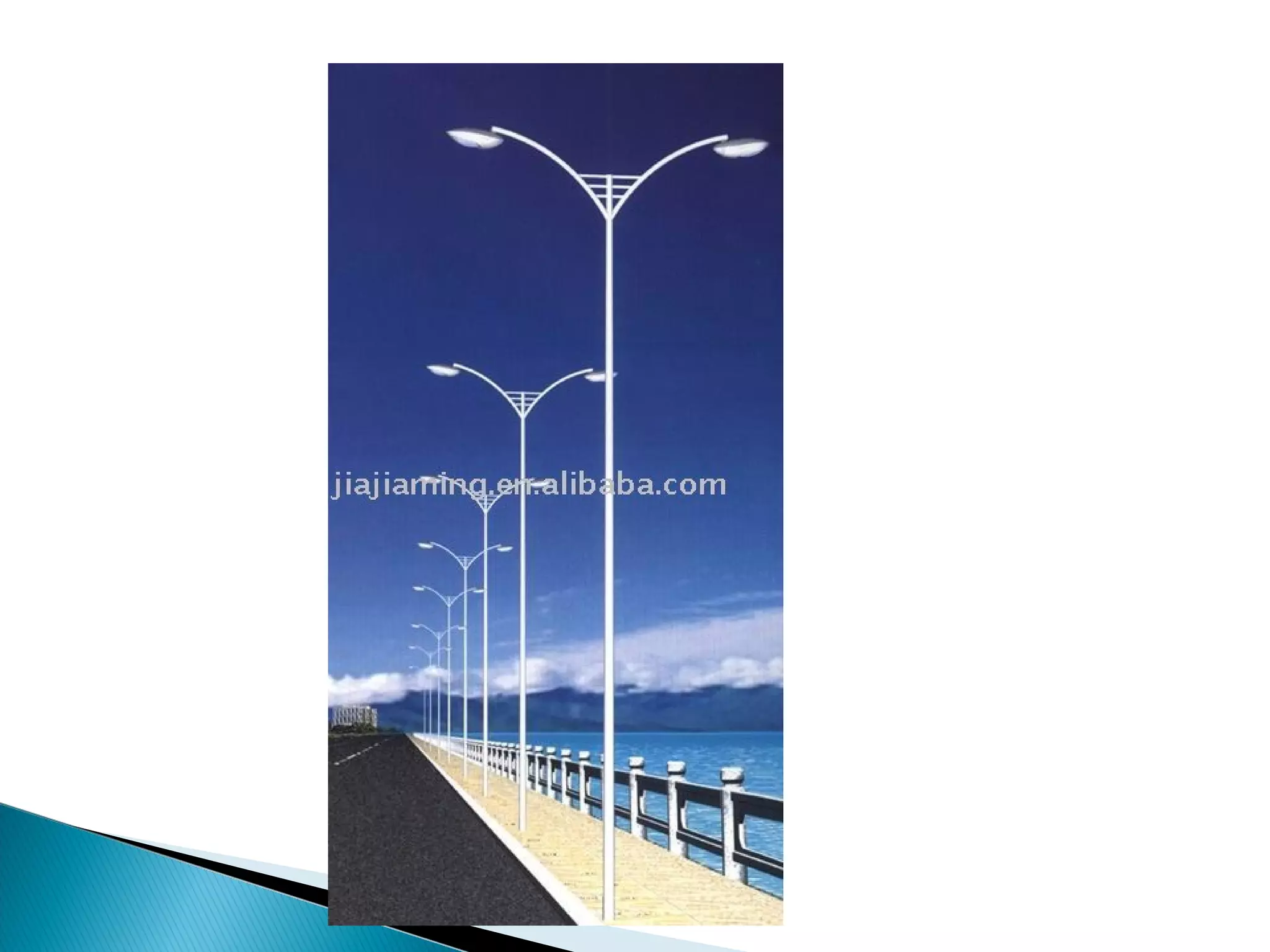
 Steel Poles
 Lattice Structure Steel Towers
Wooden Poles
Reinforced Concrete Poles
Steel Poles
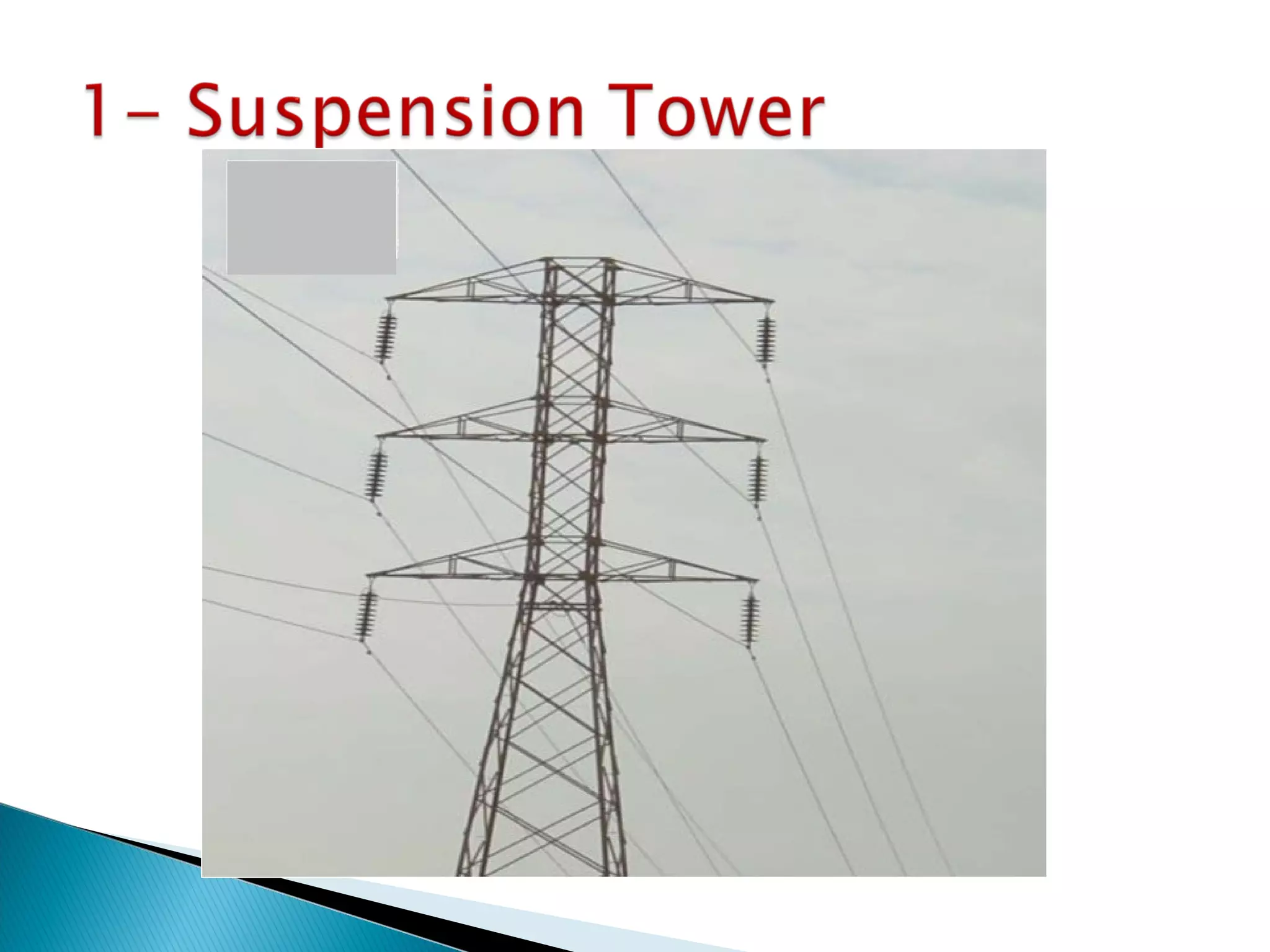
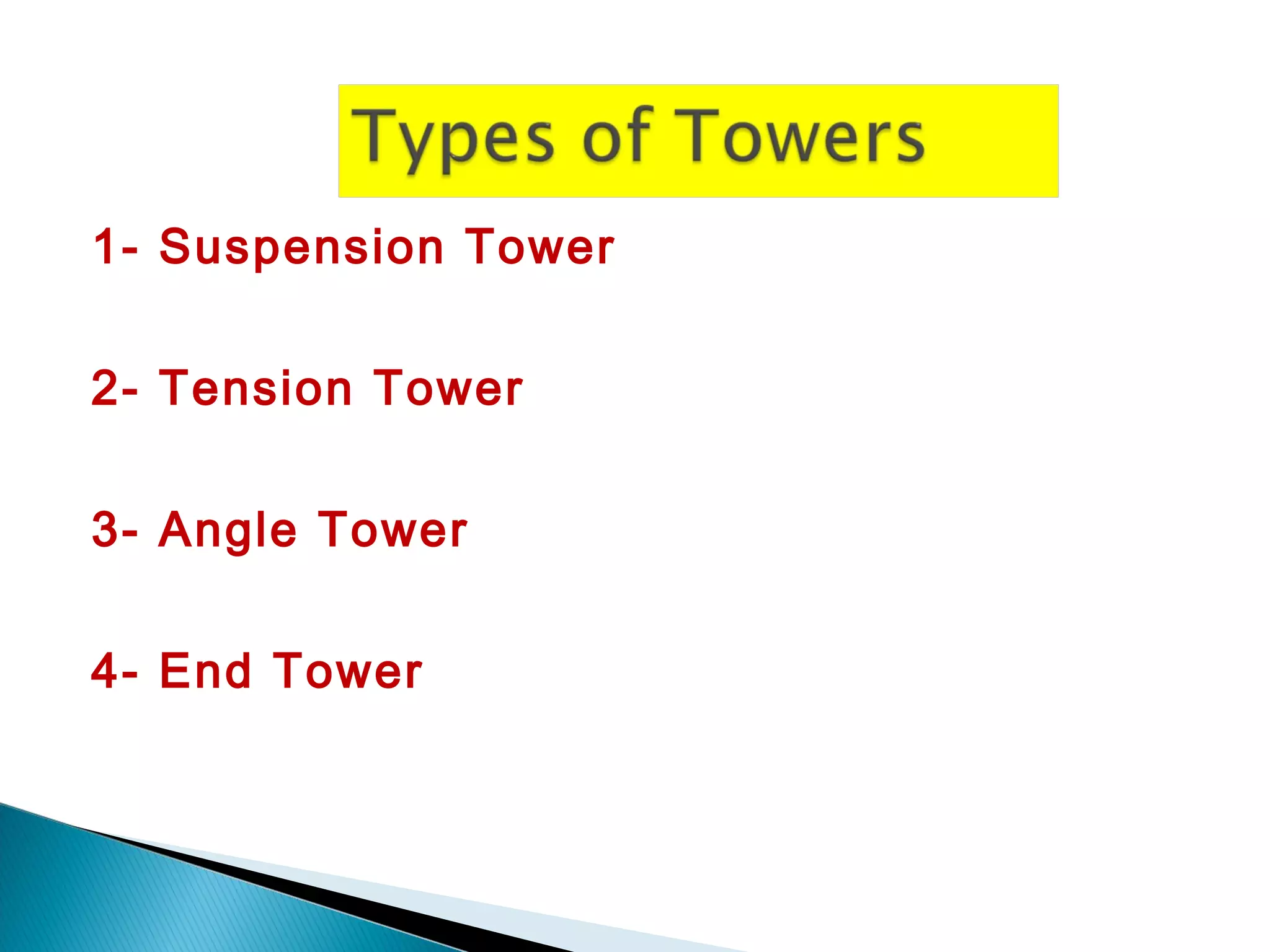
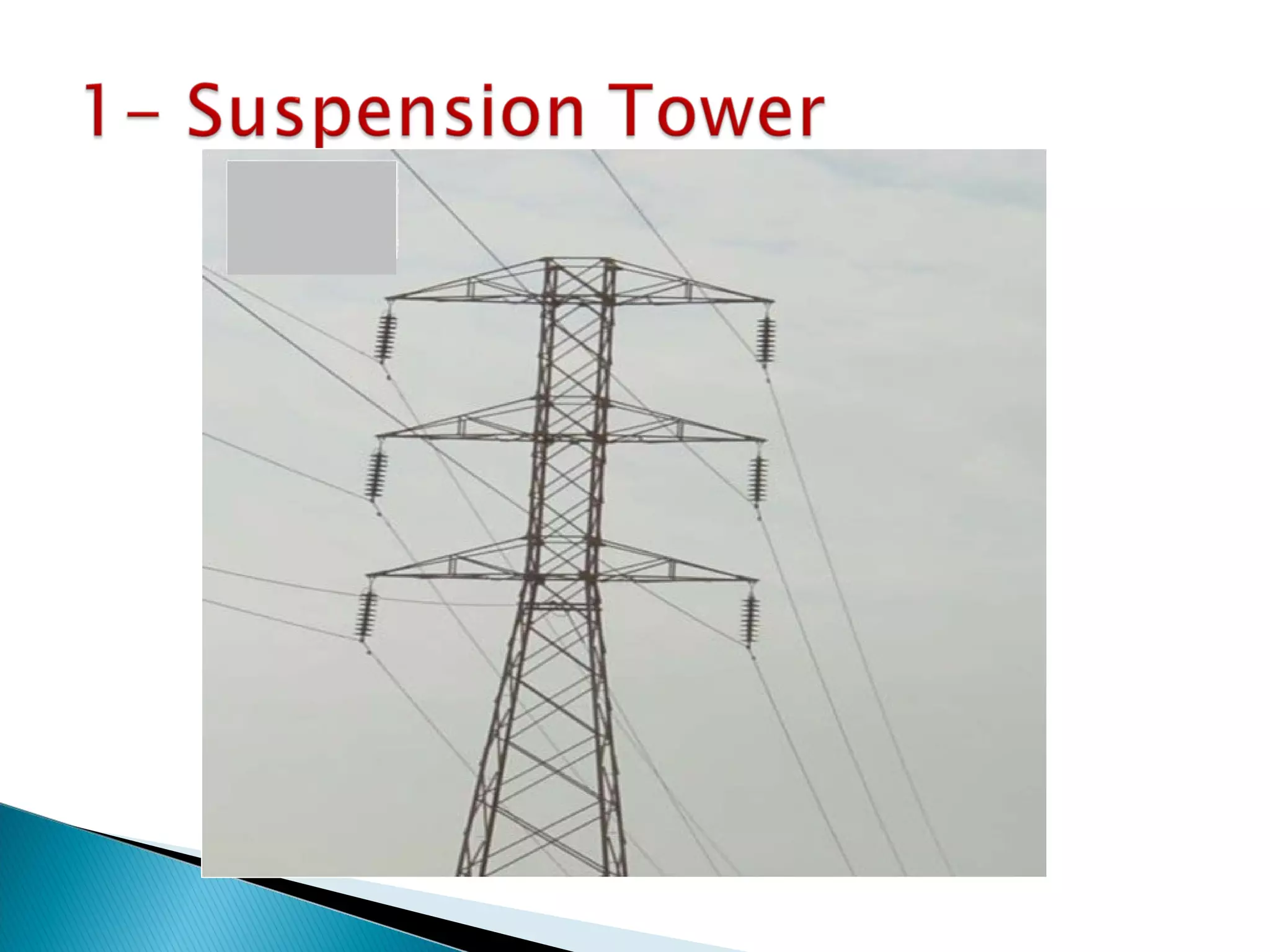
1- Suspension Tower
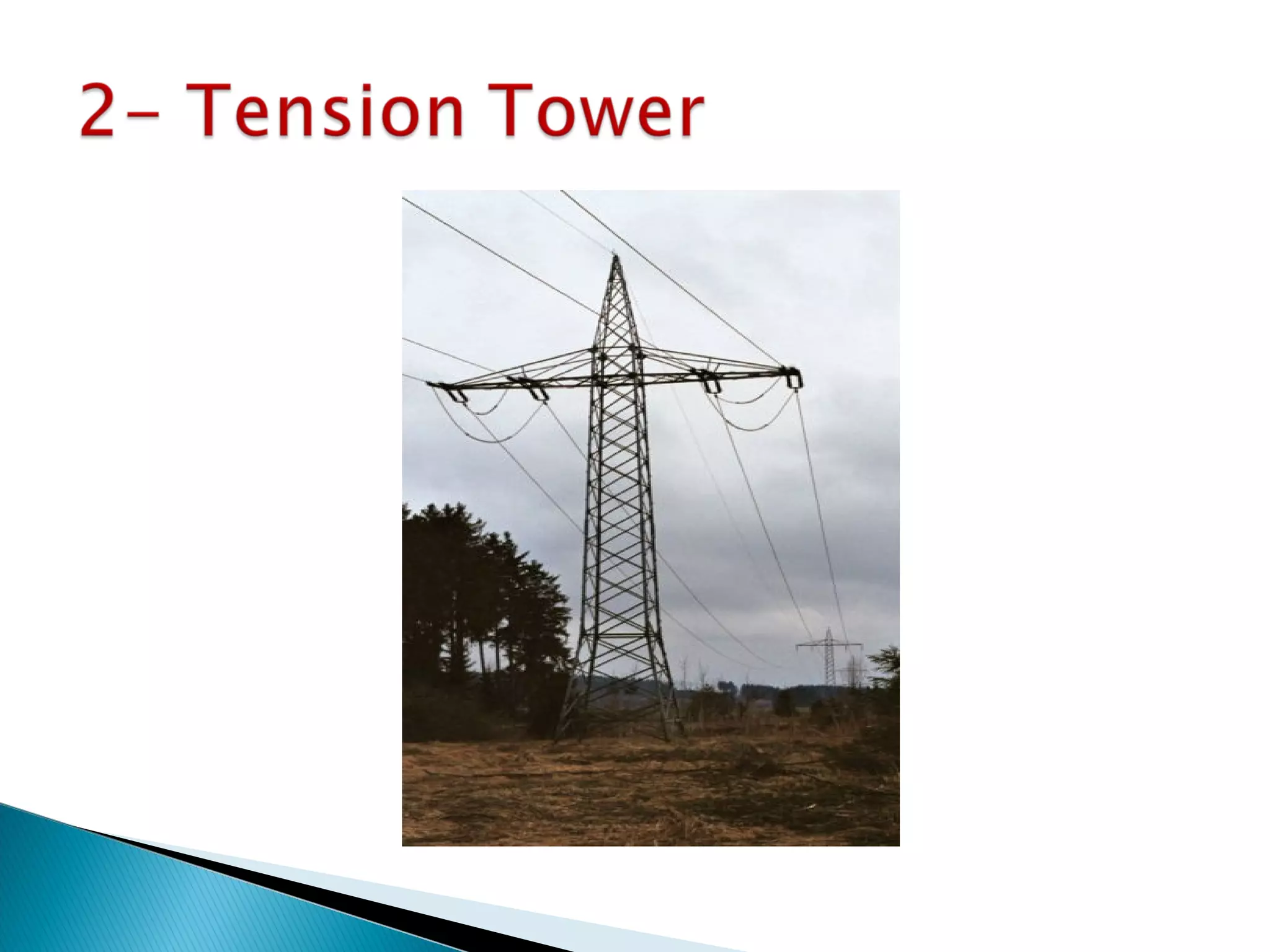
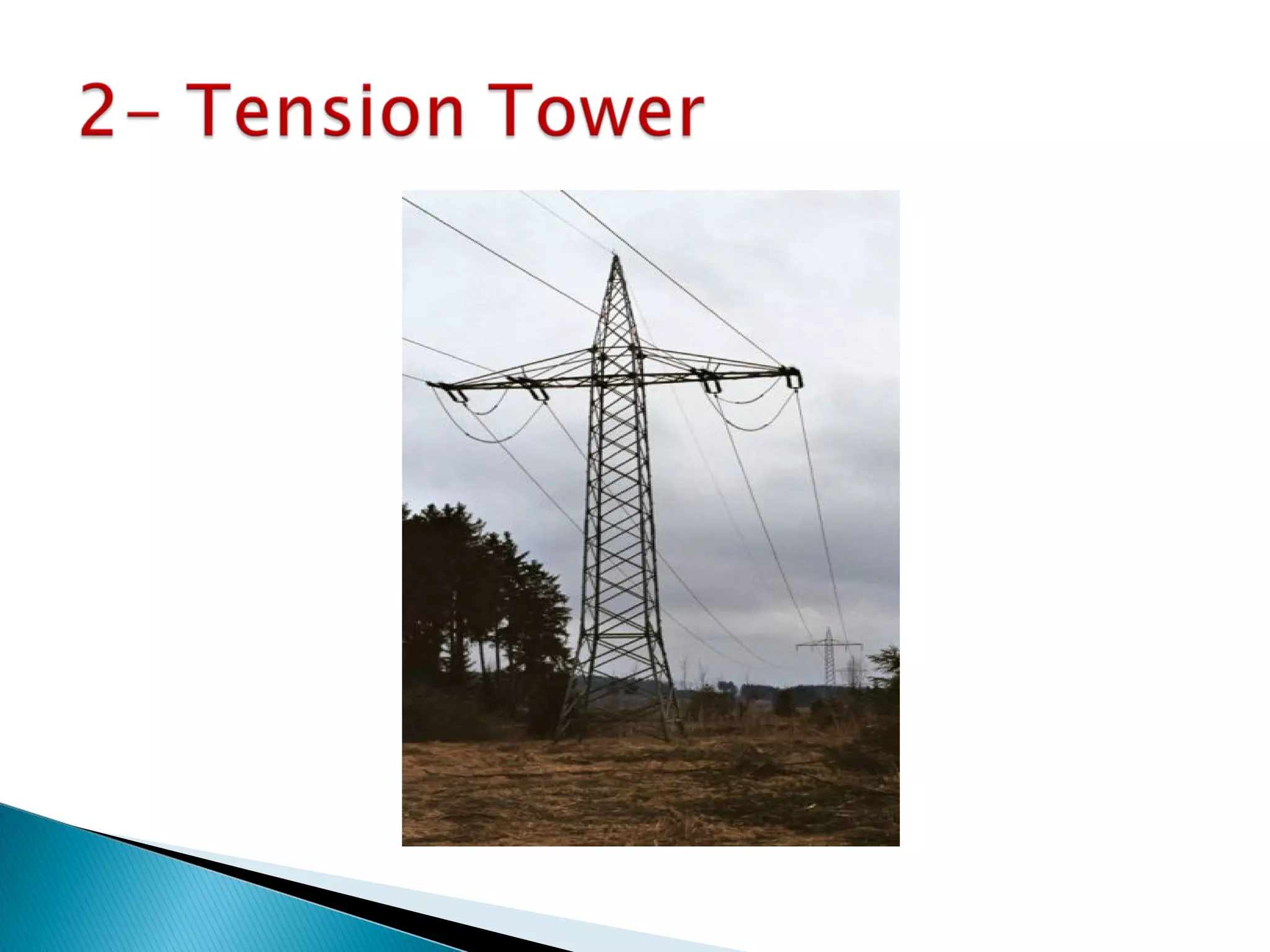
2- Tension Tower
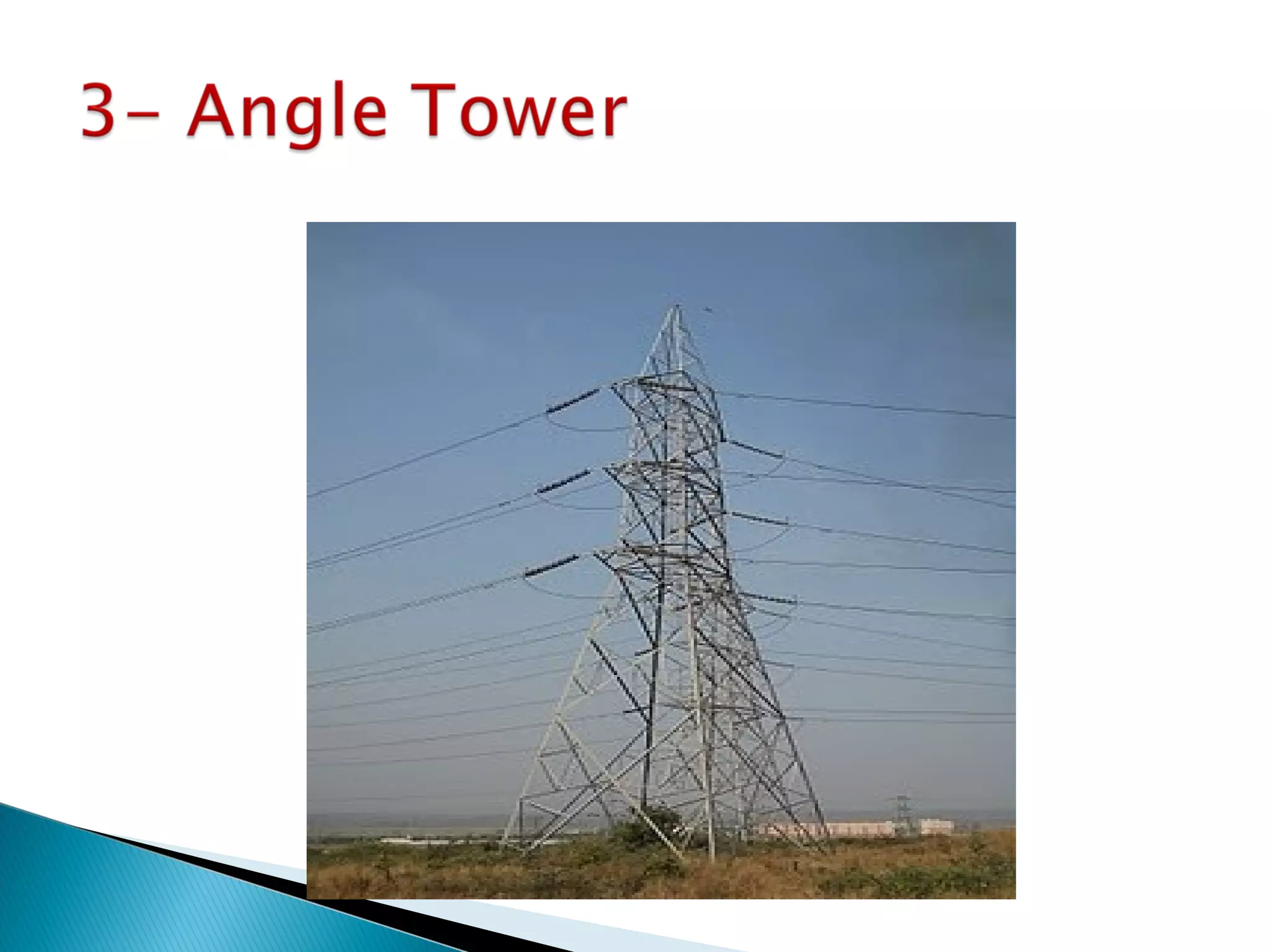
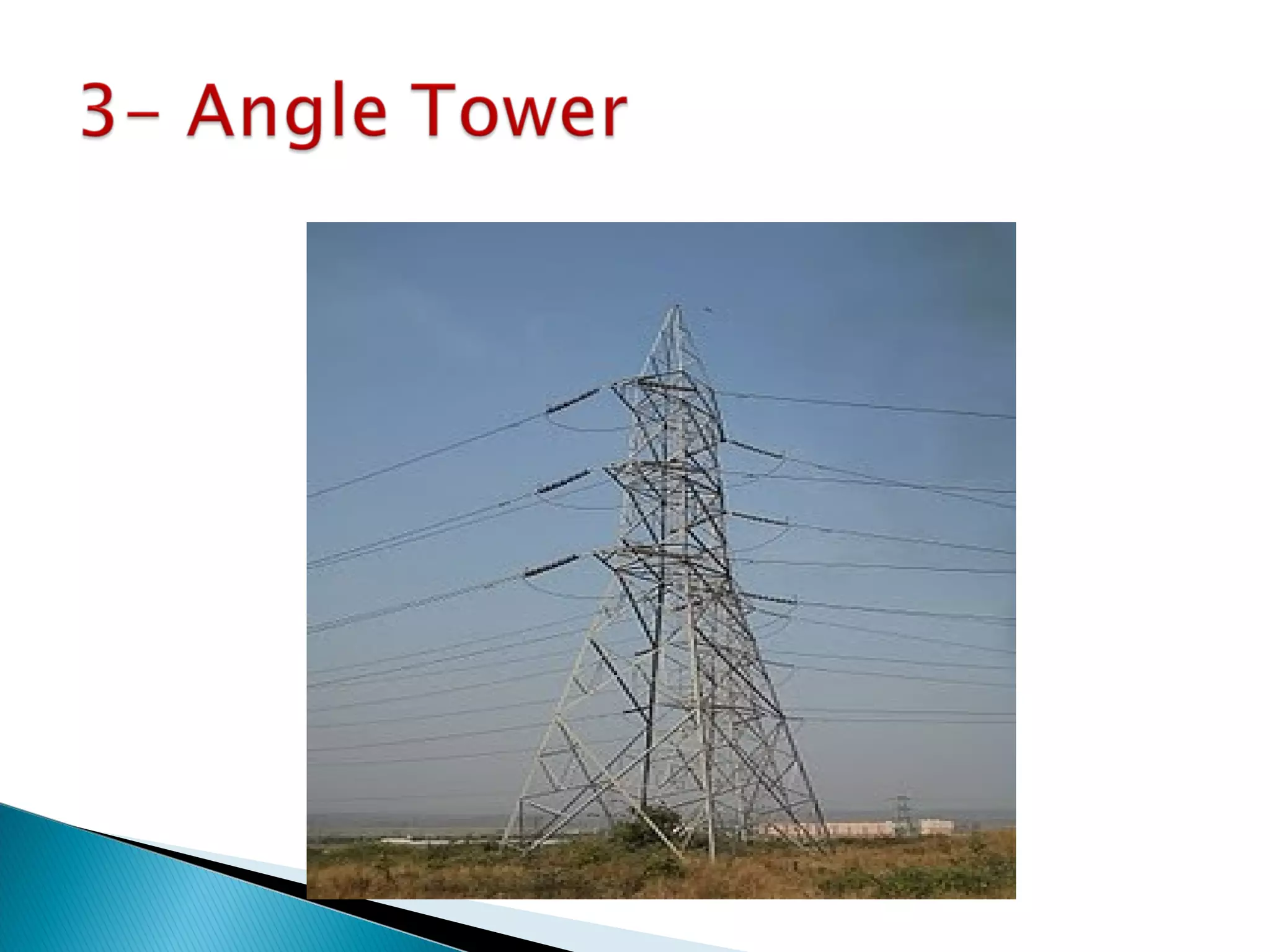
3- Angle Tower
4- End Tower
This type of towers exist in the beginning
and at the end of the line which exposed
to tension in one side.
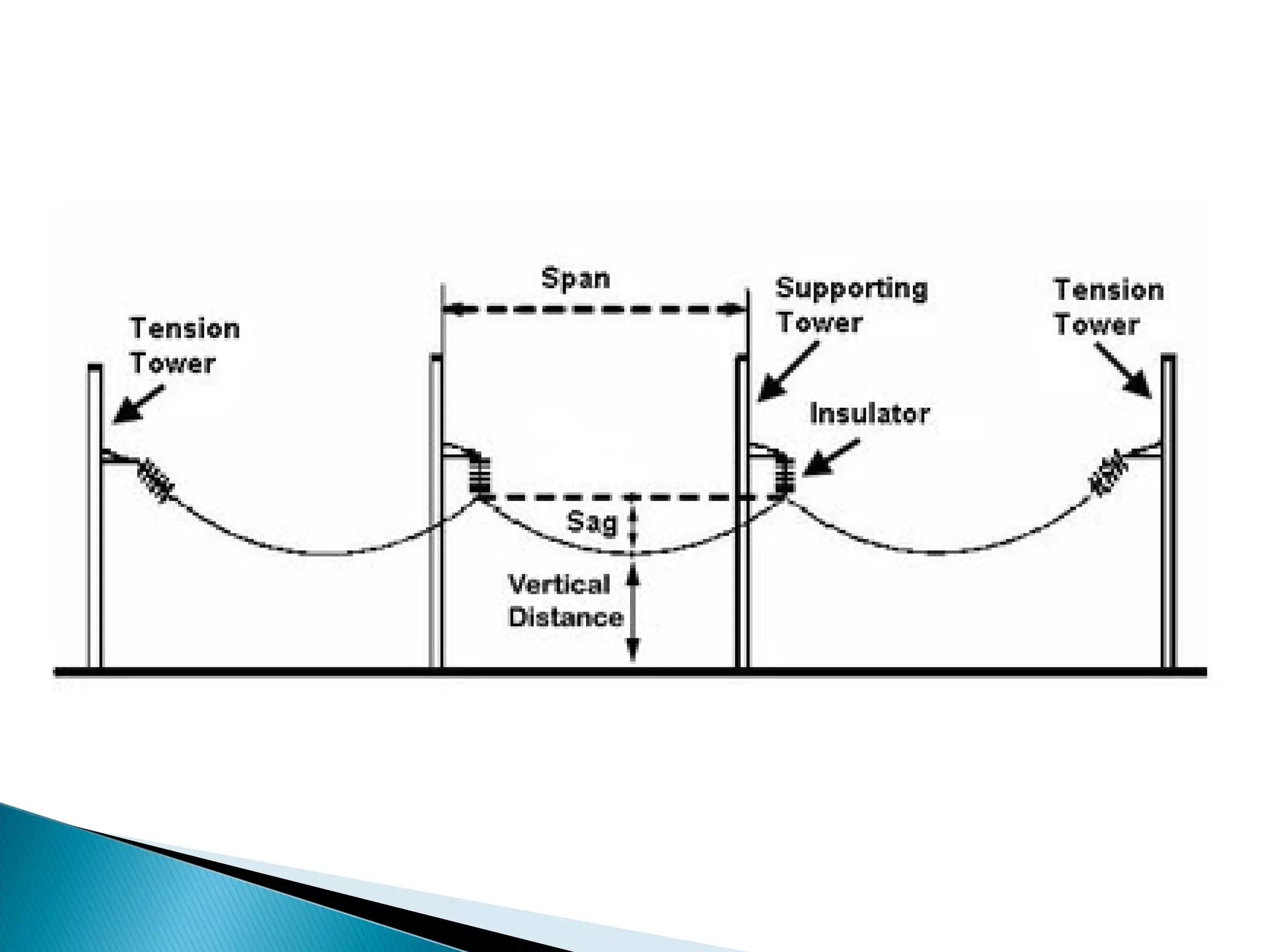
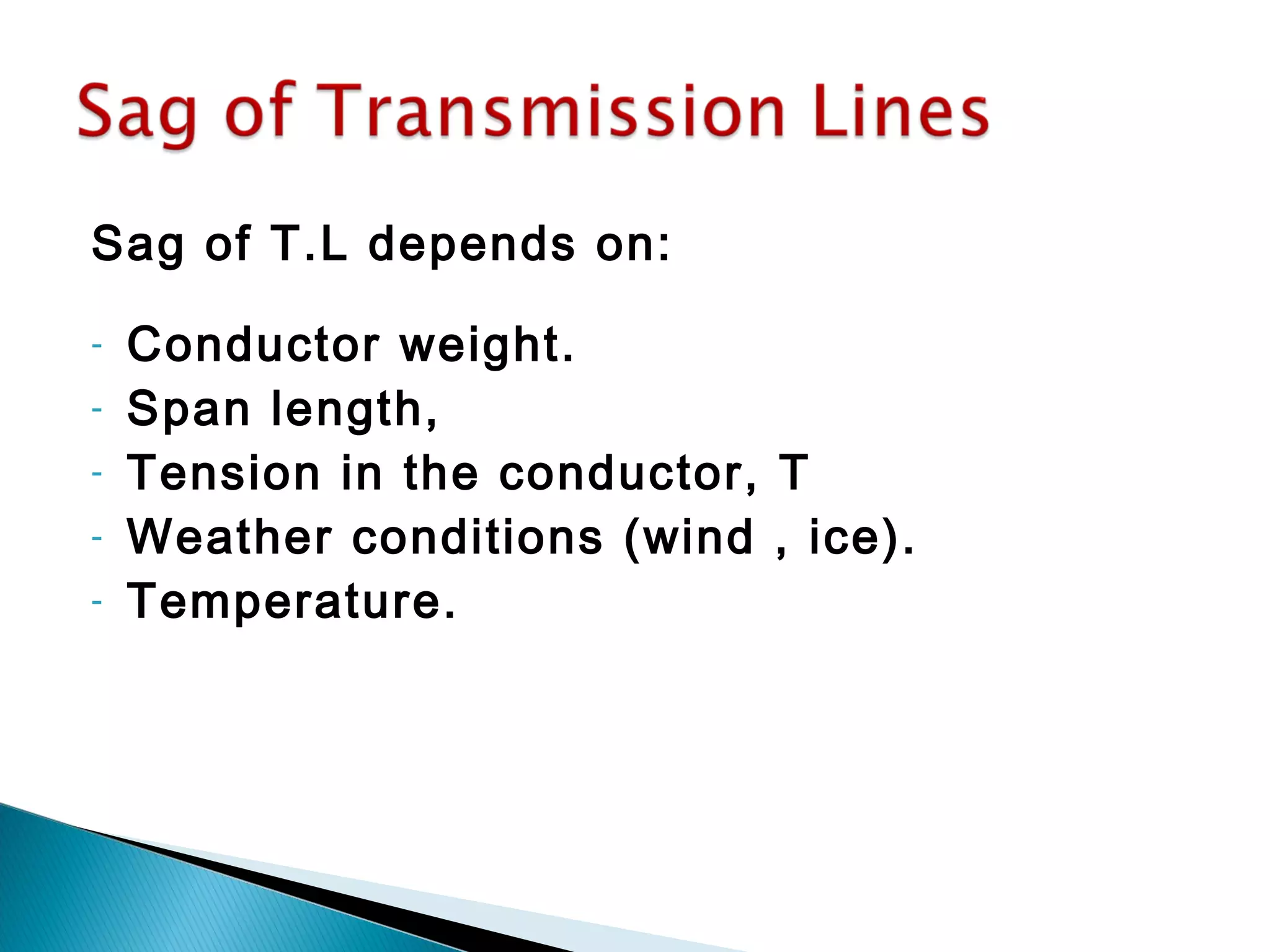
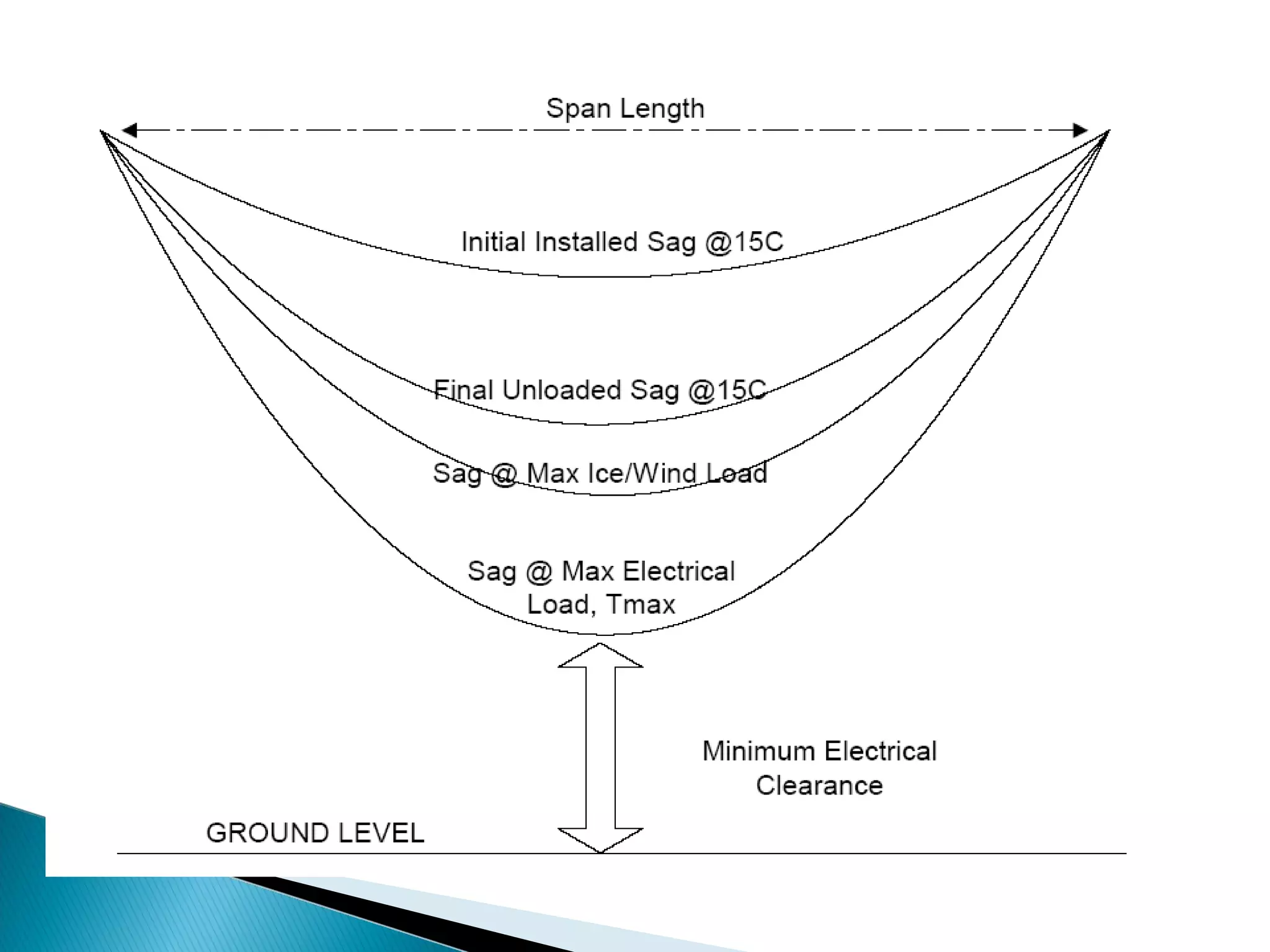
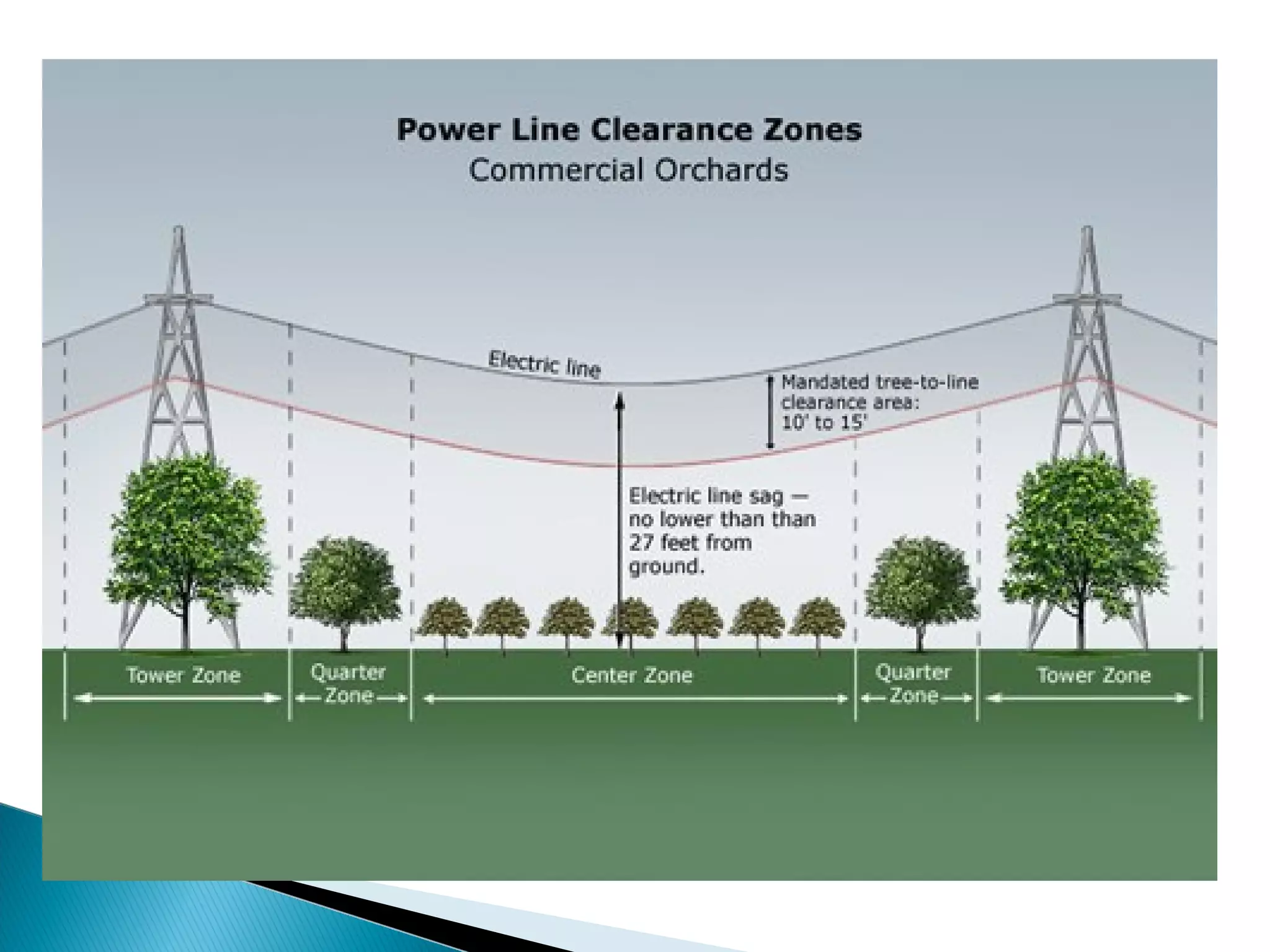
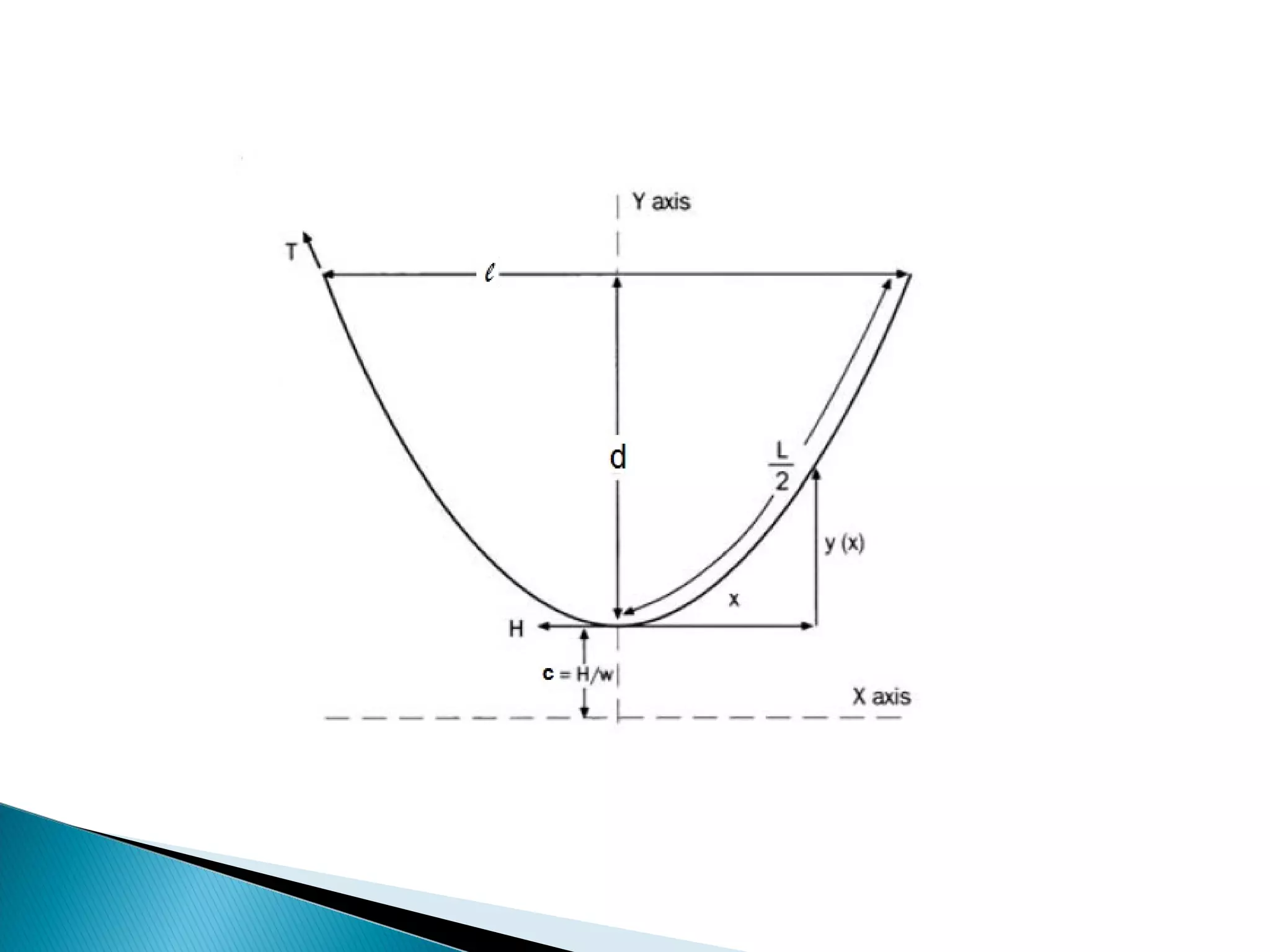
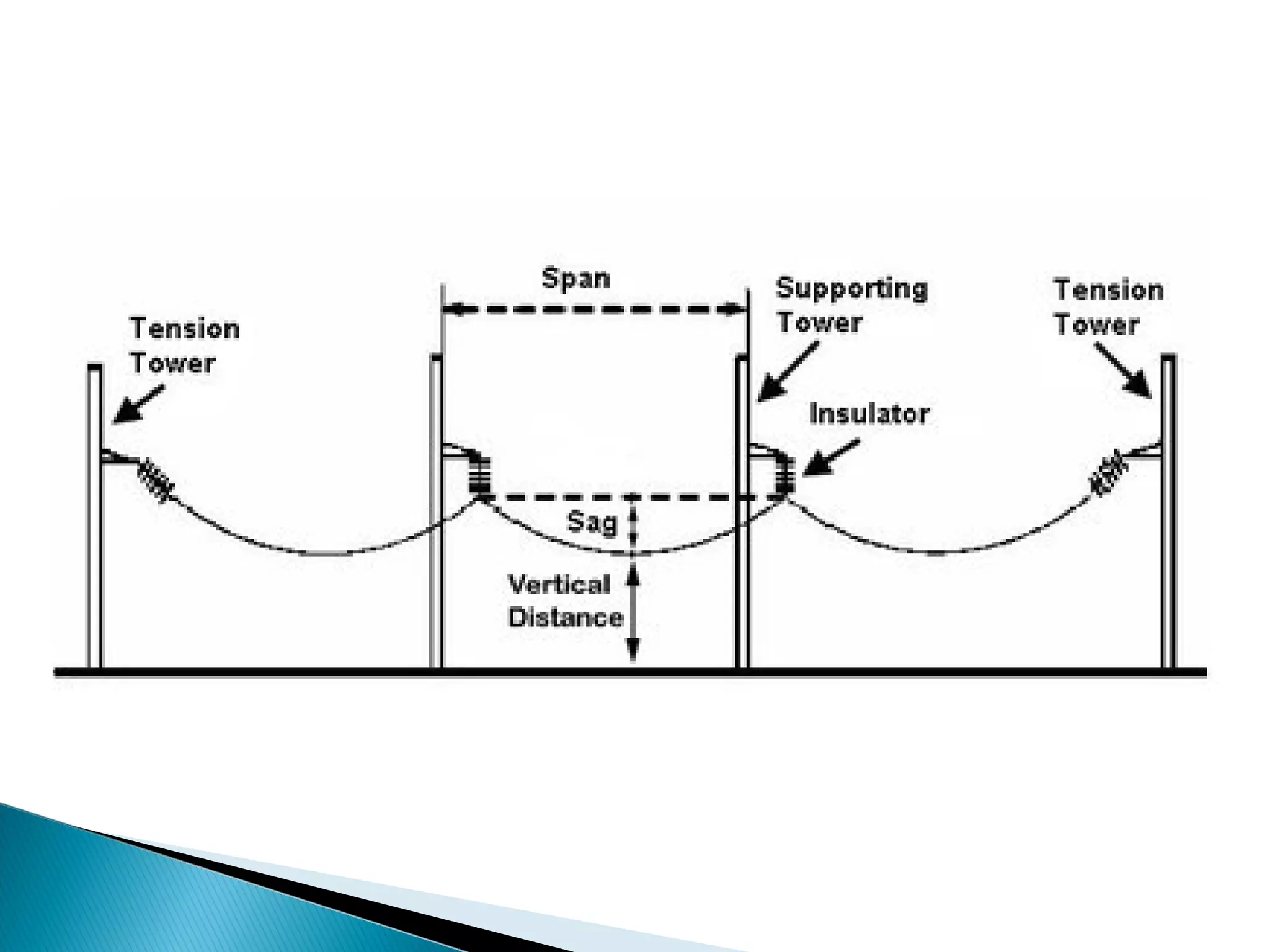
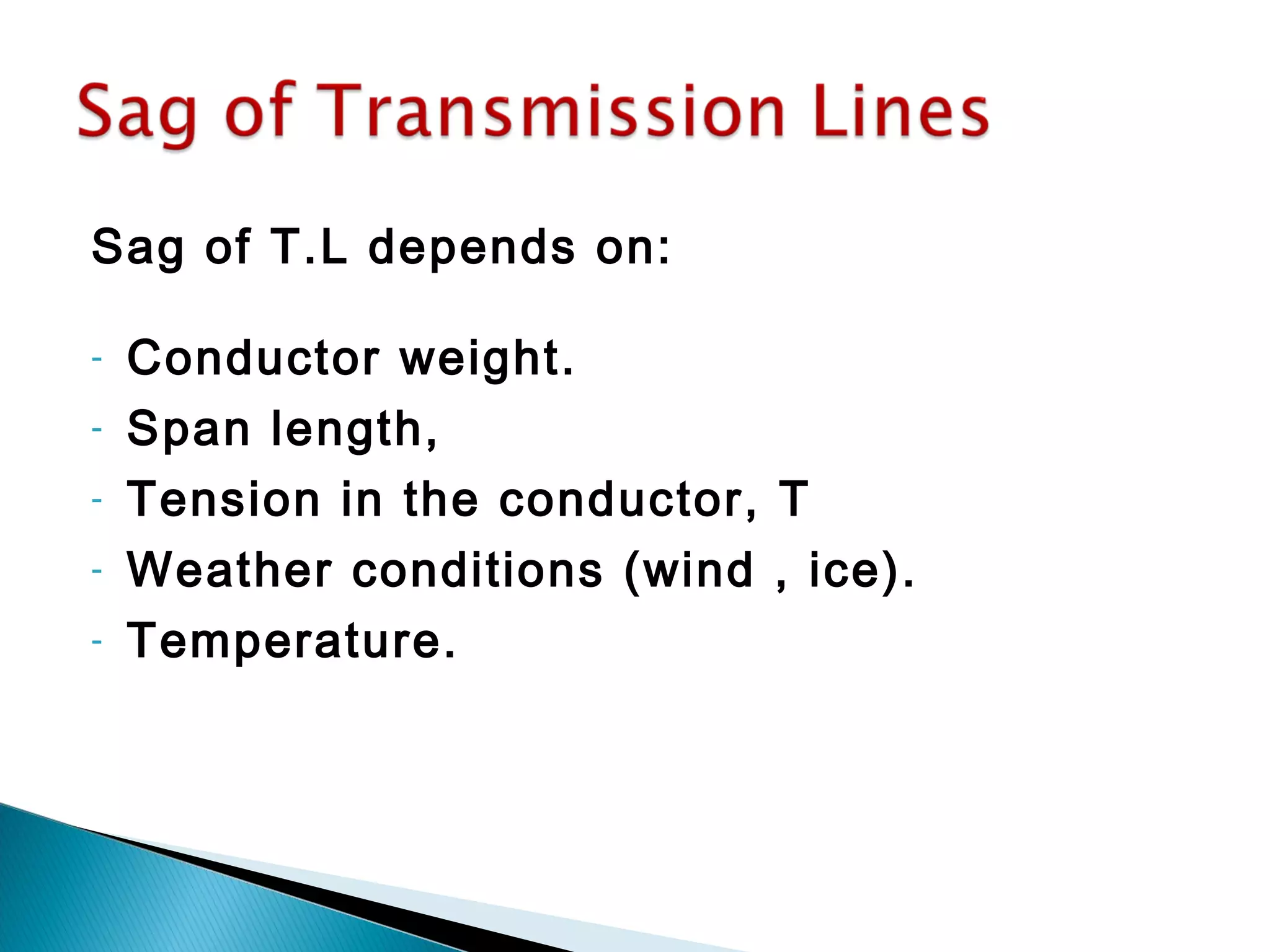
Sag of T.L depends on:
- Conductor weight.
- Span length,
- Tension in the conductor, T
- Weather conditions (wind , ice).
- Temperature.
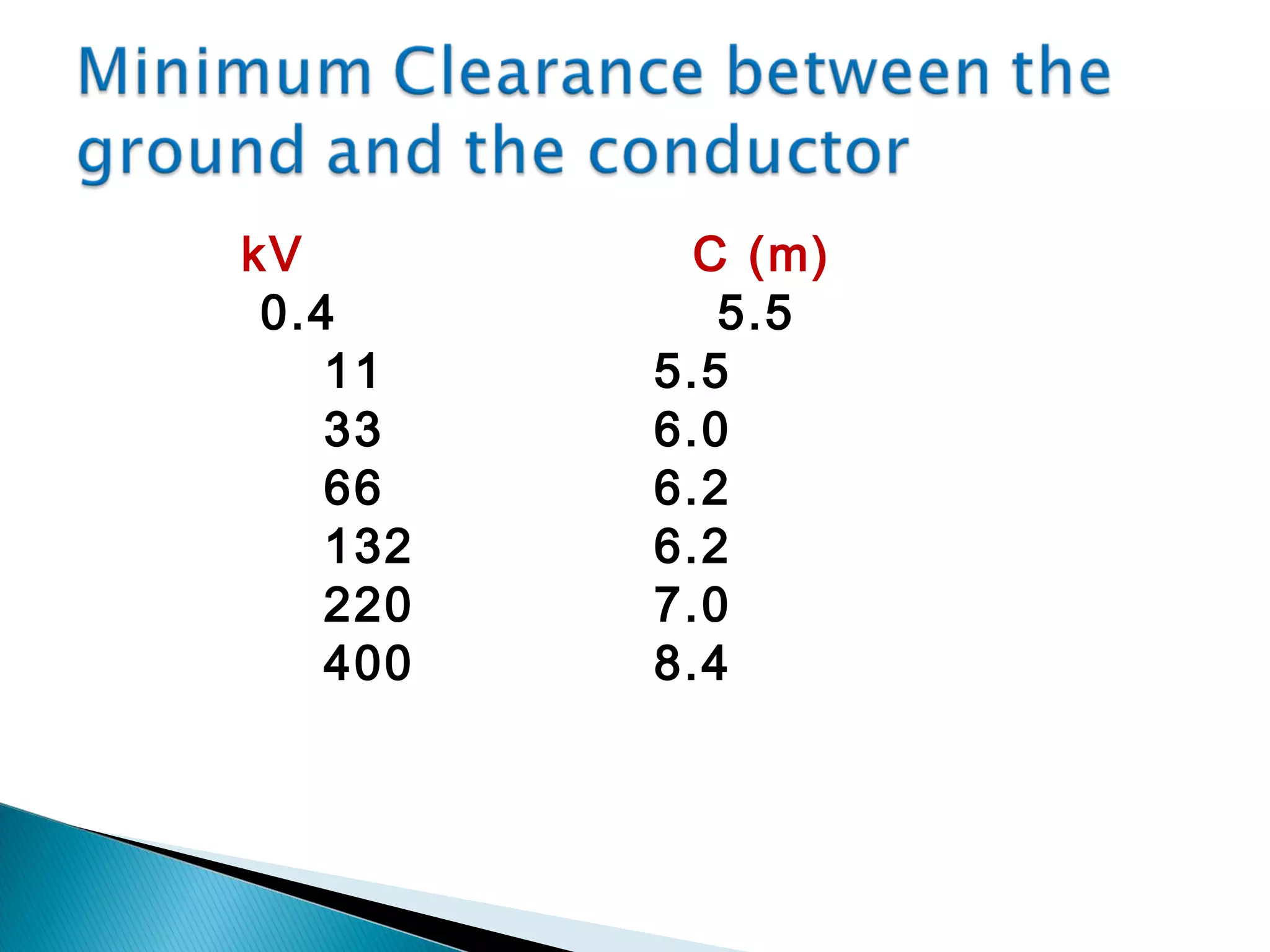
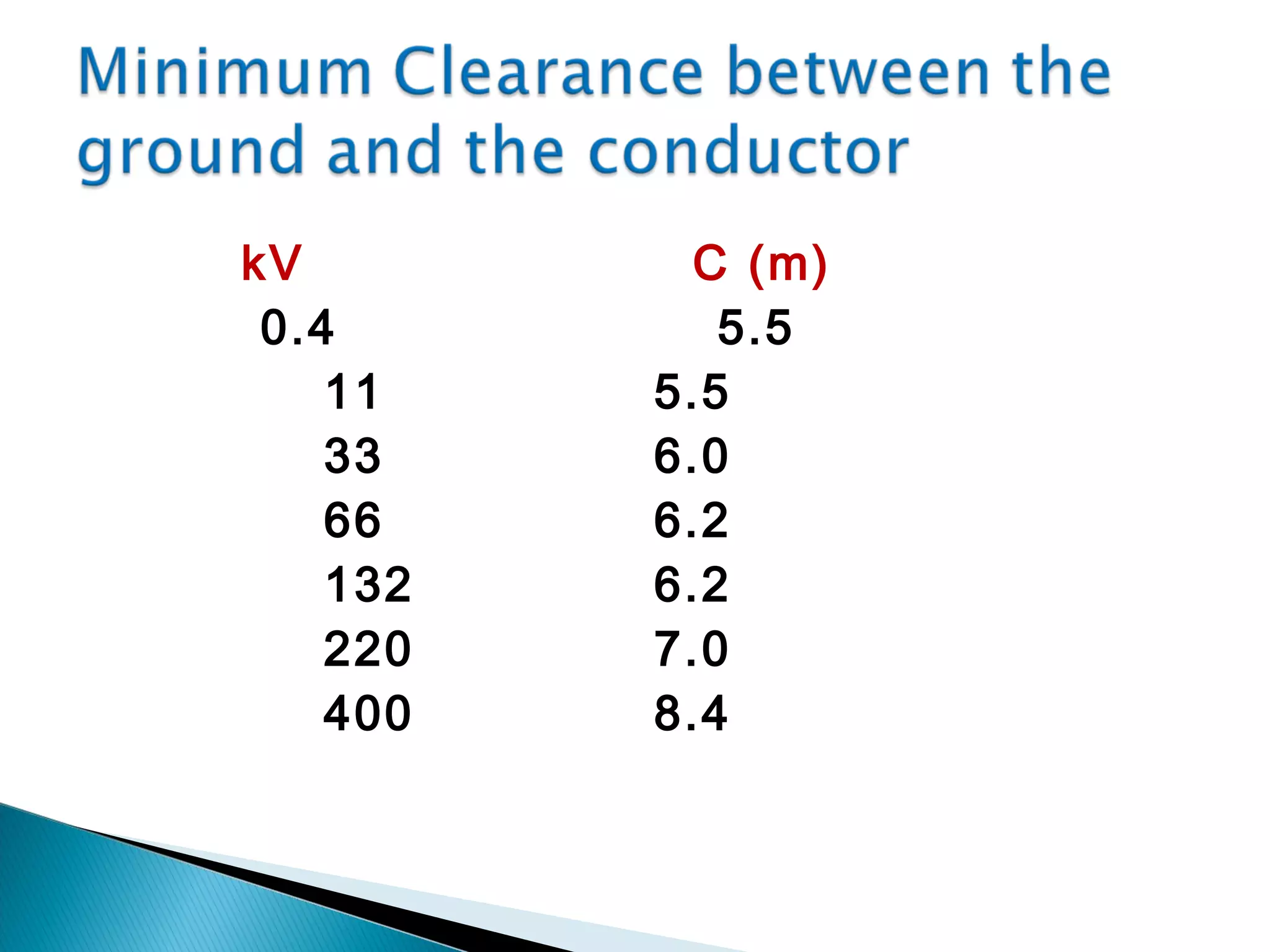
kV C (m)
0.4 5.5
11 5.5
33 6.0
66 6.2
132 6.2
220 7.0
400 8.4
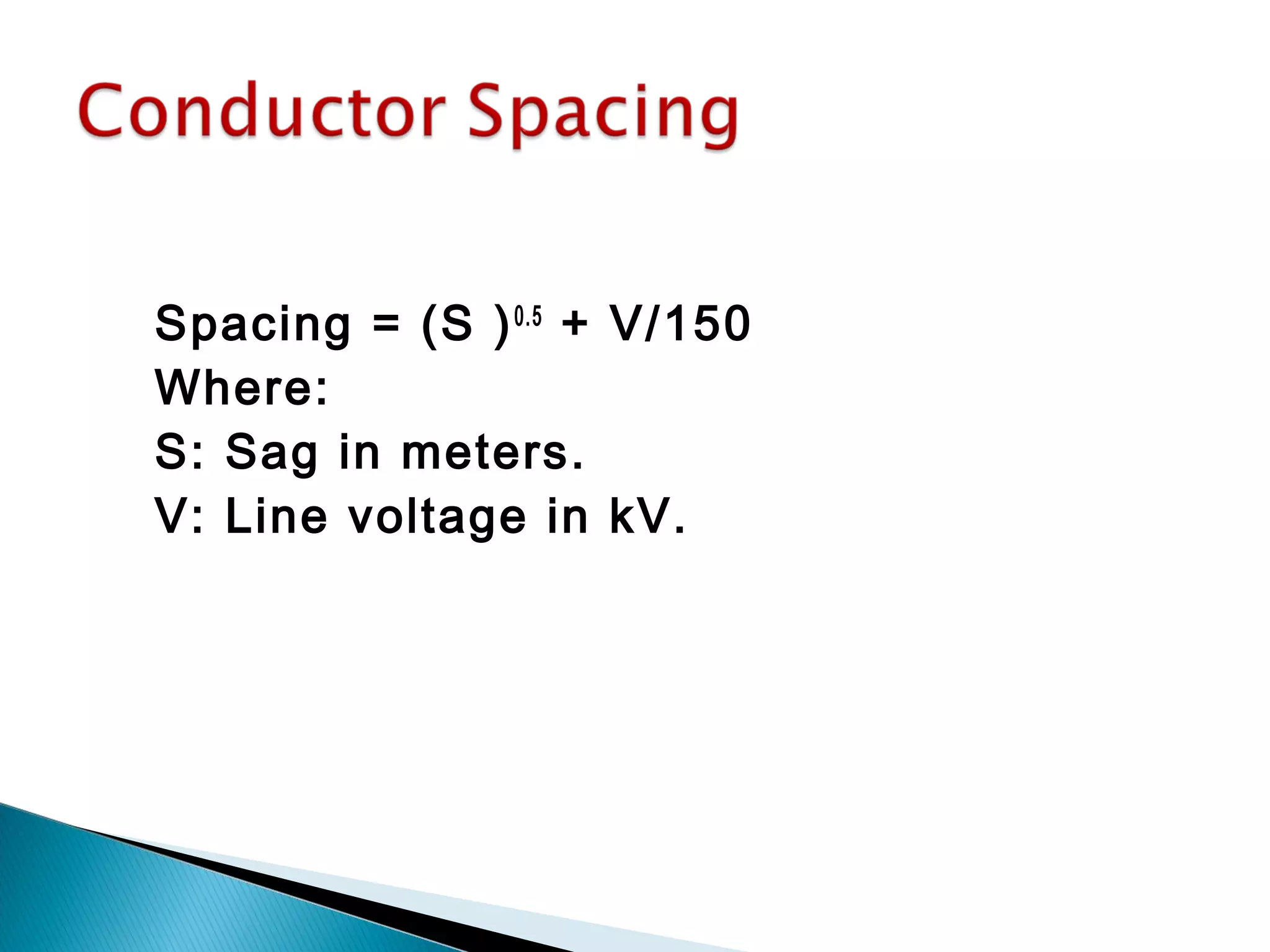
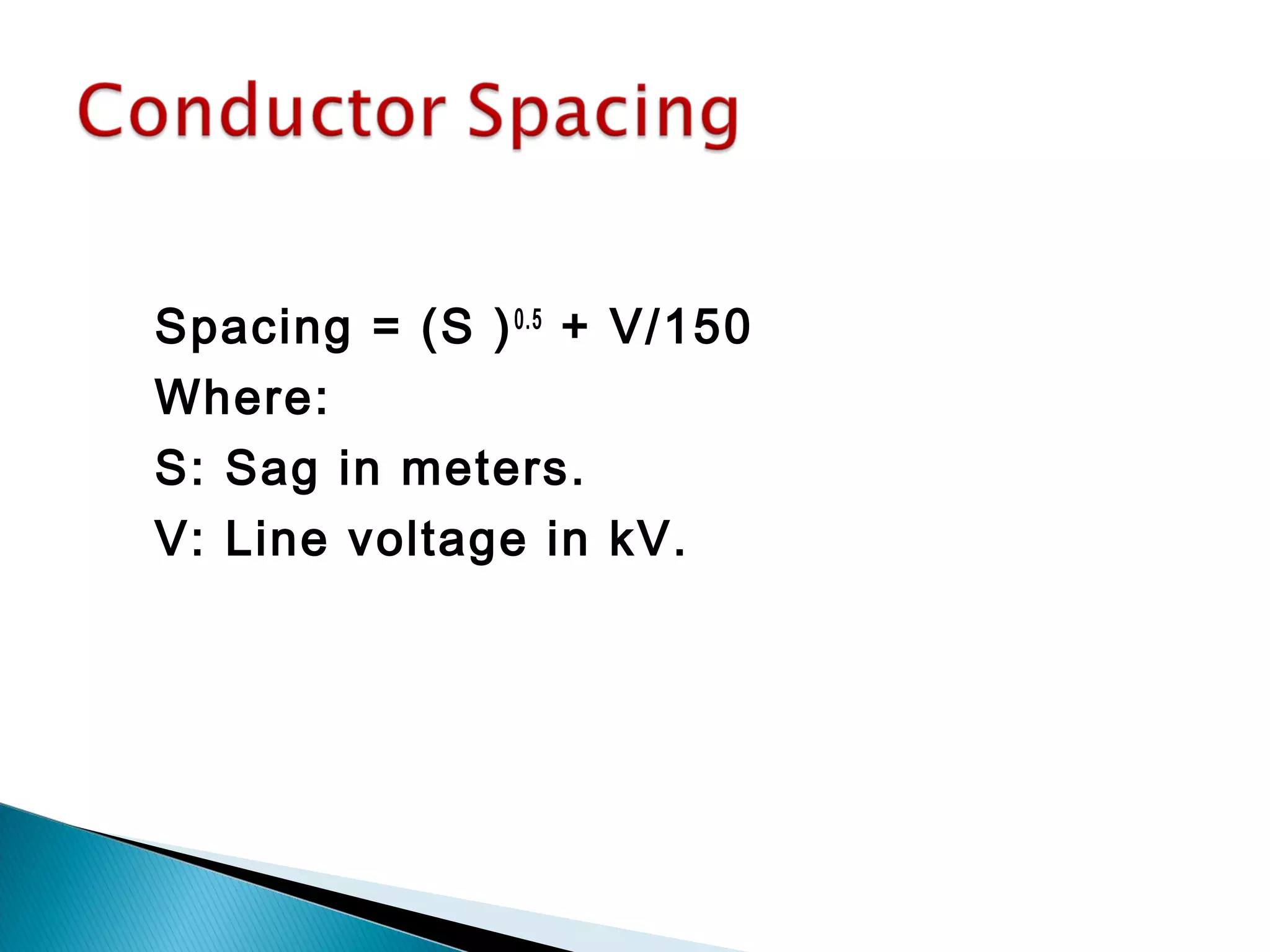
Spacing = (S )0.5
+ V/150
Where:
S: Sag in meters.
V: Line voltage in kV.
Electrical Considerations for T.L. Design:
 Low voltage drop
 Minimum power loss for high efficiency of
power transmission.
 The line should have sufficient current
carrying capacity so that the power can be
transmitted without excessive voltage
drop or overheating.
 Conductivity of Conductor:
R = ρ.L/A , or
R = L/Ϭ. A
Where:
L: Conductor length.
A: Conductor cross sectional area.
ρ: resistivity
Ϭ: Conductivity (Ϭ= 1/ρ)
 The conductor conductivity must be very
high
to reduce Conductor resistance R and
hence reduce losses
PL= 3 I2
.R
Mechanical Considerations for T.L. Design:
 The conductors and line supports should have
sufficient mechanical strength:
- to withstand conductor weight, Conductor
Tension and weather conditions (wind, ice).
- The Spans between the towers can be long.
- Sag will be small.
- Reducing the number and height of towers and
the number of insulators.
• Heat expansion coefficient must be very
small.
Rt = R0. (1 + α0 .t)
αt = α0/(1+ α0.t)
α t is the heat expansion coefficient at t.
TYPES OF
CONDUCTORS
MATERIALS
lowest cost – low mechanical
strength
Used for small span
1- Steel strands
2- Aluminum strands
ACSR (26/7)
• High mechanical strength can be utilized
by using spans of larger lengths.
• A reduction in the number of supports also
include reduction in insulators and the risk
of lines outage due to flash over or faults
is reduced.
• losses are reduced due to larger diameter
of conductor.
• High current carrying capacity.
 Wooden Poles
 Reinforced Concrete Poles
 Steel Poles
 Lattice Structure Steel Towers
Wooden Poles
Reinforced Concrete Poles
Steel Poles
1- Suspension Tower
2- Tension Tower
3- Angle Tower
4- End Tower
This type of towers exist in the beginning
and at the end of the line which exposed
to tension in one side.
Sag of T.L depends on:
- Conductor weight.
- Span length,
- Tension in the conductor, T
- Weather conditions (wind , ice).
- Temperature.
kV C (m)
0.4 5.5
11 5.5
33 6.0
66 6.2
132 6.2
220 7.0
400 8.4
Spacing = (S )0.5
+ V/150
Where:
S: Sag in meters.
V: Line voltage in kV.
Power system planning & operation [eceg 4410]

Power system planning & operation [eceg 4410]

  • 1.
  • 2.
     Accurate electricload forecasting is crucial for power system planning and operation.  The forecasted load should be close to the load demand on the power system.  Load forecasting is always associated with some uncertainty.  Power systems, however, are to be planned in such a way that changing load developments can be accommodated by the expansion of the system .
  • 3.
     load forecastinghelps a company to decide ◦ Purchasing electric power ◦ Generating electric power ◦ Load switching ◦ Infrastructure development  Three types of forecasts: 1. short-term forecasts- which are usually from one hour to one week 2. Medium-term forecasts- which are usually from a week to a year 3. long-term forecasts- which are longer than a year
  • 4.
     Some loadforecasting methods are: 1. Load forecast with load increase factors 2. Load forecast based on economic characteristic data 3. Load forecast with estimated values 4. Load forecast with standardized load curves. 5. Regression 6. Modern forecasting methods
  • 5.
     The preciseapplication of the different methods cannot be determined exactly.  And combinations of the methods are usually applied.
  • 6.
     This methodis based on the existing load and the increase in the previous years and estimates the future load increase by means of exponential increase:  s=rate of increase per year  P0 = previous load  Pn=load at the nth year  n=year
  • 7.
     This methodis simple but cannot consider externally measured variables and is hardly suitable to provide reliable load and energy predictions. Example:  Assume the pick load on Haramaya substation is 5 MW and the annual growth rate is 7%. What will be the pick load after 10 solid years?  Ans: P10=9.84 MW
  • 8.
     An increasein accuracy is obtained if the load forecast is carried out separately for the individual consumption sectors, such as households, commercial, public supply and industrial sectors.  Then the individual results are summed for each year to obtain the total system load.  Another model for load forecasting is based on the phenomenological description of the growth of electrical energy consumption as shown next:
  • 9.
     With thismodel, adjustments can be combined with the process of load development of the past with different increases and saturation effects for the future.
  • 10.
     Load forecastcalculated with the load development model (curves for various values of k and l ).
  • 11.
     As theeconomy of a country grows, so does the power demand.  Load forecast with economic characteristic data obtained from energy statistics assumes different relations between economic growth, availability of energy resources, energy consumption and requirements in general, such as the increase in energy consumption due to growth of population, and in special applications, such as energy requirements of industry.
  • 12.
     The requirementfor electrical energy per capita of the population is determined to a large extent by the standard of living and the degree of industrialization of a country.  However, high consumption of energy can be also an indicator of high waste of energy.  The increase of electrical energy consumption in industrialized countries is less affected by the growth of population and predominantly by the growth of the gross domestic product ( GDP ) and/or the gross national product ( GNP ).
  • 13.
    Example:  In theGTP, the GDP of Ethiopia is supposed to grow at 15%. Before the GTP period, the power demand was growing at a rate of 23% (GDP growth=11%). Assuming a direct relationship between the economy and the power demand, a. What is the rate of power demand growth in the GTP period? b. In 2002 E.C, the national power demand was approximately 1500 MW. What will be the expected power demand in 2007 E.C?
  • 14.
     In powersystem expansion, development plan is vital in forecasting the power requirement.  For instance, we can use the table on the next slide in power system planning.
  • 16.
    Example:  Near Addis,a business area of 10km-squared is to be electrified. Forecast the power demand.  Land development plans contain general information about the area development and use of land, and the size, location and types of residential, industrial and commercial areas, without allowing one to be able to derive detailed individual measures from them.
  • 17.
     Another wayof load forecasting is based on the annual energy consumption of individual consumer or consumer groups, which can be taken from the annual electricity bill.  The system load can be determined by means of standardized load curves for different consumer groups such as ◦ Residential ◦ Commercial ◦ Public sectors ◦ industrial
  • 18.
     As consumptionprofiles of the particular customer groups not only change with time of day but also show day - of - week and seasonal changes, characteristic days are defined, such as working - day, Saturday, Sunday (or Friday in Islamic countries) and holiday as well as seasonal differences in winter, summer and transition periods.  Based on the load curves we can forecast the future load for a particular hour, a particular day and a particular year.
  • 19.
  • 20.
  • 21.
     Regression isalso used in forecasting loads.  Read this at your home.
  • 22.
     Nowadays, fuzylogic, ANN, and other algorithms are used in power system planning to forecast load.  These algorithms have artificial learning capabilities.  And thus, by taking the past into consideration, they can predict the future.
  • 24.
    Planning and Designof hydro generation stations Ayele Nigussie
  • 25.
    1. Introduction 2. Layout 3.Environmental Effects of HPPs 4. Economic Aspects of HPPs 5. Designing HPPs 6. Summary
  • 26.
     Hydroelectric powercaptures the energy released from falling water.  Potential Energy  Kinetic energy  Electrical Energy  Hydroelectric power plants are categorized as ◦ Micro hydropower plants [<100 kW) ◦ Mini Hydropower Plants [100 kW – 1 MW] ◦ Small Hydropower Plants [1 MW – 30 MW] ◦ Large Hydropower Plants [>30 MW]  In Ethiopia, more than 96% of the electricity is hydro.
  • 28.
     The effectsare:  Physical - ◦ change the ecosystem, ◦ effect on downstream, ◦ Loss of habitat ◦ Loss of farms ◦ Deforestation ◦ Effect on micro-climate level  Biological- ◦ Flora ◦ Fauna ◦ Humans
  • 29.
     High initialcost of construction.  Electricity is cheap.  Energy is green.  In an HPP construction, costs to be considered: ◦ land/land rights, ◦ structures and improvements, ◦ equipment, reservoirs, dams, waterways, roads, railroads, and bridges. ◦ protecting fish and wildlife. ◦ Operation and maintenance costs ◦ hydraulic expenses, electric expenses, and rents.
  • 30.
     When designinga hydroelectric power plant a number of elements and equipment need to be taken into consideration.  Dam size, retention basin size and depth, inlet valves, weir and control gates, penstock length and diameter, turbines, generators, transformers and excitation equipment, and efficiency all have to be examined.  Elevation or head and stream flow have to be established as well. 
  • 31.
  • 32.
     Based onthe firm power: ◦ Mechanical Engineers design the hydraulic turbines. ◦ Electrical engineers design the generators, transformers, the switch yards and the protection system. ◦ Dams, canals, intakes, penstocks, tailraces and power houses are designed by civil engineers.  Firm power is also one of the main factors that decides the feasibility of an HPP.
  • 33.
     Feasibility studycontains: ◦ Site visit and selection ◦ Capacity analysis ◦ Economic analysis ◦ Environmental impact analysis  Feasibility study is the first step in HPP construction.
  • 34.
     In planningan HHP, the general requirements are: ◦ Determining location of the powerhouse , location of switchyard , ◦ Laying out the highway and railroad access, other site features, ◦ Determining types of powerhouse, structures, ◦ selection of type of powerhouse, ◦ location of main transformers, powerhouse and switchyard, equipment, powerhouse Auxiliary Equipment
  • 35.
     Architectural designrequirements are: ◦ Exterior Design ◦ Exterior Details ◦ Interior Design ◦ Interior Details ◦ Schedule of Finishes ◦ Painting ◦ Design memorandum ◦ Drawings
  • 36.
     The structuralrequirements are: ◦ All the civil works are under this category.
  • 38.
  • 39.
    3.1 Introduction 3.2 Whatis a substation? 3.3 Important points 3.4 Classification of substations 3.5 Substation equipments 3.6 Substation Configurations 3.7 Substation design 3.8 Planning of substations 3.9 Conclusion
  • 40.
     A substationis a nodal point in a power system.  Internationally standardized voltage level for substations:  66 kV, 110 kV, 132 kV, 150 kV, 220 kV, 380 kV,  For very long transmission distances : 500 kV, 800 kV
  • 42.
    Tasks of substation: Distribution of power towards load circuit  Separation of different network groups (reduction of short circuit power)  Coupling of different voltage level via power transformers  Measuring, signaling and monitoring of network data (e.g. U, I, P, Q, f)
  • 43.
    3.2 What isa Substation ?The assembly of apparatus used to change some characteristics (e.g. voltage, a.c. to d.c. ,freq, p.f. etc..) of electrical supply is called a substation.
  • 44.
     It shouldbe located at a proper site(i.e. at the center of gravity of load).  It should provide safe and reliable arrangement.  It should be easily operated and maintained.  It should involve minimum capital costs.
  • 45.
    Substation According to servicerequirement According to constructional feature
  • 46.
    According to Servicerequirement:  Transformer Substation: Transformers are installed to transform voltage from one level to another as per needs.  Switching Substations: This substations mean for switching operation of powerlines with out transforming the voltage.  Power factor correction Substation: This substations are installed to increase the power factor to minimise losses.  Frequency Changer Substation: This substations are installed where speed control of motors is required.  Converting Substation: This substations convert a.c to d.c or vice versa.  Industrial Substation: This substations are installed to supply power only to an industries.
  • 47.
    According To ConstructionalFeatures:  Indoor SubstationsIndoor Substations: In this substations, the apparatus are installed with in the substation building. Till 66 kV.  Outdoor SubstationsOutdoor Substations: this substations are installed in open land. This substations are employed for voltage levels beyond 66k.v.  Underground SubstationsUnderground Substations: This: This substations are installed under ground in densely populated cities where cost of the land is more.  Pole-Mounted SubstationsPole-Mounted Substations: This substations are erected for distribution of power in localities. This is employed for transformers up to 250 kVA.).  Foundation Mounted SubstationsFoundation Mounted Substations: This substations are installed 3.4 Classification of Substation …
  • 48.
     Busbar: isa conductor connecting power line to substation equipment.  Insulators & fittings: fix and isolate the busbar system.  Isolating Switch: is used for disconnecting equipment for maintenance and repair.
  • 49.
     Relays &Circuit Breaker: open and close a circuit under normal and fault conditions.  Power Transformers: are used in substations to step up or step down the voltages.  Instrument Transformers: used for measuring .
  • 50.
     Metering &Indicating Instruments: used to watch over the circuit quantities.  Power line carrier communication systems: used for SCADA.  Coupling capacitors and wave traps
  • 52.
    AC/DC supply: isused for auxillaries and DC supply for relay operation. Oil handling system: used for purifying oil from moisture. Illumination: should be properly illuminated for safety. Compressed air system: for functioning of CB. Service bay: to carry the equipments to installation side. Fire extinguishers
  • 53.
  • 54.
  • 55.
    • Circuit Breakers 3.5Substation equipments …
  • 56.
  • 57.
  • 58.
  • 59.
    Piezoelectric motorsPiezoelectric motors PiezoGeneratorsPiezo Generators ActuatorsActuators Ultrasonic TransducersUltrasonic Transducers And many more…And many more…
  • 60.
    What are tobe considered?  Site selection  Design of structures  Design of foundation for transformers & structures(IE Rules 64)  Control room building  Cable trench & drainage  Design of earthing  Protection schemes & interlocks
  • 61.
    Conventional substations (AIS): Construction according to standardized minimal distances (clearance) between phase and earth  Normally used for outdoor substations, just in very few cases used for indoor substations  Based on single power system equipments ◦ Replacement of single equipment by equipments from other manufacturers is possible.  Simple to expand (in case that space is not an issue)  Excellent overview, simple handling and easy access
  • 62.
     Minimum clearancein air according to IEC 61936- 1
  • 63.
     Minimum clearancein air according to IEC 61936- 1
  • 64.
    Basis requirements fornew substations:  Optimal location of substations within power system (load flow, short circuit, customer requirements, long term planning, land space)  Selection of substation design  Calculation of short-circuit currents and long term development (ratings)  Selection of power system requirements  Adaption of design according to available space, fixing of busbar configuration (e.g. using wire conductor or tubular conductor)  Detailed planning of: primary and secondary equipment, auxiliary equipment, basement, steel structure, building, earthing system
  • 65.
     You canfind important standards for power system installations:  Planning and Design of a substation normally starts with the development of the electrical single line diagram.  A single line diagram shows number of busbars and substation bays including the relevant equipment.
  • 66.
     Selection ofsubstation layout depends on ◦ Its importance within the power system (power system reliability in case of failures and maintenance activities) ◦ Power system operation
  • 67.
    Substation is theheart of a power system. Hence, its design should be such that it will provide continuous , quality & desired power with safety.
  • 68.
     Read furtheron substations.
  • 69.
  • 71.
    Electrical Considerations forT.L. Design:  Low voltage drop  Minimum power loss for high efficiency of power transmission.  The line should have sufficient current carrying capacity so that the power can be transmitted without excessive voltage drop or overheating.
  • 72.
     Conductivity ofConductor: R = ρ.L/A , or R = L/Ϭ. A Where: L: Conductor length. A: Conductor cross sectional area. ρ: resistivity Ϭ: Conductivity (Ϭ= 1/ρ)
  • 73.
     The conductorconductivity must be very high to reduce Conductor resistance R and hence reduce losses PL= 3 I2 .R
  • 74.
    Mechanical Considerations forT.L. Design:  The conductors and line supports should have sufficient mechanical strength: - to withstand conductor weight, Conductor Tension and weather conditions (wind, ice). - The Spans between the towers can be long. - Sag will be small. - Reducing the number and height of towers and the number of insulators.
  • 76.
    • Heat expansioncoefficient must be very small. Rt = R0. (1 + α0 .t) αt = α0/(1+ α0.t) α t is the heat expansion coefficient at t.
  • 77.
  • 78.
    lowest cost –low mechanical strength Used for small span
  • 81.
    1- Steel strands 2-Aluminum strands ACSR (26/7)
  • 86.
    • High mechanicalstrength can be utilized by using spans of larger lengths. • A reduction in the number of supports also include reduction in insulators and the risk of lines outage due to flash over or faults is reduced. • losses are reduced due to larger diameter of conductor. • High current carrying capacity.
  • 87.
     Wooden Poles Reinforced Concrete Poles  Steel Poles  Lattice Structure Steel Towers
  • 88.
  • 93.
  • 96.
  • 98.
    1- Suspension Tower 2-Tension Tower 3- Angle Tower 4- End Tower
  • 104.
    This type oftowers exist in the beginning and at the end of the line which exposed to tension in one side.
  • 106.
    Sag of T.Ldepends on: - Conductor weight. - Span length, - Tension in the conductor, T - Weather conditions (wind , ice). - Temperature.
  • 107.
    kV C (m) 0.45.5 11 5.5 33 6.0 66 6.2 132 6.2 220 7.0 400 8.4
  • 108.
    Spacing = (S)0.5 + V/150 Where: S: Sag in meters. V: Line voltage in kV.
  • 113.
    Electrical Considerations forT.L. Design:  Low voltage drop  Minimum power loss for high efficiency of power transmission.  The line should have sufficient current carrying capacity so that the power can be transmitted without excessive voltage drop or overheating.
  • 114.
     Conductivity ofConductor: R = ρ.L/A , or R = L/Ϭ. A Where: L: Conductor length. A: Conductor cross sectional area. ρ: resistivity Ϭ: Conductivity (Ϭ= 1/ρ)
  • 115.
     The conductorconductivity must be very high to reduce Conductor resistance R and hence reduce losses PL= 3 I2 .R
  • 116.
    Mechanical Considerations forT.L. Design:  The conductors and line supports should have sufficient mechanical strength: - to withstand conductor weight, Conductor Tension and weather conditions (wind, ice). - The Spans between the towers can be long. - Sag will be small. - Reducing the number and height of towers and the number of insulators.
  • 118.
    • Heat expansioncoefficient must be very small. Rt = R0. (1 + α0 .t) αt = α0/(1+ α0.t) α t is the heat expansion coefficient at t.
  • 119.
  • 120.
    lowest cost –low mechanical strength Used for small span
  • 123.
    1- Steel strands 2-Aluminum strands ACSR (26/7)
  • 128.
    • High mechanicalstrength can be utilized by using spans of larger lengths. • A reduction in the number of supports also include reduction in insulators and the risk of lines outage due to flash over or faults is reduced. • losses are reduced due to larger diameter of conductor. • High current carrying capacity.
  • 129.
     Wooden Poles Reinforced Concrete Poles  Steel Poles  Lattice Structure Steel Towers
  • 130.
  • 135.
  • 138.
  • 140.
    1- Suspension Tower 2-Tension Tower 3- Angle Tower 4- End Tower
  • 146.
    This type oftowers exist in the beginning and at the end of the line which exposed to tension in one side.
  • 148.
    Sag of T.Ldepends on: - Conductor weight. - Span length, - Tension in the conductor, T - Weather conditions (wind , ice). - Temperature.
  • 149.
    kV C (m) 0.45.5 11 5.5 33 6.0 66 6.2 132 6.2 220 7.0 400 8.4
  • 150.
    Spacing = (S)0.5 + V/150 Where: S: Sag in meters. V: Line voltage in kV.