“Smart Grid” – An OverviewRob Masinter - InvVESTSeptember 2009
Purpose of this DocumentSmart Grid Overview - InvVEST - Sept 20092The “Smart Grid” is at the center of current clean technology / alternative energy initiatives.  This document is intended to provide readers with an overview of the concept, evolving business models, and why Smart Grid implementation will be a foundational enabler of Sustainable Energy. Document ContentsElectric power supply, demand and CO2 emissions outlookRationale for a smarter gridThe Smart Grid concept, taxonomy, and benefitsFinancing and StimulusInitial investment areas for Smart Grid businessesImplementation challengesCompanies in the Smart Grid landscapeList of resources and references
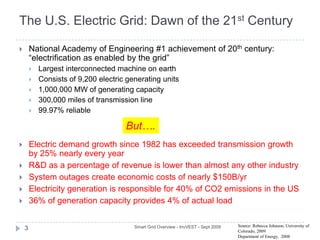
The U.S. Electric Grid: Dawn of the 21st CenturySmart Grid Overview - InvVEST - Sept 20093National Academy of Engineering #1 achievement of 20th century: “electrification as enabled by the grid”Largest interconnected machine on earthConsists of 9,200 electric generating units 1,000,000 MW of generating capacity300,000 miles of transmission line99.97% reliableElectric demand growth since 1982 has exceeded transmission growth by 25% nearly every yearR&D as a percentage of revenue is lower than almost any other industry System outages create economic costs of nearly $150B/yrElectricity generation is responsible for 40% of CO2 emissions in the US36% of generation capacity provides 4% of actual loadBut….Source: Rebecca Johnson, University of Colorado, 2009Department of Energy,  2008
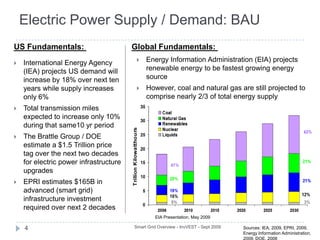
Electric Power Supply / Demand: BAUSmart Grid Overview - InvVEST - Sept 20094US Fundamentals: Global Fundamentals: Energy Information Administration (EIA) projects renewable energy to be fastest growing energy source
However, coal and natural gas are still projected to comprise nearly 2/3 of total energy supplyInternational Energy Agency (IEA) projects US demand will increase by 18% over next ten years while supply increases only 6%Total transmission miles expected to increase only 10% during that same10 yr periodThe Brattle Group / DOE estimate a $1.5 Trillion price tag over the next two decades for electric power infrastructure upgrades EPRI estimates $165B in advanced (smart grid) infrastructure investment required over next 2 decadesEIA Presentation, May 2009Sources: IEA, 2009, EPRI, 2009, Energy Information Administration, 2009, DOE, 2008
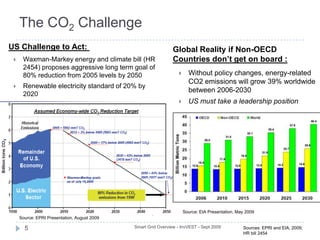
The CO2 ChallengeSmart Grid Overview - InvVEST - Sept 20095US Challenge to Act: Global Reality if Non-OECD Countries don’t get on board : Waxman-Markey energy and climate bill (HR 2454) proposes aggressive long term goal of 80% reduction from 2005 levels by 2050
Renewable electricity standard of 20% by 2020
Without policy changes, energy-related CO2 emissions will grow 39% worldwide between 2006-2030
US must take a leadership positionSource: EIA Presentation, May 2009Source: EPRI Presentation, August 2009Sources: EPRI and EIA, 2009; HR bill 2454
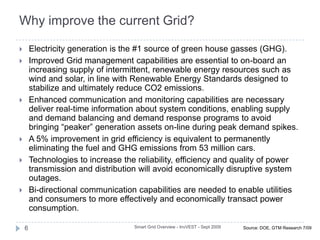
Why improve the current Grid?Smart Grid Overview - InvVEST - Sept 20096Electricity generation is the #1 source of green house gasses (GHG).  Improved Grid management capabilities are essential to on-board an increasing supply of intermittent, renewable energy resources such as wind and solar, in line with Renewable Energy Standards designed to stabilize and ultimately reduce CO2 emissions.    Enhanced communication and monitoring capabilities are necessary deliver real-time information about system conditions, enabling supply and demand balancing and demand response programs to avoid bringing “peaker” generation assets on-line during peak demand spikes. A 5% improvement in grid efficiency is equivalent to permanently eliminating the fuel and GHG emissions from 53 million cars.Technologies to increase the reliability, efficiency and quality of power transmission and distribution will avoid economically disruptive system outages.Bi-directional communication capabilities are needed to enable utilities and consumers to more effectively and economically transact power consumption.Source: DOE, GTM Research 7/09
Current Grid – Anything but “Smart”Electricity supply must match electricity demand - almost simultaneouslyElectricity suppliers have minimal ability to influence demand at any point in timeElectricity suppliers have less-than-optimal levels of information about what is happening on their system. Leads to lower precision in operation.Two-way information flow between suppliers and consumers is very limited. Consumers get a bill at the end of the month, call if there is a problem with their service.Consumers are insulated by fixed-rate pricing structures from the volatility of electricity prices at different levels of demandConsumers have very little information about the environmental attributes of the energy they are consuming (ex: coal versus wind)Source: Rebecca Johnson, University of ColoradoDepartment of Energy,  National Energy Technology Lab http://www.netl.doe.gov/moderngrid/opportunity/vision_characteristics.html
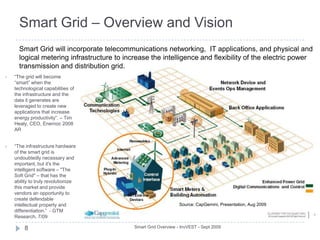
Smart Grid – Overview and VisionSmart Grid Overview - InvVEST - Sept 20098Smart Grid will incorporate telecommunications networking,  IT applications, and physical and logical metering infrastructure to increase the intelligence and flexibility of the electric power transmission and distribution grid.  “The grid will become “smart” when the technological capabilities of the infrastructure and the data it generates are leveraged to create new applications that increase energy productivity”. – Tim Healy, CEO, Enernoc 2008 AR
“The infrastructure hardware of the smart grid is undoubtedly necessary and important, but it's the intelligent software – "The Soft Grid" – that has the ability to truly revolutionize this market and provide vendors an opportunity to create defendable intellectual property and differentiation.”  - GTM Research, 7/09Source: CapGemini, Presentation, Aug 2009
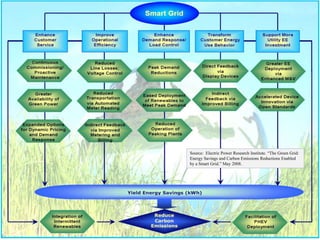
Smart Grid Overview - InvVEST - Sept 20099Source:  Electric Power Research Institute. “The Green Grid:  Energy Savings and Carbon Emissions Reductions Enabled by a Smart Grid.” May 2008.
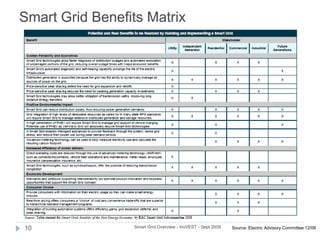
Smart Grid Benefits MatrixSmart Grid Overview - InvVEST - Sept 200910Source: Electric Advisory Committee 12/08
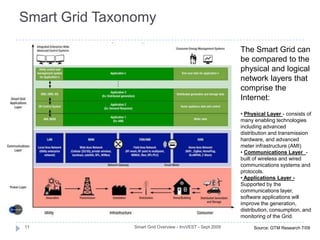
Smart Grid Taxonomy11Smart Grid Overview - InvVEST - Sept 2009The Smart Grid can be compared to the physical and logical network layers that comprise the Internet:Physical Layer - consists of many enabling technologies including advanced distribution and transmission hardware, and advanced meter infrastructure (AMI)
Communications Layer  - built of wireless and wired communications systems and protocols.

Smart Grid Overview

  • 1.
    “Smart Grid” –An OverviewRob Masinter - InvVESTSeptember 2009
  • 2.
    Purpose of thisDocumentSmart Grid Overview - InvVEST - Sept 20092The “Smart Grid” is at the center of current clean technology / alternative energy initiatives. This document is intended to provide readers with an overview of the concept, evolving business models, and why Smart Grid implementation will be a foundational enabler of Sustainable Energy. Document ContentsElectric power supply, demand and CO2 emissions outlookRationale for a smarter gridThe Smart Grid concept, taxonomy, and benefitsFinancing and StimulusInitial investment areas for Smart Grid businessesImplementation challengesCompanies in the Smart Grid landscapeList of resources and references
  • 3.
    The U.S. ElectricGrid: Dawn of the 21st CenturySmart Grid Overview - InvVEST - Sept 20093National Academy of Engineering #1 achievement of 20th century: “electrification as enabled by the grid”Largest interconnected machine on earthConsists of 9,200 electric generating units 1,000,000 MW of generating capacity300,000 miles of transmission line99.97% reliableElectric demand growth since 1982 has exceeded transmission growth by 25% nearly every yearR&D as a percentage of revenue is lower than almost any other industry System outages create economic costs of nearly $150B/yrElectricity generation is responsible for 40% of CO2 emissions in the US36% of generation capacity provides 4% of actual loadBut….Source: Rebecca Johnson, University of Colorado, 2009Department of Energy, 2008
  • 4.
    Electric Power Supply/ Demand: BAUSmart Grid Overview - InvVEST - Sept 20094US Fundamentals: Global Fundamentals: Energy Information Administration (EIA) projects renewable energy to be fastest growing energy source
  • 5.
    However, coal andnatural gas are still projected to comprise nearly 2/3 of total energy supplyInternational Energy Agency (IEA) projects US demand will increase by 18% over next ten years while supply increases only 6%Total transmission miles expected to increase only 10% during that same10 yr periodThe Brattle Group / DOE estimate a $1.5 Trillion price tag over the next two decades for electric power infrastructure upgrades EPRI estimates $165B in advanced (smart grid) infrastructure investment required over next 2 decadesEIA Presentation, May 2009Sources: IEA, 2009, EPRI, 2009, Energy Information Administration, 2009, DOE, 2008
  • 6.
    The CO2 ChallengeSmartGrid Overview - InvVEST - Sept 20095US Challenge to Act: Global Reality if Non-OECD Countries don’t get on board : Waxman-Markey energy and climate bill (HR 2454) proposes aggressive long term goal of 80% reduction from 2005 levels by 2050
  • 7.
  • 8.
    Without policy changes,energy-related CO2 emissions will grow 39% worldwide between 2006-2030
  • 9.
    US must takea leadership positionSource: EIA Presentation, May 2009Source: EPRI Presentation, August 2009Sources: EPRI and EIA, 2009; HR bill 2454
  • 10.
    Why improve thecurrent Grid?Smart Grid Overview - InvVEST - Sept 20096Electricity generation is the #1 source of green house gasses (GHG). Improved Grid management capabilities are essential to on-board an increasing supply of intermittent, renewable energy resources such as wind and solar, in line with Renewable Energy Standards designed to stabilize and ultimately reduce CO2 emissions. Enhanced communication and monitoring capabilities are necessary deliver real-time information about system conditions, enabling supply and demand balancing and demand response programs to avoid bringing “peaker” generation assets on-line during peak demand spikes. A 5% improvement in grid efficiency is equivalent to permanently eliminating the fuel and GHG emissions from 53 million cars.Technologies to increase the reliability, efficiency and quality of power transmission and distribution will avoid economically disruptive system outages.Bi-directional communication capabilities are needed to enable utilities and consumers to more effectively and economically transact power consumption.Source: DOE, GTM Research 7/09
  • 11.
    Current Grid –Anything but “Smart”Electricity supply must match electricity demand - almost simultaneouslyElectricity suppliers have minimal ability to influence demand at any point in timeElectricity suppliers have less-than-optimal levels of information about what is happening on their system. Leads to lower precision in operation.Two-way information flow between suppliers and consumers is very limited. Consumers get a bill at the end of the month, call if there is a problem with their service.Consumers are insulated by fixed-rate pricing structures from the volatility of electricity prices at different levels of demandConsumers have very little information about the environmental attributes of the energy they are consuming (ex: coal versus wind)Source: Rebecca Johnson, University of ColoradoDepartment of Energy, National Energy Technology Lab http://www.netl.doe.gov/moderngrid/opportunity/vision_characteristics.html
  • 12.
    Smart Grid –Overview and VisionSmart Grid Overview - InvVEST - Sept 20098Smart Grid will incorporate telecommunications networking, IT applications, and physical and logical metering infrastructure to increase the intelligence and flexibility of the electric power transmission and distribution grid. “The grid will become “smart” when the technological capabilities of the infrastructure and the data it generates are leveraged to create new applications that increase energy productivity”. – Tim Healy, CEO, Enernoc 2008 AR
  • 13.
    “The infrastructure hardwareof the smart grid is undoubtedly necessary and important, but it's the intelligent software – "The Soft Grid" – that has the ability to truly revolutionize this market and provide vendors an opportunity to create defendable intellectual property and differentiation.” - GTM Research, 7/09Source: CapGemini, Presentation, Aug 2009
  • 14.
    Smart Grid Overview- InvVEST - Sept 20099Source: Electric Power Research Institute. “The Green Grid: Energy Savings and Carbon Emissions Reductions Enabled by a Smart Grid.” May 2008.
  • 15.
    Smart Grid BenefitsMatrixSmart Grid Overview - InvVEST - Sept 200910Source: Electric Advisory Committee 12/08
  • 16.
    Smart Grid Taxonomy11SmartGrid Overview - InvVEST - Sept 2009The Smart Grid can be compared to the physical and logical network layers that comprise the Internet:Physical Layer - consists of many enabling technologies including advanced distribution and transmission hardware, and advanced meter infrastructure (AMI)
  • 17.
    Communications Layer - built of wireless and wired communications systems and protocols.