

BY-RANJAN KUMAR (EE/AIET/3rd YEAR)
ARYA INSTITUTE OF ENGINEERING AND
TECHNOLOGY
1
DEPARTMENT OF ELECTRICAL ENGINEERING
SMART GRID
TECHNOLOGY
SOME CONTENT :-
2
What is electrical grid ?
What is smart grid ?
Need of smart grid
 Benefit of smart grid
 Difference between conventional grid and smart grid
 Type of smart grid
 Key driver of smart grid
 Challenge in smart grid
2
2
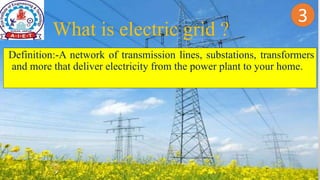
Definition:-A network of transmission lines, substations, transformers
and more that deliver electricity from the power plant to your home.
What is electric grid ?
3
WHAT IS SMART GRID ?
DEFINATION :-
4
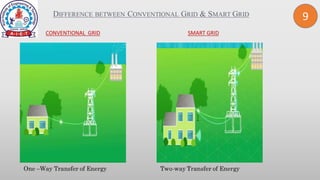
IN SIMPLE WORD:- Two way transmission of electrical energy and two
way communication is known as smart grid.
OR
IN OTHER WORLD:- A "smart grid" is an electrical grid which includes a
variety of operational and energy measures including smart meters,
smart appliances, renewable energy resources includes a variety of
operational and energy measures, and energy efficiency resources.
WHAT IS SMART GRID
5
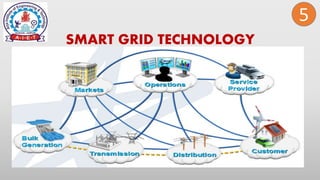
SMART GRID TECHNOLOGY
NEED OF SMART GRID :-
1. To satisfy the increase demand of growing population .
2. To minimize the Transmission and Distribution losses .
3. To Integrate the renewable energy sources into the system to
reduce the dependency over the fossil fuel and would get pollution
free energy .
4. To set up a communication channel between utility and consumer .
5. To make fault detection , isolation and restoration easier and
convenient .
6. For Advance Metering Infrastructure (AMI) .
7. For Cyber Security .
8. For Distribution Grid Management .
9. For Energy Storage 2
6
2
 Reliability- By reducing the cost of interruptions and power quality
disturbances and reducing the probability and consequences of widespread
blackouts.
 Economics- By keeping downward prices on electricity prices, reducing the
amount paid by consumers as compared to the “business as usual” (BAU) grid,
creating new jobs, and stimulating the U.S. gross domestic product (GDP).
 Efficiency- The smart grid can improve load factor and reduce system
losses , by reducing the cost to produce, deliver, and consume electricity.
 Environmental- By reducing emissions when compared to BAU by enabling a
larger penetration of renewable and improving efficiency of generation,
delivery, and consumption.
 Security- By reducing the probability and consequences of manmade attacks
and natural disasters.
 Safety- By reducing injuries and loss of life from grid-related events
Benefits of Smart Grid :-
7
7
2
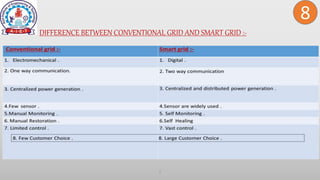
DIFFERENCE BETWEEN CONVENTIONAL GRID AND SMART GRID :-
8
CONVENTIONAL GRID SMART GRID
9
2
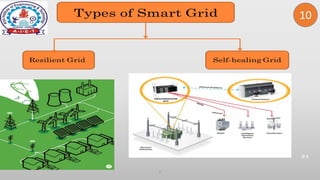
10
2
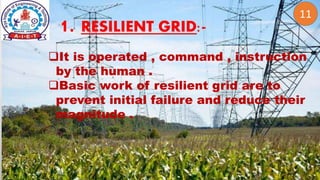
1. RESILIENT GRID:-
11
It is operated , command , instruction
by the human .
Basic work of resilient grid are to
prevent initial failure and reduce their
magnitude .
2
12
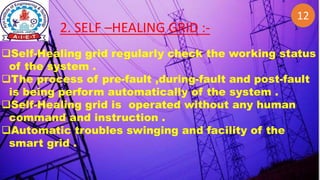
2. SELF –HEALING GRID :-
Self-Healing grid regularly check the working status
of the system .
The process of pre-fault ,during-fault and post-fault
is being perform automatically of the system .
Self-Healing grid is operated without any human
command and instruction .
Automatic troubles swinging and facility of the
smart grid .
KEY DRIVER IN SMART GRID :-
13
1. INTERNAL MARKET :-
• Liberalization
• Competitiveness
• Low price
2. SECURITY OF ENERGY SUPPLY :-
• Energy availability
• Reliability and quantity capacity
3. ENVIRONMENTAL :-
• Global warming
• Climate change
• Pollution
CHALLENGE IN SMART GRID :-
2
14
Smart equipment .
Communication system .
Cyber security .
Energy storage system .
Consumer Participation .
Reliability .
Demand side management .
Self –Healing / Automation .
2
CONCLUSION :-
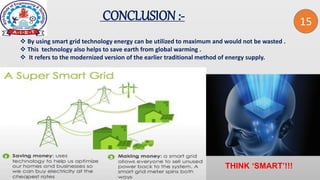
 By using smart grid technology energy can be utilized to maximum and would not be wasted .
 This technology also helps to save earth from global warming .
 It refers to the modernized version of the earlier traditional method of energy supply.
THINK ‘SMART’!!!
15
2
ANY QUERRIES ?
16
2
THANK YOU !!!!
17

SMART GRID TECHNOLOGY

  • 1.
    BY-RANJAN KUMAR (EE/AIET/3rdYEAR) ARYA INSTITUTE OF ENGINEERING AND TECHNOLOGY 1 DEPARTMENT OF ELECTRICAL ENGINEERING SMART GRID TECHNOLOGY
  • 2.
    SOME CONTENT :- 2 Whatis electrical grid ? What is smart grid ? Need of smart grid  Benefit of smart grid  Difference between conventional grid and smart grid  Type of smart grid  Key driver of smart grid  Challenge in smart grid 2
  • 3.
    2 Definition:-A network oftransmission lines, substations, transformers and more that deliver electricity from the power plant to your home. What is electric grid ? 3
  • 4.
    WHAT IS SMARTGRID ? DEFINATION :- 4 IN SIMPLE WORD:- Two way transmission of electrical energy and two way communication is known as smart grid. OR IN OTHER WORLD:- A "smart grid" is an electrical grid which includes a variety of operational and energy measures including smart meters, smart appliances, renewable energy resources includes a variety of operational and energy measures, and energy efficiency resources.
  • 5.
    WHAT IS SMARTGRID 5 SMART GRID TECHNOLOGY
  • 6.
    NEED OF SMARTGRID :- 1. To satisfy the increase demand of growing population . 2. To minimize the Transmission and Distribution losses . 3. To Integrate the renewable energy sources into the system to reduce the dependency over the fossil fuel and would get pollution free energy . 4. To set up a communication channel between utility and consumer . 5. To make fault detection , isolation and restoration easier and convenient . 6. For Advance Metering Infrastructure (AMI) . 7. For Cyber Security . 8. For Distribution Grid Management . 9. For Energy Storage 2 6
  • 7.
    2  Reliability- Byreducing the cost of interruptions and power quality disturbances and reducing the probability and consequences of widespread blackouts.  Economics- By keeping downward prices on electricity prices, reducing the amount paid by consumers as compared to the “business as usual” (BAU) grid, creating new jobs, and stimulating the U.S. gross domestic product (GDP).  Efficiency- The smart grid can improve load factor and reduce system losses , by reducing the cost to produce, deliver, and consume electricity.  Environmental- By reducing emissions when compared to BAU by enabling a larger penetration of renewable and improving efficiency of generation, delivery, and consumption.  Security- By reducing the probability and consequences of manmade attacks and natural disasters.  Safety- By reducing injuries and loss of life from grid-related events Benefits of Smart Grid :- 7 7
  • 8.
    2 DIFFERENCE BETWEEN CONVENTIONALGRID AND SMART GRID :- 8
  • 9.
  • 10.
  • 11.
    2 1. RESILIENT GRID:- 11 Itis operated , command , instruction by the human . Basic work of resilient grid are to prevent initial failure and reduce their magnitude .
  • 12.
    2 12 2. SELF –HEALINGGRID :- Self-Healing grid regularly check the working status of the system . The process of pre-fault ,during-fault and post-fault is being perform automatically of the system . Self-Healing grid is operated without any human command and instruction . Automatic troubles swinging and facility of the smart grid .
  • 13.
    KEY DRIVER INSMART GRID :- 13 1. INTERNAL MARKET :- • Liberalization • Competitiveness • Low price 2. SECURITY OF ENERGY SUPPLY :- • Energy availability • Reliability and quantity capacity 3. ENVIRONMENTAL :- • Global warming • Climate change • Pollution
  • 14.
    CHALLENGE IN SMARTGRID :- 2 14 Smart equipment . Communication system . Cyber security . Energy storage system . Consumer Participation . Reliability . Demand side management . Self –Healing / Automation .
  • 15.
    2 CONCLUSION :-  Byusing smart grid technology energy can be utilized to maximum and would not be wasted .  This technology also helps to save earth from global warming .  It refers to the modernized version of the earlier traditional method of energy supply. THINK ‘SMART’!!! 15
  • 16.
  • 17.