Presented By:-
RAJAT KUMAR
Electricity deregulation and requirements
Main Objective
Competition,Deregulation and Open
Access
Benefits of Electricity Deregulation
Entities in Deregulated Environment
Transmission and Distribution
Why Regulation?
Structure of Regulated and Deregulated
industry
Market Model,Issues,Optimal Bidding,risks
in electricity market
Electricity act 2003
Deregulation-“Electric deregulation is the
process of changing rules and regulations that
control the electric industry to provide
customers the choice of electricity suppliers
who are either retailers or traders by allowing
competition. Deregulation improves the
economic efficiency of the production and use
of electricity. Due to competition in the electric
industry, the power prices are likely to come
down which benefits the consumers.
 To provide electricity for all reasonable demands.
 To encourage the “competition” in the generation
and supply of electricity.
 To improve the continuity of supply and the quality
of services.
 To promote efficiency and economy of the power
system.
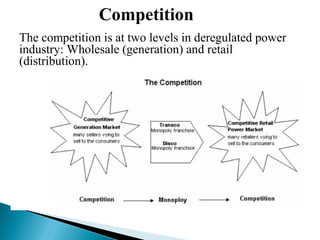
Competition
The competition is at two levels in deregulated power
industry: Wholesale (generation) and retail
(distribution).
 Systems capacity will be used efficiently.
 Optimization of energy supply will takes place.
 Price of the electricity will become clearer.
 Consumer choice will be improved.
 Bad technologies are ignored and good technologies
are replaced in their place.
 Electricity prices are reduced.
 The usage efficiency is improved due to restructuring
in price signals.
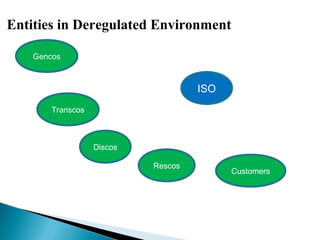
Entities in Deregulated Environment
Gencos
Transcos
Discos
Rescos
Customers
ISO
Why “REGULATION” ?Why “REGULATION” ?
Regulation of utilities is based on the
inherent risk that a single monopoly
supplier will overcharge consumers due
to the lack of competition and high
demand.
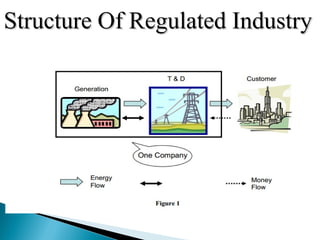
Structure Of Regulated IndustryStructure Of Regulated Industry
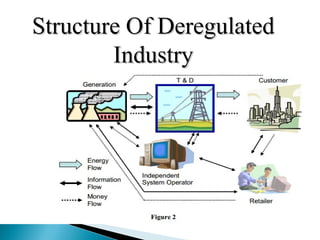
Structure Of DeregulatedStructure Of Deregulated
IndustryIndustry
The Marketplace Mechanism
12
1. Poolco
There is only one buyer in this system. The Poolco is a
governmental agency that buys for everyone, taking
bids from all sellers and buying enough power to meet
the total need, taking the lowest cost bidders.
2.Bilateral Exchange
In this type of multi-seller/buyer system individual
buyer or seller make a deal to exchange a power at
prices and under the conditions they agree to.
3.Power Exchange (PX)
The Government sets up, or causes the power industry to
establish, a trading exchange for electric power, which operates
much like a stock exchange. The buyers and sellers enter their
needs into the power exchange. whereas, the seller would enter
his demand .
Pool Market
1)All energy transactions are carried
out through the pool
2)The Poolco operator is responsible
for the market settlements, unit
commitment and determination of
pool price.
3)Participation by Gencos is
mandatory
4)Here Poolco operator is
responsible
5)Eg. UK market
Open access market
1)Bulk of energy transactions are
carried out as bilateral trades.
2)The ISO is responsible for market
administration, generation
scheduling or dispatch function.
3)Participation in the market by
Gencos is not mandatory
4)The ISO is responsible for
system security and control.
5)Eg. Nordic markets
 Network Conjestion
When the producers and consumers of the electric
energy desire to produce and consume in amounts
that would cause the transmission system to operate
at or beyond one or more transfer limit, the system is
said to be congested.
1.Price Area Congestion Management
2.Available Transfer Capability (ATC) based
Congestion Management
3.Optimal Power Flow (OPF ) based Congestion
Management.
For a genco to survive in competitive
environment, it has to operate very
efficiently. But only efficient operation
sometimes may not suffice because in the
energy auction it has to sell its products at
competitive prices to get the maximum
profit out of it
All those activities on the
interconnected grid that are necessary
to support the transmission of power
while maintaining reliable operation
and ensuring the required degree of
quality and safety.
 Supply Shortage
A supply shortage due to generation outages
can cause electricity prices to shoot up
drastically.
 Defaults
The default of the participant to complete the
transaction can raise the issue of creditworthiness and
this also may load to price hike
 Lack Of Experience
Market participant’s lack of experience with hedging
tools could be another source of risks in electricity
markets.
The electricity sector must be opened for
competition. The Act also seeks to consolidate,
update and rationalize laws related to generation,
transmission, distribution, trading and use of
power.
It focuses on:
• Creating competition in the industry
• Protecting consumer interest
• Ensuring supply of electricity to all area
Reliability and “fair” electricity prices
through innovative technologies,
economics and competition
Deregulation in power industry

Deregulation in power industry

  • 1.
  • 2.
    Electricity deregulation andrequirements Main Objective Competition,Deregulation and Open Access Benefits of Electricity Deregulation Entities in Deregulated Environment Transmission and Distribution Why Regulation? Structure of Regulated and Deregulated industry Market Model,Issues,Optimal Bidding,risks in electricity market Electricity act 2003
  • 3.
    Deregulation-“Electric deregulation isthe process of changing rules and regulations that control the electric industry to provide customers the choice of electricity suppliers who are either retailers or traders by allowing competition. Deregulation improves the economic efficiency of the production and use of electricity. Due to competition in the electric industry, the power prices are likely to come down which benefits the consumers.
  • 4.
     To provideelectricity for all reasonable demands.  To encourage the “competition” in the generation and supply of electricity.  To improve the continuity of supply and the quality of services.  To promote efficiency and economy of the power system.
  • 5.
    Competition The competition isat two levels in deregulated power industry: Wholesale (generation) and retail (distribution).
  • 6.
     Systems capacitywill be used efficiently.  Optimization of energy supply will takes place.  Price of the electricity will become clearer.  Consumer choice will be improved.  Bad technologies are ignored and good technologies are replaced in their place.  Electricity prices are reduced.  The usage efficiency is improved due to restructuring in price signals.
  • 7.
    Entities in DeregulatedEnvironment Gencos Transcos Discos Rescos Customers ISO
  • 9.
    Why “REGULATION” ?Why“REGULATION” ? Regulation of utilities is based on the inherent risk that a single monopoly supplier will overcharge consumers due to the lack of competition and high demand.
  • 10.
    Structure Of RegulatedIndustryStructure Of Regulated Industry
  • 11.
    Structure Of DeregulatedStructureOf Deregulated IndustryIndustry
  • 12.
    The Marketplace Mechanism 12 1.Poolco There is only one buyer in this system. The Poolco is a governmental agency that buys for everyone, taking bids from all sellers and buying enough power to meet the total need, taking the lowest cost bidders. 2.Bilateral Exchange In this type of multi-seller/buyer system individual buyer or seller make a deal to exchange a power at prices and under the conditions they agree to.
  • 13.
    3.Power Exchange (PX) TheGovernment sets up, or causes the power industry to establish, a trading exchange for electric power, which operates much like a stock exchange. The buyers and sellers enter their needs into the power exchange. whereas, the seller would enter his demand .
  • 14.
    Pool Market 1)All energytransactions are carried out through the pool 2)The Poolco operator is responsible for the market settlements, unit commitment and determination of pool price. 3)Participation by Gencos is mandatory 4)Here Poolco operator is responsible 5)Eg. UK market Open access market 1)Bulk of energy transactions are carried out as bilateral trades. 2)The ISO is responsible for market administration, generation scheduling or dispatch function. 3)Participation in the market by Gencos is not mandatory 4)The ISO is responsible for system security and control. 5)Eg. Nordic markets
  • 15.
     Network Conjestion Whenthe producers and consumers of the electric energy desire to produce and consume in amounts that would cause the transmission system to operate at or beyond one or more transfer limit, the system is said to be congested.
  • 16.
    1.Price Area CongestionManagement 2.Available Transfer Capability (ATC) based Congestion Management 3.Optimal Power Flow (OPF ) based Congestion Management.
  • 17.
    For a gencoto survive in competitive environment, it has to operate very efficiently. But only efficient operation sometimes may not suffice because in the energy auction it has to sell its products at competitive prices to get the maximum profit out of it
  • 18.
    All those activitieson the interconnected grid that are necessary to support the transmission of power while maintaining reliable operation and ensuring the required degree of quality and safety.
  • 19.
     Supply Shortage Asupply shortage due to generation outages can cause electricity prices to shoot up drastically.  Defaults The default of the participant to complete the transaction can raise the issue of creditworthiness and this also may load to price hike
  • 20.
     Lack OfExperience Market participant’s lack of experience with hedging tools could be another source of risks in electricity markets.
  • 21.
    The electricity sectormust be opened for competition. The Act also seeks to consolidate, update and rationalize laws related to generation, transmission, distribution, trading and use of power. It focuses on: • Creating competition in the industry • Protecting consumer interest • Ensuring supply of electricity to all area
  • 22.
    Reliability and “fair”electricity prices through innovative technologies, economics and competition