Disruptive Technologies:
Explained
An archestra notebook
© 2013 Malcolm Ryder / archestra
WHAT ARE THE DISRUPTIVE
TECHNOLOGIES LOOMING BEFORE US?
We know many of them, but the answer is “it depends”…
What is a “technology”
Any item designed specifically to be a tool
used in a prescribed method of production.

What will they disrupt, and Why?
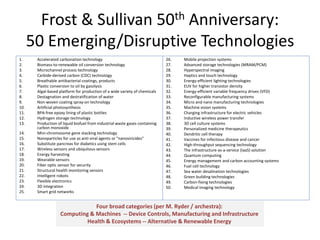
Frost & Sullivan 50th Anniversary:
50 Emerging/Disruptive Technologies
1.
2.
3.
4.
5.
6.
7.
8.
9.
10.
11.
12.
13.
14.
15.
16.
17.
18.
19.
20.
21.
22.
23.
24.
25.

Accelerated carbonation technology
Biomass-to-renewable oil conversion technology
Microchannel process technology
Carbide-derived carbon (CDC) technology
Breathable antibacterial coatings, products
Plastic conversion to oil by gasolysis
Algal-based platform for production of a wide variety of chemicals
Destagnation and destratification of water
Non-woven coating spray-on technology
Artificial photosynthesis
BPA-free epoxy lining of plastic bottles
Hydrogen storage technology
Production of liquid biofuel from industrial waste gases containing
carbon monoxide
Mini-chromosome gene stacking technology
Nanoparticles for use as anti-viral agents or "nanoviricides"
Substitute pancreas for diabetics using stem cells
Wireless sensors and ubiquitous sensors
Energy harvesting
Wearable sensors
Fiber optic sensor for security
Structural health monitoring sensors
Intelligent robots
Flexible electronics
3D integration
Smart grid networks

26.
27.
28.
29.
30.
31.
32.
33.
34.
35.
36.
37.
38.
39.
40.
41.
42.
43.
44.
45.
46.
47.
48.
49.
50.

Mobile projection systems
Advanced storage technologies (MRAM/PCM)
Hyperspectral imaging
Haptics and touch technology
Energy-efficient lighting technologies
EUV for higher transistor density
Energy-efficient variable frequency drives (VFD)
Reconfigurable manufacturing systems
Micro and nano manufacturing technologies
Machine vision systems
Charging infrastructure for electric vehicles
Inductive wireless power transfer
3D cell culture systems
Personalized medicine therapeutics
Dendritic cell therapy
Vaccines for infectious disease and cancer
High-throughput sequencing technology
The infrastructure-as-a-service (IaaS) solution
Quantum computing
Energy management and carbon accounting systems
Fuel cell technology
Sea water desalination technologies
Green building technologies
Carbon-fixing technologies
Medical imaging technology

Four broad categories (per M. Ryder / archestra):
Computing & Machines -- Device Controls, Manufacturing and Infrastructure
Health & Ecosystems -- Alternative & Renewable Energy
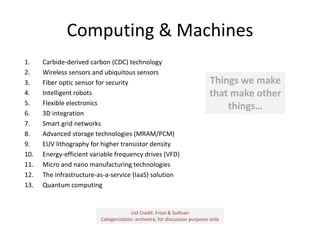
Computing & Machines
1.
2.
3.
4.
5.
6.
7.
8.
9.
10.
11.
12.
13.

Carbide-derived carbon (CDC) technology
Wireless sensors and ubiquitous sensors
Fiber optic sensor for security
Intelligent robots
Flexible electronics
3D integration
Smart grid networks
Advanced storage technologies (MRAM/PCM)
EUV lithography for higher transistor density
Energy-efficient variable frequency drives (VFD)
Micro and nano manufacturing technologies
The infrastructure-as-a-service (IaaS) solution
Quantum computing

Things we make
that make other
things…

List Credit: Frost & Sullivan
Categorization: archestra, for discussion purposes only
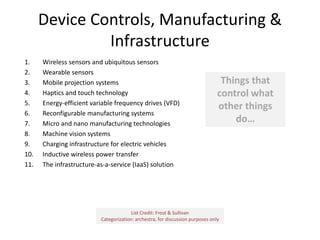
Device Controls, Manufacturing &
Infrastructure
1.
2.
3.
4.
5.
6.
7.
8.
9.
10.
11.

Wireless sensors and ubiquitous sensors
Wearable sensors
Mobile projection systems
Haptics and touch technology
Energy-efficient variable frequency drives (VFD)
Reconfigurable manufacturing systems
Micro and nano manufacturing technologies
Machine vision systems
Charging infrastructure for electric vehicles
Inductive wireless power transfer
The infrastructure-as-a-service (IaaS) solution

Things that
control what
other things
do…

List Credit: Frost & Sullivan
Categorization: archestra, for discussion purposes only
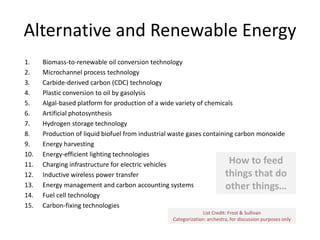
Alternative and Renewable Energy
1.
2.
3.
4.
5.
6.
7.
8.
9.
10.
11.
12.
13.
14.
15.

Biomass-to-renewable oil conversion technology
Microchannel process technology
Carbide-derived carbon (CDC) technology
Plastic conversion to oil by gasolysis
Algal-based platform for production of a wide variety of chemicals
Artificial photosynthesis
Hydrogen storage technology
Production of liquid biofuel from industrial waste gases containing carbon monoxide
Energy harvesting
Energy-efficient lighting technologies
How to feed
Charging infrastructure for electric vehicles
things that do
Inductive wireless power transfer
Energy management and carbon accounting systems
other things…
Fuel cell technology
Carbon-fixing technologies
List Credit: Frost & Sullivan
Categorization: archestra, for discussion purposes only
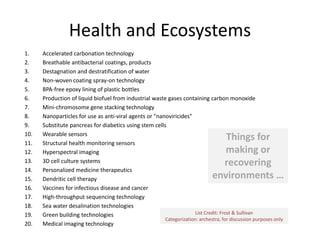
Health and Ecosystems
1.
2.
3.
4.
5.
6.
7.
8.
9.
10.
11.
12.
13.
14.
15.
16.
17.
18.
19.
20.

Accelerated carbonation technology
Breathable antibacterial coatings, products
Destagnation and destratification of water
Non-woven coating spray-on technology
BPA-free epoxy lining of plastic bottles
Production of liquid biofuel from industrial waste gases containing carbon monoxide
Mini-chromosome gene stacking technology
Nanoparticles for use as anti-viral agents or "nanoviricides"
Substitute pancreas for diabetics using stem cells
Wearable sensors
Structural health monitoring sensors
Hyperspectral imaging
3D cell culture systems
Personalized medicine therapeutics
Dendritic cell therapy
Vaccines for infectious disease and cancer
High-throughput sequencing technology
Sea water desalination technologies
List Credit: Frost & Sullivan
Green building technologies
Categorization: archestra, for discussion purposes only
Medical imaging technology

Things for
making or
recovering
environments …
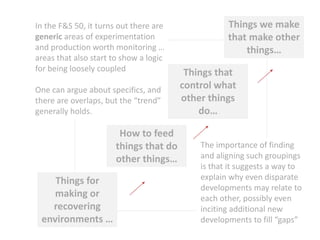
In the F&S 50, it turns out there are
generic areas of experimentation
and production worth monitoring …
areas that also start to show a logic
for being loosely coupled
One can argue about specifics, and
there are overlaps, but the “trend”
generally holds.

How to feed
things that do
other things…
Things for
making or
recovering
environments …

Things we make
that make other
things…
Things that
control what
other things
do…
The importance of finding
and aligning such groupings
is that it suggests a way to
explain why even disparate
developments may relate to
each other, possibly even
inciting additional new
developments to fill “gaps”
In other words…
It is plausible that technology-based disruptions of
some general kinds can be strongly anticipated, if not
yet specifically forecast.
This doesn’t make them less disruptive, but it can
make discovered disruptions more manageable after
the fact, while also increasing the chances of
disruption being premeditated for one’s own
purposes.
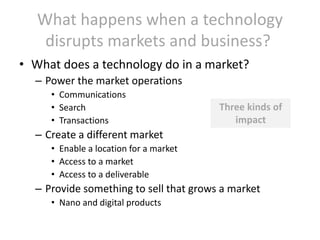
What happens when a technology
disrupts markets and business?
• What does a technology do in a market?
– Power the market operations
• Communications
• Search
• Transactions

Three kinds of
impact

– Create a different market
• Enable a location for a market
• Access to a market
• Access to a deliverable

– Provide something to sell that grows a market
• Nano and digital products
What happens when a technology
disrupts markets and business?
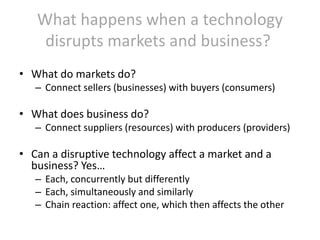
• What do markets do?
– Connect sellers (businesses) with buyers (consumers)

• What does business do?
– Connect suppliers (resources) with producers (providers)

• Can a disruptive technology affect a market and a
business? Yes…
– Each, concurrently but differently
– Each, simultaneously and similarly
– Chain reaction: affect one, which then affects the other
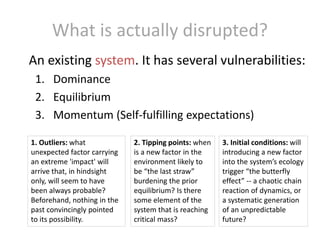
What is actually disrupted?
An existing system. It has several vulnerabilities:
1. Dominance
2. Equilibrium
3. Momentum (Self-fulfilling expectations)
1. Outliers: what
unexpected factor carrying
an extreme 'impact' will
arrive that, in hindsight
only, will seem to have
been always probable?
Beforehand, nothing in the
past convincingly pointed
to its possibility.

2. Tipping points: when
is a new factor in the
environment likely to
be “the last straw”
burdening the prior
equilibrium? Is there
some element of the
system that is reaching
critical mass?

3. Initial conditions: will
introducing a new factor
into the system’s ecology
trigger “the butterfly
effect” -- a chaotic chain
reaction of dynamics, or
a systematic generation
of an unpredictable
future?
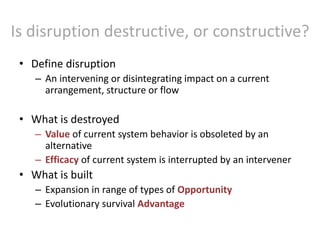
Is disruption destructive, or constructive?
• Define disruption
– An intervening or disintegrating impact on a current
arrangement, structure or flow

• What is destroyed
– Value of current system behavior is obsoleted by an
alternative
– Efficacy of current system is interrupted by an intervener

• What is built
– Expansion in range of types of Opportunity
– Evolutionary survival Advantage
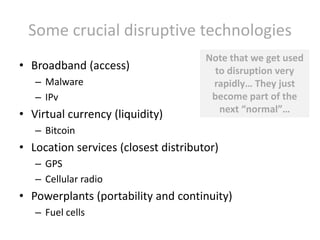
Some crucial disruptive technologies
• Broadband (access)
– Malware
– IPv

• Virtual currency (liquidity)

Note that we get used
to disruption very
rapidly… They just
become part of the
next “normal”…

– Bitcoin

• Location services (closest distributor)
– GPS
– Cellular radio

• Powerplants (portability and continuity)
– Fuel cells
WHAT IS THE SYSTEM THAT IS
BEING DISRUPTED?
The system is a set of Relational, Environmental, Cultural and
Industrial arrangements in Markets vs. Businesses.
These arrangements are subject to disruption.
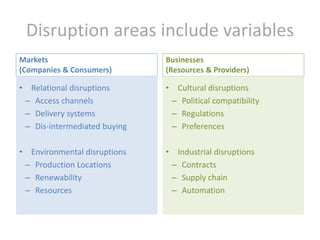
Disruption areas include variables
Markets
(Companies & Consumers)

Businesses
(Resources & Providers)

• Relational disruptions
– Access channels
– Delivery systems
– Dis-intermediated buying

• Cultural disruptions
– Political compatibility
– Regulations
– Preferences

• Environmental disruptions
– Production Locations
– Renewability
– Resources

• Industrial disruptions
– Contracts
– Supply chain
– Automation
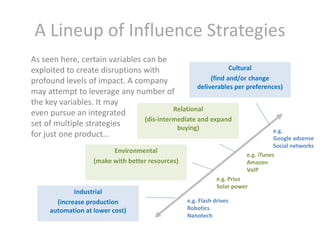
A Lineup of Influence Strategies
As seen here, certain variables can be
Cultural
exploited to create disruptions with
(find and/or change
profound levels of impact. A company
deliverables per preferences)
may attempt to leverage any number of
the key variables. It may
Relational
even pursue an integrated
(dis-intermediate and expand
set of multiple strategies
buying)
e.g.
for just one product…
Google adsense
Social networks
e.g. iTunes
Amazon
VoIP

Environmental
(make with better resources)

Industrial
(increase production
automation at lower cost)

e.g. Prius
Solar power
e.g. Flash drives
Robotics
Nanotech
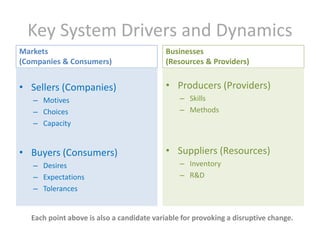
Key System Drivers and Dynamics
Markets
(Companies & Consumers)

Businesses
(Resources & Providers)

• Sellers (Companies)

• Producers (Providers)

– Motives
– Choices
– Capacity

• Buyers (Consumers)
– Desires
– Expectations
– Tolerances

– Skills
– Methods

• Suppliers (Resources)
– Inventory
– R&D

Each point above is also a candidate variable for provoking a disruptive change.
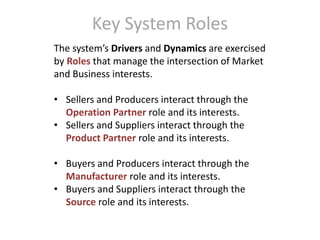
Key System Roles
The system’s Drivers and Dynamics are exercised
by Roles that manage the intersection of Market
and Business interests.
• Sellers and Producers interact through the
Operation Partner role and its interests.
• Sellers and Suppliers interact through the
Product Partner role and its interests.

• Buyers and Producers interact through the
Manufacturer role and its interests.
• Buyers and Suppliers interact through the
Source role and its interests.
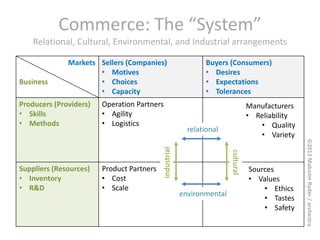
Commerce: The “System”
Relational, Cultural, Environmental, and Industrial arrangements

Business

Markets Sellers (Companies)
• Motives
• Choices
• Capacity

Suppliers (Resources)
• Inventory
• R&D

Product Partners
• Cost
• Scale

Manufacturers
• Reliability
• Quality
• Variety

relational

cultural

industrial

Operation Partners
• Agility
• Logistics

environmental

Sources
• Values
• Ethics
• Tastes
• Safety

©2013 Malcolm Ryder / archestra

Producers (Providers)
• Skills
• Methods

Buyers (Consumers)
• Desires
• Expectations
• Tolerances
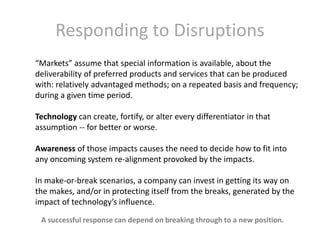
Responding to Disruptions
“Markets” assume that special information is available, about the
deliverability of preferred products and services that can be produced
with: relatively advantaged methods; on a repeated basis and frequency;
during a given time period.

Technology can create, fortify, or alter every differentiator in that
assumption -- for better or worse.
Awareness of those impacts causes the need to decide how to fit into
any oncoming system re-alignment provoked by the impacts.
In make-or-break scenarios, a company can invest in getting its way on
the makes, and/or in protecting itself from the breaks, generated by the
impact of technology’s influence.
A successful response can depend on breaking through to a new position.
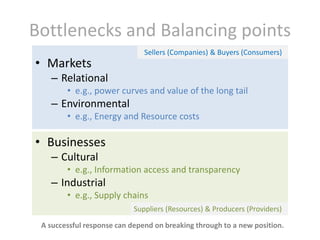
Bottlenecks and Balancing points
• Markets

Sellers (Companies) & Buyers (Consumers)

– Relational
• e.g., power curves and value of the long tail

– Environmental
• e.g., Energy and Resource costs

• Businesses
– Cultural
• e.g., Information access and transparency

– Industrial
• e.g., Supply chains
Suppliers (Resources) & Producers (Providers)
A successful response can depend on breaking through to a new position.
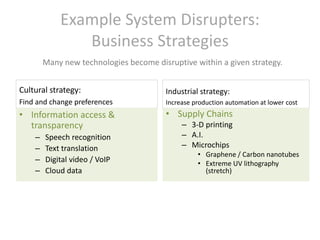
Example System Disrupters:
Business Strategies
Many new technologies become disruptive within a given strategy.
Cultural strategy:

Industrial strategy:

Find and change preferences

Increase production automation at lower cost

• Information access &
transparency

• Supply Chains

–
–
–
–

Speech recognition
Text translation
Digital video / VoIP
Cloud data

– 3-D printing
– A.I.
– Microchips
• Graphene / Carbon nanotubes
• Extreme UV lithography
(stretch)
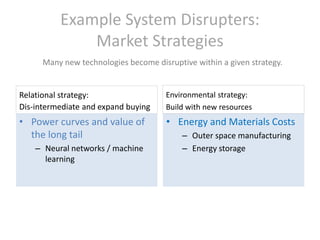
Example System Disrupters:
Market Strategies
Many new technologies become disruptive within a given strategy.

Relational strategy:
Dis-intermediate and expand buying

Environmental strategy:
Build with new resources

• Power curves and value of
the long tail

• Energy and Materials Costs

– Neural networks / machine
learning

– Outer space manufacturing
– Energy storage
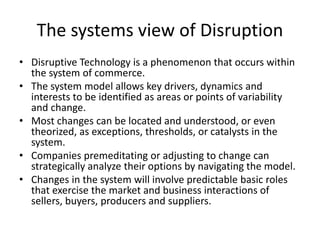
The systems view of Disruption
• Disruptive Technology is a phenomenon that occurs within
the system of commerce.
• The system model allows key drivers, dynamics and
interests to be identified as areas or points of variability
and change.
• Most changes can be located and understood, or even
theorized, as exceptions, thresholds, or catalysts in the
system.
• Companies premeditating or adjusting to change can
strategically analyze their options by navigating the model.
• Changes in the system will involve predictable basic roles
that exercise the market and business interactions of
sellers, buyers, producers and suppliers.

Disruptive Technologies Explained

  • 1.
    Disruptive Technologies: Explained An archestranotebook © 2013 Malcolm Ryder / archestra
  • 2.
    WHAT ARE THEDISRUPTIVE TECHNOLOGIES LOOMING BEFORE US? We know many of them, but the answer is “it depends”…
  • 3.
    What is a“technology” Any item designed specifically to be a tool used in a prescribed method of production. What will they disrupt, and Why?
  • 4.
    Frost & Sullivan50th Anniversary: 50 Emerging/Disruptive Technologies 1. 2. 3. 4. 5. 6. 7. 8. 9. 10. 11. 12. 13. 14. 15. 16. 17. 18. 19. 20. 21. 22. 23. 24. 25. Accelerated carbonation technology Biomass-to-renewable oil conversion technology Microchannel process technology Carbide-derived carbon (CDC) technology Breathable antibacterial coatings, products Plastic conversion to oil by gasolysis Algal-based platform for production of a wide variety of chemicals Destagnation and destratification of water Non-woven coating spray-on technology Artificial photosynthesis BPA-free epoxy lining of plastic bottles Hydrogen storage technology Production of liquid biofuel from industrial waste gases containing carbon monoxide Mini-chromosome gene stacking technology Nanoparticles for use as anti-viral agents or "nanoviricides" Substitute pancreas for diabetics using stem cells Wireless sensors and ubiquitous sensors Energy harvesting Wearable sensors Fiber optic sensor for security Structural health monitoring sensors Intelligent robots Flexible electronics 3D integration Smart grid networks 26. 27. 28. 29. 30. 31. 32. 33. 34. 35. 36. 37. 38. 39. 40. 41. 42. 43. 44. 45. 46. 47. 48. 49. 50. Mobile projection systems Advanced storage technologies (MRAM/PCM) Hyperspectral imaging Haptics and touch technology Energy-efficient lighting technologies EUV for higher transistor density Energy-efficient variable frequency drives (VFD) Reconfigurable manufacturing systems Micro and nano manufacturing technologies Machine vision systems Charging infrastructure for electric vehicles Inductive wireless power transfer 3D cell culture systems Personalized medicine therapeutics Dendritic cell therapy Vaccines for infectious disease and cancer High-throughput sequencing technology The infrastructure-as-a-service (IaaS) solution Quantum computing Energy management and carbon accounting systems Fuel cell technology Sea water desalination technologies Green building technologies Carbon-fixing technologies Medical imaging technology Four broad categories (per M. Ryder / archestra): Computing & Machines -- Device Controls, Manufacturing and Infrastructure Health & Ecosystems -- Alternative & Renewable Energy
  • 5.
    Computing & Machines 1. 2. 3. 4. 5. 6. 7. 8. 9. 10. 11. 12. 13. Carbide-derivedcarbon (CDC) technology Wireless sensors and ubiquitous sensors Fiber optic sensor for security Intelligent robots Flexible electronics 3D integration Smart grid networks Advanced storage technologies (MRAM/PCM) EUV lithography for higher transistor density Energy-efficient variable frequency drives (VFD) Micro and nano manufacturing technologies The infrastructure-as-a-service (IaaS) solution Quantum computing Things we make that make other things… List Credit: Frost & Sullivan Categorization: archestra, for discussion purposes only
  • 6.
    Device Controls, Manufacturing& Infrastructure 1. 2. 3. 4. 5. 6. 7. 8. 9. 10. 11. Wireless sensors and ubiquitous sensors Wearable sensors Mobile projection systems Haptics and touch technology Energy-efficient variable frequency drives (VFD) Reconfigurable manufacturing systems Micro and nano manufacturing technologies Machine vision systems Charging infrastructure for electric vehicles Inductive wireless power transfer The infrastructure-as-a-service (IaaS) solution Things that control what other things do… List Credit: Frost & Sullivan Categorization: archestra, for discussion purposes only
  • 7.
    Alternative and RenewableEnergy 1. 2. 3. 4. 5. 6. 7. 8. 9. 10. 11. 12. 13. 14. 15. Biomass-to-renewable oil conversion technology Microchannel process technology Carbide-derived carbon (CDC) technology Plastic conversion to oil by gasolysis Algal-based platform for production of a wide variety of chemicals Artificial photosynthesis Hydrogen storage technology Production of liquid biofuel from industrial waste gases containing carbon monoxide Energy harvesting Energy-efficient lighting technologies How to feed Charging infrastructure for electric vehicles things that do Inductive wireless power transfer Energy management and carbon accounting systems other things… Fuel cell technology Carbon-fixing technologies List Credit: Frost & Sullivan Categorization: archestra, for discussion purposes only
  • 8.
    Health and Ecosystems 1. 2. 3. 4. 5. 6. 7. 8. 9. 10. 11. 12. 13. 14. 15. 16. 17. 18. 19. 20. Acceleratedcarbonation technology Breathable antibacterial coatings, products Destagnation and destratification of water Non-woven coating spray-on technology BPA-free epoxy lining of plastic bottles Production of liquid biofuel from industrial waste gases containing carbon monoxide Mini-chromosome gene stacking technology Nanoparticles for use as anti-viral agents or "nanoviricides" Substitute pancreas for diabetics using stem cells Wearable sensors Structural health monitoring sensors Hyperspectral imaging 3D cell culture systems Personalized medicine therapeutics Dendritic cell therapy Vaccines for infectious disease and cancer High-throughput sequencing technology Sea water desalination technologies List Credit: Frost & Sullivan Green building technologies Categorization: archestra, for discussion purposes only Medical imaging technology Things for making or recovering environments …
  • 9.
    In the F&S50, it turns out there are generic areas of experimentation and production worth monitoring … areas that also start to show a logic for being loosely coupled One can argue about specifics, and there are overlaps, but the “trend” generally holds. How to feed things that do other things… Things for making or recovering environments … Things we make that make other things… Things that control what other things do… The importance of finding and aligning such groupings is that it suggests a way to explain why even disparate developments may relate to each other, possibly even inciting additional new developments to fill “gaps”
  • 10.
    In other words… Itis plausible that technology-based disruptions of some general kinds can be strongly anticipated, if not yet specifically forecast. This doesn’t make them less disruptive, but it can make discovered disruptions more manageable after the fact, while also increasing the chances of disruption being premeditated for one’s own purposes.
  • 11.
    What happens whena technology disrupts markets and business? • What does a technology do in a market? – Power the market operations • Communications • Search • Transactions Three kinds of impact – Create a different market • Enable a location for a market • Access to a market • Access to a deliverable – Provide something to sell that grows a market • Nano and digital products
  • 12.
    What happens whena technology disrupts markets and business? • What do markets do? – Connect sellers (businesses) with buyers (consumers) • What does business do? – Connect suppliers (resources) with producers (providers) • Can a disruptive technology affect a market and a business? Yes… – Each, concurrently but differently – Each, simultaneously and similarly – Chain reaction: affect one, which then affects the other
  • 13.
    What is actuallydisrupted? An existing system. It has several vulnerabilities: 1. Dominance 2. Equilibrium 3. Momentum (Self-fulfilling expectations) 1. Outliers: what unexpected factor carrying an extreme 'impact' will arrive that, in hindsight only, will seem to have been always probable? Beforehand, nothing in the past convincingly pointed to its possibility. 2. Tipping points: when is a new factor in the environment likely to be “the last straw” burdening the prior equilibrium? Is there some element of the system that is reaching critical mass? 3. Initial conditions: will introducing a new factor into the system’s ecology trigger “the butterfly effect” -- a chaotic chain reaction of dynamics, or a systematic generation of an unpredictable future?
  • 14.
    Is disruption destructive,or constructive? • Define disruption – An intervening or disintegrating impact on a current arrangement, structure or flow • What is destroyed – Value of current system behavior is obsoleted by an alternative – Efficacy of current system is interrupted by an intervener • What is built – Expansion in range of types of Opportunity – Evolutionary survival Advantage
  • 15.
    Some crucial disruptivetechnologies • Broadband (access) – Malware – IPv • Virtual currency (liquidity) Note that we get used to disruption very rapidly… They just become part of the next “normal”… – Bitcoin • Location services (closest distributor) – GPS – Cellular radio • Powerplants (portability and continuity) – Fuel cells
  • 16.
    WHAT IS THESYSTEM THAT IS BEING DISRUPTED? The system is a set of Relational, Environmental, Cultural and Industrial arrangements in Markets vs. Businesses. These arrangements are subject to disruption.
  • 17.
    Disruption areas includevariables Markets (Companies & Consumers) Businesses (Resources & Providers) • Relational disruptions – Access channels – Delivery systems – Dis-intermediated buying • Cultural disruptions – Political compatibility – Regulations – Preferences • Environmental disruptions – Production Locations – Renewability – Resources • Industrial disruptions – Contracts – Supply chain – Automation
  • 18.
    A Lineup ofInfluence Strategies As seen here, certain variables can be Cultural exploited to create disruptions with (find and/or change profound levels of impact. A company deliverables per preferences) may attempt to leverage any number of the key variables. It may Relational even pursue an integrated (dis-intermediate and expand set of multiple strategies buying) e.g. for just one product… Google adsense Social networks e.g. iTunes Amazon VoIP Environmental (make with better resources) Industrial (increase production automation at lower cost) e.g. Prius Solar power e.g. Flash drives Robotics Nanotech
  • 19.
    Key System Driversand Dynamics Markets (Companies & Consumers) Businesses (Resources & Providers) • Sellers (Companies) • Producers (Providers) – Motives – Choices – Capacity • Buyers (Consumers) – Desires – Expectations – Tolerances – Skills – Methods • Suppliers (Resources) – Inventory – R&D Each point above is also a candidate variable for provoking a disruptive change.
  • 20.
    Key System Roles Thesystem’s Drivers and Dynamics are exercised by Roles that manage the intersection of Market and Business interests. • Sellers and Producers interact through the Operation Partner role and its interests. • Sellers and Suppliers interact through the Product Partner role and its interests. • Buyers and Producers interact through the Manufacturer role and its interests. • Buyers and Suppliers interact through the Source role and its interests.
  • 21.
    Commerce: The “System” Relational,Cultural, Environmental, and Industrial arrangements Business Markets Sellers (Companies) • Motives • Choices • Capacity Suppliers (Resources) • Inventory • R&D Product Partners • Cost • Scale Manufacturers • Reliability • Quality • Variety relational cultural industrial Operation Partners • Agility • Logistics environmental Sources • Values • Ethics • Tastes • Safety ©2013 Malcolm Ryder / archestra Producers (Providers) • Skills • Methods Buyers (Consumers) • Desires • Expectations • Tolerances
  • 22.
    Responding to Disruptions “Markets”assume that special information is available, about the deliverability of preferred products and services that can be produced with: relatively advantaged methods; on a repeated basis and frequency; during a given time period. Technology can create, fortify, or alter every differentiator in that assumption -- for better or worse. Awareness of those impacts causes the need to decide how to fit into any oncoming system re-alignment provoked by the impacts. In make-or-break scenarios, a company can invest in getting its way on the makes, and/or in protecting itself from the breaks, generated by the impact of technology’s influence. A successful response can depend on breaking through to a new position.
  • 23.
    Bottlenecks and Balancingpoints • Markets Sellers (Companies) & Buyers (Consumers) – Relational • e.g., power curves and value of the long tail – Environmental • e.g., Energy and Resource costs • Businesses – Cultural • e.g., Information access and transparency – Industrial • e.g., Supply chains Suppliers (Resources) & Producers (Providers) A successful response can depend on breaking through to a new position.
  • 24.
    Example System Disrupters: BusinessStrategies Many new technologies become disruptive within a given strategy. Cultural strategy: Industrial strategy: Find and change preferences Increase production automation at lower cost • Information access & transparency • Supply Chains – – – – Speech recognition Text translation Digital video / VoIP Cloud data – 3-D printing – A.I. – Microchips • Graphene / Carbon nanotubes • Extreme UV lithography (stretch)
  • 25.
    Example System Disrupters: MarketStrategies Many new technologies become disruptive within a given strategy. Relational strategy: Dis-intermediate and expand buying Environmental strategy: Build with new resources • Power curves and value of the long tail • Energy and Materials Costs – Neural networks / machine learning – Outer space manufacturing – Energy storage
  • 26.
    The systems viewof Disruption • Disruptive Technology is a phenomenon that occurs within the system of commerce. • The system model allows key drivers, dynamics and interests to be identified as areas or points of variability and change. • Most changes can be located and understood, or even theorized, as exceptions, thresholds, or catalysts in the system. • Companies premeditating or adjusting to change can strategically analyze their options by navigating the model. • Changes in the system will involve predictable basic roles that exercise the market and business interactions of sellers, buyers, producers and suppliers.