

Authority versus
Leadership
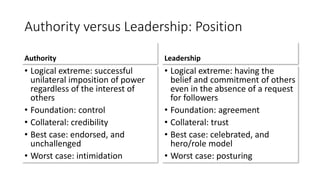
Authority versus Leadership: Position
Authority
• Logical extreme: successful
unilateral imposition of power
regardless of the interest of
others
• Foundation: control
• Collateral: credibility
• Best case: endorsed, and
unchallenged
• Worst case: intimidation
Leadership
• Logical extreme: having the
belief and commitment of others
even in the absence of a request
for followers
• Foundation: agreement
• Collateral: trust
• Best case: celebrated, and
hero/role model
• Worst case: posturing
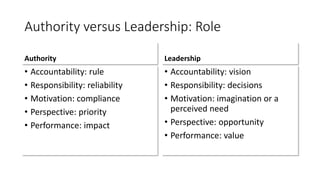
Authority versus Leadership: Role
Authority
• Accountability: rule
• Responsibility: reliability
• Motivation: compliance
• Perspective: priority
• Performance: impact
Leadership
• Accountability: vision
• Responsibility: decisions
• Motivation: imagination or a
perceived need
• Perspective: opportunity
• Performance: value
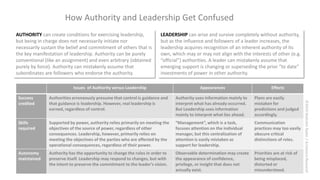
How Authority and Leadership Get Confused
Issues of Authority versus Leadership Appearances Effects
Success
credited
Authorities erroneously presume that control is guidance and
that guidance is leadership. However, real leadership is
earned, regardless of control.
Authority uses information mainly to
interpret what has already occurred.
But Leadership uses information
mainly to interpret what lies ahead.
Plans are easily
mistaken for
predictions and judged
accordingly.
Skills
required
Supported by power, authority relies primarily on meeting the
objectives of the source of power, regardless of other
consequences. Leadership, however, primarily relies on
meeting the objectives of the parties who are affected by the
operational consequences, regardless of their power.
“Management”, which is a task,
focuses attention on the individual
manager, but this centralization of
attention is easily mistaken as
support for leadership.
Communication
practices may too easily
obscure critical
distinctions of roles.
Autonomy
maintained
Authority has the opportunity to change the rules in order to
preserve itself. Leadership may respond to changes, but with
the intent to preserve the commitment to the leader’s vision.
Observable determination may create
the appearance of confidence,
privilege, or insight that does not
actually exist.
Priorities are at risk of
being misplaced,
distorted or
misunderstood.
AUTHORITY can create conditions for exercising leadership,
but being in charge does not necessarily initiate nor
necessarily sustain the belief and commitment of others that is
the key manifestation of leadership. Authority can be purely
conventional (like an assignment) and even arbitrary (obtained
purely by force). Authority can mistakenly assume that
subordinates are followers who endorse the authority.
LEADERSHIP can arise and survive completely without authority,
but as the influence and followers of a leader increases, the
leadership acquires recognition of an inherent authority of its
own, which may or may not align with the interests of other (e.g.
“official”) authorities. A leader can mistakenly assume that
emerging support is changing or superseding the prior “to date”
investments of power in other authority.
©2019MalcolmRyder/ArchestraResearch
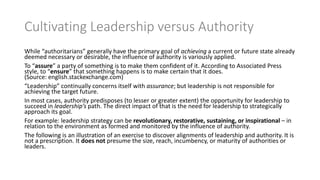
Cultivating Leadership versus Authority
While “authoritarians” generally have the primary goal of achieving a current or future state already
deemed necessary or desirable, the influence of authority is variously applied.
To “assure” a party of something is to make them confident of it. According to Associated Press
style, to “ensure” that something happens is to make certain that it does.
(Source: english.stackexchange.com)
“Leadership” continually concerns itself with assurance; but leadership is not responsible for
achieving the target future.
In most cases, authority predisposes (to lesser or greater extent) the opportunity for leadership to
succeed in leadership’s path. The direct impact of that is the need for leadership to strategically
approach its goal.
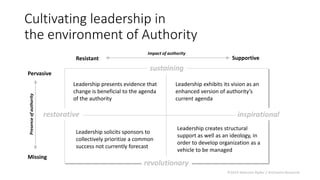
For example: leadership strategy can be revolutionary, restorative, sustaining, or inspirational – in
relation to the environment as formed and monitored by the influence of authority.
The following is an illustration of an exercise to discover alignments of leadership and authority. It is
not a prescription. It does not presume the size, reach, incumbency, or maturity of authorities or
leaders.
Cultivating leadership in
the environment of Authority
Missing
Pervasive
Resistant Supportive
z
Leadership presents evidence that
change is beneficial to the agenda
of the authority
Leadership solicits sponsors to
collectively prioritize a common
success not currently forecast
Leadership exhibits its vision as an
enhanced version of authority’s
current agenda
Leadership creates structural
support as well as an ideology, in
order to develop organization as a
vehicle to be managed
revolutionary
restorative inspirational
sustaining
Impact of authority
Presenceofauthority
©2019 Malcolm Ryder / Archestra Research
Shareholders versus Stakeholders
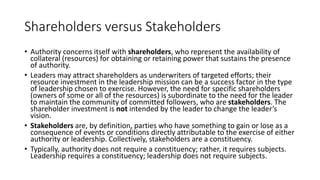
• Authority concerns itself with shareholders, who represent the availability of
collateral (resources) for obtaining or retaining power that sustains the presence
of authority.
• Leaders may attract shareholders as underwriters of targeted efforts; their
resource investment in the leadership mission can be a success factor in the type
of leadership chosen to exercise. However, the need for specific shareholders
(owners of some or all of the resources) is subordinate to the need for the leader
to maintain the community of committed followers, who are stakeholders. The
shareholder investment is not intended by the leader to change the leader’s
vision.
• Stakeholders are, by definition, parties who have something to gain or lose as a
consequence of events or conditions directly attributable to the exercise of either
authority or leadership. Collectively, stakeholders are a constituency.
• Typically, authority does not require a constituency; rather, it requires subjects.
Leadership requires a constituency; leadership does not require subjects.
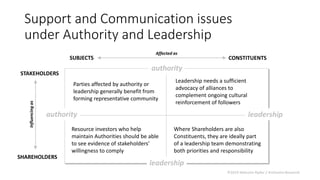
Support and Communication issues
under Authority and Leadership
SHAREHOLDERS
STAKEHOLDERS
SUBJECTS CONSTITUENTS
z
Parties affected by authority or
leadership generally benefit from
forming representative community
Resource investors who help
maintain Authorities should be able
to see evidence of stakeholders’
willingness to comply
Leadership needs a sufficient
advocacy of alliances to
complement ongoing cultural
reinforcement of followers
Where Shareholders are also
Constituents, they are ideally part
of a leadership team demonstrating
both priorities and responsibility
Affected as
Influencingas
leadership
authority leadership
authority
©2019 Malcolm Ryder / Archestra Research
Archestra notebooks compile and organize decades of in-the-field and ongoing empirical findings.
All presented findings are derived exclusively from original research.
Archestra notebooks carry no prescriptive warranty.
As ongoing research, all notebooks are subject to change at any time.
©2019 Malcolm Ryder / Archestra Research
www.archestra.com
mryder@archestra.com
Archestra research is done from the perspective of strategy and architecture.
With all subject matter and topics, the purpose of the notes is analytic, primarily to:
* explore, expose and model why things are
included, excluded, or can happen
in given ways and/or to certain effects.
* comment on, and navigate between,
motives and potentials that predetermine
decisions about, and shapings of, the observed activity.

Authority versus Leadership

  • 1.
  • 2.
    Authority versus Leadership:Position Authority • Logical extreme: successful unilateral imposition of power regardless of the interest of others • Foundation: control • Collateral: credibility • Best case: endorsed, and unchallenged • Worst case: intimidation Leadership • Logical extreme: having the belief and commitment of others even in the absence of a request for followers • Foundation: agreement • Collateral: trust • Best case: celebrated, and hero/role model • Worst case: posturing
  • 3.
    Authority versus Leadership:Role Authority • Accountability: rule • Responsibility: reliability • Motivation: compliance • Perspective: priority • Performance: impact Leadership • Accountability: vision • Responsibility: decisions • Motivation: imagination or a perceived need • Perspective: opportunity • Performance: value
  • 4.
    How Authority andLeadership Get Confused Issues of Authority versus Leadership Appearances Effects Success credited Authorities erroneously presume that control is guidance and that guidance is leadership. However, real leadership is earned, regardless of control. Authority uses information mainly to interpret what has already occurred. But Leadership uses information mainly to interpret what lies ahead. Plans are easily mistaken for predictions and judged accordingly. Skills required Supported by power, authority relies primarily on meeting the objectives of the source of power, regardless of other consequences. Leadership, however, primarily relies on meeting the objectives of the parties who are affected by the operational consequences, regardless of their power. “Management”, which is a task, focuses attention on the individual manager, but this centralization of attention is easily mistaken as support for leadership. Communication practices may too easily obscure critical distinctions of roles. Autonomy maintained Authority has the opportunity to change the rules in order to preserve itself. Leadership may respond to changes, but with the intent to preserve the commitment to the leader’s vision. Observable determination may create the appearance of confidence, privilege, or insight that does not actually exist. Priorities are at risk of being misplaced, distorted or misunderstood. AUTHORITY can create conditions for exercising leadership, but being in charge does not necessarily initiate nor necessarily sustain the belief and commitment of others that is the key manifestation of leadership. Authority can be purely conventional (like an assignment) and even arbitrary (obtained purely by force). Authority can mistakenly assume that subordinates are followers who endorse the authority. LEADERSHIP can arise and survive completely without authority, but as the influence and followers of a leader increases, the leadership acquires recognition of an inherent authority of its own, which may or may not align with the interests of other (e.g. “official”) authorities. A leader can mistakenly assume that emerging support is changing or superseding the prior “to date” investments of power in other authority. ©2019MalcolmRyder/ArchestraResearch
  • 5.
    Cultivating Leadership versusAuthority While “authoritarians” generally have the primary goal of achieving a current or future state already deemed necessary or desirable, the influence of authority is variously applied. To “assure” a party of something is to make them confident of it. According to Associated Press style, to “ensure” that something happens is to make certain that it does. (Source: english.stackexchange.com) “Leadership” continually concerns itself with assurance; but leadership is not responsible for achieving the target future. In most cases, authority predisposes (to lesser or greater extent) the opportunity for leadership to succeed in leadership’s path. The direct impact of that is the need for leadership to strategically approach its goal. For example: leadership strategy can be revolutionary, restorative, sustaining, or inspirational – in relation to the environment as formed and monitored by the influence of authority. The following is an illustration of an exercise to discover alignments of leadership and authority. It is not a prescription. It does not presume the size, reach, incumbency, or maturity of authorities or leaders.
  • 6.
    Cultivating leadership in theenvironment of Authority Missing Pervasive Resistant Supportive z Leadership presents evidence that change is beneficial to the agenda of the authority Leadership solicits sponsors to collectively prioritize a common success not currently forecast Leadership exhibits its vision as an enhanced version of authority’s current agenda Leadership creates structural support as well as an ideology, in order to develop organization as a vehicle to be managed revolutionary restorative inspirational sustaining Impact of authority Presenceofauthority ©2019 Malcolm Ryder / Archestra Research
  • 7.
    Shareholders versus Stakeholders •Authority concerns itself with shareholders, who represent the availability of collateral (resources) for obtaining or retaining power that sustains the presence of authority. • Leaders may attract shareholders as underwriters of targeted efforts; their resource investment in the leadership mission can be a success factor in the type of leadership chosen to exercise. However, the need for specific shareholders (owners of some or all of the resources) is subordinate to the need for the leader to maintain the community of committed followers, who are stakeholders. The shareholder investment is not intended by the leader to change the leader’s vision. • Stakeholders are, by definition, parties who have something to gain or lose as a consequence of events or conditions directly attributable to the exercise of either authority or leadership. Collectively, stakeholders are a constituency. • Typically, authority does not require a constituency; rather, it requires subjects. Leadership requires a constituency; leadership does not require subjects.
  • 8.
    Support and Communicationissues under Authority and Leadership SHAREHOLDERS STAKEHOLDERS SUBJECTS CONSTITUENTS z Parties affected by authority or leadership generally benefit from forming representative community Resource investors who help maintain Authorities should be able to see evidence of stakeholders’ willingness to comply Leadership needs a sufficient advocacy of alliances to complement ongoing cultural reinforcement of followers Where Shareholders are also Constituents, they are ideally part of a leadership team demonstrating both priorities and responsibility Affected as Influencingas leadership authority leadership authority ©2019 Malcolm Ryder / Archestra Research
  • 9.
    Archestra notebooks compileand organize decades of in-the-field and ongoing empirical findings. All presented findings are derived exclusively from original research. Archestra notebooks carry no prescriptive warranty. As ongoing research, all notebooks are subject to change at any time. ©2019 Malcolm Ryder / Archestra Research www.archestra.com mryder@archestra.com Archestra research is done from the perspective of strategy and architecture. With all subject matter and topics, the purpose of the notes is analytic, primarily to: * explore, expose and model why things are included, excluded, or can happen in given ways and/or to certain effects. * comment on, and navigate between, motives and potentials that predetermine decisions about, and shapings of, the observed activity.