Strategic
structures for
aligning
Cooperation
Enterprise and non-enterprise
configurations
Enterprise or Not
An “enterprise” can have business
outcomes as its common purpose
but it is not necessarily business that
characterizes an enterprise.
In fact, to most clearly define an
“enterprise”, it is also necessary to
know what it is NOT. In that regard,
the fundamental distinction has
nothing to do with “systems”, nor
“complexity”, nor “scale”.
An enterprise model of organization is
a strategic choice for pursuit of a
purpose. But its basic differentiation
from other models stems from the
role of a central authority.
Supervisory authority aligns the tactics
of multiple parties under centrally
declared governance, priorities, and
goals. Without this, the organizational
configuration is not an enterprise.
Enterprise Coordination for Purpose
• An enterprise is a structural model for coordinating multiple
organizations to a common purpose under a single supervisory
management authority.
• An enterprise is characterized by its creation, sustainability, and
portfolio of opportunity.
• The role of the authority over the included parties is to direct and
leverage combinations of their otherwise independent autonomy,
production and contribution.
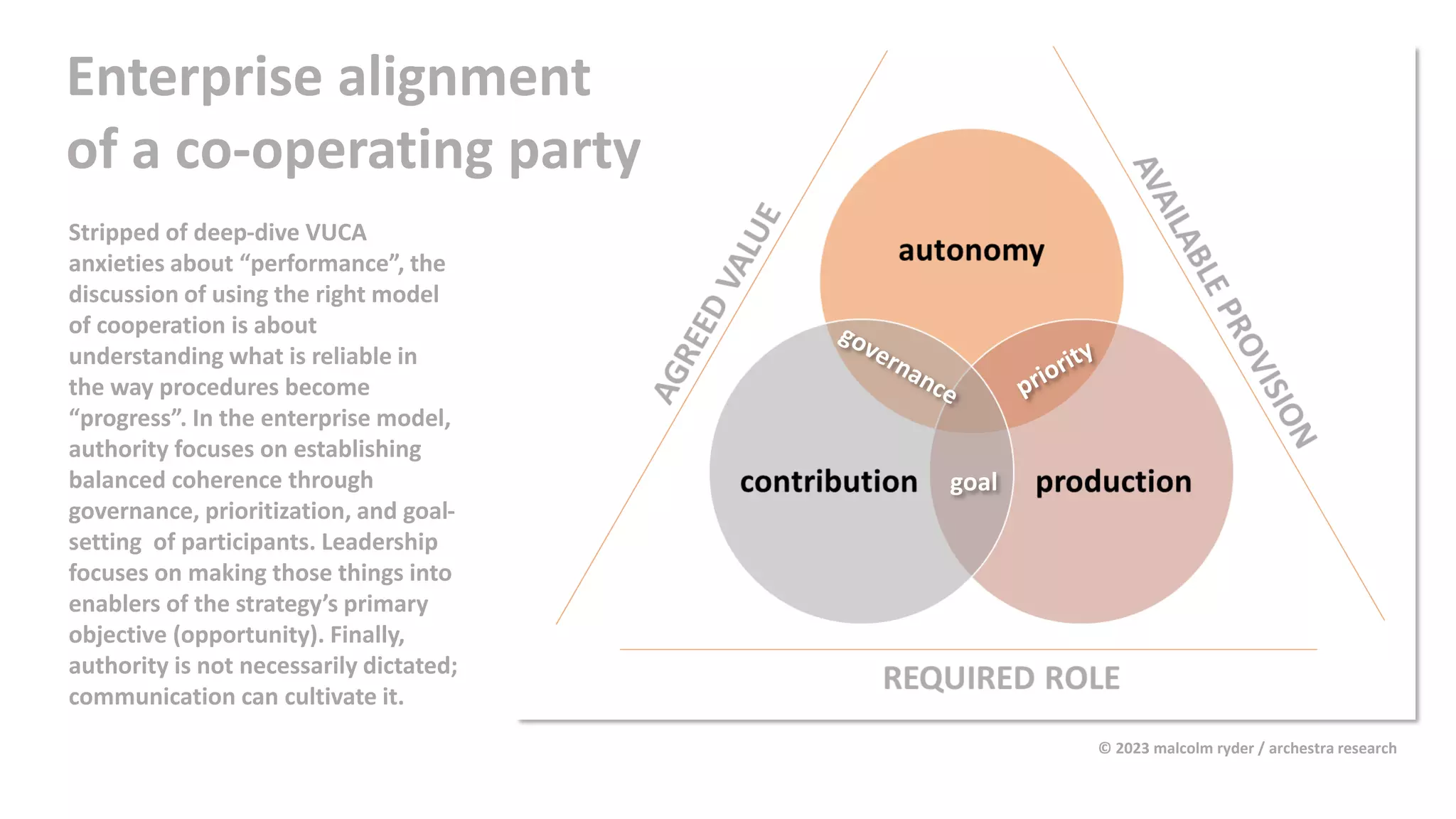
goal
Enterprise alignment
of a co-operating party
Stripped of deep-dive VUCA
anxieties about “performance”, the
discussion of using the right model
of cooperation is about
understanding what is reliable in
the way procedures become
“progress”. In the enterprise model,
authority focuses on establishing
balanced coherence through
governance, prioritization, and goal-
setting of participants. Leadership
focuses on making those things into
enablers of the strategy’s primary
objective (opportunity). Finally,
authority is not necessarily dictated;
communication can cultivate it.
© 2023 malcolm ryder / archestra research
Other co-operative models (non-enterprise)
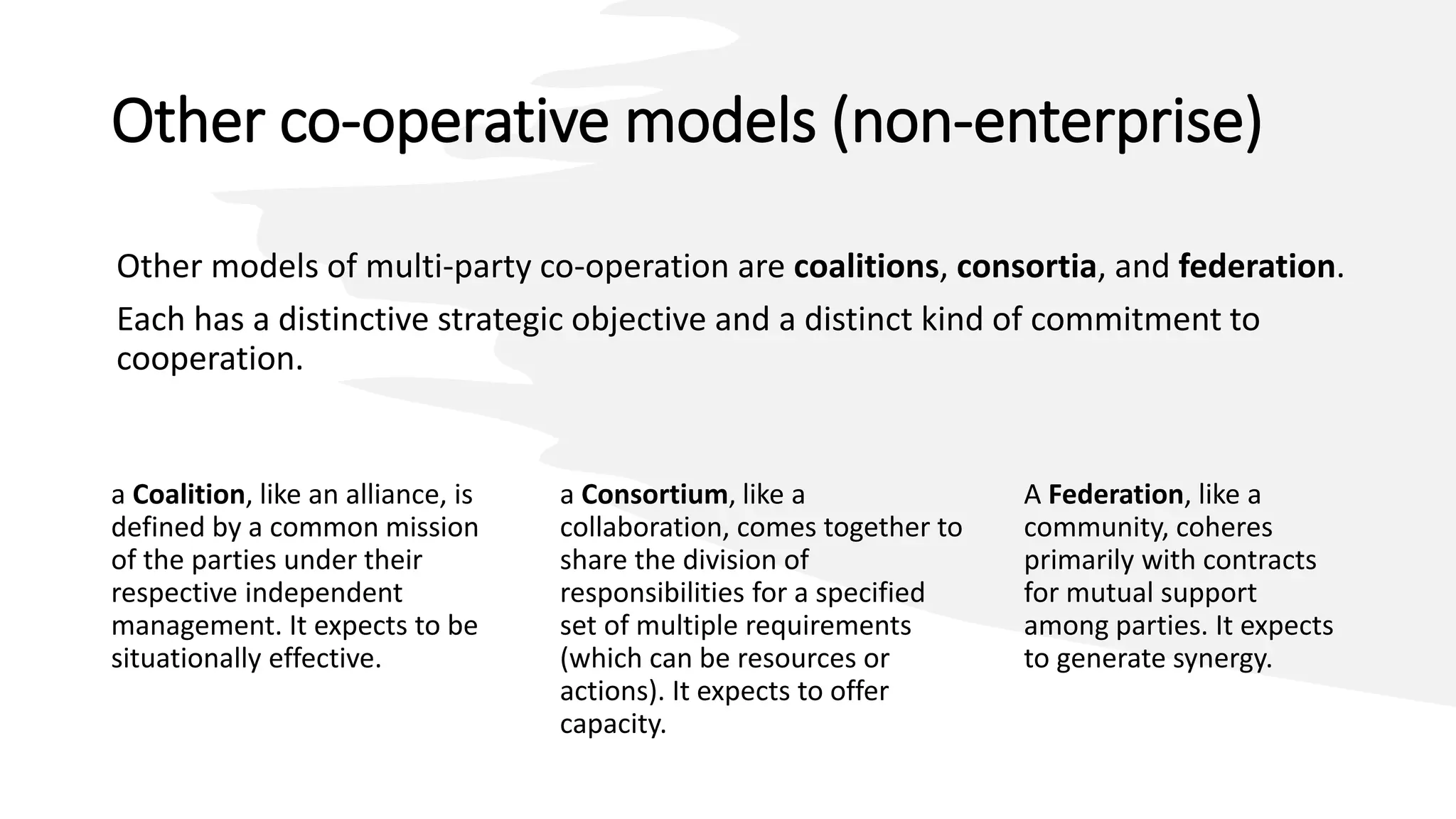
Other models of multi-party co-operation are coalitions, consortia, and federation.
Each has a distinctive strategic objective and a distinct kind of commitment to
cooperation.
a Coalition, like an alliance, is
defined by a common mission
of the parties under their
respective independent
management. It expects to be
situationally effective.
A Federation, like a
community, coheres
primarily with contracts
for mutual support
among parties. It expects
to generate synergy.
a Consortium, like a
collaboration, comes together to
share the division of
responsibilities for a specified
set of multiple requirements
(which can be resources or
actions). It expects to offer
capacity.
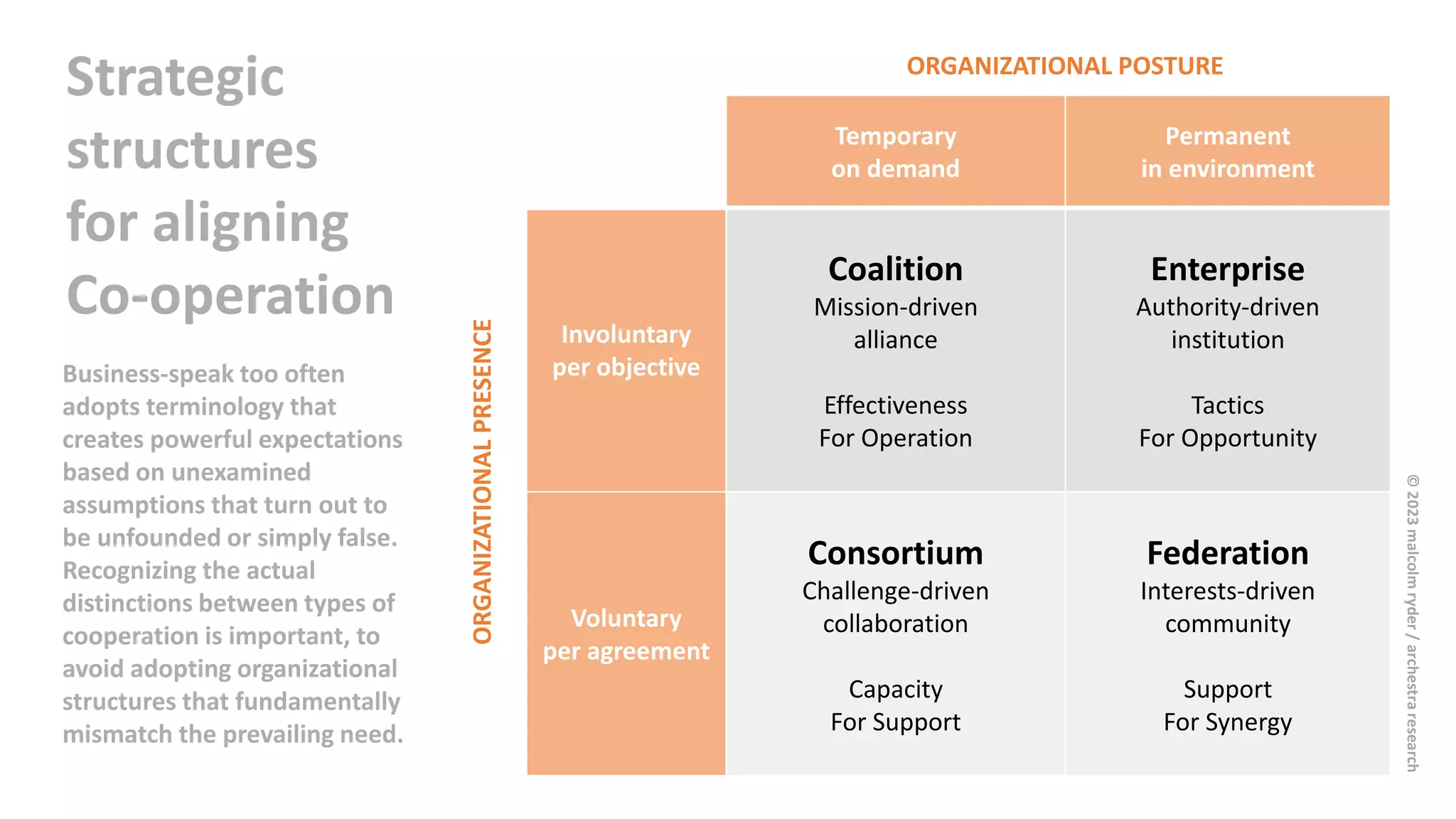
Temporary
on demand
Permanent
in environment
Involuntary
per objective
Coalition
Mission-driven
alliance
Effectiveness
For Operation
Enterprise
Authority-driven
institution
Tactics
For Opportunity
Voluntary
per agreement
Consortium
Challenge-driven
collaboration
Capacity
For Support
Federation
Interests-driven
community
Support
For Synergy
Strategic
structures
for aligning
Co-operation
ORGANIZATIONAL POSTURE
ORGANIZATIONAL
PRESENCE
Business-speak too often
adopts terminology that
creates powerful expectations
based on unexamined
assumptions that turn out to
be unfounded or simply false.
Recognizing the actual
distinctions between types of
cooperation is important, to
avoid adopting organizational
structures that fundamentally
mismatch the prevailing need.
©
2023
malcolm
ryder
/
archestra
research

Strategic structures for aligning Cooperation_the Enterprise.pdf

  • 1.
  • 2.
    Enterprise or Not An“enterprise” can have business outcomes as its common purpose but it is not necessarily business that characterizes an enterprise. In fact, to most clearly define an “enterprise”, it is also necessary to know what it is NOT. In that regard, the fundamental distinction has nothing to do with “systems”, nor “complexity”, nor “scale”. An enterprise model of organization is a strategic choice for pursuit of a purpose. But its basic differentiation from other models stems from the role of a central authority. Supervisory authority aligns the tactics of multiple parties under centrally declared governance, priorities, and goals. Without this, the organizational configuration is not an enterprise.
  • 3.
    Enterprise Coordination forPurpose • An enterprise is a structural model for coordinating multiple organizations to a common purpose under a single supervisory management authority. • An enterprise is characterized by its creation, sustainability, and portfolio of opportunity. • The role of the authority over the included parties is to direct and leverage combinations of their otherwise independent autonomy, production and contribution.
  • 4.
    goal Enterprise alignment of aco-operating party Stripped of deep-dive VUCA anxieties about “performance”, the discussion of using the right model of cooperation is about understanding what is reliable in the way procedures become “progress”. In the enterprise model, authority focuses on establishing balanced coherence through governance, prioritization, and goal- setting of participants. Leadership focuses on making those things into enablers of the strategy’s primary objective (opportunity). Finally, authority is not necessarily dictated; communication can cultivate it. © 2023 malcolm ryder / archestra research
  • 5.
    Other co-operative models(non-enterprise) Other models of multi-party co-operation are coalitions, consortia, and federation. Each has a distinctive strategic objective and a distinct kind of commitment to cooperation. a Coalition, like an alliance, is defined by a common mission of the parties under their respective independent management. It expects to be situationally effective. A Federation, like a community, coheres primarily with contracts for mutual support among parties. It expects to generate synergy. a Consortium, like a collaboration, comes together to share the division of responsibilities for a specified set of multiple requirements (which can be resources or actions). It expects to offer capacity.
  • 6.
    Temporary on demand Permanent in environment Involuntary perobjective Coalition Mission-driven alliance Effectiveness For Operation Enterprise Authority-driven institution Tactics For Opportunity Voluntary per agreement Consortium Challenge-driven collaboration Capacity For Support Federation Interests-driven community Support For Synergy Strategic structures for aligning Co-operation ORGANIZATIONAL POSTURE ORGANIZATIONAL PRESENCE Business-speak too often adopts terminology that creates powerful expectations based on unexamined assumptions that turn out to be unfounded or simply false. Recognizing the actual distinctions between types of cooperation is important, to avoid adopting organizational structures that fundamentally mismatch the prevailing need. © 2023 malcolm ryder / archestra research