Meetings
An Architecture of Information Behaviors
How to Build a Meeting
Given the “always-on” information access that is
typical today, the most important decision to
make about a meeting is the decision to have it
at all.
Certainly, there are meetings that take place
mainly to find out if attendees know the priority
of what to look for when they are not in the
meeting. And although those meetings are not
exceptions, the only reason to take them
seriously would be based on the observable
effectiveness of their intent.
That thought gives us the starting point for
understanding meetings in general: the only
reason to have a meeting is to get something
done that wouldn’t get done without the
meeting.
This perspective pushes the matter into
understanding how a meeting is worth the
trouble. In turn, that brings up the first key
factor of a meeting: timing.
The second key factor is, of course, the
“do-ers” who will attend; they should actually
know what they are doing for and in the
meeting, not outside of the meeting.
And a third key factor is, again, what the
meeting actually accomplishes.
So far, if there actually is a need for a meeting,
we haven’t pointed at anything particularly
surprising.
And the main point is still to not have a meeting
unless it will generate something important that
won’t otherwise be generated on time.
How to Build a Meeting (cont’d)
This perspective on informational behavior
pushes the matter into understanding how a
meeting will be a cause of a valuable effect.
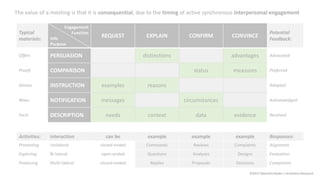
To chart this relationship, the Archestra
Research framework considers:
• the forms of information that make ideas
usable in the meeting (materials, concepts)
• the behaviors that drive a meeting forward in
some predictable way (motivated activity
types that work on ideas or engagement)
• And the reactions to those forms and
behaviors
Meetings are an orchestrated group behavior:
an objective pursued via purposeful
engagement.
The framework exposes the reality of
composing meetings.
Although meetings can be given a standardized
pattern, the pattern itself should exist only to
promote the consequence that provides the
important difference needed at that time.
It isn’t the pattern that makes the meeting
successful; it is the focus that makes the pattern
logically meaningful.
The framework emphasizes the need to identify
the supports for the focus:
• In the absence of “completed” communication
through other means, how information will be
used in a real-time synchronous engagement
to pursue an effect that is necessary at that
time.
Typical
materials:
Engagement
Function
Info
Purpose
REQUEST EXPLAIN CONFIRM CONVINCE
Potential
Feedback:
Offers PERSUASION distinctions advantages Advocated
Proofs COMPARISON status measures Preferred
Demos INSTRUCTION examples reasons Adopted
News NOTIFICATION messages circumstances Acknowledged
Facts DESCRIPTION needs context data evidence Received
Activities: interaction can be example example example Responses:
Presenting Unilateral closed-ended Commands Reviews Complaints Alignment
Exploring Bi-lateral open-ended Questions Analyses Designs Evaluation
Producing Multi-lateral closed-ended Replies Proposals Decisions Completion
The value of a meeting is that it is consequential, due to the timing of active synchronous interpersonal engagement
©2017 Malcolm Ryder / Archestra Research
Archestra notebooks compile and organize decades of in-the-field empirical findings. The notes offer explanations of why things
are included, excluded, or can happen in certain ways or to certain effects. The descriptions are determined mainly from the
perspective of strategy and architecture. They comment on, and navigate between, the motives and potentials that predetermine
the decisions and shapes of activity as discussed in the notes. As ongoing research, all notebooks are subject to change.
©2017 Malcolm Ryder / Archestra Research
www.archestra.com
mryder@archestra.com

Meetings as Information Behaviors

  • 1.
    Meetings An Architecture ofInformation Behaviors
  • 2.
    How to Builda Meeting Given the “always-on” information access that is typical today, the most important decision to make about a meeting is the decision to have it at all. Certainly, there are meetings that take place mainly to find out if attendees know the priority of what to look for when they are not in the meeting. And although those meetings are not exceptions, the only reason to take them seriously would be based on the observable effectiveness of their intent. That thought gives us the starting point for understanding meetings in general: the only reason to have a meeting is to get something done that wouldn’t get done without the meeting. This perspective pushes the matter into understanding how a meeting is worth the trouble. In turn, that brings up the first key factor of a meeting: timing. The second key factor is, of course, the “do-ers” who will attend; they should actually know what they are doing for and in the meeting, not outside of the meeting. And a third key factor is, again, what the meeting actually accomplishes. So far, if there actually is a need for a meeting, we haven’t pointed at anything particularly surprising. And the main point is still to not have a meeting unless it will generate something important that won’t otherwise be generated on time.
  • 3.
    How to Builda Meeting (cont’d) This perspective on informational behavior pushes the matter into understanding how a meeting will be a cause of a valuable effect. To chart this relationship, the Archestra Research framework considers: • the forms of information that make ideas usable in the meeting (materials, concepts) • the behaviors that drive a meeting forward in some predictable way (motivated activity types that work on ideas or engagement) • And the reactions to those forms and behaviors Meetings are an orchestrated group behavior: an objective pursued via purposeful engagement. The framework exposes the reality of composing meetings. Although meetings can be given a standardized pattern, the pattern itself should exist only to promote the consequence that provides the important difference needed at that time. It isn’t the pattern that makes the meeting successful; it is the focus that makes the pattern logically meaningful. The framework emphasizes the need to identify the supports for the focus: • In the absence of “completed” communication through other means, how information will be used in a real-time synchronous engagement to pursue an effect that is necessary at that time.
  • 4.
    Typical materials: Engagement Function Info Purpose REQUEST EXPLAIN CONFIRMCONVINCE Potential Feedback: Offers PERSUASION distinctions advantages Advocated Proofs COMPARISON status measures Preferred Demos INSTRUCTION examples reasons Adopted News NOTIFICATION messages circumstances Acknowledged Facts DESCRIPTION needs context data evidence Received Activities: interaction can be example example example Responses: Presenting Unilateral closed-ended Commands Reviews Complaints Alignment Exploring Bi-lateral open-ended Questions Analyses Designs Evaluation Producing Multi-lateral closed-ended Replies Proposals Decisions Completion The value of a meeting is that it is consequential, due to the timing of active synchronous interpersonal engagement ©2017 Malcolm Ryder / Archestra Research
  • 5.
    Archestra notebooks compileand organize decades of in-the-field empirical findings. The notes offer explanations of why things are included, excluded, or can happen in certain ways or to certain effects. The descriptions are determined mainly from the perspective of strategy and architecture. They comment on, and navigate between, the motives and potentials that predetermine the decisions and shapes of activity as discussed in the notes. As ongoing research, all notebooks are subject to change. ©2017 Malcolm Ryder / Archestra Research ©2017 Malcolm Ryder / Archestra Research www.archestra.com mryder@archestra.com