EAD-5871: Tecnologia e Economia de Empresas (Economia da Inovação)
Economics of Industrial Innovation
Prof. Dr. Paulo Roberto Feldmann
Class 2: What is Disruptive Innovation?
by Clayton M. Cristensen, Michael E. Raynor, and Rory McDonald
Nei Grando
August, 9 - 2016
UNIVERSIDADE DE SÃO PAULO
FACULDADE DE ECONOMIA, ADMINISTRAÇÃO E CONTABILIDADE
DEPARTAMENTO DE ADMINISTRAÇÃO
PROGRAMA DE PÓS-GRADUAÇÃO EM ADMINISTRAÇÃO
About the article
Harvard Business Review
What is Disruptive Innovation?
by Clayton M. Cristensen, Michael E. Raynor, and Rory
McDonald – December, 2015 issue
The theory of disruptive Innovation was introduced in the
article: Disruptive Technologies: Catching the Wave, by
Joseph L. Bower and Clayton M. Christensen
from the HBR january–february 1995 issue
Clayton M. Christensen is the Kim B. Clark
Professor at Harvard Business School and a
coauthor of the forthcoming Competing Against
Luck: The Story of Innovation and Customer
Choice (HarperBusiness/ HarperCollins October
2016).
Michael E. Raynor is a director at Deloitte
Consulting LLP. He is the coauthor, with Mumtaz
Ahmed, of The Three Rules: How Exceptional
Companies Think (New York: Penguin Books, 2013).
Rory McDonald is an assistant professor at Harvard
Business School
1997 2003 2004
The Idea (it is a process)
“Disruption” describes a process whereby a smaller company with fewer resources is
able to successfully challenge established incumbent businesses.
Specifically, as incumbents focus on improving their products and services for their most
demanding (and usually most profitable) customers, they exceed the needs of some
segments and ignore the needs of others.
Entrants that prove disruptive begin by successfully targeting those overlooked segments,
gaining a foothold by delivering more-suitable functionality—frequently at a lower price.
Incumbents, chasing higher profitability in more-demanding segments, tend not to respond vigorously.
Entrants then move upmarket, delivering the performance that incumbents’ mainstream
customers require, while preserving the advantages that drove their early success.
When mainstream customers start adopting the entrants’ offerings in volume, disruption has occurred.
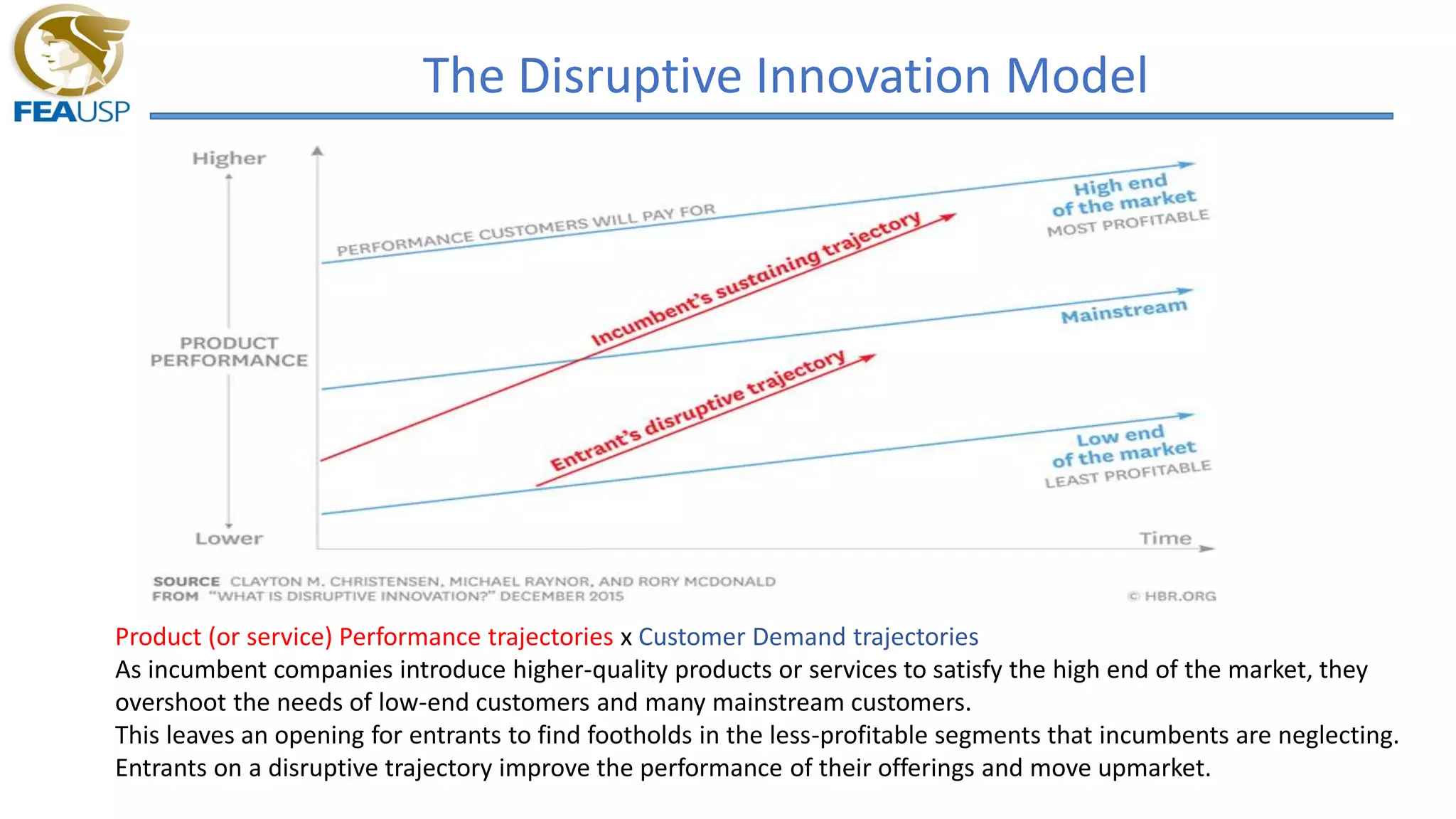
The Disruptive Innovation Model
Product (or service) Performance trajectories x Customer Demand trajectories
As incumbent companies introduce higher-quality products or services to satisfy the high end of the market, they
overshoot the needs of low-end customers and many mainstream customers.
This leaves an opening for entrants to find footholds in the less-profitable segments that incumbents are neglecting.
Entrants on a disruptive trajectory improve the performance of their offerings and move upmarket.
Is Uber a Disruptive Innovation?
The theory’s core concepts have been widely misunderstood and its basic
tenets frequently misapplied.
Is a disruption any situation in which an industry is shaken up and
previously successful incumbents stumble?
Is Uber disrupting the taxi business?
According to the theory, the answer is NO.
 Uber was launched in a well-served taxi market.
 Their customers already have the habit of hiring rides.
Disruptive innovations originate in low-end or new-market footholds.
[ two types of markets that incumbents overlook ] Disruptive innovations are
initially considered inferior by most of an incumbent’s customers.
Sustaining innovation, make good products better (incremental advances or
major breakthroughs) in the eyes of an incumbent’s existing customer.
Uber is an outlier. It started on a mainstream market with a competitive
“better” service (in a regulated taxi business).
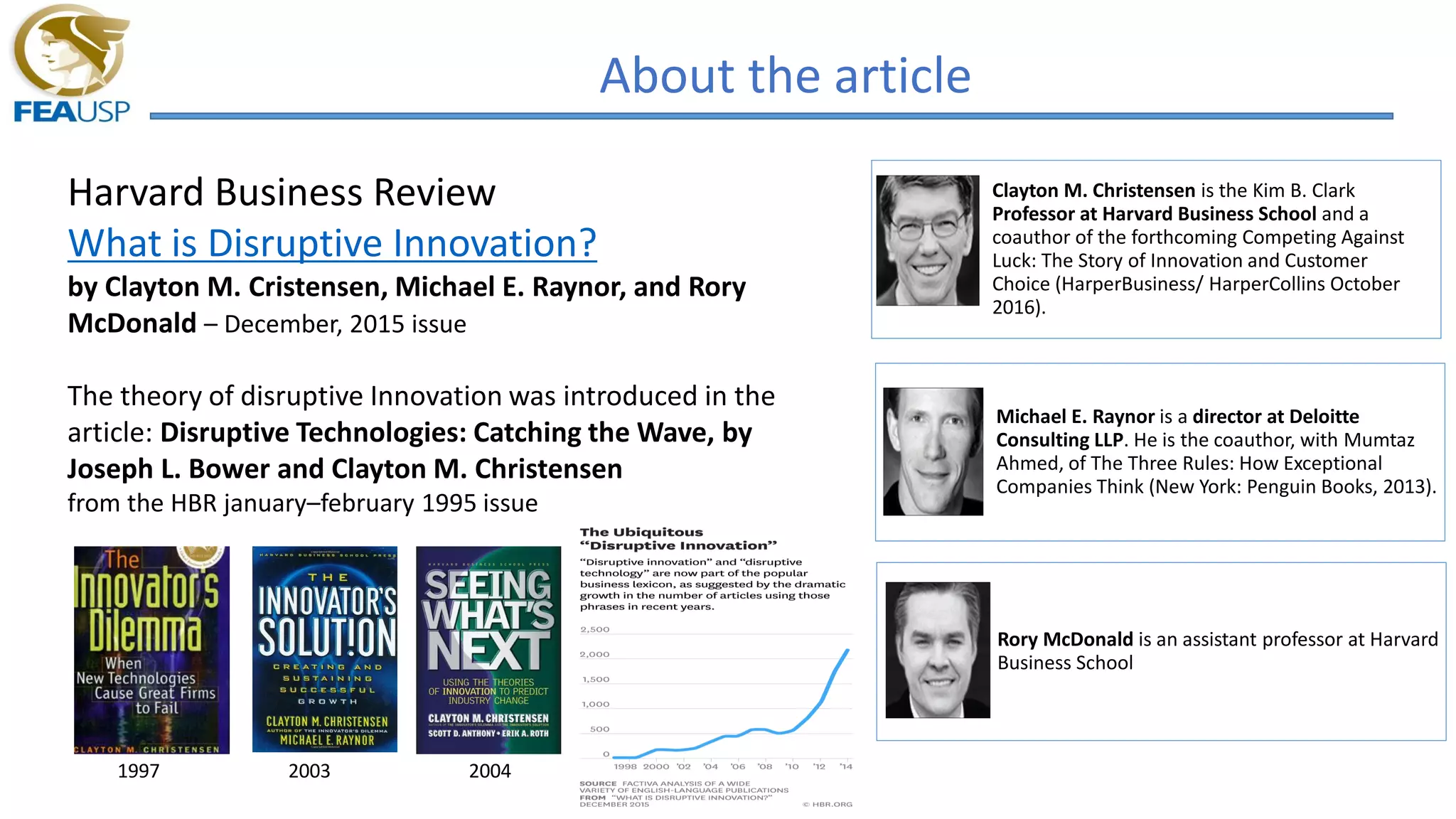
Important points
1. Disruption is a process - it refers to a product or service evolution
over time. Ex: PC x Minicomputers. Netflix x Blockbuster.
“Because disruption can take time, incumbents frequently
overlook disrupters”
2. Disrupters often build business models that are very different
from those of incumbents - it is not just technology.
3. Some disruptive innovations succeed; some don’t - a common
mistake is to focus on the results achieved—to claim that a
company is disruptive by virtue of its success.
4. The mantra “Disrupt or be disrupted” can misguide us -
Incumbent companies do need to respond to disruption if it’s
occurring, but they should not overreact by dismantling a still-
profitable business. Instead, they should continue to strengthen
relationships with core customers by investing in sustaining
innovations. In addition, they can create a new division focused
solely on the growth opportunities that arise from the disruption.
New Technology and Strategy Choices
When New Technology arises, disruption theory can guide Strategic Choices.
[ taking a sustaining path x taking a disruptive one (with a new business unit) ]
The theory of disruptive innovation was simply a statement about correlation:
“Empirical findings showed that incumbents outperformed entrants in a sustaining
innovation context but underperformed in a disruptive innovation context”.
Two reasons why:
1 - strategic change is profoundly affected by the interests of customers who provide the resources
the firm needs to survive.
2 - Incumbents’ focus on their existing customers becomes institutionalized in internal processes that
make it difficult for even senior managers to shift investment to disruptive innovations.
[ high margins and targeted large markets with well-known customers ] x
[ smaller markets with poorly defined customers ].
Disrupters work starting with simple products, more convenient, or less costly. And along the time
they improve their products and drive upmarket.
Examples
Some examples of disruptive innovation include:
Disruptor Disruptee
Personal computers Mainframe and mini computers
Mini mills Integrated steel mills
Cellular phones Fixed line telephony
Community colleges Four-year colleges
Discount retailers Full-service department stores
Retail medical clinics Traditional doctor’s offices
Source: http://www.claytonchristensen.com/key-concepts/

What is disruptive innovation?

  • 1.
    EAD-5871: Tecnologia eEconomia de Empresas (Economia da Inovação) Economics of Industrial Innovation Prof. Dr. Paulo Roberto Feldmann Class 2: What is Disruptive Innovation? by Clayton M. Cristensen, Michael E. Raynor, and Rory McDonald Nei Grando August, 9 - 2016 UNIVERSIDADE DE SÃO PAULO FACULDADE DE ECONOMIA, ADMINISTRAÇÃO E CONTABILIDADE DEPARTAMENTO DE ADMINISTRAÇÃO PROGRAMA DE PÓS-GRADUAÇÃO EM ADMINISTRAÇÃO
  • 2.
    About the article HarvardBusiness Review What is Disruptive Innovation? by Clayton M. Cristensen, Michael E. Raynor, and Rory McDonald – December, 2015 issue The theory of disruptive Innovation was introduced in the article: Disruptive Technologies: Catching the Wave, by Joseph L. Bower and Clayton M. Christensen from the HBR january–february 1995 issue Clayton M. Christensen is the Kim B. Clark Professor at Harvard Business School and a coauthor of the forthcoming Competing Against Luck: The Story of Innovation and Customer Choice (HarperBusiness/ HarperCollins October 2016). Michael E. Raynor is a director at Deloitte Consulting LLP. He is the coauthor, with Mumtaz Ahmed, of The Three Rules: How Exceptional Companies Think (New York: Penguin Books, 2013). Rory McDonald is an assistant professor at Harvard Business School 1997 2003 2004
  • 3.
    The Idea (itis a process) “Disruption” describes a process whereby a smaller company with fewer resources is able to successfully challenge established incumbent businesses. Specifically, as incumbents focus on improving their products and services for their most demanding (and usually most profitable) customers, they exceed the needs of some segments and ignore the needs of others. Entrants that prove disruptive begin by successfully targeting those overlooked segments, gaining a foothold by delivering more-suitable functionality—frequently at a lower price. Incumbents, chasing higher profitability in more-demanding segments, tend not to respond vigorously. Entrants then move upmarket, delivering the performance that incumbents’ mainstream customers require, while preserving the advantages that drove their early success. When mainstream customers start adopting the entrants’ offerings in volume, disruption has occurred.
  • 4.
    The Disruptive InnovationModel Product (or service) Performance trajectories x Customer Demand trajectories As incumbent companies introduce higher-quality products or services to satisfy the high end of the market, they overshoot the needs of low-end customers and many mainstream customers. This leaves an opening for entrants to find footholds in the less-profitable segments that incumbents are neglecting. Entrants on a disruptive trajectory improve the performance of their offerings and move upmarket.
  • 5.
    Is Uber aDisruptive Innovation? The theory’s core concepts have been widely misunderstood and its basic tenets frequently misapplied. Is a disruption any situation in which an industry is shaken up and previously successful incumbents stumble? Is Uber disrupting the taxi business? According to the theory, the answer is NO.  Uber was launched in a well-served taxi market.  Their customers already have the habit of hiring rides. Disruptive innovations originate in low-end or new-market footholds. [ two types of markets that incumbents overlook ] Disruptive innovations are initially considered inferior by most of an incumbent’s customers. Sustaining innovation, make good products better (incremental advances or major breakthroughs) in the eyes of an incumbent’s existing customer. Uber is an outlier. It started on a mainstream market with a competitive “better” service (in a regulated taxi business).
  • 6.
    Important points 1. Disruptionis a process - it refers to a product or service evolution over time. Ex: PC x Minicomputers. Netflix x Blockbuster. “Because disruption can take time, incumbents frequently overlook disrupters” 2. Disrupters often build business models that are very different from those of incumbents - it is not just technology. 3. Some disruptive innovations succeed; some don’t - a common mistake is to focus on the results achieved—to claim that a company is disruptive by virtue of its success. 4. The mantra “Disrupt or be disrupted” can misguide us - Incumbent companies do need to respond to disruption if it’s occurring, but they should not overreact by dismantling a still- profitable business. Instead, they should continue to strengthen relationships with core customers by investing in sustaining innovations. In addition, they can create a new division focused solely on the growth opportunities that arise from the disruption.
  • 7.
    New Technology andStrategy Choices When New Technology arises, disruption theory can guide Strategic Choices. [ taking a sustaining path x taking a disruptive one (with a new business unit) ] The theory of disruptive innovation was simply a statement about correlation: “Empirical findings showed that incumbents outperformed entrants in a sustaining innovation context but underperformed in a disruptive innovation context”. Two reasons why: 1 - strategic change is profoundly affected by the interests of customers who provide the resources the firm needs to survive. 2 - Incumbents’ focus on their existing customers becomes institutionalized in internal processes that make it difficult for even senior managers to shift investment to disruptive innovations. [ high margins and targeted large markets with well-known customers ] x [ smaller markets with poorly defined customers ]. Disrupters work starting with simple products, more convenient, or less costly. And along the time they improve their products and drive upmarket.
  • 8.
    Examples Some examples ofdisruptive innovation include: Disruptor Disruptee Personal computers Mainframe and mini computers Mini mills Integrated steel mills Cellular phones Fixed line telephony Community colleges Four-year colleges Discount retailers Full-service department stores Retail medical clinics Traditional doctor’s offices Source: http://www.claytonchristensen.com/key-concepts/