
DISRUPTIVE &
EMERGING Technology
Ashima Wadhwa
Assistant Professor (IT)
Amity University ,Noida
Disruptive Technology:
Famous Incorrect Predictions
“The horse is here to stay, but the automobile is only a
novelty – a fad” Advice to Henry Ford’s Lawyer, 1922
“Well informed people know that it is impossible to transmit
the voice over wires and were that it were possible to do so,
it would be of no practical value” Editorial in the Boston
Post, 1865
“This telephone has too many shortcomings to be seriously
considered as a means of communication.  The device is
inherently of no value to us.”  Western Union Internal Memo,
1876
Disruptive Technology:
Famous Incorrect Predictions
“The wireless music box has no imaginable commercial
value.  Who would pay for a message sent to nobody in
particular?” Response of Associates of David Sarnoff, when
invited to invest in radio
“I think there is a market for about five computers.”
Thomas Watson, Sr. Founder of IBM, 1943
“There is no reason anyone would want a computer in their
home.” Ken Olsen, President and Founder of Digital
Equipment Corp., 1977
“640k ought to be enough for anybody”
Attributed to Bill Gates in 1981
Technologies
• Sustaining – Steady, linear improvement of existing
technology
• Disruptive – Introduction of completely new
approaches that have the potential to create a new
industry or transform an existing one
– Revolutionary – radical innovations
• digital photography, microbots, high-temperature
superconductors
– Evolutionary – formed by the convergence of previously
separate research areas
• MRI imaging, faxing, electronic banking
ADVANTAGES OF DISRUPTIVE
TECHNOLOGIES
• The PC is a prime example of a "disruptive technology"
that was dismissed out of hand by an industry's
established leaders until it was too late.
• Disruptive technologies work by offering, at least initially,
little in the way of performance, but plenty in terms of
cheapness, convenience and ease of use.
– As such, they appeal to a different class of customers, carving
out new markets for themselves before going on to have the
industrial Goliaths' business for lunch.
The Innovator’s Dilemma
• The Innovator's Dilemma: A company which is in an existing
business and listening to its existing customers feels that there is no
need for anything new.
• Should it invest its money to
– make new products that its best customers can use and that
would improve the company’s profit margins" or
– invest its money to create worse products that none of its
customers can use, that would wreck its profit margins.
• Sustaining technologies – meet the needs of customers today and the
ones who are paying
• Disruptive technologies – come from innovators who keep improving the
product performance till it comes "from below" and starts hurting the
entrenched incumbents.
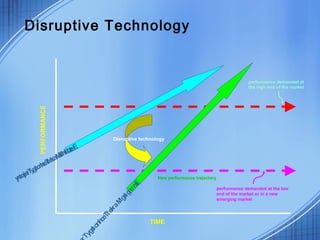
Disruptive Technology
performance demanded at
the high end of the market
New performance trajectory
Disruptive technology
PERFORMANCE
TIME
performance demanded at the low
end of the market or in a new
emerging market
EstablishedMarketTechnologyTrajectory
Emerging
MarketTechnologyT
Disruptive Technology
• The sustaining technologies are on the blue line e.g., incremental engineering
advances that all good companies are able to grind out.
• The downward yellow arrow, a disruptive technology, is something that brings to
the market a product or service that is not as good as what historically had been
available, and therefore it can't be valued or used by customers in the
mainstream of the market. Yet it takes root in a different application.
• The green line represents the new performance trajectory - it slopes upward
faster than the sustaining technology and intersects with the customers needs
and the mainstream.
Disruptive Technologies
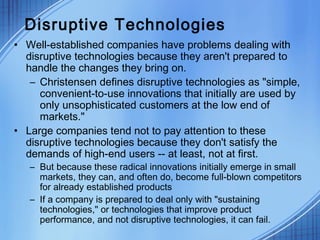
• Well-established companies have problems dealing with
disruptive technologies because they aren't prepared to
handle the changes they bring on.
– Christensen defines disruptive technologies as "simple,
convenient-to-use innovations that initially are used by
only unsophisticated customers at the low end of
markets."
• Large companies tend not to pay attention to these
disruptive technologies because they don't satisfy the
demands of high-end users -- at least, not at first.
– But because these radical innovations initially emerge in small
markets, they can, and often do, become full-blown competitors
for already established products
– If a company is prepared to deal only with "sustaining
technologies," or technologies that improve product
performance, and not disruptive technologies, it can fail.
Technology Adoption Lifecycle Curve
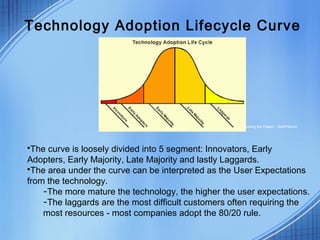
The curve is loosely divided into 5 segment: Innovators, Early
Adopters, Early Majority, Late Majority and lastly Laggards.
The area under the curve can be interpreted as the User Expectations
from the technology.
-The more mature the technology, the higher the user expectations.
-The laggards are the most difficult customers often requiring the
most resources - most companies adopt the 80/20 rule.
“Crossing the Chasm”, Geoff Moore
80/20 Rule
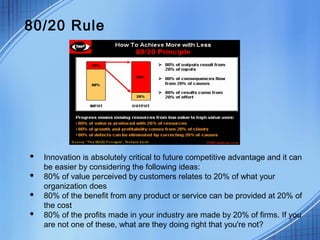
 Innovation is absolutely critical to future competitive advantage and it can
be easier by considering the following ideas:
 80% of value perceived by customers relates to 20% of what your
organization does
 80% of the benefit from any product or service can be provided at 20% of
the cost
 80% of the profits made in your industry are made by 20% of firms. If you
are not one of these, what are they doing right that you're not?
2/10 Rule of Technology Adoption
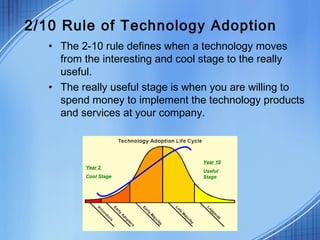
• The 2-10 rule defines when a technology moves
from the interesting and cool stage to the really
useful.
• The really useful stage is when you are willing to
spend money to implement the technology products
and services at your company.
Year 2
Cool Stage
Year 10
Useful
Stage
2/10 Rule of Technology Adoption
• Examples: fax machine; desktop PCs; operating
systems; PDAs; GPS; mobile phones; email and
ecommerce.
– All of these products and services were launched with
great fanfare that touted the way they would revolutionize
our lives. All of them failed to live up to their hype in the
early days. But all of them have gone on to over-deliver
on their original promises and expectations.
THANK YOU !!

Disruptive technology

  • 1.
    DISRUPTIVE & EMERGING Technology AshimaWadhwa Assistant Professor (IT) Amity University ,Noida
  • 2.
    Disruptive Technology: Famous IncorrectPredictions “The horse is here to stay, but the automobile is only a novelty – a fad” Advice to Henry Ford’s Lawyer, 1922 “Well informed people know that it is impossible to transmit the voice over wires and were that it were possible to do so, it would be of no practical value” Editorial in the Boston Post, 1865 “This telephone has too many shortcomings to be seriously considered as a means of communication.  The device is inherently of no value to us.”  Western Union Internal Memo, 1876
  • 3.
    Disruptive Technology: Famous IncorrectPredictions “The wireless music box has no imaginable commercial value.  Who would pay for a message sent to nobody in particular?” Response of Associates of David Sarnoff, when invited to invest in radio “I think there is a market for about five computers.” Thomas Watson, Sr. Founder of IBM, 1943 “There is no reason anyone would want a computer in their home.” Ken Olsen, President and Founder of Digital Equipment Corp., 1977 “640k ought to be enough for anybody” Attributed to Bill Gates in 1981
  • 4.
    Technologies • Sustaining –Steady, linear improvement of existing technology • Disruptive – Introduction of completely new approaches that have the potential to create a new industry or transform an existing one – Revolutionary – radical innovations • digital photography, microbots, high-temperature superconductors – Evolutionary – formed by the convergence of previously separate research areas • MRI imaging, faxing, electronic banking
  • 5.
    ADVANTAGES OF DISRUPTIVE TECHNOLOGIES •The PC is a prime example of a "disruptive technology" that was dismissed out of hand by an industry's established leaders until it was too late. • Disruptive technologies work by offering, at least initially, little in the way of performance, but plenty in terms of cheapness, convenience and ease of use. – As such, they appeal to a different class of customers, carving out new markets for themselves before going on to have the industrial Goliaths' business for lunch.
  • 6.
    The Innovator’s Dilemma •The Innovator's Dilemma: A company which is in an existing business and listening to its existing customers feels that there is no need for anything new. • Should it invest its money to – make new products that its best customers can use and that would improve the company’s profit margins" or – invest its money to create worse products that none of its customers can use, that would wreck its profit margins. • Sustaining technologies – meet the needs of customers today and the ones who are paying • Disruptive technologies – come from innovators who keep improving the product performance till it comes "from below" and starts hurting the entrenched incumbents.
  • 7.
    Disruptive Technology performance demandedat the high end of the market New performance trajectory Disruptive technology PERFORMANCE TIME performance demanded at the low end of the market or in a new emerging market EstablishedMarketTechnologyTrajectory Emerging MarketTechnologyT
  • 8.
    Disruptive Technology • Thesustaining technologies are on the blue line e.g., incremental engineering advances that all good companies are able to grind out. • The downward yellow arrow, a disruptive technology, is something that brings to the market a product or service that is not as good as what historically had been available, and therefore it can't be valued or used by customers in the mainstream of the market. Yet it takes root in a different application. • The green line represents the new performance trajectory - it slopes upward faster than the sustaining technology and intersects with the customers needs and the mainstream.
  • 9.
    Disruptive Technologies • Well-establishedcompanies have problems dealing with disruptive technologies because they aren't prepared to handle the changes they bring on. – Christensen defines disruptive technologies as "simple, convenient-to-use innovations that initially are used by only unsophisticated customers at the low end of markets." • Large companies tend not to pay attention to these disruptive technologies because they don't satisfy the demands of high-end users -- at least, not at first. – But because these radical innovations initially emerge in small markets, they can, and often do, become full-blown competitors for already established products – If a company is prepared to deal only with "sustaining technologies," or technologies that improve product performance, and not disruptive technologies, it can fail.
  • 10.
    Technology Adoption LifecycleCurve The curve is loosely divided into 5 segment: Innovators, Early Adopters, Early Majority, Late Majority and lastly Laggards. The area under the curve can be interpreted as the User Expectations from the technology. -The more mature the technology, the higher the user expectations. -The laggards are the most difficult customers often requiring the most resources - most companies adopt the 80/20 rule. “Crossing the Chasm”, Geoff Moore
  • 11.
    80/20 Rule  Innovationis absolutely critical to future competitive advantage and it can be easier by considering the following ideas:  80% of value perceived by customers relates to 20% of what your organization does  80% of the benefit from any product or service can be provided at 20% of the cost  80% of the profits made in your industry are made by 20% of firms. If you are not one of these, what are they doing right that you're not?
  • 12.
    2/10 Rule ofTechnology Adoption • The 2-10 rule defines when a technology moves from the interesting and cool stage to the really useful. • The really useful stage is when you are willing to spend money to implement the technology products and services at your company. Year 2 Cool Stage Year 10 Useful Stage
  • 13.
    2/10 Rule ofTechnology Adoption • Examples: fax machine; desktop PCs; operating systems; PDAs; GPS; mobile phones; email and ecommerce. – All of these products and services were launched with great fanfare that touted the way they would revolutionize our lives. All of them failed to live up to their hype in the early days. But all of them have gone on to over-deliver on their original promises and expectations.
  • 14.