
Redefining the Role of Educator in Covid-19 Outbreak Era
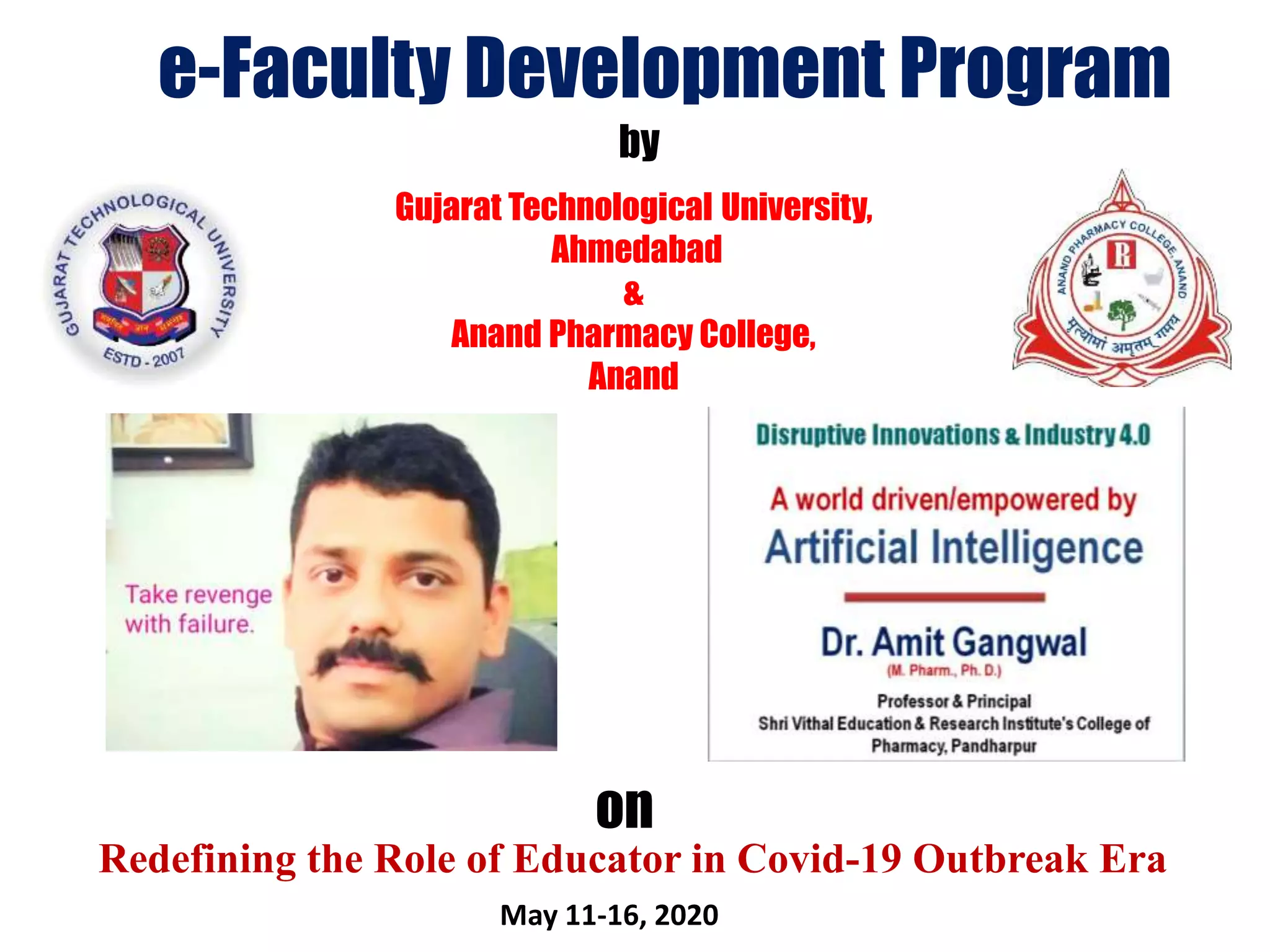
e-Faculty Development Program
Gujarat Technological University,
Ahmedabad
&
Anand Pharmacy College,
Anand
by
on
May 11-16, 2020
Disruptive Innovations & Industry 4.0
A world driven/empowered by
Artificial Intelligence
Dr. Amit Gangwal
(M. Pharm., Ph. D.)
Professor & Principal
Shri Vithal Education & Research Institute's College of
Pharmacy, Pandharpur
May 11, 2020:
12:00PM to 01:00Pm)
I salute you all teachers
Because everyday you are dealing with 60
families in a lecture of 60 minutes; each time
you have to fine tune your overall connection
and bond with your students. This a rare
phenomenon across any of the industry.
1Dr. Amit Gangwal
Representative
Images
2Dr. Amit Gangwal
3Dr. Amit Gangwal
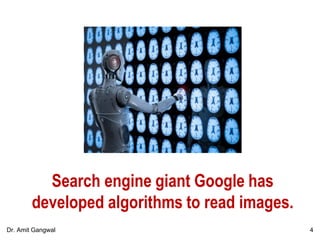
Search engine giant Google has
developed algorithms to read images.
4Dr. Amit Gangwal
5Dr. Amit Gangwal
6Dr. Amit Gangwal
7Dr. Amit Gangwal
8Dr. Amit Gangwal
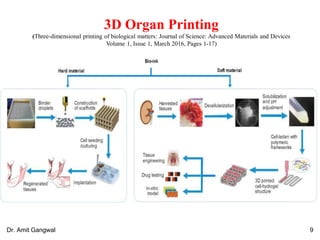
3D Organ Printing
(Three-dimensional printing of biological matters: Journal of Science: Advanced Materials and Devices
Volume 1, Issue 1, March 2016, Pages 1-17)
9Dr. Amit Gangwal
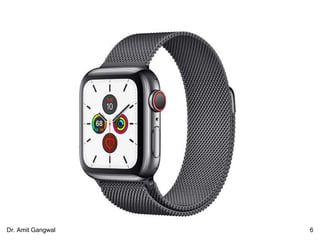
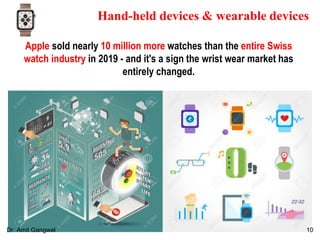
Hand-held devices & wearable devices
Apple sold nearly 10 million more watches than the entire Swiss
watch industry in 2019 - and it's a sign the wrist wear market has
entirely changed.
10Dr. Amit Gangwal
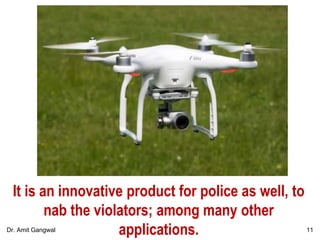
It is an innovative product for police as well, to
nab the violators; among many other
applications. 11Dr. Amit Gangwal
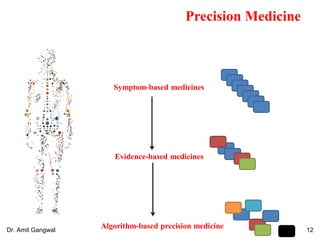
Precision Medicine
Symptom-based medicines
Evidence-based medicines
Algorithm-based precision medicine 12Dr. Amit Gangwal
Disruptive innovations
or
Disruptive technologies
13Dr. Amit Gangwal
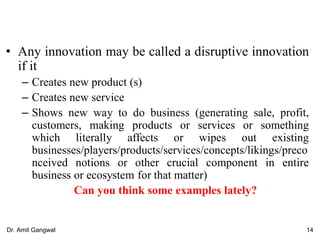
• Any innovation may be called a disruptive innovation
if it
– Creates new product (s)
– Creates new service
– Shows new way to do business (generating sale, profit,
customers, making products or services or something
which literally affects or wipes out existing
businesses/players/products/services/concepts/likings/preco
nceived notions or other crucial component in entire
business or ecosystem for that matter)
Can you think some examples lately?
14Dr. Amit Gangwal
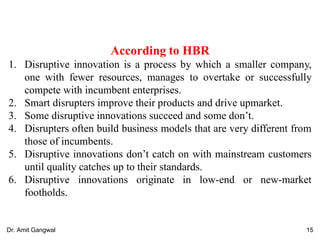
According to HBR
1. Disruptive innovation is a process by which a smaller company,
one with fewer resources, manages to overtake or successfully
compete with incumbent enterprises.
2. Smart disrupters improve their products and drive upmarket.
3. Some disruptive innovations succeed and some don’t.
4. Disrupters often build business models that are very different from
those of incumbents.
5. Disruptive innovations don’t catch on with mainstream customers
until quality catches up to their standards.
6. Disruptive innovations originate in low-end or new-market
footholds.
15Dr. Amit Gangwal
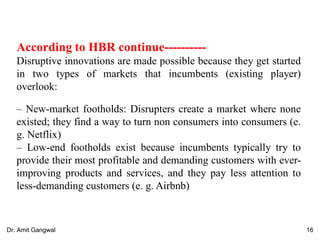
According to HBR continue----------
Disruptive innovations are made possible because they get started
in two types of markets that incumbents (existing player)
overlook:
– New-market footholds: Disrupters create a market where none
existed; they find a way to turn non consumers into consumers (e.
g. Netflix)
– Low-end footholds exist because incumbents typically try to
provide their most profitable and demanding customers with ever-
improving products and services, and they pay less attention to
less-demanding customers (e. g. Airbnb)
16Dr. Amit Gangwal
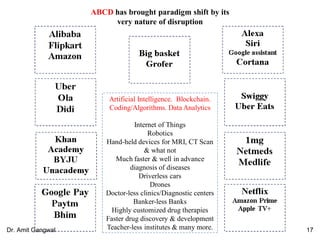
Artificial Intelligence. Blockchain.
Coding/Algorithms. Data Analytics
Internet of Things
Robotics
Hand-held devices for MRI, CT Scan
& what not
Much faster & well in advance
diagnosis of diseases
Driverless cars
Drones
Doctor-less clinics/Diagnostic centers
Banker-less Banks
Highly customized drug therapies
Faster drug discovery & development
Teacher-less institutes & many more.
ABCD has brought paradigm shift by its
very nature of disruption
17Dr. Amit Gangwal
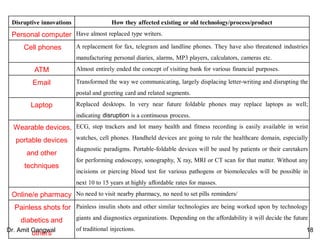
Disruptive innovations How they affected existing or old technology/process/product
Personal computer Have almost replaced type writers.
Cell phones A replacement for fax, telegram and landline phones. They have also threatened industries
manufacturing personal diaries, alarms, MP3 players, calculators, cameras etc.
ATM Almost entirely ended the concept of visiting bank for various financial purposes.
Email Transformed the way we communicating, largely displacing letter-writing and disrupting the
postal and greeting card and related segments.
Laptop Replaced desktops. In very near future foldable phones may replace laptops as well;
indicating disruption is a continuous process.
Wearable devices,
portable devices
and other
techniques
ECG, step trackers and lot many health and fitness recording is easily available in wrist
watches, cell phones. Handheld devices are going to rule the healthcare domain, especially
diagnostic paradigms. Portable-foldable devices will be used by patients or their caretakers
for performing endoscopy, sonography, X ray, MRI or CT scan for that matter. Without any
incisions or piercing blood test for various pathogens or biomolecules will be possible in
next 10 to 15 years at highly affordable rates for masses.
Online/e pharmacy No need to visit nearby pharmacy, no need to set pills reminders/
Painless shots for
diabetics and
others
Painless insulin shots and other similar technologies are being worked upon by technology
giants and diagnostics organizations. Depending on the affordability it will decide the future
of traditional injections. 18Dr. Amit Gangwal
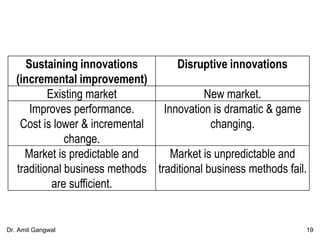
Sustaining innovations
(incremental improvement)
Disruptive innovations
Existing market New market.
Improves performance.
Cost is lower & incremental
change.
Innovation is dramatic & game
changing.
Market is predictable and
traditional business methods
are sufficient.
Market is unpredictable and
traditional business methods fail.
19Dr. Amit Gangwal
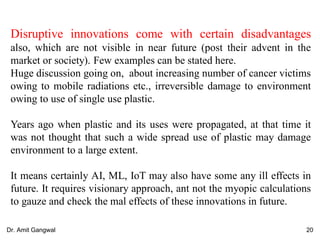
Disruptive innovations come with certain disadvantages
also, which are not visible in near future (post their advent in the
market or society). Few examples can be stated here.
Huge discussion going on, about increasing number of cancer victims
owing to mobile radiations etc., irreversible damage to environment
owing to use of single use plastic.
Years ago when plastic and its uses were propagated, at that time it
was not thought that such a wide spread use of plastic may damage
environment to a large extent.
It means certainly AI, ML, IoT may also have some any ill effects in
future. It requires visionary approach, ant not the myopic calculations
to gauze and check the mal effects of these innovations in future.
20Dr. Amit Gangwal
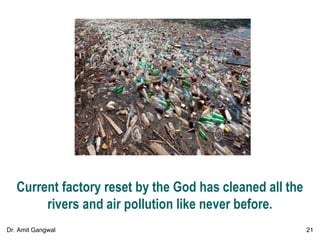
Current factory reset by the God has cleaned all the
rivers and air pollution like never before.
21Dr. Amit Gangwal
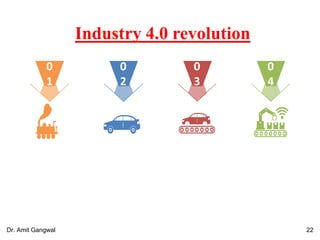
Industry 4.0 revolution
0
2
0
3
0
4
0
1
22Dr. Amit Gangwal
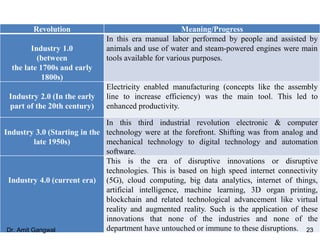
Revolution Meaning/Progress
Industry 1.0
(between
the late 1700s and early
1800s)
In this era manual labor performed by people and assisted by
animals and use of water and steam-powered engines were main
tools available for various purposes.
Industry 2.0 (In the early
part of the 20th century)
Electricity enabled manufacturing (concepts like the assembly
line to increase efficiency) was the main tool. This led to
enhanced productivity.
Industry 3.0 (Starting in the
late 1950s)
In this third industrial revolution electronic & computer
technology were at the forefront. Shifting was from analog and
mechanical technology to digital technology and automation
software.
Industry 4.0 (current era)
This is the era of disruptive innovations or disruptive
technologies. This is based on high speed internet connectivity
(5G), cloud computing, big data analytics, internet of things,
artificial intelligence, machine learning, 3D organ printing,
blockchain and related technological advancement like virtual
reality and augmented reality. Such is the application of these
innovations that none of the industries and none of the
department have untouched or immune to these disruptions. 23Dr. Amit Gangwal
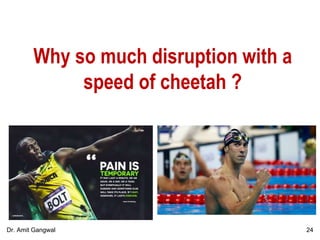
Why so much disruption with a
speed of cheetah ?
24Dr. Amit Gangwal
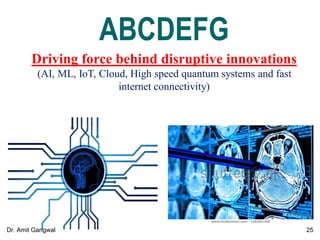
Driving force behind disruptive innovations
(AI, ML, IoT, Cloud, High speed quantum systems and fast
internet connectivity)
ABCDEFG
25Dr. Amit Gangwal
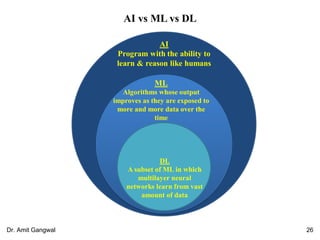
AI vs ML vs DL
AI
Program with the ability to
learn & reason like humans
ML
Algorithms whose output
improves as they are exposed to
more and more data over the
time
DL
A subset of ML in which
multilayer neural
networks learn from vast
amount of data
26Dr. Amit Gangwal
What experts have to say about disruptive
technology/industry 4.0/Artificial Intelligence
“Success in creating AI would be the biggest
event in human history. Unfortunately, it might
also be the last, unless we learn how to avoid
the risks.” Stephen Hawking
“By 2030, the global GDP could rise by 14
percent as a result of AI enabled activities. That
is equal to $15.7 trillion:. PWC
“Artificial intelligence (AI) will be
more transformative to humanity than
electricity”. Sundar Pichai
“Japan should make AI a mandatory subject for
college entrance exams”. Masayoshi Son
“Explainable AI won’t replace
human workers; rather, it will
complement and support people,
so they can make better, faster,
more accurate decisions”. “AI
technology can enhance business
productivity by up to 40%”.
Accenture
27Dr. Amit Gangwal
28Dr. Amit Gangwal
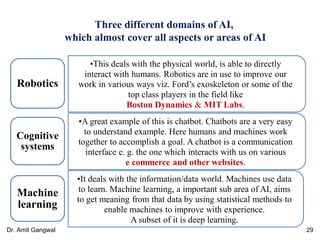
Three different domains of AI,
which almost cover all aspects or areas of AI
•This deals with the physical world, is able to directly
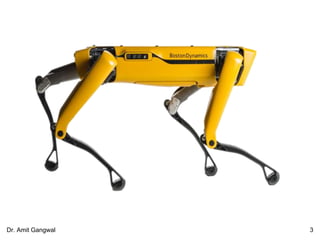
interact with humans. Robotics are in use to improve our
work in various ways viz. Ford’s exoskeleton or some of the
top class players in the field like
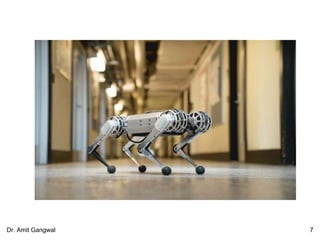
Boston Dynamics & MIT Labs.
Robotics
•A great example of this is chatbot. Chatbots are a very easy
to understand example. Here humans and machines work
together to accomplish a goal. A chatbot is a communication
interface e. g. the one which interacts with us on various
e commerce and other websites.
Cognitive
systems
•It deals with the information/data world. Machines use data
to learn. Machine learning, a important sub area of AI, aims
to get meaning from that data by using statistical methods to
enable machines to improve with experience.
A subset of it is deep learning.
Machine
learning
29Dr. Amit Gangwal
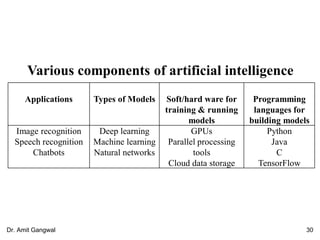
Various components of artificial intelligence
Applications Types of Models Soft/hard ware for
training & running
models
Programming
languages for
building models
Image recognition
Speech recognition
Chatbots
Deep learning
Machine learning
Natural networks
GPUs
Parallel processing
tools
Cloud data storage
Python
Java
C
TensorFlow
30Dr. Amit Gangwal
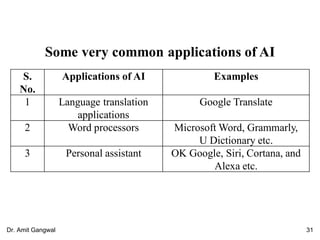
S.
No.
Applications of AI Examples
1 Language translation
applications
Google Translate
2 Word processors Microsoft Word, Grammarly,
U Dictionary etc.
3 Personal assistant OK Google, Siri, Cortana, and
Alexa etc.
Some very common applications of AI
31Dr. Amit Gangwal
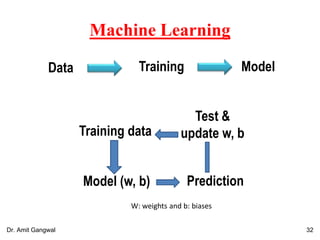
Machine Learning
Data Training Model
Training data
Model (w, b) Prediction
Test &
update w, b
W: weights and b: biases
32Dr. Amit Gangwal
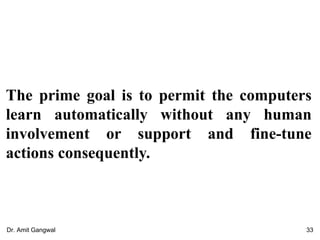
The prime goal is to permit the computers
learn automatically without any human
involvement or support and fine-tune
actions consequently.
33Dr. Amit Gangwal
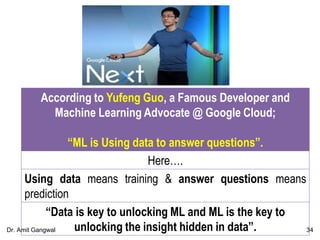
According to Yufeng Guo, a Famous Developer and
Machine Learning Advocate @ Google Cloud;
“ML is Using data to answer questions”.
Here….
Using data means training & answer questions means
prediction
“Data is key to unlocking ML and ML is the key to
unlocking the insight hidden in data”. 34Dr. Amit Gangwal
Study from data, recognize patterns and make decisions with negligible
human intervention
Can understand images, sounds, and language.
Instead of writing a brand new algorithm, machine learning tools
empower systems to develop and refine algorithms, by finding some
arrangements in huge database.
Finding use from helping people with debilities to felicitating
businesses with decision-making and dynamic pricing, to identifying
skin cancer, to sorting vegetables, to detecting escalators in need of
repairs.
35Dr. Amit Gangwal
Whether a chemical structure is suitable
for diabetes treatment or heart problem ?
Let’s imagine that you have to create a system that answers
above question.
This question answering system that experts build is called a
“model”, and this model is shaped via a process called
“training”.
The aim of training is to develop a precise model that
answers questions fittingly most of the time.
Finally to train a model, we require to collect data to train
on. 36Dr. Amit Gangwal
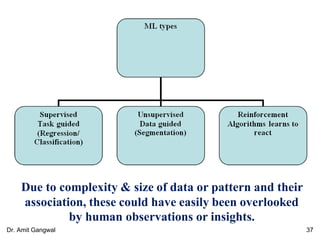
Due to complexity & size of data or pattern and their
association, these could have easily been overlooked
by human observations or insights.
37Dr. Amit Gangwal
Quickly we see definitions and
examples one by one
Regression & Classification
are the two types of supervised machine learning methods.
38Dr. Amit Gangwal
Classification
Learns a method for predicting the instances class from pre-
labelled (classified) instances.
It is a supervised machine learning and predictive method. It
is highly applicable in pattern recognition etc. e.g. decision
tree, Bayesian classifier.
The quality of a classification analysis is often assessed via
precision and recall which are popular metric procedures.
E.g. a classification algorithm would train a model to identify
whether a certain cell is malignant or benign.
39Dr. Amit Gangwal
Algorithms used in Classification
• Decision Tree
• Naïve Bayes
• Random Forest
• Logistic Regression
• KNN
40Dr. Amit Gangwal
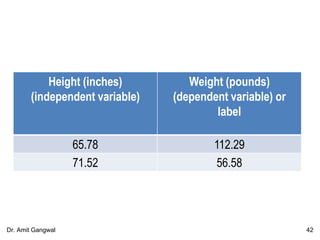
Regression
An attempt to predict a continuous attribute.
It is a predictive method.
Supervised.
A regression problem has a real no as its output e. g.
we could use the data in the table below to show
relationship between weight and height of people.
41Dr. Amit Gangwal
Height (inches)
(independent variable)
Weight (pounds)
(dependent variable) or
label
65.78 112.29
71.52 56.58
42Dr. Amit Gangwal
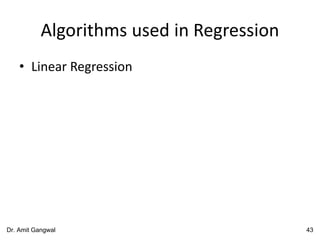
Algorithms used in Regression
• Linear Regression
43Dr. Amit Gangwal
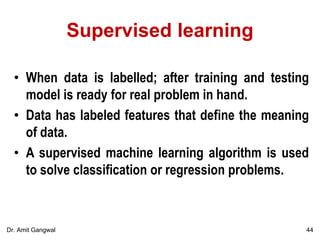
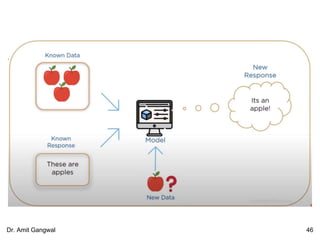
Supervised learning
• When data is labelled; after training and testing
model is ready for real problem in hand.
• Data has labeled features that define the meaning
of data.
• A supervised machine learning algorithm is used
to solve classification or regression problems.
44Dr. Amit Gangwal
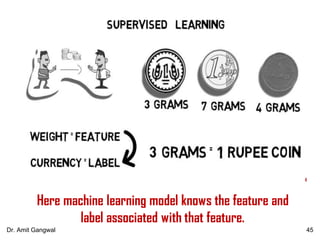
Here machine learning model knows the feature and
label associated with that feature.
45Dr. Amit Gangwal
46Dr. Amit Gangwal
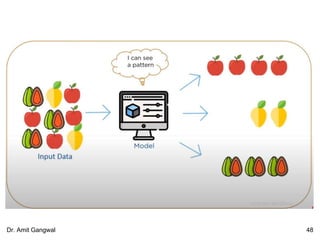
Unsupervised learning
• When machine learning models , find some hidden
patterns in vast amount of data and they cluster or
classify the data set or information in a concrete
manner e. g.
Flagging or highlighting or removing or suspending
some account on social media sites like Twitter or
marking few emails as spam by Gmail
47Dr. Amit Gangwal
48Dr. Amit Gangwal
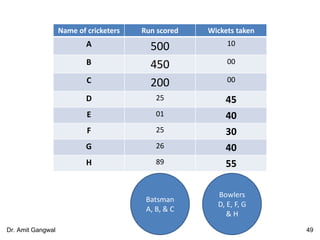
Name of cricketers Run scored Wickets taken
A 500 10
B 450 00
C 200 00
D 25 45
E 01 40
F 25 30
G 26 40
H 89 55
Batsman
A, B, & C
Bowlers
D, E, F, G
& H
49Dr. Amit Gangwal
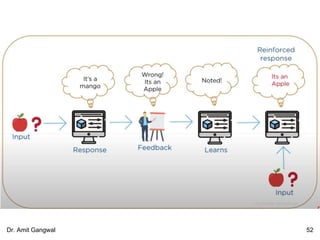
Reinforced Learning
(model learns from rewards)
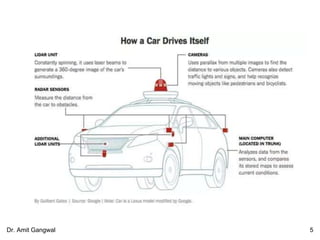
Working of self-driving cars &
Learning to navigate staring by robots.
50Dr. Amit Gangwal
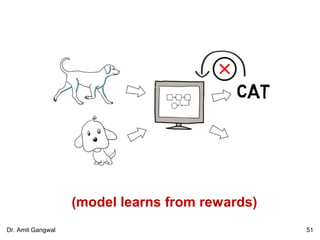
(model learns from rewards)
51Dr. Amit Gangwal
52Dr. Amit Gangwal
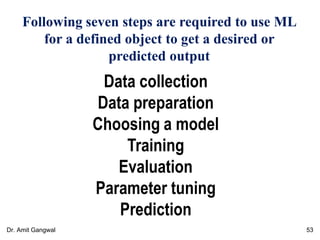
Following seven steps are required to use ML
for a defined object to get a desired or
predicted output
Data collection
Data preparation
Choosing a model
Training
Evaluation
Parameter tuning
Prediction
53Dr. Amit Gangwal
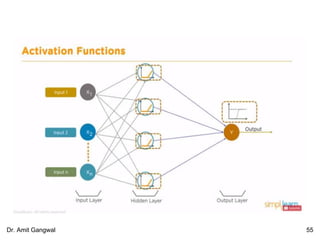
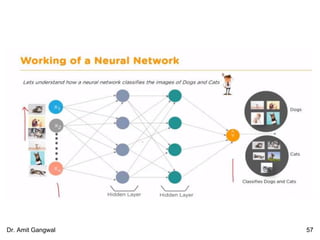
Deep Neural Network
54Dr. Amit Gangwal
55Dr. Amit Gangwal
56Dr. Amit Gangwal
57Dr. Amit Gangwal
58Dr. Amit Gangwal
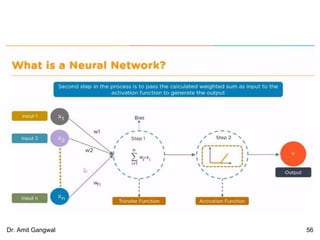
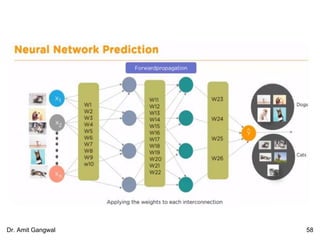
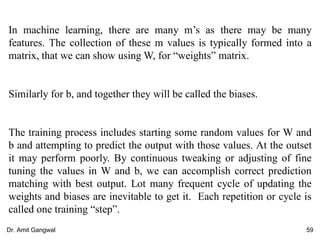
In machine learning, there are many m’s as there may be many
features. The collection of these m values is typically formed into a
matrix, that we can show using W, for “weights” matrix.
Similarly for b, and together they will be called the biases.
The training process includes starting some random values for W and
b and attempting to predict the output with those values. At the outset
it may perform poorly. By continuous tweaking or adjusting of fine
tuning the values in W and b, we can accomplish correct prediction
matching with best output. Lot many frequent cycle of updating the
weights and biases are inevitable to get it. Each repetition or cycle is
called one training “step”.
59Dr. Amit Gangwal
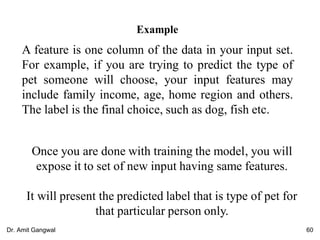
A feature is one column of the data in your input set.
For example, if you are trying to predict the type of
pet someone will choose, your input features may
include family income, age, home region and others.
The label is the final choice, such as dog, fish etc.
Example
Once you are done with training the model, you will
expose it to set of new input having same features.
It will present the predicted label that is type of pet for
that particular person only.
60Dr. Amit Gangwal
61Dr. Amit Gangwal
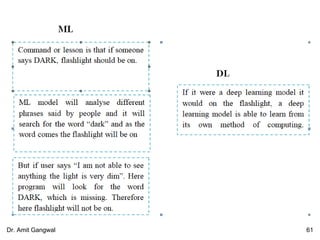
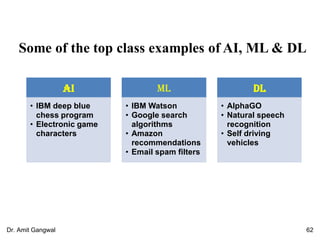
AI
• IBM deep blue
chess program
• Electronic game
characters
ML
• IBM Watson
• Google search
algorithms
• Amazon
recommendations
• Email spam filters
DL
• AlphaGO
• Natural speech
recognition
• Self driving
vehicles
Some of the top class examples of AI, ML & DL
62Dr. Amit Gangwal
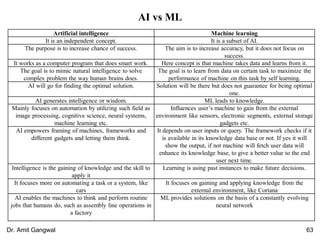
Artificial intelligence Machine learning
It is an independent concept. It is a subset of AI.
The purpose is to increase chance of success. The aim is to increase accuracy, but it does not focus on
success.
It works as a computer program that does smart work. Here concept is that machine takes data and learns from it.
The goal is to mimic natural intelligence to solve
complex problem the way human brains does.
The goal is to learn from data on certain task to maximize the
performance of machine on this task by self learning.
AI will go for finding the optimal solution. Solution will be there but does not guarantee for being optimal
one.
AI generates intelligence or wisdom. ML leads to knowledge.
Mainly focuses on automation by utilizing such field as
image processing, cognitive science, neural systems,
machine learning etc.
Influences user’s machine to gain from the external
environment like sensors, electronic segments, external storage
gadgets etc.
AI empowers framing of machines, frameworks and
different gadgets and letting them think.
It depends on user inputs or query. The framework checks if it
is available in its knowledge data base or not. If yes it will
show the output, if not machine will fetch user data will
enhance its knowledge base, to give a better value to the end
user next time.
Intelligence is the gaining of knowledge and the skill to
apply it
Learning is using past instances to make future decisions.
It focuses more on automating a task or a system, like
cars
It focuses on gaining and applying knowledge from the
external environment, like Cortana
AI enables the machines to think and perform routine
jobs that humans do, such as assembly line operations in
a factory
ML provides solutions on the basis of a constantly evolving
neural network
AI vs ML
63Dr. Amit Gangwal
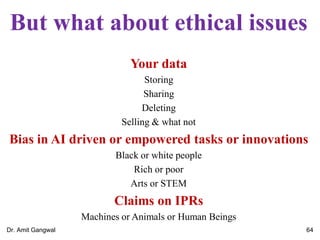
But what about ethical issues
Your data
Storing
Sharing
Deleting
Selling & what not
Bias in AI driven or empowered tasks or innovations
Black or white people
Rich or poor
Arts or STEM
Claims on IPRs
Machines or Animals or Human Beings
64Dr. Amit Gangwal
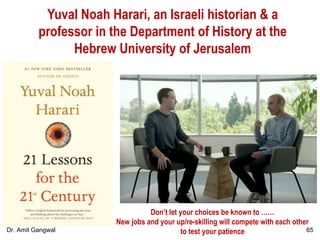
Yuval Noah Harari, an Israeli historian & a
professor in the Department of History at the
Hebrew University of Jerusalem
Don’t let your choices be known to ……
New jobs and your up/re-skilling will compete with each other
to test your patience 65Dr. Amit Gangwal
Your health
Sedentary life style
Depression
Anxiety
Metabolic disorders
66Dr. Amit Gangwal
An under trial self driving car of
Uber hit and killed a joyrider.
• Who will be held responsible?
• What if the algorithm has been designed to kill a
particular gender, community, group, race, class, citizens
etc.
• Or if a driver-less car can save the life of only one
pedestrian out of two, what will be its choice?
67Dr. Amit Gangwal
If we are biased then AI output will
also be biased, until we design a
neutral algorithms.
68Dr. Amit Gangwal
Here who will play major role to
make AI or Disruptive Innovations
Neutral
Socially responsible
Kind enough at least to its master, let alone other
Should not store information or indulge in any sort of
mal-practices
?
69Dr. Amit Gangwal
What next ?
• In coming years, you will be able to do your full
body scan, biochemical tests at home only suing
various hand-held and wearable devices which
will be managed by AI, ML, IoT, Blockchain etc.
• Depending on ethical considerations and
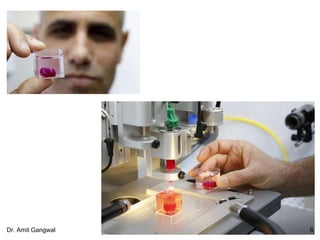
economical approach you may be allowed to print
your body organs using 3D printers.
• DIY diagnostic test machines will be a common
scene like ATMs, on which you can have print of
all your body parameters.
DIY
70Dr. Amit Gangwal
What for a nation builder that is for a
Teacher
?
71Dr. Amit Gangwal
Being Teachers
We should be the first to
Sense
Bring
Create
Develop
Incubate
Nurture
Patent & Implement
“Disruptive Innovations” 72Dr. Amit Gangwal
Why to wait for Corona sort of
tragedy ?
73Dr. Amit Gangwal
Re-skilling & Up-skilling are now more
important than core degree certificates;
like never before.
Are you implementing Train the Trainer
concept?
74Dr. Amit Gangwal
It is time to introspect ?
75Dr. Amit Gangwal
• Are we ready ?
• Why few of us were waiting for Corona for coming out of comfort
zones to hug technology and other teaching –learning tools?
• Are we preparing our students mentally & academically on this
front ?
• Are we undergoing re-skilling and up-skilling so often?
• Are we enabling out students to sit on a giant or we helping them to
become one?
• Are we challenging average so often?
• Are we exposing students to higher difficulty level frequently?
• Are we producing superior replicas?
• Are we visiting industries at least twice in a year ?
76Dr. Amit Gangwal
• Do we share top quality learning tools and content from internet
with our students without any fear or complex?
• Are we reading same day latest news from newspapers directly in
classrooms?
• Are we inculcating /instilling/imbibing Sanskar in our students ?
• Are we only producing executives or some business tycoons and
some
Ratan Tatas
77Dr. Amit Gangwal
All teachers, regardless of their stream or expertise
should do some basic or advanced course on
• Artificial Intelligence
• Machine Learning
• Python
• Tensorflow
• Sustainable Development
• Innovator Leadership
• Design Thinking
• Emotional Intelligence 78Dr. Amit Gangwal
• This courses are other than your core subjects
re/up-skilling; but equally important to survive.
79Dr. Amit Gangwal
There is no harm in becoming an
incessant learner……
• Even if you are a civil engineering teacher, you
should know
– coding basics
– basics of algorithms
– working on excel
– General international affairs
– Data presentation skills/tools
– ERP, CRM, BI, Tableu etc.
– Most-in-demand skill sets required by head hunters in
industries.
80Dr. Amit Gangwal
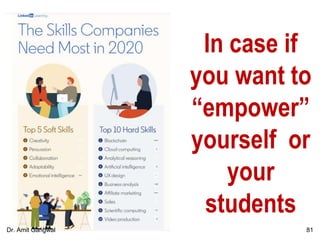
In case if
you want to
“empower”
yourself or
your
students
81Dr. Amit Gangwal
Images and infographics are taken from original
resources, just to disseminate the information
and not for commercial purposes.
I am thankful to Boston Dynamics, MIT, Tel
Aviv University, Apple, Google and other
original copyright holders.
Major infographics from Simplilearn, with
thanks.
Dr. Amit Gangwal
Keep
producing
superior
replicas &
not the
followers.
Dr. Amit Gangwal
Thanks
gangwal.amit@gmail.com
Dr. Amit Gangwal

Disruptive innovations, disruptive technologies, industry 4.0, artificial intelligence

  • 1.
    Redefining the Roleof Educator in Covid-19 Outbreak Era e-Faculty Development Program Gujarat Technological University, Ahmedabad & Anand Pharmacy College, Anand by on May 11-16, 2020
  • 2.
    Disruptive Innovations &Industry 4.0 A world driven/empowered by Artificial Intelligence Dr. Amit Gangwal (M. Pharm., Ph. D.) Professor & Principal Shri Vithal Education & Research Institute's College of Pharmacy, Pandharpur May 11, 2020: 12:00PM to 01:00Pm)
  • 3.
    I salute youall teachers Because everyday you are dealing with 60 families in a lecture of 60 minutes; each time you have to fine tune your overall connection and bond with your students. This a rare phenomenon across any of the industry. 1Dr. Amit Gangwal
  • 4.
  • 5.
  • 6.
    Search engine giantGoogle has developed algorithms to read images. 4Dr. Amit Gangwal
  • 7.
  • 8.
  • 9.
  • 10.
  • 11.
    3D Organ Printing (Three-dimensionalprinting of biological matters: Journal of Science: Advanced Materials and Devices Volume 1, Issue 1, March 2016, Pages 1-17) 9Dr. Amit Gangwal
  • 12.
    Hand-held devices &wearable devices Apple sold nearly 10 million more watches than the entire Swiss watch industry in 2019 - and it's a sign the wrist wear market has entirely changed. 10Dr. Amit Gangwal
  • 13.
    It is aninnovative product for police as well, to nab the violators; among many other applications. 11Dr. Amit Gangwal
  • 14.
    Precision Medicine Symptom-based medicines Evidence-basedmedicines Algorithm-based precision medicine 12Dr. Amit Gangwal
  • 15.
  • 16.
    • Any innovationmay be called a disruptive innovation if it – Creates new product (s) – Creates new service – Shows new way to do business (generating sale, profit, customers, making products or services or something which literally affects or wipes out existing businesses/players/products/services/concepts/likings/preco nceived notions or other crucial component in entire business or ecosystem for that matter) Can you think some examples lately? 14Dr. Amit Gangwal
  • 17.
    According to HBR 1.Disruptive innovation is a process by which a smaller company, one with fewer resources, manages to overtake or successfully compete with incumbent enterprises. 2. Smart disrupters improve their products and drive upmarket. 3. Some disruptive innovations succeed and some don’t. 4. Disrupters often build business models that are very different from those of incumbents. 5. Disruptive innovations don’t catch on with mainstream customers until quality catches up to their standards. 6. Disruptive innovations originate in low-end or new-market footholds. 15Dr. Amit Gangwal
  • 18.
    According to HBRcontinue---------- Disruptive innovations are made possible because they get started in two types of markets that incumbents (existing player) overlook: – New-market footholds: Disrupters create a market where none existed; they find a way to turn non consumers into consumers (e. g. Netflix) – Low-end footholds exist because incumbents typically try to provide their most profitable and demanding customers with ever- improving products and services, and they pay less attention to less-demanding customers (e. g. Airbnb) 16Dr. Amit Gangwal
  • 19.
    Artificial Intelligence. Blockchain. Coding/Algorithms.Data Analytics Internet of Things Robotics Hand-held devices for MRI, CT Scan & what not Much faster & well in advance diagnosis of diseases Driverless cars Drones Doctor-less clinics/Diagnostic centers Banker-less Banks Highly customized drug therapies Faster drug discovery & development Teacher-less institutes & many more. ABCD has brought paradigm shift by its very nature of disruption 17Dr. Amit Gangwal
  • 20.
    Disruptive innovations Howthey affected existing or old technology/process/product Personal computer Have almost replaced type writers. Cell phones A replacement for fax, telegram and landline phones. They have also threatened industries manufacturing personal diaries, alarms, MP3 players, calculators, cameras etc. ATM Almost entirely ended the concept of visiting bank for various financial purposes. Email Transformed the way we communicating, largely displacing letter-writing and disrupting the postal and greeting card and related segments. Laptop Replaced desktops. In very near future foldable phones may replace laptops as well; indicating disruption is a continuous process. Wearable devices, portable devices and other techniques ECG, step trackers and lot many health and fitness recording is easily available in wrist watches, cell phones. Handheld devices are going to rule the healthcare domain, especially diagnostic paradigms. Portable-foldable devices will be used by patients or their caretakers for performing endoscopy, sonography, X ray, MRI or CT scan for that matter. Without any incisions or piercing blood test for various pathogens or biomolecules will be possible in next 10 to 15 years at highly affordable rates for masses. Online/e pharmacy No need to visit nearby pharmacy, no need to set pills reminders/ Painless shots for diabetics and others Painless insulin shots and other similar technologies are being worked upon by technology giants and diagnostics organizations. Depending on the affordability it will decide the future of traditional injections. 18Dr. Amit Gangwal
  • 21.
    Sustaining innovations (incremental improvement) Disruptiveinnovations Existing market New market. Improves performance. Cost is lower & incremental change. Innovation is dramatic & game changing. Market is predictable and traditional business methods are sufficient. Market is unpredictable and traditional business methods fail. 19Dr. Amit Gangwal
  • 22.
    Disruptive innovations comewith certain disadvantages also, which are not visible in near future (post their advent in the market or society). Few examples can be stated here. Huge discussion going on, about increasing number of cancer victims owing to mobile radiations etc., irreversible damage to environment owing to use of single use plastic. Years ago when plastic and its uses were propagated, at that time it was not thought that such a wide spread use of plastic may damage environment to a large extent. It means certainly AI, ML, IoT may also have some any ill effects in future. It requires visionary approach, ant not the myopic calculations to gauze and check the mal effects of these innovations in future. 20Dr. Amit Gangwal
  • 23.
    Current factory resetby the God has cleaned all the rivers and air pollution like never before. 21Dr. Amit Gangwal
  • 24.
  • 25.
    Revolution Meaning/Progress Industry 1.0 (between thelate 1700s and early 1800s) In this era manual labor performed by people and assisted by animals and use of water and steam-powered engines were main tools available for various purposes. Industry 2.0 (In the early part of the 20th century) Electricity enabled manufacturing (concepts like the assembly line to increase efficiency) was the main tool. This led to enhanced productivity. Industry 3.0 (Starting in the late 1950s) In this third industrial revolution electronic & computer technology were at the forefront. Shifting was from analog and mechanical technology to digital technology and automation software. Industry 4.0 (current era) This is the era of disruptive innovations or disruptive technologies. This is based on high speed internet connectivity (5G), cloud computing, big data analytics, internet of things, artificial intelligence, machine learning, 3D organ printing, blockchain and related technological advancement like virtual reality and augmented reality. Such is the application of these innovations that none of the industries and none of the department have untouched or immune to these disruptions. 23Dr. Amit Gangwal
  • 26.
    Why so muchdisruption with a speed of cheetah ? 24Dr. Amit Gangwal
  • 27.
    Driving force behinddisruptive innovations (AI, ML, IoT, Cloud, High speed quantum systems and fast internet connectivity) ABCDEFG 25Dr. Amit Gangwal
  • 28.
    AI vs MLvs DL AI Program with the ability to learn & reason like humans ML Algorithms whose output improves as they are exposed to more and more data over the time DL A subset of ML in which multilayer neural networks learn from vast amount of data 26Dr. Amit Gangwal
  • 29.
    What experts haveto say about disruptive technology/industry 4.0/Artificial Intelligence “Success in creating AI would be the biggest event in human history. Unfortunately, it might also be the last, unless we learn how to avoid the risks.” Stephen Hawking “By 2030, the global GDP could rise by 14 percent as a result of AI enabled activities. That is equal to $15.7 trillion:. PWC “Artificial intelligence (AI) will be more transformative to humanity than electricity”. Sundar Pichai “Japan should make AI a mandatory subject for college entrance exams”. Masayoshi Son “Explainable AI won’t replace human workers; rather, it will complement and support people, so they can make better, faster, more accurate decisions”. “AI technology can enhance business productivity by up to 40%”. Accenture 27Dr. Amit Gangwal
  • 30.
  • 31.
    Three different domainsof AI, which almost cover all aspects or areas of AI •This deals with the physical world, is able to directly interact with humans. Robotics are in use to improve our work in various ways viz. Ford’s exoskeleton or some of the top class players in the field like Boston Dynamics & MIT Labs. Robotics •A great example of this is chatbot. Chatbots are a very easy to understand example. Here humans and machines work together to accomplish a goal. A chatbot is a communication interface e. g. the one which interacts with us on various e commerce and other websites. Cognitive systems •It deals with the information/data world. Machines use data to learn. Machine learning, a important sub area of AI, aims to get meaning from that data by using statistical methods to enable machines to improve with experience. A subset of it is deep learning. Machine learning 29Dr. Amit Gangwal
  • 32.
    Various components ofartificial intelligence Applications Types of Models Soft/hard ware for training & running models Programming languages for building models Image recognition Speech recognition Chatbots Deep learning Machine learning Natural networks GPUs Parallel processing tools Cloud data storage Python Java C TensorFlow 30Dr. Amit Gangwal
  • 33.
    S. No. Applications of AIExamples 1 Language translation applications Google Translate 2 Word processors Microsoft Word, Grammarly, U Dictionary etc. 3 Personal assistant OK Google, Siri, Cortana, and Alexa etc. Some very common applications of AI 31Dr. Amit Gangwal
  • 34.
    Machine Learning Data TrainingModel Training data Model (w, b) Prediction Test & update w, b W: weights and b: biases 32Dr. Amit Gangwal
  • 35.
    The prime goalis to permit the computers learn automatically without any human involvement or support and fine-tune actions consequently. 33Dr. Amit Gangwal
  • 36.
    According to YufengGuo, a Famous Developer and Machine Learning Advocate @ Google Cloud; “ML is Using data to answer questions”. Here…. Using data means training & answer questions means prediction “Data is key to unlocking ML and ML is the key to unlocking the insight hidden in data”. 34Dr. Amit Gangwal
  • 37.
    Study from data,recognize patterns and make decisions with negligible human intervention Can understand images, sounds, and language. Instead of writing a brand new algorithm, machine learning tools empower systems to develop and refine algorithms, by finding some arrangements in huge database. Finding use from helping people with debilities to felicitating businesses with decision-making and dynamic pricing, to identifying skin cancer, to sorting vegetables, to detecting escalators in need of repairs. 35Dr. Amit Gangwal
  • 38.
    Whether a chemicalstructure is suitable for diabetes treatment or heart problem ? Let’s imagine that you have to create a system that answers above question. This question answering system that experts build is called a “model”, and this model is shaped via a process called “training”. The aim of training is to develop a precise model that answers questions fittingly most of the time. Finally to train a model, we require to collect data to train on. 36Dr. Amit Gangwal
  • 39.
    Due to complexity& size of data or pattern and their association, these could have easily been overlooked by human observations or insights. 37Dr. Amit Gangwal
  • 40.
    Quickly we seedefinitions and examples one by one Regression & Classification are the two types of supervised machine learning methods. 38Dr. Amit Gangwal
  • 41.
    Classification Learns a methodfor predicting the instances class from pre- labelled (classified) instances. It is a supervised machine learning and predictive method. It is highly applicable in pattern recognition etc. e.g. decision tree, Bayesian classifier. The quality of a classification analysis is often assessed via precision and recall which are popular metric procedures. E.g. a classification algorithm would train a model to identify whether a certain cell is malignant or benign. 39Dr. Amit Gangwal
  • 42.
    Algorithms used inClassification • Decision Tree • Naïve Bayes • Random Forest • Logistic Regression • KNN 40Dr. Amit Gangwal
  • 43.
    Regression An attempt topredict a continuous attribute. It is a predictive method. Supervised. A regression problem has a real no as its output e. g. we could use the data in the table below to show relationship between weight and height of people. 41Dr. Amit Gangwal
  • 44.
    Height (inches) (independent variable) Weight(pounds) (dependent variable) or label 65.78 112.29 71.52 56.58 42Dr. Amit Gangwal
  • 45.
    Algorithms used inRegression • Linear Regression 43Dr. Amit Gangwal
  • 46.
    Supervised learning • Whendata is labelled; after training and testing model is ready for real problem in hand. • Data has labeled features that define the meaning of data. • A supervised machine learning algorithm is used to solve classification or regression problems. 44Dr. Amit Gangwal
  • 47.
    Here machine learningmodel knows the feature and label associated with that feature. 45Dr. Amit Gangwal
  • 48.
  • 49.
    Unsupervised learning • Whenmachine learning models , find some hidden patterns in vast amount of data and they cluster or classify the data set or information in a concrete manner e. g. Flagging or highlighting or removing or suspending some account on social media sites like Twitter or marking few emails as spam by Gmail 47Dr. Amit Gangwal
  • 50.
  • 51.
    Name of cricketersRun scored Wickets taken A 500 10 B 450 00 C 200 00 D 25 45 E 01 40 F 25 30 G 26 40 H 89 55 Batsman A, B, & C Bowlers D, E, F, G & H 49Dr. Amit Gangwal
  • 52.
    Reinforced Learning (model learnsfrom rewards) Working of self-driving cars & Learning to navigate staring by robots. 50Dr. Amit Gangwal
  • 53.
    (model learns fromrewards) 51Dr. Amit Gangwal
  • 54.
  • 55.
    Following seven stepsare required to use ML for a defined object to get a desired or predicted output Data collection Data preparation Choosing a model Training Evaluation Parameter tuning Prediction 53Dr. Amit Gangwal
  • 56.
  • 57.
  • 58.
  • 59.
  • 60.
  • 61.
    In machine learning,there are many m’s as there may be many features. The collection of these m values is typically formed into a matrix, that we can show using W, for “weights” matrix. Similarly for b, and together they will be called the biases. The training process includes starting some random values for W and b and attempting to predict the output with those values. At the outset it may perform poorly. By continuous tweaking or adjusting of fine tuning the values in W and b, we can accomplish correct prediction matching with best output. Lot many frequent cycle of updating the weights and biases are inevitable to get it. Each repetition or cycle is called one training “step”. 59Dr. Amit Gangwal
  • 62.
    A feature isone column of the data in your input set. For example, if you are trying to predict the type of pet someone will choose, your input features may include family income, age, home region and others. The label is the final choice, such as dog, fish etc. Example Once you are done with training the model, you will expose it to set of new input having same features. It will present the predicted label that is type of pet for that particular person only. 60Dr. Amit Gangwal
  • 63.
  • 64.
    AI • IBM deepblue chess program • Electronic game characters ML • IBM Watson • Google search algorithms • Amazon recommendations • Email spam filters DL • AlphaGO • Natural speech recognition • Self driving vehicles Some of the top class examples of AI, ML & DL 62Dr. Amit Gangwal
  • 65.
    Artificial intelligence Machinelearning It is an independent concept. It is a subset of AI. The purpose is to increase chance of success. The aim is to increase accuracy, but it does not focus on success. It works as a computer program that does smart work. Here concept is that machine takes data and learns from it. The goal is to mimic natural intelligence to solve complex problem the way human brains does. The goal is to learn from data on certain task to maximize the performance of machine on this task by self learning. AI will go for finding the optimal solution. Solution will be there but does not guarantee for being optimal one. AI generates intelligence or wisdom. ML leads to knowledge. Mainly focuses on automation by utilizing such field as image processing, cognitive science, neural systems, machine learning etc. Influences user’s machine to gain from the external environment like sensors, electronic segments, external storage gadgets etc. AI empowers framing of machines, frameworks and different gadgets and letting them think. It depends on user inputs or query. The framework checks if it is available in its knowledge data base or not. If yes it will show the output, if not machine will fetch user data will enhance its knowledge base, to give a better value to the end user next time. Intelligence is the gaining of knowledge and the skill to apply it Learning is using past instances to make future decisions. It focuses more on automating a task or a system, like cars It focuses on gaining and applying knowledge from the external environment, like Cortana AI enables the machines to think and perform routine jobs that humans do, such as assembly line operations in a factory ML provides solutions on the basis of a constantly evolving neural network AI vs ML 63Dr. Amit Gangwal
  • 66.
    But what aboutethical issues Your data Storing Sharing Deleting Selling & what not Bias in AI driven or empowered tasks or innovations Black or white people Rich or poor Arts or STEM Claims on IPRs Machines or Animals or Human Beings 64Dr. Amit Gangwal
  • 67.
    Yuval Noah Harari,an Israeli historian & a professor in the Department of History at the Hebrew University of Jerusalem Don’t let your choices be known to …… New jobs and your up/re-skilling will compete with each other to test your patience 65Dr. Amit Gangwal
  • 68.
    Your health Sedentary lifestyle Depression Anxiety Metabolic disorders 66Dr. Amit Gangwal
  • 69.
    An under trialself driving car of Uber hit and killed a joyrider. • Who will be held responsible? • What if the algorithm has been designed to kill a particular gender, community, group, race, class, citizens etc. • Or if a driver-less car can save the life of only one pedestrian out of two, what will be its choice? 67Dr. Amit Gangwal
  • 70.
    If we arebiased then AI output will also be biased, until we design a neutral algorithms. 68Dr. Amit Gangwal
  • 71.
    Here who willplay major role to make AI or Disruptive Innovations Neutral Socially responsible Kind enough at least to its master, let alone other Should not store information or indulge in any sort of mal-practices ? 69Dr. Amit Gangwal
  • 72.
    What next ? •In coming years, you will be able to do your full body scan, biochemical tests at home only suing various hand-held and wearable devices which will be managed by AI, ML, IoT, Blockchain etc. • Depending on ethical considerations and economical approach you may be allowed to print your body organs using 3D printers. • DIY diagnostic test machines will be a common scene like ATMs, on which you can have print of all your body parameters. DIY 70Dr. Amit Gangwal
  • 73.
    What for anation builder that is for a Teacher ? 71Dr. Amit Gangwal
  • 74.
    Being Teachers We shouldbe the first to Sense Bring Create Develop Incubate Nurture Patent & Implement “Disruptive Innovations” 72Dr. Amit Gangwal
  • 75.
    Why to waitfor Corona sort of tragedy ? 73Dr. Amit Gangwal
  • 76.
    Re-skilling & Up-skillingare now more important than core degree certificates; like never before. Are you implementing Train the Trainer concept? 74Dr. Amit Gangwal
  • 77.
    It is timeto introspect ? 75Dr. Amit Gangwal
  • 78.
    • Are weready ? • Why few of us were waiting for Corona for coming out of comfort zones to hug technology and other teaching –learning tools? • Are we preparing our students mentally & academically on this front ? • Are we undergoing re-skilling and up-skilling so often? • Are we enabling out students to sit on a giant or we helping them to become one? • Are we challenging average so often? • Are we exposing students to higher difficulty level frequently? • Are we producing superior replicas? • Are we visiting industries at least twice in a year ? 76Dr. Amit Gangwal
  • 79.
    • Do weshare top quality learning tools and content from internet with our students without any fear or complex? • Are we reading same day latest news from newspapers directly in classrooms? • Are we inculcating /instilling/imbibing Sanskar in our students ? • Are we only producing executives or some business tycoons and some Ratan Tatas 77Dr. Amit Gangwal
  • 80.
    All teachers, regardlessof their stream or expertise should do some basic or advanced course on • Artificial Intelligence • Machine Learning • Python • Tensorflow • Sustainable Development • Innovator Leadership • Design Thinking • Emotional Intelligence 78Dr. Amit Gangwal
  • 81.
    • This coursesare other than your core subjects re/up-skilling; but equally important to survive. 79Dr. Amit Gangwal
  • 82.
    There is noharm in becoming an incessant learner…… • Even if you are a civil engineering teacher, you should know – coding basics – basics of algorithms – working on excel – General international affairs – Data presentation skills/tools – ERP, CRM, BI, Tableu etc. – Most-in-demand skill sets required by head hunters in industries. 80Dr. Amit Gangwal
  • 83.
    In case if youwant to “empower” yourself or your students 81Dr. Amit Gangwal
  • 84.
    Images and infographicsare taken from original resources, just to disseminate the information and not for commercial purposes. I am thankful to Boston Dynamics, MIT, Tel Aviv University, Apple, Google and other original copyright holders. Major infographics from Simplilearn, with thanks. Dr. Amit Gangwal
  • 85.
  • 86.