










Disruptive Technologies
Christian Sandström holds a PhD from Chalmers
University of Technology, Sweden. He writes and speaks
 about disruptive innovation and technological change.
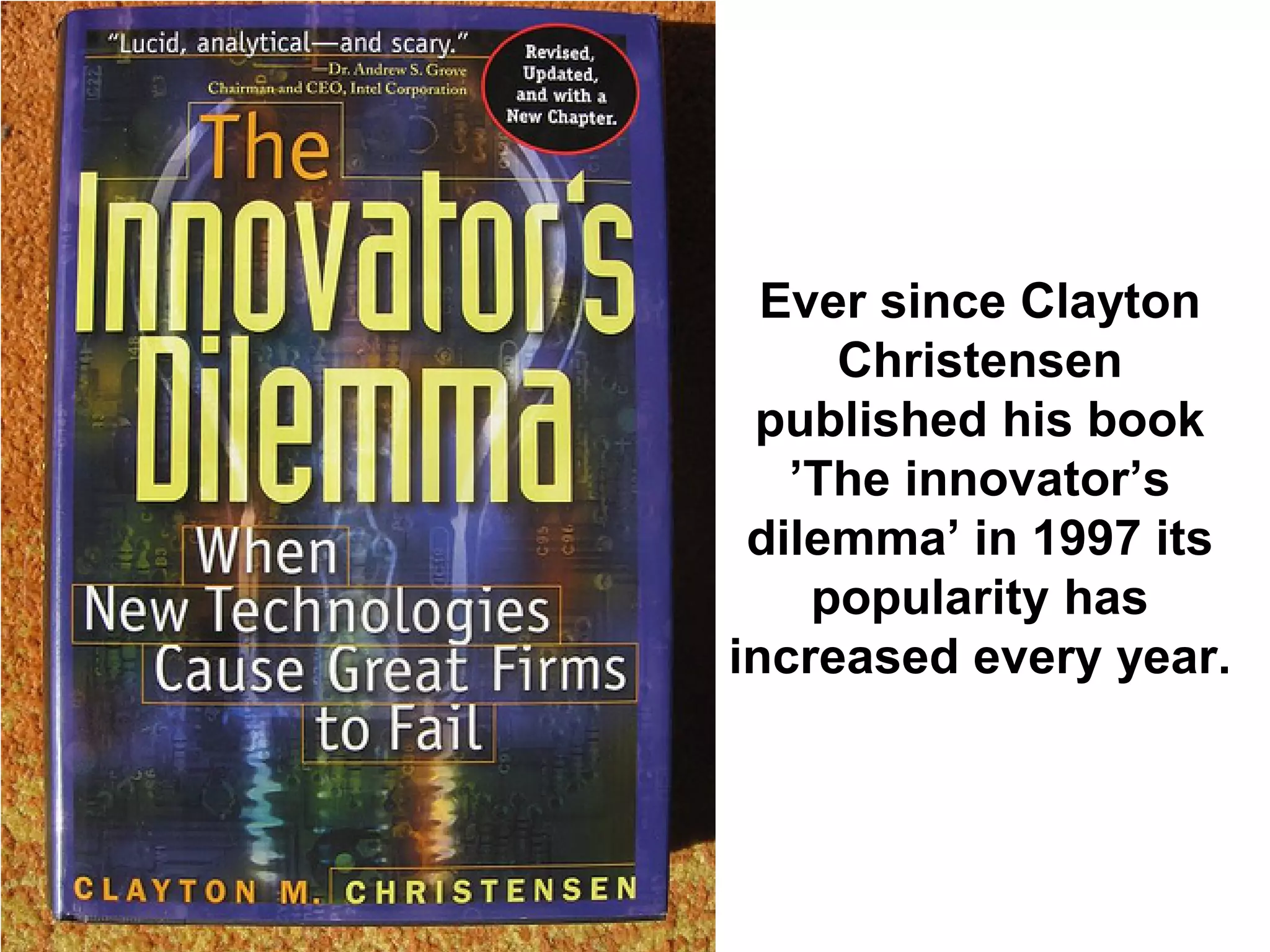
Ever since Clayton
     Christensen
 published his book
   ’The innovator’s
 dilemma’ in 1997 its
    popularity has
increased every year.
The book has had a profound impact
   on how both practitioners and
scholars think about innovation and
       technological change.
This presentation will give a brief
introduction to the main idea of the book.
In his book, Christensen sought to
  explain why great firms fail under
conditions of technological change.
While there are many explanations of such
failure, Christensen brought an intriguingly
    different perspective upon this issue.
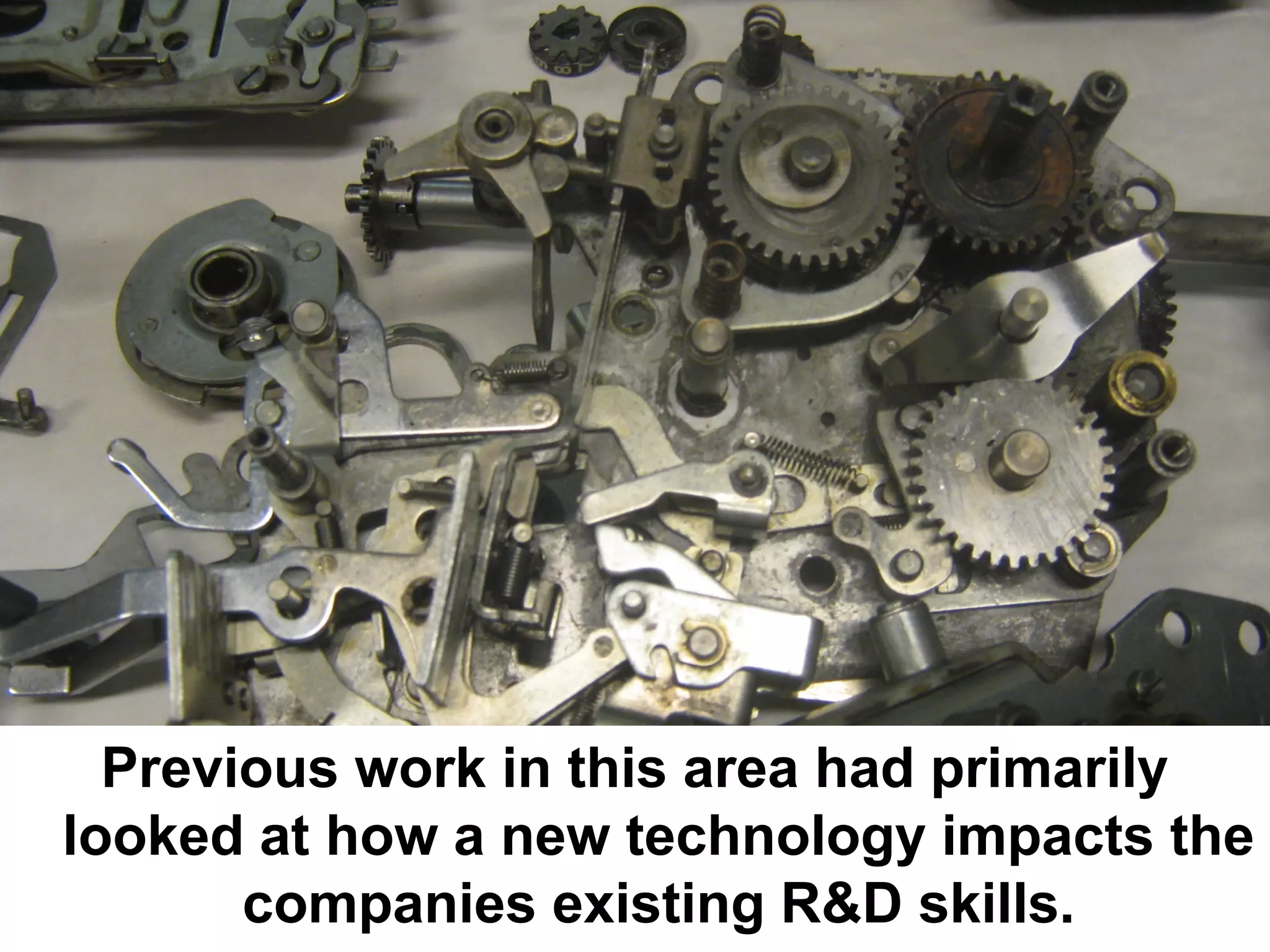
Previous work in this area had primarily
looked at how a new technology impacts the
       companies existing R&D skills.
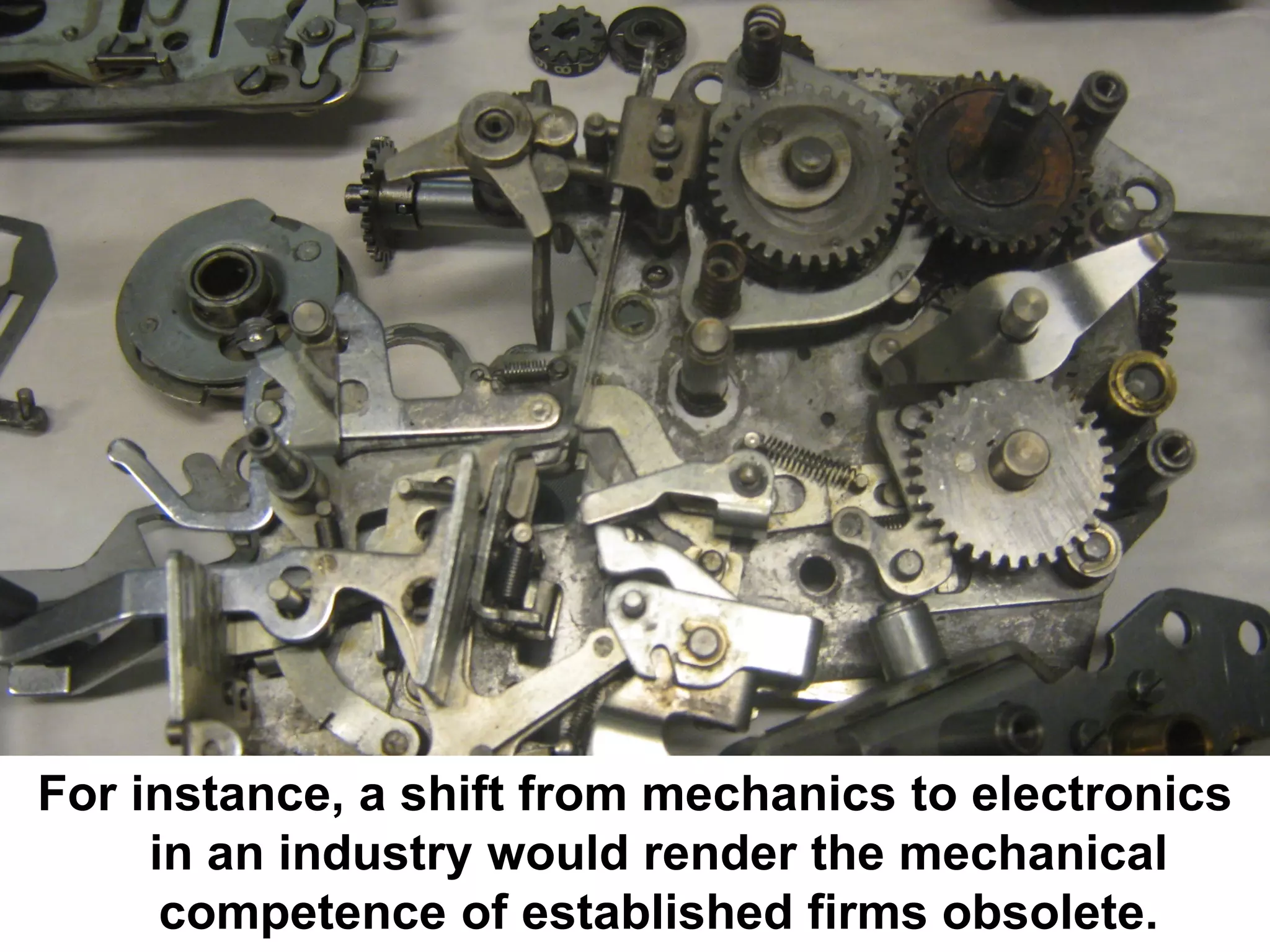
For instance, a shift from mechanics to electronics
     in an industry would render the mechanical
      competence of established firms obsolete.
However, those perspectives could not
explain what happened in the disk drive
 industry, which Christensen studied
       during is PhD at Harvard.
In this industry, established firms
managed to renew their competence
         base, yet still failed.
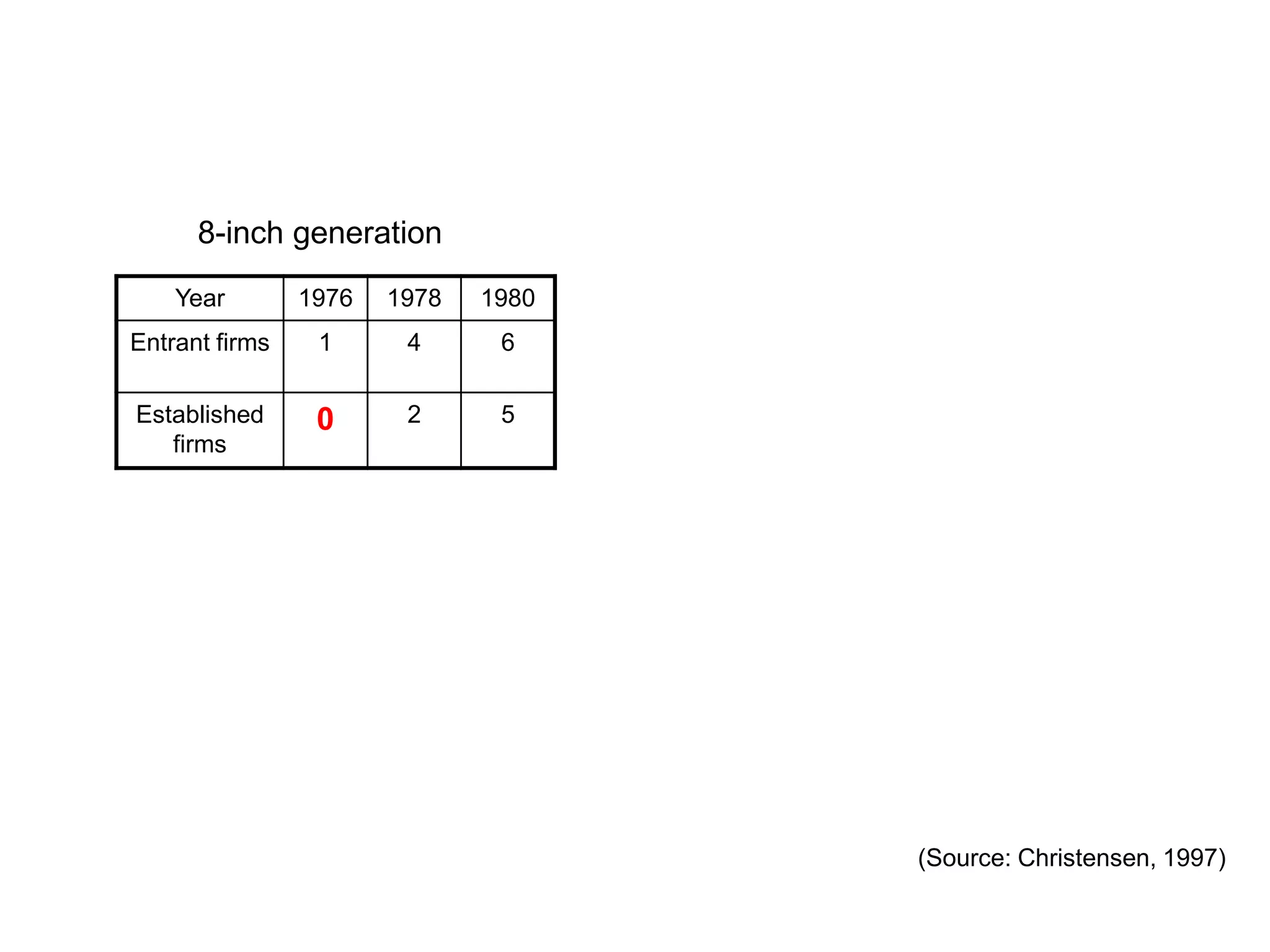
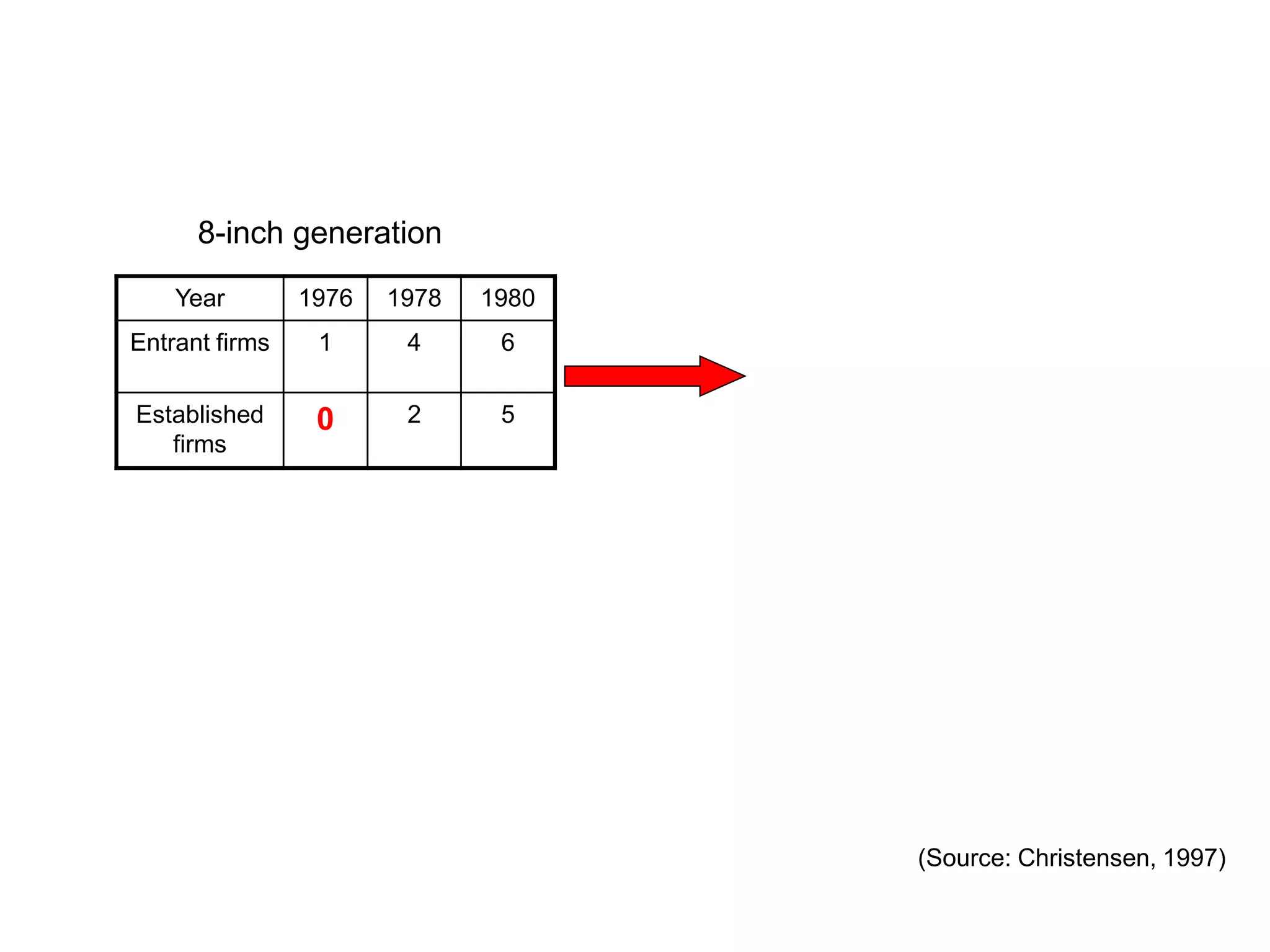
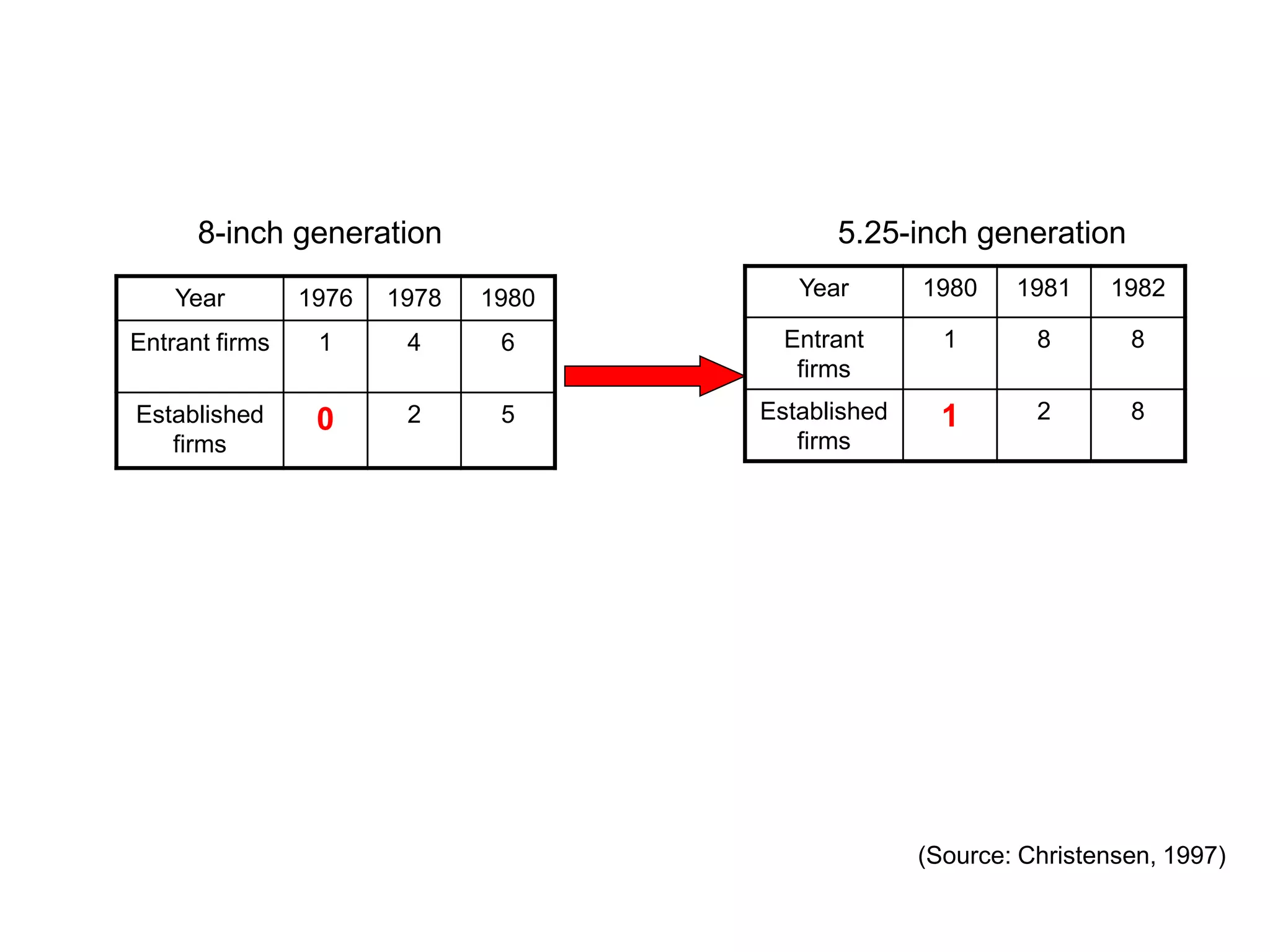
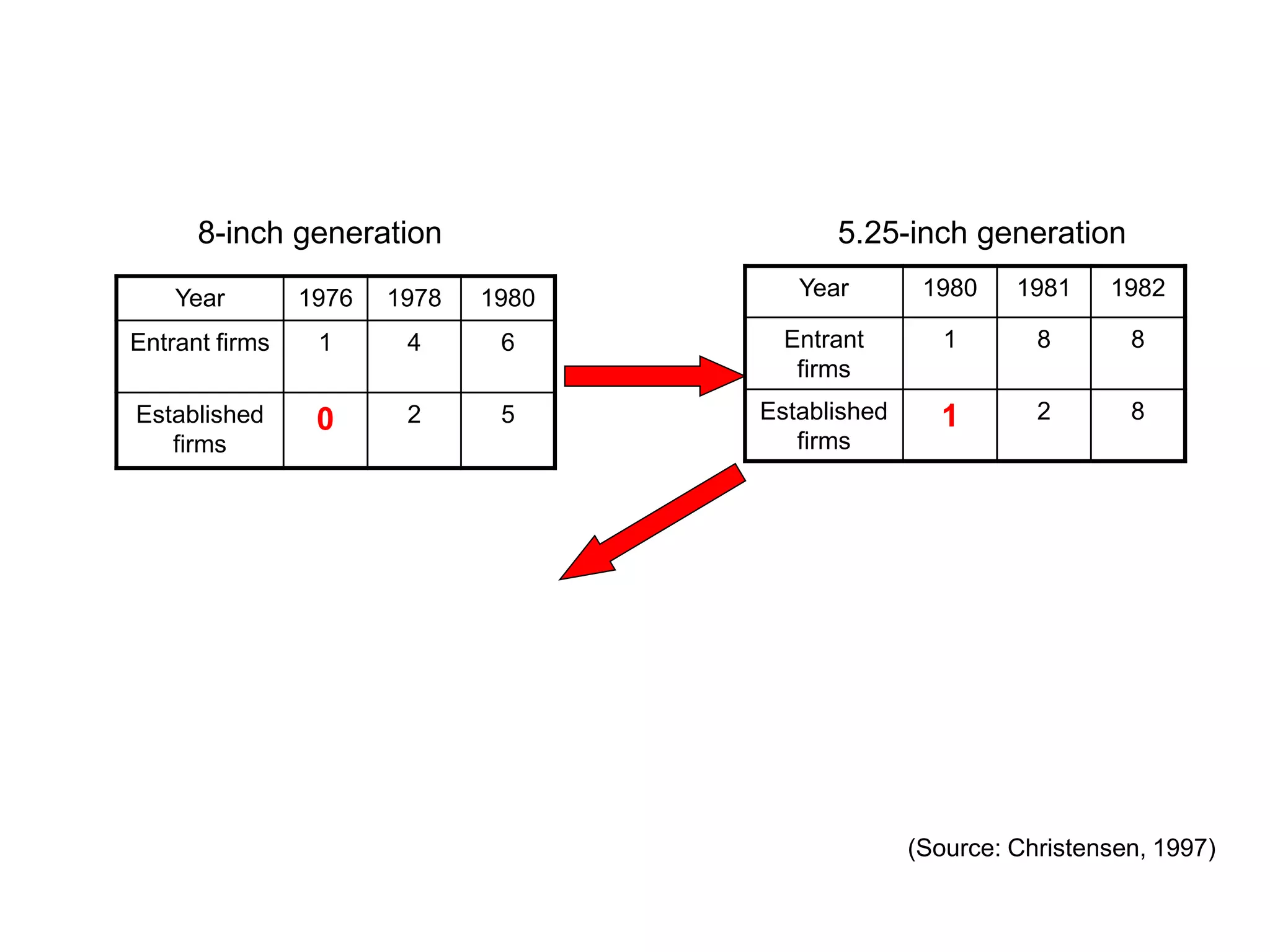
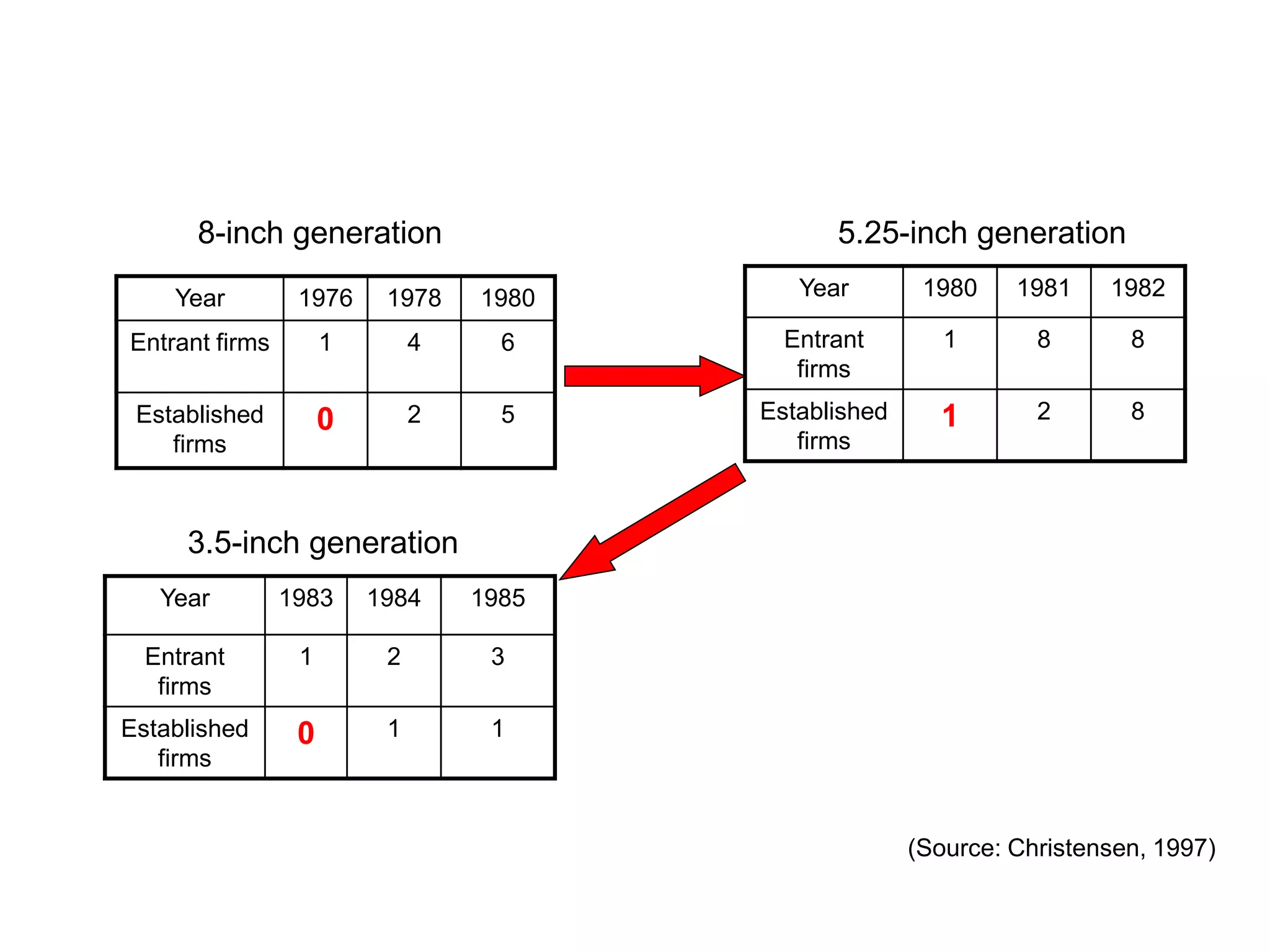
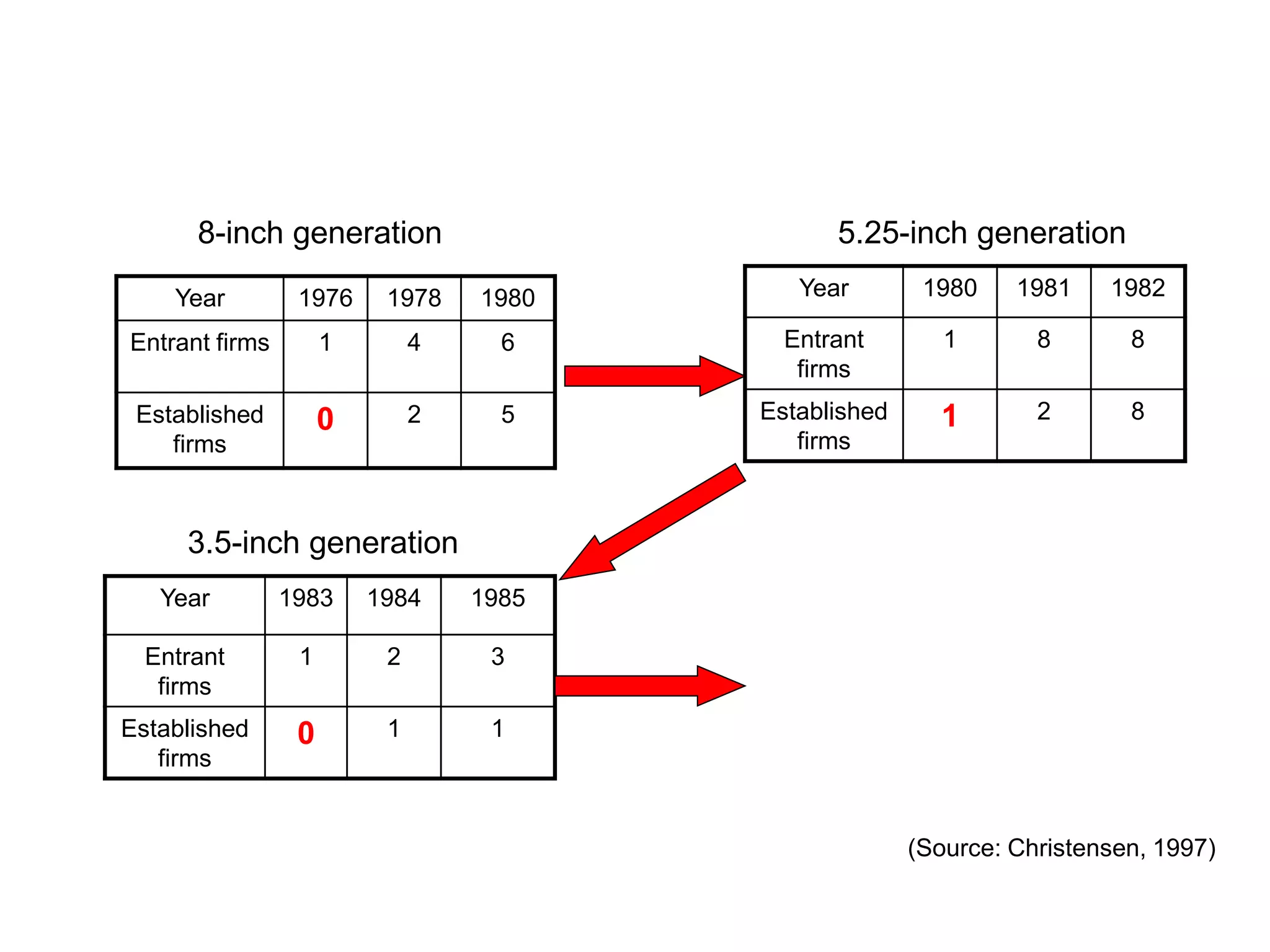
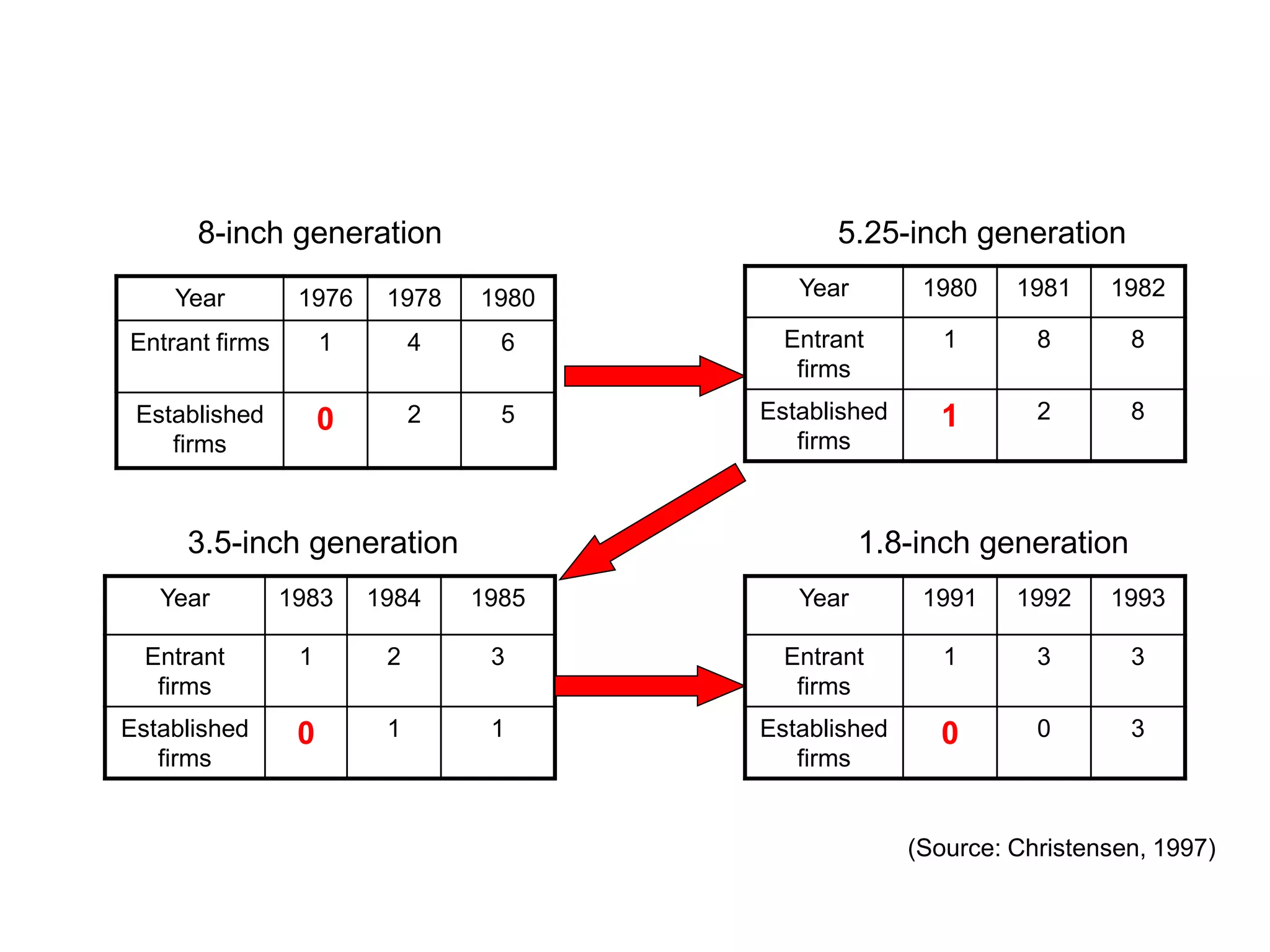
Just take a look at what happened in
each shift from one generation of disk
        drives to another one:
8-inch generation
    Year        1976   1978   1980
Entrant firms    1      4      6

Established      0      2      5
   firms


                                     (Source: Christensen, 1997)
8-inch generation
    Year        1976   1978   1980
Entrant firms    1      4      6

Established      0      2      5
   firms


                                     (Source: Christensen, 1997)
8-inch generation                    5.25-inch generation
    Year        1976   1978   1980      Year       1980    1981    1982

Entrant firms    1      4      6       Entrant       1       8       8
                                        firms
Established      0      2      5     Established     1       2       8
   firms                                firms


                                                   (Source: Christensen, 1997)
8-inch generation                    5.25-inch generation
    Year        1976   1978   1980      Year        1980    1981    1982

Entrant firms    1      4      6       Entrant        1       8       8
                                        firms
Established      0      2      5     Established     1        2       8
   firms                                firms


                                                   (Source: Christensen, 1997)
8-inch generation                        5.25-inch generation
    Year         1976     1978    1980      Year        1980    1981    1982

Entrant firms        1        4     6      Entrant        1       8       8
                                            firms
 Established         0        2     5    Established     1        2       8
    firms                                   firms


     3.5-inch generation
   Year         1983     1984     1985

  Entrant        1        2        3
   firms
Established      0        1        1
   firms


                                                       (Source: Christensen, 1997)
8-inch generation                        5.25-inch generation
    Year         1976     1978    1980      Year        1980    1981    1982

Entrant firms        1        4     6      Entrant        1       8       8
                                            firms
 Established         0        2     5    Established     1        2       8
    firms                                   firms


     3.5-inch generation
   Year         1983     1984     1985

  Entrant        1        2        3
   firms
Established      0        1        1
   firms


                                                       (Source: Christensen, 1997)
8-inch generation                        5.25-inch generation
    Year         1976     1978    1980      Year        1980    1981    1982

Entrant firms        1        4     6      Entrant        1       8       8
                                            firms
 Established         0        2     5    Established     1        2       8
    firms                                   firms


     3.5-inch generation                           1.8-inch generation
   Year         1983     1984     1985      Year        1991    1992    1993

  Entrant        1        2        3       Entrant        1       3       3
   firms                                    firms
Established      0        1        1     Established     0        0       3
   firms                                    firms


                                                       (Source: Christensen, 1997)
In total, one established firm managed
the transition from one generation of disk
            drives to the next one!
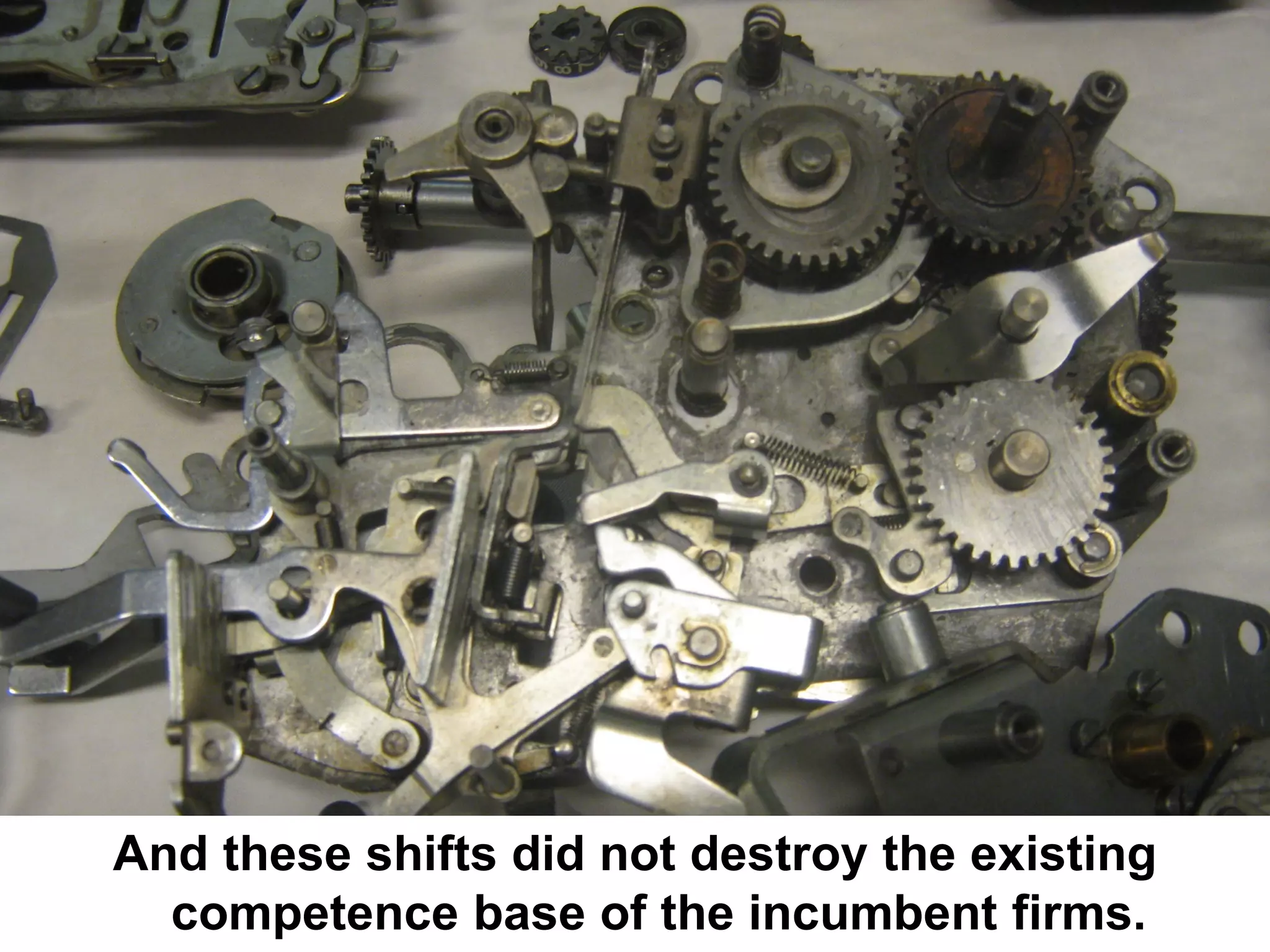
And these shifts did not destroy the existing
  competence base of the incumbent firms.
Why then, did those firms fail?
Christensen’s answer:
Because they listened to their customers!
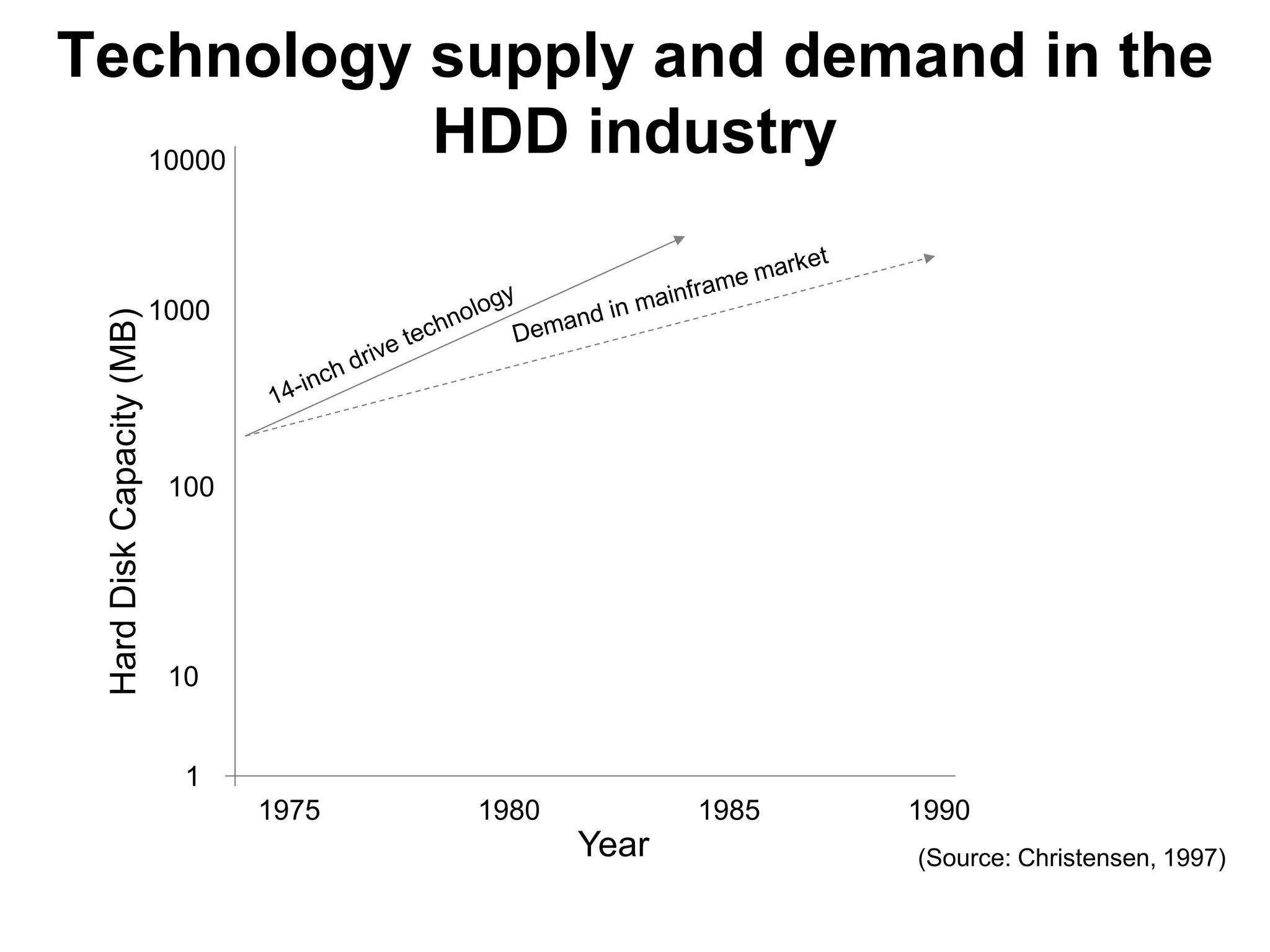
Each of the new generations of disk drives
offered a worse performance in terms of what
       existing customers demanded.
Customers wanted a better storage
capacity - and a smaller disk drive
   initially offered less storage.
Therefore, the established firms could
not find any financial logic in entering the
             next generation.
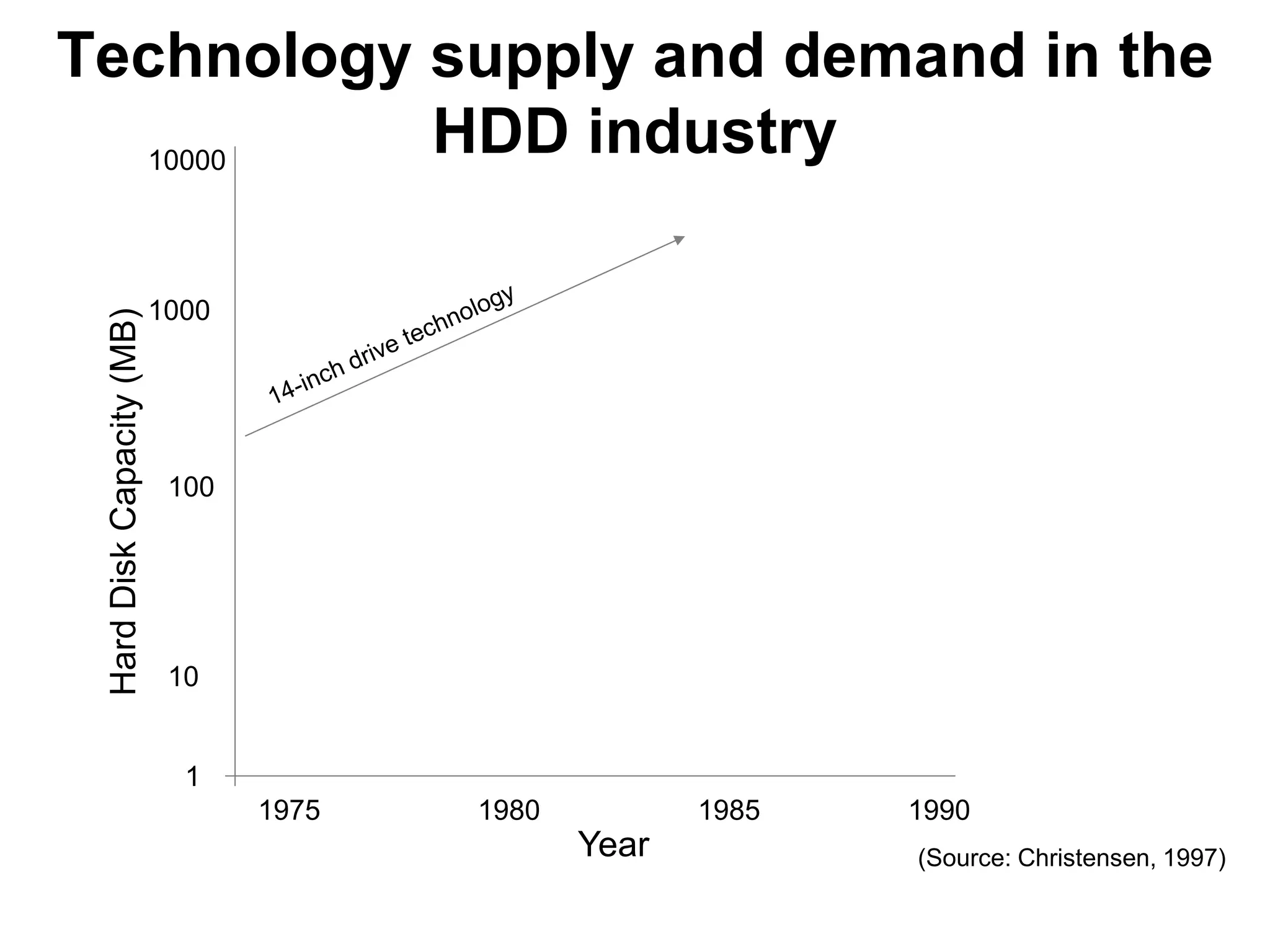
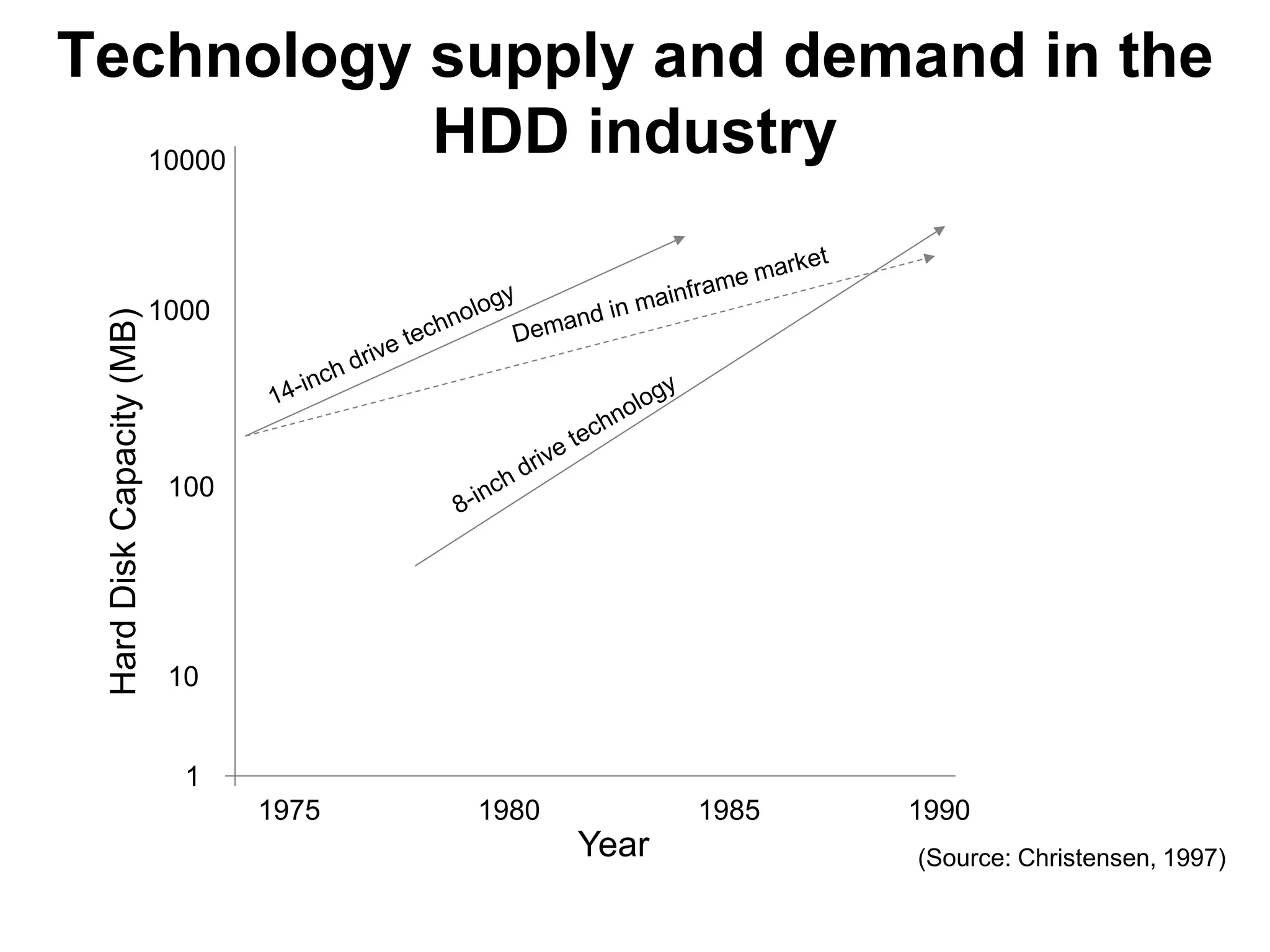
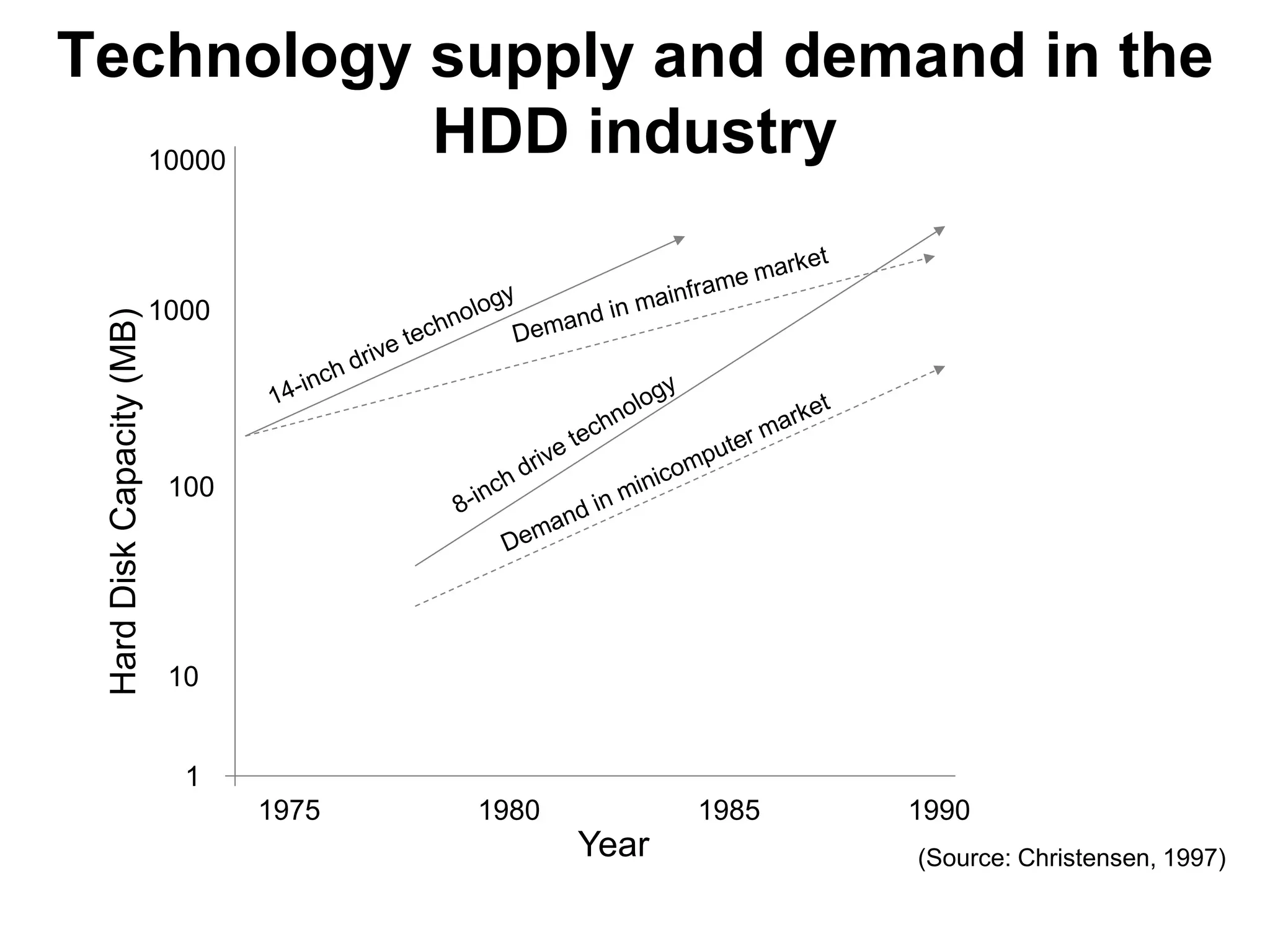
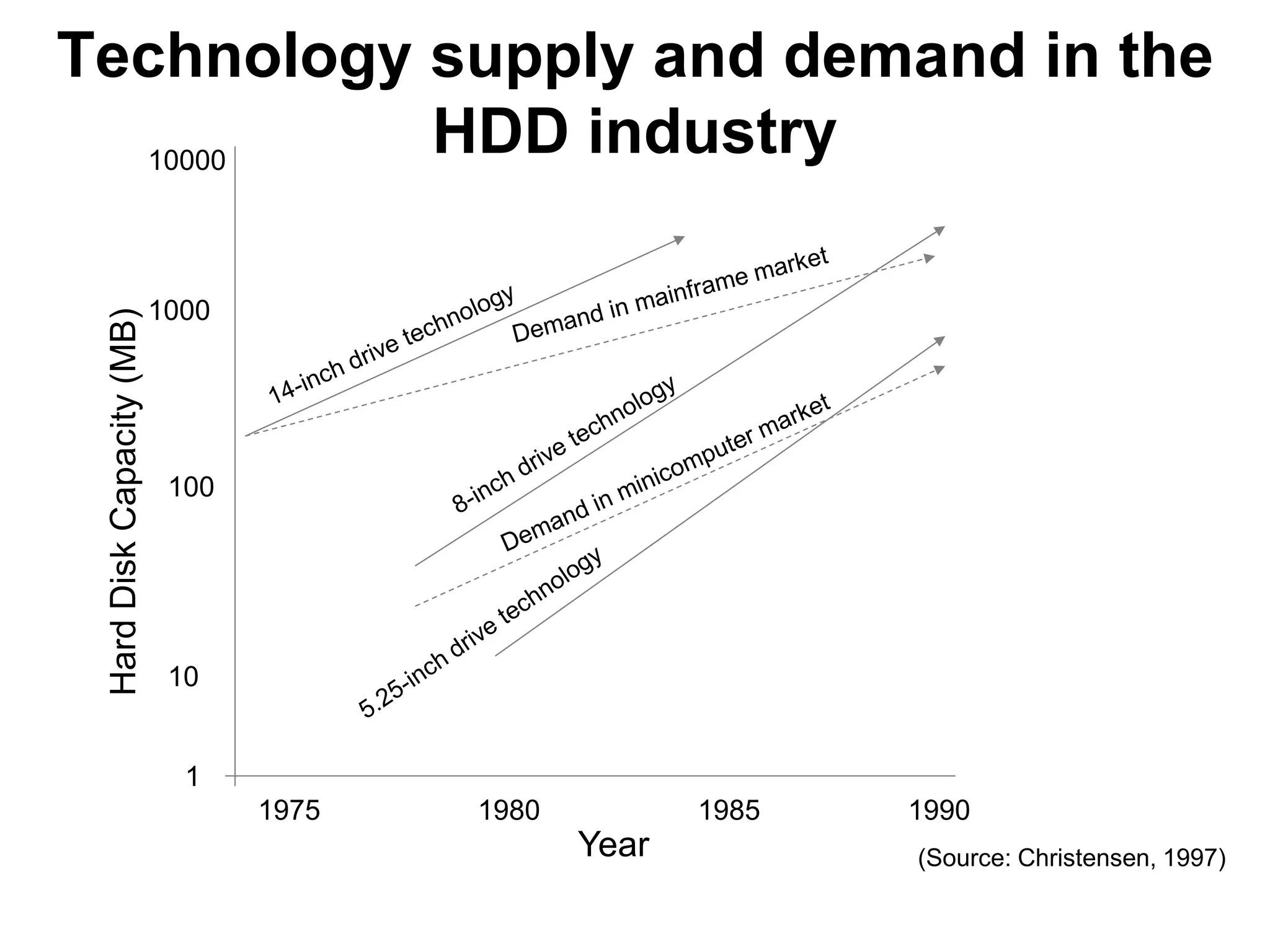
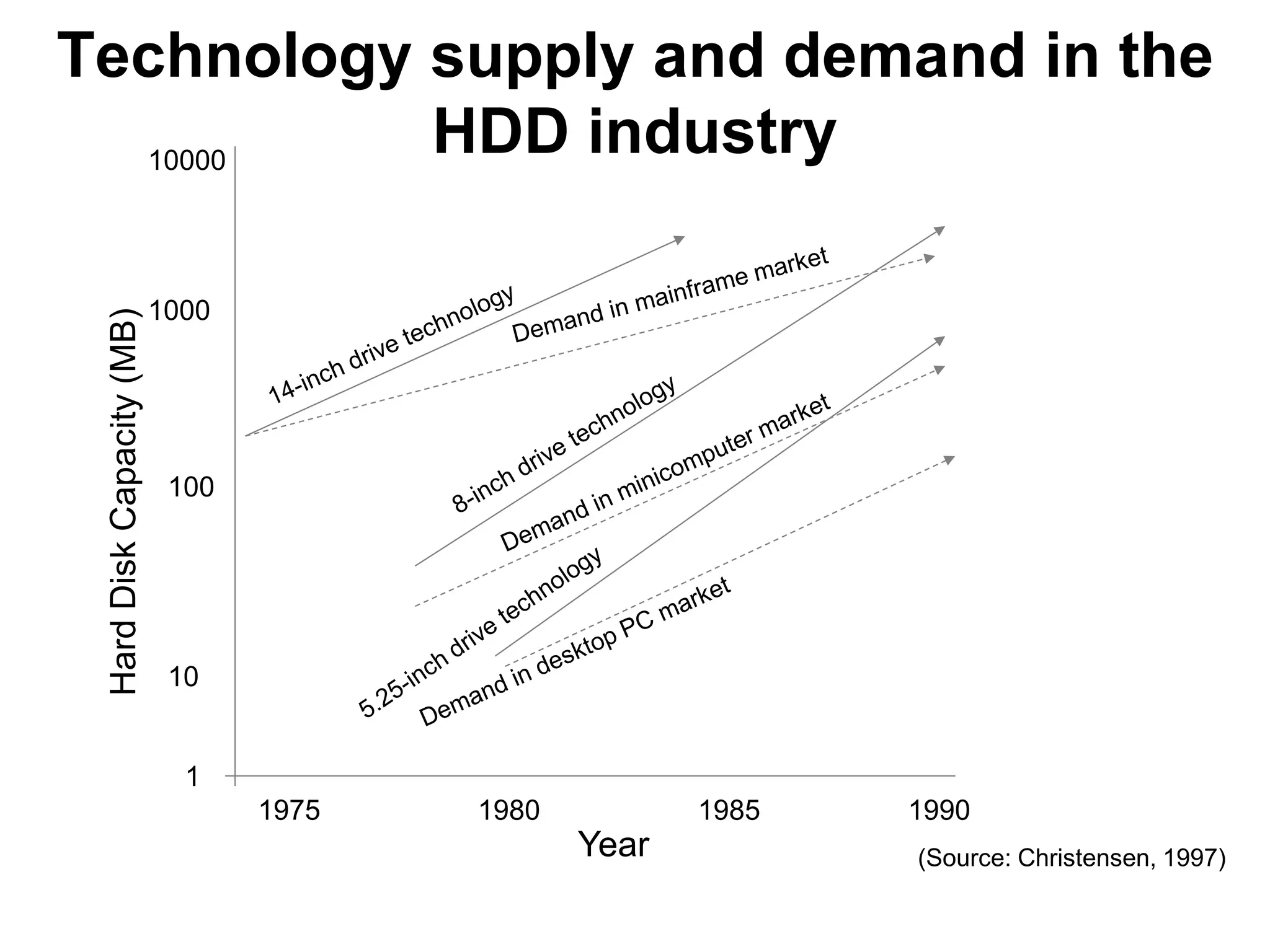
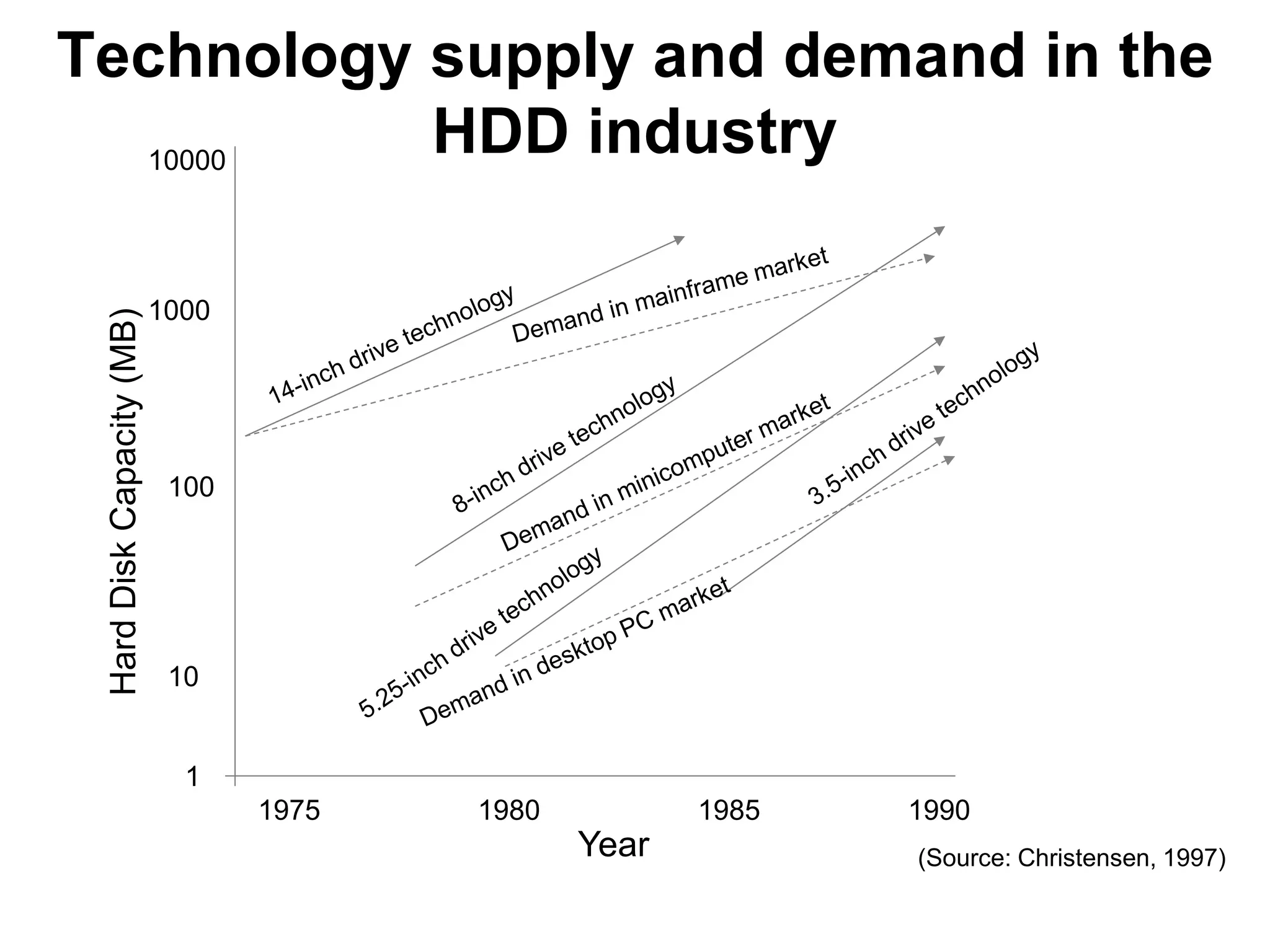
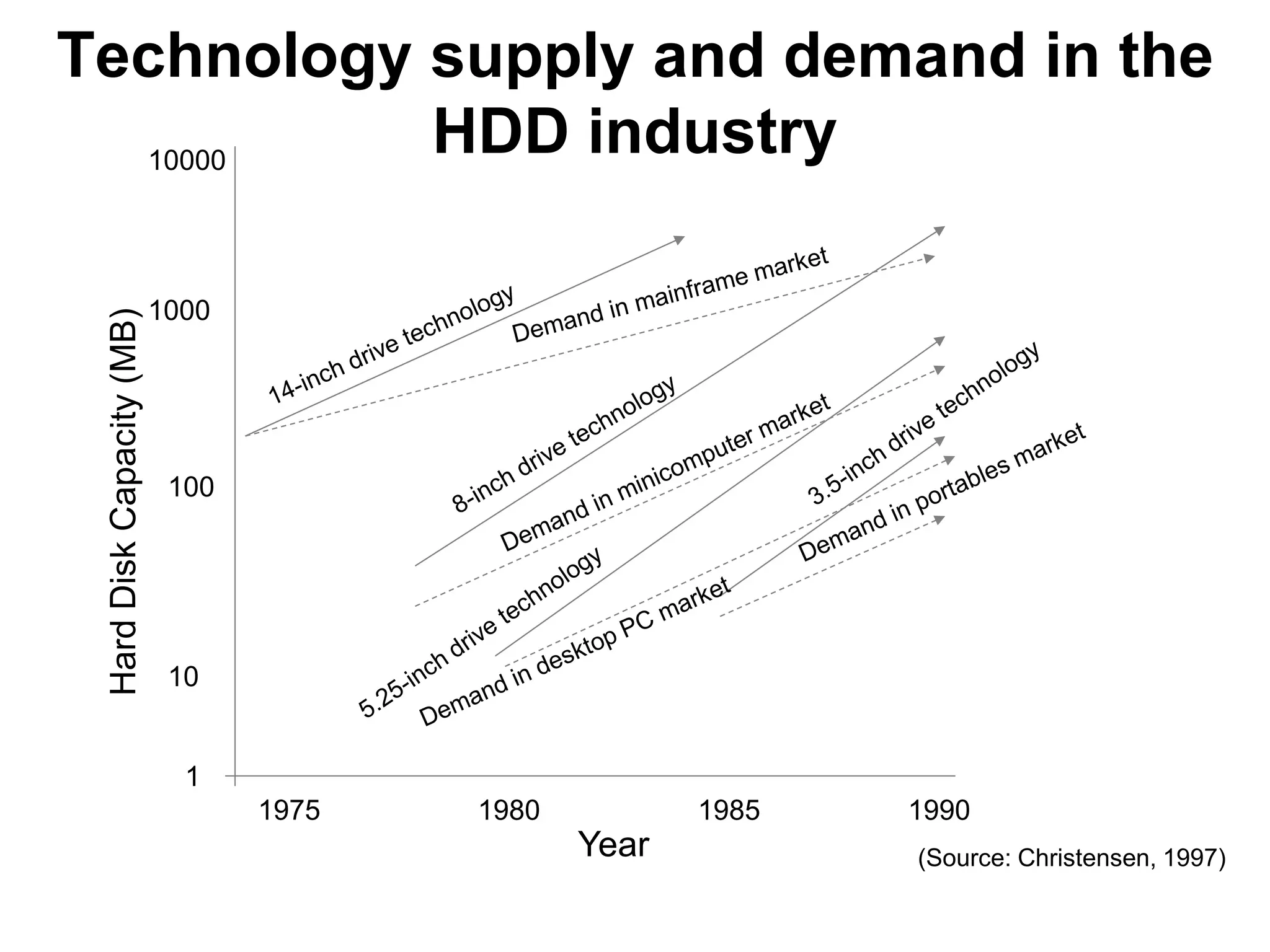
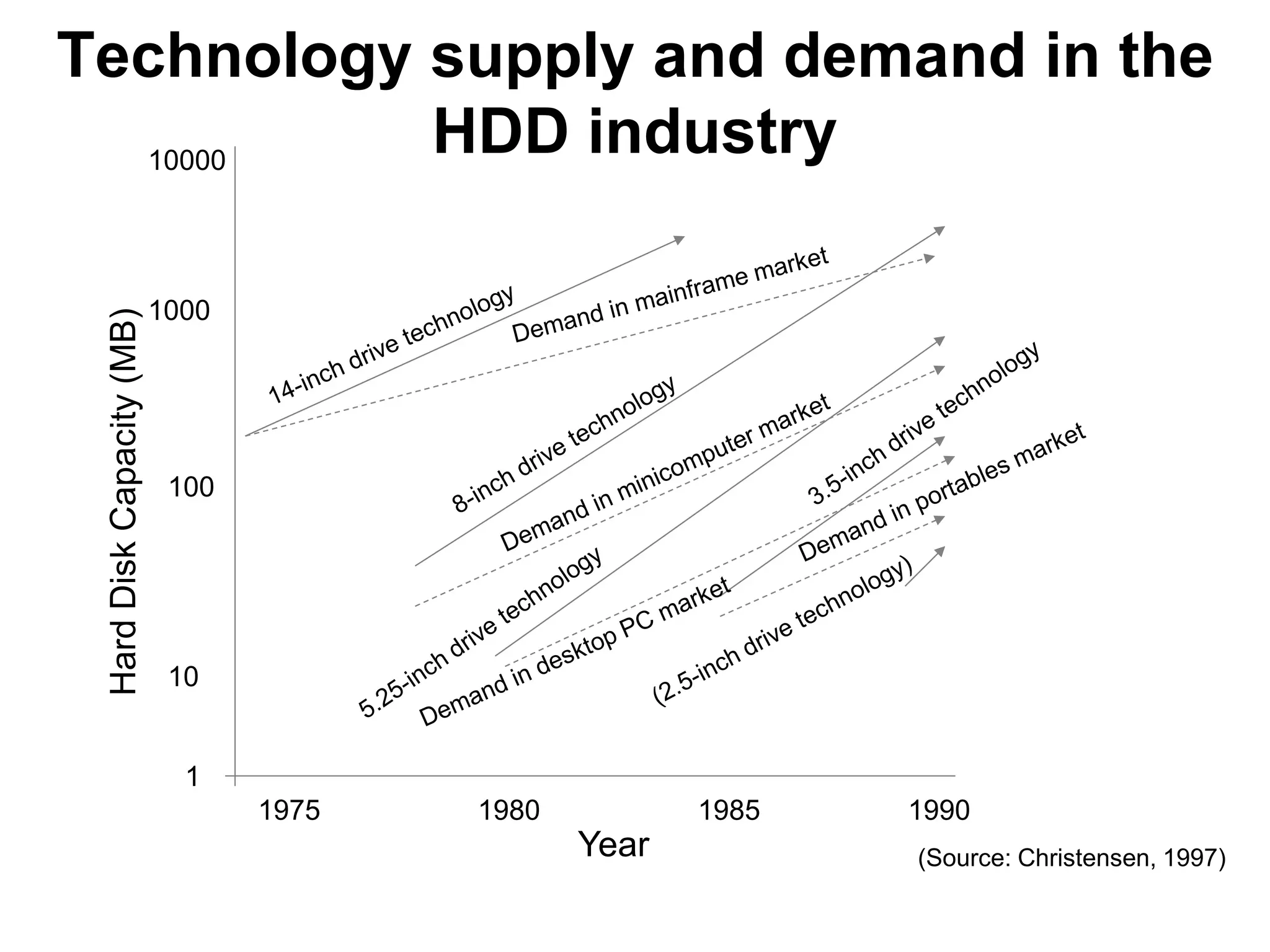
Later on, the smaller generation would reach
   ’good enough’ performance levels and
consequently displace the former generation.
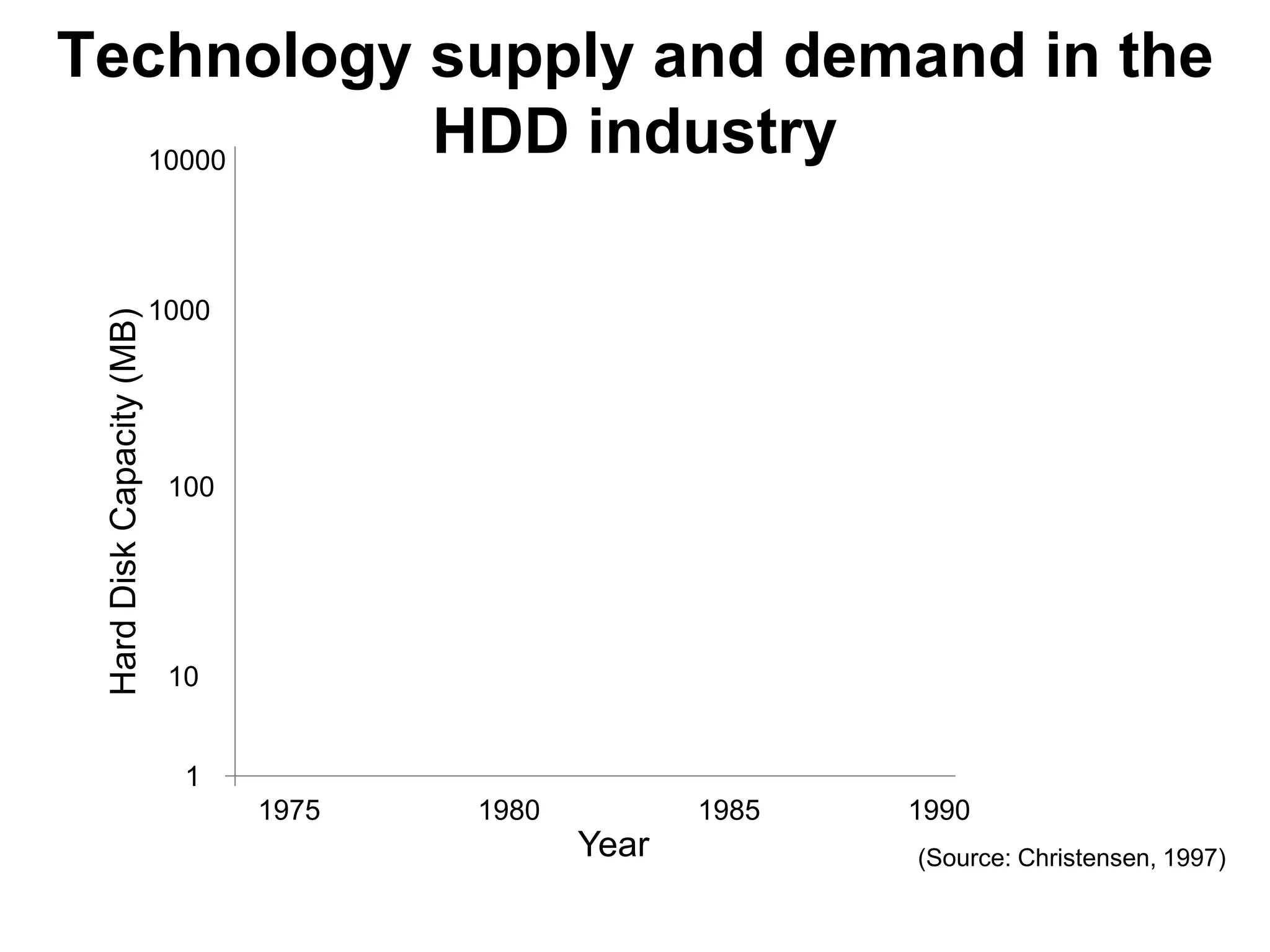
It looked like this:
Technology supply and demand in the
  10000
           HDD industry

                           1000
 Hard Disk Capacity (MB)


                            100


                            10


                             1
                                  1975   1980          1985   1990
                                                Year          (Source: Christensen, 1997)
Technology supply and demand in the
  10000
           HDD industry

                           1000
 Hard Disk Capacity (MB)


                            100


                            10


                             1
                                  1975   1980          1985   1990
                                                Year          (Source: Christensen, 1997)
Technology supply and demand in the
  10000
           HDD industry

                           1000
 Hard Disk Capacity (MB)


                            100


                            10


                             1
                                  1975   1980          1985   1990
                                                Year          (Source: Christensen, 1997)
Technology supply and demand in the
  10000
           HDD industry

                           1000
 Hard Disk Capacity (MB)


                            100


                            10


                             1
                                  1975   1980          1985   1990
                                                Year          (Source: Christensen, 1997)
Technology supply and demand in the
  10000
           HDD industry

                           1000
 Hard Disk Capacity (MB)


                            100


                            10


                             1
                                  1975   1980          1985   1990
                                                Year          (Source: Christensen, 1997)
Technology supply and demand in the
  10000
           HDD industry

                           1000
 Hard Disk Capacity (MB)


                            100


                            10


                             1
                                  1975   1980          1985   1990
                                                Year          (Source: Christensen, 1997)
Technology supply and demand in the
  10000
           HDD industry

                           1000
 Hard Disk Capacity (MB)


                            100


                            10


                             1
                                  1975   1980          1985   1990
                                                Year          (Source: Christensen, 1997)
Technology supply and demand in the
  10000
           HDD industry

                           1000
 Hard Disk Capacity (MB)


                            100


                            10


                             1
                                  1975   1980          1985   1990
                                                Year          (Source: Christensen, 1997)
Technology supply and demand in the
  10000
           HDD industry

                           1000
 Hard Disk Capacity (MB)


                            100


                            10


                             1
                                  1975   1980          1985   1990
                                                Year          (Source: Christensen, 1997)
Technology supply and demand in the
  10000
           HDD industry

                           1000
 Hard Disk Capacity (MB)


                            100


                            10


                             1
                                  1975   1980          1985   1990
                                                Year          (Source: Christensen, 1997)
Companies went bankrupt by listening to
 their customers and giving them what
            they demanded.
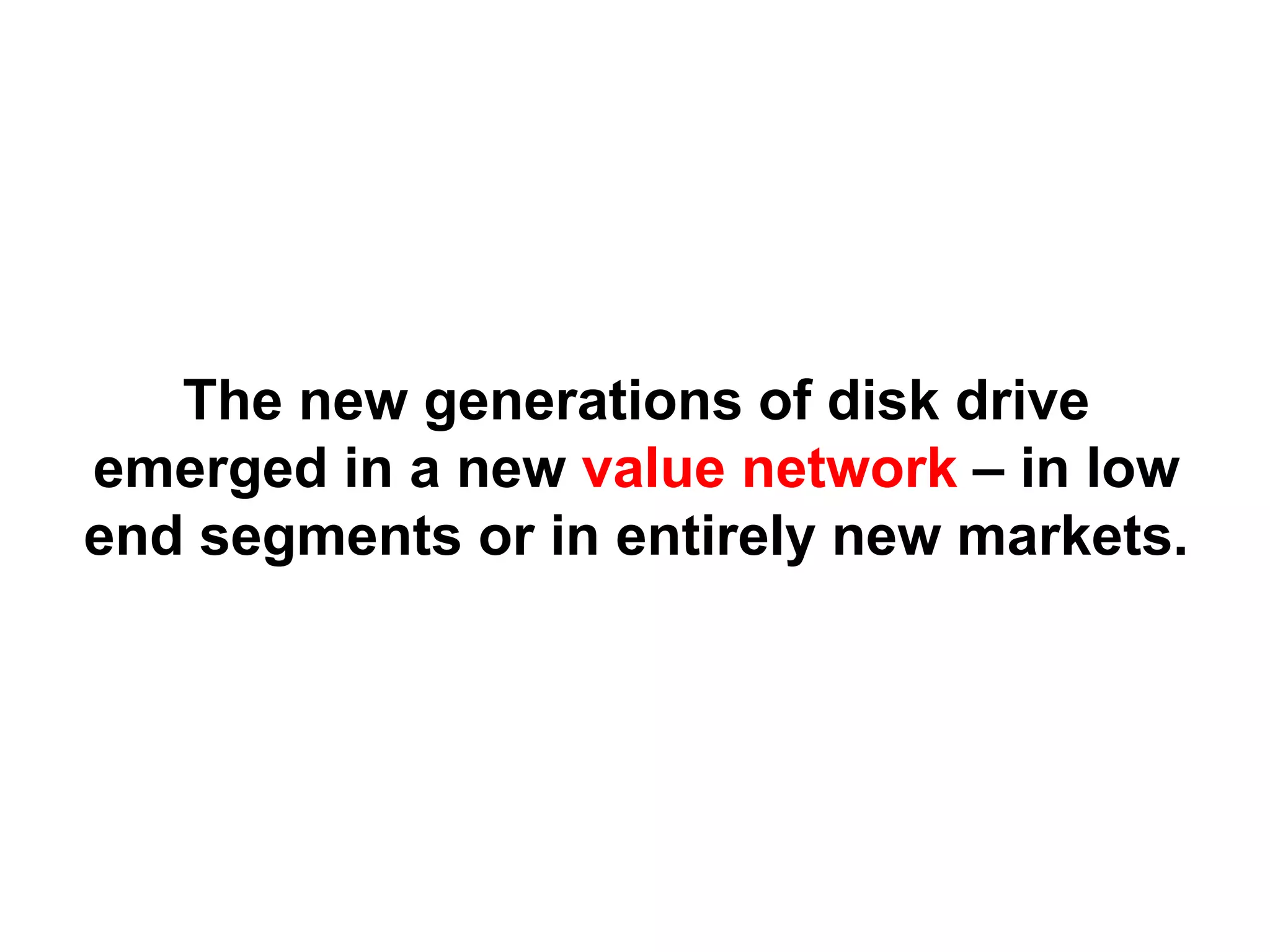
The new generations of disk drive
emerged in a new value network – in low
end segments or in entirely new markets.
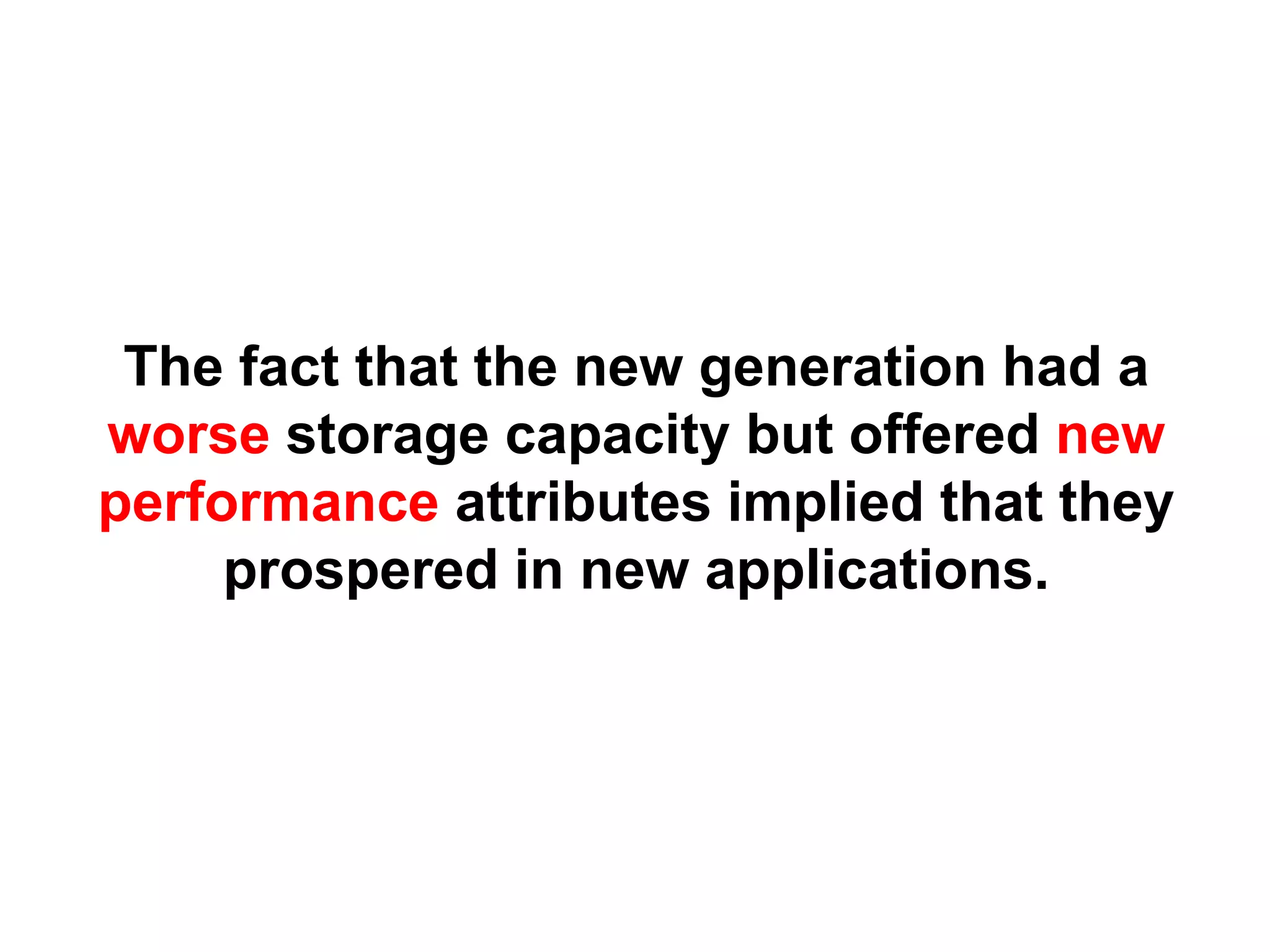
The fact that the new generation had a
worse storage capacity but offered new
performance attributes implied that they
     prospered in new applications.
Eventually, the products became ’good
enough’ in terms of storage capacity and
  then displaced the former generation.
Therefore, Christensen argued
that one must look at whether
 innovations satisfy a firm’s
current customer base or not.
Sustaining innovations are those
 which mainstream customers
            demand.
Sustaining innovations are those
 which mainstream customers
            demand.

Those innovations which do not
 satisfy current customers are
    regarded as disruptive.
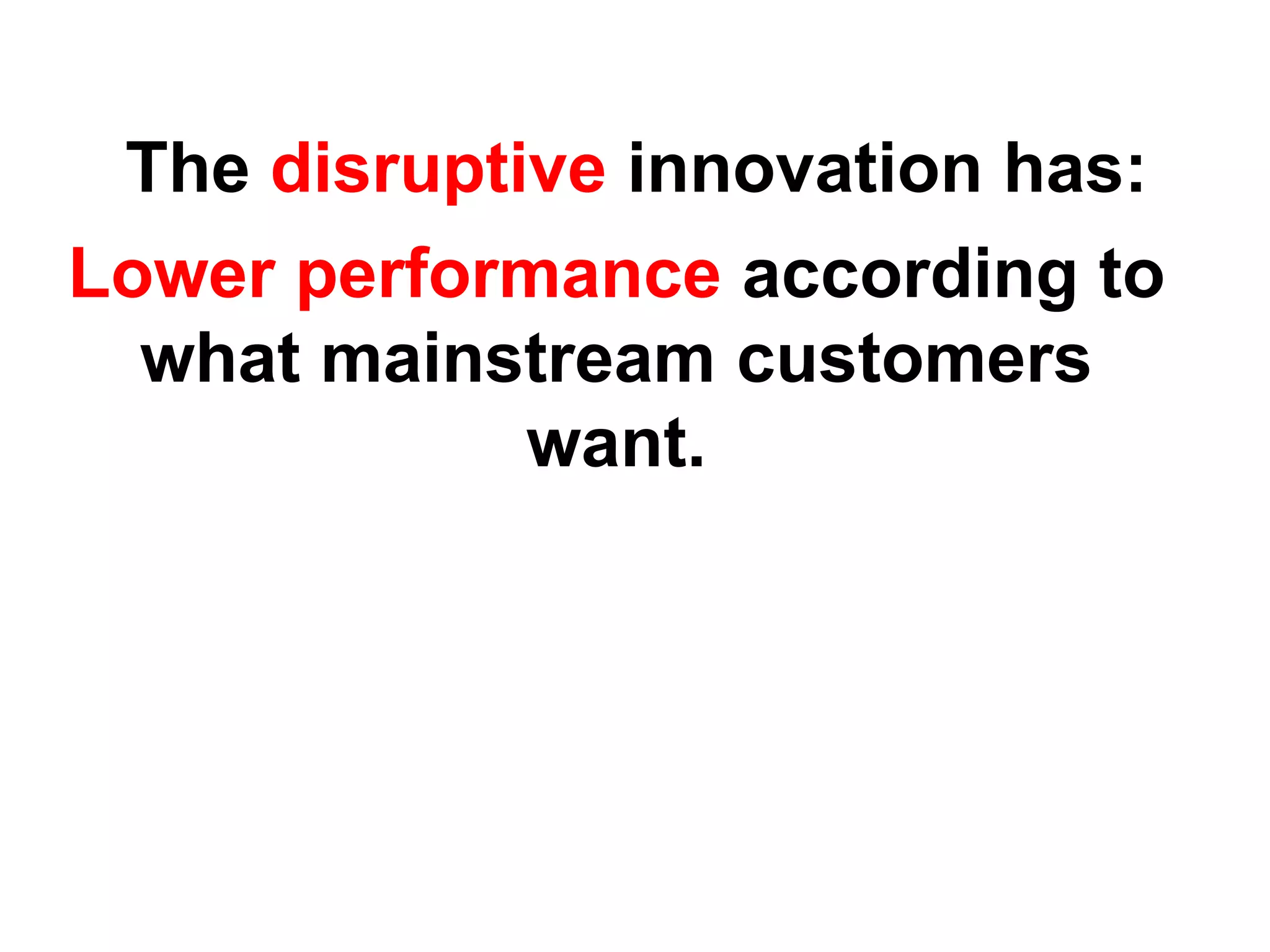
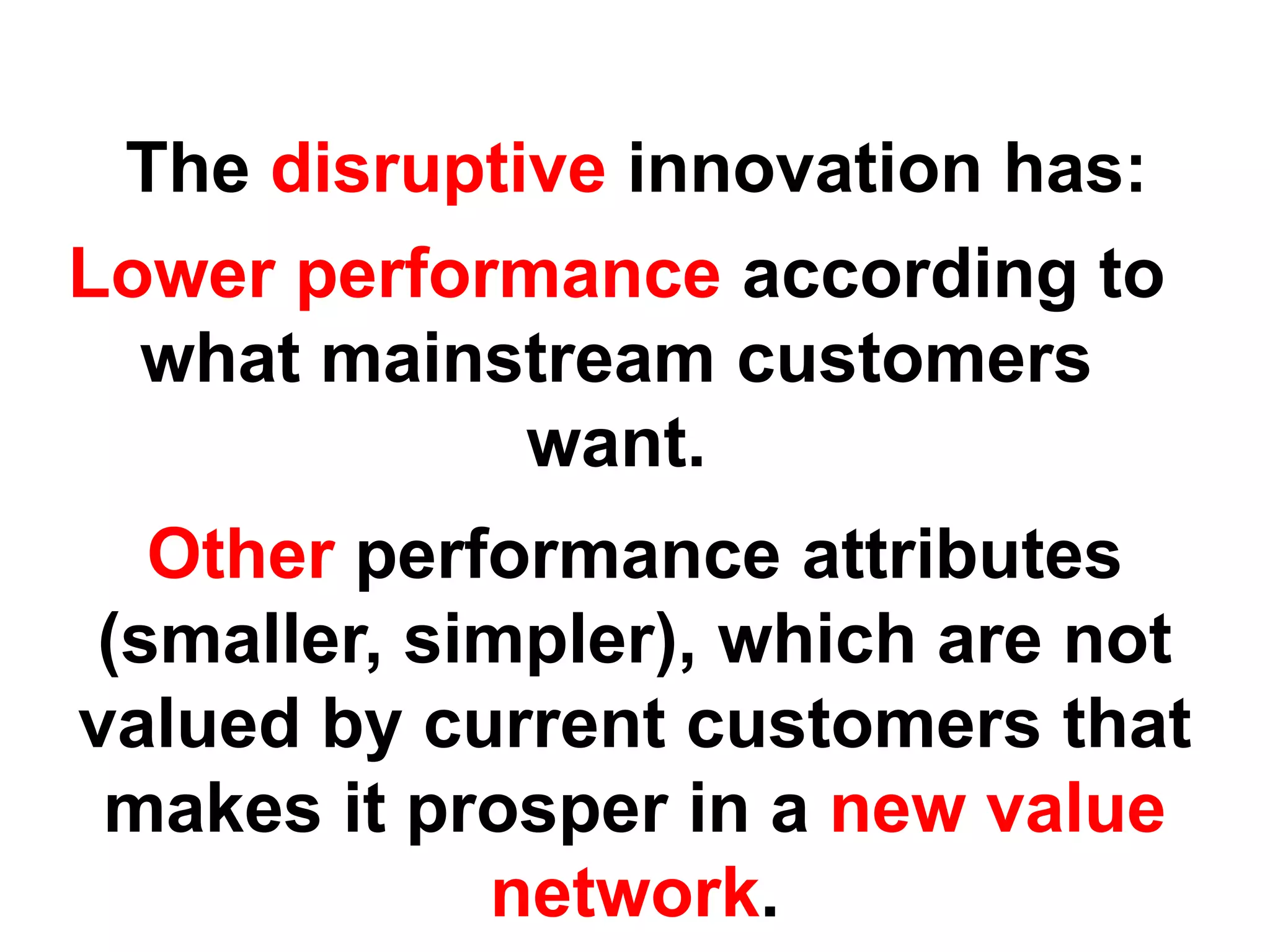
The disruptive innovation has:
Lower performance according to
  what mainstream customers
             want.
The disruptive innovation has:
Lower performance according to
  what mainstream customers
             want.
  Other performance attributes
(smaller, simpler), which are not
valued by current customers that
 makes it prosper in a new value
            network.
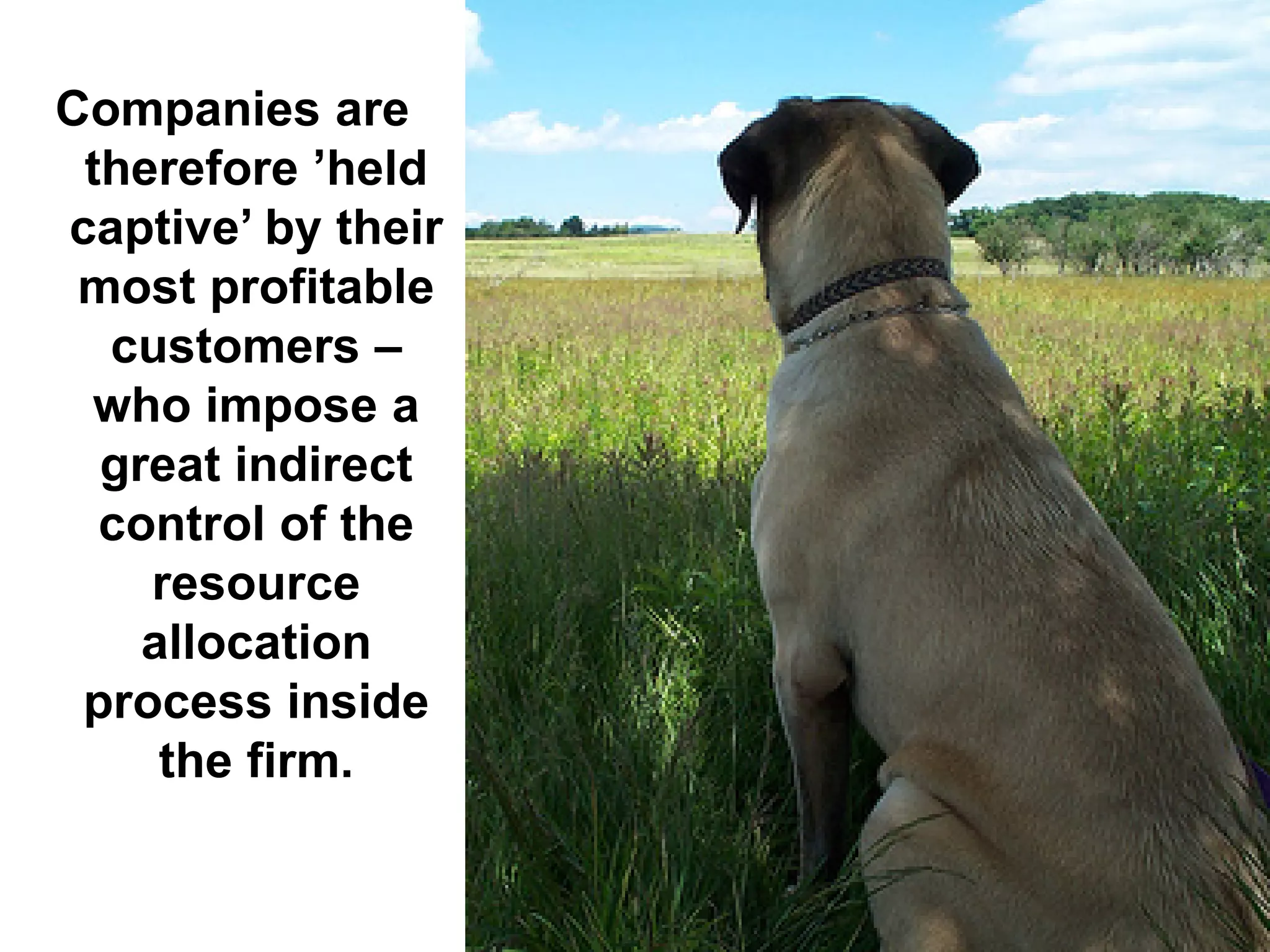
Companies are
 therefore ’held
captive’ by their
 most profitable
  customers –
  who impose a
  great indirect
  control of the
    resource
    allocation
 process inside
     the firm.
If you throw a stick into the field, you haven’t forced
    the dog to go and get it, but it would still do so.
You are fact in power, because you have something
                  that the dog wants.
In the same way, existing customers influence what
     firms decide to do because they provide the
          company with profitable revenues.
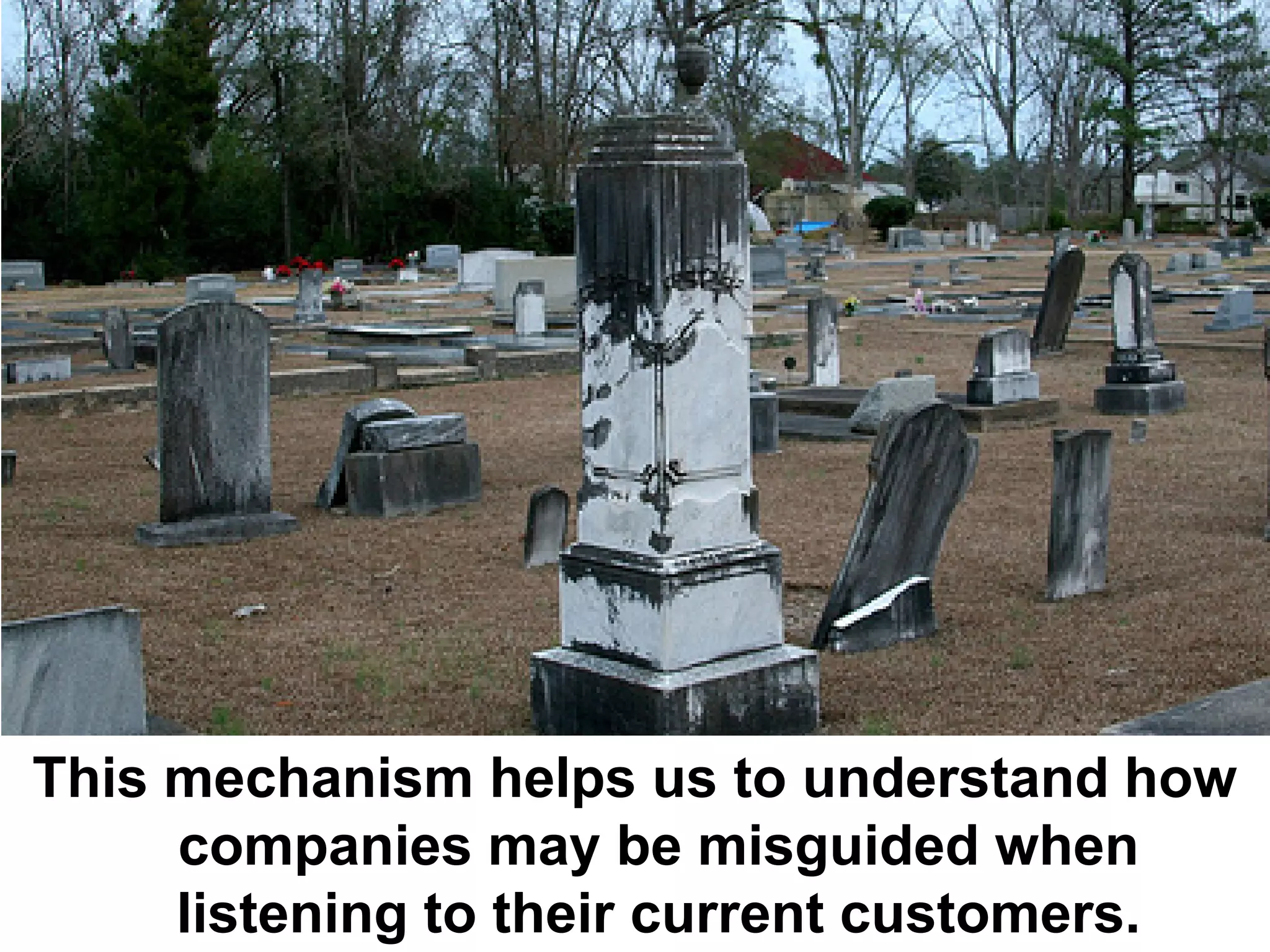
This mechanism helps us to understand how
     companies may be misguided when
     listening to their current customers.
Sources


Christensen, C.M. (1997) The Innovator’s
  Dilemma, Harvard Business School
  Press, Cambridge, Massachusetts.
Image attributions
Find out more:

www.disruptiveinnovation.se

Disruptive Technologies - an introduction

  • 1.
  • 2.
    Christian Sandström holdsa PhD from Chalmers University of Technology, Sweden. He writes and speaks about disruptive innovation and technological change.
  • 3.
    Ever since Clayton Christensen published his book ’The innovator’s dilemma’ in 1997 its popularity has increased every year.
  • 4.
    The book hashad a profound impact on how both practitioners and scholars think about innovation and technological change.
  • 5.
    This presentation willgive a brief introduction to the main idea of the book.
  • 6.
    In his book,Christensen sought to explain why great firms fail under conditions of technological change.
  • 7.
    While there aremany explanations of such failure, Christensen brought an intriguingly different perspective upon this issue.
  • 8.
    Previous work inthis area had primarily looked at how a new technology impacts the companies existing R&D skills.
  • 9.
    For instance, ashift from mechanics to electronics in an industry would render the mechanical competence of established firms obsolete.
  • 10.
    However, those perspectivescould not explain what happened in the disk drive industry, which Christensen studied during is PhD at Harvard.
  • 11.
    In this industry,established firms managed to renew their competence base, yet still failed.
  • 12.
    Just take alook at what happened in each shift from one generation of disk drives to another one:
  • 13.
    8-inch generation Year 1976 1978 1980 Entrant firms 1 4 6 Established 0 2 5 firms (Source: Christensen, 1997)
  • 14.
    8-inch generation Year 1976 1978 1980 Entrant firms 1 4 6 Established 0 2 5 firms (Source: Christensen, 1997)
  • 15.
    8-inch generation 5.25-inch generation Year 1976 1978 1980 Year 1980 1981 1982 Entrant firms 1 4 6 Entrant 1 8 8 firms Established 0 2 5 Established 1 2 8 firms firms (Source: Christensen, 1997)
  • 16.
    8-inch generation 5.25-inch generation Year 1976 1978 1980 Year 1980 1981 1982 Entrant firms 1 4 6 Entrant 1 8 8 firms Established 0 2 5 Established 1 2 8 firms firms (Source: Christensen, 1997)
  • 17.
    8-inch generation 5.25-inch generation Year 1976 1978 1980 Year 1980 1981 1982 Entrant firms 1 4 6 Entrant 1 8 8 firms Established 0 2 5 Established 1 2 8 firms firms 3.5-inch generation Year 1983 1984 1985 Entrant 1 2 3 firms Established 0 1 1 firms (Source: Christensen, 1997)
  • 18.
    8-inch generation 5.25-inch generation Year 1976 1978 1980 Year 1980 1981 1982 Entrant firms 1 4 6 Entrant 1 8 8 firms Established 0 2 5 Established 1 2 8 firms firms 3.5-inch generation Year 1983 1984 1985 Entrant 1 2 3 firms Established 0 1 1 firms (Source: Christensen, 1997)
  • 19.
    8-inch generation 5.25-inch generation Year 1976 1978 1980 Year 1980 1981 1982 Entrant firms 1 4 6 Entrant 1 8 8 firms Established 0 2 5 Established 1 2 8 firms firms 3.5-inch generation 1.8-inch generation Year 1983 1984 1985 Year 1991 1992 1993 Entrant 1 2 3 Entrant 1 3 3 firms firms Established 0 1 1 Established 0 0 3 firms firms (Source: Christensen, 1997)
  • 20.
    In total, oneestablished firm managed the transition from one generation of disk drives to the next one!
  • 21.
    And these shiftsdid not destroy the existing competence base of the incumbent firms.
  • 22.
    Why then, didthose firms fail?
  • 23.
    Christensen’s answer: Because theylistened to their customers!
  • 24.
    Each of thenew generations of disk drives offered a worse performance in terms of what existing customers demanded.
  • 25.
    Customers wanted abetter storage capacity - and a smaller disk drive initially offered less storage.
  • 26.
    Therefore, the establishedfirms could not find any financial logic in entering the next generation.
  • 27.
    Later on, thesmaller generation would reach ’good enough’ performance levels and consequently displace the former generation.
  • 28.
  • 29.
    Technology supply anddemand in the 10000 HDD industry 1000 Hard Disk Capacity (MB) 100 10 1 1975 1980 1985 1990 Year (Source: Christensen, 1997)
  • 30.
    Technology supply anddemand in the 10000 HDD industry 1000 Hard Disk Capacity (MB) 100 10 1 1975 1980 1985 1990 Year (Source: Christensen, 1997)
  • 31.
    Technology supply anddemand in the 10000 HDD industry 1000 Hard Disk Capacity (MB) 100 10 1 1975 1980 1985 1990 Year (Source: Christensen, 1997)
  • 32.
    Technology supply anddemand in the 10000 HDD industry 1000 Hard Disk Capacity (MB) 100 10 1 1975 1980 1985 1990 Year (Source: Christensen, 1997)
  • 33.
    Technology supply anddemand in the 10000 HDD industry 1000 Hard Disk Capacity (MB) 100 10 1 1975 1980 1985 1990 Year (Source: Christensen, 1997)
  • 34.
    Technology supply anddemand in the 10000 HDD industry 1000 Hard Disk Capacity (MB) 100 10 1 1975 1980 1985 1990 Year (Source: Christensen, 1997)
  • 35.
    Technology supply anddemand in the 10000 HDD industry 1000 Hard Disk Capacity (MB) 100 10 1 1975 1980 1985 1990 Year (Source: Christensen, 1997)
  • 36.
    Technology supply anddemand in the 10000 HDD industry 1000 Hard Disk Capacity (MB) 100 10 1 1975 1980 1985 1990 Year (Source: Christensen, 1997)
  • 37.
    Technology supply anddemand in the 10000 HDD industry 1000 Hard Disk Capacity (MB) 100 10 1 1975 1980 1985 1990 Year (Source: Christensen, 1997)
  • 38.
    Technology supply anddemand in the 10000 HDD industry 1000 Hard Disk Capacity (MB) 100 10 1 1975 1980 1985 1990 Year (Source: Christensen, 1997)
  • 39.
    Companies went bankruptby listening to their customers and giving them what they demanded.
  • 41.
    The new generationsof disk drive emerged in a new value network – in low end segments or in entirely new markets.
  • 42.
    The fact thatthe new generation had a worse storage capacity but offered new performance attributes implied that they prospered in new applications.
  • 43.
    Eventually, the productsbecame ’good enough’ in terms of storage capacity and then displaced the former generation.
  • 44.
    Therefore, Christensen argued thatone must look at whether innovations satisfy a firm’s current customer base or not.
  • 45.
    Sustaining innovations arethose which mainstream customers demand.
  • 46.
    Sustaining innovations arethose which mainstream customers demand. Those innovations which do not satisfy current customers are regarded as disruptive.
  • 47.
  • 48.
    The disruptive innovationhas: Lower performance according to what mainstream customers want.
  • 49.
    The disruptive innovationhas: Lower performance according to what mainstream customers want. Other performance attributes (smaller, simpler), which are not valued by current customers that makes it prosper in a new value network.
  • 50.
    Companies are therefore’held captive’ by their most profitable customers – who impose a great indirect control of the resource allocation process inside the firm.
  • 51.
    If you throwa stick into the field, you haven’t forced the dog to go and get it, but it would still do so.
  • 52.
    You are factin power, because you have something that the dog wants.
  • 53.
    In the sameway, existing customers influence what firms decide to do because they provide the company with profitable revenues.
  • 54.
    This mechanism helpsus to understand how companies may be misguided when listening to their current customers.
  • 55.
    Sources Christensen, C.M. (1997)The Innovator’s Dilemma, Harvard Business School Press, Cambridge, Massachusetts.
  • 56.
  • 57.