Innovator’s Dilemma - Introduction   Clayton M Christensen, HBS Press, 1997
Innovator’s Dilemma - Introduction   Clayton M Christensen, HBS Press, 1997 Disruptive technology is often developed by  established companies Existing customers undervalue the changes  which do not address their specific needs Established players renew their focus on  ‘sustaining’ technology development New entrants intro the disruptive technology  to small ‘fringe’ markets (attacker’s advantage) Disruptive technology moves ‘upmarket’ Established firms try to catch-up
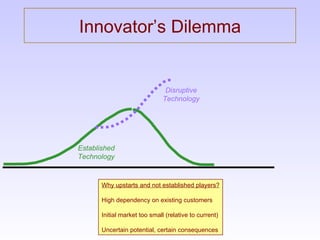
Innovator’s Dilemma Why upstarts and not established players? High dependency on existing customers Initial market too small (relative to current) Uncertain potential, certain consequences Established Technology Disruptive Technology
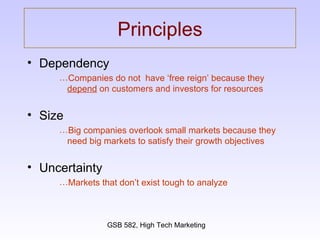
Principles Dependency Companies do not  have ‘free reign’ because they  depend  on customers and investors for resources Size Big companies overlook small markets because they need big markets to satisfy their growth objectives Uncertainty Markets that don’t exist tough to analyze
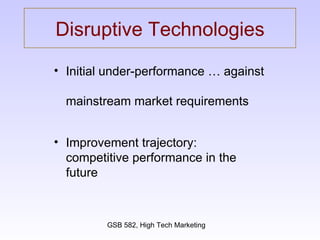
Disruptive Technologies Initial under-performance … against  mainstream market requirements Improvement trajectory:  competitive performance in the future
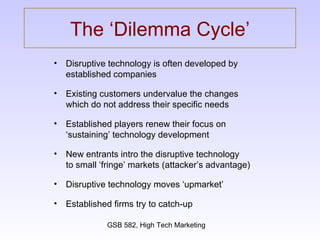
The ‘Dilemma Cycle’ Disruptive technology is often developed by  established companies Existing customers undervalue the changes  which do not address their specific needs Established players renew their focus on  ‘sustaining’ technology development New entrants intro the disruptive technology  to small ‘fringe’ markets (attacker’s advantage) Disruptive technology moves ‘upmarket’ Established firms try to catch-up
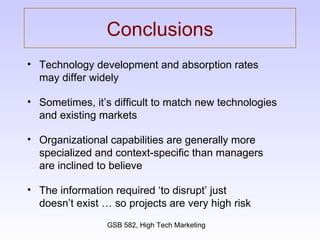
Conclusions Technology development and absorption rates  may differ widely Sometimes, it’s difficult to match new technologies  and existing markets Organizational capabilities are generally more specialized and context-specific than managers  are inclined to believe The information required ‘to disrupt’ just  doesn’t exist … so projects are very high risk

Innovators Dilemma Slides

  • 1.
    Innovator’s Dilemma -Introduction Clayton M Christensen, HBS Press, 1997
  • 2.
    Innovator’s Dilemma -Introduction Clayton M Christensen, HBS Press, 1997 Disruptive technology is often developed by established companies Existing customers undervalue the changes which do not address their specific needs Established players renew their focus on ‘sustaining’ technology development New entrants intro the disruptive technology to small ‘fringe’ markets (attacker’s advantage) Disruptive technology moves ‘upmarket’ Established firms try to catch-up
  • 3.
    Innovator’s Dilemma Whyupstarts and not established players? High dependency on existing customers Initial market too small (relative to current) Uncertain potential, certain consequences Established Technology Disruptive Technology
  • 4.
    Principles Dependency Companiesdo not have ‘free reign’ because they depend on customers and investors for resources Size Big companies overlook small markets because they need big markets to satisfy their growth objectives Uncertainty Markets that don’t exist tough to analyze
  • 5.
    Disruptive Technologies Initialunder-performance … against mainstream market requirements Improvement trajectory: competitive performance in the future
  • 6.
    The ‘Dilemma Cycle’Disruptive technology is often developed by established companies Existing customers undervalue the changes which do not address their specific needs Established players renew their focus on ‘sustaining’ technology development New entrants intro the disruptive technology to small ‘fringe’ markets (attacker’s advantage) Disruptive technology moves ‘upmarket’ Established firms try to catch-up
  • 7.
    Conclusions Technology developmentand absorption rates may differ widely Sometimes, it’s difficult to match new technologies and existing markets Organizational capabilities are generally more specialized and context-specific than managers are inclined to believe The information required ‘to disrupt’ just doesn’t exist … so projects are very high risk