Strategies for
Mature and
Declining
Markets
Chapter 16
McGraw-Hill/Irwin Copyright © 2010 by The McGraw-Hill Companies, Inc. All rights reserved.
16-2
Strategic Choices in Mature Markets
• It is not always easy to tell when a market
has reached maturity.
• Variations in brands, marketing programs,
and customer groups can mean that
different brands and market segments
reach maturity at different times.
16-3
Strategic Choices in Mature Markets
• As the maturity stage progresses, a
variety of threats and opportunities can
disrupt an industry’s stability:
– Shifts in customer needs or preferences,
– Product substitutes,
– Increased raw material costs,
– Changes in government regulations,
– The entry of low-cost producers or
– Mergers and acquisitions.
16-4
Strategic Choices in Mature Markets
• Success in mature markets requires two
sets of strategic actions:
– The development of a well-implemented
business strategy to sustain a competitive
advantage, customer satisfaction, and loyalty;
– Flexible and creative marketing programs
geared to pursue growth or profit
opportunities as conditions change in specific
product-markets.
16-5
Strategic Choices in Mature Markets
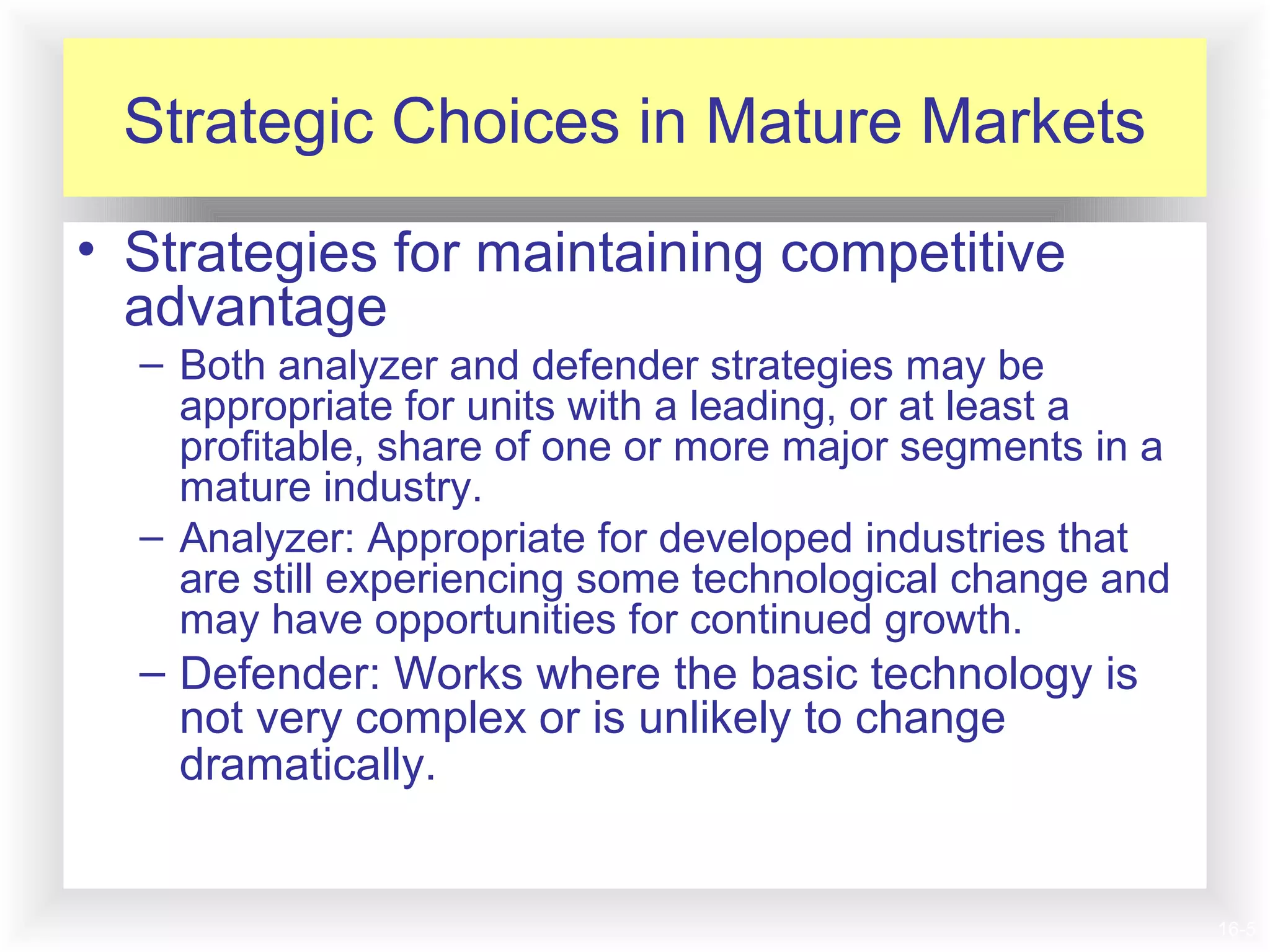
• Strategies for maintaining competitive
advantage
– Both analyzer and defender strategies may be
appropriate for units with a leading, or at least a
profitable, share of one or more major segments in a
mature industry.
– Analyzer: Appropriate for developed industries that
are still experiencing some technological change and
may have opportunities for continued growth.
– Defender: Works where the basic technology is
not very complex or is unlikely to change
dramatically.
16-6
Analyzer Strategy
The analyzer strategy is a balanced strategy, it is neither as risky as the prospector strategy nor as
conservative as the defender strategy. Analyzers will invest in research and development, though
not as heavily as prospectors. They will usually allow other firms to test the waters with a new
technology or market before entering it themselves. Firms using an analyzer strategy will often
maintain a portfolio of businesses, each with varying degrees of risk, to balance firm risks.
Defender Strategy
The defender strategy is essentially the opposite of the prospector strategy. It is a
low-risk strategy that involves selecting stable, mature markets and defending
them. Firms using a defender strategy will tend to be less innovative than
prospectors and will not invest a lot in research and development. Instead, firms
using the defender strategy are more likely to exploit existing technology with only
minor developments.
16-7
Strategic Choices in Mature Markets
• Both analyzers and defenders can attempt
to sustain a competitive advantage in
established product-markets:
– Through differentiation of their product
offering or
– By maintaining a low-cost position.
16-8
The Process of Customer Value Management
16-9
Strategic Choices in Mature Markets
• Dimensions of product quality:
– Performance
– Durability
– Conformance with specifications
– Features
– Reliability
– Serviceability
– Fit and finish
– Brand name
– Make
16-10
Strategic Choices in Mature Markets
• Dimensions of service quality
– Tangibles
– Reliability
– Responsiveness
– Assurance
– Empathy
16-11
Strategic Choices in Mature Markets
• Are the dimensions the same for service
quality on the Internet?
– 11 dimensions of perceived e-service quality
are: access, ease of navigation, efficiency,
flexibility, reliability, personalization,
security/privacy, responsiveness,
assurance/trust, site aesthetics, and price
knowledge.
16-12
Strategic Choices in Mature Markets
• Five gaps that can lead to dissatisfaction with
service delivery:
– Gap between the customer’s expectations and the
marketer’s perceptions.
– Gap between management perceptions and service
quality specifications.
– Gap between service quality specifications and
service delivery.
– Gap between service delivery and external
communications.
– Gap between perceived service and expected
service.
16-13
Determinants of Perceived Service Quality
16-14
Strategic Choices in Mature Markets
• Methods of maintaining a low-cost
position:
– A no-frills productA no-frills or no frills service or product is one for which the non-essential
features have been removed to keep the price low. The use of the term "frills" refers to a style of fabric decoration. Something
offered to customers for no additional charge may be designated as a "frill" - for example, free drinks on airline journeys, or a radio
installed in a rental car.[1]
No-frills businesses operate on the principle that by removing luxurious additions, customers may be
offered lower prices.[2]
– Innovative product design
– Cheaper raw materials
– Innovative production processes
– Low-cost distribution
– Reductions in overhead
16-15
Strategic Choices in Mature Markets
• Measuring customer satisfaction
– Measures of customer satisfaction should
examine customers’ expectations and
preferences concerning the various
dimensions of product and service quality
performance, and their perceptions
concerning how well the firm is meeting those
expectations.
16-16
Strategic Choices in Mature Markets
• Satisfaction measures need to be
supplemented with examinations of
customer behavior such as:
– measures of the annual retention rate,
– frequency of purchases, and
– the percentage of a customer’s total
purchases captured by the firm.
16-17
Strategic Choices in Mature Markets
• Are all customers equally valuable?
– The ability of firms to tailor different levels of
service and benefits to different customers
based on each person’s potential to produce
a profit has been facilitated by the growing
popularity of the Internet.
– Increased stratification of consumer society.
– Ethical and strategic questions.
16-18
Marketing Strategies for Mature
Markets
• Marketing strategies to maintain market
share in growth markets:
– Fortress defense
– Flanker brands extension of an existing brand to create another product or
brand with increased market share. The new product may be a different size, flavor, or type
but still falls within the same category of products. For example, Ocean Spray juice may
create new fruit juice flavors as a flanker brand.
Niche strategy
16-19
Marketing Strategies for Mature
Markets
• Strategies for extending volume growth
• Increased penetration strategy
– Discovering why nonusers are uninterested.
– Developing and selling integrated systems
that help improve the basic product’s
performance or ease of use.
– Offering services that improve its performance
or ease of use for the potential customer.
– Expanding distribution or developing more
convenient and accessible channels.
16-20
Marketing Strategies for Mature
Markets
• Extended use strategy
– Increasing the amount of product used by the
average customer by increasing frequency of
use or developing new and more varied ways
to use the product.
16-21
Marketing Strategies for Mature
Markets
• Market expansion strategy
– Strengthening a firm’s position in new or
underdeveloped domestic geographic
markets can lead to experience-curve benefits
and operating synergies.
– Smaller regional competitors might consider
domestic geographic expansion.
– Firms may identify and develop entirely new
customer or application segments.
– Domestic market expansion by producing
private-label brands for large retailers.
16-22
Marketing Strategies for Mature
Markets
• Global market expansion—sequential
strategies
– For firms with leading positions in mature
domestic markets, less-developed markets in
foreign countries often present the most
viable opportunities for geographic expansion.
– The most common expansion route involves
moving from Japan to developing countries to
developed countries.
16-23
Strategies for Declining Markets
• Three sets of factors help determine the
strategic attractiveness of declining
product markets:
– Conditions of demand,
– Exit barriers, and
– Factors affecting the intensity of future
competitive rivalry.
16-24
Strategies for Declining Markets
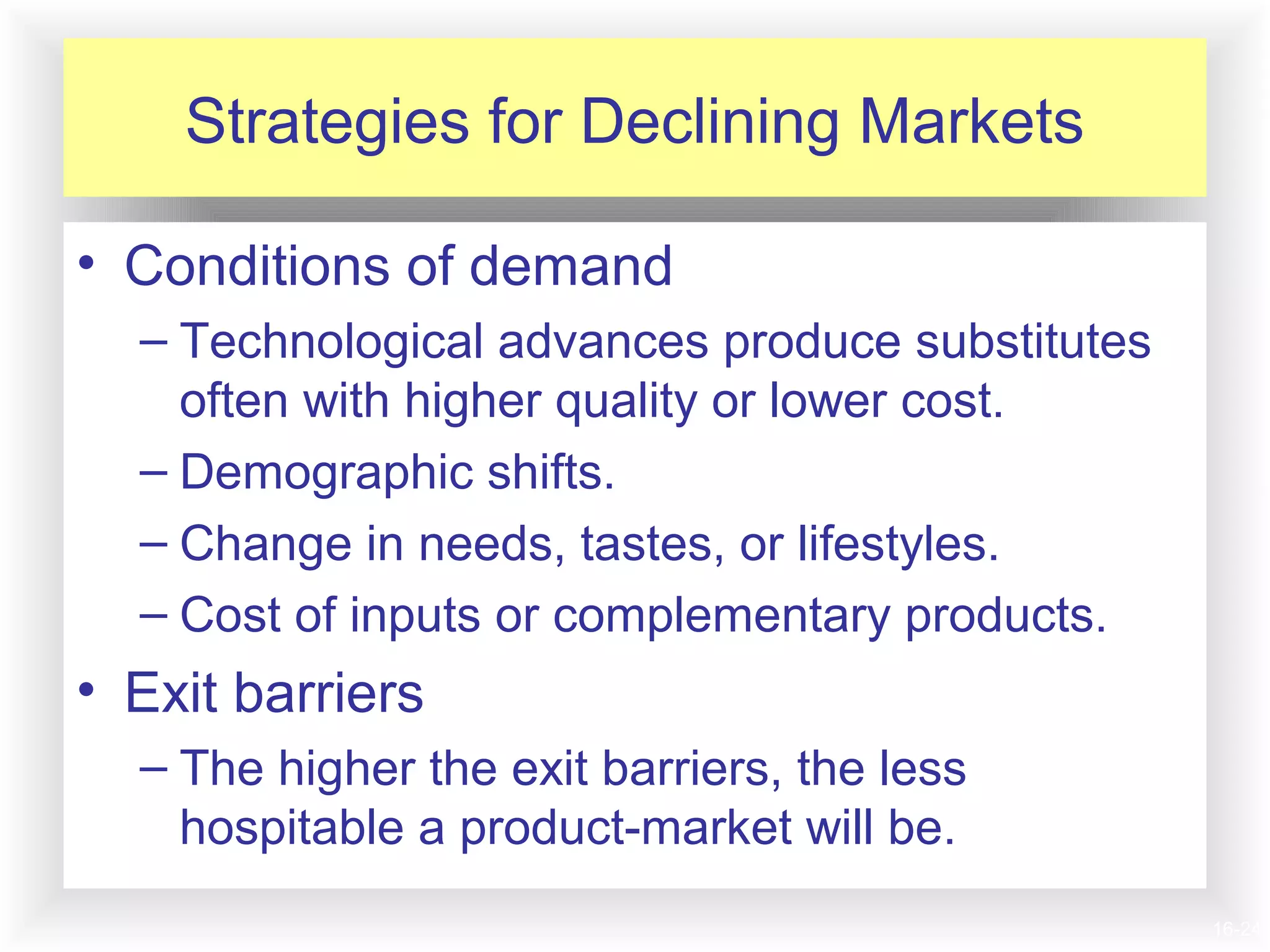
• Conditions of demand
– Technological advances produce substitutes
often with higher quality or lower cost.
– Demographic shifts.
– Change in needs, tastes, or lifestyles.
– Cost of inputs or complementary products.
• Exit barriers
– The higher the exit barriers, the less
hospitable a product-market will be.
16-25
Strategies for Declining Markets
• Intensity of future competitive rivalry
– Size and bargaining power of the customers
who continue to buy the product,
– Customers’ ability to switch to substitute
products or to alternative suppliers, and
– Any potential diseconomies of scale involved
in capturing an increased share of the
remaining volume.
16-26
Strategies for Declining Markets
• Divestment or liquidation
– The firm that divests early runs the risk that its
forecast of the industry’s future may be
wrong.
– Quick divestment may not be possible if the
firm faces high exit barriers.
– By planning early for departure, the firm may
be able to reduce some of those barriers
before the liquidation is necessary.
16-27
Strategies for Declining Markets
• Marketing strategies for remaining
competitors
• Harvesting strategy
– The objective is to generate cash quickly by
maximizing cash flow over a relatively short
term.
– This typically involves:
• Avoiding any additional investment in the business,
• Greatly reducing operating expenses, and
• Raising prices.
16-28
Strategies for Declining Markets
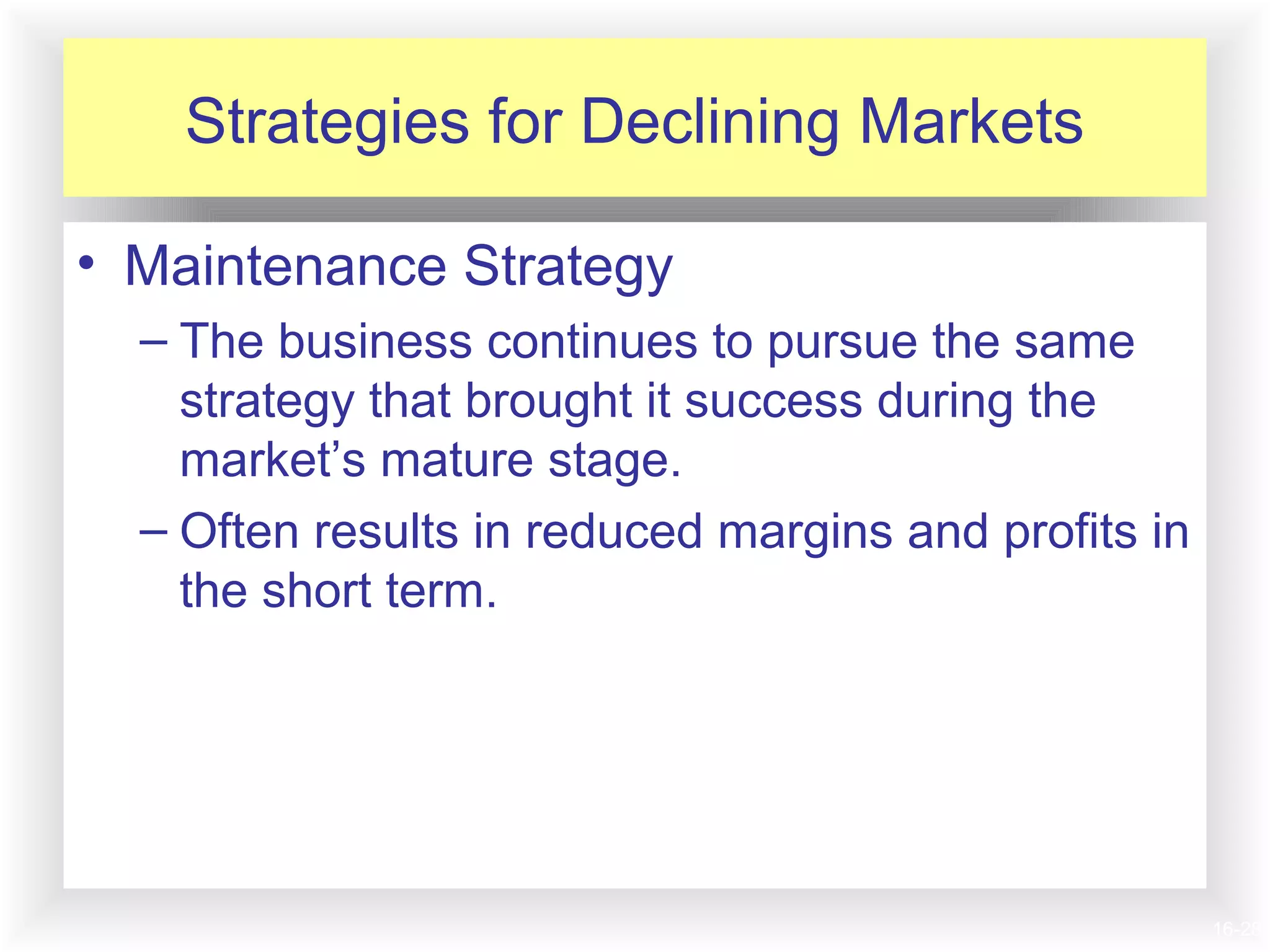
• Maintenance Strategy
– The business continues to pursue the same
strategy that brought it success during the
market’s mature stage.
– Often results in reduced margins and profits in
the short term.
16-29
Strategies for Declining Markets
• Profitable survivor strategy
– Investing enough to increase share position
and establishing itself as the industry leader
for the remainder of the market’s decline.
– The key to the success is to encourage other
competitors to leave the market early.
16-30
Strategies for Declining Markets
• Niche Strategy
– May be viable if one or more substantial
segments will either remain as stable pockets
of demand or decay slowly.
– Even smaller competitors can sometimes
successfully pursue this strategy.
16-31
Take-Aways
• Strategic choices in mature, or even
declining, markets are by no means
always bleak. Many of the world’s most
profitable companies operate largely in
such markets.
16-32
Take-Aways
• A critical marketing objective for all
competitors in a mature market is to
maintain the loyalty of existing customers.
To accomplish that goal, firms must
pursue improvements in the perceived
value those customers receive from their
offerings—either by differentiating
themselves on the basis of superior quality
or service, by lowering costs and prices, or
both.
16-33
Take-Aways
• An important secondary objective for
some firms, particularly share leaders, in
mature markets is to stimulate further
volume growth by taking actions to convert
nonusers into users, to increase use
frequency among current users, or to
expand into untapped or under-developed
markets.
16-34
Take-Aways
• Declining markets can still offer attractive
opportunities for sales revenues and
profits.
– Their attractiveness—and the appropriate
marketing strategy to follow—depends on,
among other things, the pace and certainty of
market decline, the presence of exit barriers,
the firm’s competitive strengths, and the likely
intensity of future competition.

Strategies for Mature and Declining Markets

  • 1.
    Strategies for Mature and Declining Markets Chapter16 McGraw-Hill/Irwin Copyright © 2010 by The McGraw-Hill Companies, Inc. All rights reserved.
  • 2.
    16-2 Strategic Choices inMature Markets • It is not always easy to tell when a market has reached maturity. • Variations in brands, marketing programs, and customer groups can mean that different brands and market segments reach maturity at different times.
  • 3.
    16-3 Strategic Choices inMature Markets • As the maturity stage progresses, a variety of threats and opportunities can disrupt an industry’s stability: – Shifts in customer needs or preferences, – Product substitutes, – Increased raw material costs, – Changes in government regulations, – The entry of low-cost producers or – Mergers and acquisitions.
  • 4.
    16-4 Strategic Choices inMature Markets • Success in mature markets requires two sets of strategic actions: – The development of a well-implemented business strategy to sustain a competitive advantage, customer satisfaction, and loyalty; – Flexible and creative marketing programs geared to pursue growth or profit opportunities as conditions change in specific product-markets.
  • 5.
    16-5 Strategic Choices inMature Markets • Strategies for maintaining competitive advantage – Both analyzer and defender strategies may be appropriate for units with a leading, or at least a profitable, share of one or more major segments in a mature industry. – Analyzer: Appropriate for developed industries that are still experiencing some technological change and may have opportunities for continued growth. – Defender: Works where the basic technology is not very complex or is unlikely to change dramatically.
  • 6.
    16-6 Analyzer Strategy The analyzerstrategy is a balanced strategy, it is neither as risky as the prospector strategy nor as conservative as the defender strategy. Analyzers will invest in research and development, though not as heavily as prospectors. They will usually allow other firms to test the waters with a new technology or market before entering it themselves. Firms using an analyzer strategy will often maintain a portfolio of businesses, each with varying degrees of risk, to balance firm risks. Defender Strategy The defender strategy is essentially the opposite of the prospector strategy. It is a low-risk strategy that involves selecting stable, mature markets and defending them. Firms using a defender strategy will tend to be less innovative than prospectors and will not invest a lot in research and development. Instead, firms using the defender strategy are more likely to exploit existing technology with only minor developments.
  • 7.
    16-7 Strategic Choices inMature Markets • Both analyzers and defenders can attempt to sustain a competitive advantage in established product-markets: – Through differentiation of their product offering or – By maintaining a low-cost position.
  • 8.
    16-8 The Process ofCustomer Value Management
  • 9.
    16-9 Strategic Choices inMature Markets • Dimensions of product quality: – Performance – Durability – Conformance with specifications – Features – Reliability – Serviceability – Fit and finish – Brand name – Make
  • 10.
    16-10 Strategic Choices inMature Markets • Dimensions of service quality – Tangibles – Reliability – Responsiveness – Assurance – Empathy
  • 11.
    16-11 Strategic Choices inMature Markets • Are the dimensions the same for service quality on the Internet? – 11 dimensions of perceived e-service quality are: access, ease of navigation, efficiency, flexibility, reliability, personalization, security/privacy, responsiveness, assurance/trust, site aesthetics, and price knowledge.
  • 12.
    16-12 Strategic Choices inMature Markets • Five gaps that can lead to dissatisfaction with service delivery: – Gap between the customer’s expectations and the marketer’s perceptions. – Gap between management perceptions and service quality specifications. – Gap between service quality specifications and service delivery. – Gap between service delivery and external communications. – Gap between perceived service and expected service.
  • 13.
  • 14.
    16-14 Strategic Choices inMature Markets • Methods of maintaining a low-cost position: – A no-frills productA no-frills or no frills service or product is one for which the non-essential features have been removed to keep the price low. The use of the term "frills" refers to a style of fabric decoration. Something offered to customers for no additional charge may be designated as a "frill" - for example, free drinks on airline journeys, or a radio installed in a rental car.[1] No-frills businesses operate on the principle that by removing luxurious additions, customers may be offered lower prices.[2] – Innovative product design – Cheaper raw materials – Innovative production processes – Low-cost distribution – Reductions in overhead
  • 15.
    16-15 Strategic Choices inMature Markets • Measuring customer satisfaction – Measures of customer satisfaction should examine customers’ expectations and preferences concerning the various dimensions of product and service quality performance, and their perceptions concerning how well the firm is meeting those expectations.
  • 16.
    16-16 Strategic Choices inMature Markets • Satisfaction measures need to be supplemented with examinations of customer behavior such as: – measures of the annual retention rate, – frequency of purchases, and – the percentage of a customer’s total purchases captured by the firm.
  • 17.
    16-17 Strategic Choices inMature Markets • Are all customers equally valuable? – The ability of firms to tailor different levels of service and benefits to different customers based on each person’s potential to produce a profit has been facilitated by the growing popularity of the Internet. – Increased stratification of consumer society. – Ethical and strategic questions.
  • 18.
    16-18 Marketing Strategies forMature Markets • Marketing strategies to maintain market share in growth markets: – Fortress defense – Flanker brands extension of an existing brand to create another product or brand with increased market share. The new product may be a different size, flavor, or type but still falls within the same category of products. For example, Ocean Spray juice may create new fruit juice flavors as a flanker brand. Niche strategy
  • 19.
    16-19 Marketing Strategies forMature Markets • Strategies for extending volume growth • Increased penetration strategy – Discovering why nonusers are uninterested. – Developing and selling integrated systems that help improve the basic product’s performance or ease of use. – Offering services that improve its performance or ease of use for the potential customer. – Expanding distribution or developing more convenient and accessible channels.
  • 20.
    16-20 Marketing Strategies forMature Markets • Extended use strategy – Increasing the amount of product used by the average customer by increasing frequency of use or developing new and more varied ways to use the product.
  • 21.
    16-21 Marketing Strategies forMature Markets • Market expansion strategy – Strengthening a firm’s position in new or underdeveloped domestic geographic markets can lead to experience-curve benefits and operating synergies. – Smaller regional competitors might consider domestic geographic expansion. – Firms may identify and develop entirely new customer or application segments. – Domestic market expansion by producing private-label brands for large retailers.
  • 22.
    16-22 Marketing Strategies forMature Markets • Global market expansion—sequential strategies – For firms with leading positions in mature domestic markets, less-developed markets in foreign countries often present the most viable opportunities for geographic expansion. – The most common expansion route involves moving from Japan to developing countries to developed countries.
  • 23.
    16-23 Strategies for DecliningMarkets • Three sets of factors help determine the strategic attractiveness of declining product markets: – Conditions of demand, – Exit barriers, and – Factors affecting the intensity of future competitive rivalry.
  • 24.
    16-24 Strategies for DecliningMarkets • Conditions of demand – Technological advances produce substitutes often with higher quality or lower cost. – Demographic shifts. – Change in needs, tastes, or lifestyles. – Cost of inputs or complementary products. • Exit barriers – The higher the exit barriers, the less hospitable a product-market will be.
  • 25.
    16-25 Strategies for DecliningMarkets • Intensity of future competitive rivalry – Size and bargaining power of the customers who continue to buy the product, – Customers’ ability to switch to substitute products or to alternative suppliers, and – Any potential diseconomies of scale involved in capturing an increased share of the remaining volume.
  • 26.
    16-26 Strategies for DecliningMarkets • Divestment or liquidation – The firm that divests early runs the risk that its forecast of the industry’s future may be wrong. – Quick divestment may not be possible if the firm faces high exit barriers. – By planning early for departure, the firm may be able to reduce some of those barriers before the liquidation is necessary.
  • 27.
    16-27 Strategies for DecliningMarkets • Marketing strategies for remaining competitors • Harvesting strategy – The objective is to generate cash quickly by maximizing cash flow over a relatively short term. – This typically involves: • Avoiding any additional investment in the business, • Greatly reducing operating expenses, and • Raising prices.
  • 28.
    16-28 Strategies for DecliningMarkets • Maintenance Strategy – The business continues to pursue the same strategy that brought it success during the market’s mature stage. – Often results in reduced margins and profits in the short term.
  • 29.
    16-29 Strategies for DecliningMarkets • Profitable survivor strategy – Investing enough to increase share position and establishing itself as the industry leader for the remainder of the market’s decline. – The key to the success is to encourage other competitors to leave the market early.
  • 30.
    16-30 Strategies for DecliningMarkets • Niche Strategy – May be viable if one or more substantial segments will either remain as stable pockets of demand or decay slowly. – Even smaller competitors can sometimes successfully pursue this strategy.
  • 31.
    16-31 Take-Aways • Strategic choicesin mature, or even declining, markets are by no means always bleak. Many of the world’s most profitable companies operate largely in such markets.
  • 32.
    16-32 Take-Aways • A criticalmarketing objective for all competitors in a mature market is to maintain the loyalty of existing customers. To accomplish that goal, firms must pursue improvements in the perceived value those customers receive from their offerings—either by differentiating themselves on the basis of superior quality or service, by lowering costs and prices, or both.
  • 33.
    16-33 Take-Aways • An importantsecondary objective for some firms, particularly share leaders, in mature markets is to stimulate further volume growth by taking actions to convert nonusers into users, to increase use frequency among current users, or to expand into untapped or under-developed markets.
  • 34.
    16-34 Take-Aways • Declining marketscan still offer attractive opportunities for sales revenues and profits. – Their attractiveness—and the appropriate marketing strategy to follow—depends on, among other things, the pace and certainty of market decline, the presence of exit barriers, the firm’s competitive strengths, and the likely intensity of future competition.