Producing Change
Getting Beyond Execution
The Current State
After decades of applying process models and certifications,
organizations still today have “failure” rates of 66% to 75% in managed
changes.
Somehow, the reported benefit of the discipline has not improved
despite lessons learned, new technology, and outright urgency to
succeed.
Types of failure
We know that there are many ways that, on evaluation day, a change
effort might be seen to have failed.
In general, the impact needed from the effort is insufficient because of:
• Inadequate strength, relevance, or usability at the finish,
• or net negatives versus positives that occurred along the way.
How failure developed
The general “cause” of any failure usually amounts to the following:
while the effort was underway, speed, complexity, or the most current
need caused the effort to go out of alignment with the eventual target
deemed “success”.
In short, the organization failed to adjust its effort over time,
or the organization did not know how to use the results obtained,
or both.
The Root Cause Analysis
Where failure starts
When organizations and evaluators do not agree on what is
“valuable”, there is little chance that making future states different
from current states will be deemed “successful” efforts.
The most important consideration to apply in starting change is the
understanding of “value” and how the understanding can be shared
among all participants.
Any impacts that are generated by the participants need to be
compatible with obtaining the target value.
Missing, or counter-productive, co-operation is an undisputed show
stopper.
Staying out of trouble
Obtaining the intended value should be both viable and feasible when
having all interim impacts support progress towards the intended
future state.
But the history of managed changes so far continues to demonstrate
that aligning interim impacts is either not adequately done, or the
alignment is only a precondition, not a cause.
Most retrospectives do identify that insufficient preconditions predict
failure.
That problem is the common reality of a failure to manage risks to
expectations, in production.
THE PACE OF CHANGE CREATES RISKS TO VALUE
The “new normal”, of increased frequency and variety of change, makes an
organization’s role as a provider of value far more risky versus any predictability.
But that risk is mainly based on preconceptions (explicit or not) about what kind
of value is worth investing in.
Organizations are usually structured specifically to address the requirements for
generating specified (preconceived) types of value. Despite that, risks may
prevail:
• Ongoing change can mean that prior structural preparation lacks alignment to
newly emerged requirements.
• Frequent change can mean that fixed structures are at best only temporarily
relevant.
• Unpredictable change can mean that the advertised requirements offer little
practical opportunity to misaligned providers.
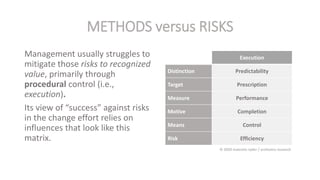
Management usually struggles to
mitigate those risks to recognized
value, primarily through
procedural control (i.e.,
execution).
Its view of “success” against risks
in the change effort relies on
influences that look like this
matrix.
Execution
Distinction Predictability
Target Prescription
Measure Performance
Motive Completion
Means Control
Risk Efficiency
METHODS versus RISKS
© 2020 malcolm ryder / archestra research
The Problem
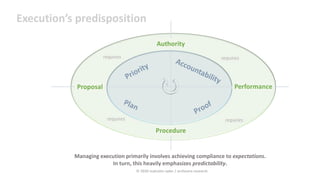
Managing execution primarily involves achieving compliance to expectations.
In turn, this heavily emphasizes predictability.
Execution’s predisposition
© 2020 malcolm ryder / archestra research
Execution setbacks…
The main problem with the Execution orientation is that, statistically, it does
not improve change management’s rate of success, despite decades of
“lessons learned”.
Generally, that means even if execution is improving, there is a basic link
missing between “execution” and “accepted value”, in most cases.
Doing the work right is not equating to doing the right work.
Specifically, we have to conclude that either:
• the execution mode’s outputs are not likely to be sufficient in precision or
scope, or…
• the ultimate value proposition that is dependent on change is not stated
adequately for the execution mode to target effectively.
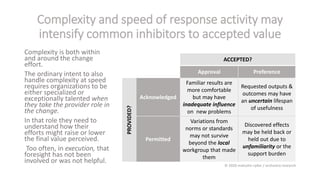
Complexity and speed of response activity may
intensify common inhibitors to accepted value
ACCEPTED?
Approval Preference
PROVIDED?
Acknowledged
Familiar results are
more comfortable
but may have
inadequate influence
on new problems
Requested outputs &
outcomes may have
an uncertain lifespan
of usefulness
Permitted
Variations from
norms or standards
may not survive
beyond the local
workgroup that made
them
Discovered effects
may be held back or
held out due to
unfamiliarity or the
support burden
Complexity is both within
and around the change
effort.
The ordinary intent to also
handle complexity at speed
requires organizations to be
either specialized or
exceptionally talented when
they take the provider role in
the change.
In that role they need to
understand how their
efforts might raise or lower
the final value perceived.
Too often, in execution, that
foresight has not been
involved or was not helpful.
© 2020 malcolm ryder / archestra research
Aligning execution to Value
On the surface it would seem to be good advice to tackle complexity through
simplification, and to tackle speed through sizing.
The formula would be to always pursue the fewest and smallest chunks of work
that will “suffice” against known requirements.
That advice presumes there is very good work done on decomposing the most
important value proposition(s) into usable requirements that are well understood
by participants in provider roles.
An even bigger presumption is that the value proposition will probably stay the
same for the duration of the change effort.
But again, this is not a new idea, and execution with these presumptions has not
improved the reported success rates for far more than a decade.
Aligning Value to Capability
An important point to highlight here is that the way value is defined is always a
major factor in the evaluated “success” or “failure” of execution.
Since the way value is defined can predetermine evaluated “success” or “failure” of
any supporting effort, we have to understand two things:
• Should value be defined especially to allow execution to be more successful? In
this matter, history suggests that it is time to look for alternatives to basing value
on execution. The vast number and variety of specific changes has been more
than enough to test different ways of having execution’s performance mandate
constrain value definition, and it has not been working well.
• Does the ongoing increase in the pace of change mean that value must be
defined differently than in the past? In this matter, any future state created by a
change effort needs to be a difference that can offer value – so “value” itself
must be probable from the effort, whether the value is prescribed or emerges.
Change how you Change
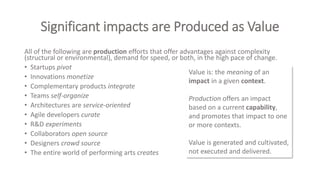
Significant impacts are Produced as Value
All of the following are production efforts that offer advantages against complexity
(structural or environmental), demand for speed, or both, in the high pace of change.
• Startups pivot
• Innovations monetize
• Complementary products integrate
• Teams self-organize
• Architectures are service-oriented
• Agile developers curate
• R&D experiments
• Collaborators open source
• Designers crowd source
• The entire world of performing arts creates
Value is: the meaning of an
impact in a given context.
Production offers an impact
based on a current capability,
and promotes that impact to one
or more contexts.
Value is generated and cultivated,
not executed and delivered.
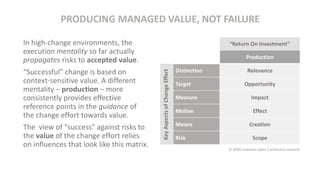
Production
Distinction Relevance
Target Opportunity
Measure Impact
Motive Effect
Means Creation
Risk Scope
PRODUCING MANAGED VALUE, NOT FAILURE
“Return On Investment”
© 2020 malcolm ryder / archestra research
KeyAspectsofChangeEffort
In high-change environments, the
execution mentality so far actually
propagates risks to accepted value.
“Successful” change is based on
context-sensitive value. A different
mentality – production – more
consistently provides effective
reference points in the guidance of
the change effort towards value.
The view of “success” against risks to
the value of the change effort relies
on influences that look like this matrix.
Producing value follows being built for change
• Expecting and investing in diversity and variety
• Modeling business on value(s) available from impacts
• Adopting the production mentality and measures
• Cultivating capabilities for production impacts
• Mitigating risks to impacts, not risks to managers’ performance
evaluations
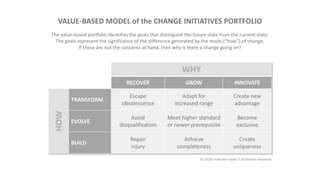
WHY
RECOVER GROW INNOVATE
HOW
TRANSFORM
Escape
obsolescence
Adapt for
increased range
Create new
advantage
EVOLVE
Avoid
disqualification
Meet higher standard
or newer prerequisite
Become
exclusive
BUILD
Repair
injury
Achieve
completeness
Create
uniqueness
VALUE-BASED MODEL of the CHANGE INITIATIVES PORTFOLIO
© 2020 malcolm ryder / archestra research
The value-based portfolio identifies the goals that distinguish the future state from the current state.
The goals represent the significance of the difference generated by the mode (“how”) of change.
If these are not the concerns at hand, then why is there a change going on?
Aligning Expectations
Success, Production and Execution
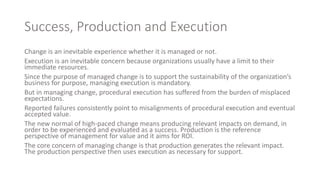
Change is an inevitable experience whether it is managed or not.
Execution is an inevitable concern because organizations usually have a limit to their
immediate resources.
Since the purpose of managed change is to support the sustainability of the organization’s
business for purpose, managing execution is mandatory.
But in managing change, procedural execution has suffered from the burden of misplaced
expectations.
Reported failures consistently point to misalignments of procedural execution and eventual
accepted value.
The new normal of high-paced change means producing relevant impacts on demand, in
order to be experienced and evaluated as a success. Production is the reference
perspective of management for value and it aims for ROI.
The core concern of managing change is that production generates the relevant impact.
The production perspective then uses execution as necessary for support.
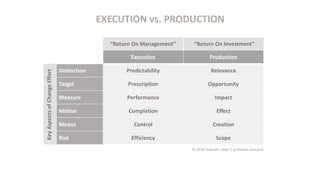
Execution Production
Distinction Predictability Relevance
Target Prescription Opportunity
Measure Performance Impact
Motive Completion Effect
Means Control Creation
Risk Efficiency Scope
EXECUTION vs. PRODUCTION
“Return On Management” “Return On Investment”
© 2020 malcolm ryder / archestra research
KeyAspectsofChangeEffort
Archestra notebooks compile and organize decades of in-the-field and ongoing empirical findings.
All presented findings are derived exclusively from original research.
Archestra notebooks carry no prescriptive warranty.
As ongoing research, all notebooks are subject to change at any time.
©2020 Malcolm Ryder / Archestra Research
www.archestra.com
mryder@archestra.com
Archestra research is done from the perspective of strategy and architecture.
With all subject matter and topics, the purpose of the notes is analytic, primarily to:
* explore, expose and model why things are
included, excluded, or can happen
in given ways and/or to certain effects.
* comment on, and navigate between,
motives and potentials that predetermine
decisions about, and shapings of, the observed activity.

Producing Change - Getting Beyond Execution

  • 1.
  • 2.
    The Current State Afterdecades of applying process models and certifications, organizations still today have “failure” rates of 66% to 75% in managed changes. Somehow, the reported benefit of the discipline has not improved despite lessons learned, new technology, and outright urgency to succeed.
  • 3.
    Types of failure Weknow that there are many ways that, on evaluation day, a change effort might be seen to have failed. In general, the impact needed from the effort is insufficient because of: • Inadequate strength, relevance, or usability at the finish, • or net negatives versus positives that occurred along the way.
  • 4.
    How failure developed Thegeneral “cause” of any failure usually amounts to the following: while the effort was underway, speed, complexity, or the most current need caused the effort to go out of alignment with the eventual target deemed “success”. In short, the organization failed to adjust its effort over time, or the organization did not know how to use the results obtained, or both.
  • 5.
  • 6.
    Where failure starts Whenorganizations and evaluators do not agree on what is “valuable”, there is little chance that making future states different from current states will be deemed “successful” efforts. The most important consideration to apply in starting change is the understanding of “value” and how the understanding can be shared among all participants. Any impacts that are generated by the participants need to be compatible with obtaining the target value. Missing, or counter-productive, co-operation is an undisputed show stopper.
  • 7.
    Staying out oftrouble Obtaining the intended value should be both viable and feasible when having all interim impacts support progress towards the intended future state. But the history of managed changes so far continues to demonstrate that aligning interim impacts is either not adequately done, or the alignment is only a precondition, not a cause. Most retrospectives do identify that insufficient preconditions predict failure. That problem is the common reality of a failure to manage risks to expectations, in production.
  • 8.
    THE PACE OFCHANGE CREATES RISKS TO VALUE The “new normal”, of increased frequency and variety of change, makes an organization’s role as a provider of value far more risky versus any predictability. But that risk is mainly based on preconceptions (explicit or not) about what kind of value is worth investing in. Organizations are usually structured specifically to address the requirements for generating specified (preconceived) types of value. Despite that, risks may prevail: • Ongoing change can mean that prior structural preparation lacks alignment to newly emerged requirements. • Frequent change can mean that fixed structures are at best only temporarily relevant. • Unpredictable change can mean that the advertised requirements offer little practical opportunity to misaligned providers.
  • 9.
    Management usually strugglesto mitigate those risks to recognized value, primarily through procedural control (i.e., execution). Its view of “success” against risks in the change effort relies on influences that look like this matrix. Execution Distinction Predictability Target Prescription Measure Performance Motive Completion Means Control Risk Efficiency METHODS versus RISKS © 2020 malcolm ryder / archestra research
  • 10.
  • 11.
    Managing execution primarilyinvolves achieving compliance to expectations. In turn, this heavily emphasizes predictability. Execution’s predisposition © 2020 malcolm ryder / archestra research
  • 12.
    Execution setbacks… The mainproblem with the Execution orientation is that, statistically, it does not improve change management’s rate of success, despite decades of “lessons learned”. Generally, that means even if execution is improving, there is a basic link missing between “execution” and “accepted value”, in most cases. Doing the work right is not equating to doing the right work. Specifically, we have to conclude that either: • the execution mode’s outputs are not likely to be sufficient in precision or scope, or… • the ultimate value proposition that is dependent on change is not stated adequately for the execution mode to target effectively.
  • 13.
    Complexity and speedof response activity may intensify common inhibitors to accepted value ACCEPTED? Approval Preference PROVIDED? Acknowledged Familiar results are more comfortable but may have inadequate influence on new problems Requested outputs & outcomes may have an uncertain lifespan of usefulness Permitted Variations from norms or standards may not survive beyond the local workgroup that made them Discovered effects may be held back or held out due to unfamiliarity or the support burden Complexity is both within and around the change effort. The ordinary intent to also handle complexity at speed requires organizations to be either specialized or exceptionally talented when they take the provider role in the change. In that role they need to understand how their efforts might raise or lower the final value perceived. Too often, in execution, that foresight has not been involved or was not helpful. © 2020 malcolm ryder / archestra research
  • 14.
    Aligning execution toValue On the surface it would seem to be good advice to tackle complexity through simplification, and to tackle speed through sizing. The formula would be to always pursue the fewest and smallest chunks of work that will “suffice” against known requirements. That advice presumes there is very good work done on decomposing the most important value proposition(s) into usable requirements that are well understood by participants in provider roles. An even bigger presumption is that the value proposition will probably stay the same for the duration of the change effort. But again, this is not a new idea, and execution with these presumptions has not improved the reported success rates for far more than a decade.
  • 15.
    Aligning Value toCapability An important point to highlight here is that the way value is defined is always a major factor in the evaluated “success” or “failure” of execution. Since the way value is defined can predetermine evaluated “success” or “failure” of any supporting effort, we have to understand two things: • Should value be defined especially to allow execution to be more successful? In this matter, history suggests that it is time to look for alternatives to basing value on execution. The vast number and variety of specific changes has been more than enough to test different ways of having execution’s performance mandate constrain value definition, and it has not been working well. • Does the ongoing increase in the pace of change mean that value must be defined differently than in the past? In this matter, any future state created by a change effort needs to be a difference that can offer value – so “value” itself must be probable from the effort, whether the value is prescribed or emerges.
  • 16.
  • 17.
    Significant impacts areProduced as Value All of the following are production efforts that offer advantages against complexity (structural or environmental), demand for speed, or both, in the high pace of change. • Startups pivot • Innovations monetize • Complementary products integrate • Teams self-organize • Architectures are service-oriented • Agile developers curate • R&D experiments • Collaborators open source • Designers crowd source • The entire world of performing arts creates Value is: the meaning of an impact in a given context. Production offers an impact based on a current capability, and promotes that impact to one or more contexts. Value is generated and cultivated, not executed and delivered.
  • 18.
    Production Distinction Relevance Target Opportunity MeasureImpact Motive Effect Means Creation Risk Scope PRODUCING MANAGED VALUE, NOT FAILURE “Return On Investment” © 2020 malcolm ryder / archestra research KeyAspectsofChangeEffort In high-change environments, the execution mentality so far actually propagates risks to accepted value. “Successful” change is based on context-sensitive value. A different mentality – production – more consistently provides effective reference points in the guidance of the change effort towards value. The view of “success” against risks to the value of the change effort relies on influences that look like this matrix.
  • 19.
    Producing value followsbeing built for change • Expecting and investing in diversity and variety • Modeling business on value(s) available from impacts • Adopting the production mentality and measures • Cultivating capabilities for production impacts • Mitigating risks to impacts, not risks to managers’ performance evaluations
  • 20.
    WHY RECOVER GROW INNOVATE HOW TRANSFORM Escape obsolescence Adaptfor increased range Create new advantage EVOLVE Avoid disqualification Meet higher standard or newer prerequisite Become exclusive BUILD Repair injury Achieve completeness Create uniqueness VALUE-BASED MODEL of the CHANGE INITIATIVES PORTFOLIO © 2020 malcolm ryder / archestra research The value-based portfolio identifies the goals that distinguish the future state from the current state. The goals represent the significance of the difference generated by the mode (“how”) of change. If these are not the concerns at hand, then why is there a change going on?
  • 21.
  • 22.
    Success, Production andExecution Change is an inevitable experience whether it is managed or not. Execution is an inevitable concern because organizations usually have a limit to their immediate resources. Since the purpose of managed change is to support the sustainability of the organization’s business for purpose, managing execution is mandatory. But in managing change, procedural execution has suffered from the burden of misplaced expectations. Reported failures consistently point to misalignments of procedural execution and eventual accepted value. The new normal of high-paced change means producing relevant impacts on demand, in order to be experienced and evaluated as a success. Production is the reference perspective of management for value and it aims for ROI. The core concern of managing change is that production generates the relevant impact. The production perspective then uses execution as necessary for support.
  • 23.
    Execution Production Distinction PredictabilityRelevance Target Prescription Opportunity Measure Performance Impact Motive Completion Effect Means Control Creation Risk Efficiency Scope EXECUTION vs. PRODUCTION “Return On Management” “Return On Investment” © 2020 malcolm ryder / archestra research KeyAspectsofChangeEffort
  • 24.
    Archestra notebooks compileand organize decades of in-the-field and ongoing empirical findings. All presented findings are derived exclusively from original research. Archestra notebooks carry no prescriptive warranty. As ongoing research, all notebooks are subject to change at any time. ©2020 Malcolm Ryder / Archestra Research www.archestra.com mryder@archestra.com Archestra research is done from the perspective of strategy and architecture. With all subject matter and topics, the purpose of the notes is analytic, primarily to: * explore, expose and model why things are included, excluded, or can happen in given ways and/or to certain effects. * comment on, and navigate between, motives and potentials that predetermine decisions about, and shapings of, the observed activity.