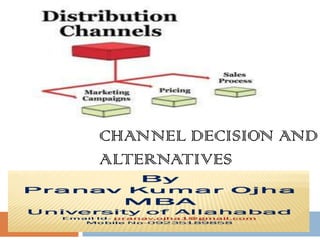
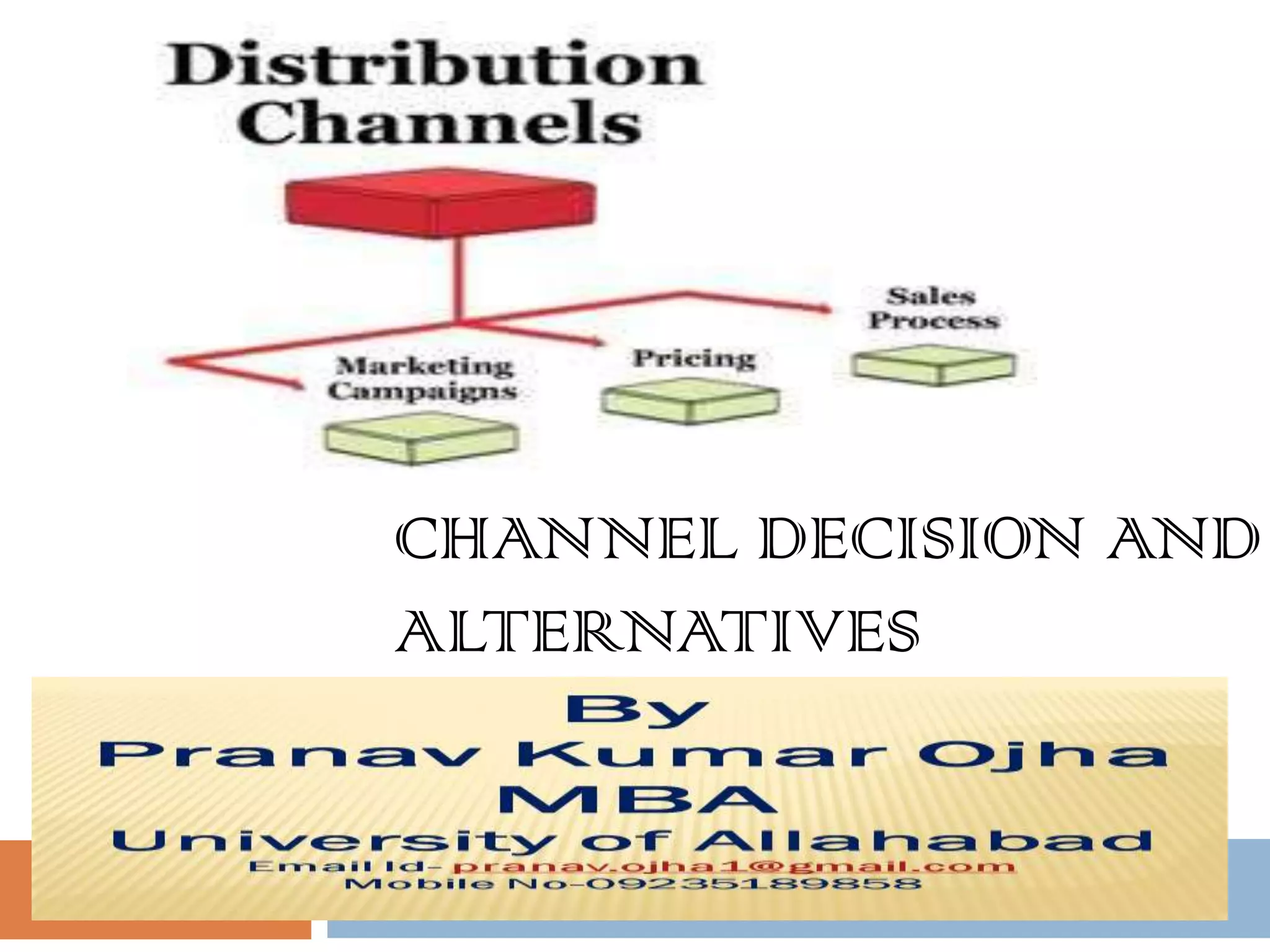
CHANNEL DECISION AND
ALTERNATIVES
CHANNEL- A CONCEPT
2


       A Marketing channel is a set of
        organizations involved in the process
        of making product or services available
        for use or consumption.
Definitions


                                 -
                       -PHILIP
KOTLER
Why Do Marketing Channels Exist?

   Middlemen often perform the needed functions
    at a lower cost than either the customer or the
    manufacturer could by themselves.
   The first step in designing a distribution
    channel for a given product is to determine
    what objectives the channel must accomplish
    and their relative importance.
Designing Distribution Channels: What are the
Objectives to be Accomplished?

   Objectives of distribution channels:
     Increase  the availability of the good or service to
      potential customers.
     Satisfy customer requirements by providing high
      levels of service.
     Ensure promotional effort.

     Obtain timely and detailed market information.

     Increase cost- effectiveness.

     Maintain flexibility.
Designing Distribution Channels: What are the
Objectives to be Accomplished?

   Product availability
     The  most important objective for a channel.
     For industrial goods, two aspects of availability
      must be considered.
       Attain the desired level of coverage in terms of
        appropriate retail outlets.
       The item’s positioning within the store
Designing Distribution Channels: What are the
Objectives to be Accomplished?

   Meeting customers’ service requirements
     Crucialobjective for analyzer and defender
      businesses attempting to differentiate themselves
      on service dimensions.
     Some the service requirements include:
       Order cycle time
       Dependability
       Communication between buyer and seller
       Convenience
       Postsale services
Designing Distribution Channels: What are the
Objectives to be Accomplished?

   Promotional effort
     Obtain
          promotional support from channel
     members for the firm’s product.
   Market information
     Middlemen   are often relied on for fast and
      accurate feedback.
     A high level of channel feedback is particularly
      important for firms in highly competitive
      industries.
     Feedback is crucial for prospectors.
Designing Distribution Channels: What are the
Objectives to be Accomplished?

   Cost-effectiveness
     Important to businesses pursuing low-cost
      analyzer or defender strategies.
   Flexibility
     Firms  pursuing prospector strategies in new or
      rapidly growing or technically turbulent product
      categories, consider this important.
     A flexible channel is one where it is relatively easy
      to switch channel structures or add new types of
      middlemen.
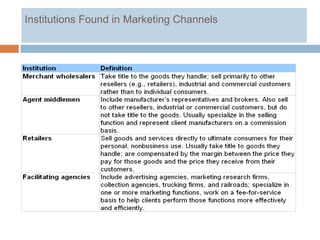
Institutions Found in Marketing Channels
Designing Distribution Channels: What
Kinds of Institutions Might Be Included?

   Merchant Wholesalers
     Some    types of merchant wholesalers engage in a
      full range of wholesaling functions while others
      specialize in only limited services.
     Both buy goods from various suppliers and then
      resell those goods to their commercial
      customers, either industrial buyers or other
      resellers such as a retailer.
Designing Distribution Channels: What
Kinds of Institutions Might Be Included?

   Agent middlemen do not take title to, or
    physical possession of, the goods they deal in.
     Manufacturer’s   agents or manufacturer’s reps
     Salesagents
     Brokers

     E-Hubs
Designing Distribution Channels: What
Kinds of Institutions Might Be Included?

   Retailers
     Sellgoods and services directly to final
      consumers for their personal, nonbusiness use.
     One classification scheme groups stores
      according to their method of operation:
       Low margin/high turnover
       High margin/low turnover
Designing Distribution Channels: What
Kinds of Institutions Might Be Included?

   Nonstore Retailing
     Includes direct selling, mail-order catalogs, TV
      shopping, vending machines, and Web sites.
     Auction sites facilitate retail start-ups.
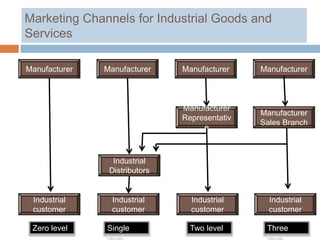
Marketing Channels for Industrial Goods and
Services

Manufacturer   Manufacturer    Manufacturer    Manufacturer


                               Manufacturer
                                               Manufacturer
                               Representativ
                                               Sales Branch
                                    e


                 Industrial
                Distributors


 Industrial      Industrial      Industrial      Industrial
 customer        customer        customer        customer

 Zero level    Single            Two level      Three
Which Alternative Is Best?

   There are trade-offs among the various
    objectives a company might try to accomplish
    with its distribution channel.
   The decision depends on:
     Which  distribution objectives are considered most
      important,
     Which is influenced by the business’s competitive
      strategy and the other components of the
      marketing program.
Which Alternative Is Best?

   Number of intermediaries - Three basic
    strategies are available:
     Intensive Distribution
     Exclusive Distribution

     Selective Distribution
Which Alternative Is Best?

   Promotional effort, market information, and
    post sale service objectives
   Economic criteria
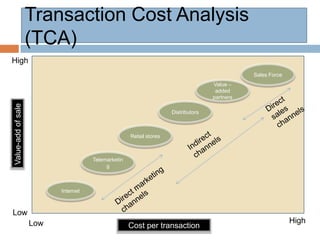
     The  theory of transaction cost analysis (TCA)
     argues that when substantial transaction-specific
     assets are involved, the costs of using and
     administering independent channel members are
     likely to be higher than the costs of managing a
     company sales force and/or distribution centers.
Which Alternative Is Best?

   Cost-effectiveness
     Minimizing physical distribution costs subject to
      the constraint of achieving some target level of
      product availability and customer service.
     Make-or-buy decisions

     Supply chain management
Transaction Cost Analysis
                    (TCA)
High
                                                                                              Sales Force
                                                                                   Value –
                                                                                    added
                                                                                   partners
Value-add of sale


                                                                    Distributors


                                                    Retail stores


                                     Telemarketin
                                          g


                          Internet


Low
                    Low                                                                                     High
                                                    Cost per transaction
Which Alternative Is Best?

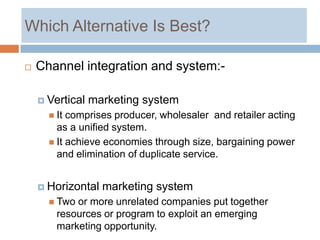
   Channel integration and system:-

     Vertical   marketing system
       It comprises producer, wholesaler and retailer acting
        as a unified system.
       It achieve economies through size, bargaining power
        and elimination of duplicate service.


     Horizontal   marketing system
       Two or more unrelated companies put together
        resources or program to exploit an emerging
        marketing opportunity.
Which Alternative Is Best?

   Flexibility
     Generally,   vertically integrated systems are
      difficult to alter quickly.
     Channels involving independent middlemen are
      often more flexible.
Which Alternative Is Best?

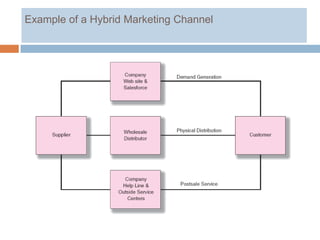
   Multichannel distribution
     Companies   are increasingly using multiple
      channels.
     Some use dual distribution systems.
     Hybrid system is a variation.
     Multichannel systems employ separate channels
      to reach different target segments.
     Members of a hybrid system perform
      complementary functions for the same customer
      segment.
Example of a Hybrid Marketing Channel
Channel Design for Global Markets

   Market entry strategies
     Exporting is simple because it involves the least
      commitment and risk.
     Contractual entry modes are non equity
      arrangements that involve the transfer of
      technology and/or skills to an entity in a foreign
      country.
     Overseas direct investment can be implemented
      in two ways—through joint ventures or sole
      ownership.
Channel Design for Global Markets

   Contractual entry modes:
     Licensing

     Franchising

     Includecontract manufacturing
     Turnkey construction contract

     Coproduction

     Countertrade
Channel Design for Global Markets

   Channel alternatives
     The use of domestic middlemen who provide
      marketing services from a domestic base.
     The use of foreign middlemen.
Conclusion
   The primary responsibility for channel success
    lie with the manufacturer. Thus, manufacturers
    must recognize those functions that cannot be
    delegated to middlemen and perform them at a
    level at least equivalent to that expected from
    the other channel members.
Channel decision and alternatives

Channel decision and alternatives

  • 1.
  • 2.
    CHANNEL- A CONCEPT 2  A Marketing channel is a set of organizations involved in the process of making product or services available for use or consumption.
  • 3.
    Definitions - -PHILIP KOTLER
  • 4.
    Why Do MarketingChannels Exist?  Middlemen often perform the needed functions at a lower cost than either the customer or the manufacturer could by themselves.  The first step in designing a distribution channel for a given product is to determine what objectives the channel must accomplish and their relative importance.
  • 5.
    Designing Distribution Channels:What are the Objectives to be Accomplished?  Objectives of distribution channels:  Increase the availability of the good or service to potential customers.  Satisfy customer requirements by providing high levels of service.  Ensure promotional effort.  Obtain timely and detailed market information.  Increase cost- effectiveness.  Maintain flexibility.
  • 6.
    Designing Distribution Channels:What are the Objectives to be Accomplished?  Product availability  The most important objective for a channel.  For industrial goods, two aspects of availability must be considered.  Attain the desired level of coverage in terms of appropriate retail outlets.  The item’s positioning within the store
  • 7.
    Designing Distribution Channels:What are the Objectives to be Accomplished?  Meeting customers’ service requirements  Crucialobjective for analyzer and defender businesses attempting to differentiate themselves on service dimensions.  Some the service requirements include:  Order cycle time  Dependability  Communication between buyer and seller  Convenience  Postsale services
  • 8.
    Designing Distribution Channels:What are the Objectives to be Accomplished?  Promotional effort  Obtain promotional support from channel members for the firm’s product.  Market information  Middlemen are often relied on for fast and accurate feedback.  A high level of channel feedback is particularly important for firms in highly competitive industries.  Feedback is crucial for prospectors.
  • 9.
    Designing Distribution Channels:What are the Objectives to be Accomplished?  Cost-effectiveness  Important to businesses pursuing low-cost analyzer or defender strategies.  Flexibility  Firms pursuing prospector strategies in new or rapidly growing or technically turbulent product categories, consider this important.  A flexible channel is one where it is relatively easy to switch channel structures or add new types of middlemen.
  • 10.
    Institutions Found inMarketing Channels
  • 11.
    Designing Distribution Channels:What Kinds of Institutions Might Be Included?  Merchant Wholesalers  Some types of merchant wholesalers engage in a full range of wholesaling functions while others specialize in only limited services.  Both buy goods from various suppliers and then resell those goods to their commercial customers, either industrial buyers or other resellers such as a retailer.
  • 12.
    Designing Distribution Channels:What Kinds of Institutions Might Be Included?  Agent middlemen do not take title to, or physical possession of, the goods they deal in.  Manufacturer’s agents or manufacturer’s reps  Salesagents  Brokers  E-Hubs
  • 13.
    Designing Distribution Channels:What Kinds of Institutions Might Be Included?  Retailers  Sellgoods and services directly to final consumers for their personal, nonbusiness use.  One classification scheme groups stores according to their method of operation:  Low margin/high turnover  High margin/low turnover
  • 14.
    Designing Distribution Channels:What Kinds of Institutions Might Be Included?  Nonstore Retailing  Includes direct selling, mail-order catalogs, TV shopping, vending machines, and Web sites.  Auction sites facilitate retail start-ups.
  • 15.
    Marketing Channels forIndustrial Goods and Services Manufacturer Manufacturer Manufacturer Manufacturer Manufacturer Manufacturer Representativ Sales Branch e Industrial Distributors Industrial Industrial Industrial Industrial customer customer customer customer Zero level Single Two level Three
  • 16.
    Which Alternative IsBest?  There are trade-offs among the various objectives a company might try to accomplish with its distribution channel.  The decision depends on:  Which distribution objectives are considered most important,  Which is influenced by the business’s competitive strategy and the other components of the marketing program.
  • 17.
    Which Alternative IsBest?  Number of intermediaries - Three basic strategies are available:  Intensive Distribution  Exclusive Distribution  Selective Distribution
  • 18.
    Which Alternative IsBest?  Promotional effort, market information, and post sale service objectives  Economic criteria  The theory of transaction cost analysis (TCA) argues that when substantial transaction-specific assets are involved, the costs of using and administering independent channel members are likely to be higher than the costs of managing a company sales force and/or distribution centers.
  • 19.
    Which Alternative IsBest?  Cost-effectiveness  Minimizing physical distribution costs subject to the constraint of achieving some target level of product availability and customer service.  Make-or-buy decisions  Supply chain management
  • 20.
    Transaction Cost Analysis (TCA) High Sales Force Value – added partners Value-add of sale Distributors Retail stores Telemarketin g Internet Low Low High Cost per transaction
  • 21.
    Which Alternative IsBest?  Channel integration and system:-  Vertical marketing system  It comprises producer, wholesaler and retailer acting as a unified system.  It achieve economies through size, bargaining power and elimination of duplicate service.  Horizontal marketing system  Two or more unrelated companies put together resources or program to exploit an emerging marketing opportunity.
  • 22.
    Which Alternative IsBest?  Flexibility  Generally, vertically integrated systems are difficult to alter quickly.  Channels involving independent middlemen are often more flexible.
  • 23.
    Which Alternative IsBest?  Multichannel distribution  Companies are increasingly using multiple channels.  Some use dual distribution systems.  Hybrid system is a variation.  Multichannel systems employ separate channels to reach different target segments.  Members of a hybrid system perform complementary functions for the same customer segment.
  • 24.
    Example of aHybrid Marketing Channel
  • 25.
    Channel Design forGlobal Markets  Market entry strategies  Exporting is simple because it involves the least commitment and risk.  Contractual entry modes are non equity arrangements that involve the transfer of technology and/or skills to an entity in a foreign country.  Overseas direct investment can be implemented in two ways—through joint ventures or sole ownership.
  • 26.
    Channel Design forGlobal Markets  Contractual entry modes:  Licensing  Franchising  Includecontract manufacturing  Turnkey construction contract  Coproduction  Countertrade
  • 27.
    Channel Design forGlobal Markets  Channel alternatives  The use of domestic middlemen who provide marketing services from a domestic base.  The use of foreign middlemen.
  • 28.
    Conclusion  The primary responsibility for channel success lie with the manufacturer. Thus, manufacturers must recognize those functions that cannot be delegated to middlemen and perform them at a level at least equivalent to that expected from the other channel members.

Editor's Notes

  • #3 They are set of pathways which product or services fallows after production, culminating in purchase and use by the final end user.