Download as PDF, PPTX
![Displacement Addressing
By Mourin Mondol [152-35-1298]](https://image.slidesharecdn.com/displacementaddressing-180412210633/75/Displacement-addressing-1-2048.jpg)

![3 COMMON
USES
● RELATIVE ADDRESSING
● BASE-REGISTER
● INDEXING
[Relative]: referenced register is
the program counter (PC)
[Base-register]: referenced register
contains a main memory
address and the address field
contains a displacement from
that address.
[Indexing]: address field references
a main memory address, and
referenced register contains a
positive displacement from that
address.](https://image.slidesharecdn.com/displacementaddressing-180412210633/75/Displacement-addressing-6-2048.jpg)


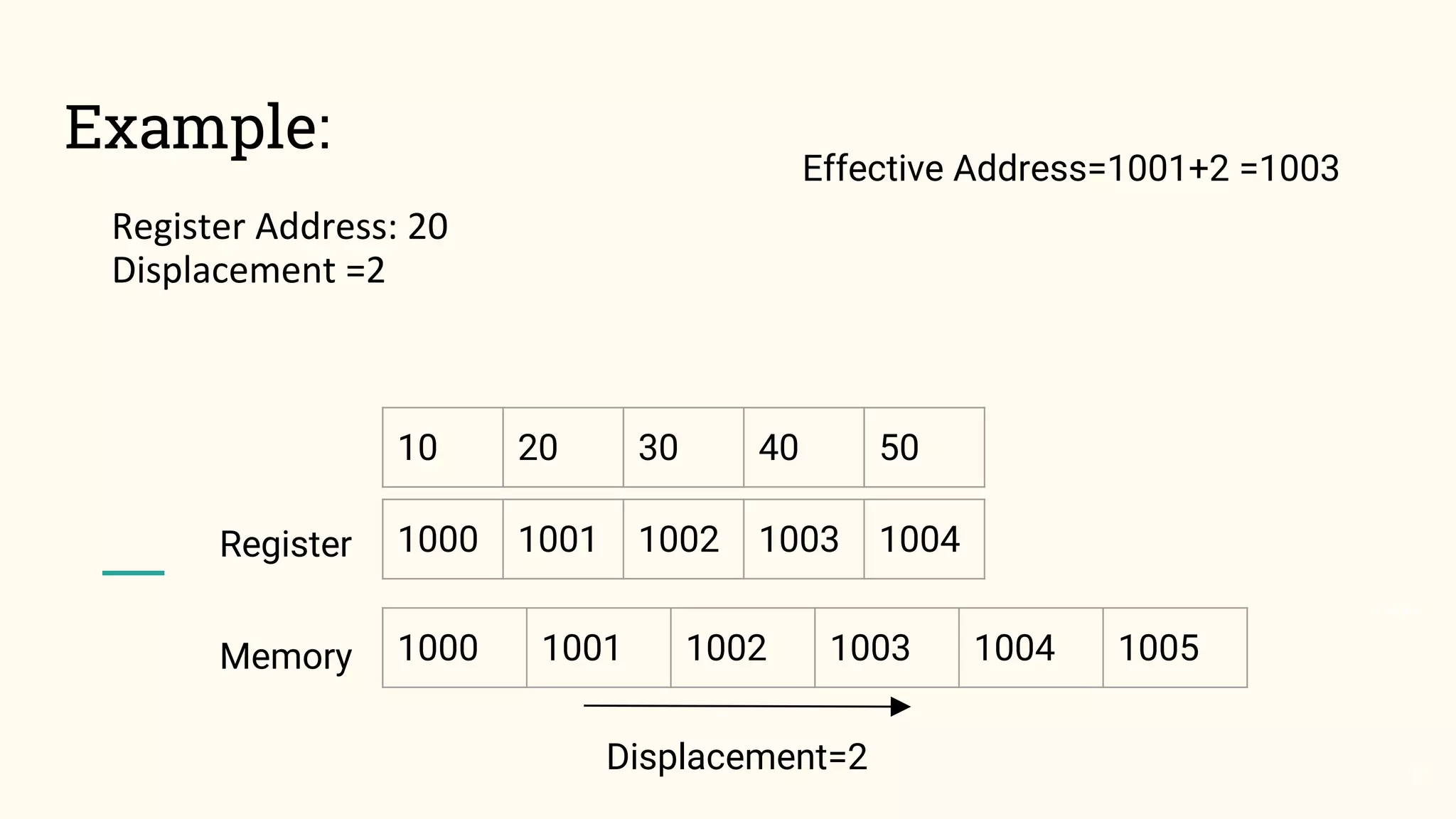
Displacement addressing combines direct and register indirect addressing by using an effective address that is the sum of a memory address and the contents of a register plus a displacement value. It provides flexibility but also complexity. For example, if a register contains 20 and the displacement is 2, the effective address is the memory address 1001 plus the register value 20 plus the displacement 2, for a total of 1003. The main uses of displacement addressing are relative addressing using the program counter, base-register addressing where the register contains a base memory address, and indexing where the register provides an offset from a memory address.
Introduction to displacement addressing, highlighting its combination of direct and indirect addressing methods.
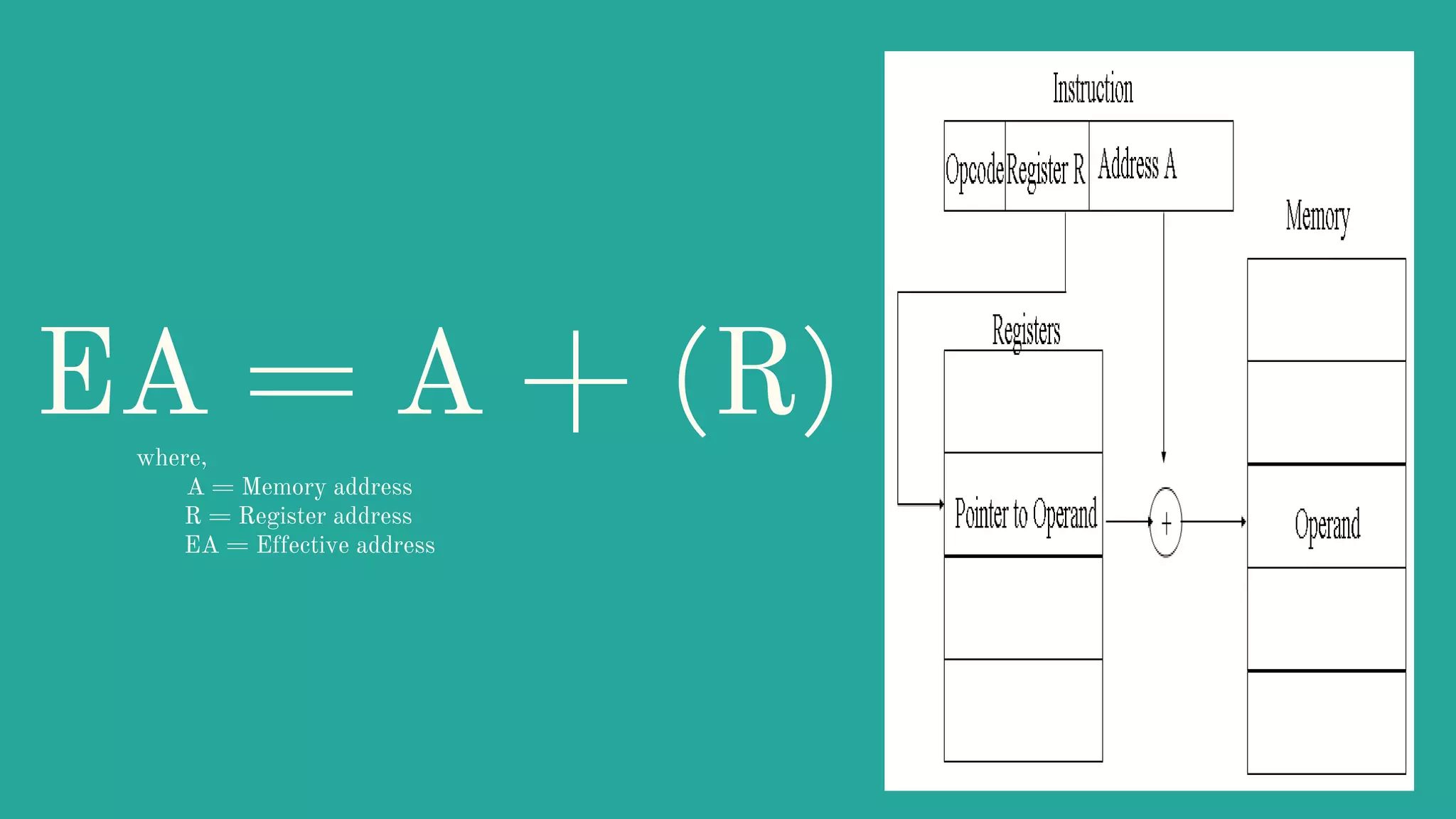
Formula for calculating effective address (EA = A + R). Definitions of parts: A (Memory address), R (Register address).
Discussion on when to use displacement addressing based on its flexibility versus complexity.
Example showing calculation of effective address using a register and displacement. Illustrates memory addresses.
Outlines three uses: Relative Addressing, Base-Register, and Indexing with brief descriptions.
Open floor for questions regarding displacement addressing concepts presented.


![Chat Application [Full Documentation]](https://cdn.slidesharecdn.com/ss_thumbnails/finaldoconchatapp-170418182505-thumbnail.jpg?width=640&height=640&fit=bounds)


