BY
SAKTHIPRIYA.V
NADAR SARASWATHI COLLEGE OF ARTS ANDSCIENCE
MRI DEFINITION:
To specify the microoperation needed for
the execution of the instruction.
An instruction in words in usually lengthy
and enough space is available in the table.
It is can be defined by means of register
transfer notation.
CONT..
Data are store in a memory can be
processed directly.
It must be read from memory to a register
can be operate in logic circuit.
In the lengthly explanation.
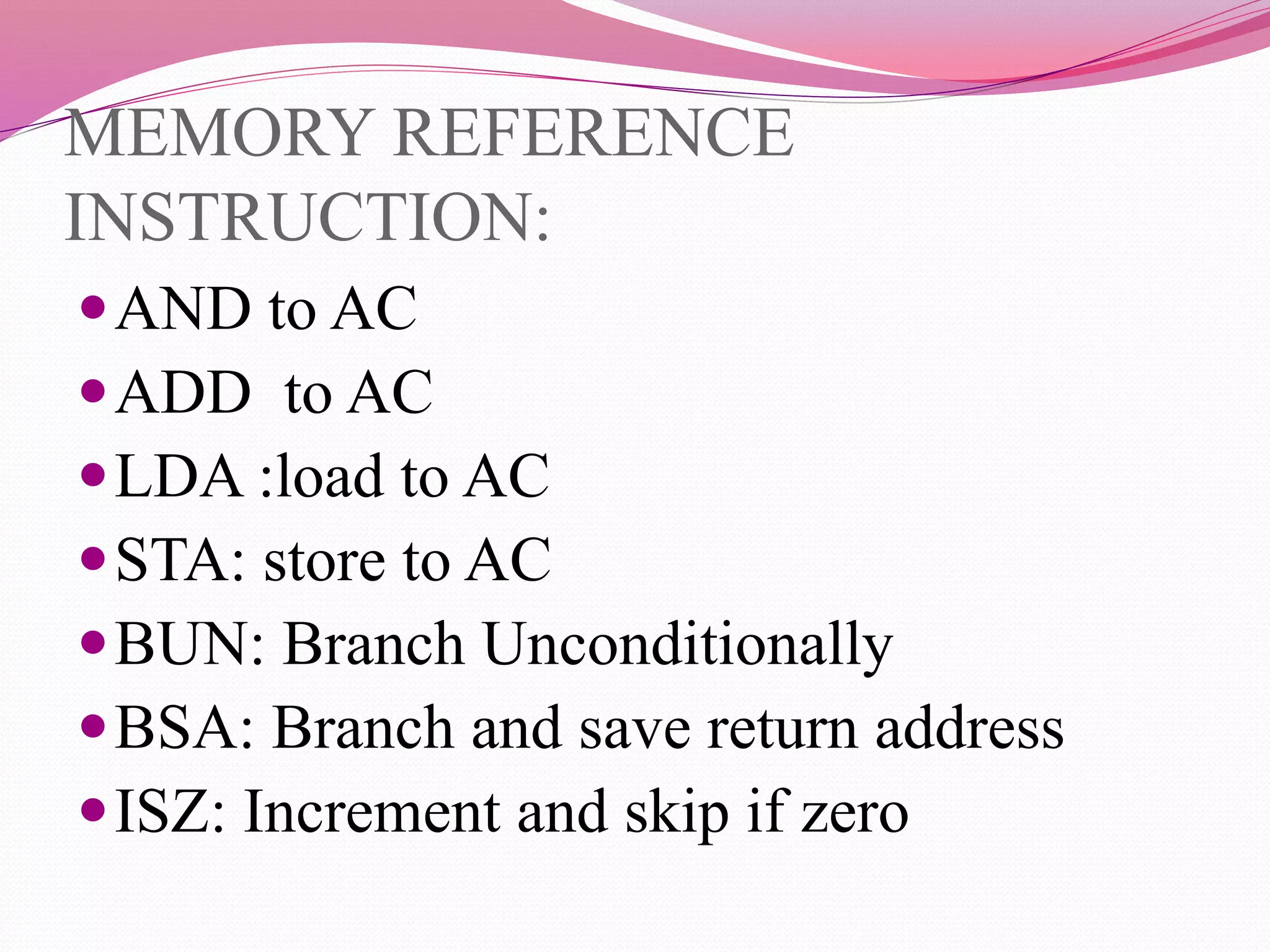
MEMORY REFERENCE
INSTRUCTION:
AND to AC
ADD to AC
LDA :load to AC
STA: store to AC
BUN: Branch Unconditionally
BSA: Branch and save return address
ISZ: Increment and skip if zero
SYMPOL OPERATION
DECODER
SYMBOLIC DESCRIPTION
AND D0 AC  AC ^ M[AR]
ADD D1 AC <- AC+M[AR], E <- Cout
LDA D2 AC <- M[AR]
STA D3 M[AR] <-AC
BUN D4 PC <- AR
BSA D5 M[AR]<- PC, PC<- AR+1
M[AR] <- M[AR]+1
ISZ D6 IF M[AR]+1=0 THEN
PC <- PC+1
AND TO AC:
It performs the AND logic operation in
AC, and the memory word specified by
the “effective address”.
D0T4:DR <- M[AR]
D0T5:AC <-AC ^DR,SC <-0
• The two timing signal are T4 ,T5.
• T4 transfer the operand from memory in
DR.
T5 transfer to AC result AND logic
operation.
T0 is to start a new instruction cycle.
ADD to AC:
 Adds the content of the memory word specified by the
effective addresses.
 Sum transferred to AC and output is carry(cout)
transfer to the E flip flop.
D1T4:DR<-M[AR]
D1T5:AC<-AC+DR,E<-COUT,SC<-0
 Two timing signals t4 and t5.decoder d1 instead d0
used in AND instruction
 Instruction fetched from memory and decoder.
 Two timing signals t4 and t5.decoder d1 instead d0
used in AND instruction
 Instruction fetched from memory and decoder.
 Output determine the sequence of microoperation
execution of a MRI.
LDA:LOAD to AC:
 Memory word specified by the effective addresses to
AC.
D2T4:DR<-M[AR]
D2T5:AC<-DR,SC<-0
 No direct path from the bus into AC.
 The adder and logic circuit receive information from
DR.transfer to AC.
 Read from memory and transfer to the adder and logic
circuit.
STA:-STORE AC:
 Memory word specified by the effective address.
 Output of AC is applied to the bus data input of
memory is connected to the execute the one
microoperation.
D3T4:M[AR]<-AC,SC<-0.
BUN:-BRANCH UNCONDITIONALLY:
 Instruction specified to the effective address.
 Pc holds the address of the instruction read from
memory in the next instruction cycle.
 The programmer specify an instruction out of
sequence.program branch unconditionally.
 Execute one microoperation.
D4T4 :PC<-AR,SC<-0
 EA from AR is transferred the common bus to PC.SC to
O transfer control to T0.
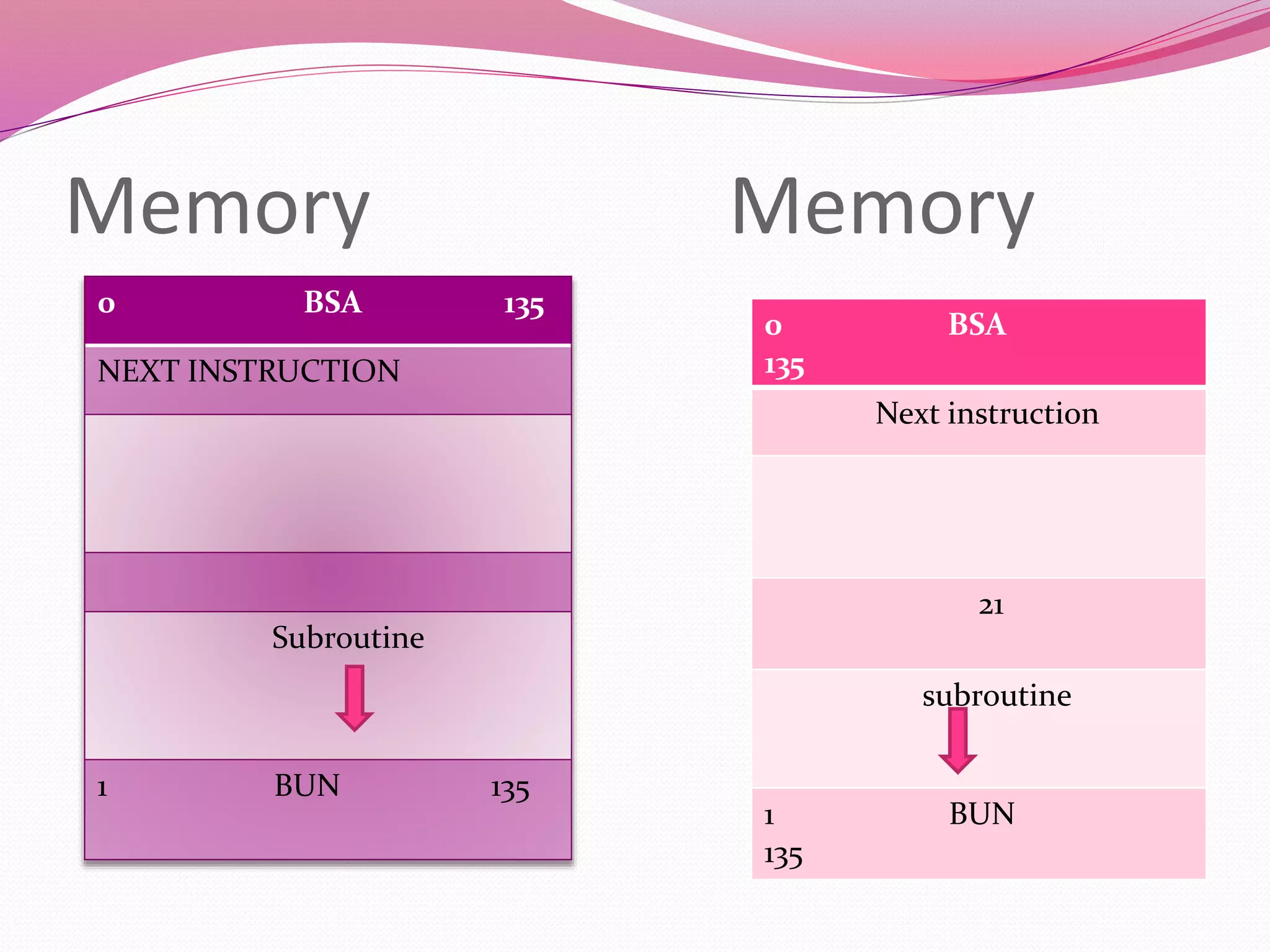
BSA :-BRANCH and SAVE RETURN
ADDRESS:
 Subroutine(or)procedure.
 Memory location specified by the effective address.
 Address of the first instruction in the subroutine.
M[AR]<-PC, PC<-AR+1.
 Next instruction is called return address.
M[135]<-21,PC<-135+1=136.
 BSA instruction performs the function usually referred
to as a subroutine call.
 End of the subroutine performs the function refer is called
subroutine return.
D5T4 :M[AR]<-PC,AR <-+1
D5T5 :PC<-AR,SC<-0
 Enable the INR input of AR.
Memory Memory
0 BSA 135
NEXT INSTRUCTION
Subroutine
1 BUN 135
0 BSA
135
Next instruction
21
subroutine
1 BUN
135
ISZ:-INCREMENT and SKIP it ZERO
 The instruction increment the word specified by the
effective address.
 INR value is 0,PC incremented by 1.
 It is stored in a negative number.so used to an 2’s
complements.negative number are incremented by 1.
 The instruction is a sequence of microoperation
D6T4:DR<-M[AR].
D6T5: DR<-DR+1.
D6T6:M[AR]<-DR ,if(DR=0)then (PC<-
PC+1),SC<-0.
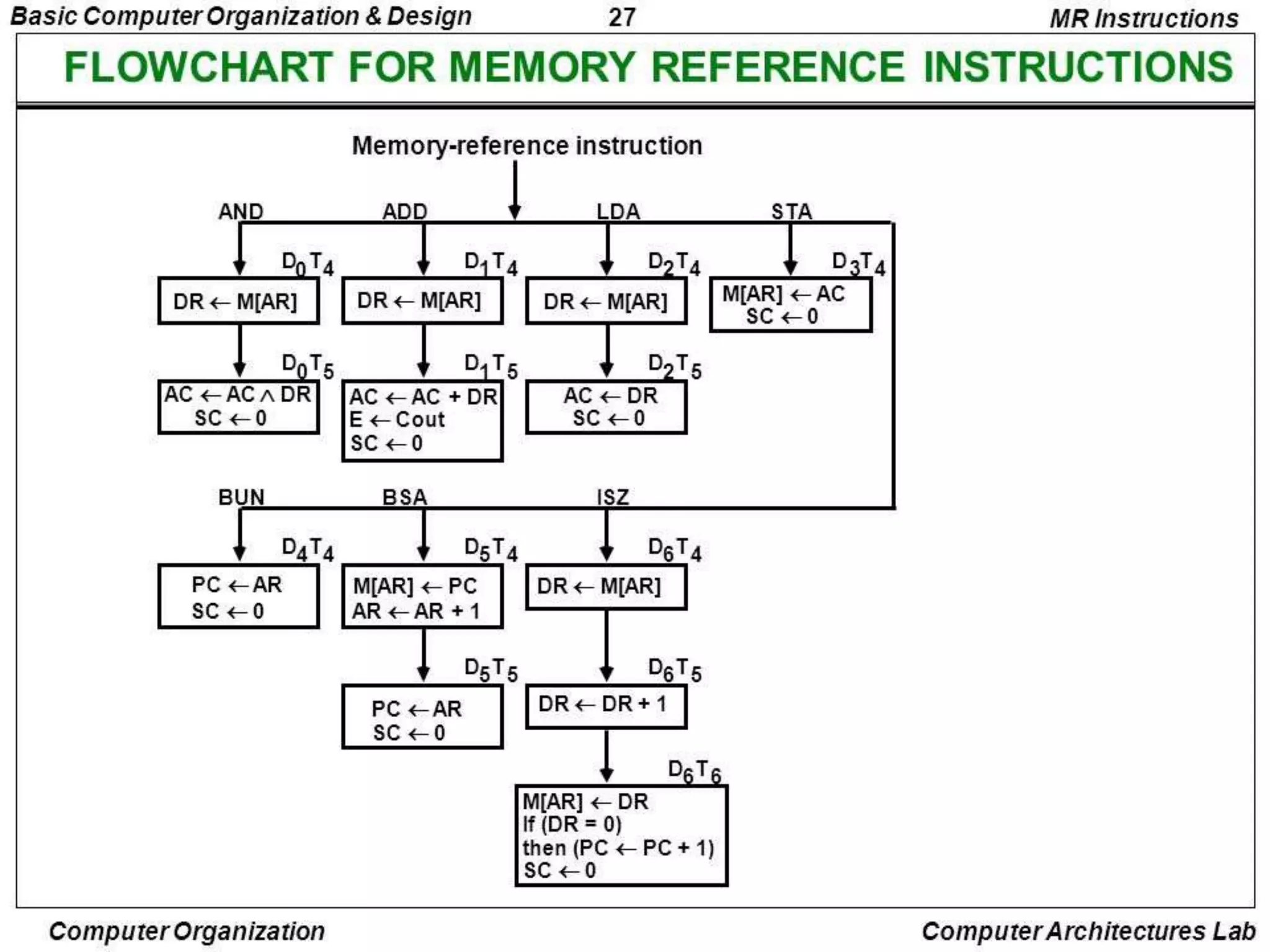
CONTROL FLOW CHART:
 Show the execution of the microoperation in seven
memory reference instruction.
 It is preformed to the timing signals for T4,T5 or T6
the timing signals are operation code value.
 SC is the sequence counter and sc is cleared to 0.is
include to an last timing signal.
 The increment and skip is zero(ISZ).to there are
include three bits counter.
memory reference instruction

memory reference instruction

  • 1.
  • 2.
    MRI DEFINITION: To specifythe microoperation needed for the execution of the instruction. An instruction in words in usually lengthy and enough space is available in the table. It is can be defined by means of register transfer notation.
  • 3.
    CONT.. Data are storein a memory can be processed directly. It must be read from memory to a register can be operate in logic circuit. In the lengthly explanation.
  • 4.
    MEMORY REFERENCE INSTRUCTION: AND toAC ADD to AC LDA :load to AC STA: store to AC BUN: Branch Unconditionally BSA: Branch and save return address ISZ: Increment and skip if zero
  • 5.
    SYMPOL OPERATION DECODER SYMBOLIC DESCRIPTION ANDD0 AC  AC ^ M[AR] ADD D1 AC <- AC+M[AR], E <- Cout LDA D2 AC <- M[AR] STA D3 M[AR] <-AC BUN D4 PC <- AR BSA D5 M[AR]<- PC, PC<- AR+1 M[AR] <- M[AR]+1 ISZ D6 IF M[AR]+1=0 THEN PC <- PC+1
  • 6.
    AND TO AC: Itperforms the AND logic operation in AC, and the memory word specified by the “effective address”. D0T4:DR <- M[AR] D0T5:AC <-AC ^DR,SC <-0 • The two timing signal are T4 ,T5. • T4 transfer the operand from memory in DR.
  • 7.
    T5 transfer toAC result AND logic operation. T0 is to start a new instruction cycle.
  • 8.
    ADD to AC: Adds the content of the memory word specified by the effective addresses.  Sum transferred to AC and output is carry(cout) transfer to the E flip flop. D1T4:DR<-M[AR] D1T5:AC<-AC+DR,E<-COUT,SC<-0  Two timing signals t4 and t5.decoder d1 instead d0 used in AND instruction  Instruction fetched from memory and decoder.
  • 9.
     Two timingsignals t4 and t5.decoder d1 instead d0 used in AND instruction  Instruction fetched from memory and decoder.  Output determine the sequence of microoperation execution of a MRI.
  • 10.
    LDA:LOAD to AC: Memory word specified by the effective addresses to AC. D2T4:DR<-M[AR] D2T5:AC<-DR,SC<-0  No direct path from the bus into AC.  The adder and logic circuit receive information from DR.transfer to AC.  Read from memory and transfer to the adder and logic circuit.
  • 11.
    STA:-STORE AC:  Memoryword specified by the effective address.  Output of AC is applied to the bus data input of memory is connected to the execute the one microoperation. D3T4:M[AR]<-AC,SC<-0.
  • 12.
    BUN:-BRANCH UNCONDITIONALLY:  Instructionspecified to the effective address.  Pc holds the address of the instruction read from memory in the next instruction cycle.  The programmer specify an instruction out of sequence.program branch unconditionally.  Execute one microoperation. D4T4 :PC<-AR,SC<-0  EA from AR is transferred the common bus to PC.SC to O transfer control to T0.
  • 13.
    BSA :-BRANCH andSAVE RETURN ADDRESS:  Subroutine(or)procedure.  Memory location specified by the effective address.  Address of the first instruction in the subroutine. M[AR]<-PC, PC<-AR+1.  Next instruction is called return address. M[135]<-21,PC<-135+1=136.  BSA instruction performs the function usually referred to as a subroutine call.
  • 14.
     End ofthe subroutine performs the function refer is called subroutine return. D5T4 :M[AR]<-PC,AR <-+1 D5T5 :PC<-AR,SC<-0  Enable the INR input of AR.
  • 15.
    Memory Memory 0 BSA135 NEXT INSTRUCTION Subroutine 1 BUN 135 0 BSA 135 Next instruction 21 subroutine 1 BUN 135
  • 16.
    ISZ:-INCREMENT and SKIPit ZERO  The instruction increment the word specified by the effective address.  INR value is 0,PC incremented by 1.  It is stored in a negative number.so used to an 2’s complements.negative number are incremented by 1.  The instruction is a sequence of microoperation D6T4:DR<-M[AR]. D6T5: DR<-DR+1. D6T6:M[AR]<-DR ,if(DR=0)then (PC<- PC+1),SC<-0.
  • 17.
    CONTROL FLOW CHART: Show the execution of the microoperation in seven memory reference instruction.  It is preformed to the timing signals for T4,T5 or T6 the timing signals are operation code value.  SC is the sequence counter and sc is cleared to 0.is include to an last timing signal.  The increment and skip is zero(ISZ).to there are include three bits counter.