ATAL BIHARI VAJPAYEE VISHWAVIDYALAYA
DEPARTMENT OF COMPUTER SCIENCE & APPLICALION
SUBMITTED BY
UJJWAL MATOLIYA
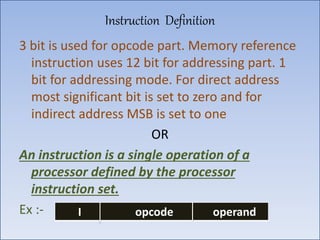
Instruction Definition
3 bit is used for opcode part. Memory reference
instruction uses 12 bit for addressing part. 1
bit for addressing mode. For direct address
most significant bit is set to zero and for
indirect address MSB is set to one
OR
An instruction is a single operation of a
processor defined by the processor
instruction set.
Ex :- I opcode operand
Instruction are categorized into different
format with respect to the operand fields in
the instruction
 Zero address instructions
 One address instructions
 Two address instructions
 Three address instructions
Zero address instructions
IT does not use any address field in the
computational instruction
ADD and MUL instruction don’t use any
address field of the stack (set of memory
location); however, address field is
necessary for PUSH and POP instruction
Ex. X=(A+B)*(C+D)
PUSH A M[SP] A
PUSH B M[SP] B
ADD M[SP] A+B
PUSH C M[SP] C
PUSH D M[SP] D
ADD M[SP] C+D
MUL M[SP] (A+B)*(C+D)
POP X M[X] M[SP]
ONE address instructions
 THE instruction with one address format use
only one address field.
IT use accumulator (AC) register for all types
of data manipulation
EX. X=(A+B)*(C+D)
LOAD A // AC M[A]
ADD B // AC AC+M[B]
STORE T // M[T] AC
LOAD C // AC M[C]
ADD D // AC AC+M[D]
MUL T // AC AC*M[T]
Two address instructions
 THE instructions with two address format
uses two address fields.
 Each address field can specify a register
or a memory location.
 example are: ADD, MOV , CMP, BIS etc.
EX. X=(A+B)*(C+D)
MOV R0 M[A]
MOV R1 M[B]
ADD R0 R1
MOV R2 M[C]
MOV R3 M[D]
ADD R2 R3
MUL R0 R2
STORE M[X] R3
Three address instructions
o THE instruction with three address format
uses three address field.
o Each address field can specify a register or a
memory location.
o A program with arithmetic produces fast and
better results.
EX. X= (A+B)*(C+D)
ADD R0 A B
ADD R1 C D
MUL M[X] R0 R1
Addressing modes
The various formats for
specifying operand are
called addressing modes.
Addressing mode types
Immediate/Implied addressing mode
Register addressing mode
Register Indirect
Auto Increment / Auto decrement
Direct addressing mode
Indirect addressing mode
Relative addressing mode
Index addressing mode
Base Register addressing mode
Immediate Addressing Mode
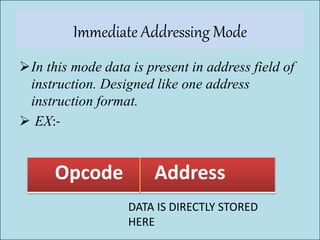
In this mode data is present in address field of
instruction. Designed like one address
instruction format.
 EX:-
Opcode Address
DATA IS DIRECTLY STORED
HERE
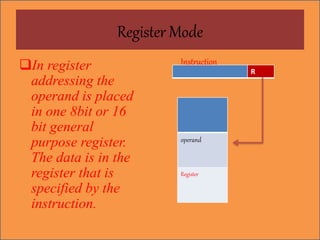
Register Mode
In register
addressing the
operand is placed
in one 8bit or 16
bit general
purpose register.
The data is in the
register that is
specified by the
instruction.
R
operand
Register
Instruction
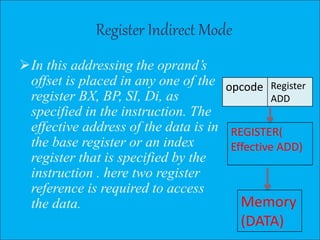
Register Indirect Mode
In this addressing the oprand’s
offset is placed in any one of the
register BX, BP, SI, Di, as
specified in the instruction. The
effective address of the data is in
the base register or an index
register that is specified by the
instruction . here two register
reference is required to access
the data.
opcode Register
ADD
REGISTER(
Effective ADD)
Memory
(DATA)
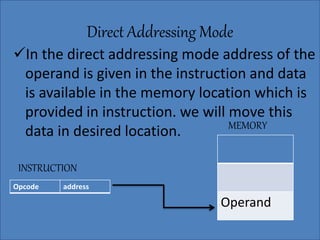
Direct Addressing Mode
In the direct addressing mode address of the
operand is given in the instruction and data
is available in the memory location which is
provided in instruction. we will move this
data in desired location.
Opcode address
Operand
INSTRUCTION
MEMORY
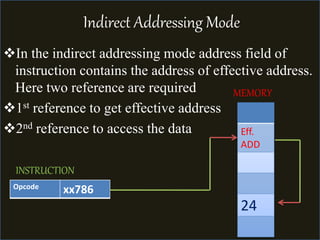
Indirect Addressing Mode
In the indirect addressing mode address field of
instruction contains the address of effective address.
Here two reference are required
1st reference to get effective address
2nd reference to access the data
Opcode
xx786
INSTRUCTION
Eff.
ADD
24
MEMORY
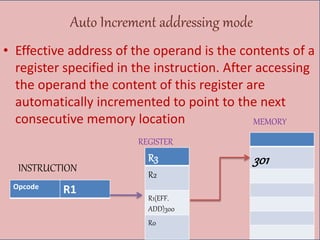
Auto Increment addressing mode
• Effective address of the operand is the contents of a
register specified in the instruction. After accessing
the operand the content of this register are
automatically incremented to point to the next
consecutive memory location
Opcode
R1
R3
R2
R1(EFF.
ADD)300
R0
REGISTER
301
MEMORY
INSTRUCTION
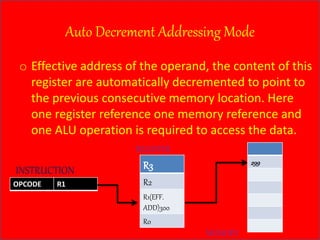
Auto Decrement Addressing Mode
o Effective address of the operand, the content of this
register are automatically decremented to point to
the previous consecutive memory location. Here
one register reference one memory reference and
one ALU operation is required to access the data.
INSTRUCTION
OPCODE R1
REGISTER
R3
R2
R1(EFF.
ADD)300
R0
MEMORY
299
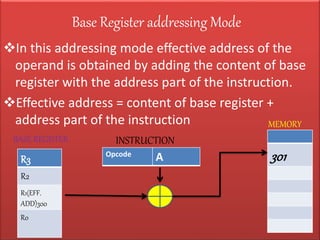
Base Register addressing Mode
In this addressing mode effective address of the
operand is obtained by adding the content of base
register with the address part of the instruction.
Effective address = content of base register +
address part of the instruction
Opcode
A
INSTRUCTION
R3
R2
R1(EFF.
ADD)300
R0
BASE REGISTER
301
MEMORY
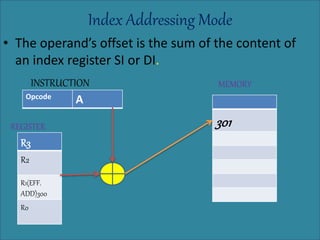
Index Addressing Mode
• The operand’s offset is the sum of the content of
an index register SI or DI.
Opcode
A
301
R3
R2
R1(EFF.
ADD)300
R0
MEMORY
REGISTER
INSTRUCTION
301
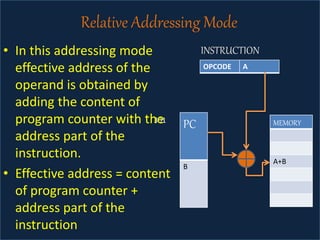
Relative Addressing Mode
• In this addressing mode
effective address of the
operand is obtained by
adding the content of
program counter with the
address part of the
instruction.
• Effective address = content
of program counter +
address part of the
instruction
OPCODE A
INSTRUCTION
PC
B
MEMORY
A+B
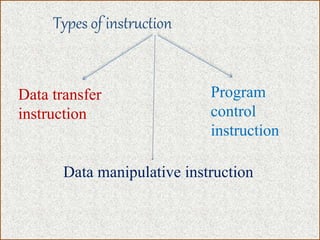
Types of instruction
Data transfer
instruction
Data manipulative instruction
Program
control
instruction
THANK
YOU

Instruction format UJJWAL MATOLIYA.pptx

  • 1.
    ATAL BIHARI VAJPAYEEVISHWAVIDYALAYA DEPARTMENT OF COMPUTER SCIENCE & APPLICALION SUBMITTED BY UJJWAL MATOLIYA
  • 2.
    Instruction Definition 3 bitis used for opcode part. Memory reference instruction uses 12 bit for addressing part. 1 bit for addressing mode. For direct address most significant bit is set to zero and for indirect address MSB is set to one OR An instruction is a single operation of a processor defined by the processor instruction set. Ex :- I opcode operand
  • 3.
    Instruction are categorizedinto different format with respect to the operand fields in the instruction  Zero address instructions  One address instructions  Two address instructions  Three address instructions
  • 4.
    Zero address instructions ITdoes not use any address field in the computational instruction ADD and MUL instruction don’t use any address field of the stack (set of memory location); however, address field is necessary for PUSH and POP instruction
  • 5.
    Ex. X=(A+B)*(C+D) PUSH AM[SP] A PUSH B M[SP] B ADD M[SP] A+B PUSH C M[SP] C PUSH D M[SP] D ADD M[SP] C+D MUL M[SP] (A+B)*(C+D) POP X M[X] M[SP]
  • 6.
    ONE address instructions THE instruction with one address format use only one address field. IT use accumulator (AC) register for all types of data manipulation
  • 7.
    EX. X=(A+B)*(C+D) LOAD A// AC M[A] ADD B // AC AC+M[B] STORE T // M[T] AC LOAD C // AC M[C] ADD D // AC AC+M[D] MUL T // AC AC*M[T]
  • 8.
    Two address instructions THE instructions with two address format uses two address fields.  Each address field can specify a register or a memory location.  example are: ADD, MOV , CMP, BIS etc.
  • 9.
    EX. X=(A+B)*(C+D) MOV R0M[A] MOV R1 M[B] ADD R0 R1 MOV R2 M[C] MOV R3 M[D] ADD R2 R3 MUL R0 R2 STORE M[X] R3
  • 10.
    Three address instructions oTHE instruction with three address format uses three address field. o Each address field can specify a register or a memory location. o A program with arithmetic produces fast and better results.
  • 11.
    EX. X= (A+B)*(C+D) ADDR0 A B ADD R1 C D MUL M[X] R0 R1
  • 12.
    Addressing modes The variousformats for specifying operand are called addressing modes.
  • 13.
    Addressing mode types Immediate/Impliedaddressing mode Register addressing mode Register Indirect Auto Increment / Auto decrement Direct addressing mode Indirect addressing mode Relative addressing mode Index addressing mode Base Register addressing mode
  • 14.
    Immediate Addressing Mode Inthis mode data is present in address field of instruction. Designed like one address instruction format.  EX:- Opcode Address DATA IS DIRECTLY STORED HERE
  • 15.
    Register Mode In register addressingthe operand is placed in one 8bit or 16 bit general purpose register. The data is in the register that is specified by the instruction. R operand Register Instruction
  • 16.
    Register Indirect Mode Inthis addressing the oprand’s offset is placed in any one of the register BX, BP, SI, Di, as specified in the instruction. The effective address of the data is in the base register or an index register that is specified by the instruction . here two register reference is required to access the data. opcode Register ADD REGISTER( Effective ADD) Memory (DATA)
  • 17.
    Direct Addressing Mode Inthe direct addressing mode address of the operand is given in the instruction and data is available in the memory location which is provided in instruction. we will move this data in desired location. Opcode address Operand INSTRUCTION MEMORY
  • 18.
    Indirect Addressing Mode Inthe indirect addressing mode address field of instruction contains the address of effective address. Here two reference are required 1st reference to get effective address 2nd reference to access the data Opcode xx786 INSTRUCTION Eff. ADD 24 MEMORY
  • 19.
    Auto Increment addressingmode • Effective address of the operand is the contents of a register specified in the instruction. After accessing the operand the content of this register are automatically incremented to point to the next consecutive memory location Opcode R1 R3 R2 R1(EFF. ADD)300 R0 REGISTER 301 MEMORY INSTRUCTION
  • 20.
    Auto Decrement AddressingMode o Effective address of the operand, the content of this register are automatically decremented to point to the previous consecutive memory location. Here one register reference one memory reference and one ALU operation is required to access the data. INSTRUCTION OPCODE R1 REGISTER R3 R2 R1(EFF. ADD)300 R0 MEMORY 299
  • 21.
    Base Register addressingMode In this addressing mode effective address of the operand is obtained by adding the content of base register with the address part of the instruction. Effective address = content of base register + address part of the instruction Opcode A INSTRUCTION R3 R2 R1(EFF. ADD)300 R0 BASE REGISTER 301 MEMORY
  • 22.
    Index Addressing Mode •The operand’s offset is the sum of the content of an index register SI or DI. Opcode A 301 R3 R2 R1(EFF. ADD)300 R0 MEMORY REGISTER INSTRUCTION
  • 23.
    301 Relative Addressing Mode •In this addressing mode effective address of the operand is obtained by adding the content of program counter with the address part of the instruction. • Effective address = content of program counter + address part of the instruction OPCODE A INSTRUCTION PC B MEMORY A+B
  • 24.
    Types of instruction Datatransfer instruction Data manipulative instruction Program control instruction
  • 25.