Assembly language Programming
 Low level language.
 Depends on computer architecture.
 Compiler converts high level language into machine language.
 Assembler converts the ALP into machine language.
 Machine language instructions contain only 0’s and 1’s.
 Assembly language contain Mnemonics.
 To study the behavior of particular architecture
Machine Language Assembly Language
B9 04 00 MOV CX,0004
B9 10 00 MOV CX,0010
Instructions
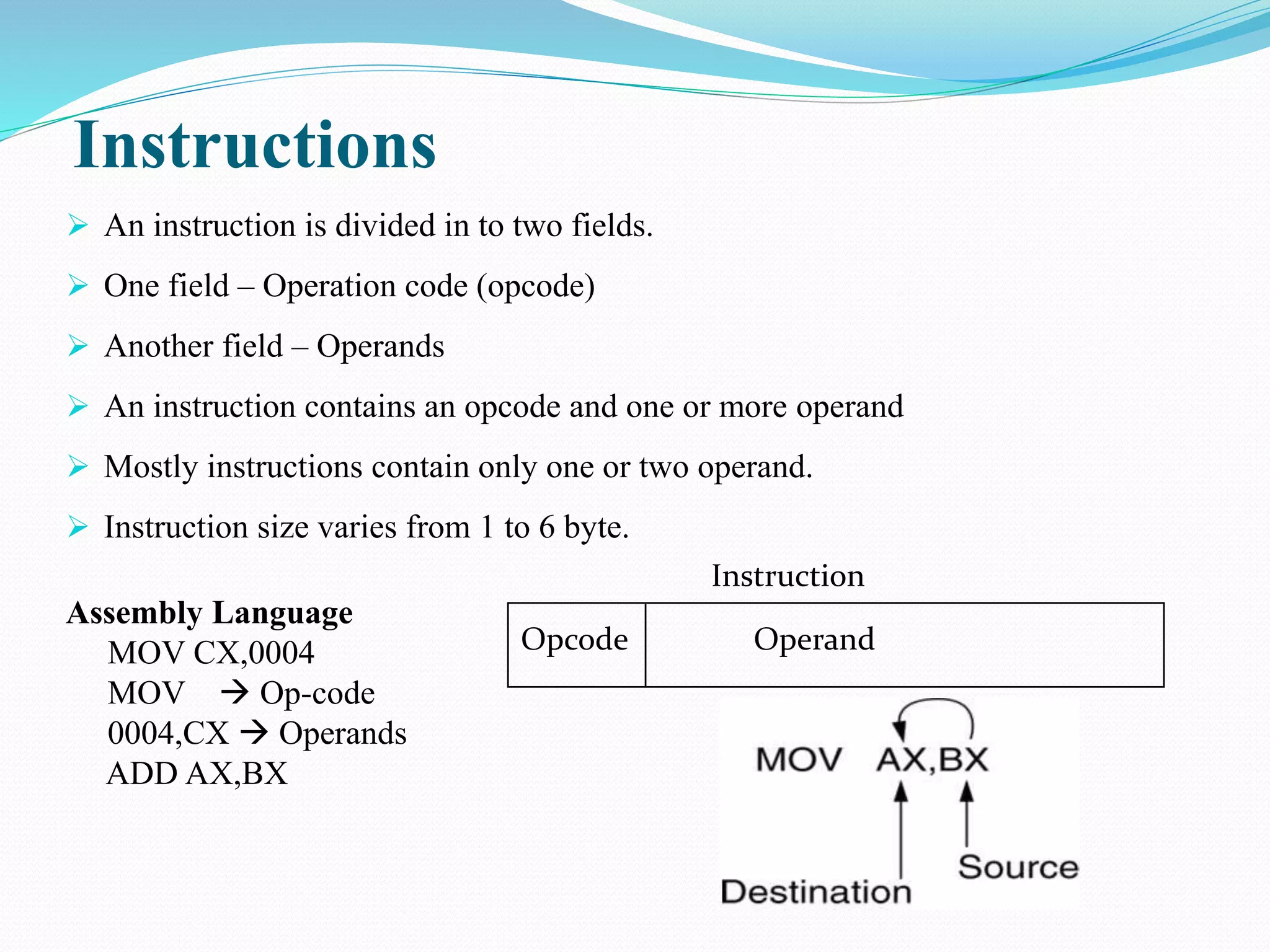
 An instruction is divided in to two fields.
 One field – Operation code (opcode)
 Another field – Operands
 An instruction contains an opcode and one or more operand
 Mostly instructions contain only one or two operand.
 Instruction size varies from 1 to 6 byte.
Assembly Language
MOV CX,0004
MOV  Op-code
0004,CX  Operands
ADD AX,BX
Opcode
Instruction
Operand
Addressing Modes
 The way in which operands are specified
 The operand may be mentioned directly or specified in register/memory.
 7 types of Data Addressing Mode.
Data Addressing Modes
 Immediate
 Direct
 Register
 Register Indirect
 Register Relative
 Based Indexed
 Relative Based Indexed
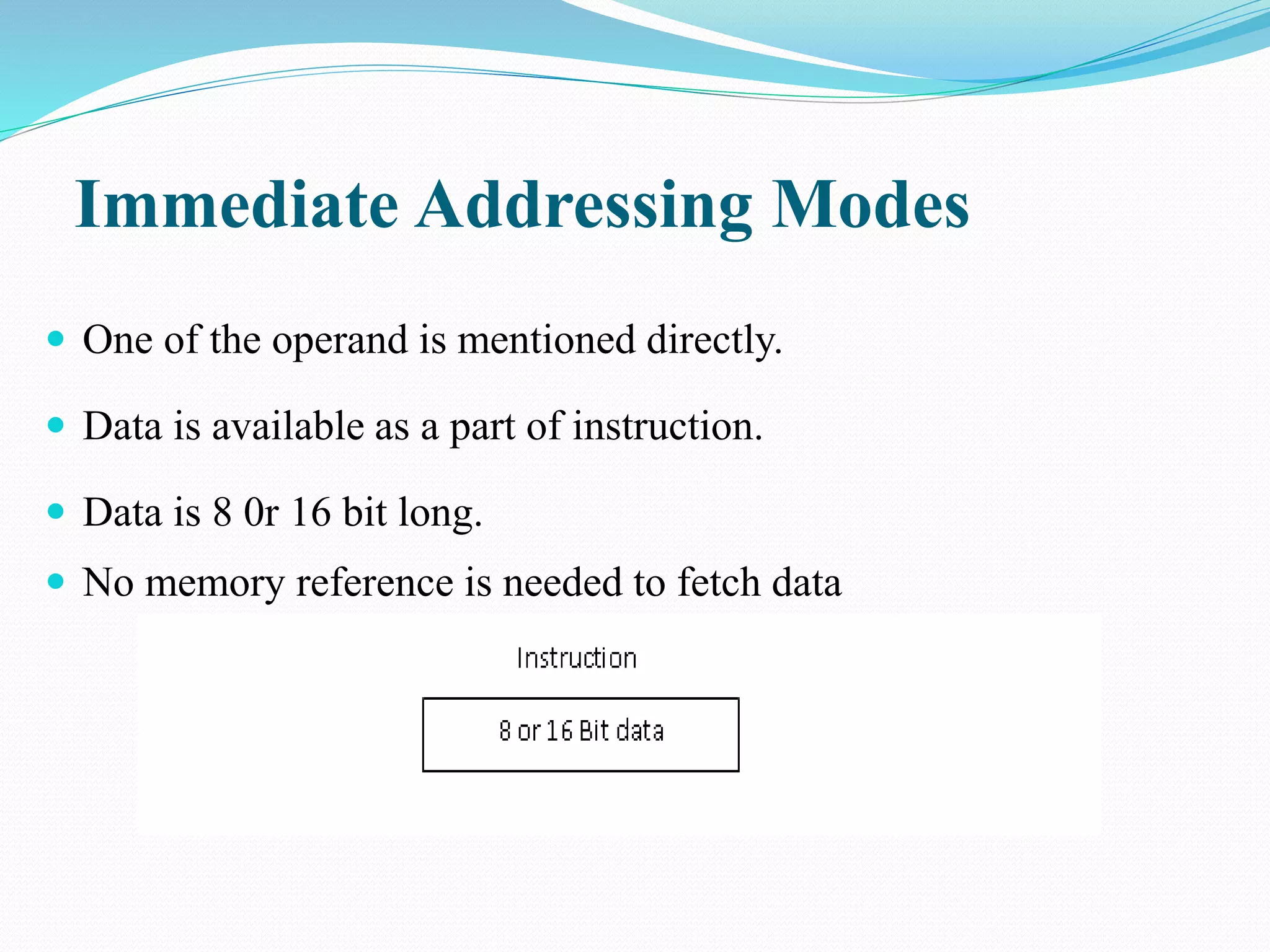
 One of the operand is mentioned directly.
 Data is available as a part of instruction.
 Data is 8 0r 16 bit long.
 No memory reference is needed to fetch data
Immediate Addressing Modes
Immediate Mode :Eg.
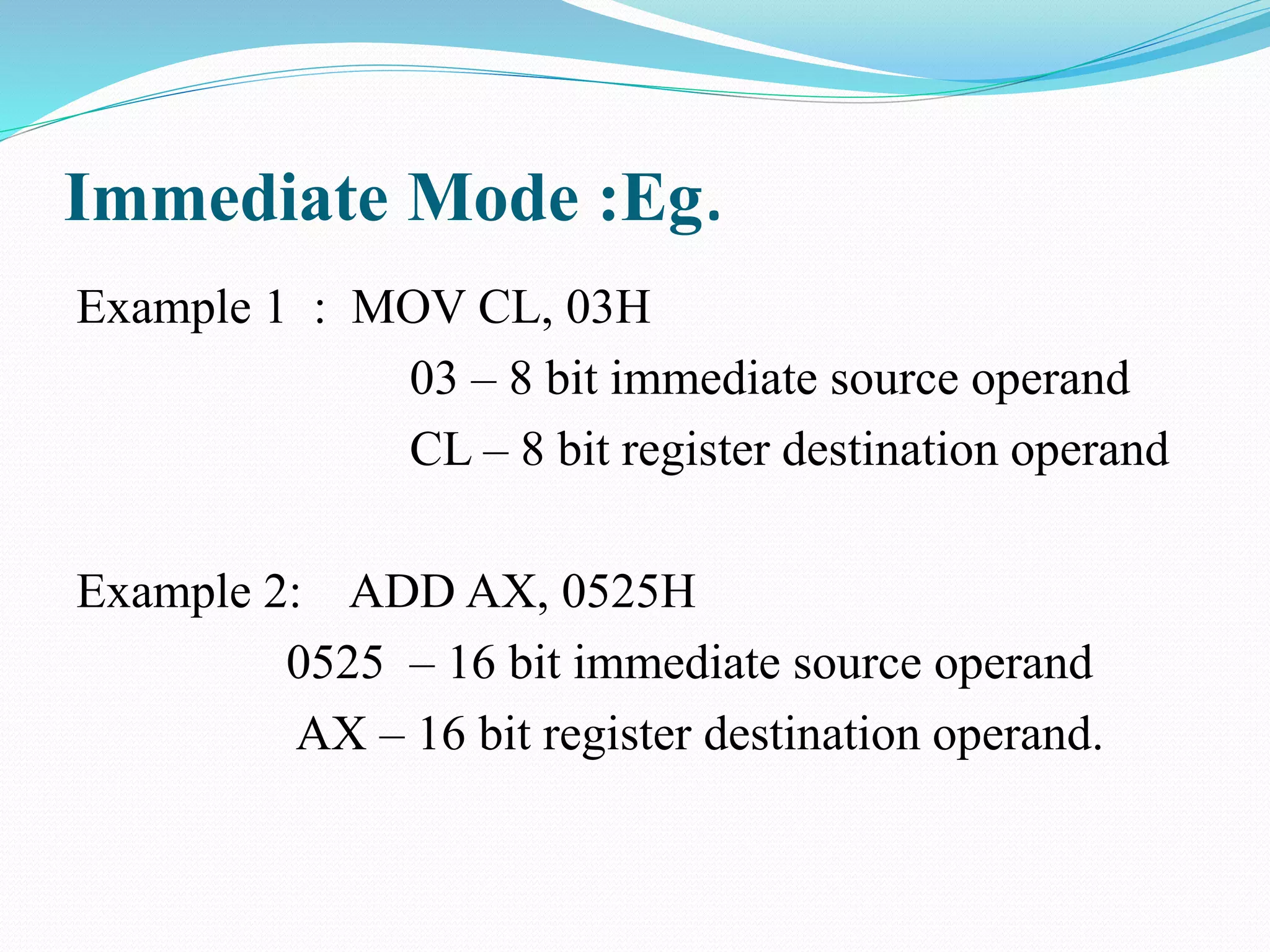
Example 1 : MOV CL, 03H
03 – 8 bit immediate source operand
CL – 8 bit register destination operand
Example 2: ADD AX, 0525H
0525 – 16 bit immediate source operand
AX – 16 bit register destination operand.
Register Addressing Mode
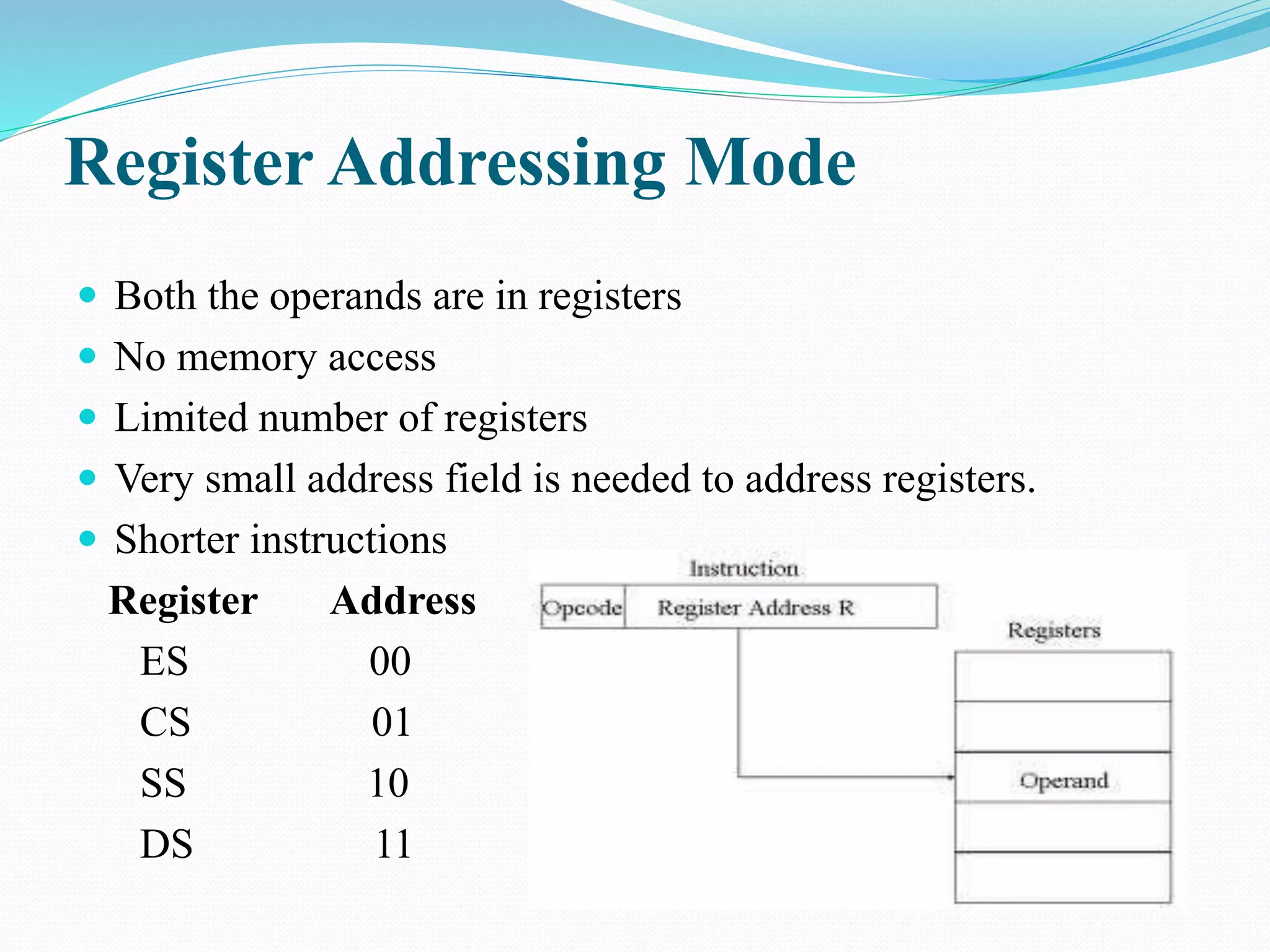
 Both the operands are in registers
 No memory access
 Limited number of registers
 Very small address field is needed to address registers.
 Shorter instructions
Register Address
ES 00
CS 01
SS 10
DS 11
Example
Examples : 16 bit register instruction
MOV AX,BX
ADD AX,DI
8 bit register instructions
MOV CL,DL
ADD AL,CL
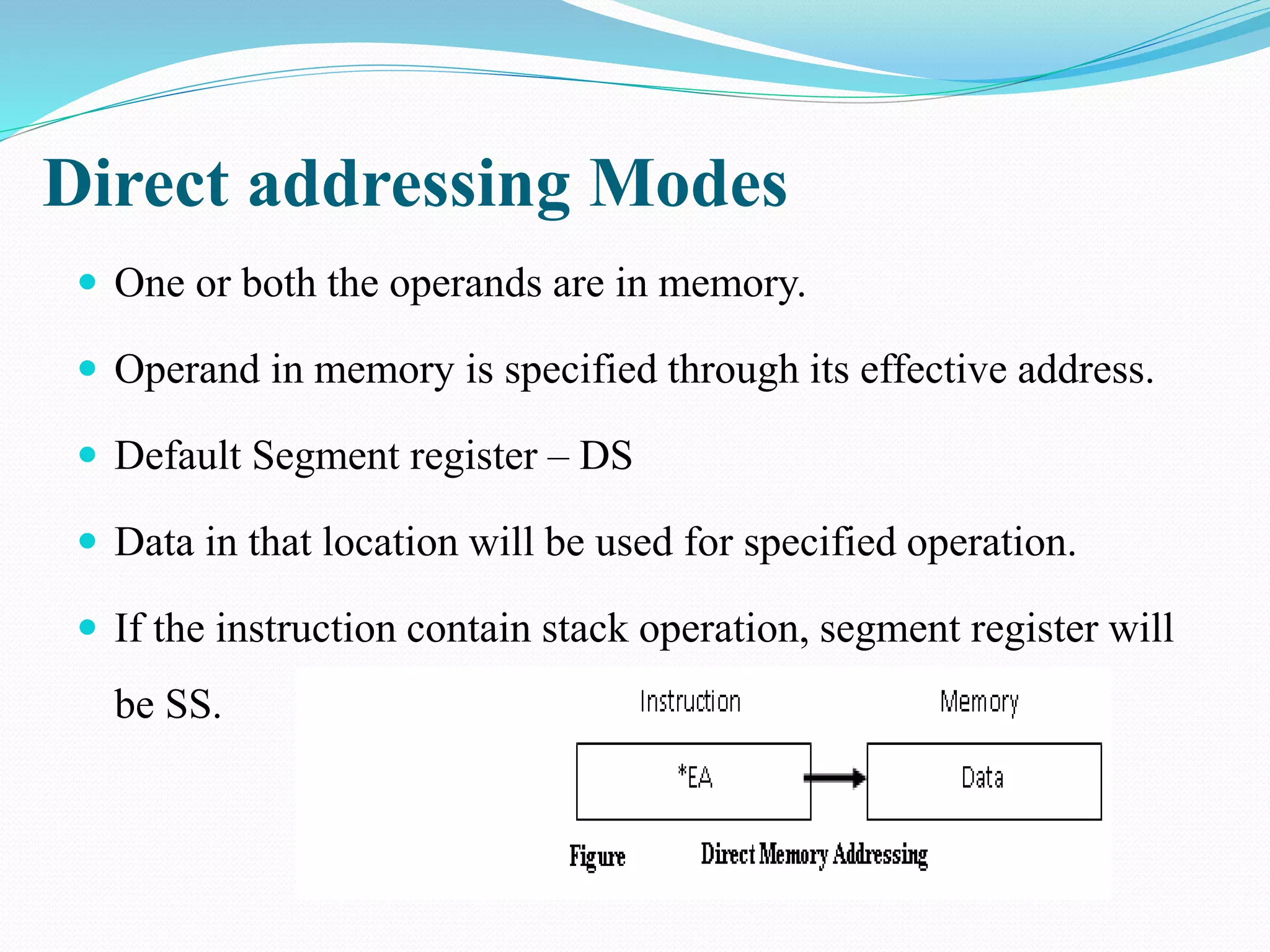
Direct addressing Modes
 One or both the operands are in memory.
 Operand in memory is specified through its effective address.
 Default Segment register – DS
 Data in that location will be used for specified operation.
 If the instruction contain stack operation, segment register will
be SS.
Example
MOV CX, [0400]
[DS] = 3050
PA : 30500+0400 = 30540.
[30540]  CL
[30541] CH
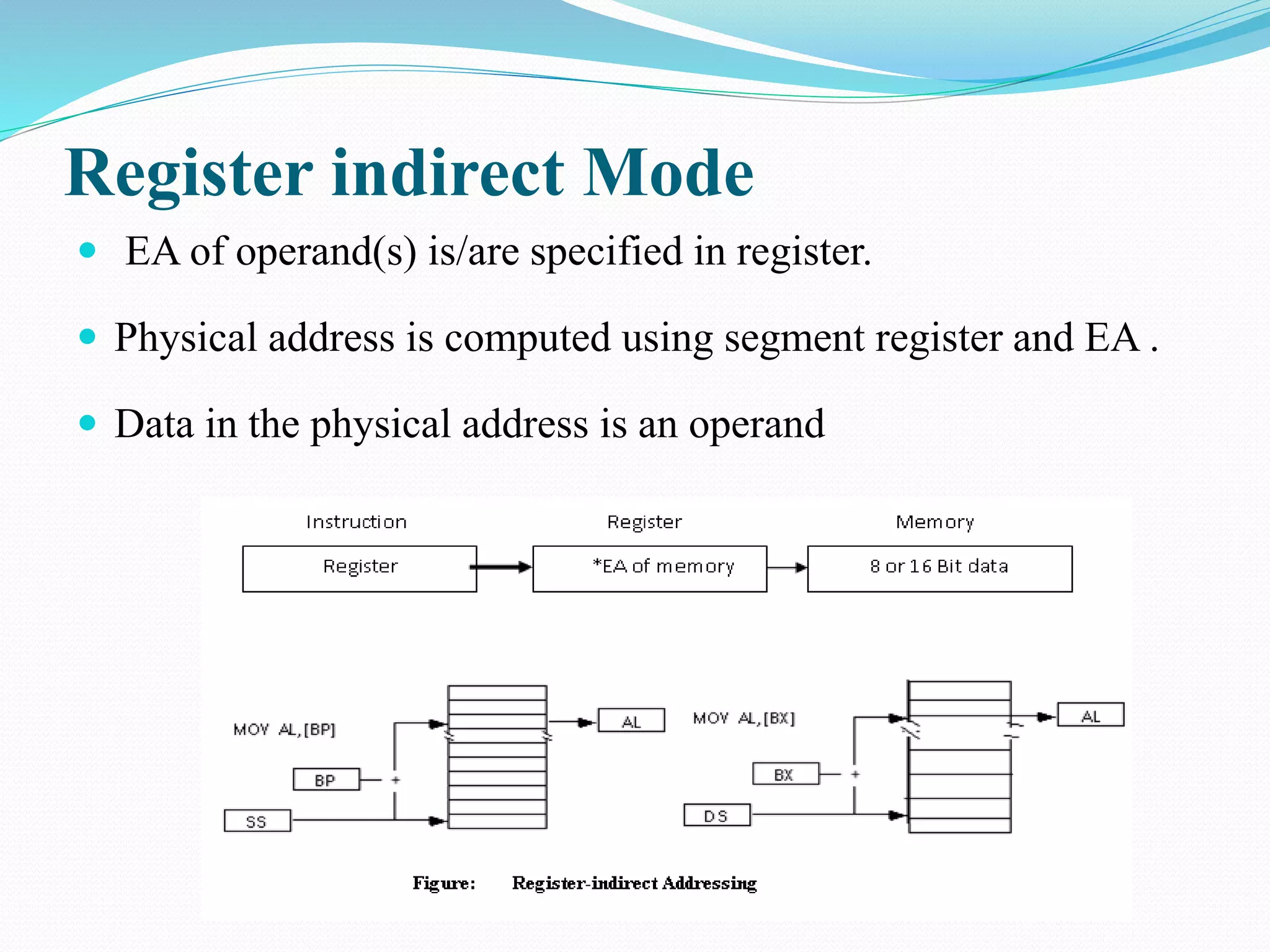
Register indirect Mode
 EA of operand(s) is/are specified in register.
 Physical address is computed using segment register and EA .
 Data in the physical address is an operand
Example
 Example 1 : MOV AX, [BX]
[DS] = 5004, [BX] = 0020, PA=50060.
50060 contain 0015H
0015H is moved to memory AX
 Example 2: MOV [BX],[AX]
Source and destination address is calculated by AX and BX content
respectively .
Then content of source address is moved to destination address
Register Relative
 Effective address = [ Base/pointer register] + 8 or 16 bit
displacement
 Base/Pointer register : BX or BP or SI or DI
Example
 MOV AX, 10[BP]
 [BP] = 0105 , [DS] = 2020
 P.A = 20200 + 0105 + 10 = 20315
 Content of memory address 20315 is moved to AX
Based Indexed MODE
 Effective address = [Base register] + [Index register]
 Base register  BX or BP
 Index register  SI or DI
Example
 MOV AX,[BX][SI]
[BX] = 1500 [SI] = 0020 [DS] = 2020
P.A of source : 20200 + 1500 + 0020 = 21720
Content of 21720 is moved to AX
Relative Based Indexed
 Effective address = [Base register] + [Index register]
+ 8 or 16 bit displacement
Example
1. MOV CX,1010[BX][SI]
[BX] = 102B [SI] = 0003 [DS] = 2020
PA = 20200 + 102B + 0008 + 1010 = 2223E
Content of memory address 2223E is moved to CX
2.MOV 1010[BX][SI], CX
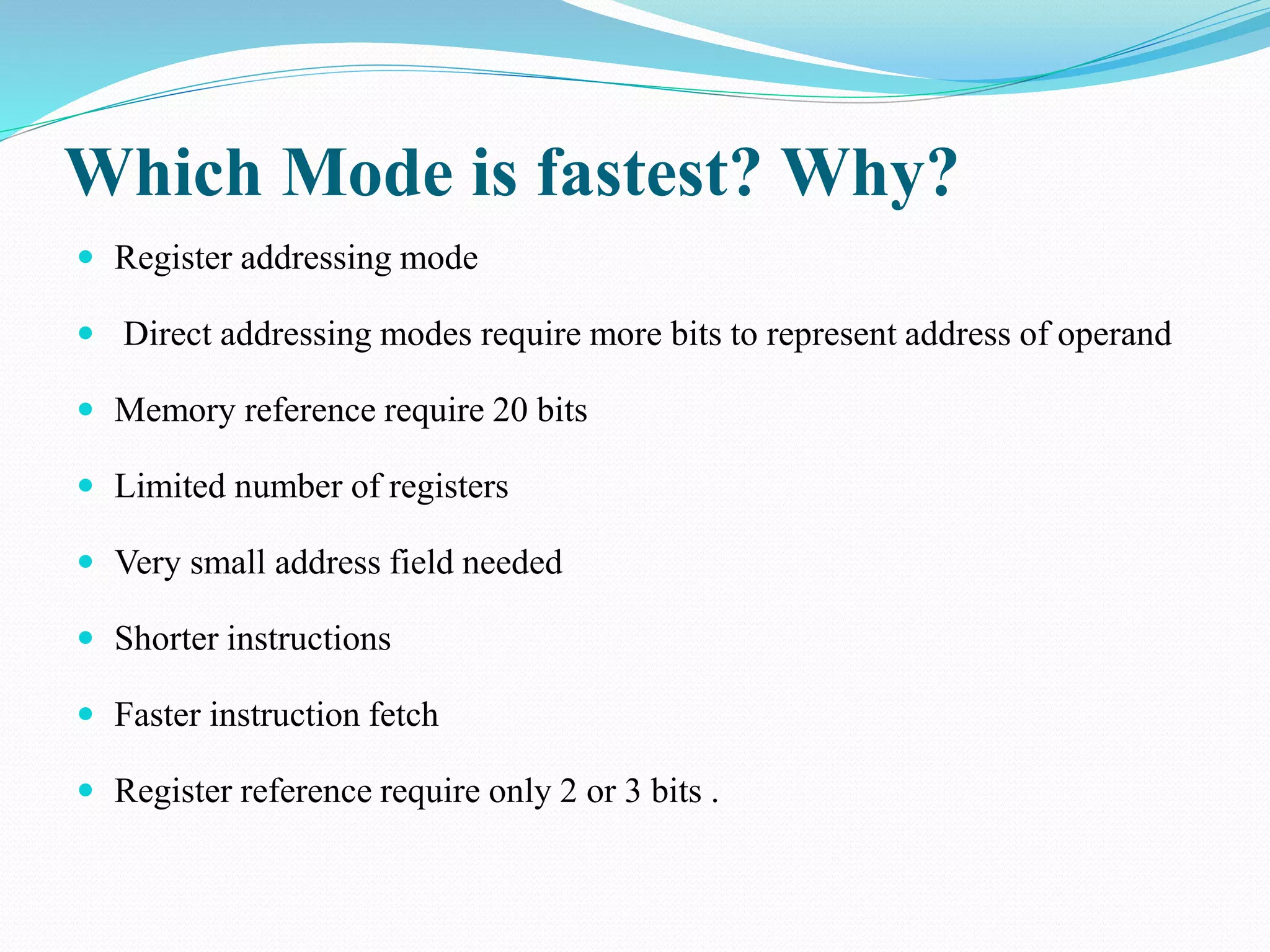
Which Mode is fastest? Why?
 Register addressing mode
 Direct addressing modes require more bits to represent address of operand
 Memory reference require 20 bits
 Limited number of registers
 Very small address field needed
 Shorter instructions
 Faster instruction fetch
 Register reference require only 2 or 3 bits .
Problem
Given that
[BP] = 5000 [SI] = 0005 [DI]=0100 [DS] = 1000
[6000] = 520A [6005] = 5402 [6100] = 0003 [6015]=065B
[6110] = 003E
[5000] = 5505 [5100] = FB05 [5005] = 060B
After the following instructions are executed, What will be the value
of registers AX,BX,CX,DX ? DS is a segment register for all instructions.
MOV AX,[BP]
MOV DX, [5100]
MOV BX,5[BP]
MOV CX,[BP][DI]
ALP Program
MOV AX,4343
MOV BX,1111
ADD AX,BX
MOV [2000H],AX
HLT
Note:
HLT – Halt the process.
Indicate end of the program
ALP for different addressing modes
 Immediate mode
MOV AX, 200
ADD AX,300
MOV [2000],AX
HLT
 Register mode
MOV BX,500
MOV AX,200
ADD AX,BX
MOV [5000],AX
HLT
 Direct mode
MOV AX,[5000]
ADD AX,[5002]
MOV AX,[5004]
HLT
 Register indirect mode
MOV BX,5000
MOV DX, 5002
ADD [DX],[BX]
MOV [5004],AX
HLT
Register Relative mode
MOV BX,4990
MOV AX,300
ADD AX,10[BX]
MOV [5002],AX
HLT
Based indexed mode
MOV AX,300
MOV BX,5000
MOV SI,5
ADD AX,[BX][SI]
MOV [5002],AX
HLT
 Relative Based indexed
MOV BX,5000
MOV SI,5
MOV CX,5[BX][SI]
MOV AX,300
ADD AX,CX
MOV [5012],AX
HLT
Steps
 Menu display – A,D,F,I,M,P,T,U
 Enter A - Assembly
 Enter program
 Menu display – D input location
 Input data in memory
 Execute using Go command
 Menu display – D output location

Addressing modes

  • 2.
    Assembly language Programming Low level language.  Depends on computer architecture.  Compiler converts high level language into machine language.  Assembler converts the ALP into machine language.  Machine language instructions contain only 0’s and 1’s.  Assembly language contain Mnemonics.  To study the behavior of particular architecture Machine Language Assembly Language B9 04 00 MOV CX,0004 B9 10 00 MOV CX,0010
  • 3.
    Instructions  An instructionis divided in to two fields.  One field – Operation code (opcode)  Another field – Operands  An instruction contains an opcode and one or more operand  Mostly instructions contain only one or two operand.  Instruction size varies from 1 to 6 byte. Assembly Language MOV CX,0004 MOV  Op-code 0004,CX  Operands ADD AX,BX Opcode Instruction Operand
  • 4.
    Addressing Modes  Theway in which operands are specified  The operand may be mentioned directly or specified in register/memory.  7 types of Data Addressing Mode.
  • 5.
    Data Addressing Modes Immediate  Direct  Register  Register Indirect  Register Relative  Based Indexed  Relative Based Indexed
  • 6.
     One ofthe operand is mentioned directly.  Data is available as a part of instruction.  Data is 8 0r 16 bit long.  No memory reference is needed to fetch data Immediate Addressing Modes
  • 7.
    Immediate Mode :Eg. Example1 : MOV CL, 03H 03 – 8 bit immediate source operand CL – 8 bit register destination operand Example 2: ADD AX, 0525H 0525 – 16 bit immediate source operand AX – 16 bit register destination operand.
  • 8.
    Register Addressing Mode Both the operands are in registers  No memory access  Limited number of registers  Very small address field is needed to address registers.  Shorter instructions Register Address ES 00 CS 01 SS 10 DS 11
  • 9.
    Example Examples : 16bit register instruction MOV AX,BX ADD AX,DI 8 bit register instructions MOV CL,DL ADD AL,CL
  • 10.
    Direct addressing Modes One or both the operands are in memory.  Operand in memory is specified through its effective address.  Default Segment register – DS  Data in that location will be used for specified operation.  If the instruction contain stack operation, segment register will be SS.
  • 11.
    Example MOV CX, [0400] [DS]= 3050 PA : 30500+0400 = 30540. [30540]  CL [30541] CH
  • 12.
    Register indirect Mode EA of operand(s) is/are specified in register.  Physical address is computed using segment register and EA .  Data in the physical address is an operand
  • 13.
    Example  Example 1: MOV AX, [BX] [DS] = 5004, [BX] = 0020, PA=50060. 50060 contain 0015H 0015H is moved to memory AX  Example 2: MOV [BX],[AX] Source and destination address is calculated by AX and BX content respectively . Then content of source address is moved to destination address
  • 14.
    Register Relative  Effectiveaddress = [ Base/pointer register] + 8 or 16 bit displacement  Base/Pointer register : BX or BP or SI or DI
  • 15.
    Example  MOV AX,10[BP]  [BP] = 0105 , [DS] = 2020  P.A = 20200 + 0105 + 10 = 20315  Content of memory address 20315 is moved to AX
  • 16.
    Based Indexed MODE Effective address = [Base register] + [Index register]  Base register  BX or BP  Index register  SI or DI
  • 17.
    Example  MOV AX,[BX][SI] [BX]= 1500 [SI] = 0020 [DS] = 2020 P.A of source : 20200 + 1500 + 0020 = 21720 Content of 21720 is moved to AX
  • 18.
    Relative Based Indexed Effective address = [Base register] + [Index register] + 8 or 16 bit displacement
  • 19.
    Example 1. MOV CX,1010[BX][SI] [BX]= 102B [SI] = 0003 [DS] = 2020 PA = 20200 + 102B + 0008 + 1010 = 2223E Content of memory address 2223E is moved to CX 2.MOV 1010[BX][SI], CX
  • 20.
    Which Mode isfastest? Why?  Register addressing mode  Direct addressing modes require more bits to represent address of operand  Memory reference require 20 bits  Limited number of registers  Very small address field needed  Shorter instructions  Faster instruction fetch  Register reference require only 2 or 3 bits .
  • 21.
    Problem Given that [BP] =5000 [SI] = 0005 [DI]=0100 [DS] = 1000 [6000] = 520A [6005] = 5402 [6100] = 0003 [6015]=065B [6110] = 003E [5000] = 5505 [5100] = FB05 [5005] = 060B After the following instructions are executed, What will be the value of registers AX,BX,CX,DX ? DS is a segment register for all instructions. MOV AX,[BP] MOV DX, [5100] MOV BX,5[BP] MOV CX,[BP][DI]
  • 22.
    ALP Program MOV AX,4343 MOVBX,1111 ADD AX,BX MOV [2000H],AX HLT Note: HLT – Halt the process. Indicate end of the program
  • 23.
    ALP for differentaddressing modes  Immediate mode MOV AX, 200 ADD AX,300 MOV [2000],AX HLT  Register mode MOV BX,500 MOV AX,200 ADD AX,BX MOV [5000],AX HLT
  • 24.
     Direct mode MOVAX,[5000] ADD AX,[5002] MOV AX,[5004] HLT  Register indirect mode MOV BX,5000 MOV DX, 5002 ADD [DX],[BX] MOV [5004],AX HLT
  • 25.
    Register Relative mode MOVBX,4990 MOV AX,300 ADD AX,10[BX] MOV [5002],AX HLT Based indexed mode MOV AX,300 MOV BX,5000 MOV SI,5 ADD AX,[BX][SI] MOV [5002],AX HLT
  • 26.
     Relative Basedindexed MOV BX,5000 MOV SI,5 MOV CX,5[BX][SI] MOV AX,300 ADD AX,CX MOV [5012],AX HLT
  • 27.
    Steps  Menu display– A,D,F,I,M,P,T,U  Enter A - Assembly  Enter program  Menu display – D input location  Input data in memory  Execute using Go command  Menu display – D output location