WHAT IS BUG/DEFECT?
Bug can be defined as the abnormal behavior of the
software. A bug /defect is a specific concern about the
quality of the Software. The elimination of bugs from
the software depends upon the efficiency of testing
done on the software.
BUG LIFE CYCLE
• In software development process , the bug has a
life cycle . The bug should go through the life
cycle to be closed. A specific life cycle ensures
that the process is standardized. The bug execute
different states in life Cycle..
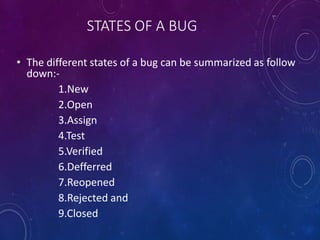
STATES OF A BUG
• The different states of a bug can be summarized as follow
down:-
1.New
2.Open
3.Assign
4.Test
5.Verified
6.Defferred
7.Reopened
8.Rejected and
9.Closed
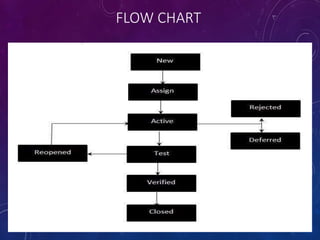
FLOW CHART
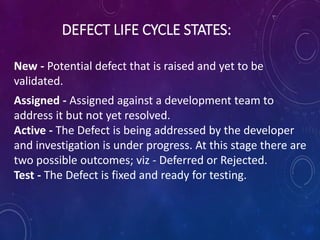
DEFECT LIFE CYCLE STATES:
New - Potential defect that is raised and yet to be
validated.
Assigned - Assigned against a development team to
address it but not yet resolved.
Active - The Defect is being addressed by the developer
and investigation is under progress. At this stage there are
two possible outcomes; viz - Deferred or Rejected.
Test - The Defect is fixed and ready for testing.
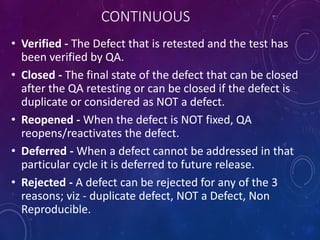
CONTINUOUS
• Verified - The Defect that is retested and the test has
been verified by QA.
• Closed - The final state of the defect that can be closed
after the QA retesting or can be closed if the defect is
duplicate or considered as NOT a defect.
• Reopened - When the defect is NOT fixed, QA
reopens/reactivates the defect.
• Deferred - When a defect cannot be addressed in that
particular cycle it is deferred to future release.
• Rejected - A defect can be rejected for any of the 3
reasons; viz - duplicate defect, NOT a Defect, Non
Reproducible.
BUG REPORTING
• Testers report bugs to programmers
• Problem Report forms are commonly used
• If the report is not clear and understandable, the bug will
not get fixed
• To write a fully effective report you must:
• Explain how to reproduce the problem
• Analyze the error so that it can be described with a minimum
number of steps
• Write a report that is complete, easy to understand.

Presentation On Software Testing Bug Life Cycle

  • 2.
    WHAT IS BUG/DEFECT? Bugcan be defined as the abnormal behavior of the software. A bug /defect is a specific concern about the quality of the Software. The elimination of bugs from the software depends upon the efficiency of testing done on the software.
  • 3.
    BUG LIFE CYCLE •In software development process , the bug has a life cycle . The bug should go through the life cycle to be closed. A specific life cycle ensures that the process is standardized. The bug execute different states in life Cycle..
  • 4.
    STATES OF ABUG • The different states of a bug can be summarized as follow down:- 1.New 2.Open 3.Assign 4.Test 5.Verified 6.Defferred 7.Reopened 8.Rejected and 9.Closed
  • 5.
  • 6.
    DEFECT LIFE CYCLESTATES: New - Potential defect that is raised and yet to be validated. Assigned - Assigned against a development team to address it but not yet resolved. Active - The Defect is being addressed by the developer and investigation is under progress. At this stage there are two possible outcomes; viz - Deferred or Rejected. Test - The Defect is fixed and ready for testing.
  • 7.
    CONTINUOUS • Verified -The Defect that is retested and the test has been verified by QA. • Closed - The final state of the defect that can be closed after the QA retesting or can be closed if the defect is duplicate or considered as NOT a defect. • Reopened - When the defect is NOT fixed, QA reopens/reactivates the defect. • Deferred - When a defect cannot be addressed in that particular cycle it is deferred to future release. • Rejected - A defect can be rejected for any of the 3 reasons; viz - duplicate defect, NOT a Defect, Non Reproducible.
  • 8.
    BUG REPORTING • Testersreport bugs to programmers • Problem Report forms are commonly used • If the report is not clear and understandable, the bug will not get fixed • To write a fully effective report you must: • Explain how to reproduce the problem • Analyze the error so that it can be described with a minimum number of steps • Write a report that is complete, easy to understand.