Instruction formats By Bhawna
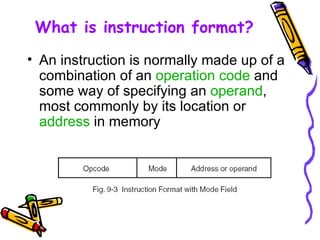
What is instruction format? An instruction is normally made up of a combination of an  operation code  and some way of specifying an  operand , most commonly by its location or  address  in memory
Types of address instructions   Three address instructions Memory addresses for the two operands and one destination need to be specified. It is also called  General register organization . Instruction: ADD R1, R2, R3 Microoperation: R1    R2 + R3
EVALUATE X=(A+B)*(C+D) ADD  R1, A, B  R1    M[A]+M[B] ADD  R2, C, D  R2    M[C]+M[D] MUL  X, R1, R2  M[X]    R1*R2
Two address instructions Two address registers or two memory locations are specified Assumes that the destination address is the same as that of the first operand . Instruction: ADD R1, R2 Microoperation: R1    R1 + R2
EVALUATE X=(A+B)*(C+D) MOV  R1, A  R1    M[A] ADD  R1, B  R1    R1+M[B] MOV  R2, C  R2    M[C] ADD  R2, D  R2    R2+M[D] MUL  R1,R2  R1    R1*R2 MOV  X,R1  M[X]    R1
One address instructions One address can be a register name or memory address. SINGLE ACCUMULATOR ORGANIZATION It uses AC register for all data manipulation Instruction: ADD X Microoperation: AC   AC + M[X]
EVALUATE X=(A+B)*(C+D) LOAD  A  AC    M[A] ADD  B  AC    AC+M[B] STORE  T  M[T]    AC LOAD  C  AC    M[C] ADD  D  AC    AC+M[D] MUL  T  AC    AC*M[T] STORE  X  M[X]    AC
Zero address instruction Stack is used. Arithmetic operation pops two operands from the stack and pushes the result.  Also called  stack organization
Zero address instruction Evaluate  X = ( A +B ) * ( C +D ) PUSH A  TOS   A PUSH B  TOS   B ADD  TOS   (A+B) PUSH C  TOS    C PUSH D  TOS    D ADD  TOS    (C+D)  MUL  TOS   (C+D)*(A+B) POP   X  M[X]   TOS Store Mult ADD Push D Push C ADD Push B Push A
Addressing Modes Addressing mode specifies a rule for  interpreting or modifying  the  address field  of the instruction before the operand is actually executed.
Well known addressing modes- Implied mode Immediate mode Register mode Register indirect mode Autoincrement or Autodecrement Direct address mode Indirect address mode Relative address mode Indexed addressing mode Base register addressing mode
Implied Mode   In this mode the operands are specified implicitly in the definition of the instruction.   All register reference instructions that use an accumulator are implied mode instruction.  Example: CMA compliment accumulator.
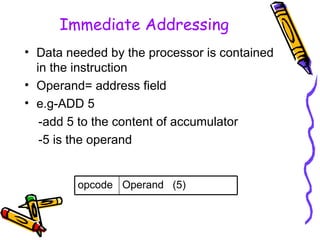
Immediate Addressing Data needed by the processor is contained in the instruction Operand= address field e.g-ADD 5 -add 5 to the content of accumulator -5 is the operand Operand  (5) opcode
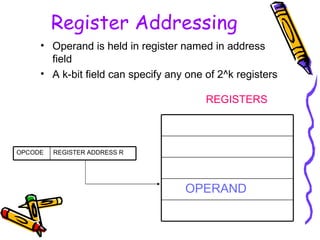
Register Addressing Operand is held in register named in address field A k-bit field can specify any one of 2^k registers REGISTERS REGISTER ADDRESS R OPCODE OPERAND
Register Indirect Addressing The selected register contains the address of the operand rather than the operand itself. REGISTERS Memory R 500 REGISTER ADDRESS R OPCODE ADDRESS OF OPERAND(500) OPERAND(72)
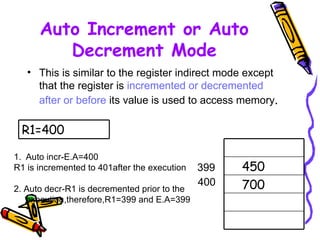
Auto Increment or Auto Decrement Mode This is similar to the register indirect mode except that the register is  incremented or decremented   after or before  its value is used to access memory .  399 400 Auto incr-E.A=400 R1 is incremented to 401after the execution 2. Auto decr-R1 is decremented prior to the execution,therefore,R1=399 and E.A=399 R1=400 700 450
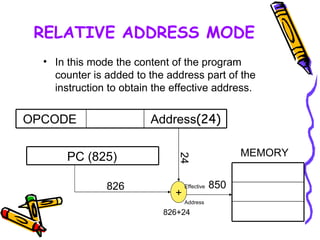
RELATIVE ADDRESS MODE In this mode the content of the program counter is added to the address part of the instruction to obtain the effective address. + Address Effective MEMORY 826 24 8226 826+24 850 Address (24) OPCODE PC (825)
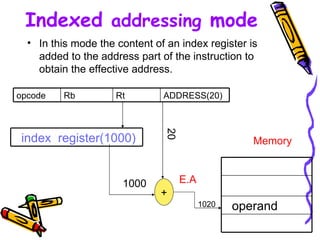
Indexed  addressing  mode In this mode the content of an index register is added to the address part of the instruction to obtain the effective address. + 1020 E.A 1000 20 Memory Rt Rb ADDRESS(20) opcode index  register(1000) operand
BASE REGISTER ADDRESSING MODE In this mode the content of a base register is added to the address part of the instruction to obtain the effective address. Memory + 400 100 E.A 500 Rt Rb ADDRESS opcode REGISTER(400) 42

Instruction format

  • 1.
  • 2.
    What is instructionformat? An instruction is normally made up of a combination of an operation code and some way of specifying an operand , most commonly by its location or address in memory
  • 3.
    Types of addressinstructions Three address instructions Memory addresses for the two operands and one destination need to be specified. It is also called General register organization . Instruction: ADD R1, R2, R3 Microoperation: R1  R2 + R3
  • 4.
    EVALUATE X=(A+B)*(C+D) ADD R1, A, B R1  M[A]+M[B] ADD R2, C, D R2  M[C]+M[D] MUL X, R1, R2 M[X]  R1*R2
  • 5.
    Two address instructionsTwo address registers or two memory locations are specified Assumes that the destination address is the same as that of the first operand . Instruction: ADD R1, R2 Microoperation: R1  R1 + R2
  • 6.
    EVALUATE X=(A+B)*(C+D) MOV R1, A R1  M[A] ADD R1, B R1  R1+M[B] MOV R2, C R2  M[C] ADD R2, D R2  R2+M[D] MUL R1,R2 R1  R1*R2 MOV X,R1 M[X]  R1
  • 7.
    One address instructionsOne address can be a register name or memory address. SINGLE ACCUMULATOR ORGANIZATION It uses AC register for all data manipulation Instruction: ADD X Microoperation: AC  AC + M[X]
  • 8.
    EVALUATE X=(A+B)*(C+D) LOAD A AC  M[A] ADD B AC  AC+M[B] STORE T M[T]  AC LOAD C AC  M[C] ADD D AC  AC+M[D] MUL T AC  AC*M[T] STORE X M[X]  AC
  • 9.
    Zero address instructionStack is used. Arithmetic operation pops two operands from the stack and pushes the result. Also called stack organization
  • 10.
    Zero address instructionEvaluate X = ( A +B ) * ( C +D ) PUSH A TOS  A PUSH B TOS  B ADD TOS  (A+B) PUSH C TOS   C PUSH D TOS   D ADD TOS   (C+D) MUL TOS  (C+D)*(A+B) POP X M[X]  TOS Store Mult ADD Push D Push C ADD Push B Push A
  • 11.
    Addressing Modes Addressingmode specifies a rule for interpreting or modifying the address field of the instruction before the operand is actually executed.
  • 12.
    Well known addressingmodes- Implied mode Immediate mode Register mode Register indirect mode Autoincrement or Autodecrement Direct address mode Indirect address mode Relative address mode Indexed addressing mode Base register addressing mode
  • 13.
    Implied Mode In this mode the operands are specified implicitly in the definition of the instruction. All register reference instructions that use an accumulator are implied mode instruction. Example: CMA compliment accumulator.
  • 14.
    Immediate Addressing Dataneeded by the processor is contained in the instruction Operand= address field e.g-ADD 5 -add 5 to the content of accumulator -5 is the operand Operand (5) opcode
  • 15.
    Register Addressing Operandis held in register named in address field A k-bit field can specify any one of 2^k registers REGISTERS REGISTER ADDRESS R OPCODE OPERAND
  • 16.
    Register Indirect AddressingThe selected register contains the address of the operand rather than the operand itself. REGISTERS Memory R 500 REGISTER ADDRESS R OPCODE ADDRESS OF OPERAND(500) OPERAND(72)
  • 17.
    Auto Increment orAuto Decrement Mode This is similar to the register indirect mode except that the register is incremented or decremented after or before its value is used to access memory . 399 400 Auto incr-E.A=400 R1 is incremented to 401after the execution 2. Auto decr-R1 is decremented prior to the execution,therefore,R1=399 and E.A=399 R1=400 700 450
  • 18.
    RELATIVE ADDRESS MODEIn this mode the content of the program counter is added to the address part of the instruction to obtain the effective address. + Address Effective MEMORY 826 24 8226 826+24 850 Address (24) OPCODE PC (825)
  • 19.
    Indexed addressing mode In this mode the content of an index register is added to the address part of the instruction to obtain the effective address. + 1020 E.A 1000 20 Memory Rt Rb ADDRESS(20) opcode index register(1000) operand
  • 20.
    BASE REGISTER ADDRESSINGMODE In this mode the content of a base register is added to the address part of the instruction to obtain the effective address. Memory + 400 100 E.A 500 Rt Rb ADDRESS opcode REGISTER(400) 42