Assignment on
Different types of Addressing Modes
Course Title: Computer Architecture & Organization
Course Code: CSE 322
Submitted By:
Umme Habiba
ID: 142-15-3677
Section: B
Submitted To
Rubaiya Hafiz
Lecturer
Department of Computer
Science & Engineering
Addressing modes:
Addressing modes are nothing but the different ways in which the
location of an operand can be specified in an instruction. The number of
addressing modes that a processor supports changes according to the
instruction set it is based on, however there are a few generic ones that
are present in almost all processors and are thus of utmost importance.
They are as follows:
• register (or register-direct) addressing: R1
• register indirect addressing: M[R1]
• immediate addressing: data
• direct (or absolute) addressing: M[address]
• indirect addressing: M[M[address]]
• implicit addressing: default location
• relative & indexed addressing: M[R1+address]
• pre-decrement, post-decrement, pre-increment, ...
Register(or register-direct)Addressing:
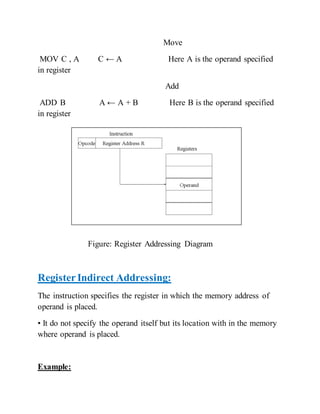
• The operand is specified with in one of the processor register.
• Instruction specifies the register in which the operand is stored.
Example:
Move
MOV C , A C ← A Here A is the operand specified
in register
Add
ADD B A ← A + B Here B is the operand specified
in register
Figure: Register Addressing Diagram
RegisterIndirect Addressing:
The instruction specifies the register in which the memory address of
operand is placed.
• It do not specify the operand itself but its location with in the memory
where operand is placed.
Example:
Move
MOV A , M A ← [[H][L]]
It moves the data from memory location specified by HL register pair to
A
Figure: Register Indirect Addressing Diagram
Immediate Addressing:
The operand is specified with in the instruction.
• Operand itself is provided in the instruction rather than its address.
Example:
Move Immediate
MVI A , 15h A ← 15h
Here 15h is the immediate operand
Add Immediate
ADI 3Eh A ← A + 3Eh
Here 3Eh is the immediate operand
Figure: Immediate Addressing Diagram
Direct (or absolute)addressing:
• The instruction specifies the direct address of the operand.
• The memory address is specified where the actual operand is.
Example:
Load Accumulator
LDA 2805h A ← [2805]
It loads the data from memory location 2805 to A.
Store Accumulator
STA 2803h [2803] ← A
It stores the data from A to memory location 2803.
Figure: Direct Addressing Diagram
Indirect Addressing:
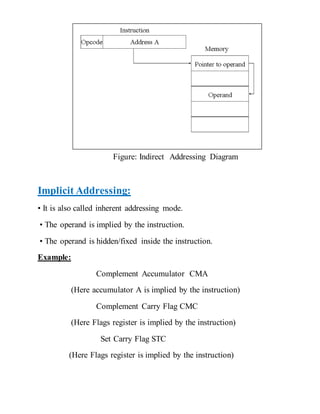
• The instruction specifies the indirect address where the effective
address of the operand is placed.
• The memory address is specified where the actual address of operand
is placed.
Example:
Move
MOV A, 2802h A ← [[2802]]
It moves the data from memory location specified by the
location 2802 to A.
Figure: Indirect Addressing Diagram
Implicit Addressing:
• It is also called inherent addressing mode.
• The operand is implied by the instruction.
• The operand is hidden/fixed inside the instruction.
Example:
Complement Accumulator CMA
(Here accumulator A is implied by the instruction)
Complement Carry Flag CMC
(Here Flags register is implied by the instruction)
Set Carry Flag STC
(Here Flags register is implied by the instruction)
RelativeAddressing Mode:
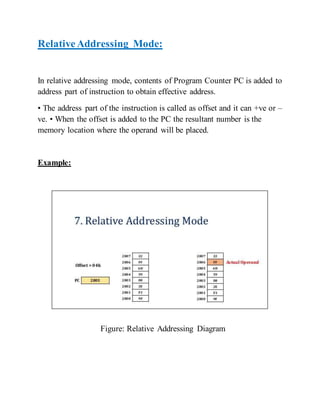
In relative addressing mode, contents of Program Counter PC is added to
address part of instruction to obtain effective address.
• The address part of the instruction is called as offset and it can +ve or –
ve. • When the offset is added to the PC the resultant number is the
memory location where the operand will be placed.
Example:
Figure: Relative Addressing Diagram
Index Addressing Mode:
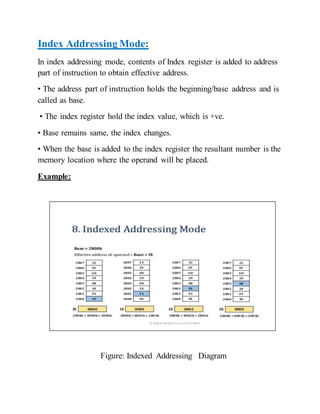
In index addressing mode, contents of Index register is added to address
part of instruction to obtain effective address.
• The address part of instruction holds the beginning/base address and is
called as base.
• The index register hold the index value, which is +ve.
• Base remains same, the index changes.
• When the base is added to the index register the resultant number is the
memory location where the operand will be placed.
Example:
Figure: Indexed Addressing Diagram
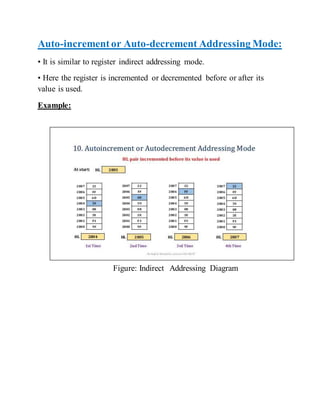
Auto-incrementor Auto-decrement Addressing Mode:
• It is similar to register indirect addressing mode.
• Here the register is incremented or decremented before or after its
value is used.
Example:
Figure: Indirect Addressing Diagram

Different types of Addressing.cao

  • 1.
    Assignment on Different typesof Addressing Modes Course Title: Computer Architecture & Organization Course Code: CSE 322 Submitted By: Umme Habiba ID: 142-15-3677 Section: B Submitted To Rubaiya Hafiz Lecturer Department of Computer Science & Engineering
  • 2.
    Addressing modes: Addressing modesare nothing but the different ways in which the location of an operand can be specified in an instruction. The number of addressing modes that a processor supports changes according to the instruction set it is based on, however there are a few generic ones that are present in almost all processors and are thus of utmost importance. They are as follows: • register (or register-direct) addressing: R1 • register indirect addressing: M[R1] • immediate addressing: data • direct (or absolute) addressing: M[address] • indirect addressing: M[M[address]] • implicit addressing: default location • relative & indexed addressing: M[R1+address] • pre-decrement, post-decrement, pre-increment, ... Register(or register-direct)Addressing: • The operand is specified with in one of the processor register. • Instruction specifies the register in which the operand is stored. Example:
  • 3.
    Move MOV C ,A C ← A Here A is the operand specified in register Add ADD B A ← A + B Here B is the operand specified in register Figure: Register Addressing Diagram RegisterIndirect Addressing: The instruction specifies the register in which the memory address of operand is placed. • It do not specify the operand itself but its location with in the memory where operand is placed. Example:
  • 4.
    Move MOV A ,M A ← [[H][L]] It moves the data from memory location specified by HL register pair to A Figure: Register Indirect Addressing Diagram Immediate Addressing: The operand is specified with in the instruction. • Operand itself is provided in the instruction rather than its address. Example: Move Immediate MVI A , 15h A ← 15h Here 15h is the immediate operand Add Immediate
  • 5.
    ADI 3Eh A← A + 3Eh Here 3Eh is the immediate operand Figure: Immediate Addressing Diagram Direct (or absolute)addressing: • The instruction specifies the direct address of the operand. • The memory address is specified where the actual operand is. Example: Load Accumulator LDA 2805h A ← [2805] It loads the data from memory location 2805 to A. Store Accumulator STA 2803h [2803] ← A It stores the data from A to memory location 2803.
  • 6.
    Figure: Direct AddressingDiagram Indirect Addressing: • The instruction specifies the indirect address where the effective address of the operand is placed. • The memory address is specified where the actual address of operand is placed. Example: Move MOV A, 2802h A ← [[2802]] It moves the data from memory location specified by the location 2802 to A.
  • 7.
    Figure: Indirect AddressingDiagram Implicit Addressing: • It is also called inherent addressing mode. • The operand is implied by the instruction. • The operand is hidden/fixed inside the instruction. Example: Complement Accumulator CMA (Here accumulator A is implied by the instruction) Complement Carry Flag CMC (Here Flags register is implied by the instruction) Set Carry Flag STC (Here Flags register is implied by the instruction)
  • 8.
    RelativeAddressing Mode: In relativeaddressing mode, contents of Program Counter PC is added to address part of instruction to obtain effective address. • The address part of the instruction is called as offset and it can +ve or – ve. • When the offset is added to the PC the resultant number is the memory location where the operand will be placed. Example: Figure: Relative Addressing Diagram
  • 9.
    Index Addressing Mode: Inindex addressing mode, contents of Index register is added to address part of instruction to obtain effective address. • The address part of instruction holds the beginning/base address and is called as base. • The index register hold the index value, which is +ve. • Base remains same, the index changes. • When the base is added to the index register the resultant number is the memory location where the operand will be placed. Example: Figure: Indexed Addressing Diagram
  • 10.
    Auto-incrementor Auto-decrement AddressingMode: • It is similar to register indirect addressing mode. • Here the register is incremented or decremented before or after its value is used. Example: Figure: Indirect Addressing Diagram Figure: Indirect Addressing Diagram