Download to read offline

![Auto Indexing
Indexed items are frequently accessed sequentially. So an
access to X(k) stored in memory location A is immediately
followed by a reference to X(k+1) or X(k-1) stored in location
A+1 or A-1, respectively. So, addressing mode that
automatically increment or decrement an address can be
defined, which is known as auto indexing.
Example: -(A3) [Motorola 680X0 series] indicate that the
content of A3 must be decremented before the instruction is
executed. The process is known as pre-decrementing.
Similarly, (A3)+ indicates that A3 should be incremented
automatically after the instruction has been executed. This
process is called post-incrementing.
In each case the amount of the address increment or
decrement is the length in bytes of the indexed operands.](https://image.slidesharecdn.com/lecture06-171203222425/85/Lecture-06-12-320.jpg)
![Register Indirect Addressing
Register indirect addressing refers to indirect addressing
with a register R name in the address field.
Example:
MOVE.B (A0), D1
It uses parentheses to indicate that (A0) is an indirect
address involving the 680X0’s A0 address register.
This move-byte instruction - the opcode’s .B suffix
specifies a 1-byte operand – corresponds to
D1[7:0] := M(A0) and copies the byte addressed by A0
into the low-order byte position of data register D1. The
other three bytes of D1 are unchanged.](https://image.slidesharecdn.com/lecture06-171203222425/85/Lecture-06-14-320.jpg)


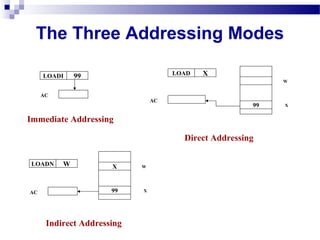
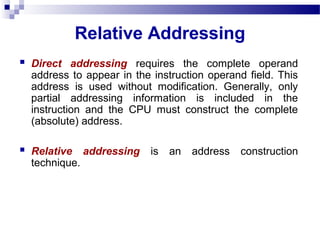
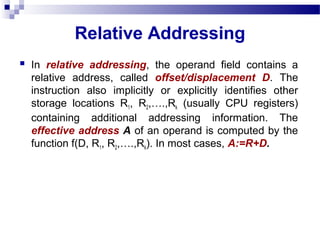
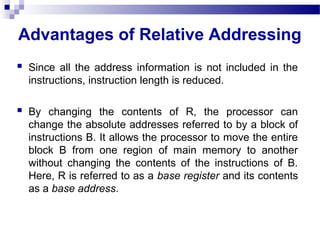
This document discusses different addressing modes used in computer instructions, including immediate, direct, indirect, relative, auto indexing, register direct, register indirect, and register indirect with offset addressing. It explains what each addressing mode is, provides examples, and discusses the advantages and disadvantages of relative addressing. The key points are that addressing modes specify how operand values are accessed and can affect access speed and ease of specifying/altering operands.


