PROFESSOR MARK PALLEN UNIVERSITY OF BIRMINGHAM High-throughput sequencing  Overview and selected applications
Outline What is high-throughput sequencing? How it works Key considerations Applications Clinical Microbiology Cancer Biology
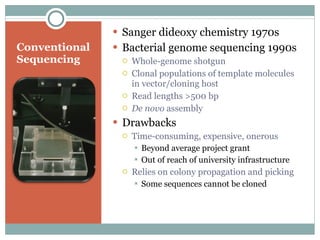
Conventional Sequencing Sanger dideoxy chemistry 1970s Bacterial genome sequencing 1990s Whole-genome shotgun Clonal populations of template molecules in vector/cloning host Read lengths >500 bp De novo  assembly Drawbacks Time-consuming, expensive, onerous Beyond average project grant Out of reach of university infrastructure Relies on colony propagation and picking Some sequences cannot be cloned
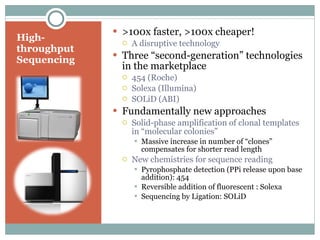
High-throughput Sequencing >100x faster, >100x cheaper! A disruptive technology Three “second-generation” technologies in the marketplace 454 (Roche) Solexa (Illumina) SOLiD (ABI) Fundamentally new approaches Solid-phase amplification of clonal templates in “molecular colonies”  Massive increase in number of “clones” compensates for shorter read length New chemistries for sequence reading Pyrophosphate detection (PPi release upon base addition): 454 Reversible addition of fluorescent : Solexa Sequencing by Ligation: SOLiD
Recent Developments Single-molecule sequencing Pacific Biosciences (PacBio) Nanopore Benchtop sequencers Ion Torrent MiSeq
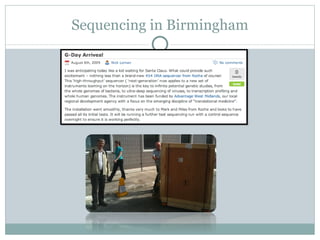
Sequencing in Birmingham
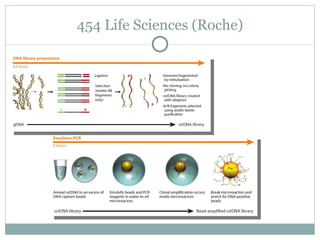
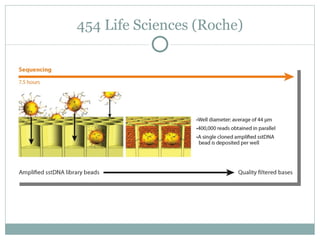
454 Life Sciences (Roche)
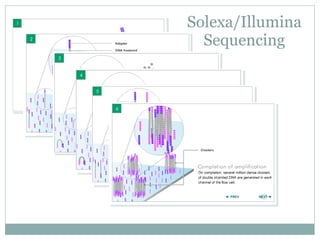
Solexa/Illumina Sequencing
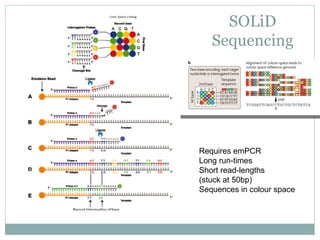
SOLiD Sequencing Requires emPCR Long run-times Short read-lengths (stuck at 50bp) Sequences in colour space
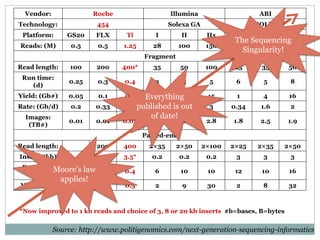
Source: http://www.politigenomics.com/next-generation-sequencing-informatics *Now improved to 1 kb reads and choice of 3, 8 or 20 kb inserts  #b=bases, B=bytes   Vendor: Roche Illumina ABI Technology: 454 Solexa GA SOLiD Platform: GS20 FLX Ti I II IIx 1 2 3 Reads: (M) 0.5 0.5 1.25 28 100 150 40 115 320 Fragment Read length: 100 200 400* 35 50 100 25 35 50 Run time: (d) 0.25 0.3 0.4 3 3 5 6 5 8 Yield: (Gb#) 0.05 0.1 0.5 1 5 15 1 4 16 Rate: (Gb/d) 0.2 0.33 1.25 0.33 1.67 3 0.34 1.6 2 Images: (TB#) 0.01 0.01 0.03 0.5 1.1 2.8 1.8 2.5 1.9 Paired-end Read length: 200 400 2×35 2×50 2×100 2×25 2×35 2×50 Insert: (kb) 3.5 3.5* 0.2 0.2 0.2 3 3 3 Run time: (d) 0.3 0.4 6 10 10 12 10 16 Yield: (Gb) 0.1 0.5 2 9 30 2 8 32 Moore’s law applies! The Sequencing Singularity! Everything published is out of date!
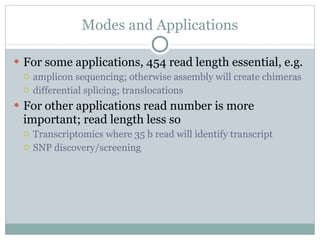
Modes and Applications For some applications, 454 read length essential, e.g.  amplicon sequencing; otherwise assembly will create chimeras differential splicing; translocations For other applications read number is more important; read length less so  Transcriptomics where 35 b read will identify transcript SNP discovery/screening
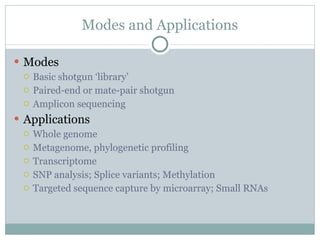
Modes and Applications Modes Basic shotgun ‘library’  Paired-end or mate-pair shotgun Amplicon sequencing Applications Whole genome Metagenome, phylogenetic profiling  Transcriptome SNP analysis; Splice variants; Methylation Targeted sequence capture by microarray; Small RNAs
Modes and Applications Sequencing run is the basic unit Basic cost of 454 or Illumina ~several £1000s per run in consumables & essential on-costs  Additions for consumables and/or staff time for multiple library preparation some modes, e.g. paired end  data analysis etc Run can be subdivided Plate-dividing gaskets (loss of wells) Multiplex identifiers (MIDs or sequence barcodes) So cost per sample may be ~£10s not £1000s! But logistics of filling a plate may incur delays
“ De novo  assembly” versus “ alignment against template” (aka “re-sequencing”)
Bacterial Genomic Epidemiology Genome sequencing brings the advantages of  open-endedness (revealing the “unknown unknowns”),  universal applicability  ultimate in resolution High-throughput platforms 454, Illumina, PacBio Expense and set-up puts them beyond average lab Bench-top sequencing platforms  generate data sufficiently quickly and cheaply to have an impact on real-world clinical and epidemiological problems
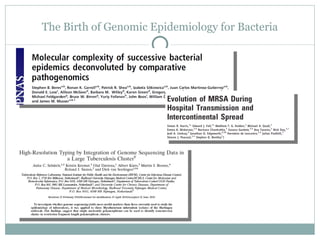
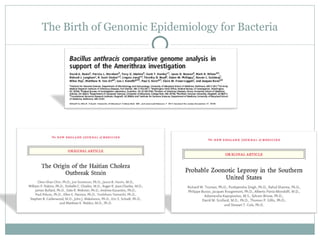
The Birth of Genomic Epidemiology for Bacteria
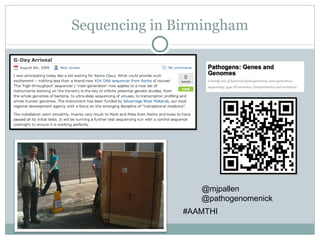
Sequencing in Birmingham @mjpallen @pathogenomenick #AAMTHI
Case Study  Acinetobacter baumannii Gram-negative bacillus Multi-drug resistant colistin and tigecycline as reserve agents moving towards pan-resistance Associated with  wound infections and ventilator-associated pneumonia bloodstream infections returning military personnel from Iraq and Afghanistan transmission from military to civilian patients
Acinetobacter baumannii : problems Hard to identify in clinical laboratory Two related genomospecies 3 and 13TU, (now A. pittii and A. nosocomialis) impossible to distinguish phenotypically  Outbreak strains can be identified by PFGE, VNTR and gene-specific assays BUT mode of spread and transmission chains often uncertain, hindering optimal management of outbreaks and rational design of policies Mechanism of resistance hard to identify in individual cases Poor understanding of pathogen biology
Applications and Questions Epidemiology Q1: Can whole-genome sequencing detect differences between isolates within an outbreak? Q2: Can these differences be used to help determine chains of transmission? Emergence of Resistance Q3: Can it reveal how resistance emerges? Taxonomy and Identification Q4: Can it tell us what defines a species within a genus?
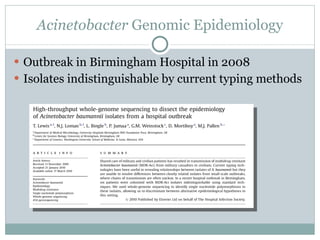
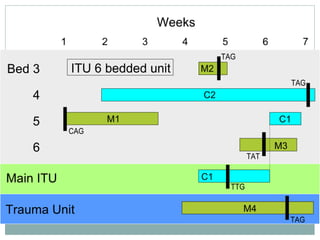
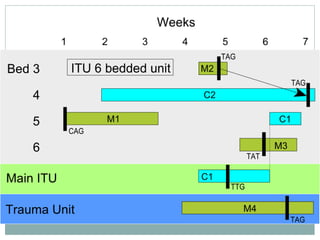
Acinetobacter  Genomic Epidemiology Outbreak in Birmingham Hospital in 2008 Isolates indistinguishable by current typing methods
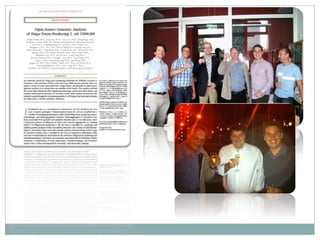
Acinetobacter  Genomic Epidemiology 454 whole-genome sequencing of 6 isolates SNP detection by mapping reads against draft reference assembly SNP filtering for false positives SNP validation with Sanger sequencing of PCR amplicons
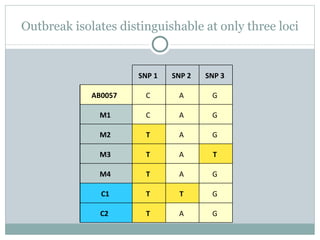
Outbreak isolates distinguishable at only three loci   SNP 1  SNP 2  SNP 3  AB0057  C  A  G  M1  C  A  G  M2  T  A  G  M3  T  A  T  M4  T  A  G  C1  T  T  G  C2  T  A  G
 
 
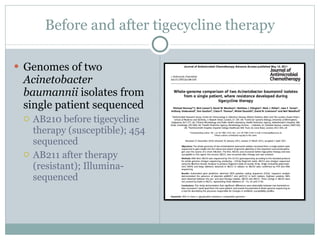
Before and after tigecycline therapy Genomes of two  Acinetobacter baumannii  isolates from single patient sequenced  AB210 before tigecycline therapy (susceptible); 454 sequenced AB211 after therapy (resistant); Illumina-sequenced
Before and after tigecycline therapy Eighteen SNPs detected between AB210 and AB211 nine non-synonymous including a SNP in  adeS  which accounts for resistance phenotype  Three contigs in AB210 not covered by reads in AB211, representing three deletions of ~15, 44,17 kb mutS  truncated; likely increase in mutation rate
 
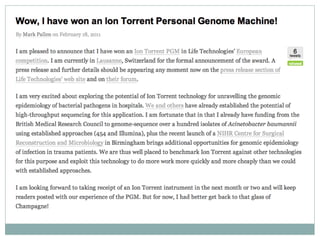
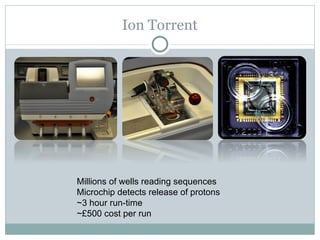
Ion Torrent Millions of wells reading sequences Microchip detects release of protons ~3 hour run-time ~£500 cost per run


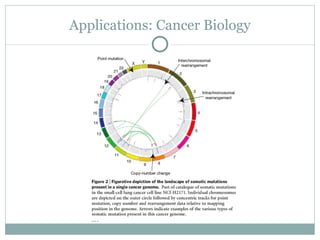
Applications: Cancer Biology
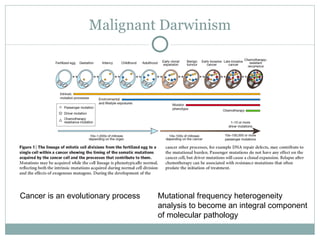
Malignant Darwinism Mutational frequency heterogeneity analysis to become an integral component of molecular pathology Cancer is an evolutionary process
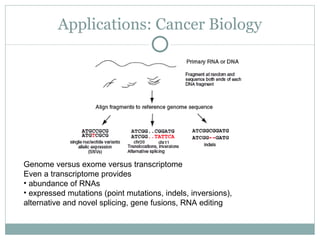
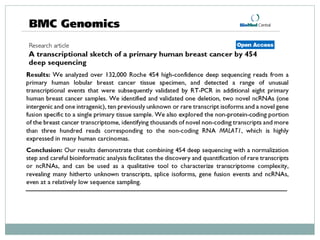
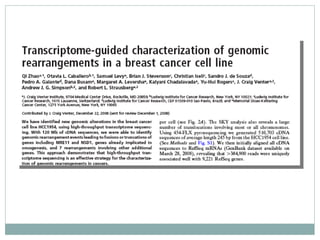
Applications: Cancer Biology Genome versus exome versus transcriptome Even a transcriptome provides  abundance of RNAs  expressed mutations (point mutations, indels, inversions), alternative and novel splicing, gene fusions, RNA editing
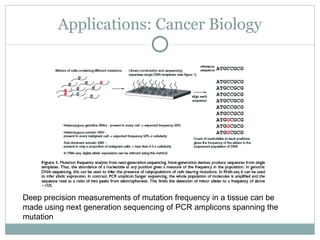
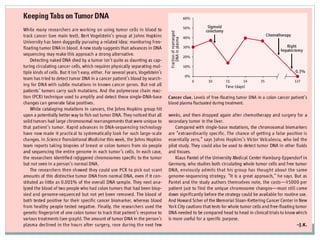
Applications: Cancer Biology Deep precision measurements of mutation frequency in a tissue can be made using next generation sequencing of PCR amplicons spanning the mutation
 
Challenges In recent cancer genomes ~50% of predicted SNVs from the primary sequence data could not be revalidated. Many private germline polymorphisms still exist in every individual, so additional qualification against germline DNA is always necessary to distinguish somatic variants
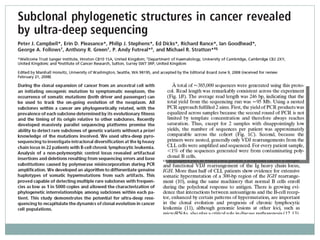
Applications: Cancer Biology Coding SNPs dominated by a few frequently mutated loci (oncogenes or tumour suppressors) long tail of population-infrequent SNPs driver/passenger distinction regulatory sequence mutations yet to be explored Hundreds of genomes for each cancer type required to make sense of the mutations seen?  BUT driver mutations in some cancer subtypes found with much smaller studies C134Y FOXL2 mutation in adult type granulosa cell tumours from the transcriptomes of four granulosa cell cases


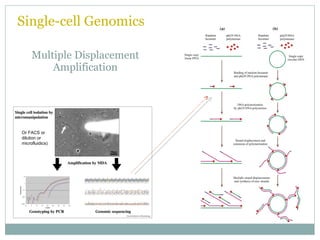
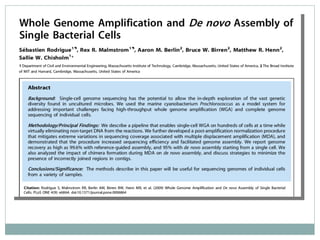
Multiple Displacement Amplification Single-cell Genomics Or FACS or dilution or microfluidics)
 
What will you do when you can sequence everything?
Further Information High-throughput sequencing technology http://pathogenomics.bham.ac.uk/blog http://www.nature.com/nrg/journal/v11/n1/pdf/nrg2626.pdf http://onlinelibrary.wiley.com/doi/10.1002/smll.200900976/pdf http://dx.doi.org/10.1016/j.tibtech.2008.07.003 Clinical Microbiology Pallen, Loman, Penn  High-throughput sequencing and clinical microbiology: progress, opportunities and challenges  Current Opinion in Infectious Disease  http://www.sciencedirect.com/science/journal/13695274
Further Information Cancer genomics http ://www.ncbi.nlm.nih.gov/pubmed/19921711,19918804,20016485,20164919,20016488,20200521, 20371490 http://www.nature.com/nature/journal/v458/n7239/pdf/nature07943.pdf http://www.nature.com/news/2010/100414/pdf/464972a.pdf http://www.nature.com/nature/journal/v464/n7289/pdf/464678a.pdf http://www.nature.com/nature/journal/v464/n7289/pdf/464679a.pdf http://omicsomics.blogspot.com/2010/04/value-of-cancer-genomics.html http://cancergenome.nih.gov/ http://www.sanger.ac.uk/genetics/CGP/ http://scienceonline.org/cgi/content/full/sci;327/5969/1074 http://app2.capitalreach.com/esp1204/servlet/tc?cn=aacr&c=10165&s=20435&e=12623&&m=1&br=80&audio=false http://app2.capitalreach.com/esp1204/servlet/tc?cn=aacr&c=10165&s=20435&e=12624&&m=1&br=80&audio=false