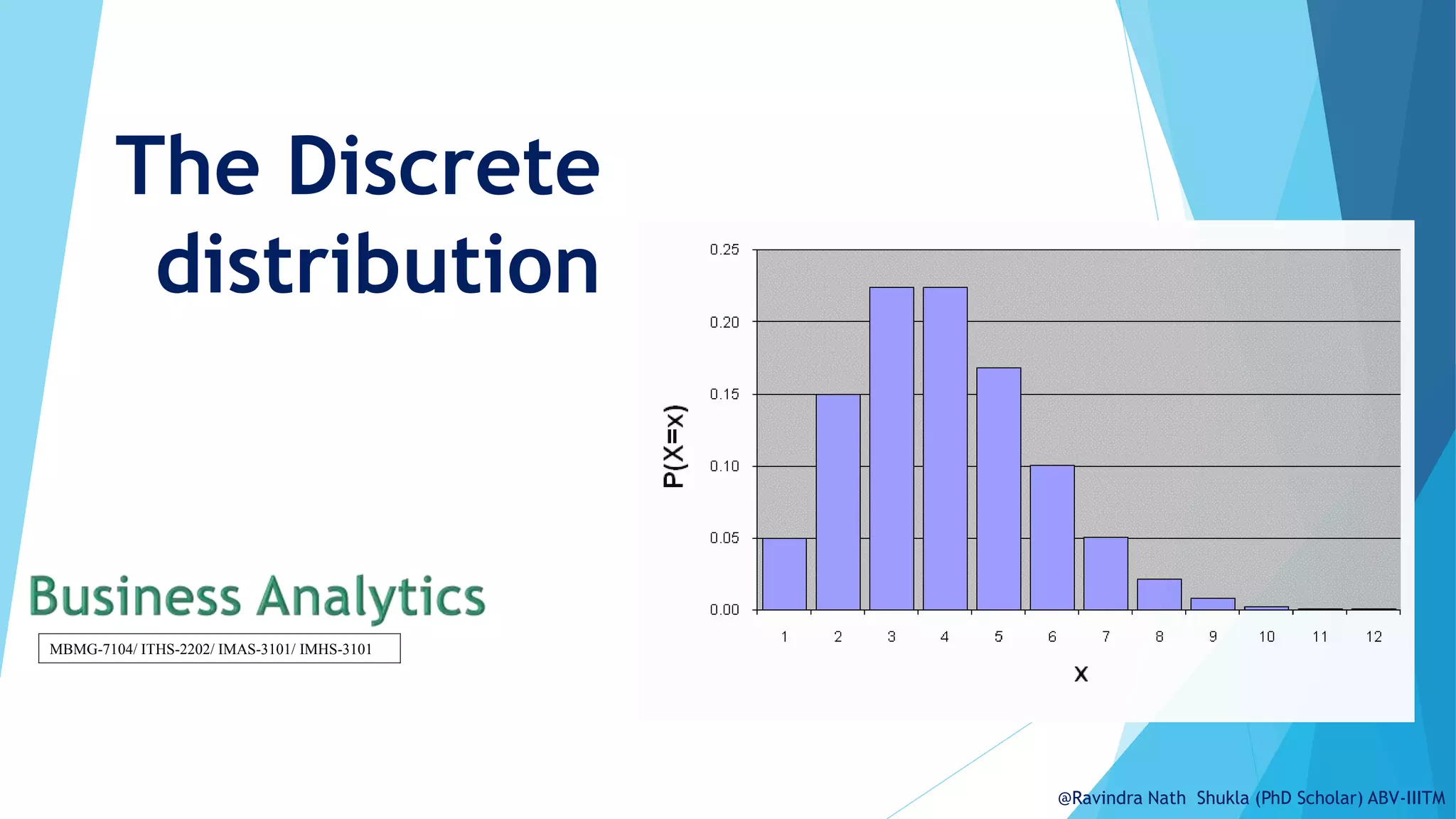
The Discrete
distribution
MBMG-7104/ ITHS-2202/ IMAS-3101/ IMHS-3101
@Ravindra Nath Shukla (PhD Scholar) ABV-IIITM
What is Probability Distribution?
Probability Distribution is a statistical function
which links or lists all the possible outcomes a
random variable can take, in any random
process, with its corresponding probability of
occurrence.
@Ravindra Nath Shukla (PhD Scholar) ABV-IIITM
For example, if you roll a dice, the outcome is random (not
fixed) and there are 6 possible outcomes, each of which
occur with probability one-sixth.
Or A random variable X takes on a defined set of
values with different probabilities.
For example, if you toss a fair coin, there are 2 possible
outcomes head or tails, each of which occur with probability
1/2. The outcome of having head or tails is random (not
fixed).
@Ravindra Nath Shukla (PhD Scholar) ABV-IIITM
Mathematically :-
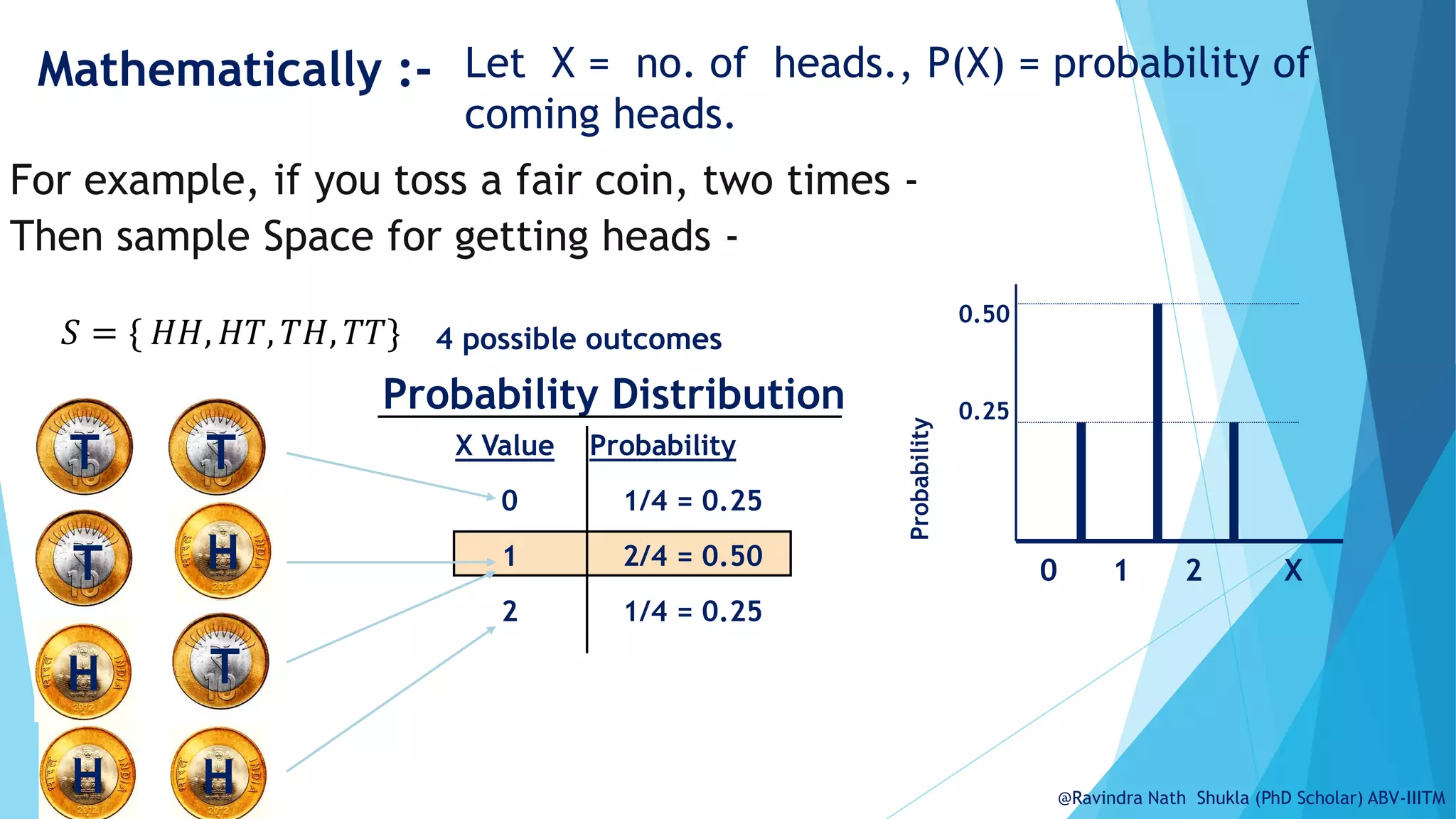
For example, if you toss a fair coin, two times -
Then sample Space for getting heads -
𝑆 = { 𝐻𝐻, 𝐻𝑇, 𝑇𝐻, 𝑇𝑇}
Let X = no. of heads., P(X) = probability of
coming heads.
T
4 possible outcomes
T
H
Probability Distribution
X Value Probability
0 1/4 = 0.25
1 2/4 = 0.50
2 1/4 = 0.25
T
T
H
H
H
0 1 2 X
Probability
0.50
0.25
@Ravindra Nath Shukla (PhD Scholar) ABV-IIITM
PROBABILITY DISTRIBUTION OF A DISCRETE
RANDOM VARIABLE
Let us consider a discrete r.v. X which can take the possible
values x1, x2, x3,…, xn. With each value of the variable X, we
associate a number,
pi = P(X = Xi ) ; i = 1, 2,…, n
which is known as the probability of Xi and satisfies the
following conditions :
(i) pi = P(X = Xi ) ≥ 0, (i = 1, 2,…, n) …(1)
i.e., pi’s are all non-negative.
@Ravindra Nath Shukla (PhD Scholar) ABV-IIITM
PROBABILITY DISTRIBUTION OF A DISCRETE
RANDOM VARIABLE
and
(ii) ∑ pi = p1 + p2 + … + pn = 1, …(2)
i.e., the total probability is one.
More specifically, let X be a discrete random variable and
define :
p (x) = P(X = xi)
such that p(x) ≥ 0 and ∑ p(x) = 1,
@Ravindra Nath Shukla (PhD Scholar) ABV-IIITM
Requirements for the
Probability Distribution of a Discrete
Random Variable x
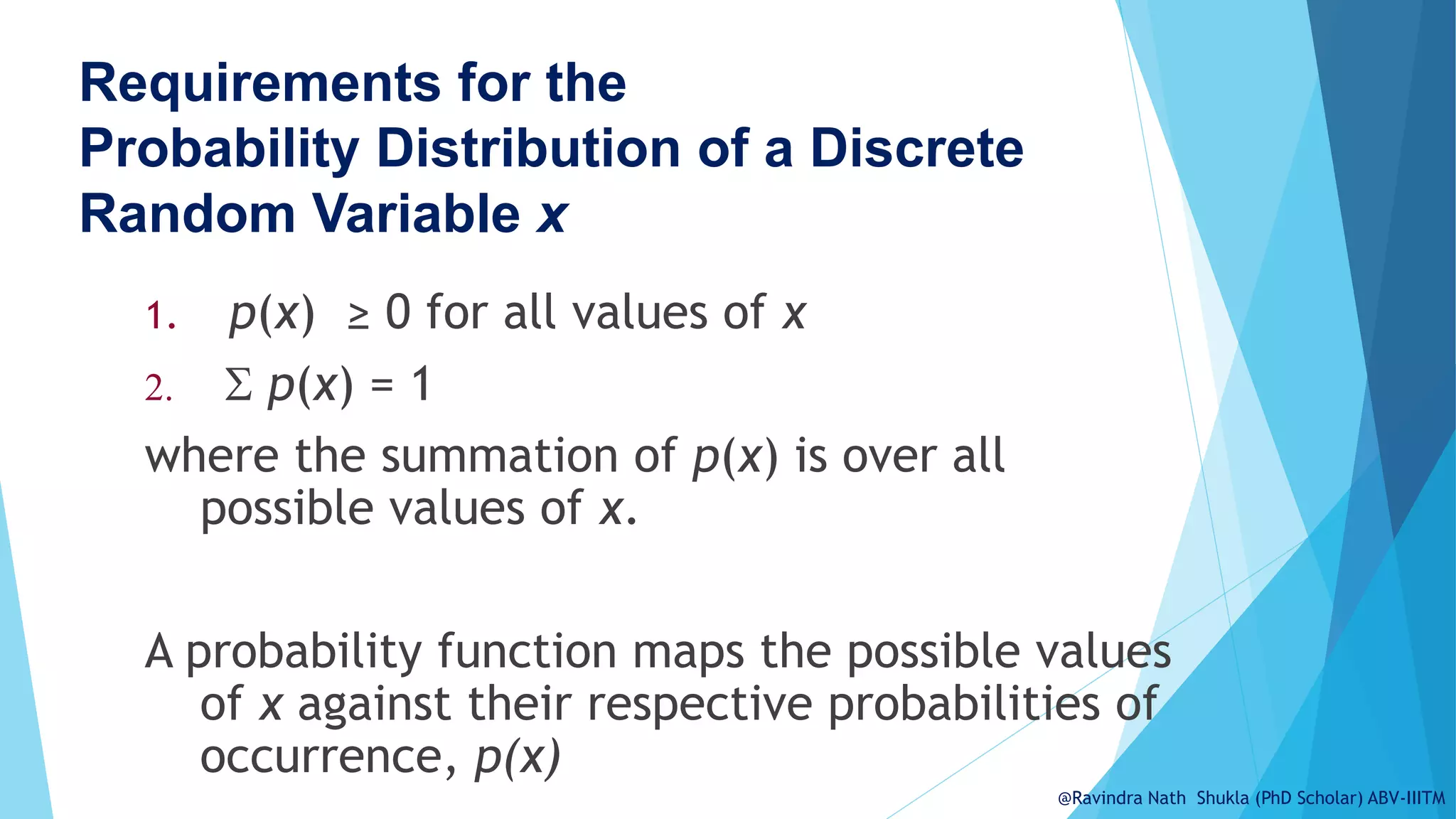
1. p(x) ≥ 0 for all values of x
2.  p(x) = 1
where the summation of p(x) is over all
possible values of x.
A probability function maps the possible values
of x against their respective probabilities of
occurrence, p(x)
@Ravindra Nath Shukla (PhD Scholar) ABV-IIITM
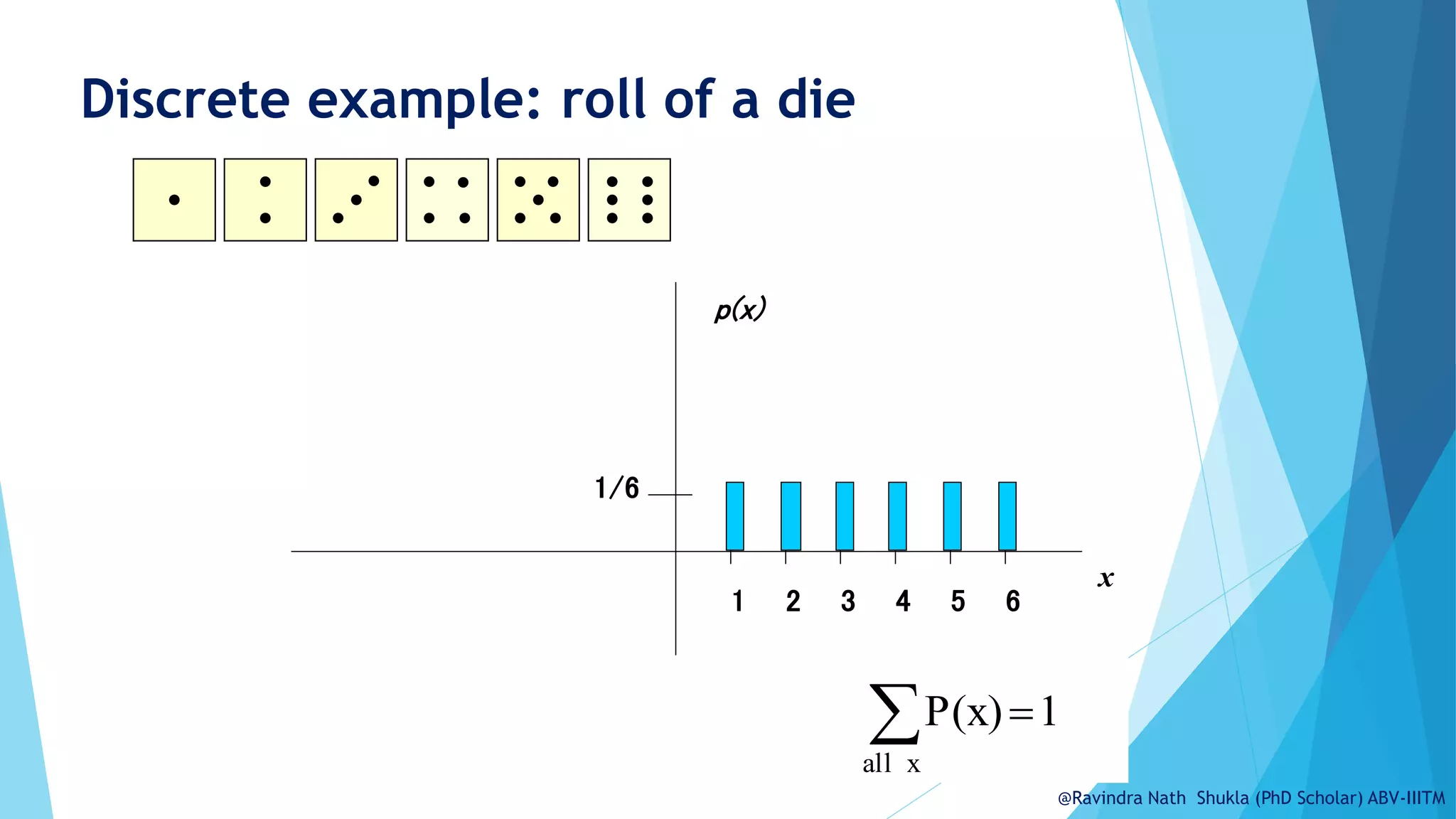
Discrete example: roll of a die
x
p(x)
1/6
1 4 5 6
2 3
 
x
all
1
P(x)
@Ravindra Nath Shukla (PhD Scholar) ABV-IIITM
Probability mass function (pmf)
x p(x)
1 p(x=1)=1/6
2 p(x=2)=1/6
3 p(x=3)=1/6
4 p(x=4)=1/6
5 p(x=5)=1/6
6 p(x=6)=1/6
1.0
@Ravindra Nath Shukla (PhD Scholar) ABV-IIITM
Cumulative distribution function (CDF)
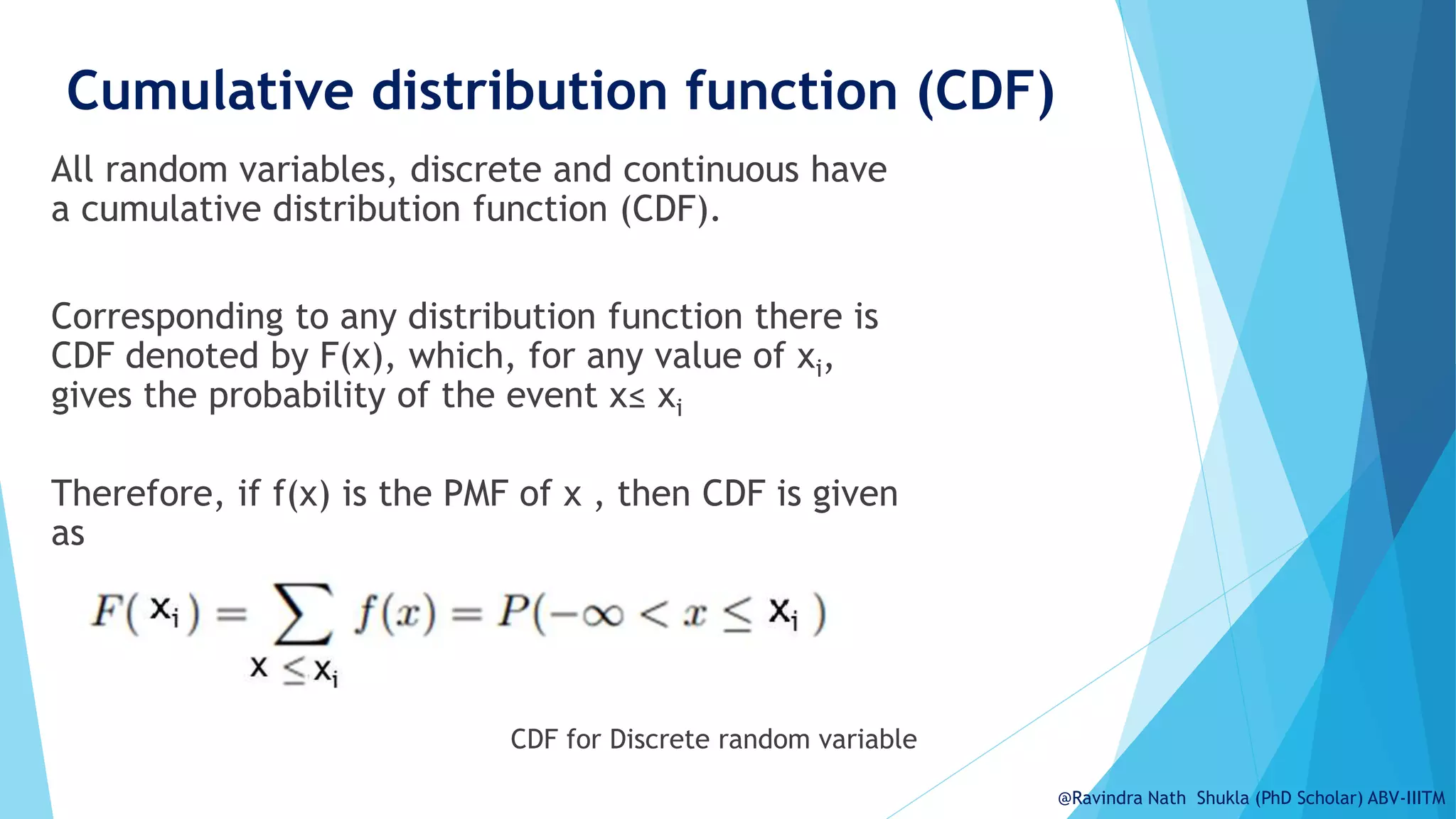
All random variables, discrete and continuous have
a cumulative distribution function (CDF).
Corresponding to any distribution function there is
CDF denoted by F(x), which, for any value of xi,
gives the probability of the event x≤ xi
Therefore, if f(x) is the PMF of x , then CDF is given
as
CDF for Discrete random variable
@Ravindra Nath Shukla (PhD Scholar) ABV-IIITM
Cumulative distribution function
x
P(x)
1/6
1 4 5 6
2 3
1/3
1/2
2/3
5/6
1.0
x P(x≤A)
1 P(x≤1)=1/6
2 P(x≤2)=2/6
3 P(x≤3)=3/6
4 P(x≤4)=4/6
5 P(x≤5)=5/6
6 P(x≤6)=6/6
@Ravindra Nath Shukla (PhD Scholar) ABV-IIITM
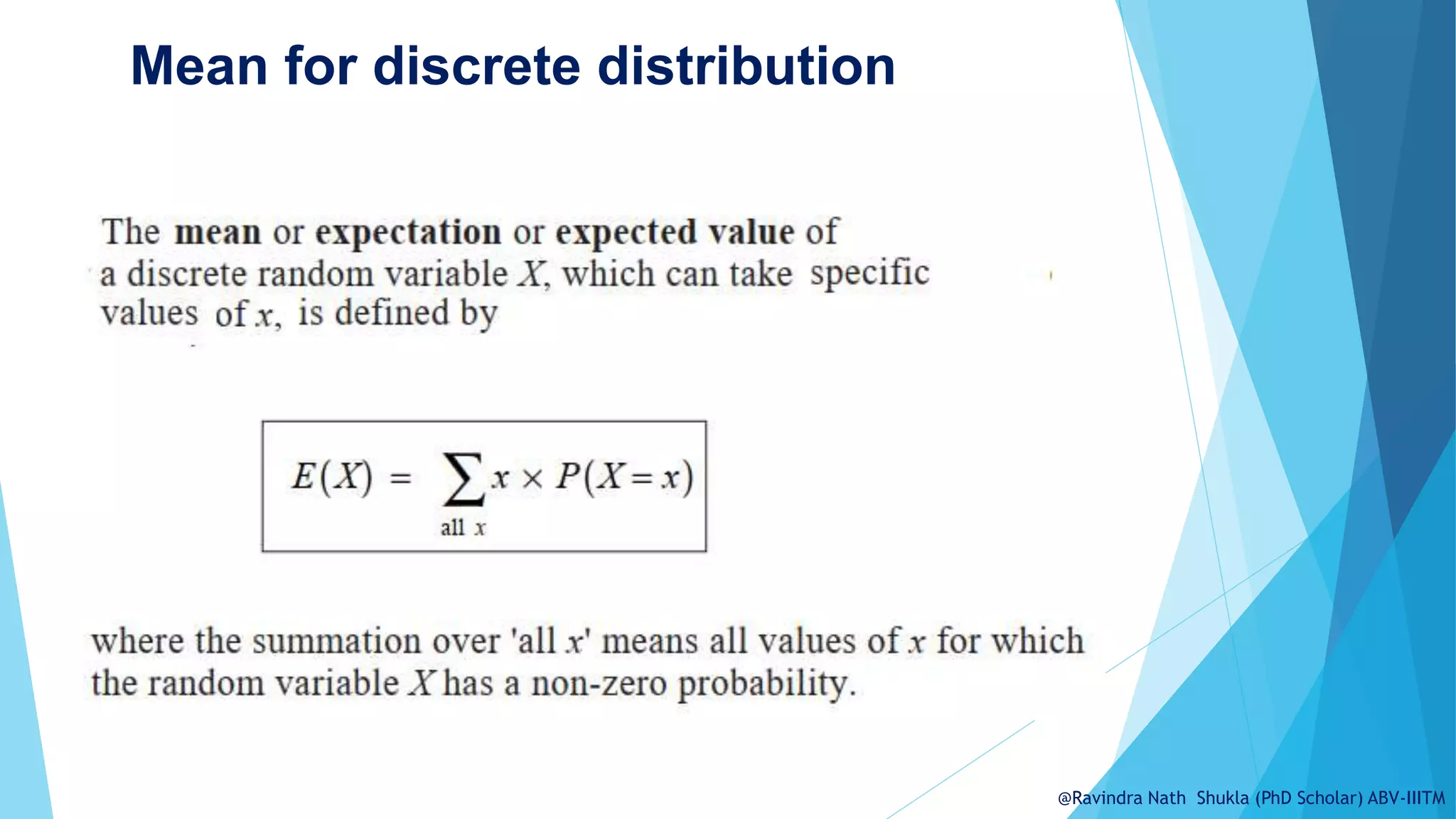
Mean for discrete distribution
@Ravindra Nath Shukla (PhD Scholar) ABV-IIITM
Mean for discrete distribution
Example : - When throwing a normal die , let X be
the random variable defined by
X = the score shown on die
Probability distribution
X 1 2 3 4 5 6
P(x) 1/6 1/6 1/6 1/6 1/6 1/6
Or
𝐸(𝑋) = 1 ×
1
6
+ 2 ×
1
6
+ 3 ×
1
6
+ 4 ×
1
6
+ 5 ×
1
6
+ 6 ×
1
6
=
1
6
1 + 2 + 3 + 4 + 5 + 6 =
21
6
=
7
2
= 3.5
@Ravindra Nath Shukla (PhD Scholar) ABV-IIITM
Variance for discrete distribution
Example : - for above example
X = the score shown on die
𝐸(𝑋2) = 12 ×
1
6
+ 22 ×
1
6
+ 32 ×
1
6
+ 42 ×
1
6
+ 52 ×
1
6
+ 62 ×
1
6
=
1
6
12 + 22 + 32 + 42 + 52 + 62
=
1
6
1 + 4 + 9 + 16 + 25 + 36 =
91
6
@Ravindra Nath Shukla (PhD Scholar) ABV-IIITM
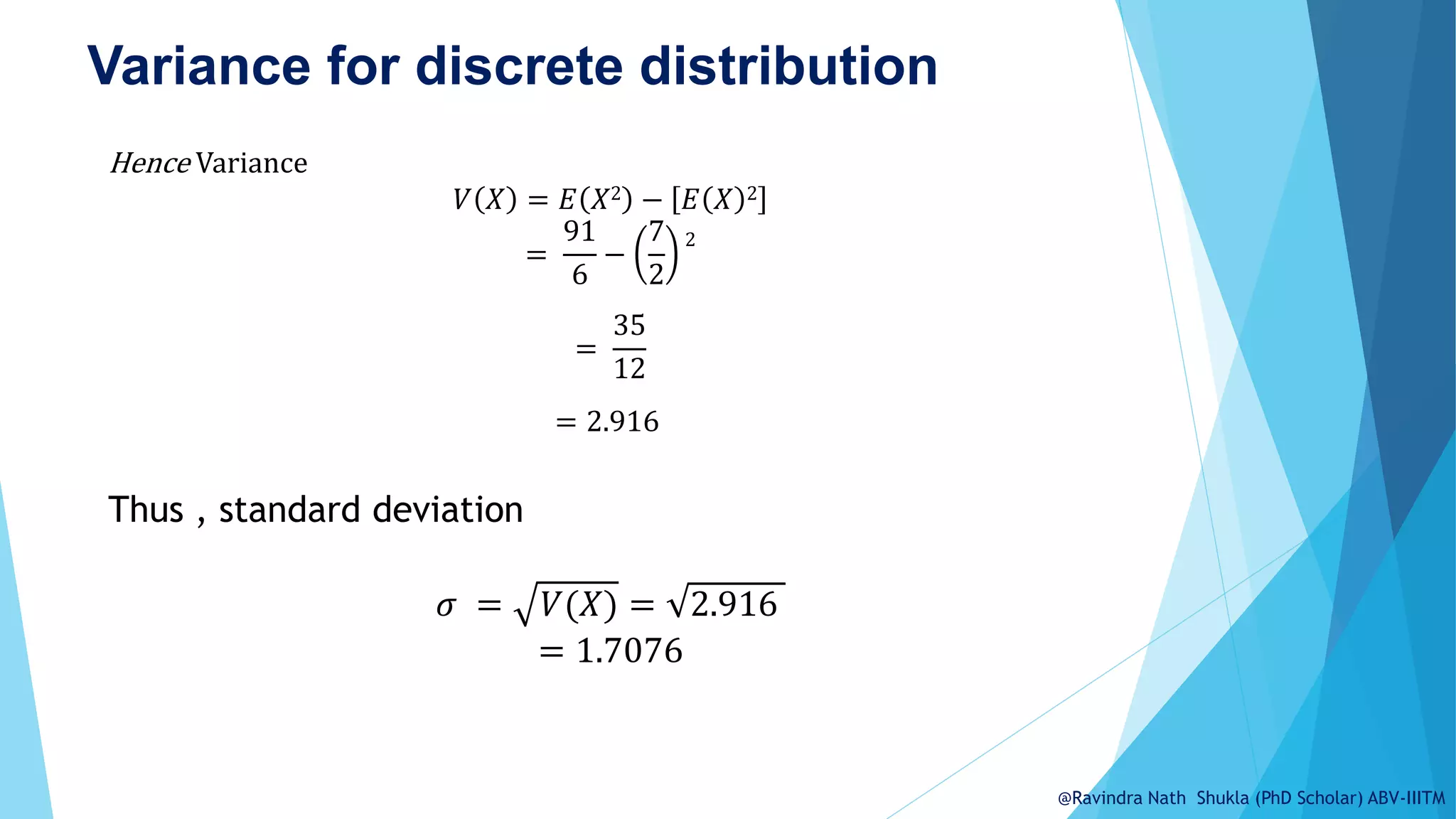
Variance for discrete distribution
Hence Variance
𝑉 𝑋 = 𝐸 𝑋2 − 𝐸 𝑋 2
=
91
6
−
7
2
2
=
35
12
= 2.916
Thus , standard deviation
𝜎 = 𝑉(𝑋) = 2.916
= 1.7076
@Ravindra Nath Shukla (PhD Scholar) ABV-IIITM
Mean & Variance for discrete distribution
Example : - A company XYZ, estimates the net profit of a new
product it is launching, to be Rs. 3,000,000 during the first year if
it is successful, Rs. 1,000,000 if it is moderately successful and a
loss of Rs. 1,000,000. The company assigns the following
probabilities to first year prospectus for the product, successful:
0.15, moderately successful : 0.25, and unsuccessful : 0.60. What
are the expected value and standard deviation of first year net
profit for the product?
Hence Variance
𝑉 𝑋 = 𝐸 𝑋2 − 𝐸 𝑋 2
standard deviation 𝜎 = 𝑉(𝑋)
@Ravindra Nath Shukla (PhD Scholar) ABV-IIITM
© 2011 Pearson Education, Inc
@Ravindra Nath Shukla (PhD Scholar) ABV-IIITM
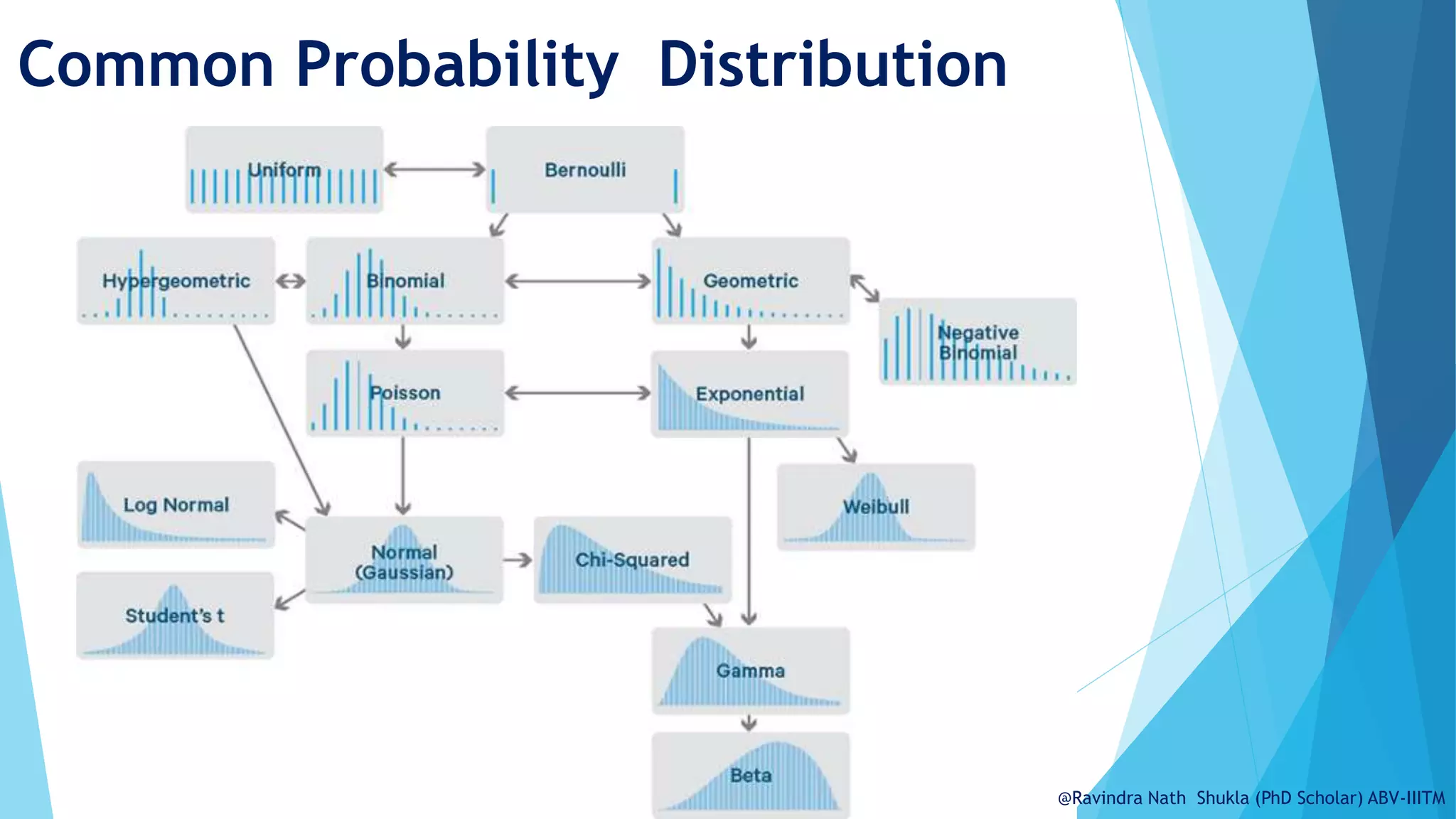
Common Probability Distribution
@Ravindra Nath Shukla (PhD Scholar) ABV-IIITM
© 2011 Pearson Education, Inc
Uniform Distribution
@Ravindra Nath Shukla (PhD Scholar) ABV-IIITM
Discrete example: roll of a die
x
p(x)
1/6
1 4 5 6
2 3
 
x
all
1
P(x)
𝑋 ~ 𝑈 𝑎, 𝑏
X~ U(1,6)
All outcomes has equal
probability
@Ravindra Nath Shukla (PhD Scholar) ABV-IIITM
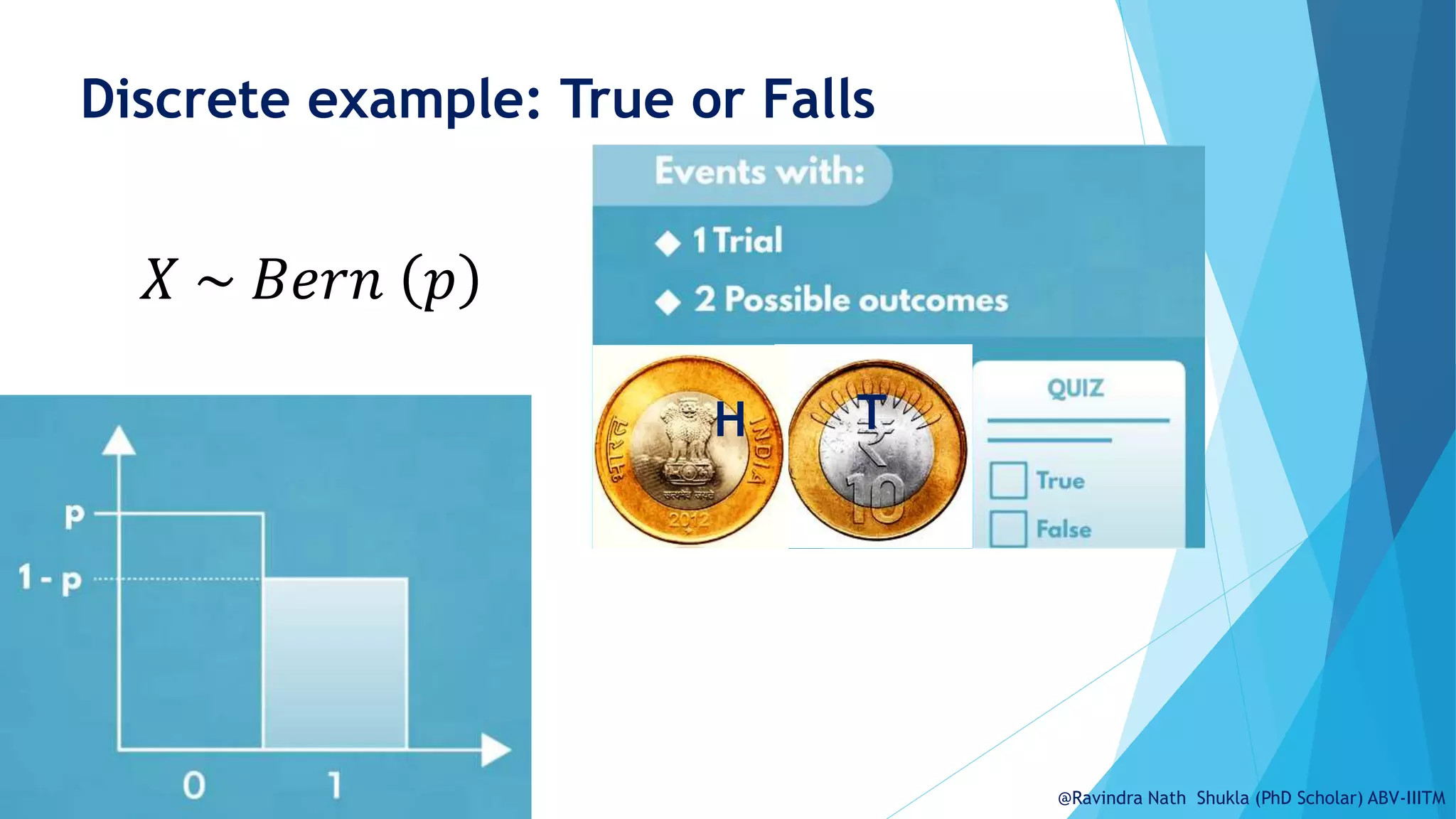
Bernoulli Distribution
@Ravindra Nath Shukla (PhD Scholar) ABV-IIITM
Discrete example: True or Falls
𝑋 ~ 𝐵𝑒𝑟𝑛 𝑝
T
H
@Ravindra Nath Shukla (PhD Scholar) ABV-IIITM
Binomial Distribution
@Ravindra Nath Shukla (PhD Scholar) ABV-IIITM
Binomial Distribution
@Ravindra Nath Shukla (PhD Scholar) ABV-IIITM
Binomial Probability
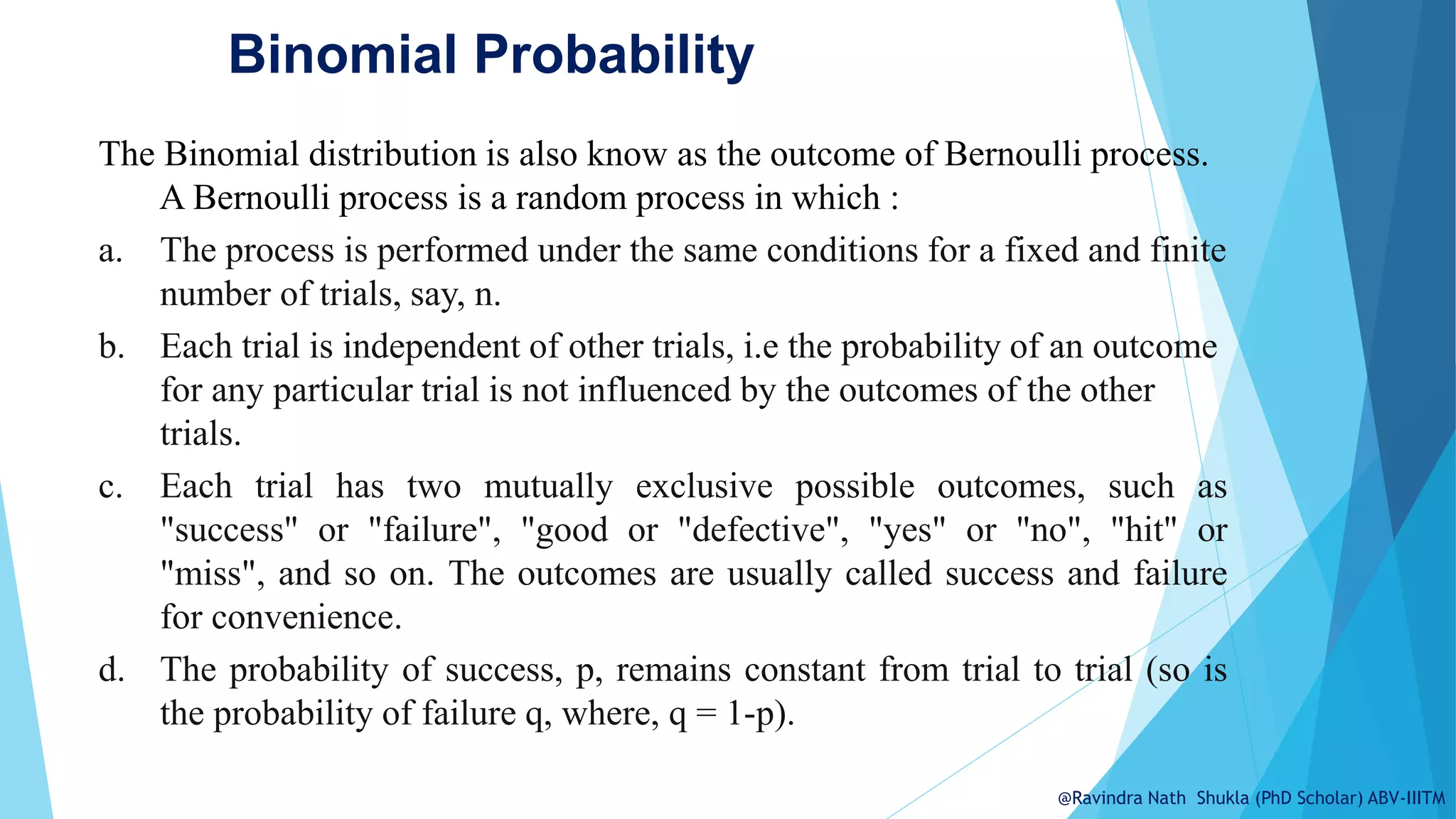
The Binomial distribution is also know as the outcome of Bernoulli process.
A Bernoulli process is a random process in which :
a. The process is performed under the same conditions for a fixed and finite
number of trials, say, n.
b. Each trial is independent of other trials, i.e the probability of an outcome
for any particular trial is not influenced by the outcomes of the other
trials.
c. Each trial has two mutually exclusive possible outcomes, such as
"success" or "failure", "good or "defective", "yes" or "no", "hit" or
"miss", and so on. The outcomes are usually called success and failure
for convenience.
d. The probability of success, p, remains constant from trial to trial (so is
the probability of failure q, where, q = 1-p).
@Ravindra Nath Shukla (PhD Scholar) ABV-IIITM
Binomial Probability
Characteristics of a Binomial Experiment
1. The experiment consists of n identical trials.
2. There are only two possible outcomes on each trial. We
will denote one outcome by S (for success) and the other
by F (for failure).
3. The probability of S remains the same from trial to trial.
This probability is denoted by p, and the probability of
F is denoted by q. Note that q = 1 – p.
4. The trials are independent.
5. The binomial random variable x is the number of S’s in
n trials.
@Ravindra Nath Shukla (PhD Scholar) ABV-IIITM
Binomial Probability Distribution
!
( ) (1 )
! ( )!
x n x x n x
n n
p x p q p p
x x n x
 
 
  
 

 
p(x) = Probability of x ‘Successes’
p = Probability of a ‘Success’ on a single trial
q = 1 – p
n = Number of trials
x = Number of ‘Successes’ in n trials
(x = 0, 1, 2, ..., n)
n – x = Number of failures in n trials
@Ravindra Nath Shukla (PhD Scholar) ABV-IIITM
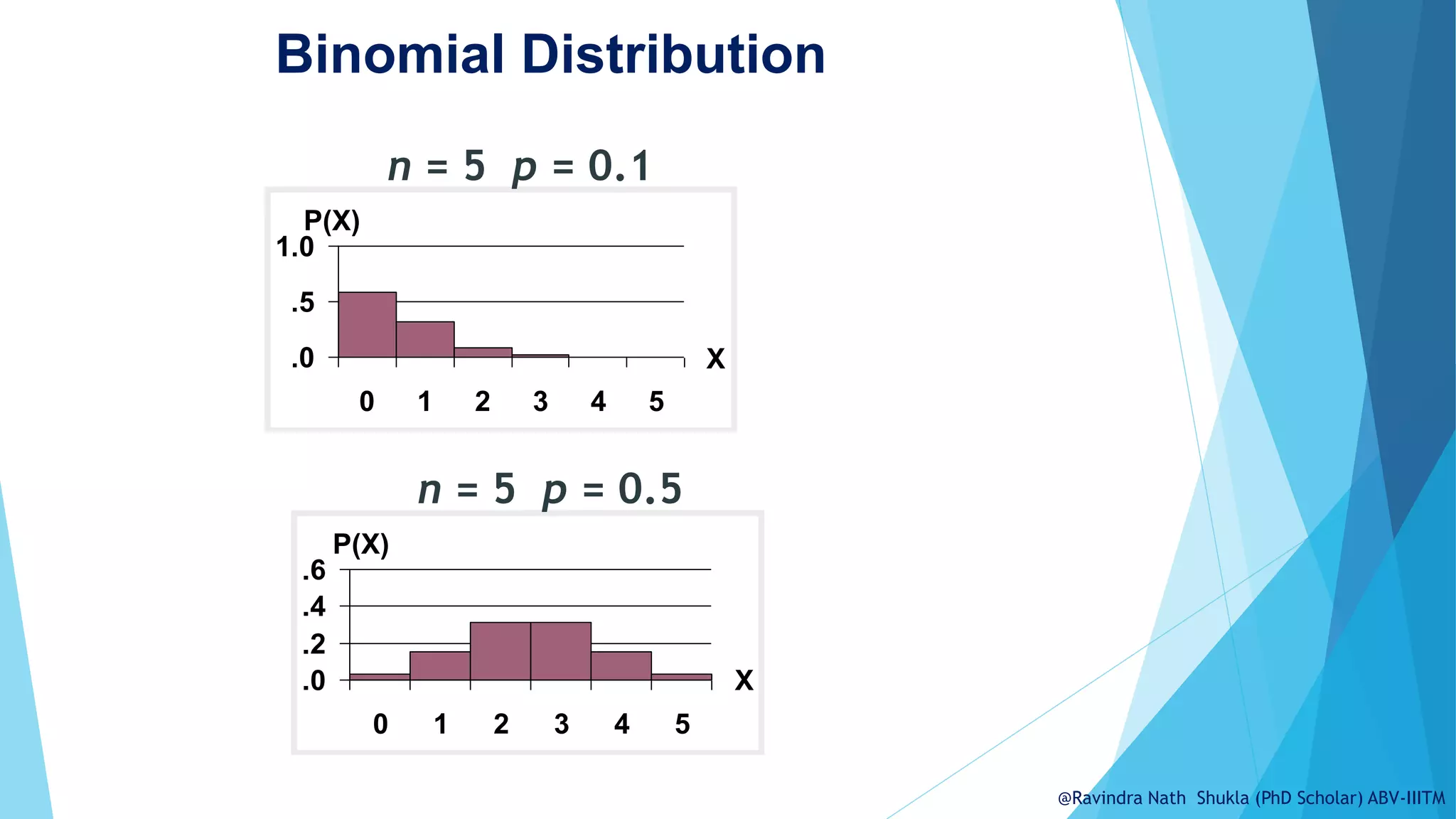
Binomial Distribution
.0
.5
1.0
0 1 2 3 4 5
X
P(X)
.0
.2
.4
.6
0 1 2 3 4 5
X
P(X)
n = 5 p = 0.1
n = 5 p = 0.5
@Ravindra Nath Shukla (PhD Scholar) ABV-IIITM
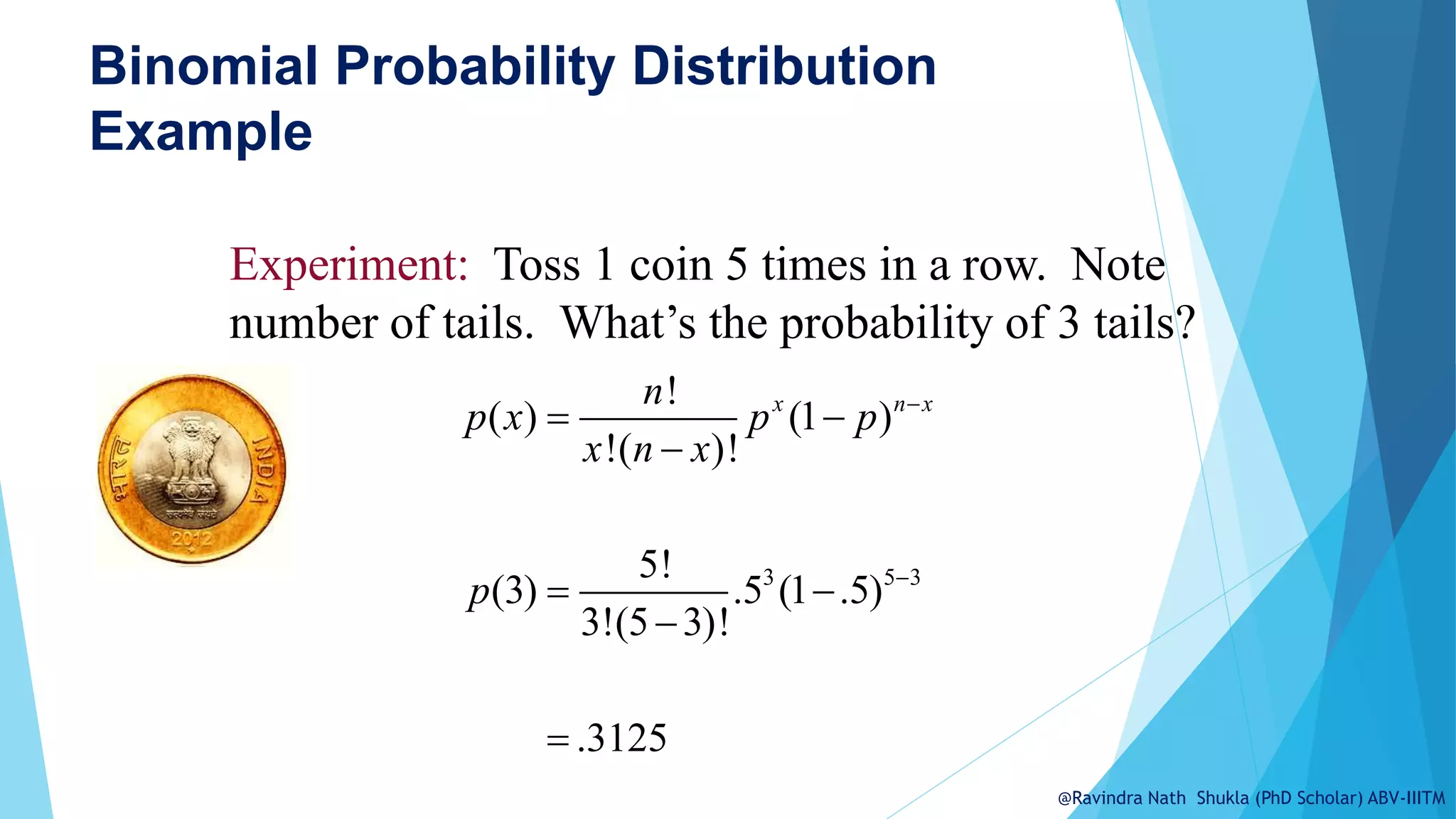
Binomial Probability Distribution
Example
3 5 3
!
( ) (1 )
!( )!
5!
(3) .5 (1 .5)
3!(5 3)!
.3125
x n x
n
p x p p
x n x
p


 

 


Experiment: Toss 1 coin 5 times in a row. Note
number of tails. What’s the probability of 3 tails?
@Ravindra Nath Shukla (PhD Scholar) ABV-IIITM
Poisson Distribution
@Ravindra Nath Shukla (PhD Scholar) ABV-IIITM
Poisson Distribution
1. Number of events that occur in an interval
• events per unit
— Time, Length, Area, Space
2. Examples
 Number of customers arriving in 20 minutes
 Number of strikes per year in the India.
 Number of defects per lot (group) of DVD’s
@Ravindra Nath Shukla (PhD Scholar) ABV-IIITM
Characteristics of a Poisson Random Variable
1. Consists of counting number of times an event
occurs during a given unit of time or in a given area
or volume (any unit of measurement).
2. The probability that an event occurs in a given unit
of time, area, or volume is the same for all units.
3. The number of events that occur in one unit of
time, area, or volume is independent of the number
that occur in any other mutually exclusive unit.
4. The mean number of events in each unit is denoted
by .
@Ravindra Nath Shukla (PhD Scholar) ABV-IIITM
Poisson Probability Distribution
Function

2 
p(x) = Probability of x given 
 = Mean (expected) number of events in unit
e = 2.71828 . . . (base of natural logarithm)
x = Number of events per unit
p x
x
( )
!

x
 
e–
(x = 0, 1, 2, 3, . . .)
@Ravindra Nath Shukla (PhD Scholar) ABV-IIITM
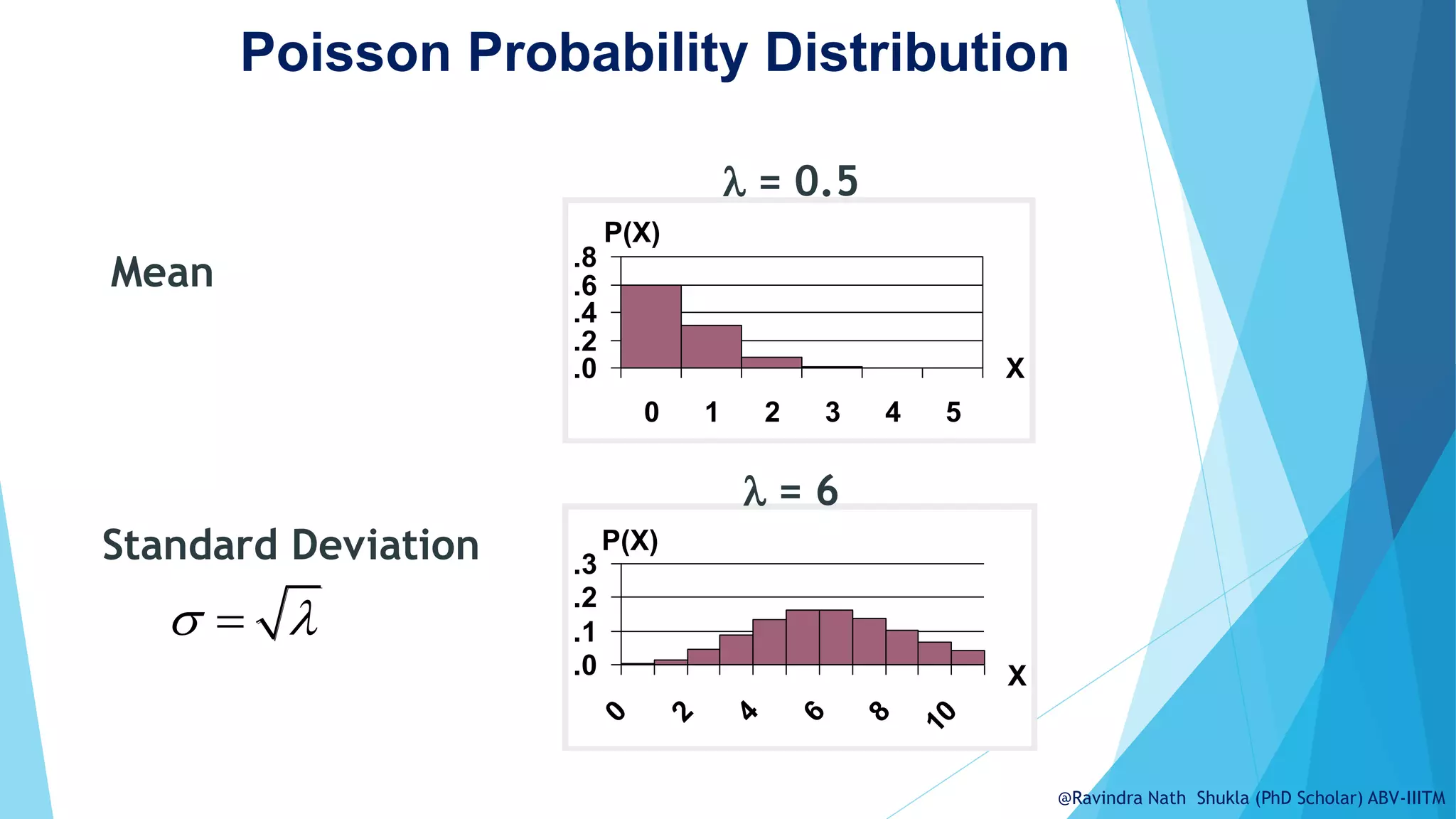
Poisson Probability Distribution
.0
.2
.4
.6
.8
0 1 2 3 4 5
X
P(X)
.0
.1
.2
.3
0
2
4
6
8
1
0
X
P(X)
= 0.5
= 6
Mean
Standard Deviation
 

@Ravindra Nath Shukla (PhD Scholar) ABV-IIITM
Poisson Distribution Example
At a departmental store, 72
customers arrive at store with a
rate of 72 customers per hour.
What is the probability for
arriving 4 customers in 3 minutes?
© 1995 Corel Corp.
@Ravindra Nath Shukla (PhD Scholar) ABV-IIITM
Poisson Distribution Solution
72 Per Hr. = 1.2 Per Min. = 3.6 Per 3 Min. Interval
 
-
4 -3.6
( )
!
3.6
(4) .1912
4!
x
e
p x
x
e
p



 
@Ravindra Nath Shukla (PhD Scholar) ABV-IIITM
Binomial Distribution Thinking Challenge
You’re a telemarketer selling service
contracts for XYZ co., You’ve sold
20 in your last 100 calls (p = .20). If
you call 12 people tonight, what’s
the probability of
A. No sales?
B. Exactly 2 sales?
C. At most 2 sales?
D. At least 2 sales?
@Ravindra Nath Shukla (PhD Scholar) ABV-IIITM
Binomial Distribution Solution*
n = 12, p = .20
A. p(0) = .0687
B. p(2) = .2835
C. p(at most 2) = p(0) + p(1) + p(2)
= .0687 + .2062 + .2835
= .5584
D. p(at least 2) = p(2) + p(3)...+ p(12)
= 1 – [p(0) + p(1)]
= 1 – .0687 – .2062
= .7251
@Ravindra Nath Shukla (PhD Scholar) ABV-IIITM
© 2011 Pearson Education, Inc
Thinking Challenge – Poisson distribution
You work in Quality Assurance for an
investment firm. A clerk enters 75
words per minute with 6 errors per
hour. What is the probability of 0
errors in a 255-word bond
transaction?
© 1984-1994 T/Maker Co.
@Ravindra Nath Shukla (PhD Scholar) ABV-IIITM
Poisson Distribution Solution: Finding
*
 75 words/min = (75 words/min)(60 min/hr)
= 4500 words/hr
 6 errors/hr= 6 errors/4500 words
= .00133 errors/word
 In a 255-word transaction (interval):
 = (.00133 errors/word )(255 words)
= .34 errors/255-word transaction
@Ravindra Nath Shukla (PhD Scholar) ABV-IIITM
© 2011 Pearson Education, Inc
Poisson Distribution Solution: Finding
p(0)*
 
-
0 -.34
( )
!
.34
(0) .7118
0!
x
e
p x
x
e
p



 
@Ravindra Nath Shukla (PhD Scholar) ABV-IIITM
Discrete Distribution.pptx

Discrete Distribution.pptx

  • 1.
    The Discrete distribution MBMG-7104/ ITHS-2202/IMAS-3101/ IMHS-3101 @Ravindra Nath Shukla (PhD Scholar) ABV-IIITM
  • 2.
    What is ProbabilityDistribution? Probability Distribution is a statistical function which links or lists all the possible outcomes a random variable can take, in any random process, with its corresponding probability of occurrence. @Ravindra Nath Shukla (PhD Scholar) ABV-IIITM
  • 3.
    For example, ifyou roll a dice, the outcome is random (not fixed) and there are 6 possible outcomes, each of which occur with probability one-sixth. Or A random variable X takes on a defined set of values with different probabilities. For example, if you toss a fair coin, there are 2 possible outcomes head or tails, each of which occur with probability 1/2. The outcome of having head or tails is random (not fixed). @Ravindra Nath Shukla (PhD Scholar) ABV-IIITM
  • 4.
    Mathematically :- For example,if you toss a fair coin, two times - Then sample Space for getting heads - 𝑆 = { 𝐻𝐻, 𝐻𝑇, 𝑇𝐻, 𝑇𝑇} Let X = no. of heads., P(X) = probability of coming heads. T 4 possible outcomes T H Probability Distribution X Value Probability 0 1/4 = 0.25 1 2/4 = 0.50 2 1/4 = 0.25 T T H H H 0 1 2 X Probability 0.50 0.25 @Ravindra Nath Shukla (PhD Scholar) ABV-IIITM
  • 5.
    PROBABILITY DISTRIBUTION OFA DISCRETE RANDOM VARIABLE Let us consider a discrete r.v. X which can take the possible values x1, x2, x3,…, xn. With each value of the variable X, we associate a number, pi = P(X = Xi ) ; i = 1, 2,…, n which is known as the probability of Xi and satisfies the following conditions : (i) pi = P(X = Xi ) ≥ 0, (i = 1, 2,…, n) …(1) i.e., pi’s are all non-negative. @Ravindra Nath Shukla (PhD Scholar) ABV-IIITM
  • 6.
    PROBABILITY DISTRIBUTION OFA DISCRETE RANDOM VARIABLE and (ii) ∑ pi = p1 + p2 + … + pn = 1, …(2) i.e., the total probability is one. More specifically, let X be a discrete random variable and define : p (x) = P(X = xi) such that p(x) ≥ 0 and ∑ p(x) = 1, @Ravindra Nath Shukla (PhD Scholar) ABV-IIITM
  • 7.
    Requirements for the ProbabilityDistribution of a Discrete Random Variable x 1. p(x) ≥ 0 for all values of x 2.  p(x) = 1 where the summation of p(x) is over all possible values of x. A probability function maps the possible values of x against their respective probabilities of occurrence, p(x) @Ravindra Nath Shukla (PhD Scholar) ABV-IIITM
  • 8.
    Discrete example: rollof a die x p(x) 1/6 1 4 5 6 2 3   x all 1 P(x) @Ravindra Nath Shukla (PhD Scholar) ABV-IIITM
  • 9.
    Probability mass function(pmf) x p(x) 1 p(x=1)=1/6 2 p(x=2)=1/6 3 p(x=3)=1/6 4 p(x=4)=1/6 5 p(x=5)=1/6 6 p(x=6)=1/6 1.0 @Ravindra Nath Shukla (PhD Scholar) ABV-IIITM
  • 10.
    Cumulative distribution function(CDF) All random variables, discrete and continuous have a cumulative distribution function (CDF). Corresponding to any distribution function there is CDF denoted by F(x), which, for any value of xi, gives the probability of the event x≤ xi Therefore, if f(x) is the PMF of x , then CDF is given as CDF for Discrete random variable @Ravindra Nath Shukla (PhD Scholar) ABV-IIITM
  • 11.
    Cumulative distribution function x P(x) 1/6 14 5 6 2 3 1/3 1/2 2/3 5/6 1.0 x P(x≤A) 1 P(x≤1)=1/6 2 P(x≤2)=2/6 3 P(x≤3)=3/6 4 P(x≤4)=4/6 5 P(x≤5)=5/6 6 P(x≤6)=6/6 @Ravindra Nath Shukla (PhD Scholar) ABV-IIITM
  • 12.
    Mean for discretedistribution @Ravindra Nath Shukla (PhD Scholar) ABV-IIITM
  • 13.
    Mean for discretedistribution Example : - When throwing a normal die , let X be the random variable defined by X = the score shown on die Probability distribution X 1 2 3 4 5 6 P(x) 1/6 1/6 1/6 1/6 1/6 1/6 Or 𝐸(𝑋) = 1 × 1 6 + 2 × 1 6 + 3 × 1 6 + 4 × 1 6 + 5 × 1 6 + 6 × 1 6 = 1 6 1 + 2 + 3 + 4 + 5 + 6 = 21 6 = 7 2 = 3.5 @Ravindra Nath Shukla (PhD Scholar) ABV-IIITM
  • 14.
    Variance for discretedistribution Example : - for above example X = the score shown on die 𝐸(𝑋2) = 12 × 1 6 + 22 × 1 6 + 32 × 1 6 + 42 × 1 6 + 52 × 1 6 + 62 × 1 6 = 1 6 12 + 22 + 32 + 42 + 52 + 62 = 1 6 1 + 4 + 9 + 16 + 25 + 36 = 91 6 @Ravindra Nath Shukla (PhD Scholar) ABV-IIITM
  • 15.
    Variance for discretedistribution Hence Variance 𝑉 𝑋 = 𝐸 𝑋2 − 𝐸 𝑋 2 = 91 6 − 7 2 2 = 35 12 = 2.916 Thus , standard deviation 𝜎 = 𝑉(𝑋) = 2.916 = 1.7076 @Ravindra Nath Shukla (PhD Scholar) ABV-IIITM
  • 16.
    Mean & Variancefor discrete distribution Example : - A company XYZ, estimates the net profit of a new product it is launching, to be Rs. 3,000,000 during the first year if it is successful, Rs. 1,000,000 if it is moderately successful and a loss of Rs. 1,000,000. The company assigns the following probabilities to first year prospectus for the product, successful: 0.15, moderately successful : 0.25, and unsuccessful : 0.60. What are the expected value and standard deviation of first year net profit for the product? Hence Variance 𝑉 𝑋 = 𝐸 𝑋2 − 𝐸 𝑋 2 standard deviation 𝜎 = 𝑉(𝑋) @Ravindra Nath Shukla (PhD Scholar) ABV-IIITM
  • 17.
    © 2011 PearsonEducation, Inc @Ravindra Nath Shukla (PhD Scholar) ABV-IIITM
  • 18.
    Common Probability Distribution @RavindraNath Shukla (PhD Scholar) ABV-IIITM
  • 19.
    © 2011 PearsonEducation, Inc Uniform Distribution @Ravindra Nath Shukla (PhD Scholar) ABV-IIITM
  • 20.
    Discrete example: rollof a die x p(x) 1/6 1 4 5 6 2 3   x all 1 P(x) 𝑋 ~ 𝑈 𝑎, 𝑏 X~ U(1,6) All outcomes has equal probability @Ravindra Nath Shukla (PhD Scholar) ABV-IIITM
  • 21.
    Bernoulli Distribution @Ravindra NathShukla (PhD Scholar) ABV-IIITM
  • 22.
    Discrete example: Trueor Falls 𝑋 ~ 𝐵𝑒𝑟𝑛 𝑝 T H @Ravindra Nath Shukla (PhD Scholar) ABV-IIITM
  • 23.
    @Ravindra Nath Shukla(PhD Scholar) ABV-IIITM
  • 24.
    Binomial Distribution @Ravindra NathShukla (PhD Scholar) ABV-IIITM
  • 25.
    Binomial Distribution @Ravindra NathShukla (PhD Scholar) ABV-IIITM
  • 26.
    Binomial Probability The Binomialdistribution is also know as the outcome of Bernoulli process. A Bernoulli process is a random process in which : a. The process is performed under the same conditions for a fixed and finite number of trials, say, n. b. Each trial is independent of other trials, i.e the probability of an outcome for any particular trial is not influenced by the outcomes of the other trials. c. Each trial has two mutually exclusive possible outcomes, such as "success" or "failure", "good or "defective", "yes" or "no", "hit" or "miss", and so on. The outcomes are usually called success and failure for convenience. d. The probability of success, p, remains constant from trial to trial (so is the probability of failure q, where, q = 1-p). @Ravindra Nath Shukla (PhD Scholar) ABV-IIITM
  • 27.
    Binomial Probability Characteristics ofa Binomial Experiment 1. The experiment consists of n identical trials. 2. There are only two possible outcomes on each trial. We will denote one outcome by S (for success) and the other by F (for failure). 3. The probability of S remains the same from trial to trial. This probability is denoted by p, and the probability of F is denoted by q. Note that q = 1 – p. 4. The trials are independent. 5. The binomial random variable x is the number of S’s in n trials. @Ravindra Nath Shukla (PhD Scholar) ABV-IIITM
  • 28.
    Binomial Probability Distribution ! () (1 ) ! ( )! x n x x n x n n p x p q p p x x n x             p(x) = Probability of x ‘Successes’ p = Probability of a ‘Success’ on a single trial q = 1 – p n = Number of trials x = Number of ‘Successes’ in n trials (x = 0, 1, 2, ..., n) n – x = Number of failures in n trials @Ravindra Nath Shukla (PhD Scholar) ABV-IIITM
  • 29.
    Binomial Distribution .0 .5 1.0 0 12 3 4 5 X P(X) .0 .2 .4 .6 0 1 2 3 4 5 X P(X) n = 5 p = 0.1 n = 5 p = 0.5 @Ravindra Nath Shukla (PhD Scholar) ABV-IIITM
  • 30.
    Binomial Probability Distribution Example 35 3 ! ( ) (1 ) !( )! 5! (3) .5 (1 .5) 3!(5 3)! .3125 x n x n p x p p x n x p          Experiment: Toss 1 coin 5 times in a row. Note number of tails. What’s the probability of 3 tails? @Ravindra Nath Shukla (PhD Scholar) ABV-IIITM
  • 31.
    Poisson Distribution @Ravindra NathShukla (PhD Scholar) ABV-IIITM
  • 32.
    Poisson Distribution 1. Numberof events that occur in an interval • events per unit — Time, Length, Area, Space 2. Examples  Number of customers arriving in 20 minutes  Number of strikes per year in the India.  Number of defects per lot (group) of DVD’s @Ravindra Nath Shukla (PhD Scholar) ABV-IIITM
  • 33.
    Characteristics of aPoisson Random Variable 1. Consists of counting number of times an event occurs during a given unit of time or in a given area or volume (any unit of measurement). 2. The probability that an event occurs in a given unit of time, area, or volume is the same for all units. 3. The number of events that occur in one unit of time, area, or volume is independent of the number that occur in any other mutually exclusive unit. 4. The mean number of events in each unit is denoted by . @Ravindra Nath Shukla (PhD Scholar) ABV-IIITM
  • 34.
    Poisson Probability Distribution Function  2 p(x) = Probability of x given   = Mean (expected) number of events in unit e = 2.71828 . . . (base of natural logarithm) x = Number of events per unit p x x ( ) !  x   e– (x = 0, 1, 2, 3, . . .) @Ravindra Nath Shukla (PhD Scholar) ABV-IIITM
  • 35.
    Poisson Probability Distribution .0 .2 .4 .6 .8 01 2 3 4 5 X P(X) .0 .1 .2 .3 0 2 4 6 8 1 0 X P(X) = 0.5 = 6 Mean Standard Deviation    @Ravindra Nath Shukla (PhD Scholar) ABV-IIITM
  • 36.
    Poisson Distribution Example Ata departmental store, 72 customers arrive at store with a rate of 72 customers per hour. What is the probability for arriving 4 customers in 3 minutes? © 1995 Corel Corp. @Ravindra Nath Shukla (PhD Scholar) ABV-IIITM
  • 37.
    Poisson Distribution Solution 72Per Hr. = 1.2 Per Min. = 3.6 Per 3 Min. Interval   - 4 -3.6 ( ) ! 3.6 (4) .1912 4! x e p x x e p      @Ravindra Nath Shukla (PhD Scholar) ABV-IIITM
  • 38.
    Binomial Distribution ThinkingChallenge You’re a telemarketer selling service contracts for XYZ co., You’ve sold 20 in your last 100 calls (p = .20). If you call 12 people tonight, what’s the probability of A. No sales? B. Exactly 2 sales? C. At most 2 sales? D. At least 2 sales? @Ravindra Nath Shukla (PhD Scholar) ABV-IIITM
  • 39.
    Binomial Distribution Solution* n= 12, p = .20 A. p(0) = .0687 B. p(2) = .2835 C. p(at most 2) = p(0) + p(1) + p(2) = .0687 + .2062 + .2835 = .5584 D. p(at least 2) = p(2) + p(3)...+ p(12) = 1 – [p(0) + p(1)] = 1 – .0687 – .2062 = .7251 @Ravindra Nath Shukla (PhD Scholar) ABV-IIITM
  • 40.
    © 2011 PearsonEducation, Inc Thinking Challenge – Poisson distribution You work in Quality Assurance for an investment firm. A clerk enters 75 words per minute with 6 errors per hour. What is the probability of 0 errors in a 255-word bond transaction? © 1984-1994 T/Maker Co. @Ravindra Nath Shukla (PhD Scholar) ABV-IIITM
  • 41.
    Poisson Distribution Solution:Finding *  75 words/min = (75 words/min)(60 min/hr) = 4500 words/hr  6 errors/hr= 6 errors/4500 words = .00133 errors/word  In a 255-word transaction (interval):  = (.00133 errors/word )(255 words) = .34 errors/255-word transaction @Ravindra Nath Shukla (PhD Scholar) ABV-IIITM
  • 42.
    © 2011 PearsonEducation, Inc Poisson Distribution Solution: Finding p(0)*   - 0 -.34 ( ) ! .34 (0) .7118 0! x e p x x e p      @Ravindra Nath Shukla (PhD Scholar) ABV-IIITM