Probability Distributions
Random Variable
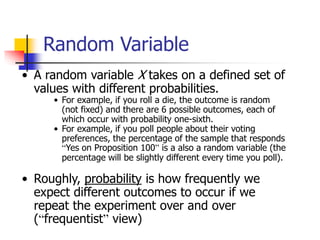
• A random variable X takes on a defined set of
values with different probabilities.
• For example, if you roll a die, the outcome is random
(not fixed) and there are 6 possible outcomes, each of
which occur with probability one-sixth.
• For example, if you poll people about their voting
preferences, the percentage of the sample that responds
“Yes on Proposition 100” is a also a random variable (the
percentage will be slightly different every time you poll).
• Roughly, probability is how frequently we
expect different outcomes to occur if we
repeat the experiment over and over
(“frequentist” view)
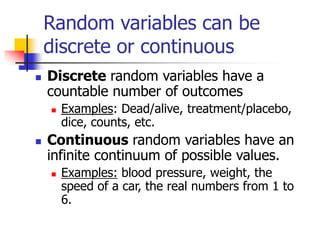
Random variables can be
discrete or continuous
◼ Discrete random variables have a
countable number of outcomes
◼ Examples: Dead/alive, treatment/placebo,
dice, counts, etc.
◼ Continuous random variables have an
infinite continuum of possible values.
◼ Examples: blood pressure, weight, the
speed of a car, the real numbers from 1 to
6.
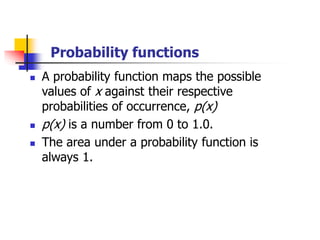
Probability functions
◼ A probability function maps the possible
values of x against their respective
probabilities of occurrence, p(x)
◼ p(x) is a number from 0 to 1.0.
◼ The area under a probability function is
always 1.
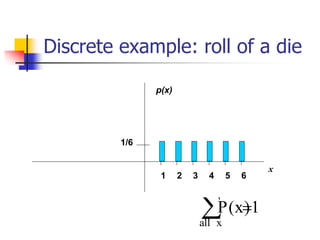
Discrete example: roll of a die
x
p(x)
1/6
1 4 5 6
2 3
 =
x
all
1
P(x)
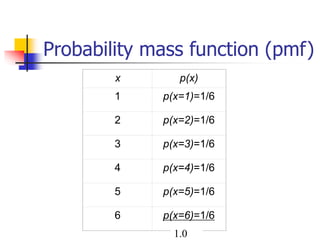
Probability mass function (pmf)
x p(x)
1 p(x=1)=1/6
2 p(x=2)=1/6
3 p(x=3)=1/6
4 p(x=4)=1/6
5 p(x=5)=1/6
6 p(x=6)=1/6
1.0
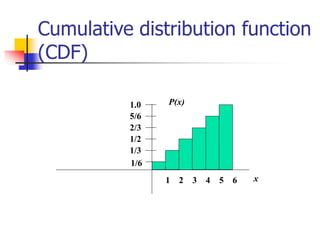
Cumulative distribution function
(CDF)
x
P(x)
1/6
1 4 5 6
2 3
1/3
1/2
2/3
5/6
1.0
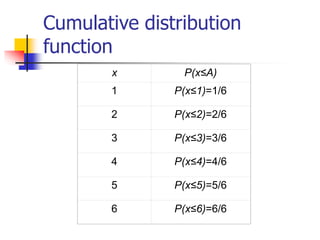
Cumulative distribution
function
x P(x≤A)
1 P(x≤1)=1/6
2 P(x≤2)=2/6
3 P(x≤3)=3/6
4 P(x≤4)=4/6
5 P(x≤5)=5/6
6 P(x≤6)=6/6
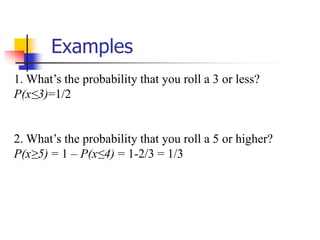
Examples
1. What’s the probability that you roll a 3 or less?
P(x≤3)=1/2
2. What’s the probability that you roll a 5 or higher?
P(x≥5) = 1 – P(x≤4) = 1-2/3 = 1/3
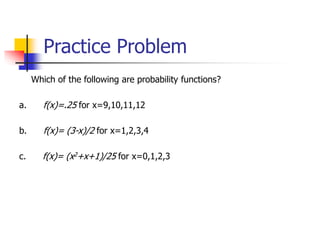
Practice Problem
Which of the following are probability functions?
a. f(x)=.25 for x=9,10,11,12
b. f(x)= (3-x)/2 for x=1,2,3,4
c. f(x)= (x2+x+1)/25 for x=0,1,2,3
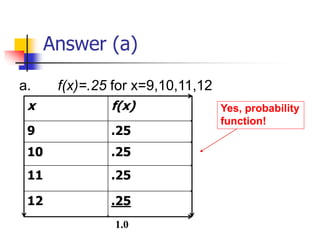
Answer (a)
a. f(x)=.25 for x=9,10,11,12
Yes, probability
function!
x f(x)
9 .25
10 .25
11 .25
12 .25
1.0
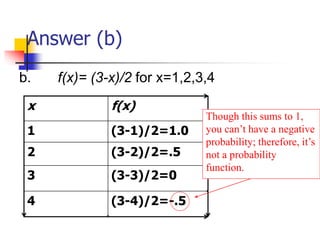
Answer (b)
b. f(x)= (3-x)/2 for x=1,2,3,4
x f(x)
1 (3-1)/2=1.0
2 (3-2)/2=.5
3 (3-3)/2=0
4 (3-4)/2=-.5
Though this sums to 1,
you can’t have a negative
probability; therefore, it’s
not a probability
function.
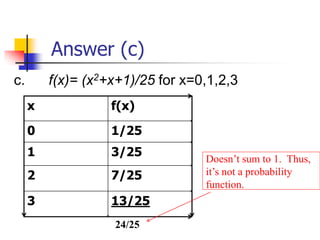
Answer (c)
c. f(x)= (x2+x+1)/25 for x=0,1,2,3
x f(x)
0 1/25
1 3/25
2 7/25
3 13/25
Doesn’t sum to 1. Thus,
it’s not a probability
function.
24/25
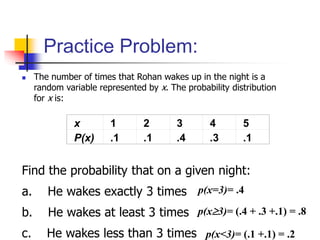
Practice Problem:
◼ The number of times that Rohan wakes up in the night is a
random variable represented by x. The probability distribution
for x is:
x 1 2 3 4 5
P(x) .1 .1 .4 .3 .1
Find the probability that on a given night:
a. He wakes exactly 3 times
b. He wakes at least 3 times
c. He wakes less than 3 times
p(x=3)= .4
p(x3)= (.4 + .3 +.1) = .8
p(x<3)= (.1 +.1) = .2
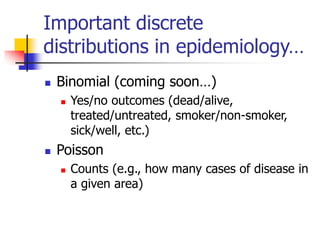
Important discrete
distributions in epidemiology…
◼ Binomial (coming soon…)
◼ Yes/no outcomes (dead/alive,
treated/untreated, smoker/non-smoker,
sick/well, etc.)
◼ Poisson
◼ Counts (e.g., how many cases of disease in
a given area)
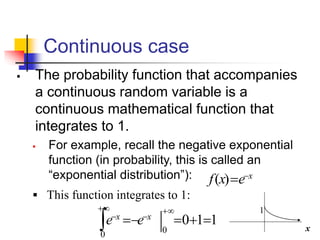
Continuous case
▪ The probability function that accompanies
a continuous random variable is a
continuous mathematical function that
integrates to 1.
▪ For example, recall the negative exponential
function (in probability, this is called an
“exponential distribution”): x
e
x
f −
=
)
(
1
1
0
0
0
=
+
=
−
=
+
−
+
−
 x
x
e
e
▪ This function integrates to 1:
x
1
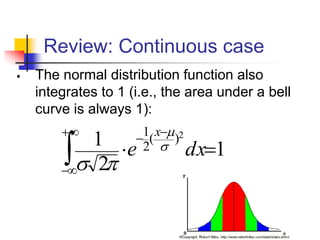
Review: Continuous case
▪ The normal distribution function also
integrates to 1 (i.e., the area under a bell
curve is always 1):
1
2
1 2
)
(
2
1
=


+

−
−
−
dx
e
x




Review: Continuous case
▪ The probabilities associated with
continuous functions are just areas under
the curve (integrals!).
▪ Probabilities are given for a range of
values, rather than a particular value (e.g.,
the probability of getting a math SAT score
between 700 and 800 is 2%).
Expected Value and Variance
◼ All probability distributions are
characterized by an expected value
(=mean!) and a variance (standard
deviation squared).
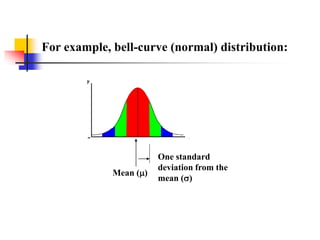
For example, bell-curve (normal) distribution:
One standard
deviation from the
mean ()
Mean ()
Expected value, or mean
◼ If we understand the underlying probability function of a
certain phenomenon, then we can make informed
decisions based on how we expect x to behave on-average
over the long-run…(so called “frequentist” theory of
probability).
◼ Expected value is just the weighted average or mean (µ)
of random variable x. Imagine placing the masses p(x) at
the points X on a beam; the balance point of the beam is
the expected value of x.
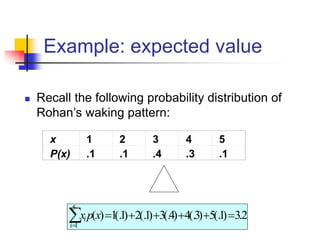
Example: expected value
◼ Recall the following probability distribution of
Rohan’s waking pattern:

=
=
+
+
+
+
=
5
1
2
.
3
)
1
(.
5
)
3
(.
4
)
4
(.
3
)
1
(.
2
)
1
(.
1
)
(
i
i x
p
x
x 1 2 3 4 5
P(x) .1 .1 .4 .3 .1
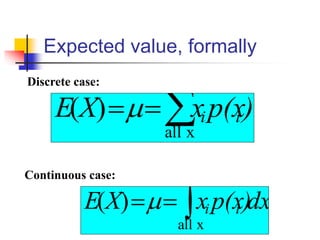
Expected value, formally

=
=
x
all
)
( )
p(x
x
X
E i
i

Discrete case:
Continuous case:
dx
)
p(x
x
X
E i
i

=
=
x
all
)
( 
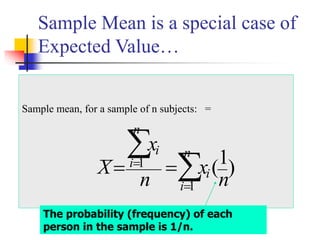
Sample Mean is a special case of
Expected Value…
Sample mean, for a sample of n subjects: =
)
1
(
1
1
n
x
n
x
X
n
i
i
n
i
i


=
=
=
=
The probability (frequency) of each
person in the sample is 1/n.
Variance/standard deviation
“The average (expected) squared
distance (or deviation) from the mean”
 −
=
−
=
=
x
all
2
2
2
)
(
]
)
[(
)
( )
p(x
x
x
E
x
Var i
i 


**We square because squaring has better properties than
absolute value. Take square root to get back linear average
distance from the mean (=”standard deviation”).
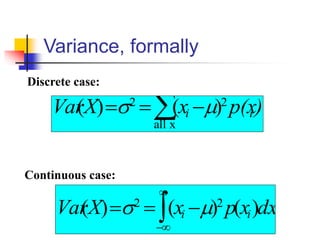
Variance, formally
 −
=
=
x
all
2
2
)
(
)
( )
p(x
x
X
Var i
i 

Discrete case:
Continuous case:



−
−
=
= dx
x
p
x
X
Var i
i )
(
)
(
)
( 2
2


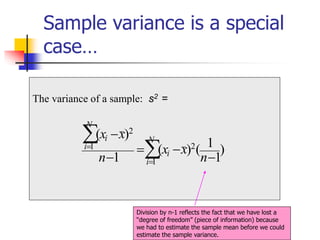
Sample variance is a special
case…
The variance of a sample: s2 =
)
1
1
(
)
(
1
)
(
2
1
2
1
−
−
=
−
−


=
=
n
x
x
n
x
x N
i
i
N
i
i
Division by n-1 reflects the fact that we have lost a
“degree of freedom” (piece of information) because
we had to estimate the sample mean before we could
estimate the sample variance.
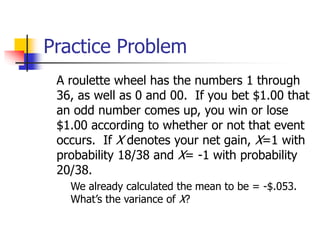
Practice Problem
A roulette wheel has the numbers 1 through
36, as well as 0 and 00. If you bet $1.00 that
an odd number comes up, you win or lose
$1.00 according to whether or not that event
occurs. If X denotes your net gain, X=1 with
probability 18/38 and X= -1 with probability
20/38.
◼ We already calculated the mean to be = -$.053.
What’s the variance of X?
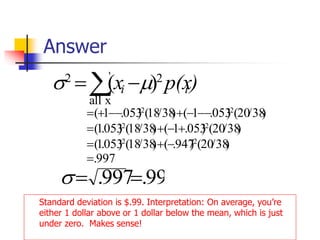
Answer
Standard deviation is $.99. Interpretation: On average, you’re
either 1 dollar above or 1 dollar below the mean, which is just
under zero. Makes sense!
 −
=
x
all
2
2
)
( )
p(x
x i
i 

997
.
)
38
/
20
(
)
947
.
(
)
38
/
18
(
)
053
.
1
(
)
38
/
20
(
)
053
.
1
(
)
38
/
18
(
)
053
.
1
(
)
38
/
20
(
)
053
.
1
(
)
38
/
18
(
)
053
.
1
(
2
2
2
2
2
2
=
−
+
=
+
−
+
=
−
−
−
+
−
−
+
=
99
.
997
. =
=

calculation formula!
2
x
all
2
x
all
2
)
(
)
(
)
( 
 −
=
−
= 
 )
p(x
x
)
p(x
x
X
Var i
i
i
i
Intervening algebra!
2
2
)]
(
[
)
( x
E
x
E −
=
For example, what are the mean and
standard deviation of the roll of a die?
x p(x)
1 p(x=1)=1/6
2 p(x=2)=1/6
3 p(x=3)=1/6
4 p(x=4)=1/6
5 p(x=5)=1/6
6 p(x=6)=1/6
1.0
17
.
15
)
6
1
(
36
)
6
1
(
25
)
6
1
(
16
)
6
1
(
9
)
6
1
(
4
)
6
1
)(
1
(
)
(
x
all
2
2
=
+
+
+
+
+
=
= )
p(x
x
x
E i
i
5
.
3
6
21
)
6
1
(
6
)
6
1
(
5
)
6
1
(
4
)
6
1
(
3
)
6
1
(
2
)
6
1
)(
1
(
)
(
x
all
=
=
+
+
+
+
+
=
= )
p(x
x
x
E i
i
71
.
1
92
.
2
92
.
2
5
.
3
17
.
15
)]
(
[
)
(
)
( 2
2
2
2
=
=
=
−
=
−
=
=
x
x x
E
x
E
x
Var


x
p(x)
1/6
1 4 5 6
2 3
mean
average distance from the mean
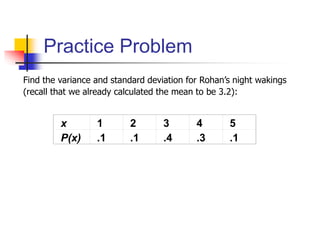
Practice Problem
Find the variance and standard deviation for Rohan’s night wakings
(recall that we already calculated the mean to be 3.2):
x 1 2 3 4 5
P(x) .1 .1 .4 .3 .1
Answer:
08
.
1
16
.
1
)
(
16
.
1
2
.
3
4
.
11
)]
(
[
)
(
)
(
4
.
11
)
1
(.
25
)
3
(.
16
)
4
(.
9
)
1
)(.
4
(
)
1
)(.
1
(
)
(
)
(
2
2
2
5
1
2
2
=
=
=
−
=
−
=
=
+
+
+
+
=
=
=
x
stddev
x
E
x
E
x
Var
x
p
x
x
E
i
i
i
Interpretation: On an average night, we expect Rohan to
awaken 3 times, plus or minus 1.08. This gives you a feel for
what would be considered an unusual night!
x2 1 4 9 16 25
P(x) .1 .1 .4 .3 .1
continuous
probability(Gaussian)
distributions:
The normal and standard normal
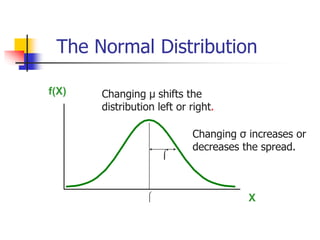
The Normal Distribution
X
f(X)


Changing μ shifts the
distribution left or right.
Changing σ increases or
decreases the spread.
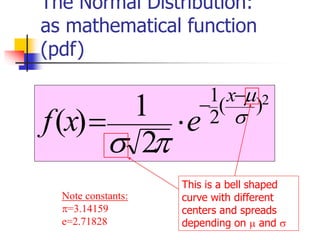
The Normal Distribution:
as mathematical function
(pdf)
2
)
(
2
1
2
1
)
( 



−
−

=
x
e
x
f
Note constants:
=3.14159
e=2.71828
This is a bell shaped
curve with different
centers and spreads
depending on  and 
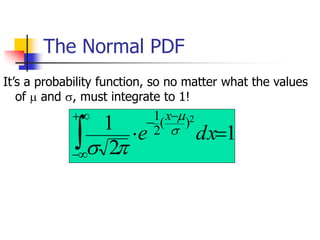
The Normal PDF
1
2
1 2
)
(
2
1
=


+

−
−
−
dx
e
x




It’s a probability function, so no matter what the values
of  and , must integrate to 1!
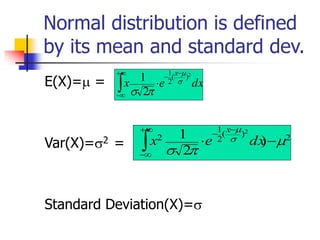
Normal distribution is defined
by its mean and standard dev.
E(X)= =
Var(X)=2 =
Standard Deviation(X)=
dx
e
x
x

+

−
−
−

2
)
(
2
1
2
1 



2
)
(
2
1
2
)
2
1
(
2





−


+

−
−
−
dx
e
x
x
**The beauty of the normal curve:
No matter what  and  are, the area between - and
+ is about 68%; the area between -2 and +2 is
about 95%; and the area between -3 and +3 is
about 99.7%. Almost all values fall within 3 standard
deviations.
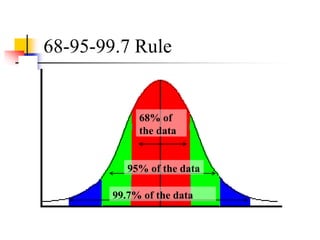
68-95-99.7 Rule
68% of
the data
95% of the data
99.7% of the data
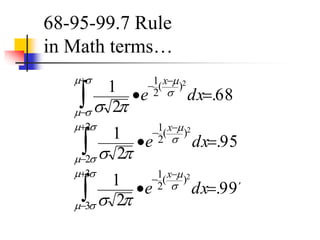
68-95-99.7 Rule
in Math terms…
997
.
2
1
95
.
2
1
68
.
2
1
3
3
)
(
2
1
2
2
)
(
2
1
)
(
2
1
2
2
2
=
•
=
•
=
•



+
−
−
−
+
−
−
−
+
−
−
−
























dx
e
dx
e
dx
e
x
x
x
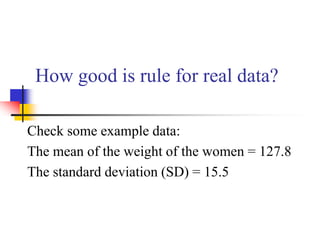
How good is rule for real data?
Check some example data:
The mean of the weight of the women = 127.8
The standard deviation (SD) = 15.5
80 90 100 110 120 130 140 150 160
0
5
10
15
20
25
P
e
r
c
e
n
t
POUNDS
127.8 143.3
112.3
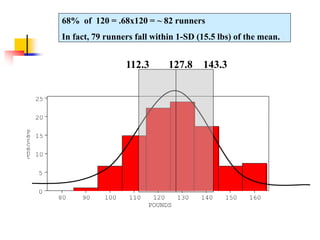
68% of 120 = .68x120 = ~ 82 runners
In fact, 79 runners fall within 1-SD (15.5 lbs) of the mean.
80 90 100 110 120 130 140 150 160
0
5
10
15
20
25
P
e
r
c
e
n
t
POUNDS
127.8
96.8
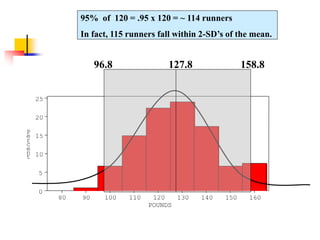
95% of 120 = .95 x 120 = ~ 114 runners
In fact, 115 runners fall within 2-SD’s of the mean.
158.8
80 90 100 110 120 130 140 150 160
0
5
10
15
20
25
P
e
r
c
e
n
t
POUNDS
127.8
81.3
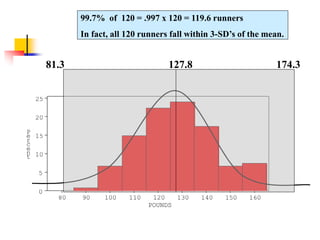
99.7% of 120 = .997 x 120 = 119.6 runners
In fact, all 120 runners fall within 3-SD’s of the mean.
174.3
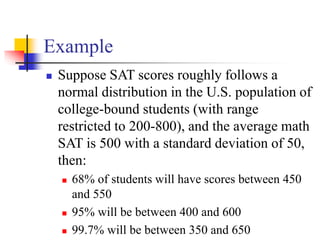
Example
◼ Suppose SAT scores roughly follows a
normal distribution in the U.S. population of
college-bound students (with range
restricted to 200-800), and the average math
SAT is 500 with a standard deviation of 50,
then:
◼ 68% of students will have scores between 450
and 550
◼ 95% will be between 400 and 600
◼ 99.7% will be between 350 and 650
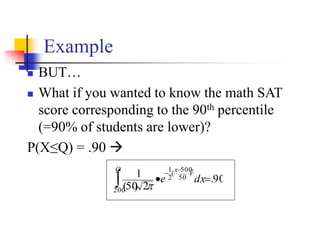
Example
◼ BUT…
◼ What if you wanted to know the math SAT
score corresponding to the 90th percentile
(=90% of students are lower)?
P(X≤Q) = .90 →
90
.
2
)
50
(
1
200
)
50
500
(
2
1 2
=
•

−
−
Q x
dx
e

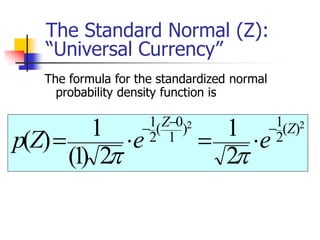
The Standard Normal (Z):
“Universal Currency”
The formula for the standardized normal
probability density function is
2
2 )
(
2
1
)
1
0
(
2
1
2
1
2
)
1
(
1
)
(
Z
Z
e
e
Z
p
−
−
−

=

=


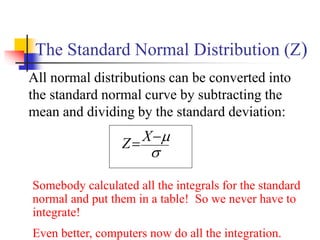
The Standard Normal Distribution (Z)
All normal distributions can be converted into
the standard normal curve by subtracting the
mean and dividing by the standard deviation:


−
= X
Z
Somebody calculated all the integrals for the standard
normal and put them in a table! So we never have to
integrate!
Even better, computers now do all the integration.
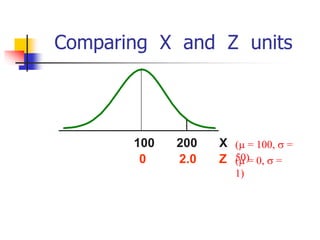
Comparing X and Z units
Z
100
2.0
0
200 X ( = 100,  =
50)
( = 0,  =
1)
Example
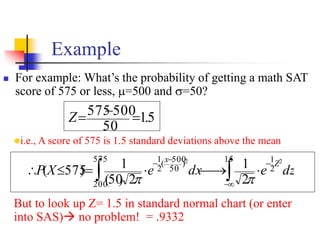
◼ For example: What’s the probability of getting a math SAT
score of 575 or less, =500 and =50?
5
.
1
50
500
575 =
−
=
Z
⚫i.e., A score of 575 is 1.5 standard deviations above the mean

 
−
−
−
−

⎯
→
⎯

=


5
.
1
2
1
575
200
)
50
500
(
2
1 2
2
2
1
2
)
50
(
1
)
575
( dz
e
dx
e
X
P
Z
x


But to look up Z= 1.5 in standard normal chart (or enter
into SAS)→ no problem! = .9332
Answer
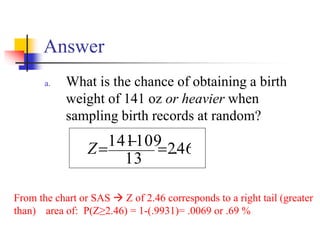
a. What is the chance of obtaining a birth
weight of 141 oz or heavier when
sampling birth records at random?
46
.
2
13
109
141 =
−
=
Z
From the chart or SAS → Z of 2.46 corresponds to a right tail (greater
than) area of: P(Z≥2.46) = 1-(.9931)= .0069 or .69 %
Answer
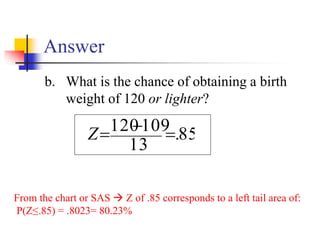
b. What is the chance of obtaining a birth
weight of 120 or lighter?
From the chart or SAS → Z of .85 corresponds to a left tail area of:
P(Z≤.85) = .8023= 80.23%
85
.
13
109
120 =
−
=
Z
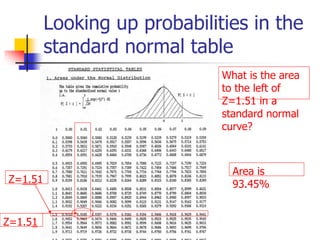
Looking up probabilities in the
standard normal table
What is the area
to the left of
Z=1.51 in a
standard normal
curve?
Z=1.51
Z=1.51
Area is
93.45%

Machine Learning - Probability Distribution.pdf

  • 1.
  • 2.
    Random Variable • Arandom variable X takes on a defined set of values with different probabilities. • For example, if you roll a die, the outcome is random (not fixed) and there are 6 possible outcomes, each of which occur with probability one-sixth. • For example, if you poll people about their voting preferences, the percentage of the sample that responds “Yes on Proposition 100” is a also a random variable (the percentage will be slightly different every time you poll). • Roughly, probability is how frequently we expect different outcomes to occur if we repeat the experiment over and over (“frequentist” view)
  • 3.
    Random variables canbe discrete or continuous ◼ Discrete random variables have a countable number of outcomes ◼ Examples: Dead/alive, treatment/placebo, dice, counts, etc. ◼ Continuous random variables have an infinite continuum of possible values. ◼ Examples: blood pressure, weight, the speed of a car, the real numbers from 1 to 6.
  • 4.
    Probability functions ◼ Aprobability function maps the possible values of x against their respective probabilities of occurrence, p(x) ◼ p(x) is a number from 0 to 1.0. ◼ The area under a probability function is always 1.
  • 5.
    Discrete example: rollof a die x p(x) 1/6 1 4 5 6 2 3  = x all 1 P(x)
  • 6.
    Probability mass function(pmf) x p(x) 1 p(x=1)=1/6 2 p(x=2)=1/6 3 p(x=3)=1/6 4 p(x=4)=1/6 5 p(x=5)=1/6 6 p(x=6)=1/6 1.0
  • 7.
  • 8.
    Cumulative distribution function x P(x≤A) 1P(x≤1)=1/6 2 P(x≤2)=2/6 3 P(x≤3)=3/6 4 P(x≤4)=4/6 5 P(x≤5)=5/6 6 P(x≤6)=6/6
  • 9.
    Examples 1. What’s theprobability that you roll a 3 or less? P(x≤3)=1/2 2. What’s the probability that you roll a 5 or higher? P(x≥5) = 1 – P(x≤4) = 1-2/3 = 1/3
  • 10.
    Practice Problem Which ofthe following are probability functions? a. f(x)=.25 for x=9,10,11,12 b. f(x)= (3-x)/2 for x=1,2,3,4 c. f(x)= (x2+x+1)/25 for x=0,1,2,3
  • 11.
    Answer (a) a. f(x)=.25for x=9,10,11,12 Yes, probability function! x f(x) 9 .25 10 .25 11 .25 12 .25 1.0
  • 12.
    Answer (b) b. f(x)=(3-x)/2 for x=1,2,3,4 x f(x) 1 (3-1)/2=1.0 2 (3-2)/2=.5 3 (3-3)/2=0 4 (3-4)/2=-.5 Though this sums to 1, you can’t have a negative probability; therefore, it’s not a probability function.
  • 13.
    Answer (c) c. f(x)=(x2+x+1)/25 for x=0,1,2,3 x f(x) 0 1/25 1 3/25 2 7/25 3 13/25 Doesn’t sum to 1. Thus, it’s not a probability function. 24/25
  • 14.
    Practice Problem: ◼ Thenumber of times that Rohan wakes up in the night is a random variable represented by x. The probability distribution for x is: x 1 2 3 4 5 P(x) .1 .1 .4 .3 .1 Find the probability that on a given night: a. He wakes exactly 3 times b. He wakes at least 3 times c. He wakes less than 3 times p(x=3)= .4 p(x3)= (.4 + .3 +.1) = .8 p(x<3)= (.1 +.1) = .2
  • 15.
    Important discrete distributions inepidemiology… ◼ Binomial (coming soon…) ◼ Yes/no outcomes (dead/alive, treated/untreated, smoker/non-smoker, sick/well, etc.) ◼ Poisson ◼ Counts (e.g., how many cases of disease in a given area)
  • 16.
    Continuous case ▪ Theprobability function that accompanies a continuous random variable is a continuous mathematical function that integrates to 1. ▪ For example, recall the negative exponential function (in probability, this is called an “exponential distribution”): x e x f − = ) ( 1 1 0 0 0 = + = − = + − + −  x x e e ▪ This function integrates to 1: x 1
  • 17.
    Review: Continuous case ▪The normal distribution function also integrates to 1 (i.e., the area under a bell curve is always 1): 1 2 1 2 ) ( 2 1 =   +  − − − dx e x    
  • 18.
    Review: Continuous case ▪The probabilities associated with continuous functions are just areas under the curve (integrals!). ▪ Probabilities are given for a range of values, rather than a particular value (e.g., the probability of getting a math SAT score between 700 and 800 is 2%).
  • 19.
    Expected Value andVariance ◼ All probability distributions are characterized by an expected value (=mean!) and a variance (standard deviation squared).
  • 20.
    For example, bell-curve(normal) distribution: One standard deviation from the mean () Mean ()
  • 21.
    Expected value, ormean ◼ If we understand the underlying probability function of a certain phenomenon, then we can make informed decisions based on how we expect x to behave on-average over the long-run…(so called “frequentist” theory of probability). ◼ Expected value is just the weighted average or mean (µ) of random variable x. Imagine placing the masses p(x) at the points X on a beam; the balance point of the beam is the expected value of x.
  • 22.
    Example: expected value ◼Recall the following probability distribution of Rohan’s waking pattern:  = = + + + + = 5 1 2 . 3 ) 1 (. 5 ) 3 (. 4 ) 4 (. 3 ) 1 (. 2 ) 1 (. 1 ) ( i i x p x x 1 2 3 4 5 P(x) .1 .1 .4 .3 .1
  • 23.
    Expected value, formally  = = x all ) () p(x x X E i i  Discrete case: Continuous case: dx ) p(x x X E i i  = = x all ) ( 
  • 24.
    Sample Mean isa special case of Expected Value… Sample mean, for a sample of n subjects: = ) 1 ( 1 1 n x n x X n i i n i i   = = = = The probability (frequency) of each person in the sample is 1/n.
  • 25.
    Variance/standard deviation “The average(expected) squared distance (or deviation) from the mean”  − = − = = x all 2 2 2 ) ( ] ) [( ) ( ) p(x x x E x Var i i    **We square because squaring has better properties than absolute value. Take square root to get back linear average distance from the mean (=”standard deviation”).
  • 26.
    Variance, formally  − = = x all 2 2 ) ( ) () p(x x X Var i i   Discrete case: Continuous case:    − − = = dx x p x X Var i i ) ( ) ( ) ( 2 2  
  • 27.
    Sample variance isa special case… The variance of a sample: s2 = ) 1 1 ( ) ( 1 ) ( 2 1 2 1 − − = − −   = = n x x n x x N i i N i i Division by n-1 reflects the fact that we have lost a “degree of freedom” (piece of information) because we had to estimate the sample mean before we could estimate the sample variance.
  • 28.
    Practice Problem A roulettewheel has the numbers 1 through 36, as well as 0 and 00. If you bet $1.00 that an odd number comes up, you win or lose $1.00 according to whether or not that event occurs. If X denotes your net gain, X=1 with probability 18/38 and X= -1 with probability 20/38. ◼ We already calculated the mean to be = -$.053. What’s the variance of X?
  • 29.
    Answer Standard deviation is$.99. Interpretation: On average, you’re either 1 dollar above or 1 dollar below the mean, which is just under zero. Makes sense!  − = x all 2 2 ) ( ) p(x x i i   997 . ) 38 / 20 ( ) 947 . ( ) 38 / 18 ( ) 053 . 1 ( ) 38 / 20 ( ) 053 . 1 ( ) 38 / 18 ( ) 053 . 1 ( ) 38 / 20 ( ) 053 . 1 ( ) 38 / 18 ( ) 053 . 1 ( 2 2 2 2 2 2 = − + = + − + = − − − + − − + = 99 . 997 . = = 
  • 30.
    calculation formula! 2 x all 2 x all 2 ) ( ) ( ) (  − = − =   ) p(x x ) p(x x X Var i i i i Intervening algebra! 2 2 )] ( [ ) ( x E x E − =
  • 31.
    For example, whatare the mean and standard deviation of the roll of a die? x p(x) 1 p(x=1)=1/6 2 p(x=2)=1/6 3 p(x=3)=1/6 4 p(x=4)=1/6 5 p(x=5)=1/6 6 p(x=6)=1/6 1.0 17 . 15 ) 6 1 ( 36 ) 6 1 ( 25 ) 6 1 ( 16 ) 6 1 ( 9 ) 6 1 ( 4 ) 6 1 )( 1 ( ) ( x all 2 2 = + + + + + = = ) p(x x x E i i 5 . 3 6 21 ) 6 1 ( 6 ) 6 1 ( 5 ) 6 1 ( 4 ) 6 1 ( 3 ) 6 1 ( 2 ) 6 1 )( 1 ( ) ( x all = = + + + + + = = ) p(x x x E i i 71 . 1 92 . 2 92 . 2 5 . 3 17 . 15 )] ( [ ) ( ) ( 2 2 2 2 = = = − = − = = x x x E x E x Var   x p(x) 1/6 1 4 5 6 2 3 mean average distance from the mean
  • 32.
    Practice Problem Find thevariance and standard deviation for Rohan’s night wakings (recall that we already calculated the mean to be 3.2): x 1 2 3 4 5 P(x) .1 .1 .4 .3 .1
  • 33.
    Answer: 08 . 1 16 . 1 ) ( 16 . 1 2 . 3 4 . 11 )] ( [ ) ( ) ( 4 . 11 ) 1 (. 25 ) 3 (. 16 ) 4 (. 9 ) 1 )(. 4 ( ) 1 )(. 1 ( ) ( ) ( 2 2 2 5 1 2 2 = = = − = − = = + + + + = = = x stddev x E x E x Var x p x x E i i i Interpretation: On anaverage night, we expect Rohan to awaken 3 times, plus or minus 1.08. This gives you a feel for what would be considered an unusual night! x2 1 4 9 16 25 P(x) .1 .1 .4 .3 .1
  • 34.
  • 35.
    The Normal Distribution X f(X)   Changingμ shifts the distribution left or right. Changing σ increases or decreases the spread.
  • 36.
    The Normal Distribution: asmathematical function (pdf) 2 ) ( 2 1 2 1 ) (     − −  = x e x f Note constants: =3.14159 e=2.71828 This is a bell shaped curve with different centers and spreads depending on  and 
  • 37.
    The Normal PDF 1 2 12 ) ( 2 1 =   +  − − − dx e x     It’s a probability function, so no matter what the values of  and , must integrate to 1!
  • 38.
    Normal distribution isdefined by its mean and standard dev. E(X)= = Var(X)=2 = Standard Deviation(X)= dx e x x  +  − − −  2 ) ( 2 1 2 1     2 ) ( 2 1 2 ) 2 1 ( 2      −   +  − − − dx e x x
  • 39.
    **The beauty ofthe normal curve: No matter what  and  are, the area between - and + is about 68%; the area between -2 and +2 is about 95%; and the area between -3 and +3 is about 99.7%. Almost all values fall within 3 standard deviations.
  • 40.
    68-95-99.7 Rule 68% of thedata 95% of the data 99.7% of the data
  • 41.
    68-95-99.7 Rule in Mathterms… 997 . 2 1 95 . 2 1 68 . 2 1 3 3 ) ( 2 1 2 2 ) ( 2 1 ) ( 2 1 2 2 2 = • = • = •    + − − − + − − − + − − −                         dx e dx e dx e x x x
  • 42.
    How good isrule for real data? Check some example data: The mean of the weight of the women = 127.8 The standard deviation (SD) = 15.5
  • 43.
    80 90 100110 120 130 140 150 160 0 5 10 15 20 25 P e r c e n t POUNDS 127.8 143.3 112.3 68% of 120 = .68x120 = ~ 82 runners In fact, 79 runners fall within 1-SD (15.5 lbs) of the mean.
  • 44.
    80 90 100110 120 130 140 150 160 0 5 10 15 20 25 P e r c e n t POUNDS 127.8 96.8 95% of 120 = .95 x 120 = ~ 114 runners In fact, 115 runners fall within 2-SD’s of the mean. 158.8
  • 45.
    80 90 100110 120 130 140 150 160 0 5 10 15 20 25 P e r c e n t POUNDS 127.8 81.3 99.7% of 120 = .997 x 120 = 119.6 runners In fact, all 120 runners fall within 3-SD’s of the mean. 174.3
  • 46.
    Example ◼ Suppose SATscores roughly follows a normal distribution in the U.S. population of college-bound students (with range restricted to 200-800), and the average math SAT is 500 with a standard deviation of 50, then: ◼ 68% of students will have scores between 450 and 550 ◼ 95% will be between 400 and 600 ◼ 99.7% will be between 350 and 650
  • 47.
    Example ◼ BUT… ◼ Whatif you wanted to know the math SAT score corresponding to the 90th percentile (=90% of students are lower)? P(X≤Q) = .90 → 90 . 2 ) 50 ( 1 200 ) 50 500 ( 2 1 2 = •  − − Q x dx e 
  • 48.
    The Standard Normal(Z): “Universal Currency” The formula for the standardized normal probability density function is 2 2 ) ( 2 1 ) 1 0 ( 2 1 2 1 2 ) 1 ( 1 ) ( Z Z e e Z p − − −  =  =  
  • 49.
    The Standard NormalDistribution (Z) All normal distributions can be converted into the standard normal curve by subtracting the mean and dividing by the standard deviation:   − = X Z Somebody calculated all the integrals for the standard normal and put them in a table! So we never have to integrate! Even better, computers now do all the integration.
  • 50.
    Comparing X andZ units Z 100 2.0 0 200 X ( = 100,  = 50) ( = 0,  = 1)
  • 51.
    Example ◼ For example:What’s the probability of getting a math SAT score of 575 or less, =500 and =50? 5 . 1 50 500 575 = − = Z ⚫i.e., A score of 575 is 1.5 standard deviations above the mean    − − − −  ⎯ → ⎯  =   5 . 1 2 1 575 200 ) 50 500 ( 2 1 2 2 2 1 2 ) 50 ( 1 ) 575 ( dz e dx e X P Z x   But to look up Z= 1.5 in standard normal chart (or enter into SAS)→ no problem! = .9332
  • 52.
    Answer a. What isthe chance of obtaining a birth weight of 141 oz or heavier when sampling birth records at random? 46 . 2 13 109 141 = − = Z From the chart or SAS → Z of 2.46 corresponds to a right tail (greater than) area of: P(Z≥2.46) = 1-(.9931)= .0069 or .69 %
  • 53.
    Answer b. What isthe chance of obtaining a birth weight of 120 or lighter? From the chart or SAS → Z of .85 corresponds to a left tail area of: P(Z≤.85) = .8023= 80.23% 85 . 13 109 120 = − = Z
  • 54.
    Looking up probabilitiesin the standard normal table What is the area to the left of Z=1.51 in a standard normal curve? Z=1.51 Z=1.51 Area is 93.45%