

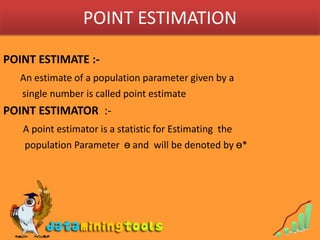
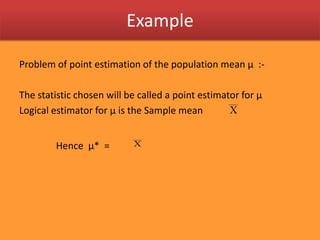
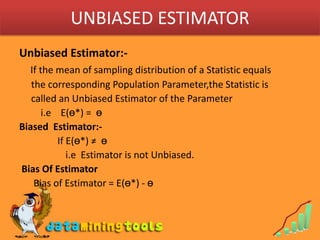

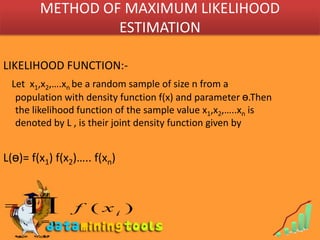
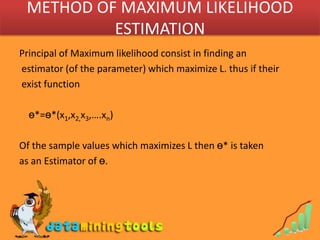
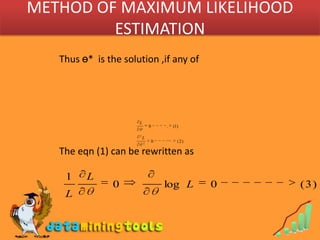
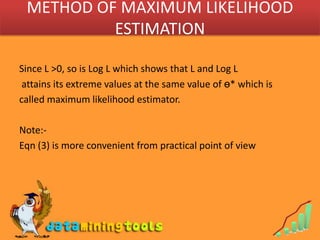
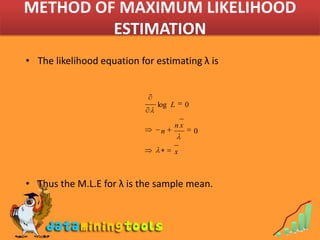

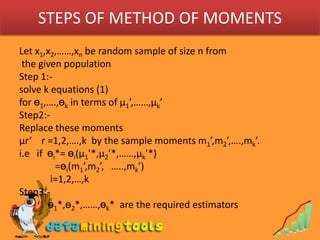
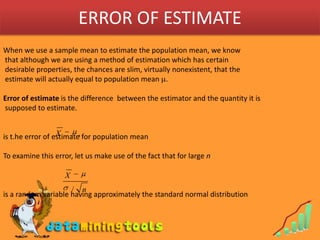


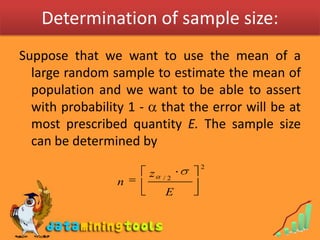

- Point estimation involves using sample data to calculate a single number (point estimate) that estimates an unknown population parameter. - A point estimator is a statistic used to calculate the point estimate. For example, when estimating an unknown population mean μ, the sample mean x̅ is a point estimator for μ. - An unbiased estimator has an expected value equal to the true population parameter value. A biased estimator has an expected value that is not equal to the true parameter value. - Common methods for finding estimators include maximum likelihood estimation and the method of moments. Maximum likelihood estimation identifies the value of the parameter that maximizes the likelihood function based on the sample data. The method of moments equates sample moments


