Flexible Budget
By : Ravindra Nath Shukla
Budget
1. Any financial plan serving as an
estimate of and a control over future
operations.
2. Hence, any estimate of future costs.
3. Any systematic plan for the
utilisation of manpower, material or
other resources.
In “A Dictionary for Accountants”, Kohler
defines budget as:
Budget
 The Chartered Institute of Management
Accountants, London, (terminology) defines a
budget as
 “A plan expressed in money. It is prepared and
approved prior to the budget period and may
show income, expenditure and the capital to be
employed. May be drawn up showing
incremental effects on former budgeted or actual
figures, or be compiled by zero-based
budgeting.”
Budget
A budget is a precise
statement of the financial and
quantitative implications of the
course of action that
management has decided to
follow in the immediate next
period of time (usually a year)
Type of Budgets
 Depending upon the various bases adopted, budgets may be
classified into different categories.
 Budgets may be classified on the basis of
(i) the coverage or scope they encompass
(ii) the capacity or efficiency to which they are related
(iii) the conditions on which they are based and
(iv) the periods which they cover.
 This is clearly shown with the help of the following diagram:
A specimen budget report for expenses :
What Is A Flexible Budget?
Flexible budget is a budget which by recognising
different cost behaviour patterns, is designed to
change as volume of output changes.
 It is useful for both planning purposes and control
purposes and is generally used to estimate factory
costs and operating costs.
 A flexible budget is much more realistic than fixed
budget since it gives emphasis on cost behavior at
different levels of activity.
 A flexible budget can be found suitable when
business conditions are constantly changing.
 Business organization prepare flexible budget to
make a clear vision about what output should be
produced to achieve the targeted profit.
 When preparing a flexible budget, managers are
forced to consider the different scenarios and their
responses to them.
 Thus, for a number of different situations,
managers will have calculated their costs and
revenues.
 If an unexpected event does occur, changing the
level of activity, the management will be better
prepared.
 These budgets are different in different levels of
activities, which facilitate the ascertainment of
fixation of cost, selling prices, and tendering of
Budgetary control
 Budgetary control is
the comparison of the
actual results against
the budget. Where the
actual level of activity is
different from that
expected, comparisons
of actual results against
a fixed budget can give
misleading results.
Type of flexible budgets
 The types decide the flexible budget format applicable in
different scenarios.
 Basic Flexible Budget : The basic flexible budget is
prepared, indicating how the expenses are completely in
sync with the revenues generated.
 the intermediate type reflects the expenses beyond what
is generated as revenue.
 The advanced budget, on the contrary, takes into
consideration the expected variations and ranges of
differences in expenses to be incurred.
 This type of budget is open to changes based on the
variations in the actual cost of the different categories of
expenses.
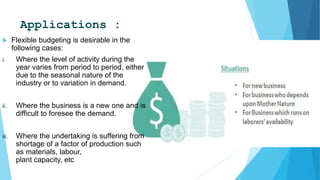
Applications :
 Flexible budgeting is desirable in the
following cases:
i. Where the level of activity during the
year varies from period to period, either
due to the seasonal nature of the
industry or to variation in demand.
ii. Where the business is a new one and is
difficult to foresee the demand.
iii. Where the undertaking is suffering from
shortage of a factor of production such
as materials, labour,
plant capacity, etc
 Following are the striking features of flexible budgets:
 (i) They are prepared for a range of activity instead of a single level.

(ii) They provide a very dynamic basis for comparison because they are
automatically geared to changes in volume.

(iii) They provide a tailor-made budget for a particular volume.

(iv) These are based upon adequate knowledge of cost behaviour pattern.
Features:
Advantages
• It can help in sales, costs, and profit calculation at
different levels of operating capacity.
• It helps to determine the quantity/amount of output
to be produced to help the company achieve the
desired profit level.
• The most significant advantage of this budget is
that it helps the management of the company to
determine the production level in different markets
and business conditions.
Advantages
• It also helps in the reclassification of various
levels of budgeted costs along with sales so
that managers can easily identify the profit
areas and thus may act accordingly.
• This budget can be re-casted on the basis of
the activity levels. It is not rigid.
Disadvantages
• This budget requires skilled workers to work
on it.
• The availability of skilled workers becomes a
challenge for the industry.
• It depends upon the proper accounting
disclosures.
• It is an expensive affair.
Disadvantages
• It also depends upon the factors of the
production, which are not in the hands of the
management.
• Therefore the predictions can be inaccurate
due to these conditions.
• Variance Analysis provides useful information
as each cost is analyzed according to its
nature. Thus it becomes difficult for the experts
to prepare Flexible budgets.
 Flexible budgets may be prepared in the
following method:
(i) Tabular method or multi-activity method
(ii) Formula method or ratio method and
(iii) Graphic method
Examples
Example 1.
Example 2.
Example 3.
Production Budget
 The production budget is a plan or
estimate of the quantum of products
required for production by the
organization over a period.
 It is an estimate based on the sales
forecast.
 It also considers the desired inventory
level the company wants to maintain
Production Budget
 The basis for preparing the production budget is
the sales budget.
 In simple equation form,
 production budget = The sales budget or
forecast + Planned inventory to be maintained in
the end – Inventory in the beginning.
Types of Production Budgets
Production budgets include:
 Direct materials budget
 Direct labor budget
 Production overhead budget
Importance -
 Basis for Planning of Future Production Process.
 Helps in Taking Key Managerial Decisions
Limitations -
 Based on Estimates
 Time Consuming Process.
Example 4.
Flexible Budget.pptx

Flexible Budget.pptx

  • 1.
    Flexible Budget By :Ravindra Nath Shukla
  • 2.
    Budget 1. Any financialplan serving as an estimate of and a control over future operations. 2. Hence, any estimate of future costs. 3. Any systematic plan for the utilisation of manpower, material or other resources. In “A Dictionary for Accountants”, Kohler defines budget as:
  • 3.
    Budget  The CharteredInstitute of Management Accountants, London, (terminology) defines a budget as  “A plan expressed in money. It is prepared and approved prior to the budget period and may show income, expenditure and the capital to be employed. May be drawn up showing incremental effects on former budgeted or actual figures, or be compiled by zero-based budgeting.”
  • 4.
    Budget A budget isa precise statement of the financial and quantitative implications of the course of action that management has decided to follow in the immediate next period of time (usually a year)
  • 5.
    Type of Budgets Depending upon the various bases adopted, budgets may be classified into different categories.  Budgets may be classified on the basis of (i) the coverage or scope they encompass (ii) the capacity or efficiency to which they are related (iii) the conditions on which they are based and (iv) the periods which they cover.
  • 6.
     This isclearly shown with the help of the following diagram:
  • 7.
    A specimen budgetreport for expenses :
  • 8.
    What Is AFlexible Budget? Flexible budget is a budget which by recognising different cost behaviour patterns, is designed to change as volume of output changes.
  • 9.
     It isuseful for both planning purposes and control purposes and is generally used to estimate factory costs and operating costs.  A flexible budget is much more realistic than fixed budget since it gives emphasis on cost behavior at different levels of activity.  A flexible budget can be found suitable when business conditions are constantly changing.  Business organization prepare flexible budget to make a clear vision about what output should be produced to achieve the targeted profit.
  • 10.
     When preparinga flexible budget, managers are forced to consider the different scenarios and their responses to them.  Thus, for a number of different situations, managers will have calculated their costs and revenues.  If an unexpected event does occur, changing the level of activity, the management will be better prepared.  These budgets are different in different levels of activities, which facilitate the ascertainment of fixation of cost, selling prices, and tendering of
  • 11.
    Budgetary control  Budgetarycontrol is the comparison of the actual results against the budget. Where the actual level of activity is different from that expected, comparisons of actual results against a fixed budget can give misleading results.
  • 12.
  • 13.
     The typesdecide the flexible budget format applicable in different scenarios.  Basic Flexible Budget : The basic flexible budget is prepared, indicating how the expenses are completely in sync with the revenues generated.  the intermediate type reflects the expenses beyond what is generated as revenue.  The advanced budget, on the contrary, takes into consideration the expected variations and ranges of differences in expenses to be incurred.  This type of budget is open to changes based on the variations in the actual cost of the different categories of expenses.
  • 14.
    Applications :  Flexiblebudgeting is desirable in the following cases: i. Where the level of activity during the year varies from period to period, either due to the seasonal nature of the industry or to variation in demand. ii. Where the business is a new one and is difficult to foresee the demand. iii. Where the undertaking is suffering from shortage of a factor of production such as materials, labour, plant capacity, etc
  • 15.
     Following arethe striking features of flexible budgets:  (i) They are prepared for a range of activity instead of a single level.  (ii) They provide a very dynamic basis for comparison because they are automatically geared to changes in volume.  (iii) They provide a tailor-made budget for a particular volume.  (iv) These are based upon adequate knowledge of cost behaviour pattern. Features:
  • 16.
    Advantages • It canhelp in sales, costs, and profit calculation at different levels of operating capacity. • It helps to determine the quantity/amount of output to be produced to help the company achieve the desired profit level. • The most significant advantage of this budget is that it helps the management of the company to determine the production level in different markets and business conditions.
  • 17.
    Advantages • It alsohelps in the reclassification of various levels of budgeted costs along with sales so that managers can easily identify the profit areas and thus may act accordingly. • This budget can be re-casted on the basis of the activity levels. It is not rigid.
  • 18.
    Disadvantages • This budgetrequires skilled workers to work on it. • The availability of skilled workers becomes a challenge for the industry. • It depends upon the proper accounting disclosures. • It is an expensive affair.
  • 19.
    Disadvantages • It alsodepends upon the factors of the production, which are not in the hands of the management. • Therefore the predictions can be inaccurate due to these conditions. • Variance Analysis provides useful information as each cost is analyzed according to its nature. Thus it becomes difficult for the experts to prepare Flexible budgets.
  • 20.
     Flexible budgetsmay be prepared in the following method: (i) Tabular method or multi-activity method (ii) Formula method or ratio method and (iii) Graphic method Examples
  • 21.
  • 23.
  • 24.
  • 26.
    Production Budget  Theproduction budget is a plan or estimate of the quantum of products required for production by the organization over a period.  It is an estimate based on the sales forecast.  It also considers the desired inventory level the company wants to maintain
  • 27.
    Production Budget  Thebasis for preparing the production budget is the sales budget.  In simple equation form,  production budget = The sales budget or forecast + Planned inventory to be maintained in the end – Inventory in the beginning.
  • 28.
    Types of ProductionBudgets Production budgets include:  Direct materials budget  Direct labor budget  Production overhead budget
  • 29.
    Importance -  Basisfor Planning of Future Production Process.  Helps in Taking Key Managerial Decisions Limitations -  Based on Estimates  Time Consuming Process.
  • 30.